When is the best month to see the Zao snow monsters in Yamagata? Compare ice buildup, peak growth, and melting from November to March, plus all 31 2026–27 illumination and snowcat dates, ropeway fares, and return buses.
- Region & Focus
- Yamagata, Zao, and Ginzan
- Reading Scope
- 20 min read · 8 chapters · 6 Q&As
- Official Verification
- 18 official sources checkedUpdated November 22, 2026
- Key Topics
- WinterSeasonsHot springs
Chapter Route Map (tap any stop)
- When Is the Best Month to See the Zao Snow Monsters?
- How Wind Locks Ice and Snow onto Fir Trees
- Clear Skies at the Base? Check Two Things Before Riding Up
- How Much Time to Budget for a Daytime Trip
- All 31 Illumination and Snowcat Dates for 2026–27
- Yamagata Day Trip vs. Overnight Stay
- Which Ski Runs Pass Through the Snow Monsters
- How to Read and Photograph the Shapes in Flat Light
- Quick Q&A
If this is your first trip to Yamagata to see the Zao snow monsters (juhyo) in daylight across an entire snow-covered slope, aim for February and block off two flexible daytime windows for Jizo Sancho Station. If you prefer watching rime ice grow sharp spikes along individual branches, January is well worth the trip. For 2026–27 night views, Zao Ropeway has scheduled 31 designated illumination and snowcat evenings between December 26, 2026, and February 23, 2027. Pick your month first, then time your daytime ascent around summit visibility and your evening plans around the event calendar and return transport.
When Is the Best Month to See the Zao Snow Monsters?
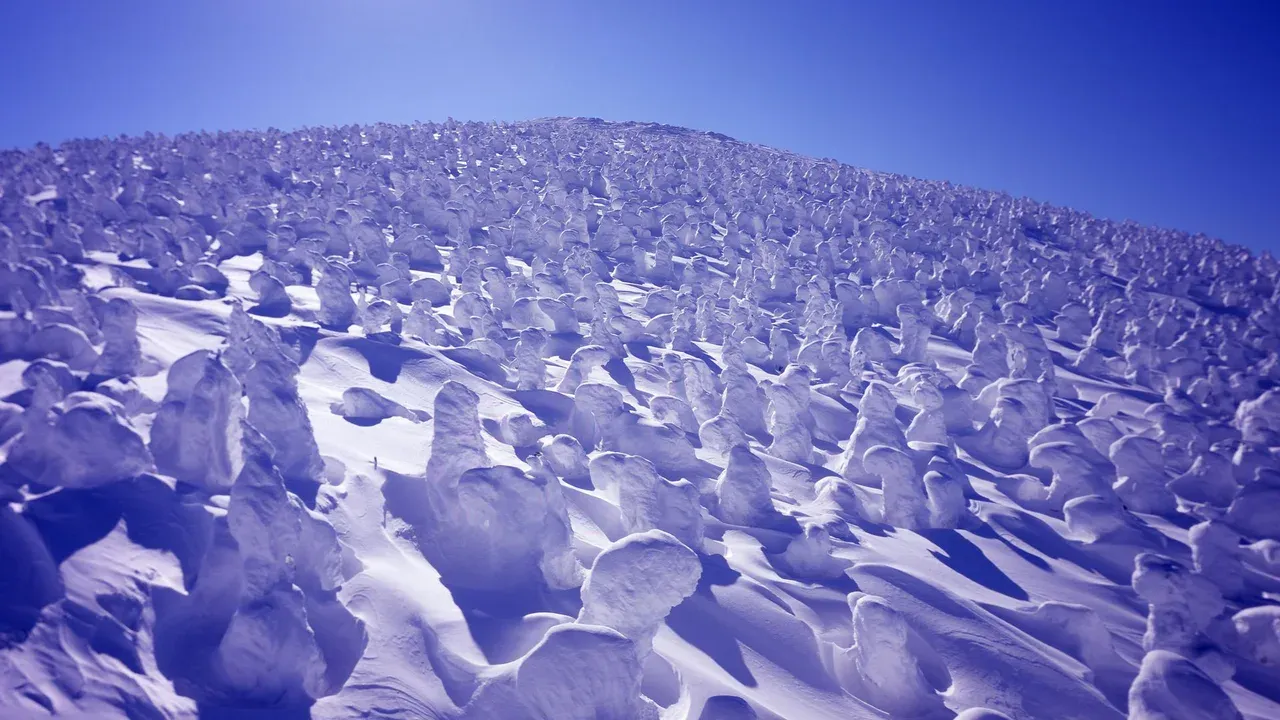
Prioritize February if you are visiting for the first time and want photos of entire hillsides packed with snow monsters. Zao Ropeway's growth calendar designates February as peak season, when continuous snow and ice accumulation fuses separate branch clusters into solid, towering silhouettes that completely hide the underlying limbs. Aiming for early to mid-February keeps both daytime viewing and night events in play. Daytime-only visitors should keep two mornings open and save the clearer one for Jizo Sancho Station. If you only have a single day, head to the summit before lunch and any other stops.
January suits travelers who want to see how snow monsters actually form. The ropeway's schedule marks it as the growth phase: the longer the windward "shrimp tails" (ebi-no-shippo) grow, the easier it becomes for blowing snow to lodge between needles and branches. On a single ascent, you can frame branch tips sprouting sharp ice spikes right alongside half-buried trees and fully formed mounds. To catch the night lights as well, January 22–24 and January 29–31 each offer three consecutive event evenings. Staying two nights across two event dates gives you room to shuffle night reservations and daytime summit rides.
November through December is the early icing and snow-adhesion stage. Lower sections already look white, though individual small trees still show distinct branches. The seasonal brochure puts daytime viewing roughly from late December through early March. If you want to ride above freshly dusted forest and spot the very first crusts of ice clinging to twigs, late December works fine, while travelers focused on full-bodied snow monsters should save their vacation days for February. The year-end illuminations open on December 26; that first event date marks when the lights turn on, while the trees on the slope keep building mass with each drop in temperature, gust, and snowfall.
Late-December and early-January itineraries are especially prone to using outdated schedules from prior seasons. For 2026–27, night events pause on December 28 and 29 before running three straight nights starting New Year's Day. If your lodging is already locked in, shift evening tours to December 30, December 31, or an open January night, and keep the dark evenings for daytime viewing instead. Choose your ascent based on how far growth has progressed: if an early ride shows only patchy frost, save a second trip up for a clear spell later in your stay to see what a fresh storm has added.
In March, save your daytime ride for whichever day offers the most schedule flexibility. Warmer air thins the outer crust, and rain can topple clusters quickly. Check the ropeway company's recent summit photos and timestamps before committing, especially right after a warm rainstorm. If photos still show unbroken stands of snow monsters, ride straight up to Jizo Sancho Station during a bright, clear window. When only scattered remnants remain, travelers curious about spring melt patterns can still go up for close-ups, whereas anyone focused strictly on full slopes may prefer pivoting to hot springs or skiing. Night events for this season wrap up on February 23.
Even within the same month, snow monsters vary noticeably across the mountain. When reading news photos, check which station is listed—Jizo Sancho Station sits roughly 330 meters higher than the transfer point at Juhyo Kogen Station. Along the ropeway line, trees exposed directly to ridge winds sit near others sheltered behind terrain folds. For sweeping views, focus on the open upper slopes; to study early- or late-season textures, compare several differently shaped trees around the viewing area rather than hunting only for the biggest one.
When is the best month to see the Zao snow monsters in Yamagata? Compare ice buildup, peak growth, and melting from November to March, plus all 31 2026–27 illumination and snowcat dates, ropeway fares, and return buses.
How Wind Locks Ice and Snow onto Fir Trees
Zao's snow monsters form on Aomori todomatsu (Maries' fir, also called Ooshirabiso). Native to the subalpine belt of the Zao mountain range, it grows roughly between 1,300 and 1,700 meters in elevation according to Yamagata Prefecture. Dense needles and stiff branches give tiny ice particles their first anchor points, and sturdy woody trunks carry the mounting weight. You only start seeing this belt of firs outside the gondola windows once the ropeway climbs well above the hot spring town.
As Zao Ropeway explains, winter northwest monsoons pick up moisture over the Sea of Japan, drop snow as air rises over the Asahi Range, cross the Yamagata Basin, and climb again up the Zao peaks. Inside the mountain clouds, water droplets can stay liquid below 0°C. When monsoon gusts slam these supercooled droplets into fir needles and branches, they freeze on contact. Because the windward side intercepts far more droplets, ice builds outward into the wind, forming the telltale elongated spikes called "shrimp tails."
Next, windblown snowflakes wedge into the gaps between ice spikes. Trapped snow and ice bond and compact through a process called sintering. Research from Yamagata University notes that small ice clumps form first at individual branch tips before merging into larger masses. Viewed from the side, you can trace early protrusions before fresh snow packs into the hollows, turning the whole tree into a smooth white figure. Spotting an early shrimp tail, follow the branch toward its sharpest outward edge, then compare it with a thicker neighbor whose original limbs remain only as faint bumps.
Snow also has to accumulate in the right place. Yamagata Prefecture lists snowpack depth as a core condition for formation: as snow builds on the ground, upper branches must still clear the surface to catch more rime and snow. That is why slopes with standing live firs develop dramatic shapes while treeless wind-scoured snowfields stay flat. On the Sancho Line, watch from the gondola as you climb out of Juhyo Kogen Station to see how snow monsters cluster into belts across the terrain. Looking parallel across a slope makes foreground and background trees overlap, so stepping back helps separate each silhouette.
When Japanese mountain reports mention "muhyo" (rime ice), look at the accompanying photos to tell how far formation has advanced. Yamagata University also classifies rime ice—droplets freezing on contact into spiky tails—as an early stage of juhyo. What people call snow monsters at Zao are formations where those ice grains and trapped snowflakes have fused into heavy blocks. Early in the season, watch along the ride to see which branches have begun merging into shared clumps. Notice the brighter, harder windward ice first, then the darker recessed pockets—the two textures stand apart even on overcast days.
Early scientific fieldwork took place right around Jizo Sancho Station. Yamagata University uncovered photos from the 1960s and 1970s showing researchers studying snow monster growth near Jizo-goya behind the Zao Jizo statue and examining ice and snow structures under microscopes. That work links the shapes you see today to microscopic crystal behavior. Standing in the viewing area, tracing a tree from its pointed tips to its recessed hollows and thick rounded base shows how one layer of rime sets up a pocket for the next snowfall.
Changes to the trees themselves also reshape the snow monsters. A 2025 Yamagata University release reports that bark beetle damage has stripped needles and branches from some Zao firs, reducing how much ice and snow they can trap. Comparing records over time, researchers found that snow monsters have become noticeably slimmer since 2019. Yamagata Prefecture and the Forestry Agency are working on forest regeneration, including sapling transplant initiatives announced by the prefecture for 2026. When comparing photos from different decades, look not only at that winter's temperature and snowfall, but also at stand density and tree width—and stick to designated viewing zones so live trees and young saplings stay undisturbed beneath the snow.
Clear Skies at the Base? Check Two Things Before Riding Up
Start with the ropeway company's live operations page. The Sanroku Line and Sancho Line report status separately, so seeing cabins moving uphill from town may only confirm the lower section is running. If your goal is Jizo Sancho Station, make sure the Sancho Line is operating too. When only the lower line runs, short-turn tickets still go to Juhyo Kogen Station. If you want the full snow monster fields from the top, wait in town for the next update or shift your summit morning to the next day so your group doesn't queue for a partial ride only to turn around at the base.
Next, check summit visibility. The webcam on Zao Ropeway's own site points at the base area—useful for seeing snow and light around the entrance, not conditions up top—so pair it with the daily summit weather report or upper-mountain photos posted by the operator. Zao Onsen Ski Resort also hosts a separate live camera page; check the slope label on each feed, such as the Juhyo Kogen Station camera aimed toward the Sancho Line boarding platform, to gauge wind and blowing snow at the transfer station. Once nearby tree lines begin showing detail, even a brief clearing lets you examine trees at varied growth stages; when distant slopes open up, linger near the station for panoramas. Zao Ropeway notes frequent northwest-to-west winds and snowstorms in January and February, meaning bright sun in town can still mean thick cloud at Jizo Sancho.
Match each planning tool to your timeline. Pick your month when booking time off, track recent summit photos and forecasts in the days leading up to arrival, and use live operating status once you are in the onsen village to decide which leg goes first. Snowfall takes time to build mass on branches, whereas fog alters visibility on the spot. If an overnight storm breaks into a brief clear morning while the Sancho Line is running, move the mountain ride to the front of your day and push lunch and hot springs to the afternoon.
Once you step out at Jizo Sancho Station, inspect the closest snow monsters inside the marked viewing zone beside the terminal first. When whiteout conditions erase the horizon, stay within the open station perimeter where buildings, safety ropes, and the entrance stay visible. Only step out toward wider viewpoints when the sky clears briefly. If blowing snow cuts visibility even at close range, duck back inside to warm up or ride down the way you came. Even bundled up warmly, it is hard to judge skiers or terrain drops in near-whiteout light, so treat the marked station boundary as your hard limit.
Dress for summit cold before leaving the base. Zao Ropeway warns that nighttime temperatures hover around -10°C (14°F), and wind chills bare ears and fingers fast. Layer thermal base clothing under a windproof shell, wear insulated boots with grippy soles, and pull your hood up before stepping outdoors. If anyone in your group needs frequent indoor warm-ups, pick a specific side of the station interior to wait while photographers step out in quick bursts. Keep gloves and traction cleats in an outer pocket of your daypack so your hands stay free to steady yourself during transfers.
How Much Time to Budget for a Daytime Trip
From Zao Onsen village, walk to Zao Sanroku Station and ride the Sanroku Line about 7 minutes to Juhyo Kogen Station, then transfer to the Sancho Line for roughly 10 minutes up to Jizo Sancho Station. Zao Ropeway lists those upper stations at 1,331 meters and 1,661 meters above sea level. That 17-minute total covers ride time alone; base queues, the mid-station transfer, walking in snow, and summit viewing all add time. Anyone connecting to a Yamagata Shinkansen on a weekend should reserve half a day for the round-trip and build in one earlier downhill bus buffer before your train. When skies are crisp up top, arriving early at the base also leaves breathing room for the next cabin instead of rushing your shots.
All listed operating hours follow Japan Standard Time (JST). Zao Ropeway posts daytime hours of 8:30–17:00 for the Sanroku Line and 8:45–16:45 for the Sancho Line, with the final daytime uphill departure for Jizo Sancho Station leaving Zao Sanroku Station at 16:00. If you want to shoot from more than one angle in the snow, start several cabins earlier. Boarding the final uphill car leaves a transfer ahead of you and puts most of your summit time under return-trip pressure. If clouds only lift in the afternoon, stop by Zao Sanroku Station to check posted notices and weigh queue times, ride durations, and how long you want outside before deciding how far up to go.
For the 2026–27 winter season, Zao Onsen's guide sets daytime round-trip fares from Zao Sanroku to Jizo Sancho Station at ¥4,600 for adults and ¥2,300 for children. Because the main snow monster viewing area sits right off the summit station, buy the full summit ticket whenever you want sweeping slope views. Travelers who prefer buying daytime tickets ahead of time can check Zao Ropeway's online booking page for automated ticket-machine pickup instructions at Zao Sanroku Station. If the Sancho Line is temporarily on hold, wait until both lines' status is clear before buying for the farthest open station—especially with older travelers or young kids, so you don't have to round everyone back down after a short stop.
Priority boarding tickets sold on the official site apply only to the uphill Sanroku Line leg. From Juhyo Kogen Station onward, both the remaining ascent and all downhill legs use standard lines. If your travel dates are fixed and you leave early the next morning, priority tickets help trim that first base queue. If you kept a second morning free as a weather backup, read the ticket terms carefully first: aside from ropeway suspensions, online priority tickets are non-cancelable and non-refundable. Fog alone does not trigger a refund, so balance that commitment against your weather flexibility.
At the summit, use the Zao Jizo statue as a clear orientation landmark. Check which viewing paths are open when you arrive before deciding how long to stay outside. In good visibility, start with elevated views across the sloping terrain and save close-up trees near the station for your return. Keep watching out the cabin windows too—as the gondola's height above the slope changes, you can trace where fir stands thin out or pack tightly along ridges. On a single-day visit, planning lunch down at the base or in the onsen village is easier to adjust than dining at the summit.
When saving map pins, bookmark both "Zao Ropeway Zao Sanroku Station" and "Zao Onsen Bus Terminal." Zao Onsen has multiple ski lifts and ropeway bases, and the daytime trip to Jizo Sancho starts specifically at Zao Sanroku Station. If you arrive with large suitcases, store them in town before heading up. For walking routes connecting the other lifts, public bathhouses, and warm indoor rest stops, follow our Zao snow monsters non-ski day guide.
All 31 Illumination and Snowcat Dates for 2026–27
Zao Ropeway's seasonal poster released on October 4 assigns both evening programs to the exact same 31 dates. You can line up your hotel search directly against this calendar. All operating hours, ticket drops, and check-in cutoffs follow Japan Standard Time (JST).
The illumination ropeway runs from 17:00 to 21:00. The seasonal poster lists the final uphill departure from Zao Sanroku Station at 19:45, and the resort handbook sets the last downhill departure from Jizo Sancho Station at 20:30. Round-trip fares from base to summit are ¥4,600 for adults and ¥2,300 for children ages 6–11. You can see lit formations from the Sancho Line cabins as well as within the designated viewing area around Jizo Sancho Station; go up earlier if you want unhurried outdoor photo time. Leave skis and snowboards at your lodging at night, and stick to the lit paths and station markers outdoors.
The "Juhyo Fantasy Corridor Tour" runs heated snowcats (Night Cruiser) in four nightly departures at 17:00, 18:00, 19:00, and 20:00, with check-in at Zao Sanroku Station 20 minutes beforehand. Your ticket includes round-trip rides on the Sanroku Line up to Juhyo Kogen Station, where you board the snowcat and climb to a turnaround just above Tower 4 of the Sancho Line. Total duration is roughly 70–80 minutes, including about 30 minutes aboard the snowcat. Fares are ¥8,000 for adults and ¥7,000 for children age 1 through elementary school, capped at 36 passengers per departure. Book online via the official tour page link or QR code; sales generally open seven days prior to the ride date at 14:00 JST.
Choose the illumination ropeway if you want glowing summit slopes against the ridgeline, or pick the snowcat tour to stay seated while watching ice-packed branches pass close to the window. For families with young kids, compare pacing: the illumination lets you step in and out of the summit station on your own schedule, while the snowcat follows fixed check-in and group boarding times. Group charters or sellouts can also narrow available snowcat slots. If companions want different experiences, meet at Zao Sanroku Station—illumination riders continue up the Sancho Line, while snowcat guests join their tour at Juhyo Kogen Station.
Decide which view matters most before committing to two nights. Daytime riding plus one illumination evening already captures both distant slopes and nighttime color. Only add a second night if close-up shots from the snowcat route are high on your list; that way you can use the clearer night for outdoor illumination viewing and keep the more sheltered snowcat for the other evening. Operators cancel night programs in severe weather or if formations collapse along the route—if that happens, fall back on dinner and a soak at your ryokan.
- December 26, 27, 30, and 31, 2026.
- January 1–3, 9–11, 16–17, 22–24, and 29–31, 2027.
- February 5–7, 10–14, and 19–23, 2027.
Yamagata Day Trip vs. Overnight Stay
For a daytime visit by public transit, catch the Z90 route bus from Yamagata Station Stop 1 to Zao Onsen Bus Terminal; one-way fares are ¥1,200 for adults and ¥600 for children. Both uphill and return buses load to seated capacity—if a bus fills, you wait for the next departure—and regular schedules split into weekday and weekend/holiday columns. If you are connecting onward to the Yamagata Shinkansen, plan backward using the C2 return timetable and pick one bus earlier than strictly necessary to absorb the village walk and ropeway queues. Route timetables also list similarly named stops like "Chuo Ropeway-mae," so step off at whichever stop matches the lift entrance you plan to use.
Yamako Bus currently lists the final C2 bus out of Zao Onsen Bus Terminal at 19:50, arriving at Yamagata Station at 20:27. To see the night illuminations and still catch that bus, ride up right at the 17:00 start and write your downhill ropeway, transfer, and terminal walk times into your plan. Missing the last bus costs far more than skipping a few extra shots, so set a firm turn-back alarm while at the summit. For snowcat tours, add 80 minutes plus walking time to your departure slot: even an 18:00 departure wraps up around 19:20, leaving razor-thin margin, while 19:00 and 20:00 tours require either staying overnight in Zao or pre-arranging private pickup at Zao Sanroku Station or your hotel.
Coming from Sendai, a seasonal highway bus operates from Sendai Station East Exit Stop 76 to Zao Onsen Bus Terminal between December 19, 2026, and March 14, 2027. One-way reserved-seat fares are ¥2,800 for adults and ¥1,400 for children. The last bus back to Sendai leaves the hot spring village at 17:30, which works well for a full daytime visit; if you want to stay after dark, book a night in Zao and take a reserved bus back the next day. Drivers crossing from Miyagi into Yamagata should take the Yamagata Expressway, as Miyagi Prefecture closes the cross-prefecture Zao Echo Line mountain road for winter from November 4, 2026, at 17:00 until its scheduled reopening on April 23, 2027, at 11:00.
If you are only approaching from Yamagata, using downtown Yamagata as a daytime base saves hauling luggage up the mountain; if illuminations or the snowcat tour are your centerpiece, staying overnight in Zao Onsen frees up far more viewing time. On a one-night stay, go up on Day 1 if visibility is clear, return to town for dinner or check-in, then head back out for your night booking. If clouds sock in the summit on arrival, save the big mountain view for checkout morning and leave your bags at your hotel until you come down. If you arrive late in the afternoon, treat Day 1 as your soak and evening program and save the full morning for daytime terrain.
To keep two swappable nights for illuminations, book two consecutive event dates rather than straddling an off-night. For instance, both February 10–14 and February 19–23 offer multi-night runs, whereas checking in on February 14 leaves February 15 dark—booking February 13 and 14 gives you two active evenings instead. Note that February 11 falls on a Japanese national holiday inside the February 10–14 window. Travelers spanning a weekend and weekday can lock fixed-time bookings onto their hotel check-in evening and keep checkout morning flexible for the summit. With two nights, put the snowcat on Night 1 and decide Night 2 between illuminations or staying warm in town based on visibility.
When pairing Zao with other day trips on the same itinerary, leave one full flex day in your schedule. Separate outings based out of Yamagata Station each eat up their own bus and transfer blocks, so squeezing the ropeway into a morning before an afternoon reservation elsewhere leaves only the earliest hours open. If your route also covers Sendai and other Yamagata stops, check our Sendai and Yamagata hot spring and seasonal itinerary and place fixed-transit days after your backup clear-weather window.
Which Ski Runs Pass Through the Snow Monsters
Skiers and snowboarders planning to ride down through the snow monster zone should first check the Zao Onsen Ski Resort trail status page for the "Zangezaka / Juhyo-gen Course" line. Stepping out of Jizo Sancho Station puts you onto Zangezaka, the signature upper-mountain trail feeding directly into the Juhyo-gen (Snow Monster Field) run. Although rated intermediate, the upper track skis narrower than photos suggest, and sightseers often slow down to look around. On mornings with flat light or firm, icy snow, warm up on gentler open slopes before deciding whether to wait for upper conditions to improve. Ropeway passenger operations and trail open/closed status live on separate official pages, so check both before heading up.
The resort lists the continuous descent from Zangezaka through Juhyo-gen, Utopia, and Hyakuman-nin down to Yokokura at roughly 8 kilometers. If you plan to ski the whole stretch top-to-bottom, review the current trail map for junctions before dropping in—connecting tracks branch off toward Kurohime and other zones, so groups splitting down different exits should factor traverse times into meeting plans. Dedicate one clearer run to soaking in the scenery rather than stopping abruptly in tight sections for photos; when you do stop to shoot, pull completely off to a safe, visible edge with room for skiers behind you.
Lift pass pricing lines up neatly with snow monster timing. For 2026–27, Zao's all-mountain pass prices January 4–29 as regular season at ¥8,000 per adult day pass, while peak season runs January 30 through February 28 at ¥9,000 per day. If your group wants early ice spikes alongside cheaper lift tickets, target late-January event dates like January 22–24. If thick February snow monsters come first, budget the peak ski pass rate for riders and standard ropeway round-trip tickets for non-skiers. Regular rates return March 1–14 before dropping to ¥7,000 from March 15–31; skiers aiming for late March can scan that week's summit photos to see what ice still clings to trees and pick open runs accordingly.
When a group splits between skiers and non-skiers, pick Zao Sanroku Station or a specific shop in the village as your rendezvous point. Skiers drop down the trails from the top while non-skiers ride the ropeway back and forth to Jizo Sancho Station, each tracking their own descent timing. If high winds halt the Sancho Line, sightseers can head back to town while skiers spend half a day on open lower zones until the next status update. For full lift ticket tiers, mountain sectors, and lodging areas, see our Zao Onsen Ski Resort guide.
How to Read and Photograph the Shapes in Flat Light
On clear days, start with a wider shot across the slope. Scan the white hillside to see which way the snow monsters lean—side light draws crisp shadows that anchor each tree's position on the terrain. Then move to a permitted spot with a slight elevation drop for close-ups showing both hard windward ice spikes and powdery snow packed into sheltered hollows. Pure snow scenes often trick camera meters into underexposed gray frames, so take a test shot and dial in positive exposure compensation while keeping highlights on the ice tips intact. In January and February, when thick and thin formations sit side by side, your photos will clearly distinguish exposed branches from merged silhouettes. During the March thaw, record both a recognizable base-to-summit slope angle and a close-up showing any exposed needles—pairing station names, dates, and slope context makes it far easier to compare changes later than isolated tight shots without landmarks.
In whiteout fog, keep your framing close. Stay within the open station viewing perimeter, place one tree's pointed tips toward the side of the frame, and read the wind direction from the stacked ridges of rime. When shooting night illuminations from inside a moving gondola, press the lens close to the glass to cut reflections, disable your flash, and check test frames for blown-out highlights. Use faster shutter speeds while the cabin is moving, saving longer exposures for stationary viewpoints beside the station. Gloves you can operate controls in matter more than packing a second camera body, and smartphone shooters should set up a quick-launch camera shortcut so you aren't digging through menus in freezing wind.
Before stepping back inside a heated station, seal your cold camera inside a zippered bag so it warms gradually and avoids condensation on the lens and body. Keep spare batteries inside an inner pocket, and keep outdoor handling brief. If a second clear spell opens up the next day, bring up your close-ups from the day before and match similar shapes—first up close where twigs catch that initial crust of rime, then farther back to see how thousands of layers turn into a single wall of snow.
A few useful answers
When is the best month to see the Zao snow monsters?
February typically brings the thickest buildup, making it the best month to see full slopes of snow monsters. January is ideal for spotting windward "shrimp tails" and half-encased trees. Ice and snow begin coating branches in November and December, while March marks the thaw, when warm rain can cause formations to collapse.
Why do the Zao snow monsters lean or jut out toward one side?
Supercooled water droplets that stay liquid below 0°C freeze on impact against Aomori todomatsu fir trees, growing into windward ice spikes known as "shrimp tails." Windblown snow then packs into the gaps and sinters with the ice, steadily thickening each tree into a solid mound.
Do the Zao snow monster illuminations run every night in 2026–27?
No. Both evening programs share 31 designated nights running from December 26, 2026, through February 23, 2027. Illumination rides operate 17:00–21:00 JST, with the last uphill departure from Zao Sanroku Station at 19:45 and the last downhill car from Jizo Sancho Station at 20:30. All seasonal dates are listed by month in the main guide.
How far in advance should I book the Zao snow monster snowcat tour?
Tickets go on sale through the official Zao Ropeway website seven days before your ride date, opening at 14:00 JST. You must check in at the Zao Sanroku Station counter 20 minutes before your scheduled departure.
Can I still catch a bus back to Yamagata Station after seeing the illuminations?
According to Yamako Bus schedules, the last C2 bus leaves Zao Onsen Bus Terminal at 19:50 for Yamagata Station. To catch it on a same-day trip, ride up right when illuminations start at 17:00 and budget extra time for both downhill ropeway legs, queues, and the walk back to the terminal. Late snowcat departures are better paired with an overnight stay or pre-arranged transfer.
What is the difference between Juhyo Kogen Station and Jizo Sancho Station?
During the day, you ride the Sanroku Line to Juhyo Kogen Station to transfer onto the Sancho Line, which climbs to Jizo Sancho Station where the main snow monster slopes sit. At night, the snowcat tour boards at Juhyo Kogen Station and turns around just above Tower 4 of the Sancho Line.
Official information and references
Sources used in this guide.
- Zao Ropeway: Snow Monster Guide, Typical Growth Calendar, and Illumination Poster
- Zao Ropeway: 2026–27 Snow Monster Illumination Operating Notice
- Zao Ropeway: Juhyo Fantasy Corridor Snowcat Tour, Seasonal Poster, and Booking Portal
- Zao Ropeway: Sanroku & Sancho Line Hours, Ride Times, and Station Elevations
- Zao Ropeway: Online Ticket Reservations, Pickup, and Priority Boarding Terms
- Zao Mountain Resort: 2026–27 Winter Guidebook, Sightseeing Fares, and Trail Map
- Zao Mountain Resort: Live Course and Gelande Open/Closed Status
- Zao Mountain Resort: Live Webcams and Juhyo Kogen Station Feed
- Zao Mountain Resort: 2026–27 All-Mountain Lift Ticket Price List
- Yamagata City Tourism Association: Zangezaka and Juhyo-gen Ski Course Guide
- Yamagata University: Jizo-goya Field Surveys and Early Snow Monster Research
- Yamagata University: Research on Fir Bark Beetle Damage and Snow Monster Thinning
- Yamagata Prefecture: Formation Conditions of the Zao Snow Monsters
- Yamagata Prefecture: Fir Forest Regeneration Plan and Sapling Transplant Notice
- Yamako Bus: Yamagata Station to Zao Onsen Route Bus Timetable and Fares
- Yamako Bus: Zao Onsen to Yamagata Station C2 Weekday and Weekend Timetable
- Yamako Bus: Sendai to Zao Onsen 2026–27 Winter Highway Bus Schedule
- Miyagi Prefecture: Winter Mountain Road Closure Notice