An autumn 2026 guide to Yoro Valley without a car: approach via Otaki by highway bus or the Ohara replacement bus, with weekday connections, Awamata Falls, the open 600-meter Nakase trail, closed routes, bath prices and return options.
- Region & Focus
- KantoSide trips
- Reading Scope
- 33 min read · 16 chapters · 6 Q&As
- Official Verification
- 14 official sources checkedUpdated October 27, 2026
- Key Topics
- ItinerariesRail travelSeasons
Chapter Route Map (tap any stop)
- In autumn 2026, approach via Otaki, then choose the falls or hot spring district
- Distinguish Yoro-Keikoku Station, Awamata-no-taki and Kazusa-Nakano
- The Kominato replacement service ends before the valley entrance
- Tokyo Yaesu to Otaki by highway bus: match the local connection first
- JR Sotobo Line to Ohara, then the Isumi replacement bus: change at Otaki
- Reading the weekday timetable: some buses end at stations, others reach the falls
- Awamata Falls: allow for the entrance, descent and return climb
- Enter Nakase from Kyoei Bridge and return after 600 meters
- Remove Omoshiro Gorge, Umegase and Mount Daifuku from the autumn hiking plan
- Pair the falls with Goriyaku-no-yu: choose an opening day and return stop
- A workable day trip: reach the falls early and return to Otaki in the afternoon
- Arriving in Otaki late in the morning means a longer Awamata stay and a later return
- Read the return destination: a bus to Yoro-Keikoku Station cannot connect to a suspended train
- Autumn colors and illuminations: leave the river by daylight on day trips
- With children or older travelers, reduce the areas and count steps and waiting time
- An overnight stay adds dinner and reliable transfers, not another closed trail
- Quick Q&A
For Yoro Valley in autumn 2026, plan your outward and return transport via Otaki first, then choose Awamata Falls or the Nakase hot spring district. The Kominato Railway suspension, replacement-service terminus and out-and-back trails each impose different limits. Once the return trip is settled, you can see how much time remains for the river and a bath.
In autumn 2026, approach via Otaki, then choose the falls or hot spring district
For a car-free visit to Yoro Valley in autumn 2026, plan transport via Otaki first. Kominato Railway services between Kazusa-Ushiku and Kazusa-Nakano are suspended, so the former through journey from Goi to Yoro-Keikoku Station is broken. Simply adding the times for Tokyo to Goi, the local train and the falls bus misses the most important change. For Awamata Falls, first compare the highway bus from Tokyo Yaesu to Otaki with the JR Sotobo Line to Ohara, followed by the Isumi Railway replacement bus to Otaki and a Kominato local bus.
Give the day to one main area. Awamata suits the falls and a day-use bath; the hot spring district and Nakase suit the red bridge, Kobundo ruins and a short riverside walk. Travel between the two areas by bus. Sites beside the same river on a map do not form a currently open hiking route. For a first visit with a same-day return to Tokyo, make Awamata Falls the priority. If the return connections do not work, save Nakase for another visit.
Transport and trail information was checked through October 27, 2026. Ichihara City’s live notice, with body text updated through October 26, says weekday replacement services stop at “Kocha Jidosha-mae,” before Yoro-Keikoku Station. Otaki Town’s October 20 notice lists the actual open sections at Nakase, Takimeguri and Omoshiro Gorge. These answer separate questions: how to reach the valley and where you can walk. Before buying tickets, read Ichihara City’s transport update and Otaki Town’s trail restrictions, then use the timetable method below to assemble your day.
| Main aim | Access plan | What fits in one day |
|---|---|---|
| Awamata Falls and bathing | Bus via Otaki; return via the same side | Short falls walk, lunch and a bath on an opening day |
| Nakase and the hot spring district | Local bus from the Otaki side toward Yoro-Keikoku Station | Out-and-back from Kyoei Bridge, Kannon Bridge area and a meal |
| Local railway ride | Plan the operating Goi–Kazusa-Ushiku section separately | A different day from valley sightseeing |
| Autumn illuminations | Arrange accommodation transport or reserve the return vehicle first | Night views and accommodation; avoid rushing between both areas for the last bus |
An autumn 2026 guide to Yoro Valley without a car: approach via Otaki by highway bus or the Ohara replacement bus, with weekday connections, Awamata Falls, the open 600-meter Nakase trail, closed routes, bath prices and return options.
Distinguish Yoro-Keikoku Station, Awamata-no-taki and Kazusa-Nakano
Yoro Valley extends across Ichihara City and Otaki Town. The station name refers to a wider sightseeing area. Awamata Falls is upstream in Awamata, while the Nakase walking trail is near the hot spring district. Each requires further local travel after Yoro-Keikoku Station. Kazusa-Nakano was the junction of the Kominato and Isumi railways. For now, understand it in terms of bus operations. Joining the two railway lines on a map does not produce an available nostalgic train trip across the Boso Peninsula.
Keep the Japanese stop names when looking up buses. The falls entrance uses “粟又ノ滝” (Awamata-no-taki); “粟又” and “粟又・ごりやくの湯” are different stops. For Nakase, look for “弘文洞入口” (Kobundo-iriguchi); the hot spring district also has “温泉郷入口” (Onsenkyo-iriguchi). Your inn may be close to one stop but far from the other area. Save the accommodation address, arrival stop and return stop separately. Agreeing to meet at a named bus stop is clearer than meeting at “the valley entrance.”
Also distinguish Otaki Station, “大多喜オリブ前” (Otaki Olive-mae), and the highway-bus stop “大多喜” (Otaki). From Ohara on the Isumi replacement bus, Otaki Station is usually the clearest transfer point. After the highway bus, follow the signs to the local stop at Otaki Olive-mae. Find the next boarding point before buying water or food during the wait, so similar shopping-center and station names do not leave you on the wrong side.
The Kominato replacement service ends before the valley entrance
Ichihara City’s notice updated October 26 states that trains between Kazusa-Ushiku and Kazusa-Nakano are suspended until further notice. Weekday replacement buses or taxis run to Kocha Jidosha-mae, while the Satoyama Torokko sightseeing train has resumed between Goi and Kazusa-Ushiku. If the local railway is your interest, make the operating section a separate trip. If you want the falls, establish the onward connection first. A railway operating somewhere on its line does not mean it can take you to Yoro Valley.
The replacement service ends before the station forecourt. Roads, walking and a local bus still follow. With older travelers, a stroller or a fixed return time, use the Otaki approach directly instead of trying every form of recovery transport. If you need the replacement route, call Kominato Railway at 0436-21-6771 with your travel date and ask about the terminus and available services. Settle both directions before leaving.
Ichihara City also says Prefectural Route 81 from the Ichihara side is closed near Ishigami, requiring a detour via Otaki. This affects taxis and accommodation transfers. Do not look for a shortest walking route on your phone at the replacement terminus and try to cross the closed road section. Give the taxi company the full inn name or falls entrance so it can use open roads. If you already bought a Boso cross-peninsula ticket, ask which transport it covers and how the suspended section is handled before keeping the original itinerary.
Tokyo Yaesu to Otaki by highway bus: match the local connection first
Otaki Town’s highway-bus information updated August 18, 2026 gives about 80 minutes from Tokyo Yaesu via the Tokyo Bay Aqua-Line to Otaki, with a one-way fare of ¥2,100 for adults and ¥1,050 for children. This covers only the highway-bus leg, not the falls. Two adults pay ¥8,400 for the Tokyo round trip before local buses, meals or bathing. Work out that total before deciding between a day trip and an overnight stay.
The local tourism website’s October 16 recovery-transport guide directs passengers from the highway-bus stop Otaki to the local bus at Otaki Olive-mae. Some services run toward Awamata–Goriyaku-no-yu or Yoro-Keikoku Station; others go only toward Otaki Depot or Kazusa-Nakano and require another transfer. Check the destination and stops before boarding. A bus displaying Otaki may only complete a short leg within town.
From Yaesu, choose a highway bus that connects with the local service and allow for road congestion and the walk between stops. On an autumn-color weekend, a connection of only a few minutes can turn a delay into a long wait in Otaki. A useful backup is a later service that still lets you complete the visit. For the return, first choose the local bus arrival in Otaki, then the highway bus. To reach Tokyo for dinner at a fixed time, shorten either the falls visit or the bath so the return does not depend on the last possible connection.
JR Sotobo Line to Ohara, then the Isumi replacement bus: change at Otaki
If you prefer rail to eastern Boso, take the JR Sotobo Line to Ohara, the Isumi Railway replacement bus to Otaki Station, then a Kominato local bus. Otaki’s recovery guide lists this route into the valley. Search JR connections from the station near your Tokyo accommodation. A limited express requires both the basic fare and a limited-express charge. Include the walk between Tokyo Station’s underground platforms and other lines, rather than discovering on arrival that your transfer time only gets you to the gate.
All Isumi Railway train services are currently suspended. Replacement buses use the timetable and boarding maps revised April 1, 2026. Weekday examples leave Ohara at 7:50 and reach Otaki at 8:33, or leave at 8:45 and arrive at 9:28. Weekend and holiday examples leave at 7:45 and arrive at 8:28, or leave at 9:00 and arrive at 9:43. These cover only Ohara to Otaki. Read the valley-bus timetable separately. Arriving in Otaki at 9:28 still means fitting the next local bus.
Isumi’s official information places the replacement stop in the roundabout outside Otaki Station. Since April, it has operated in combination with Kominato local buses between Otaki and Kazusa-Nakano. Specified commuter passes, one-day passes and Boso cross-peninsula tickets have corresponding arrangements. Without one of these tickets, pay the separate fare when changing to the Kominato local bus. Pay for the falls branch according to the actual section traveled; Isumi replacement-transport eligibility does not extend automatically to Awamata.
For a first visit, changing toward the valley in Otaki is easier to follow. Continuing to Kazusa-Nakano can involve different termini, a wait for a sightseeing bus or another local connection. If Kazusa-Nakano Station itself is part of your visit, allow time there and for the next bus. If you simply want to reach the falls early, choose the connection that works. Before returning to Ohara, leave time in Otaki for the toilet, water and finding the stop. The replacement bus is a scheduled service, not an on-demand shuttle.
Reading the weekday timetable: some buses end at stations, others reach the falls
Otaki Town’s weekday bus PDF dated April 1, 2026 puts the two directions on separate pages. For the outward journey, follow one column downward. “止” marks the end of that service; an arrow means it passes through. The 9:50 departure from Otaki Station ends at Nakano Station at 10:10. It does not continue down the column to Awamata. Finding 9:50 and 10:50 somewhere in the table can mistakenly join two buses from different origins.
One weekday morning option leaves Otaki Station at 8:40, travels via Kazusa-Nakano and the Oikawa area, and reaches Yoro-Keikoku Station at 9:17. Change there to the 9:45 departure, reaching Awamata-no-taki at 9:59. This timetable example requires a transfer and a 28-minute wait outside the station. The Ohara 7:50 bus reaches Otaki at 8:33, leaving only seven minutes before 8:40. With children, or if you want more margin, choose an earlier arrival in Otaki or stay somewhere that allows an early start the night before.
There is also a weekday 13:00 departure from Otaki Station that reaches Awamata-no-taki at 13:35 via Kazusa-Nakano. If you reach Otaki late in the morning, eat in town first and make this the main journey of the day. Concentrate on Awamata after arrival and leave out Nakase. Saturdays, Sundays and Japanese national holidays use their respective timetables. Local tourism information mentions additional sightseeing buses on Sundays, holidays and in the tourist season, but weekday plans cannot treat these as regular extra services. Match a complete outward and return journey when choosing the date.
| Boarding stop and departure | Alighting stop and arrival | How it fits |
|---|---|---|
| Otaki Station 8:40 | Yoro-Keikoku Station 9:17 | Morning detour to the station; transfer required |
| Yoro-Keikoku Station 9:45 | Awamata-no-taki 9:59 | Connects with the row above; not a through bus from Otaki |
| Otaki Station 9:50 | Nakano Station 10:10 | Ends here; does not reach the falls |
| Otaki Station 13:00 | Awamata-no-taki 13:35 | Outward leg for an afternoon focused on Awamata |
| Awamata-no-taki 13:52 | Nakano Station 14:06 | Ends at Nakano; change to the 14:40 departure, reaching Otaki at 15:07 |
| Awamata-no-taki 17:16 | Otaki Station 17:57 | Return after a longer afternoon; arrange onward transport to Tokyo separately |
Awamata Falls: allow for the entrance, descent and return climb
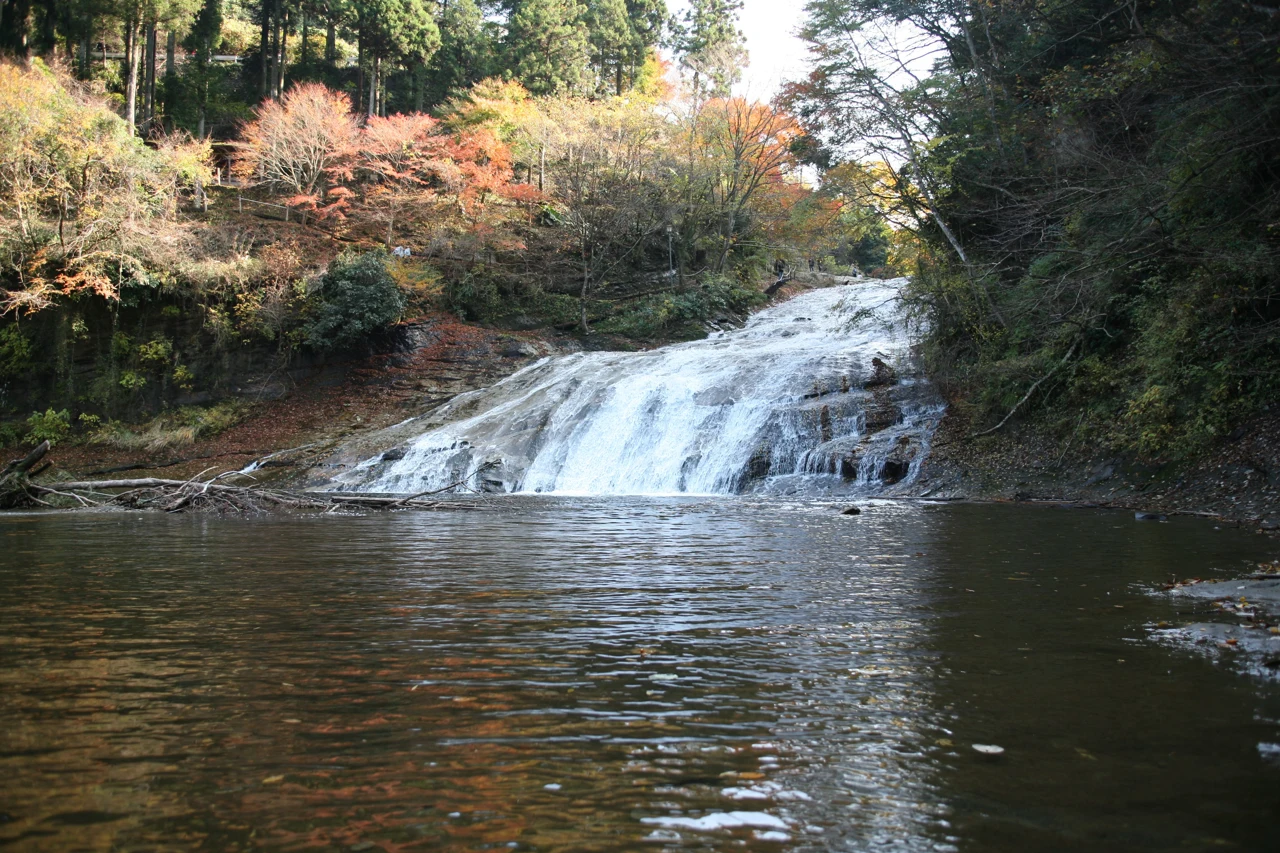
At Awamata Falls, water slides down a gently sloping rock face about 100 meters long, framed by trees and the river. The town’s attraction page announced on July 10 that walking around the falls had resumed; the October trail notice specifies the accessible section. Read the access signs at the entrance, then follow the open route down to the viewpoint. You must climb back to the bus stop afterward.
The falls are free to visit. Having no ticket queue does not leave every minute after the bus arrives available for photography. Finding the entrance, steps in both directions, giving way, using the toilet and returning to the stop all come out of the same visit. Allow about an hour for the falls and a short walk. If you want extended water photography or someone climbs slowly, allow more time and remove the next area.
From the Awamata Falls side, the Takimeguri trail is open only for about 100 meters before you turn back. Entry from the Kozawamata side is prohibited. Return to the same entrance at the turning point. Do not arrange pickup at another downstream stop expecting to walk through. The former 4.3-kilometer, roughly 90-minute Takimeguri circuit in older guides differs from the section open now. For a full day of hiking, choose another open destination instead of trying to find a way out after reaching the falls.
Baron’s CHANNEL filmed Awamata Falls on October 9, 2026. The first 3 minutes 45 seconds show the falls, rock bed and surrounding riverbank.
Enter Nakase from Kyoei Bridge and return after 600 meters
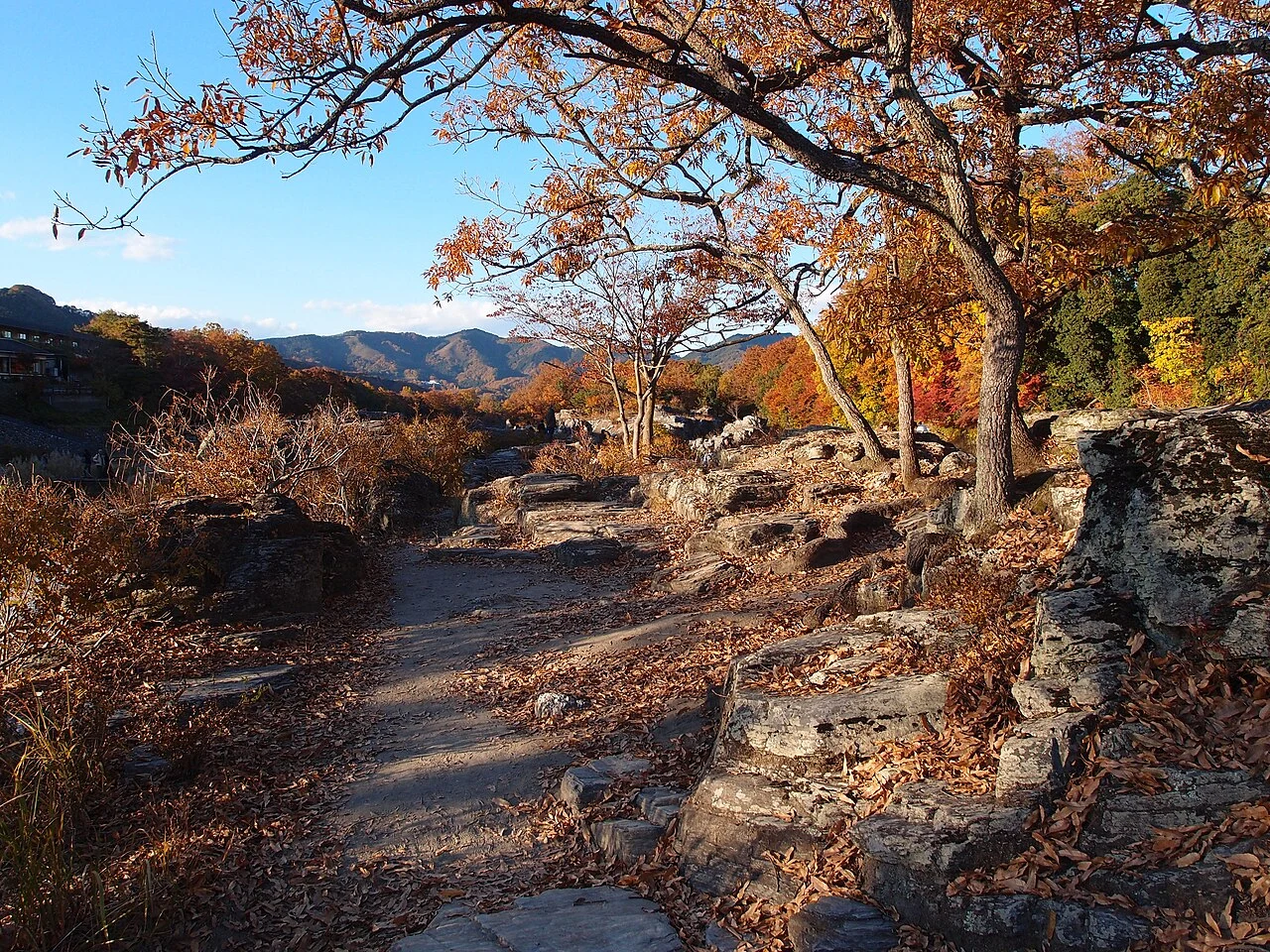
The Nakase walking trail is near the hot spring district, with access from the Kyoei Bridge side. The town’s original attraction page gives about 1.2 kilometers, but the October 20 restrictions open only about 600 meters, ending before the second set of stepping stones. Kobundo ruins can be viewed; some slopes are closed after collapses, and the Kannon Bridge entrance remains inaccessible. Plan to enter and leave on the Kyoei Bridge side, counting the time and effort for the same stretch in both directions.
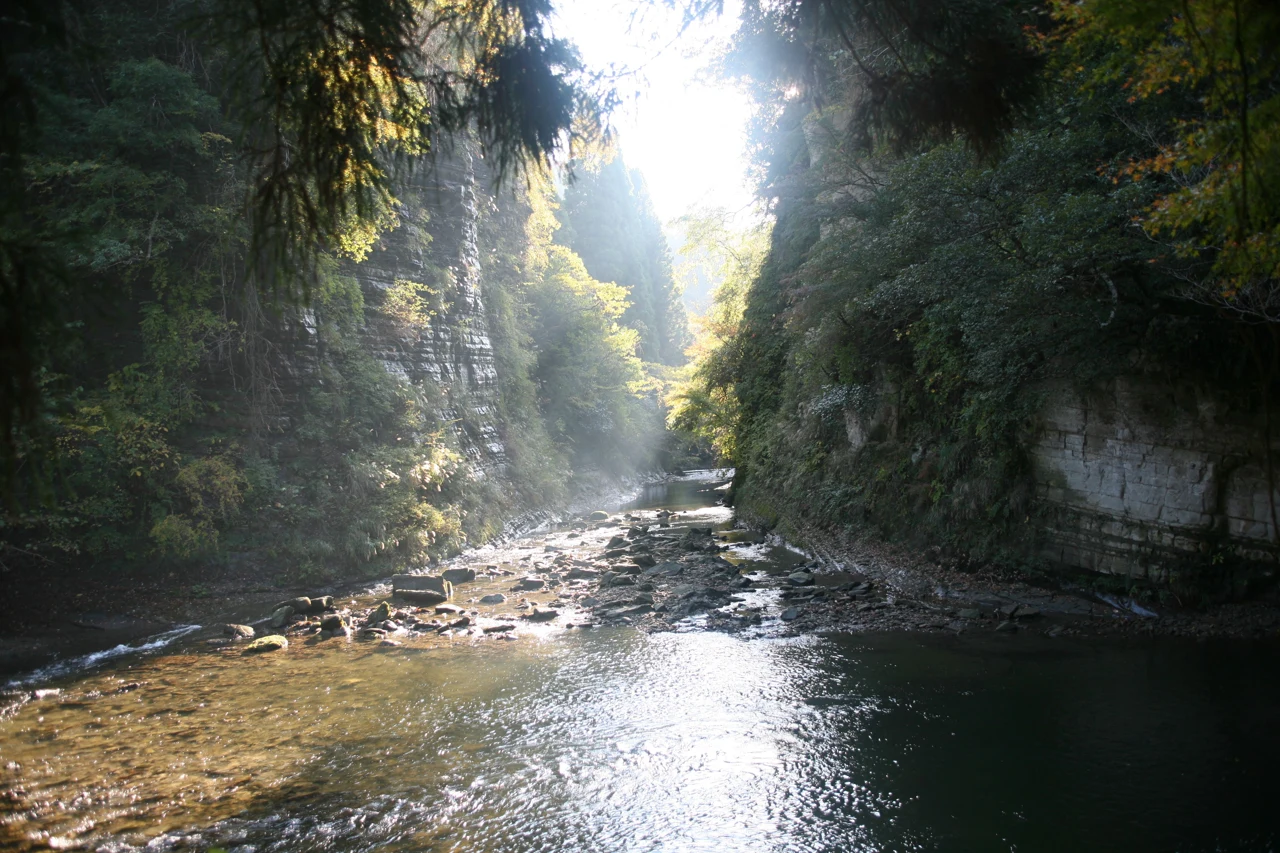
For Kobundo ruins, start near Kobundo-iriguchi and identify the road and entrance toward Kyoei Bridge, then follow signs onto the riverbank. Take time with the rock walls, river bend and tree shadows rather than aiming for the barrier. Stay on the open path at ropes, fences and slope-closure signs. Do not stand on damaged river-crossing structures for photographs. If someone cannot manage stepping stones or the riverbank descent, keep their visit to an easy-to-reach spot and agree on a clear return time for the others.
For the red arched Kannon Bridge, use the hot spring district roads separately. Visiting the bridge and adjacent streets is different from entering Nakase at that end. Ichihara City’s current FAQ also recommends a roughly 90-minute round-trip street walk from Yoro-Keikoku Station via Keikoku Bridge or Hoei Bridge and Shiratori Bridge to Kannon Bridge. This suits a visit centered on the station and hot spring district. If you have already walked Nakase and want to follow this route back to the station, add your meal and rest time. The official round-trip walking time is not the duration of the entire outing.
Remove Omoshiro Gorge, Umegase and Mount Daifuku from the autumn hiking plan
The Omoshiro Gorge trail is fully closed because its stepping stones are damaged. Entry is prohibited from both Kozawamata and Iwaibara. The town’s October 20 notice explicitly closes both ends. Old photographs and circuit maps are not a reason to try the other entrance. This also affects longer routes joining the falls with nearby woodland. Use the time freed by removing Omoshiro Gorge for a meal in Awamata or an earlier return to Otaki.
Both the ridge and stream hiking routes in Umegase Valley are closed after major landslides. Ichihara City says restoration before the 2026 autumn-color season is difficult. Chiba’s official tourism website also lists Umegase as off limits and the Mount Daifuku nature trail and observation deck as closed. For autumn colors, choose the area around Awamata Falls, the open Nakase section or the street walk recommended by Ichihara City, rather than seeking another entrance beside a closed trailhead.
These closures have a clear effect: Yoro Valley offers short walks and bathing this year, with fewer options for long mountain hikes. If your aim is a four-hour mountain walk, use another open route for the day. If you want the falls and riverbank, two or three unhurried hours still have value. Decide what you want to do first, then choose a shorter valley visit, an overnight stay or another nearby destination. Do not join every green line on the map merely to fill the day.
Pair the falls with Goriyaku-no-yu: choose an opening day and return stop
For a bath after walking, consider Takimien Kenko-mura Goriyaku-no-yu upstream of Awamata. The official facility website places it about 800 meters upstream of the falls. The bus terminus Awamata–Goriyaku-no-yu is separate from the falls stop. Use open paths from the riverbank to the road, bath entrance and bus stop; do not seek a shortcut along a closed riverside trail. To limit walking, arrange both arrival and departure at the bath stop and use a connecting bus for the falls leg.
The website currently lists bathing at ¥1,200 for adults, ¥800 for elementary-school children and ¥600 for younger children aged three and over. A bath-towel and face-towel set costs ¥200 to rent; indoor clothing costs ¥300. Two adults and one elementary-school child pay ¥3,200 for bathing alone, plus ¥600 for three towel sets. Meals and transport are separate. Day-use hours are 10:00–18:00, with last admission at 17:00. The usual closure is Wednesday; when Wednesday is a holiday, closure moves to the preceding or following day. The restaurant closes Wednesdays and Thursdays. Match your date to the website calendar.
Guests with tattoos cannot enter, including temporary tattoo stickers and body painting. Entering by mistake and then leaving does not qualify for a refund. Children still in diapers cannot use the bath, but may use the shower or a baby tub you bring. Pets cannot enter. These conditions affect how a family divides its time and eats, so settle them before boarding the bus. If one person cannot bathe, do not base their two-hour rest on an outdoor spot you have not chosen. Returning to town together for an earlier meal is also reasonable.
After bathing, allow time to dry your hair, dress, collect shoes and walk to the stop. Closing at 18:00 says nothing about which bus you can catch. If you choose the 17:14 departure from the bath terminus, finish bathing and getting ready earlier. If the return requires going back to the falls stop, add that journey too. Arriving just before last admission will not leave time for a full leisurely bath if your bus departs soon afterward.
A workable day trip: reach the falls early and return to Otaki in the afternoon
If you can reach Otaki Station before 8:40 on a weekday, use the morning plan: the 8:40 local bus reaches Yoro-Keikoku Station at 9:17; change to the 9:45 bus and reach Awamata-no-taki at 9:59. See the falls and short open section, then have lunch. Leave the falls stop at 13:52 for Nakano Station, arriving at 14:06; change to the 14:40 departure and reach Otaki Station at 15:07. Keep the wait between the two outward buses intact. Do not add a walk away from the stop during those 28 minutes. To shorten waits or reduce transfers, ask in advance about an Otaki-side taxi pickup.
From the 9:59 arrival to the 13:52 departure, you have almost four hours on the Awamata side. The falls, a meal and a rest fit comfortably. If adding a bath, shorten photography and lunch, then work backward from the service at the actual bath stop. On a Wednesday bath closure or restaurant closing day, eat at another open business or finish earlier. There is no need to fill four hours with a closed trail. If someone needs a long midday nap, make it simply the falls and lunch.
Leave a short castle-town walk or the onward transfer until after returning to Otaki. For Tokyo via JR Ohara, the weekday replacement timetable has a 16:30 departure from Otaki reaching Ohara at 17:11, leaving a buffer after 15:07. For the highway bus, look up Tokyo departures from the Otaki highway-bus stop and allow time to reach it. This morning plan requires an early start. A leisurely breakfast in central Tokyo will not fit. If your starting point cannot connect, use the afternoon plan below or stay overnight.
Arriving in Otaki late in the morning means a longer Awamata stay and a later return
With the Ohara 8:45 replacement bus arriving in Otaki at 9:28, eat and rest in town before the weekday 13:00 local bus, reaching Awamata-no-taki at 13:35. The long wait in town suits travelers who already want to visit Otaki. If the falls are your only aim and you dislike waiting, reserve a taxi from Otaki to Awamata or choose another date with an earlier arrival. The 9:50 service ending at Nakano cannot be treated as a through bus to the falls to reduce the wait.
Arriving at 13:35 and trying to leave toward Otaki at 13:52 gives only 17 minutes, a rush even for the descent, climb and falls. A fuller public-transport plan keeps the afternoon in Awamata and takes the 17:16 bus from the falls stop to Otaki Station at 17:57. Then the 18:30 Isumi replacement bus reaches Ohara at 19:11 for JR back to your accommodation. This example makes the cost of a late arrival clear: the riverside visit remains worthwhile, but the return to Tokyo is later than on a typical nearby day trip.
Late-autumn daylight ends early. Finish the riverside walk while it is light, spend the later part in an open facility and reach the stop on time. With small children, sensitivity to cold or no wish to wait for a rural bus after dark, reserve an earlier pickup or stay at an inn with dependable transport. If your group cannot accept a late dinner, choose a different day trip that morning so the afternoon transport does not disrupt everyone’s meals.
Read the return destination: a bus to Yoro-Keikoku Station cannot connect to a suspended train
First decide whether you need Otaki, Kazusa-Nakano or only Yoro-Keikoku Station. In the weekday timetable, the 13:47 departure from Awamata-no-taki reaches Yoro-Keikoku Station at 14:03. Another bus leaves five minutes later at 13:52 and ends at Nakano Station at 14:06. Change there at 14:40 to reach Otaki at 15:07. The departure times are close but the destinations differ completely. For Tokyo via Ohara or the highway bus, follow the entire Otaki-bound column instead of boarding at 13:47 just because it leaves first.
If you board the wrong bus to Yoro-Keikoku Station, check the available next leg on arrival and ask the driver or depot. Do not walk along railway tracks or closed roads to chase another service. Local buses at the station do not mean there is a train to Goi that day. During the suspension, reaching Kazusa-Ushiku independently from the valley requires a separately usable replacement service and road route. Save a stop photograph, full Japanese destination, intended service and backup on your phone before leaving. Everyone can then identify the right bus even after splitting up to shop.
Kominato’s Otaki Depot number is 0470-82-2821. Ask a specific question such as “Awamata-no-taki to Otaki Station on this date.” Establish whether the weekday or weekend/holiday schedule applies, the departure time and any transfer, keeping the Japanese stop names. If your bus is canceled or road conditions change, return earlier or use a vehicle whose availability has been confirmed. An unreserved taxi is not a fixed standby in the mountains. If you miss the final connection, do not walk into an unbooked inn expecting a room. Decide while transport and accommodation can still be contacted.
Autumn colors and illuminations: leave the river by daylight on day trips
Autumn colors around Awamata and the hot spring district are usually strongest from late November to early December. When planning in late October, use that seasonal window to select dates, then check conditions in the travel week. Tree species, light and wind alter photographs even on the same day. Water and rock walls offer plenty to see in green-leaf season or before full autumn color. If a valley full of red leaves is your sole aim, settle dates before transport tickets and nonrefundable accommodation.
Ichihara City’s notice with body text dated October 26 announces illuminations at Kannon Bridge, Awamata Falls and Kengaikyo from November 23. Night viewing needs a separate way back to your room. The daytime 13:52 and 17:16 return examples cannot serve that purpose. For an evening visit, first choose accommodation near the actual viewing area, then ask about dinner time, walking routes and available transfers. Staying on the Nakase side does not automatically provide transport to Awamata at night.
Illumination does not lift trail closures. Sections requiring you to retrace your route by day remain restricted at night. The lights cover viewing locations, not every riverside road. Day-trippers will usually find it easier to accommodate different walking speeds by finishing the falls in daylight and allowing a daylight walk back to the stop. If you want city night views, decide on a short walk near dinner after returning to Tokyo. Plan mountain and city evening travel separately.
With children or older travelers, reduce the areas and count steps and waiting time
Awamata’s accessible section is short, but the entrance and riverbank are at different heights. Nakase also has uneven ground and river-crossing structures. Use a stroller at stations or on level streets, then decide who will handle it and the luggage before descending. Avoid having one person carry a child in one arm and a stroller in the other on wet steps. For knee problems, one main area plus a seated meal is more suitable than the falls, Nakase and the station street walk together.
Handle children’s needs before a long wait: use the toilet and refill water at the departure station, eat a small snack during transfers and choose an open place with seats for lunch. Before the bath, account for diaper and tattoo rules. The restaurant is also closed Thursdays; relying on it for every meal may force a new plan at the entrance. For the full return to Tokyo, bring a warm outer layer and a few snacks so the final wait is manageable.
Shoes with grip, a backpack that leaves both hands free and rain gear that packs away easily are more useful than heavy luggage. After rain, rising water may lead the town to close even the normally open sections. Eat and rest in an open facility, leave early or switch to an indoor Tokyo day before departure. If you have not left your accommodation, changing the day is better than improvising at the riverbank. Leave large luggage at your Tokyo accommodation and bring only overnight essentials if staying, avoiding a full suitcase at every transfer.
An overnight stay adds dinner and reliable transfers, not another closed trail
Stay overnight if you want a bath, an unhurried dinner or illuminations. Before choosing a room, locate the inn in the right area: falls-side inns suit Awamata, while hot spring district inns are near Kannon Bridge and Nakase. Ichihara City’s current operating list includes Takimien, Kawanoya and Mochinoki among several inns operating normally. For booking, check arrival arrangements and the actual plan with your chosen property. An address in Otaki Town does not put the falls within walking distance.
Before comparing room prices, ask where pickup starts, at what time, whether advance booking is required and where the next day’s drop-off goes. The designated station may be Otaki, Kazusa-Nakano or elsewhere; transfers do not automatically extend to cover every transport change. Enter children’s ages, meals and bedding accurately. Dinner time on a half-board plan also limits arrival. Reaching the falls at 13:35, taking photographs, bathing and crossing to accommodation on the other side can run close to dinner. On an overnight day, it is better to give the afternoon directly to the inn.
Read cancellation terms for your exact dates and plan, especially autumn-color weekends, limited room types and prepaid offers. A suspended local railway and an inn operating normally can coexist. Whether your route or date change is free depends on the booking. Pay once you accept the terms and save an official contact number. Match the next day’s departure to Otaki or Ohara first. Do not add Umegase and Mount Daifuku after breakfast. The extra night already has a clear purpose in relaxed meals, rest and time beside the valley.
A few useful answers
Can I take Kominato Railway directly from Goi to Yoro Valley in autumn 2026?
Trains between Kazusa-Ushiku and Kazusa-Nakano are suspended. Ichihara City’s October 26 notice says weekday replacement services end at Kocha Jidosha-mae. For the falls, prioritize a local bus from the Otaki side.
Can I walk the whole Takimeguri trail at Awamata Falls now?
Walking around the falls is possible. Follow the trail for about 100 meters from the falls side, then return. Entry from Kozawamata is prohibited.
Can I walk Nakase from Kannon Bridge to Kyoei Bridge?
Currently, enter from Kyoei Bridge and turn back after about 600 meters, before the second set of stepping stones. The Kannon Bridge trail entrance is closed. Kobundo ruins can be viewed; collapsed slopes are off limits.
Are Umegase and Omoshiro Gorge suitable for autumn colors in 2026?
Both are closed. Umegase’s ridge and stream routes are off limits after landslides. Both the Kozawamata and Iwaibara entrances to Omoshiro Gorge are closed.
How do I return to Otaki from Awamata on a weekday afternoon?
The April 1, 2026 weekday timetable lists a 13:52 departure from Awamata-no-taki reaching Nakano at 14:06, with a 14:40 connection reaching Otaki at 15:07. Another service leaves at 17:16 and reaches Otaki at 17:57. The nearby 13:47 departure goes to Yoro-Keikoku Station in a different direction.
How much is bathing at Goriyaku-no-yu?
The website lists ¥1,200 for adults, ¥800 for elementary-school children and ¥600 for younger children aged three and over. Towel-set rental is ¥200. The bath normally closes Wednesdays and the restaurant Wednesdays and Thursdays; see the calendar for holiday adjustments.
Official information and references
Sources used in this guide.
- Ichihara City: live Yoro Valley sightseeing and transport notices
- Otaki Town: trail restrictions dated October 20, 2026
- Otaki Town: Awamata Falls
- Otaki Town: Nakase walking trail
- Official Chiba tourism: Awamata Falls and closures at Umegase and Mount Daifuku
- Otaki Town: local transport and taxi contacts
- Otaki Town: Tokyo highway bus and current fares
- Isumi Railway: April 2026 replacement buses and boarding locations
- Isumi Railway: replacement-bus timetable effective April 1, 2026
- Otaki Town: current local-bus timetable directory
- Otaki Town: weekday local-bus timetable effective April 1, 2026
- Wakuwaku Otaki: transport recovery and Otaki-side connections, October 16, 2026
- Goriyaku-no-yu: hours, prices and entry rules
- Kominato Railway: official website and contacts