Take the Odakyu Line from Shinjuku to Noborito and hop on a character-wrapped shuttle bus to the Fujiko F. Fujio Museum in Kawasaki. Everything you need to know about twice-monthly ticket drops, seven timed-entry windows, English audio guides, original manga manuscripts, the F Theater, and the 3F cafe—plus rainy-day and late-afternoon family routes.
- Region & Focus
- KantoFamily attractions
- Reading Scope
- 17 min read · 8 chapters · 6 Q&As
- Official Verification
- 24 official sources checkedUpdated November 22, 2026
- Key Topics
- BookingRail travelItineraries
Chapter Route Map (tap any stop)
- Tickets Drop on the 5th and 20th—Pick a One-Hour Entry Window
- Shinjuku to Noborito: Spot 2112 on the Doraemon Shuttle Bus
- Start with 1F Original Manga Pages and the Smartphone Audio Guide
- Take a Breather in the 2F F Theater and Browse the Manga Corner
- Pump Up Handsome Gian, Then Hit the Roof for Concrete Pipes and the Anywhere Door
- Check the 3F Cafe Queue First If You Want Memory Bread
- Budget Half a Day on a First Visit—What to Cut for Rain or the 16:00 Slot
- Strollers, Lockers, and the Ride Back: Free Your Hands Before You Start
- Quick Q&A
If you are taking kids out from Tokyo to see Doraemon, lock in your date and timed-entry slot at the Kawasaki City Fujiko F. Fujio Museum before you go—there is no ticket window at the door. Ride the Odakyu Line from Shinjuku to Noborito, then catch the character-wrapped shuttle bus from the Ikuta Ryokuchi Exit. For a first visit, aim for the 10:00 or 11:00 entry window and budget half a day to see original hand-drawn manga pages, catch a short film in the F Theater, and step through the pink Anywhere Door on the roof. If Memory Bread is high on your list, check the third-floor cafe waitlist as soon as you arrive.
Tickets Drop on the 5th and 20th—Pick a One-Hour Entry Window
Start by checking the museum's operating calendar for two dates that fit your trip, then mark the corresponding ticket release day. On the 5th of each month at 10:00 JST, tickets open for the 16th through the end of that month; on the 20th at 10:00 JST, tickets open for the 1st through the 15th of the following month. Set an alarm in your local time zone so you do not miss 10:00 JST. If you want to visit on December 12, you can buy starting November 20; for December 19, you wait until December 5. The same rule applies across New Year's—tickets for the first half of January drop on December 20. Around holidays, keep a second backup date in your itinerary so you have an immediate Plan B if your first time slot sells out.
Standard hours are 10:00–18:00, with the museum closed on Tuesdays and over the year-end/New Year period, though occasional Tuesday openings happen. Gray dots on the official calendar mark closures. For example, Tuesday, December 1, 2026 is open, while the museum closes from December 29, 2026 through January 3, 2027, and again from January 18 to 22, 2027. Check the official museum calendar before heading to the ticket portal. Both closed days and sold-out days appear unclickable on the booking screen, so checking the calendar first tells you whether to wait for the next drop, switch times, or pick another day.
From the official e-tix ticketing page, choose your date, entry window, and ticket types (if you see "Yotei Maisu Shuryo" on a Japanese booking screen, that slot is sold out). Admission is ¥1,000 for adults and university students, ¥700 for junior and senior high school students, ¥500 for children ages 4 and up, and free for ages 3 and under. Two adults with an 8-year-old pay ¥2,500 total; if a 3-year-old sibling is tagging along, you still only buy three tickets. Eligible visitors with disabilities and one companion can each reserve a free ticket and present valid documentation at entry, though the ticketing site explicitly notes that disability certificates issued outside Japan do not qualify for this discount.
QR code e-tickets paid by credit card carry zero handling fees. The portal accepts Visa, Mastercard, JCB, and American Express, and may trigger a 3D Secure verification prompt. Once you select your tickets, you have 15 minutes to complete checkout, so keep your phone handy for bank verification and use an email address you can open right away. After purchasing, open each person's QR code from the confirmation email or print the full tickets in advance. When entering with two kids, pull up the full order before reaching the door so you can swipe through each barcode smoothly instead of digging through your inbox in line. You can also pay and pick up paper tickets at 7-Eleven stores in Japan after reserving online, which adds ¥150 per ticket plus ¥220 per order—for travelers locking in plans before arriving in Japan, the credit card e-ticket is far simpler.
If a date looks open right after tickets drop but the next screen does not have enough seats for your group, back up to the slot selector and try another hour. Before the sale starts, put one parent in charge of the credit card authentication and confirmation inbox while the other double-checks dates, kids' ages, and transit timing. Star the confirmation email as soon as payment clears and test the ticket links before you leave for the station. Staff scan either the original mobile barcode screen or a full printout. If part of your group is arriving separately, confirm ahead of time who holds which QR codes.
A 13:00 ticket lets you enter anytime between 13:00 and 14:00; if you show up early, you wait until 13:00, and once inside you can stay until 18:00. When capacity remains, same-day online sales stay open for 45 minutes after a window starts—a 14:00 slot can be bought until 14:45 for entry by 15:00. Even if you spot that opening while still in Shinjuku, it is better to book the next available hour than sprint for the train. To change dates normally, you can cancel an entire credit card e-ticket order up to three days before your entry window starts (for a Saturday 11:00 ticket, the cutoff is Wednesday 10:59) and rebook. Convenience store tickets cannot be canceled or changed once picked up. In case of sudden illness, severe weather, or transit shutdowns, contact the museum before your scheduled arrival time to ask about rescheduling.
| Booked Slot | Entry Window | Best Way to Pace It |
|---|---|---|
| 10:00 | 10:00–11:00 | Tour galleries and snap outdoor photos, then have lunch inside |
| 11:00 | 11:00–12:00 | Weekday cafe is already open; check the waitlist upon arrival |
| 12:00 | 12:00–13:00 | Arriving right at lunch; decide early whether to eat on-site |
| 13:00 | 13:00–14:00 | Spend the morning in Tokyo and eat lunch before entering |
| 14:00 | 14:00–15:00 | Prioritize F Theater, manuscripts, and the roof; treat cafe as optional |
| 15:00 | 15:00–16:00 | If outdoor photos matter, check the rooftop daylight first |
| 16:00 | 16:00–17:00 | Museum closes at 18:00; pick your top two stops right away |
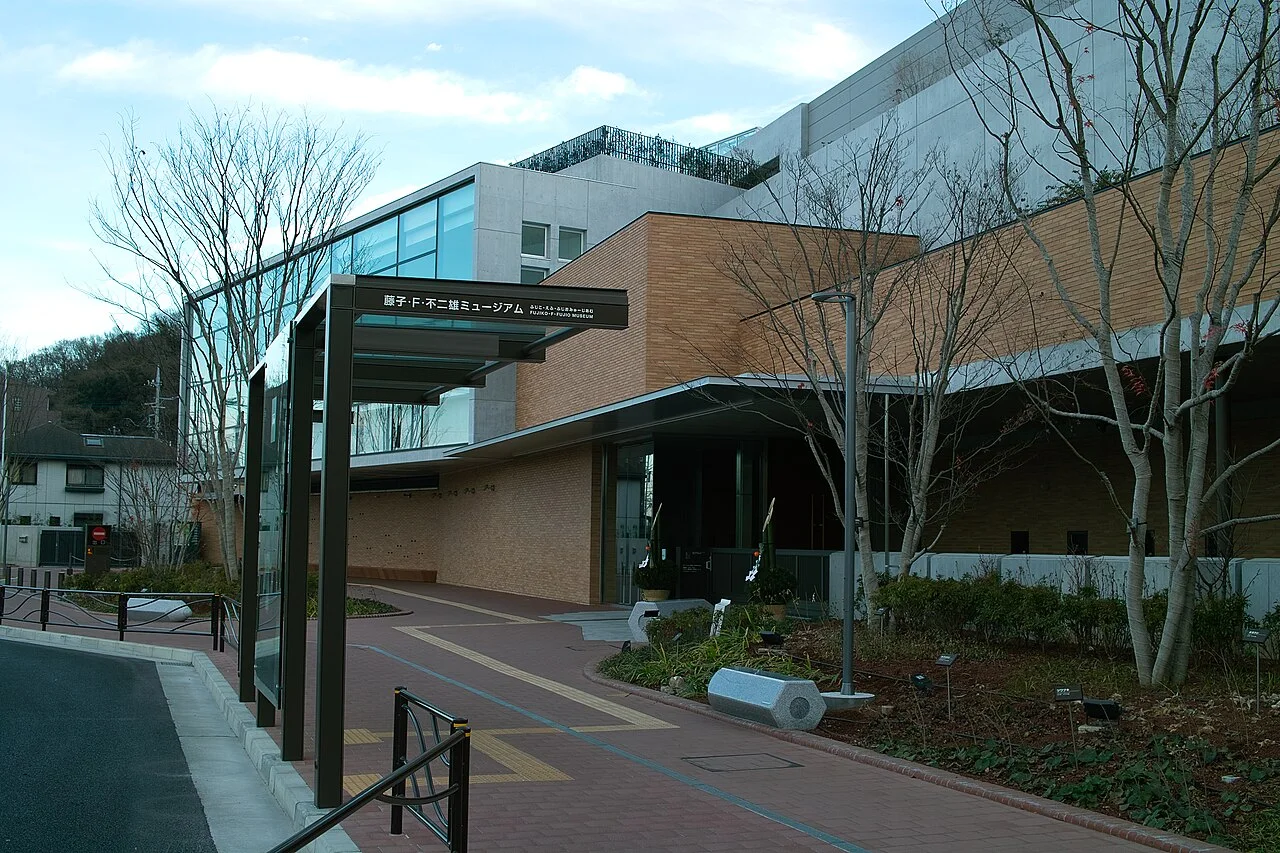
Take the Odakyu Line from Shinjuku to Noborito and hop on a character-wrapped shuttle bus to the Fujiko F. Fujio Museum in Kawasaki. Everything you need to know about twice-monthly ticket drops, seven timed-entry windows, English audio guides, original manga manuscripts, the F Theater, and the 3F cafe—plus rainy-day and late-afternoon family routes.
Shinjuku to Noborito: Spot 2112 on the Doraemon Shuttle Bus
From Shinjuku, enter the Odakyu Line ticket gates and board an outbound Odawara Line train that stops at Noborito. Both Rapid Express and Express trains stop there, though it takes two seconds to verify Noborito on the platform departure board when a Rapid Express pulls in. If family members are arriving in Shinjuku via JR lines, meet outside the Odakyu gates before tapping in together. The museum lists the fastest train ride from Shinjuku to Noborito at roughly 15 minutes, which only counts time on the rails—pad your departure for walking through Shinjuku Station, waiting for the train, and transferring to the bus.
The Odakyu side of Noborito Station is decked out in Doraemon details, giving kids something to spot while you get your bearings. Exit the gates and follow signs toward the JR Noborito Station Ikuta Ryokuchi Exit, heading down to the street-level bus rotary. Kawasaki City Bus lists stop No. 3 for the direct Fujiko F. Fujio Museum shuttle. Express buses to Ikuta Ryokuchi park share the same area, so if your elementary-schooler wants to play navigator, have them match the Japanese museum lettering on the stop sign with the destination board on the front of the bus. Several routes line up in the rotary, so checking the pole beats blindly joining the longest queue.
If you arrive a few minutes early, linger inside the Odakyu concourse to check out the Doraemon and Nobita installations along the stairs, escalator walls, and waiting room benches—challenge kids to spot yellow bells along the way to the exit. Children tend to stop dead right past the ticket gates to point, so step aside out of the commuter flow before snapping family photos. Seeing the station art during your transfer is plenty; there is no need to catch an ultra-early shuttle just to stand outside the museum before your entry slot.
The direct museum shuttle runs roughly every 10–15 minutes on open days and takes about 9 minutes. One-way fares are ¥220 for adults and ¥110 for children, payable in cash or with Suica, PASMO, and other transit IC cards. Round-trip bus fare for two adults and an 8-year-old totals ¥1,100, separate from your Odakyu train fare. Let kids tap their own child IC card if they have one, and keep your own card in an easy-access outer pocket. On weekends and holidays, a full bus can mean waiting for the next departure, so aim to reach Noborito around 9:45 for a 10:00 entry slot to keep the transfer stress-free.
Have kids look for "2112" on the bus license plates—a nod to Doraemon's birth date, September 3, 2112. Kawasaki City Bus operates four wrapped designs featuring Doraemon, Dorami, Korosuke, and Chimpui. Check which character covers the exterior while waiting, then look for hidden motifs on the seat fabric, hand straps, and stop-request buttons once you sit down. If you catch a different bus on the return trip, kids can compare how the stop buttons differ from the ride in. Keep photos to your seat area during the ride and wait until the bus comes to a full stop before standing up with a camera.
If you prefer walking over the shuttle, the museum is about 16 minutes on foot from the South Exit of Mukogaoka-Yuen Station on the Odakyu Line, or about 15 minutes from Shukugawara Station on the JR Nambu Line; set your map pin to 2-8-1 Nagao, Tama-ku, Kawasaki-shi before leaving. Visitors staying in Tokyo who want the wrapped bus experience without a return wait often ride the shuttle from Noborito on the way in and walk to Mukogaoka-Yuen to catch the Odakyu Line back. If your kids have tired legs, skip the walk and look for the return stop marked for Noborito Station right outside the museum exit. When you have a timed dinner reservation back in Tokyo, check the weekday or weekend/holiday return columns on the official museum bus timetable and work backward to leave time for the shop and lockers.
Start with 1F Original Manga Pages and the Smartphone Audio Guide
After your admission QR codes are scanned at the entrance, hold onto the paper F Theater tickets handed out by staff—you will need them later at the theater door, so tuck them somewhere accessible. To hear commentary on the artwork, scan the audio guide QR code at reception or the gallery entrance with your phone or tablet and enter "Today's Key" posted at the desk. The passcode changes daily; snap a quick photo of the sign or enter it right at the lobby so you can immediately dial in the speech-bubble numbers beside each display case. Guides are free in Japanese, English, Chinese, and Korean, with on-screen text available for anyone who prefers reading or needs accessibility support. Museum Wi-Fi covers the galleries, so just keep your phone and earbuds within reach.
Years ago, the museum's early "Ohanashi Denwa" audio devices even featured a Japanese kids' edition narrated by Doraemon and Nobita, along with character-hosted quizzes in Japanese. Children without their own phone or tablet can ask staff at the entrance to borrow a dedicated guide unit. If your kids do not speak Japanese, switch the smartphone guide to English and let them punch in the exhibit numbers for the whole family. On the first floor, let each child pick two numbers—one for a colorful illustration and one near the creator's work desk—then ask them to spot one extra detail in the art after listening so the audio connects straight back to the page in front of them.
Exhibition Room I on 1F makes the best opening stop. One wall displays vibrant color illustrations while the opposite side lays out nearly an entire manga chapter in original black-and-white pages. Whereas a cover packs characters and gadgets into one frame, sequential panels break a gag down step by step—a hand reaching out, a gadget swiped, a stunned reaction. Ask your child to pick one panel and look at the frames right before and after it to guess what happened from the characters' faces. Adults who want extra time reading the ink work can agree to regroup at the next large display instead of crowding together in front of one glass case.
Continue into Sensei's Room, where Fujiko F. Fujio's work desk sits beneath towering bookshelves and dinosaur models. Once kids spot the dinosaurs, ask how big they would draw one on paper—or how long a ruler they would need to sketch a tail that size. For kids who mostly know Doraemon from TV anime, this room connects the dots back to the hand-drawn pages they just saw, showing how the books and curiosities around a single desk fueled whole worlds of background details.
Head up to 2F and walk from the Room of Animals—filled with 3D creatures inspired by the artist's paper cutouts—toward Exhibition Room II, passing an Anywhere Door at the special gallery entrance. Running through January 17, 2027, the first half of the 15th-anniversary special exhibition spotlights wish-granting secret gadgets, with official highlights including *The Birth of Doraemon*, a cup that shrinks or enlarges whatever goes inside, and a story about an abominable snowman taking a part-time job. The second half is scheduled for January 23 through June 20, 2027; if there is a specific first-half manuscript you want to catch, factor the mid-January exhibition changeover closure into your ticket date.
Under museum photo rules effective July 1, 2026, still photography is permitted in designated spots across reception, Exhibition Room I, the History Corridor, the Studio, and the Room of Animals—just keep your phone away whenever you see a no-photo icon on specific pieces. In Exhibition Room II, photos are allowed only in the entrance zone, and "Sensei's Sunday" remains strictly no-photo. Flash, video recording, selfie sticks, and tripods are prohibited throughout the galleries. For a keepsake photo before stepping into the manuscript hall, frame your kids next to the giant "Doraemo~n" speech bubble at the 2F Exhibition Room II entrance, then put your earbuds in for the art inside.
Take a Breather in the 2F F Theater and Browse the Manga Corner
The F Theater sits on 2F, and your admission includes one screening with the paper ticket you received at entry. Showings start at 10:20 and run every 20 minutes. When you step out of the galleries, glance at the theater entrance for the next screening time and queue length—screenings are separate from your entry slot. If you are absorbed in reading a full manga story on the gallery walls, finish it before heading over; if kids' feet are already flagging, slot in the next screening before climbing to the roof so everyone gets a seated break. Visitors who want free subtitle glasses should request them from staff upon arrival, as reservations are first come, first served.
For November 2026, the museum lists the short film *Doraemon & F-Character All-Stars: Secret Gadgets Chaotic Big Adventure*, in which party guests enter an adventure gamebook in pairs and trade coins for secret gadgets. Even if younger kids only recognize Doraemon, they can easily follow who teams up with whom and which gadget saves the day. If you worry about wiggly kids sitting still, ask them before the doors open to tell you afterward which gadget they would pick first. Photography and filming are prohibited inside the theater, so save the debrief for the hallway outside.
Right nearby on 2F, the People's Square manga reading corner welcomes visitors with a statue of Doraemon reading comics while munching dorayaki. Elementary-schoolers will enjoy picking their own volume off the shelf. If they cannot read Japanese quickly, flip to pages with big, expressive reactions and take turns inventing English dialogue for each panel. It is also an easy place to kill a few minutes if your 3F cafe number is close to being called—or to wait out a passing rain shower before going outside. Reshelve your book when done before deciding whether to check out the gachapon capsule machines nearby.
Next to the square, a dedicated Kids Space decorated with *Zokun to Risuchan* artwork stocks picture books for preschoolers, with parent supervision required. If you are visiting with kids far apart in age, one adult can stay in the picture-book corner with the toddler while the other reads manga with the older sibling, then meet back by the dorayaki-eating Doraemon. Solo parents can start everyone together in the manga corner, shift to the Kids Space when the little one is ready, and head straight to the F Theater together from the same floor.
Pump Up Handsome Gian, Then Hit the Roof for Concrete Pipes and the Anywhere Door
On dry days, start your outdoor circuit on 2F at the Woodcutter's Spring, where pumping the lever makes "Handsome Gian" slowly rise out of the water. Stand where you can frame both Gian and your child while they work the handle up and down. If small hands struggle with the resistance, swap roles—have an adult pump while the child watches Gian's face appear in frame. Two adults can easily split duties, one steadying a toddler and the other holding the camera instead of dumping backpacks in the line. If you want kids in on the joke beforehand, find Vol. 36 of the Japanese *Doraemon* manga in the 2F reading corner to read the original "Woodcutter's Spring" chapter first.
Head up to the 3F rooftop lawn, Harappa, and start with the iconic stack of concrete pipes on the open grass. Crouch low to frame your child's face inside one of the lower openings, then back up for a wide shot showing the whole stack on the lawn. Kids are welcome to climb inside the lower pipes, though climbing onto the very top pipe is off-limits. Let them try out classic poses from the manga while you change angles from the ground; if another visitor is peeking out the opposite end, wait a beat so your child can actually see you through the pipe.
At the pink Anywhere Door, ask your child where they want the door to open before stepping up. Take a step back when framing so the full doorframe stands out on the open lawn—that is what makes the shot unmistakably Doraemon. Vary the poses with one photo holding the doorknob and another stepping across the threshold. Next door, find Pisuke the dinosaur from *Nobita's Dinosaur*. After seeing the small dinosaur models back in Sensei's studio, kids love comparing what fits on a desk with a full-size character standing outdoors.
For kids who want a mission at every stop, the rooftop also runs a free smartphone stamp rally called "Find the Secret Gadgets!", launched in July 2026. Scan the event QR code inside the museum, hunt down hidden gadgets scattered across Harappa, and snap photos according to the prompts to unlock digital keepsakes. Family members can fan out to spot targets and point them out, or share one phone by letting the kids search while an adult takes the photos, then trade roles for the next spot. If clouds roll in or your schedule gets tight, shoot either the concrete pipes or the Anywhere Door and skip sprinting around the lawn under an umbrella.
Visiting in November 2026 also lines up with the museum's autumn/winter displays: a large Christmas tree inside People's Square on 2F and a crystal tree on the 3F rooftop whose lights pop once dusk settles. If you want bright daytime colors on the Anywhere Door, shoot the door first and check whether you can catch the tree lit up from the same floor before leaving. The 3F cafe sells takeout hot drinks for rooftop strolls—hot lemonade and royal milk tea are ¥500 each—best picked up after your hands are free from taking photos.
If outdoor photos are your top priority, gauge the afternoon light on the roof first, and in winter head straight upstairs as soon as you enter. Whenever one spot has a queue, jump to whichever photo op is empty instead of insisting on Woodcutter's Spring, concrete pipes, and Anywhere Door in strict order. If a child wants pictures of the statues without being in them, hand over the role of photographer and pose on the lawn yourself. Clear the spot promptly for the next family once you have your shot, then wander the far side of the roof at an unhurried pace.
Check the 3F Cafe Queue First If You Want Memory Bread
If you plan to eat lunch at the museum, walk straight up to the 3F cafe entrance right after entering. When numbered waitlist tickets are in use, grab a number and watch the status board to see which group is currently seated. Stay on 3F if only a few parties are ahead of you, or step outside to snap rooftop photos while you wait. If your turn hasn't come up right before an F Theater showing, simply push the movie back one 20-minute cycle. The cafe opens at 11:00 on weekdays and 10:00 on weekends and holidays, closing at 18:00 with last order at 17:30. Weekday 10:00 ticket holders can browse 1F until the cafe opens; weekend visitors can make the cafe their very first turn upstairs.
The menu's signature "French Toast de Ankipan" (Memory Bread French Toast) is ¥1,200. In the manga, Nobita presses bread onto textbook pages to memorize facts by eating it—kids who know the episode instantly recognize why the printed side faces up on the plate. It arrives with vanilla ice cream and chocolate sauce, easy to share onto side plates once everyone gets a photo. For another Doraemon centerpiece, the Dorayaki Parfait (¥1,600) comes topped with dorayaki and a Doraemon-shaped wagashi sweet, while cafe lattes and hot cocoa (¥750 each) arrive with surprise character latte art.
If you are counting on the cafe for a proper lunch rather than just dessert, check portion sizes before ordering. Official menu highlights include Gian's Katsudon (pork cutlet rice bowl) at ¥1,800 with miso soup and pickles, and a giant 15th-anniversary "Doraemon with Ears" curry at ¥2,600 labeled for 2–3 people. Families with mixed appetites often find that pairing Gian's Katsudon with an order of Memory Bread French Toast splits more cleanly than one giant dish, whereas the oversized curry makes a fun centerpiece for a family eager to share and spot Doraemon's ears at the table. Entrees and desserts can be ordered separately, so show everyone the menu photos before locking in your table order.
If the cafe queue is backed up—or you would rather eat a full meal back around Noborito—stop by the Fujiko-ya takeout counter on the same floor for Ankipan Rusks (six-piece box for ¥1,280) and single dorayaki for red-bean fans. Another handheld treat is the "Harappa de Ice Milk," packaged with a peek-through door motif. The story's Memory Bread inspires both the sit-down French toast and Fujiko-ya's crunchy rusks, so picking one version lets you save time for the rooftop without missing the reference.
Outside food and drinks are not permitted inside the museum, with baby food as the single exception; sealed water bottles or flasks are allowed, though ask staff where to step aside before drinking. The cafe website notes allergen labeling on menus, so travelers with strict dietary needs who may require outside food should contact the museum ahead of time to ask about accommodations. If your family needs lunch right on schedule, decide before leaving Tokyo whether to eat near Noborito beforehand or grab a cafe waitlist ticket early—re-entry is not allowed, so stepping outside for lunch forfeits using your ticket for the afternoon theater.
Budget Half a Day on a First Visit—What to Cut for Rain or the 16:00 Slot
Set aside half a day from Tokyo, including roughly three hours inside the museum—more if you sit down for a full meal or have kids who linger over every manga page. On a sunny 10:00 morning, handle the cafe waitlist and rooftop weather right away, drop down to 2F for the F Theater, and save the 1F manuscripts for afterward. If your group cares most about original art, work steadily from 1F up to 2F until someone needs a rest, then hit the theater and manga corner. Keep any timed evening plans back in Tokyo loose enough to absorb the cafe queue and the Noborito transfer.
If you land the 16:00 slot, aim to enter right around 16:00. Focus on 1F original pages plus one 2F film screening for a tight, satisfying loop, or send photo-loving school-age kids straight up to the 3F Anywhere Door first before dropping down for the next available F Theater show. Because cafe last order is 17:30, families dead set on Memory Bread should grab their waitlist number before touring the galleries rather than debating dinner after photos, manuscripts, manga, and shopping are already done. Leave the 1F gift shop for your final stop near the exit, and agree ahead of time on how many items each child can pick so checkout does not run past closing.
When it rains, lead with the permanent galleries on 1F and the special exhibition on 2F, catch the F Theater short, and relax in the manga corner. Swap the lawn Anywhere Door photo for the giant speech bubble outside the 2F exhibition hall and the dorayaki-eating Doraemon in People's Square. If the rain lets up before you leave, treat the roof as a bonus and stick to the pipes and Anywhere Door. In winter, keep coats on or in one person's arms for quick lawn photos so they are easy to shed again back inside the heated galleries.
With elementary-school kids, put them in charge of spotting the shuttle bus plate, picking one favorite page in the gallery, and choosing a destination at the Anywhere Door. With babies or toddlers, build in a calm buffer for diaper changes and baby food. If two adults want to take turns reading the sequential comic pages on 1F uninterrupted, pick a meeting point near the floor entrance. Anyone in your group who dislikes crowds can wait along the side of the walkway while others snap photos—agree on which gallery zone to regroup in rather than hovering on stairs or in doorways.
If the kids still have energy when you step out, walk to Mukogaoka-Yuen Station on the return leg and save the Doraemon shuttle for the ride in; if you are carrying shopping bags, dusk has fallen, or shoes are wet, take the bus back to Noborito instead. Back on the Odakyu platform, ask each child which secret gadget they would borrow for the ride home—one picks the Anywhere Door, another picks Memory Bread, and parents get a turn too, stretching the story all the way back to Shinjuku.
| Your Scenario | Do This First | Keep Flexible |
|---|---|---|
| Sunny day, family photos first | 2F Woodcutter's Spring and 3F rooftop lawn | F Theater, galleries, and Fujiko-ya |
| Lunch at the 3F cafe | Check 3F waitlist upon entry; browse 3F while waiting | Slot galleries and F Theater around your table call |
| Rainy day or visiting with toddlers | 1F manuscripts, 2F F Theater, and reading corner | Hit the roof only if rain clears; nursing room is on 2F |
| Last entry slot (16:00) | Pick either rooftop or 1F art first, then catch F Theater | Decide early between the cafe and the 1F shop |
Strollers, Lockers, and the Ride Back: Free Your Hands Before You Start
Strollers are fine on the train and bus, though inside the museum they must be parked in the designated stroller area—strollers cannot be pushed through the galleries. Pack a baby carrier or sling if you have a little one who tires quickly. Next to the 2F Kids Space, a nursing room provides changing tables and hot water where you can prepare and feed baby food, and accessible multipurpose restrooms sit on both 1F and 2F. Two loaner wheelchairs are available free on-site on a first-come basis—just ask staff at the door, as they cannot be reserved in advance. Anyone with slower walkers who planned to walk from Shukugawara Station is better off switching to the direct shuttle from Noborito to save energy for the exhibits.
Coin lockers sit right outside the 1F shop and take a ¥100 coin, which is refunded when you pick up your bags; oversized luggage that does not fit can be checked with staff at the entrance. Before heading upstairs, keep your earbuds, phone, F Theater ticket, and water bottle on you, and stash heavy totes or spare rain gear in a locker. If your group plans to split up across floors, keep the locker key and return train/bus cards with one designated adult so nobody ends up stranded on 3F after swapping coats.
If relatives are traveling from different Tokyo hotels, meet at the JR Noborito Station Ikuta Ryokuchi Exit bus rotary rather than hunting for each other between the Odakyu and JR gates. Boarding the same shuttle together also makes it painless for one adult to present the entire group's QR tickets at the museum door. Travelers checking out early with large suitcases should ask their Tokyo hotel to hold bags for the day—skipping bulky luggage on the Odakyu train and shuttle keeps everyone's hands free for handrails.
Before leaving the museum, make one last sweep of 1F: empty your locker first, then pick out a postcard or small book in the shop. Visitors who only want edible souvenirs can finish shopping upstairs at Fujiko-ya, while stationery and exhibition catalogs live downstairs in the main store. Set a final meeting spot with the kids and bundle restroom stops with locker pickup right before stepping outside. Double-check the destination sign on the museum bus stop before boarding; back at Noborito, Shinjuku-bound travelers hop back on the Odakyu Line while anyone heading toward central Kawasaki can transfer right there to the JR Nambu Line.
A few useful answers
Can I buy tickets after arriving at the museum?
No tickets are sold at the museum door. If slots remain on an open day, you can buy same-day tickets online up to 45 minutes after a time slot begins, and enter up to 60 minutes after the slot starts.
If I book the 10:00 slot, do I have to arrive right at 10:00?
You can enter anytime between 10:00 and 11:00, though you cannot go inside before 10:00. Once in, you can stay until closing—nobody clears you out when the next entry window starts.
Where do I catch the Doraemon shuttle bus after arriving at Noborito from Shinjuku?
Exit the Odakyu Line gates at Noborito Station and walk toward the JR Noborito Station Ikuta Ryokuchi Exit bus rotary. The direct shuttle bus departs from stop No. 3 with Fujiko F. Fujio Museum displayed on the front destination board.
Will an 8-year-old be able to follow the museum audio guide?
Yes—the smartphone audio guide includes English. Scan the QR code at reception or the gallery entrance, enter the daily passcode, and tap the exhibit numbers as you go. Kids without a phone can borrow a dedicated guide device from staff at the entrance.
Can we visit just the cafe for Memory Bread without museum tickets?
No. The 3F cafe, Fujiko-ya, and the 1F museum shop are all inside the ticketed area, so you need a museum admission ticket to visit. Memory Bread French Toast is listed on the cafe menu as French Toast de Ankipan.
Is the museum still worth visiting on a rainy day?
Yes. Focus on the permanent manuscripts on 1F, the special exhibition and F Theater on 2F, and the manga reading corner. You can snap your Anywhere Door photo at the 2F special exhibition entrance and head up to the rooftop lawn if the rain clears.
Official information and references
Sources used in this guide.
- Kawasaki City Fujiko F. Fujio Museum — Calendar, Admission & Access
- Official e-tix Ticketing Portal — Sales, Payment & Cancellation Rules
- Kawasaki City Fujiko F. Fujio Museum — FAQ & Family Facilities
- Odakyu Electric Railway — Noborito Station Train Types & Map
- Kawasaki City Bus — Wrapped Shuttle Designs, Stop Buttons & Timetable
- Kawasaki City Bus — Noborito Station (Ikuta Ryokuchi Exit) Stop Lookup
- Kawasaki City Fujiko F. Fujio Museum — Permanent Galleries, Studio & Floor Guide
- Kawasaki City Fujiko F. Fujio Museum — 15th Anniversary Exhibition & Dates
- Kawasaki City Fujiko F. Fujio Museum Blog — Smartphone Audio Guide Languages & Quizzes
- Kawasaki City Fujiko F. Fujio Museum — 2026 Audio Guide & Loaner Device Notice
- Kawasaki City Fujiko F. Fujio Museum — Gallery Photography Rules
- Kawasaki City Fujiko F. Fujio Museum — F Theater Schedule & Short Film Info
- Kawasaki City Fujiko F. Fujio Museum — Manga Reading Corner & Rooftop Lawn
- Kawasaki City Fujiko F. Fujio Museum Blog — Woodcutter's Spring & Rooftop Photo Spots
- Kawasaki City Fujiko F. Fujio Museum — Cafe & Fujiko-ya Hours, Menu & Prices
- Kawasaki City Fujiko F. Fujio Museum — Full Cafe Menu (PDF)
- Kawasaki City Fujiko F. Fujio Museum Blog — Odakyu Noborito Station Character Decor
- Kawasaki City Fujiko F. Fujio Museum — Autumn/Winter Events & Rooftop Hot Drinks
- Kawasaki City Fujiko F. Fujio Museum — Secret Gadget Stamp Rally & Seasonal Events
- Kawasaki City Fujiko F. Fujio Museum — Food & Drink Policy
- Kawasaki City Fujiko F. Fujio Museum Blog — Woodcutter's Spring Manga Volume Reference
- Kawasaki City Fujiko F. Fujio Museum Blog — Early Ohanashi Denwa Kids Edition Archive
- Kawasaki City Fujiko F. Fujio Museum Blog — Rooftop Photo Spots & Concrete Pipe Rules
- Tabiiku Dayori — Visitor Photo Report of the 3F Cafe Waitlist Machine