Choose an entrance for the Canal, Katarai Ginkgo Avenue, or Japanese Garden. Plan access from Nishi-Tachikawa, bicycle rental, the Park Train, children’s facilities, and separate daytime and 2026 evening visits.
- Region & Focus
- TokyoFall foliage
- Reading Scope
- 30 min read · 18 chapters · 4 Q&As
- Official Verification
- 22 official sources checkedUpdated November 22, 2026
- Key Topics
- SeasonsItinerariesRail travel
Chapter Route Map (tap any stop)
- Choose ginkgo trees, the garden, or playtime before deciding how far to walk
- Which ginkgo avenue first? The Canal and Katarai peak at different times
- Give the Japanese Garden time beyond a photograph at the entrance
- Bonsai Garden and Kanfutei: spend more daytime in the same area
- Station to paid entrance: Nishi-Tachikawa and Tachikawa are very different
- Other entrances: Sunagawa, Akishima, and Tamagawa-Josui
- Gate to sight: limit walking by choosing one main area
- Choose walking, a rental bike, or the Park Train as your main way around
- Check the daytime Park Train route before relying on it
- With children, visit Children’s Forest while energy is high
- Lawns and strollers: avoid crossing half the park for more play equipment
- Lunch location affects how much walking remains possible
- Three daytime routes, adjusted to your purpose
- 2026 Autumn Night Walk: dates, ticket types, and children’s prices
- Staying into the evening: handle garden clearance and bikes before 4:00 p.m.
- Choosing night views: one ginkgo avenue can be a complete outing
- Plan rain, cancellation, and the return journey before buying
- Low admission does not cover a full day’s transport and food
- Quick Q&A
For autumn color at Showa Kinen Park, choosing an entrance is more useful than making a long list of sights. The Canal is beside Tachikawa Gate, Katarai Ginkgo Avenue is closer to Nishi-Tachikawa, and the Japanese Garden lies farther inside. With children, allow time for playgrounds, lunch, and naps. The 2026 Autumn Night Walk runs from October 29 to November 29, with separate rules for evening entrances, garden tickets, and transport. Plan daytime and evening as two distinct parts of your visit.
Choose ginkgo trees, the garden, or playtime before deciding how far to walk
Showa Kinen Park’s autumn sights occupy several areas with substantial distances between them. The Canal beside Tachikawa Gate has water channels and neatly clipped ginkgo trees. Katarai Ginkgo Avenue to the west lets you walk beneath a canopy of branches. The Japanese Garden calls for a slower pondside walk among maples. With young children or older companions, choose the area you most want to see, then add one nearby destination.
With only two or three afternoon hours, entering and leaving through Nishi-Tachikawa, visiting Katarai Ginkgo Avenue, and adding the Japanese Garden if energy allows is more direct than crossing the whole park. For water, fountains, and symmetrical compositions, start at Tachikawa Gate and focus on the Canal. If the children are looking forward to play equipment, make Children’s Forest the day’s destination and enjoy leaves on the way. Two adults can take turns supervising play and walking, which is easier than taking everyone to every photo spot. An ordinary autumn afternoon and the evening event have different open areas. Northern gates, cycle paths, and family facilities do not all stay open at night. Before entering for a day-and-evening visit, decide on your evening exit and how to handle rental bikes, your car, and strollers. These decisions can change your choice of daytime entrance.
Normal daytime hours are 9:30 a.m.–5:00 p.m. in October and 9:30 a.m.–4:30 p.m. from November to February. During the evening event, extensions follow the schedule for that date. Plan departure and lunch around normal hours, then check the opening calendar for your day. Playgrounds, tea service, bike rental, and food outlets finish earlier. The 9:00 p.m. closing time is useful only for planning departure after the lights.
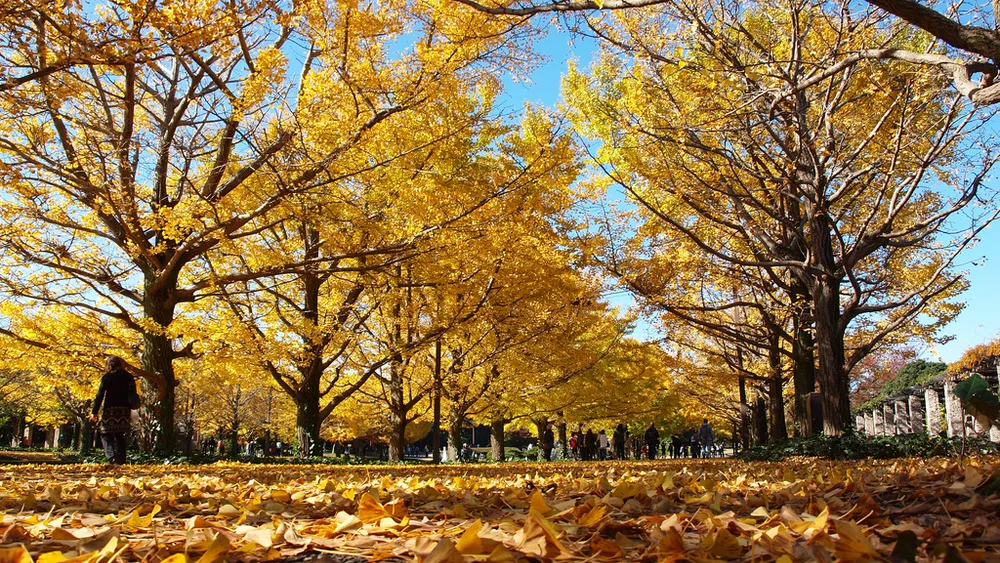
Choose an entrance for the Canal, Katarai Ginkgo Avenue, or Japanese Garden. Plan access from Nishi-Tachikawa, bicycle rental, the Park Train, children’s facilities, and separate daytime and 2026 evening visits.
Which ginkgo avenue first? The Canal and Katarai peak at different times
The Canal lies just beyond Tachikawa Gate. Its central water channel is about 200 meters long, with 106 ginkgo trees on the two sides. Their crowns are clipped into neat rectangular forms, so the channel, fountains, and tree rows form an ordered composition. The official facilities page explains that height restrictions associated with the nearby airfield led to this pruning style. Compare foreground and background from both ends of the channel.
Katarai Ginkgo Avenue is about 300 meters long, with naturally spreading trees and an undulating path. It is better than the Canal for photographs of someone walking through a tree tunnel. It remains a public route. Have companions organize their belongings at one side clear of the path, then move on after taking photographs. Waiting in smaller groups leaves more room than lining the whole group across the avenue.
The park’s 2026 event information gives the Canal’s usual color period as early to mid-November and Katarai’s as mid- to late November. Early-November visitors can make the Canal their main view. In mid- or late November, compare that week’s photographs of both areas before choosing where to start. The flowers and plants page publishes photographs and plant reports by location. Check capture dates and area names rather than assuming both avenues are at the same stage because the homepage shows one golden ginkgo.
Give the Japanese Garden time beyond a photograph at the entrance
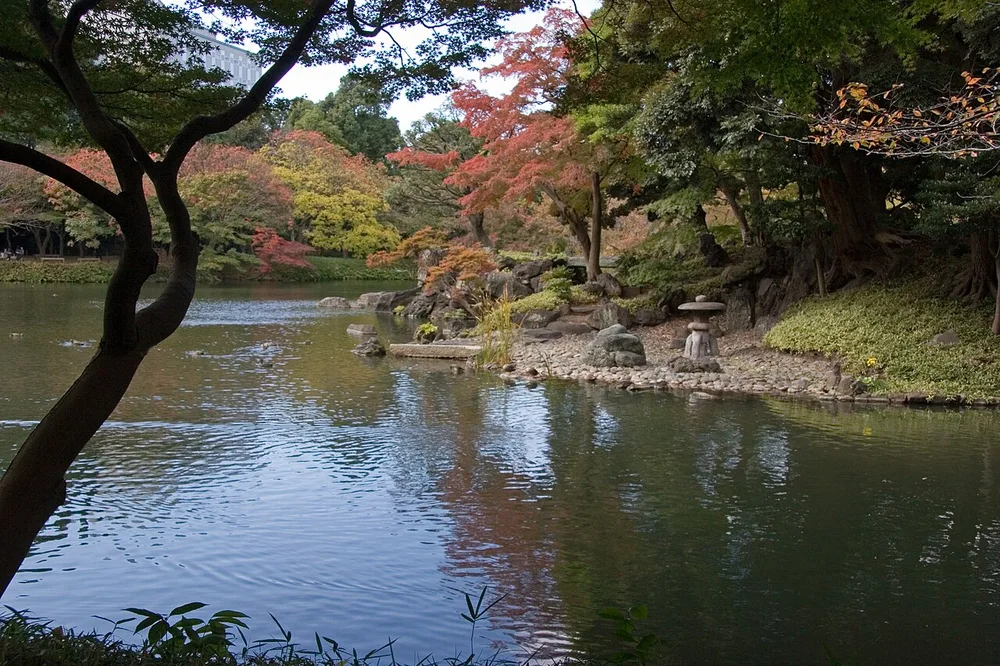
The Japanese Garden at Showa Kinen Park covers about six hectares and is designed for walking around a pond. Unlike the straight ginkgo avenues, its views change with turns, bridges, and the water’s edge. Walk a stretch before looking back at the trees across the pond. Include bridge crossings, small slopes, and pondside stops in your walking estimate.
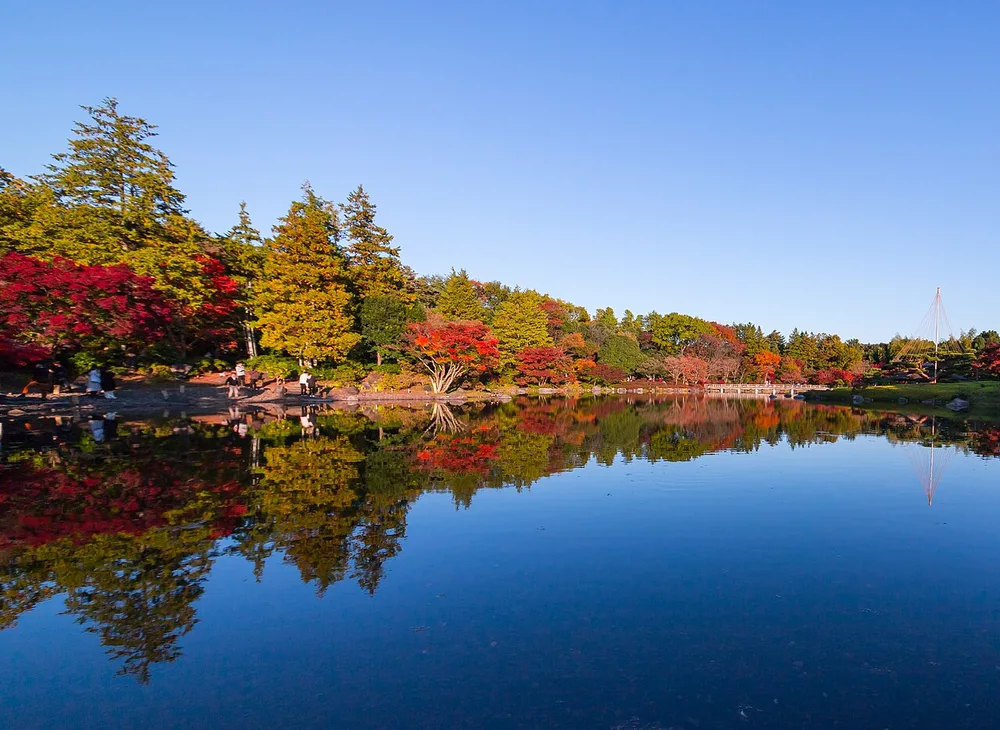
Maple varieties in the Japanese Garden usually turn from early to late November. The park’s plant page gives a wider observation period for maples across the park, extending into early December. In December, focus on the garden, flowering-tree area, or woods that still have color rather than walking to a bare avenue in search of a ginkgo tunnel. Identify the species worth seeing that week; this gives you more options than holding to one fixed “best autumn weekend.”
Pets, smoking, food and drink, picnic mats, and tents are prohibited in the garden. Drinking water to prevent heat illness is allowed under the park’s rules. Finish lunch before entering. If children need snacks while walking, take a break outside first.
For strollers, follow the accessibility signs on site. If some family members want to use stepping stones or small paths, arrange to meet farther along rather than requiring the whole group to follow the same narrow route.
Bonsai Garden and Kanfutei: spend more daytime in the same area
The Bonsai Garden is within the Japanese Garden and fits after a pond circuit. About 50 specimens are normally displayed. Look from roots to trunks and branches, comparing their scale with the full-size trees outside. With school-age children, make this a short observation activity: how does a miniature tree retain the shape of an old tree? There is no need to read out every variety.
For a seated tea break, go to Kanfutei on the pond’s west side. The official tea service page lists matcha with a fresh Japanese sweet for ¥900. Service runs from 10:30 a.m. to 12:30 p.m. and 1:00 to 4:00 p.m. from March to October; from November to February, the afternoon ends at 3:30 p.m. Orders close 30 minutes before each session ends, and may close earlier if the line is long. If you want tea during an autumn visit, enter the garden after lunch rather than arriving just before the evening lights. With about 20 seats, tea works best as an optional addition. If some want tea while others want more bonsai time, arrange to meet near the garden exit rather than having everyone wait at the teahouse for seats.
Station to paid entrance: Nishi-Tachikawa and Tachikawa are very different
For train travel with a short final walk, most autumn routes can start at Nishi-Tachikawa Station on the JR Ome Line. From its Park Exit, Nishi-Tachikawa Gate is about two minutes away. If you arrive at Tachikawa Station on the Chuo Line, transfer to the Ome Line as appropriate for your train. Check the departure board before choosing a platform; not every Chuo Line train stops at Nishi-Tachikawa. Store luggage before visiting. Pulling suitcases through the park is impractical.
When walking from central Tachikawa, distinguish Akebono Gate from the paid Tachikawa Gate. The official access page gives about ten minutes from JR Tachikawa Station’s North Exit to Akebono Gate, but about 18 minutes to Tachikawa Gate. The former enters the free Green Culture Zone, with more walking before the paid area. A navigation destination labeled simply “park entrance” can make the family expect ginkgo trees in another two minutes when they have only reached the park’s edge.
The official walk from Tachikawa-Kita Station’s Park Exit to Tachikawa Gate is about 16 minutes. Walking in makes sense if you stay north of Tachikawa and want breakfast in town before the Canal. From central Tokyo, with the Japanese Garden as your main destination, Nishi-Tachikawa saves walking. Record the station-to-gate times on the official access page separately from gate-to-sight times.
Other entrances: Sunagawa, Akishima, and Tamagawa-Josui
The official estimated walk from Sunagawa Gate to the Japanese Garden is about 15 minutes, shorter than from southern Tachikawa Gate. Drivers focusing on the northern garden and woods can compare Sunagawa Parking Lot. On the Seibu Haijima Line, Musashi-Sunagawa Station is about 20 minutes from Sunagawa Gate. A large railway detour from central Tokyo rarely pays off just to save ten or so minutes inside the park; it is more useful if you already stay along a Seibu line. Akishima Gate is about ten minutes from the North Exit of Higashi-Nakagami Station on the JR Ome Line and works for daytime walks in the west. Tamagawa-Josui Gate is about 25 minutes from Musashi-Sunagawa Station and suits plans already focused on the northern side. For a first visit to the three main autumn areas, Nishi-Tachikawa or Tachikawa is easier to navigate.
These gates are daytime options. In the 2026 evening event, only Nishi-Tachikawa and Tachikawa gates open for entry and exit. Sunagawa, Akishima, and Tamagawa-Josui cannot serve as evening exits. If you arrive from the north by day, move into the designated evening area during the afternoon. Anyone parked at Sunagawa must move the car first. Finding a path back to the parking lot on a map does not replace the evening access rules.
Gate to sight: limit walking by choosing one main area
The park’s facilities pages estimate one minute from Tachikawa Gate to the Canal, or 15 minutes from Nishi-Tachikawa; 23 minutes from Tachikawa to Katarai Ginkgo Avenue, or seven from Nishi-Tachikawa; and 25 minutes from Tachikawa to the Japanese Garden, or 20 from Nishi-Tachikawa. These estimates are most useful for comparing entrances. Autumn viewing includes photo stops, restrooms, and breaks. Adding the figures directly into a full-day timetable leaves too little time to stay.
The evening event gives separate distances along designated routes: about 1,600 meters from Nishi-Tachikawa Gate to the Japanese Garden, or 2,800 from Tachikawa; about 730 meters and 2,000 meters respectively to Katarai. Follow the open evening route. A daytime facilities estimate of “20 minutes on foot” is not a sound basis for calculating your latest arrival. There are two more stages from platform to gate and from ticket check to venue. Arrive earlier if you want a full garden visit.
For two main areas, different entry and exit gates can reduce retracing. Enter at Tachikawa, see the Canal, continue to Katarai, then leave through Nishi-Tachikawa. For the Japanese Garden, a return route through Nishi-Tachikawa is easier to manage. Rental bikes must go back to the original rental center, so this one-way walking plan does not work unchanged.
Choose walking, a rental bike, or the Park Train as your main way around
Walking is simplest for autumn photography: you can stop beneath trees without returning to a bicycle parking area. A rental bike helps more if your plans include the southern Canal, central lawn, and northern garden, and everyone can ride confidently. Use designated cycle routes, park in a designated area near the sight, then walk in. Two points may look connected on a tourist map, but a walking path is not a cycling shortcut.
The official bicycle rental page lists rental centers at Tachikawa, Nishi-Tachikawa, and Sunagawa gates. A standard bicycle costs ¥600 for three hours for adults, or ¥350 for junior-high students and younger. Each additional 30 minutes costs ¥100 for adults or ¥50 for children. Other bicycle types have different prices.
Return the bike to the same center. Rentals stop one hour before closing, and returns are due 30 minutes before closing. Three hours can pass quickly with frequent autumn stops. Decide where you will spend a long time before judging whether a rental for the whole visit is worthwhile.
The park prohibits riding while holding or carrying a child on your back. Adult and child helmets are available in limited numbers. If a child cannot ride independently, choose according to the available bicycle types and passenger conditions, or walk with a stroller. Fallen leaves and standing water make cycle routes slippery after rain. Even confident riders should slow before turns rather than brake suddenly when people stop ahead. Bikes with training wheels, balance bikes, and tricycles are prohibited on the dedicated cycle paths. For children still learning, prioritize walking routes and play areas.
Check the daytime Park Train route before relying on it
The official Park Train page says a circuit takes about 50–60 minutes, with routes varying by date. It turns a long transfer into a seated view of the park, but you should not plan adjacent sights on the assumption that the next train will arrive in ten minutes. Read the day’s route at the entrance and stops before deciding where to get off. Same-day changes appear in the website’s current opening information.
A single ride costs ¥400 for adults and ¥200 for children aged four through junior high. One circuit from your boarding stop counts as one ride; getting off and boarding again requires another ticket. Buy from the crew when the train arrives. The daytime page lists cash payment. Day passes cost ¥600 for adults, ¥600 for children aged four through junior high, and ¥500 for visitors aged 65 and over. They may be suspended even on weekdays during the busy autumn season, so check that day’s sales list. For two adults and one elementary-school child taking two rides each, single tickets total ¥2,000. Weigh that cost against the walking saved.
Strollers normally need to be folded. Each train has space for just one passenger to remain in a wheelchair; other wheelchair users depend on on-site assistance and seating arrangements. If your group needs that space, treat the wait as a proper break rather than booking a tight connection at the next stop. A day pass does not give boarding priority, and trains may fill at busy times.
With children, visit Children’s Forest while energy is high
Children’s Forest (Kodomo no Mori) is about 35 minutes on foot from Tachikawa Gate, 25 from Nishi-Tachikawa, and 23 from Sunagawa. Getting there is an outing in itself. Young children may have passed their best energy level by the time they have walked both ginkgo avenues, toured the garden, and eaten lunch. For a child-focused day, go straight to the play area in the morning, rest at midday, and see one ginkgo avenue on the way back. Adults seeking empty landscape photographs can split their time.
The Sea of Clouds bouncing dome is for junior-high students and younger. High-school students and adults may only go on it as guardians accompanying small children. Remove shoes and do not take cameras, bags, or protruding objects onto it. Chasing, somersaults, and dangerous jumps are prohibited. It closes when slippery in rain, and dew or ice can delay opening in autumn and winter. If it is closed in the morning, visit another area rather than waiting beside it.
Children’s Forest normally closes 30 minutes before the park, and the Sea of Clouds another 15 minutes earlier. The evening extension applies to selected viewing areas; a 9:00 p.m. park closing does not mean play equipment stays open until night. Mori no Ie in the area has staff, first aid, and facilities for infants. Named buildings make better meeting points than “under a tree when you finish playing.”
Lawns and strollers: avoid crossing half the park for more play equipment
Minna no Harappa, the central lawn, covers about 11 hectares, around 400 meters north to south and 300 east to west. Make it your main stop for running, a picnic, or a stroller nap. The lawn is large, so choose a place near your planned return route. Crossing it to reach another distant patch of shade means walking back again after the nap.
Wanpaku Playground is a smaller option with equipment grouped together, useful for families not going as far as Children’s Forest. Add it according to opening conditions and the children’s needs rather than simply because the map has a playground symbol. Completing foliage viewing, lunch, and a nap on one side is more useful for a stroller visit than collecting every play area.
The park’s family information lists seven infant rest facilities: Tachikawa Gate, Nishi-Tachikawa Gate, Mori no Ie, the Central Lawn Management Building, Komorebi no Sato, the General Information Center, and the Flower and Greenery Culture Center. Mark just two along your route when entering. Allow time for feeding and diaper changes rather than searching from the far side of an attraction once a child is uncomfortable.
Free strollers are lent at gates on a first-come basis and must return to the original location. Borrowing one adds a return trip to a “Tachikawa in, Nishi-Tachikawa out” plan. Bringing your own makes it easier to change exits. Infant rooms have hot water for formula but no microwave for baby food. Bring food that needs no heating and handle the child’s meal separately from the adults’ restaurant plans.
Lunch location affects how much walking remains possible
Eat a packed lunch in an area where picnics are allowed, and take your trash away. Restaurants and cafés prohibit outside food. The Japanese Garden is also unsuitable for lunch while viewing maples. From Nishi-Tachikawa, Lake Side Rest House beside Waterfowl Pond is an indoor rest area where you may bring food and drink. Unlike ordinary restaurants that prohibit outside food, it accommodates packed meals; still leave aisles clear for others. To buy food, choose nearby outlets such as Fureai Hiroba Restaurant or Keiryu Hiroba Restaurant, or find a closer shop through the park’s food directory. Check each outlet’s menu, opening days, and service end time. Daytime meals and special evening sales are separate arrangements. Do not take the whole family across the park for a set meal seen only on an old poster.
A difficult pattern is walking all morning to the Japanese Garden, returning south for a late lunch, then heading north again for the lights. Eat near midday before entering the garden, or bring lunch and rest on an approved lawn before continuing. Autumn daylight is short. Starting the lunch search in the afternoon often squeezes bike returns and the garden’s 4:00 p.m. clearance.
Three daytime routes, adjusted to your purpose
For a ginkgo-focused half day, enter at Nishi-Tachikawa, walk Katarai Ginkgo Avenue, and rest on the central lawn. Add the Canal only if time remains, then leave through Tachikawa. This ends near restaurants in central Tachikawa, but the later stages take you progressively farther from your original gate. If companions need a rest, return to Nishi-Tachikawa rather than pushing on merely to use a different exit.
For a garden-focused visit, enter at Nishi-Tachikawa, eat or have a quick snack, then go to the Japanese Garden. Spend time by the pond, in the Bonsai Garden, and at Kanfutei according to your interests, returning via Katarai to Nishi-Tachikawa. With only a few daytime hours, save the Canal for another visit. Slow garden walking deserves its own time. If the Canal is already more golden in early November, focus instead on Tachikawa Gate and the Canal, keeping only a short garden section.
For a full family day, enter at Nishi-Tachikawa in the morning and go first to Children’s Forest. Rest around lunch near your return direction, then choose either the central lawn or one ginkgo avenue in the afternoon. If the children want more play after a nap, extend playground time and drop the garden. If autumn leaves are the adults’ priority, use the afternoon for the garden and return to town early for dinner.
2026 Autumn Night Walk: dates, ticket types, and children’s prices
The 2026 Autumn Night Walk runs from October 29 to November 29. Lights are on from 4:30 to 8:30 p.m., and the park closes at 9:00 p.m. Park ticket sales end at 8:15 p.m., with last admission at 8:30 p.m. That is also when the lights finish, so arrive earlier to see them. The current park event announcement adds free evening Japanese Garden viewing on October 31: for October 29–31, no extra garden viewing ticket is needed, but park admission still applies. The Parks Foundation’s October 10 announcement also states this addition, which you can include when choosing a date and budget.
General park admission is ¥450 for high-school students and older, ¥210 for visitors aged 65 and over, and free for junior-high students and younger. Only park admission is needed for the Canal and Katarai lights. On other paid evening dates, the Japanese Garden needs an additional viewing ticket. Online garden tickets cost ¥1,200 for adults and visitors aged 65 and over, or ¥600 for elementary- and junior-high students. On-site prices are ¥1,300 and ¥700 respectively. Preschool children need no garden viewing ticket.
Two adults and one elementary-school child pay ¥3,800 with two adult admission-and-garden packages at ¥1,600 each plus a ¥600 child garden ticket. Viewing only the two ginkgo avenues costs a total of ¥900 in park admission.
The online park-and-garden package for visitors aged 65 and over is ¥1,410. If you already have park admission or qualify for free entry, buy only the garden ticket you need. Garden evening tickets have no additional disability-certificate or annual-pass discount. Online sales run from one week before the visit through the day itself. If sold out, no on-site tickets are available. Same-day on-site sales are at Komorebi no Ie from 4:00 to 8:00 p.m., cash-only. Budget separately for high-school students and older, elementary- and junior-high students, and preschool children rather than assuming one family ticket.
Staying into the evening: handle garden clearance and bikes before 4:00 p.m.
Daytime Japanese Garden entry requires only park admission. For the evening, everyone must still leave the garden by 4:00 p.m. before it reopens at 4:30 p.m. Finish your afternoon circuit with time to walk out and organize your belongings. If you have an evening ticket, save the QR code offline rather than searching email in a weak signal area at the entrance. The park also accepts printed QR codes.
Cars staying for the evening must be parked at Nishi-Tachikawa or Tachikawa Parking Lot by 4:30 p.m. Move bicycles brought into the park to designated temporary parking before entering the evening area. Return rentals according to that day’s center instructions. Cycle paths are closed at night, so you cannot ride straight from a daytime tour onto the illumination route. Decide this before renting if you plan to enter at Sunagawa in the morning and leave at Nishi-Tachikawa at night.
The night bus differs from the daytime Park Train. The 2026 notice lists service between Nagame no Terrace and the stop in front of the Japanese Garden. The first departure from the terrace is at 5:30 p.m.; the last from the garden is at 8:30 p.m. A single ride costs ¥400 for adults or ¥200 for elementary- and junior-high students, with supported cashless payment only. Strollers and wheelchairs must be folded, and passengers cannot get off between stops. The bus is not running when the lights first come on, so plan to walk if you want to reach the garden at 4:30 p.m.
Choosing night views: one ginkgo avenue can be a complete outing
For evening ginkgo alone, Katarai is closer to Nishi-Tachikawa Gate, and you can return through the same gate after one avenue. For water and symmetrical tree rows first, choose the Canal beside Tachikawa Gate. Seeing both plus the Japanese Garden makes a longer evening walk. Eat something before starting.
Food, drink, and pets are prohibited in the Japanese Garden at night. Tripods are allowed only in designated places; monopods are permitted. For reflections, stand clear of traffic and do not approach the water or leave the path for a composition. Stop to check camera settings rather than looking down while walking in darkness. With a phone, find firm footing first. If the picture is unclear, keep moving instead of turning a narrow bend into a long stop.
In 2026, evening food stalls are spread around the ginkgo areas, terrace, stream plaza, and Japanese Garden entrance. Hot food can restore energy. Finish before entering the garden, dispose of your trash properly, then present your ticket. The park’s 2020 night café video shows past ginkgo lighting and refreshment areas. Choose 2026 food from the stalls operating that evening. Walking slows after dark, so leave the sights earlier if you want a seated dinner back in central Tachikawa.
The park’s 2020 event footage shows past ginkgo illuminations and the night café area. For 2026 food information, see this section and the current official announcement.
Plan rain, cancellation, and the return journey before buying
The Autumn Night Walk operates in rain. Choosing not to attend because it rains does not automatically qualify for a refund. The official FAQ allows free cancellation of online tickets until the day before use; cancellation on the visit date costs 100% of the ticket price. Refunds under event-cancellation rules apply when the park suspends operation because of severe weather or natural disaster. If heavy rain is forecast all day, deciding the day before gives you more room than changing plans just before entry.
If you still want autumn viewing in rain, focus on one area near a gate and reduce retracing on slippery paths. Umbrellas, stroller rain covers, and cameras take space; put away unnecessary items before narrow garden sections. Cycling and the Sea of Clouds have their own wet-weather restrictions. An open park does not mean every facility is operating. With children, switch to a short ginkgo walk and an indoor break. You need not cover every venue just because the event goes ahead.
Choose your exit before checking trains. For Nishi-Tachikawa back to Tachikawa, check Ome Line destinations and departures. From Tachikawa Gate, there is still a walk to Tachikawa Station; allow extra time from gate to platform. If you stay away from the Chuo Line, include later transfers when planning dinner and bedtime.
Low admission does not cover a full day’s transport and food
Basic daytime admission for two adults is ¥900, with no extra park admission for children through junior high. Bicycle rentals, the Park Train, tea, and meals can substantially change the total. Choose walking or paid transport first, then decide on the evening. A common half-day ginkgo walk needs only admission and some food budget. A slow Japanese Garden visit does not require an evening ticket.
If you stay in Tachikawa and definitely plan two consecutive park days, compare the two-day pass: ¥500 for general adults or ¥250 for visitors aged 65 and over. It is for the same person using the same park on consecutive days, and may not be sold when the second day is a closure or free-entry day. It can separate a children’s play day from an adults’ garden day, but does not include evening Japanese Garden viewing. For same-day reentry, ask gate staff for a reentry ticket when leaving and return through a gate open at that time.
Parking for a standard car costs ¥900 per day, plus individual admission. Parking is limited to park hours; cars cannot stay overnight. For the autumn evening event, choose your parking lot and exit together. Drivers at Sunagawa by day especially need to move their cars early. For a single park day, a return train trip from your existing accommodation is usually enough. Compare Tachikawa accommodation and a two-day visit if you also have activities in the Tama area the next day.
A few useful answers
Which Showa Kinen Park gate should I use to see fall foliage during the day?
Use Tachikawa Gate for the Canal, about a minute’s walk inside. From Nishi-Tachikawa Gate, it’s about seven minutes to Katarai Ginkgo Avenue or 20 to the Japanese Garden. The gate is about a two-minute walk from the Park Exit at JR Nishi-Tachikawa Station.
When do the ginkgo and maple leaves change color in Showa Kinen Park?
The Canal ginkgos usually turn yellow from early to mid-November. Katarai Ginkgo Avenue tends to turn from mid- to late November, while the maples in the Japanese Garden change gradually from early to late November.
How should I plan a day at Showa Kinen Park with young kids?
Enter at Nishi-Tachikawa Gate in the morning and walk about 25 minutes to the Children’s Forest so the kids can play while they’re fresh. Take a midday break near your route back. For the afternoon, pick the central lawn or a walk along one of the ginkgo avenues.
Do I need an extra ticket for the 2026 fall illuminations at Showa Kinen Park?
Park admission covers the Canal and Katarai Ginkgo Avenue lights. The event runs October 29 to November 29, with no extra charge for the Japanese Garden October 29–31. Other nights require a garden ticket, priced online at ¥1,200 for adults and ¥600 for elementary and middle school students.
Official information and references
Sources used in this guide.
- Showa Kinen Park | Current autumn evening event notice
- Parks Foundation | 2026 autumn evening event and October 31 addition
- Showa Kinen Park | Evening event tickets and FAQ
- Showa Kinen Park | Access and entrances
- Showa Kinen Park | Fees
- Showa Kinen Park | Canal
- Showa Kinen Park | Katarai Ginkgo Avenue
- Showa Kinen Park | Japanese Garden
- Showa Kinen Park | Bonsai Garden
- Showa Kinen Park | Tea service
- Showa Kinen Park | Bicycle rental
- Showa Kinen Park | Park Train
- Showa Kinen Park | Children’s Forest
- Showa Kinen Park | Family facilities
- Showa Kinen Park | Minna no Harappa
- Showa Kinen Park | Wanpaku Playground
- Showa Kinen Park | Flowers and plants
- Showa Kinen Park | Lake Side Rest House
- Showa Kinen Park | Food directory
- Showa Kinen Park | FAQ and outside-food rules
- Official Asoview ticketing | Garden viewing tickets and cancellation policy
- Showa Kinen Park | Opening hours and calendar