Choose an entrance for the Canal, Katarai Ginkgo Avenue or Japanese Garden, with access from Nishi-Tachikawa, cycle hire, park transport, family facilities and 2026 evening ticket options.
- Region & Focus
- TokyoAutumn leaves
- Reading Scope
- 30 min read · 18 chapters · 4 Q&As
- Official Verification
- 22 official sources checkedUpdated 22 November 2026
- Key Topics
- SeasonsItinerariesRail travel
Chapter Route Map (tap any stop)
- Choose ginkgo, gardens or playtime before deciding how far to walk
- Which ginkgo avenue first? The Canal and Katarai peak at different times
- Give the Japanese Garden time beyond its entrance
- The Bonsai Garden and Kanfutei: allow more daylight in this area
- Station to paid entrance: Nishi-Tachikawa and Tachikawa differ considerably
- Other entrances: Sunagawa, Akishima and Tamagawa-Josui
- How far beyond the gate? Keep one area as your main focus
- Choose walking, cycling or the Park Train as your main transport
- The daytime Park Train is not an on-demand shuttle
- With children, visit Children’s Forest while energy is high
- Lawns and pushchairs: you need not cross half the park for play equipment
- Lunch location affects how far you can walk afterwards
- Three daytime routes to suit your priorities
- 2026 evening dates, ticket types and children’s charges
- Staying from day to evening: handle the garden and cycles before 16:00
- Choosing evening views: one ginkgo avenue can be a complete outing
- Plan rain, cancellations and the journey home before buying
- Low admission does not cover a full day’s transport and food
- Quick Q&A
For autumn colour at Showa Kinen Park, choosing your entrance is more useful than starting with a long list of sights. The Canal is beside Tachikawa Gate, Katarai Ginkgo Avenue is nearer Nishi-Tachikawa, and the Japanese Garden lies further inside. With children, allow time for playgrounds, lunch and naps. The 2026 Autumn Night Walk runs from 29 October to 29 November, with separate rules for evening entrances, garden tickets and transport. Plan daylight and evening as two parts of the day.
Choose ginkgo, gardens or playtime before deciding how far to walk
Showa Kinen Park’s autumn sights occupy several areas a substantial walk apart. The Canal beside Tachikawa Gate offers waterways and neatly clipped ginkgo trees. Katarai Ginkgo Avenue to the west lets you walk under a long canopy, while the Japanese Garden calls for a slower pondside walk among maples. With young children or older companions, choose one priority area and one nearby stop.
With only two or three afternoon hours, entering and leaving at Nishi-Tachikawa, walking Katarai Ginkgo Avenue and adding the Japanese Garden if energy allows is more direct than crossing the entire park. For water, fountains and symmetrical compositions, start at Tachikawa Gate and focus on the Canal. If children mainly want play equipment, make Children’s Forest the destination and see leaves along the way. Two adults can take turns supervising play and walking, instead of rushing the whole family between photo spots. The areas available on an ordinary autumn afternoon differ from those open during the evening event. Northern entrances, cycle paths and family facilities do not all stay open. Before entering, decide your evening exit and how you will handle hired cycles, your car and pushchair. That may change your daytime entrance choice.
Normal daytime hours are 09:30–17:00 in October and 09:30–16:30 from November to February. During the evening event, extended opening depends on the date. Use normal hours to plan departure and lunch, then check your date on the opening calendar. Playgrounds, tea service, cycle hire and food outlets close earlier on their own schedules. The 21:00 evening closure is useful only for planning departure after the lights.
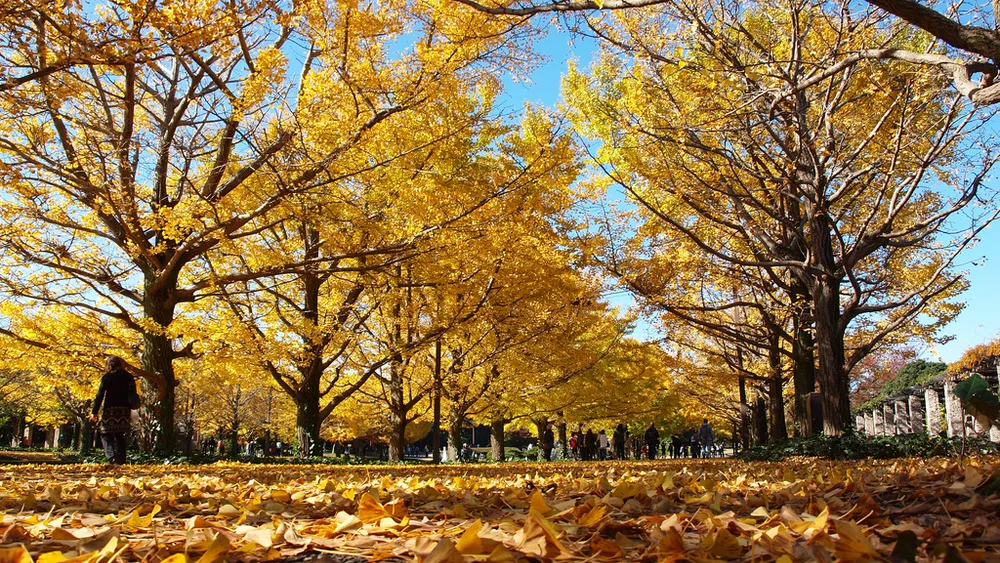
Choose an entrance for the Canal, Katarai Ginkgo Avenue or Japanese Garden, with access from Nishi-Tachikawa, cycle hire, park transport, family facilities and 2026 evening ticket options.
Which ginkgo avenue first? The Canal and Katarai peak at different times
The Canal is just beyond Tachikawa Gate. Its central waterway is about 200 metres long, with 106 ginkgo trees along its sides. The crowns are clipped into neat squares, bringing water, fountains and rows of trees into one composition. The official facilities page explains that height restrictions associated with the nearby airfield led to this pruning style. Compare foreground and background from both ends of the waterway.
Katarai Ginkgo Avenue is about 300 metres long, with naturally spreading trees and an undulating path. It is the better choice for a photograph of someone walking beneath a leafy tunnel. The avenue is still a shared route. Organise belongings to one side, clear of others, then move on after taking your photograph. Several people waiting apart leave more room than a whole group lined across the path.
The operator’s 2026 event information gives the Canal’s usual colour period as early to mid-November, and Katarai’s as mid- to late November. Early-November visitors can make the Canal their main view. In mid- or late November, compare that week’s photographs from both areas before choosing the order. The official flowers and plants page posts photographs and flower bulletins by location. Check the date and area rather than assuming one golden ginkgo image on the homepage represents both avenues on the same day.
Give the Japanese Garden time beyond its entrance
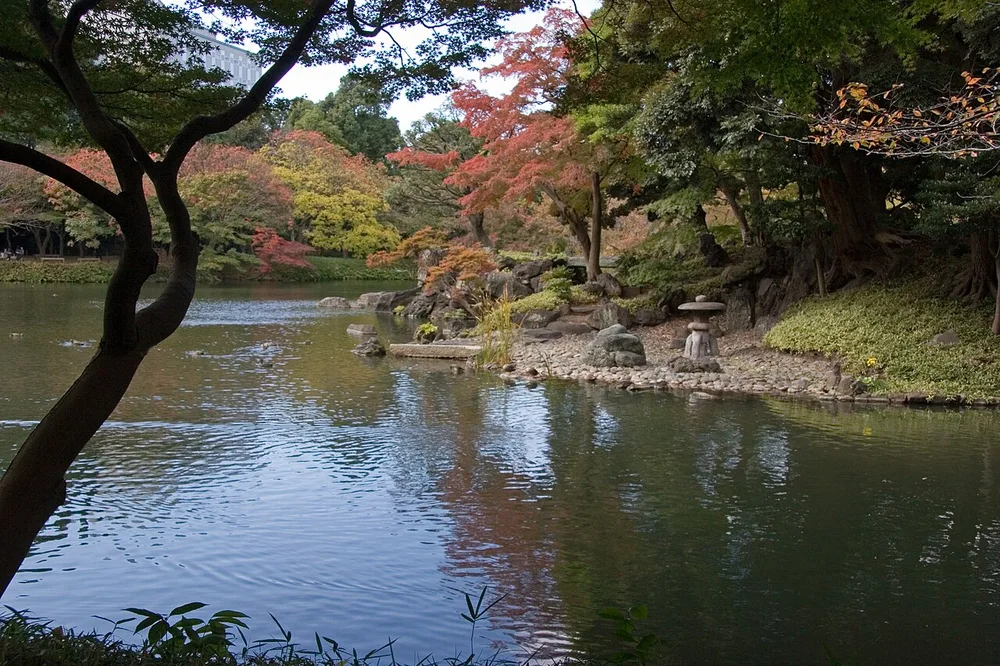
The Japanese Garden at Showa Kinen Park covers about six hectares and follows a pond circuit. Unlike the straight ginkgo avenues, views change with bends, bridges and the shoreline. Walk part of the circuit before looking back at colour across the water. Include bridges, small slopes and pondside stops in your walking estimate.
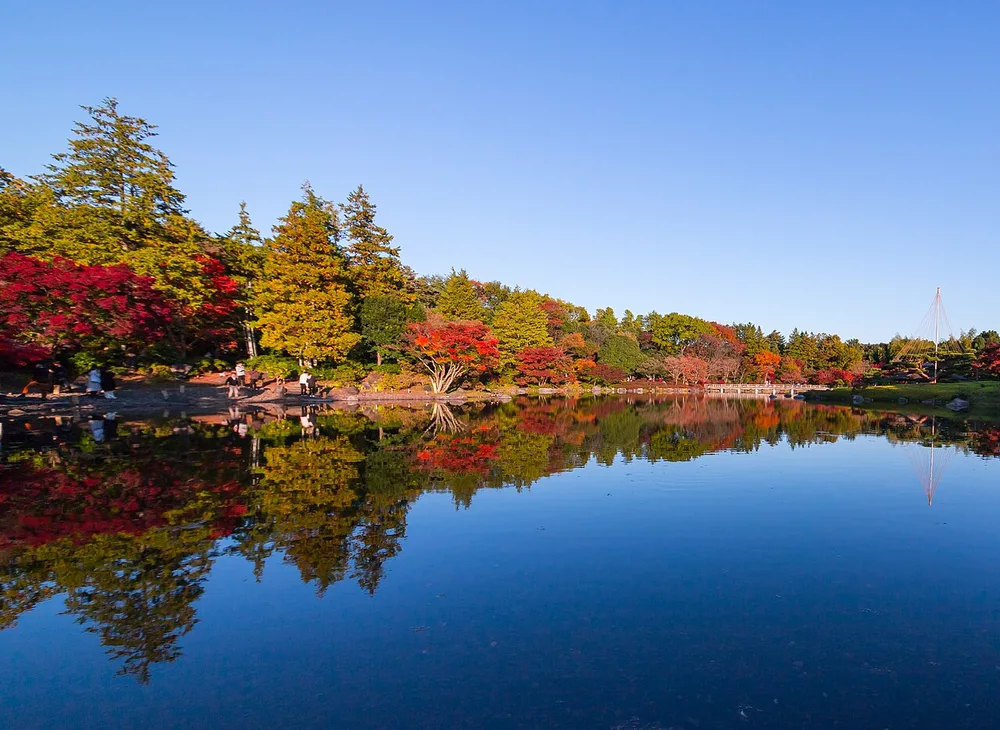
Maples in the Japanese Garden usually change colour progressively from early to late November. The official plant page extends the park-wide maple observation period into early December. In December, focus on the garden, Flowering Tree Garden or woods where colour remains, rather than walking to a bare avenue in pursuit of a ginkgo tunnel. Finding out which trees are worth seeing that week gives you more choices than sticking to a fixed ‘best autumn weekend’.
Pets, smoking, food and drink, picnic sheets and tents are prohibited in the garden. Drinking water to prevent heat illness is allowed under the park’s rules. Finish lunch before entering. If children need snacks as they walk, take a break outside first.
With a pushchair, follow the accessibility signs on site. If some relatives want to take stepping stones or smaller paths, meet again at agreed points rather than making everyone follow the same narrow route.
The Bonsai Garden and Kanfutei: allow more daylight in this area
The Bonsai Garden is within the Japanese Garden and fits naturally after a pond walk. Around 50 specimens are normally displayed. Look from roots to trunks and branches, comparing their scale with the full-sized garden trees. For school-age children, make this a short observation exercise: how do the branches and trunk of a small tree retain the form of an old one? There is no need to read out every variety.
For seated tea, head to Kanfutei on the west side of the pond. The official tea-service page lists matcha with a fresh Japanese sweet for ¥900. From March to October, service runs 10:30–12:30 and 13:00–16:00. From November to February, afternoon service ends at 15:30. The tea service stops accepting visitors 30 minutes before each session ends, or earlier when queues are long. If tea is part of your autumn visit, enter the garden after lunch rather than arriving just before the evening lights. With about 20 seats, treat tea as an optional addition. If some companions want tea and others prefer more bonsai, arrange to meet near the garden exit instead of waiting together by the door for seats.
Station to paid entrance: Nishi-Tachikawa and Tachikawa differ considerably
For less walking before the gate, most autumn routes can start at Nishi-Tachikawa Station on the JR Ome Line. From its Park Exit, Nishi-Tachikawa Gate is about two minutes away. If arriving at Tachikawa Station on the Chuo Line, change to an Ome Line train as appropriate. Check the departure boards before choosing a platform; not every Chuo Line train stops at Nishi-Tachikawa. Store luggage before visiting. Wheeling a suitcase around the park is impractical.
Walking from central Tachikawa requires a distinction between Akebono Entrance and the paid Tachikawa Gate. The official access page gives about ten minutes from JR Tachikawa Station’s North Exit to Akebono, but about 18 minutes to Tachikawa Gate. Akebono first leads into the free Green Culture Zone, with more walking before the paid area. A navigation pin labelled only ‘park entrance’ can make a family expect the ginkgo trees in another two minutes when they have merely reached the park’s edge.
From the Park Exit of Tachikawa-Kita Station, the official estimate to Tachikawa Gate is about 16 minutes. Walking makes sense if you are staying north of Tachikawa and want breakfast in town before the Canal. From central Tokyo, with the Japanese Garden as your main goal, Nishi-Tachikawa saves some walking. Record the official access page’s station-to-gate times separately from the gate-to-attraction times.
Other entrances: Sunagawa, Akishima and Tamagawa-Josui
The official walk from Sunagawa Gate to the Japanese Garden is about 15 minutes, shorter than from Tachikawa Gate to the south. Drivers visiting only the northern garden and woods can compare Sunagawa car park. On the Seibu Haijima Line, Musashi-Sunagawa Station is about 20 minutes from Sunagawa Gate. A long railway detour from central Tokyo rarely makes sense just to save a little over ten minutes inside the park, but it is worth comparing if you already stay on a Seibu line. Akishima Gate is about ten minutes from the North Exit of Higashi-Nakagami Station on the JR Ome Line and suits a daytime walk in the west. Tamagawa-Josui Gate is about 25 minutes on foot from Musashi-Sunagawa Station and suits plans already centred on the north. For a first visit to the three best-known autumn areas, Nishi-Tachikawa or Tachikawa is easier to navigate.
These entrances are useful by day. For the 2026 evening event, only Nishi-Tachikawa and Tachikawa gates are open for entry and exit. Sunagawa, Akishima, Tamagawa-Josui and other gates cannot be evening exits. If you arrive from the north by day, move into the designated evening area during the afternoon. Drivers parked at Sunagawa must move their cars first. A route back to the car park on a map does not override the evening opening rules.
How far beyond the gate? Keep one area as your main focus
Official facility pages estimate one minute from Tachikawa Gate to the Canal and 15 minutes from Nishi-Tachikawa Gate. For Katarai Ginkgo Avenue, the estimates are 23 minutes and seven minutes respectively; for the Japanese Garden, 25 minutes and 20 minutes. These gate-to-facility estimates are most useful for comparing entrances. Autumn walks include photographs, toilet stops and rests. Adding the figures together as a complete day’s duration leaves too little time to stay anywhere.
The evening event gives separate distances for its designated routes. Nishi-Tachikawa Gate to the Japanese Garden is about 1,600 metres, compared with 2,800 metres from Tachikawa Gate. To Katarai, the distances are about 730 and 2,000 metres. You must follow the open evening route, so do not use a daytime ‘20-minute walk’ to work backwards from last admission. There are two more stages: platform to gate, then ticket check to venue. Arrive earlier if you want a full garden visit.
For two main sights, different entry and exit gates can reduce retracing. Enter at Tachikawa, see the Canal, continue to Katarai and leave at Nishi-Tachikawa. For the Japanese Garden, entering and leaving through Nishi-Tachikawa makes the route easier to manage. Hired cycles must go back to their original hire centre, so this one-way walking plan does not transfer to cycling.
Choose walking, cycling or the Park Train as your main transport
Walking is simplest for autumn photography. You can stop beneath trees without returning to a cycle parking area. Cycle hire becomes more useful if your goals include the southern Canal, central lawn and northern garden, and everyone can ride confidently. Use designated cycle routes, park in the approved areas near sights, then walk in. Even if two places look connected on a tourist map, walking paths are not cycle shortcuts.
The official cycle-hire page lists centres at Tachikawa, Nishi-Tachikawa and Sunagawa gates. A standard adult cycle costs ¥600 for three hours, or ¥350 for children of junior-high-school age and younger. Each extra 30 minutes costs ¥100 for adults and ¥50 for children. Other cycle types have different prices.
Return cycles to the same centre. Hire ends one hour before closing, and returns are due 30 minutes before closing. Frequent stops for autumn leaves can quickly use three hours. Decide where you want a long stay before judging whether hiring for the whole period is worthwhile.
Riding while holding a child or carrying one on your back breaches the park’s rules. Adult and child helmets are available in limited numbers. If children cannot ride independently, choose from the actual hire types and passenger conditions on site, or walk with a pushchair. Leaves and puddles can make cycle paths slippery after rain. Even experienced adults should slow down before bends rather than brake suddenly behind a group. Cycles with stabilisers, balance bikes and tricycles cannot use the cycle routes. For children still learning, focus on walking paths and play equipment.
The daytime Park Train is not an on-demand shuttle
The official Park Train page gives a circuit time of about 50–60 minutes, with routes varying by date. It turns a long transfer into a seated view of the park, but you cannot plan on the next service arriving in ten minutes. Check the day’s route at the entrance and stops before choosing where to alight. Short-notice changes appear under the website’s opening information for today.
A single ride costs ¥400 for adults and ¥200 for children aged four through junior-high-school age. One circuit from your boarding stop counts as one ride. If you get off and board again, you need another ticket. Buy from the crew when the train arrives; the daytime page specifies cash. Day passes cost ¥600 for adults, ¥600 for children aged four through junior-high-school age, and ¥500 for those aged 65 and over. During busy autumn periods they may be suspended even on weekdays, so check that day’s sales table. Two adults and one primary-school child taking two separate rides each would spend ¥2,000. Weigh that against the walking saved.
Pushchairs normally need folding. Only one person per train can board while remaining in a wheelchair; other wheelchair arrangements depend on staff assistance and seats on site. If someone needs that space, treat the wait as a proper rest and avoid a tightly timed activity at the next stop. A day pass does not provide priority boarding, and trains can fill at peak times.
With children, visit Children’s Forest while energy is high
Children’s Forest, Kodomo no Mori, is about 35 minutes from Tachikawa Gate, 25 minutes from Nishi-Tachikawa and 23 minutes from Sunagawa. Reaching it is an activity in itself. Young children may have used their best energy if they first walk both ginkgo avenues, the garden and a lunch stop. For a child-centred day, go straight to the play area in the morning, rest at midday and see one ginkgo stretch on the return. Adults who want empty landscape photographs can take separate turns.
The Sea of Clouds, Kumo no Umi bouncing dome, is for children of junior-high-school age and younger. Older visitors cannot play on it, except guardians accompanying young children. Remove shoes and leave cameras, bags and objects with protruding parts off the dome. Chasing, somersaults and dangerous jumps are prohibited. It closes when wet in rain, and autumn or winter dew and ice can delay opening. If you see a closure sign in the morning, visit another area instead of waiting beside it.
Children’s Forest normally closes 30 minutes before park closing, with the Sea of Clouds closing another 15 minutes earlier. The evening extension applies to specified viewing areas; a 21:00 park closure does not mean play equipment stays open at night. The Forest House, Mori no Ie, has staff, first aid and baby facilities. A named building makes a better meeting point than ‘under the tree when you finish playing’.
Lawns and pushchairs: you need not cross half the park for play equipment
The central Everyone’s Meadow, Minna no Harappa, covers about 11 hectares, roughly 400 metres north to south and 300 metres east to west. It can be the main stop for running, picnicking or a pushchair nap. The lawn is large, so choose a spot near your planned return direction. Crossing it for a distant patch of shade means walking back again after the nap.
A smaller option is Wanpaku play equipment, with facilities grouped together for families who do not plan to reach Children’s Forest. Add it according to that day’s opening and the children’s needs, rather than just because the map shows a playground symbol. With a pushchair, seeing leaves, eating and napping on one side of the park is more useful than collecting every play area.
The official family information lists seven baby rooms: Tachikawa Gate, Nishi-Tachikawa Gate, Forest House, the Harappa Central Management Building, Komorebi no Sato, the General Information Centre and the Flower and Greenery Culture Centre. Mark two you will pass when you enter. Allow time for feeds and nappy changes instead of searching from the far side of an attraction once a child is uncomfortable.
Pushchairs can be borrowed free at the gates on a first-come, first-served basis that day, and must be returned to the same place. Borrowing one adds a return journey to a plan that enters at Tachikawa and leaves at Nishi-Tachikawa. Your own pushchair makes changing exits easier. Baby rooms provide hot water for formula but no microwave for baby food. Bring food that needs no on-site heating, and plan that meal separately from the adults’ restaurant stop.
Lunch location affects how far you can walk afterwards
Eat packed lunches in areas where picnics are allowed and take rubbish away. Outside food cannot be eaten in restaurants or cafés. Nor is the Japanese Garden a place for lunch while admiring maples. If entering from Nishi-Tachikawa and wanting a waterside rest, Lake Side Rest House beside the Waterfowl Pond is an indoor rest area where you may bring food and drink. This differs from the restaurants’ outside-food restriction. Keep access clear for other visitors when choosing a seat. To buy food, choose nearby outlets such as Fureai Hiroba Restaurant or Keiryu Hiroba Restaurant, or use the official food directory to find a close kiosk. Check each outlet’s page for menus, opening days and when meals finish. Daytime meals and special evening sales operate separately. Do not lead the family across the park for a set meal seen only on an old poster.
A common mistake is walking all morning to the Japanese Garden, returning south for a late lunch, then going north again for the evening views. Eat as noon approaches before entering the garden, or bring lunch and rest on an approved lawn. Autumn daylight is short. Beginning the search for lunch in the afternoon can squeeze both cycle returns and the garden’s 16:00 clearance.
Three daytime routes to suit your priorities
For a ginkgo-focused half-day, enter at Nishi-Tachikawa, walk Katarai Ginkgo Avenue and rest by the central lawn. Add the Canal only if time remains, then leave at Tachikawa. You can eat in town afterwards, but the later part takes you progressively further from Nishi-Tachikawa. If companions need rest, return there instead of pushing on merely to use a different exit.
For a garden-focused visit, enter at Nishi-Tachikawa, eat or buy supplies, then head directly to the Japanese Garden. Choose your time around the pond, Bonsai Garden and Kanfutei according to your interests, then return via Katarai to Nishi-Tachikawa. With only a few daylight hours, save the Canal for another visit. Slow garden walking deserves its own time rather than a gap before rushing elsewhere. In early November, if the Canal is yellower, reverse the emphasis: use Tachikawa Gate and the Canal, with only a shorter garden visit.
For a full family day, enter at Nishi-Tachikawa in the morning and visit Children’s Forest first. Rest at midday towards your return route, then choose either Everyone’s Meadow or one ginkgo stretch in the afternoon. If the children still want to play after a nap, extend playtime and drop the garden. If adults most want maple colour, use the afternoon for the garden and return to town early for dinner.
2026 evening dates, ticket types and children’s charges
The 2026 Autumn Night Walk runs from 29 October to 29 November. Lighting is 16:30–20:30, with park closure at 21:00. Park admission sales finish at 20:15 and last entry is 20:30. As that is also when lighting ends, arrive earlier to see the views. Last admission is not a suitable target arrival. The current official event notice adds free evening viewing in the Japanese Garden on 31 October: no extra garden viewing ticket is needed on 29–31 October, although park admission still applies. This addition is also explicit in the Parks Foundation’s 10 October announcement, so include it when comparing dates and budgets.
Standard park admission is ¥450 for high-school-age visitors and above, ¥210 for those aged 65 and over, and free for junior-high-school-age children and younger. The Canal and Katarai lights need only park admission. On other chargeable evenings, entry to the Japanese Garden needs an additional viewing ticket. Online garden-only tickets cost ¥1,200 for adults, including those aged 65 and over, and ¥600 for primary- and junior-high-school pupils. On-site prices are ¥1,300 and ¥700 respectively. Preschool children need no garden viewing ticket.
For two adults and one primary-school child, two adult combined tickets at ¥1,600 each plus a ¥600 child’s garden ticket total ¥3,800. Viewing only the two ginkgo avenues costs a total of ¥900 in park admission.
The online combined park-and-garden ticket for those aged 65 and over costs ¥1,410. If you already have park admission or qualify for free park entry, buy only the garden ticket needed. Evening garden tickets have no additional disability-certificate or annual-pass discount. Online sales run from one week before the visit through the visit date. If they sell out, no on-site tickets remain. Same-day on-site sales are cash-only at Komorebi no Ie, 16:00–20:00. Divide the family into high-school age and above, primary and junior-high school, and preschool, rather than budgeting for an undefined ‘family ticket’.
Staying from day to evening: handle the garden and cycles before 16:00
By day, the Japanese Garden needs only park admission. For evening viewing, everyone must still leave the garden before 16:00 and wait until it reopens at 16:30. Finish your afternoon circuit with time to walk out and organise belongings. If you have an evening ticket, save the QR code for offline display instead of searching for the email with poor reception at the entrance. The operator also accepts printed QR codes.
Cars staying for the evening must be in Nishi-Tachikawa or Tachikawa car parks before 16:30. Move privately brought cycles to the designated temporary parking area before entering the evening zone. Return hired cycles according to that day’s hire-centre instructions. Cycle paths are closed at night; you cannot ride straight from a daytime tour onto the illumination route. Decide this before hiring if you intend to enter at Sunagawa in the morning and leave at Nishi-Tachikawa at night.
The evening bus differs from the daytime Park Train. The 2026 notice lists a service between the View Terrace and the Japanese Garden entrance, with the first departure from the terrace at 17:30 and the last from the garden at 20:30. Single fares are ¥400 for adults and ¥200 for primary- and junior-high-school pupils, payable only by supported cashless methods. Pushchairs and wheelchairs must be folded, and alighting between stops is prohibited. The bus has not started when the lights first come on. Walk if you want to reach the garden at 16:30.
Choosing evening views: one ginkgo avenue can be a complete outing
For illuminated ginkgo alone, Katarai is nearer Nishi-Tachikawa Gate. Walk the avenue and return through the same gate. For water and symmetrical rows first, choose the Canal beside Tachikawa Gate. Seeing both areas and the Japanese Garden is a longer evening walk, so eat something before setting off.
Food, drink and pets are prohibited in the Japanese Garden at night. Tripods may be used only in designated places; monopods are allowed. Stand clear of passing visitors to photograph reflections. Do not approach the water or leave the path to improve a composition. Stop walking before checking camera settings in the dark. With a phone, find firm footing first. If a photograph is blurred, move on rather than turning a narrow bend into a prolonged stop.
In 2026, evening food stalls are distributed around the ginkgo avenues, terrace, Keiryu Hiroba and Japanese Garden entrance. Hot food can restore energy. Finish it and deal with rubbish before the garden ticket check. The operator’s 2020 night-café video shows the earlier ginkgo lighting and refreshment areas; choose 2026 food from the stalls operating that evening. Movement slows after dark. If you want a seated dinner back in Tachikawa, leave the sights earlier.
The park’s footage of the 2020 event shows earlier ginkgo illuminations and night-café areas. For 2026 food, see this section and the current official notice.
Plan rain, cancellations and the journey home before buying
The evening event proceeds in rain, and choosing not to attend because of rain does not automatically produce a refund. The official FAQ allows free cancellation of online tickets until the day before use; cancellation on the day costs 100% of the ticket price. Refunds under the closure rules apply when the operator stops the event for severe weather or natural disaster. If heavy rain is forecast all day, decide the previous day rather than changing plans just before entering.
If you still want autumn leaves in rain, choose one area near a gate and reduce retracing on slippery paths. Umbrellas, pushchair rain covers and cameras take space. Put away unneeded items before narrow garden paths. Cycling and the Sea of Clouds have their own wet-weather closure conditions. An open park does not mean every facility operates normally. With children, choose a short ginkgo walk and an indoor rest; an event proceeding as scheduled does not require you to cover every venue.
Choose your exit before checking trains. From Nishi-Tachikawa to Tachikawa, check Ome Line destinations and departures. Leaving at Tachikawa Gate still means a walk back to Tachikawa Station; allow separately for gate to platform. If your accommodation is off the Chuo Line, include later changes when planning dinner and bedtime.
Low admission does not cover a full day’s transport and food
Basic daytime admission for two adults is ¥900, with no extra park ticket for children of junior-high-school age and younger. Cycles, the Park Train, tea and meals can change the total considerably. Choose walking or paid transport first, then decide whether to stay for the evening. A typical half-day ginkgo walk needs only admission and a food budget. A slow Japanese Garden visit does not necessarily need an evening ticket.
If staying in Tachikawa and definitely visiting on two consecutive days, compare the two-day pass: ¥500 for a standard adult or ¥250 for those aged 65 and over. It is for the same person at the same park on consecutive days. It may not be sold if the second day is a closure or free-admission day. It can separate a children’s play day from an adults’ garden day, but excludes evening Japanese Garden viewing. For same-day exit and re-entry, collect a re-entry ticket from gate staff when leaving and return through an entrance open at that time.
Parking for a standard car costs ¥900 per day, with individual park admission extra. Parking is limited to opening hours, and cars cannot remain overnight. For the evening event, choose your parking and exit together, especially if you need to move from Sunagawa earlier. If this is your only park day, a return train journey from your existing accommodation is usually enough. If you have more activities in Tama the next day, compare a Tachikawa stay and two consecutive park days.
A few useful answers
Which gate should I use for daytime autumn colour at Showa Kinen Park?
The Canal is about a minute’s walk from Tachikawa Gate. Use Nishi-Tachikawa Gate for Katarai Ginkgo Avenue or the Japanese Garden, about seven and 20 minutes away on foot respectively. The gate is about two minutes from the Park Exit at JR Nishi-Tachikawa station.
When is the best time to see the ginkgos and maples at Showa Kinen Park?
For yellow ginkgo leaves, aim for early to mid-November at the Canal and mid- to late November at Katarai Ginkgo Avenue. The maples in the Japanese Garden change colour at different times from early to late November.
How can I plan a day at Showa Kinen Park with young children?
Start at Nishi-Tachikawa Gate and walk about 25 minutes to the Children’s Forest, so the children can play while they still have plenty of energy. Take a break around midday near your route back, then choose between the central meadow and a stroll along one ginkgo avenue.
Is there a separate ticket for the 2026 autumn illuminations at Showa Kinen Park?
Park admission covers the Canal and Katarai Ginkgo Avenue lights. The event runs from 29 October to 29 November, with the Japanese Garden included on 29–31 October. Other evenings require a garden ticket, priced online at ¥1,200 for adults and ¥600 for primary and lower secondary pupils.
Official information and references
Sources used in this guide.
- Showa Kinen Park | Current autumn evening event notice
- Parks Foundation | 2026 autumn evening event and added 31 October opening
- Showa Kinen Park | Autumn Night Walk tickets and FAQs
- Showa Kinen Park | Access and entrances
- Showa Kinen Park | Charges
- Showa Kinen Park | Canal
- Showa Kinen Park | Katarai Ginkgo Avenue
- Showa Kinen Park | Japanese Garden
- Showa Kinen Park | Bonsai Garden
- Showa Kinen Park | Tea service
- Showa Kinen Park | Cycle hire
- Showa Kinen Park | Park Train
- Showa Kinen Park | Children’s Forest
- Showa Kinen Park | Family facilities
- Showa Kinen Park | Everyone’s Meadow
- Showa Kinen Park | Wanpaku play equipment
- Showa Kinen Park | Flowers and plants
- Showa Kinen Park | Lake Side Rest House
- Showa Kinen Park | Food directory
- Showa Kinen Park | FAQs and outside-food rules
- Official Asoview ticket outlet | Garden viewing tickets and cancellation policy
- Showa Kinen Park | Opening hours and calendar