Kiyosumi Garden is a 3-minute walk from Kiyosumi-shirakawa Station Exit A3, with ¥150 standard admission. Here is the 2026 foliage timeline, dated ticket rules, pond and stepping-stone routes, plus how to pair it with coffee, the Fukagawa Edo Museum, or MOT.
- Region & Focus
- TokyoFall foliage
- Reading Scope
- 15 min read · 10 chapters · 6 Q&As
- Official Verification
- 24 official sources checkedUpdated November 22, 2026
- Key Topics
- SeasonsItinerariesNeighborhoods
Chapter Route Map (tap any stop)
- Check Nakanoshima First for Autumn Color
- ¥150 Admission and How to Buy Dated Online Tickets
- How to Walk Oizumi Pond in One Hour
- Strollers & Wheelchairs: Stick to Paved Paths, Skip Stepping Stones in Rain
- When the Light Is Flat: Famous Stones and Waterfowl
- Half-Day Plan: Save Coffee for After the Garden
- Rainy Day Backup: Start at the Fukagawa Edo Museum
- Save the Afternoon for the Museum of Contemporary Art Tokyo (MOT)
- Evening Illuminations and the Nine-Gardens Stamp Rally Depend on Timing
- Beyond Peak Foliage: What to See Around the Pond Year-Round
- Quick Q&A
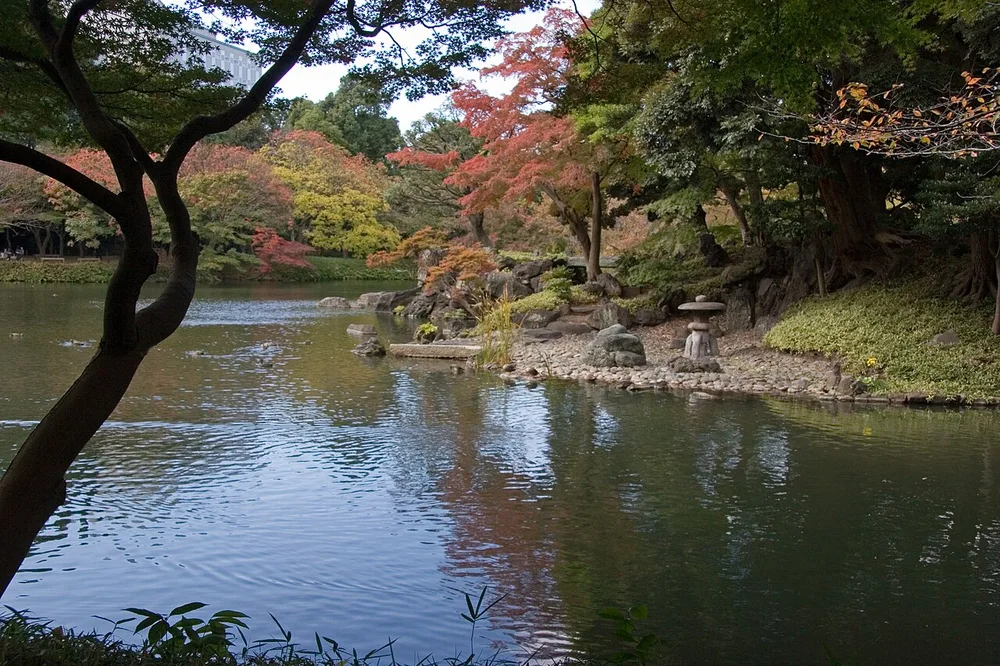
Kiyosumi Garden sits roughly a 3-minute walk from Kiyosumi-shirakawa Station Exit A3. Standard admission is ¥150, and a loop around the pond takes about 40 minutes, though budgeting a full hour gives you room to linger over reflections and spot famous garden stones. On November 19, 2026, the Tokyo Metropolitan Park Association listed the garden's wax trees as 'beginning to turn.' To frame the autumn colors on Nakanoshima island, walk along the edge of Oizumi Pond to see the full tree before deciding whether to cross the iso-watari stepping stones. With half a day left after you exit, pair the stroll with coffee in Kiyosumi-shirakawa, the Fukagawa Edo Museum, or the Museum of Contemporary Art Tokyo.
Check Nakanoshima First for Autumn Color
When checking foliage reports for Kiyosumi Garden, find its entry on the Tokyo Metropolitan Park Association's autumn color chart and look at which tree species is listed underneath. The 5:00 p.m. JST update on November 19, 2026, marked the three tracked hazenoki (wax trees) as 'beginning to turn' (irodzuku). On the chart's legend, that stage sits just before 'peak color' (migoro), indicating active color change. The park's accompanying update also noted that leaves on Nakanoshima had already turned bright vermilion, projecting the best viewing window for that tree from late November through the end of the month. You can browse park photos and notes for maples or ginkgo, but the official foliage table tracks the wax trees. Updates run every Monday and Thursday through December 17, so travelers staying in Tokyo for a few days can slot the garden into a flexible morning.
Start watching the wax trees from mid-November. Kiyosumi Garden's service center has long highlighted the large wax tree on Nakanoshima as a signature autumn sight, since its crown mixes among pine trees and stands out clearly from across the pond once it turns red. If you want Japanese maples, pin the Nomura-momiji in front of the Enki monument, which the park has featured in its stamp-rally photo updates. Because wax trees, maples, and ginkgo turn on slightly different schedules, a wide shot capturing all three often reads as a mix of red and green. If your trip spans late November into early December, check that week's photos and time your visit around the trees you care about most.
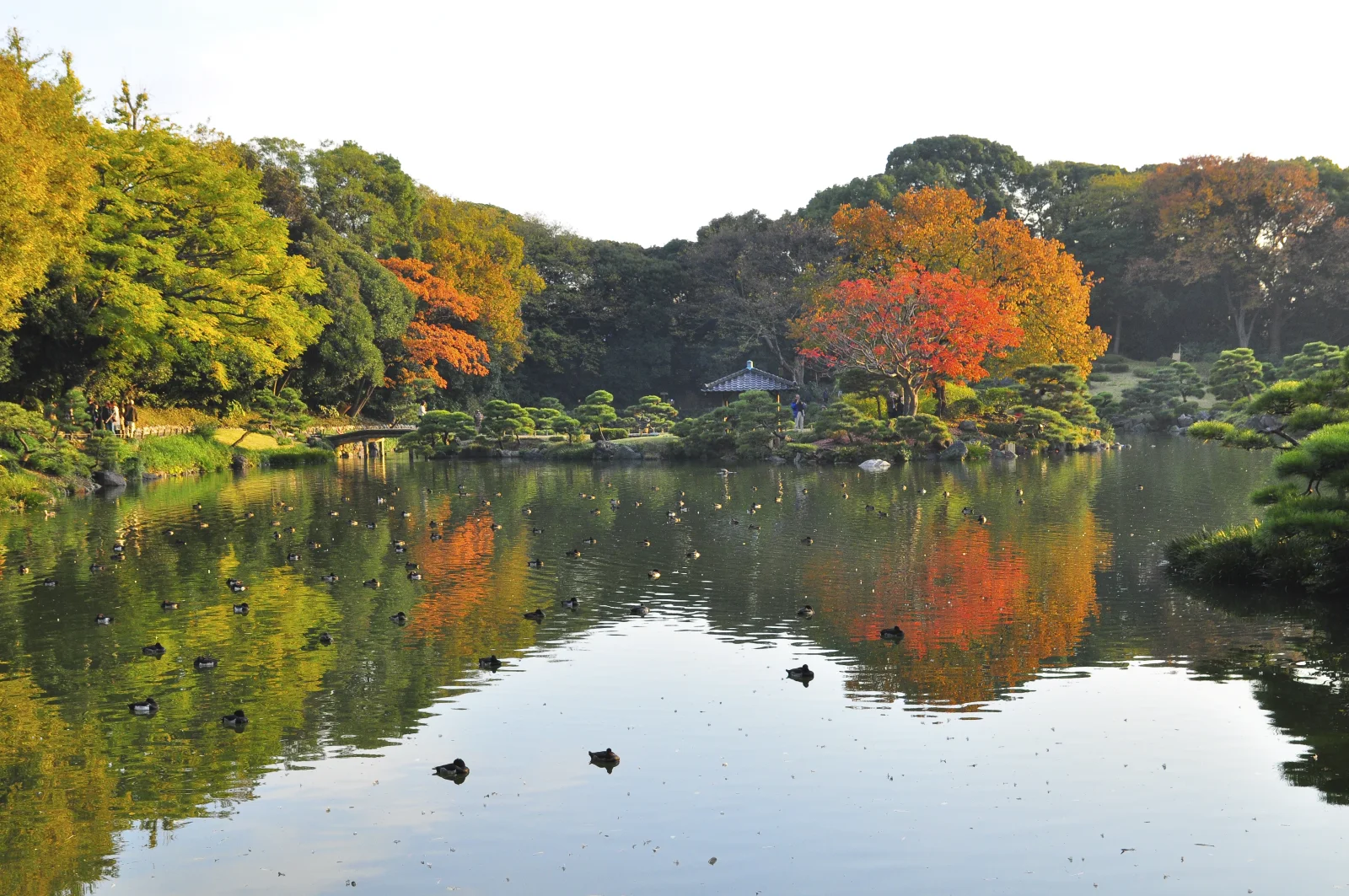
To locate Nakanoshima without staring at a phone map, look toward the Kiyosumi-dori Avenue side of the pond for a small pavilion and dense stands of pine. On the official map, Nakanoshima sits near Kiyosumi-dori with a footpath leading to that pavilion. Tsurushima and Matsushima sit farther out in the center of the pond, so use the larger Ryotei teahouse extending over the water as your landmark to get your bearings. Once you have a clear view of the pond's center, scan the banks for an angle that lines up red foliage, pine boughs, and open water in one frame, then walk toward that side. Rushing straight past from the entrance view tends to show only shoreline trees and rocks.
If your visit is locked in for late November, book your Kiyosumi-shirakawa cafe stop or museum exhibition as the fixed second half of the outing and leave your garden timing flexible. On days when green leaves still dominate, step back for wider angles that play the red wax tree off the dark pines. After several days of rain start knocking leaves down, shift your lens to the shoreline where fallen leaves gather between grass and stone, then scan the nearby bank for matching leaf shapes. When waterfowl swim past, even a small patch of red leaves along the edge pairs cleanly with ripples on the water.
Kiyosumi Garden is a 3-minute walk from Kiyosumi-shirakawa Station Exit A3, with ¥150 standard admission. Here is the 2026 foliage timeline, dated ticket rules, pond and stepping-stone routes, plus how to pair it with coffee, the Fukagawa Edo Museum, or MOT.
¥150 Admission and How to Buy Dated Online Tickets
Kiyosumi Garden is generally open from 9:00 a.m. to 5:00 p.m., with last entry at 4:30 p.m. To finish a full loop comfortably, arrive by around 3:30 p.m. ahead of the 5:00 p.m. closing bell. The garden closes from December 29 through January 1, so year-end visitors planning indoor stops afterward will need to check each museum's holiday schedule separately. If your group is arriving separately, meet outside the main gate or beside the service center. The paid garden has only one general visitor gate, so every loop brings you back to the same side.
At the ticket window, general admission is ¥150 and ¥70 for seniors aged 65 and older, with valid age ID required for the discount. Elementary school children and younger enter free, while free admission for junior high students applies specifically to those living or attending school in Tokyo under the Japanese school-grade system. Groups of 20 or more qualify for group rates at the window: ¥120 per adult and ¥50 per senior aged 65 and older. Holders of qualifying Japanese disability certificates and, in principle, one accompanying guest enter free upon presenting documentation as directed at the counter. The ticket booth accepts transit IC cards and major credit cards, making walk-up visits straightforward.
Online sales run through the Webket dated-ticket portal launched on August 17, 2026, which sells only standard adult and age 65+ tickets. Tickets open 31 days in advance and remain available until 4:00 p.m. on the day of use. At the gate, pull up the QR code on your phone for staff to scan. Group tickets, discounted passes, and annual passes must still be handled at the window. If you have a timed museum slot later in the day, buying online skips the ticket-booth queue, though you still check in at the main entrance.
Online cancellations are allowed until 4:30 p.m. on the visit date and apply to the entire payment transaction—if even one ticket in a booking has been scanned, the rest of that order cannot be refunded. Groups arriving together can buy on one order, while anyone whose arrival time or plans are uncertain should book separately. If you only decide to head over around 4:00 p.m., online sales close just 30 minutes before final entry. At that point, skip troubleshooting checkout on your phone and walk straight to the ticket booth.
A single-garden annual pass for Kiyosumi Garden costs ¥600 for adults and ¥280 for ages 65 and older, valid for one year from issue. At standard single-entry prices, it breaks even on your fourth visit and starts saving money on the fifth. A Nine-Gardens common annual pass is also available for ¥4,000 for adults and ¥2,000 for ages 65 and older. Short-term visitors should tally the single-entry fares for the specific gardens on their itinerary, counting repeat visits if any. If you only plan to visit Kiyosumi Garden once, the ¥150 single ticket makes the most sense.
How to Walk Oizumi Pond in One Hour
Leave Kiyosumi-shirakawa Station via Exit A3 and follow signs to Kiyosumi Garden's main gate. Both the Toei Oedo Line (E14) and Tokyo Metro Hanzomon Line (Z11) stop here. The garden estimates a 3-minute walk from Exit A3, and its accessibility map notes that A3 has street-level elevator access. The Hanzomon Line offers a direct ride from Otemachi, Suitengumae, or Oshiage. From Monzen-nakacho, the Oedo Line is just one stop away, making this an easy pre-checkout morning walk if you are staying in eastern Tokyo.
Approaching along the avenues from Ryogoku or Monzen-nakacho, you can also ride Toei Bus Mon 33 to the Kiyosumi-teien-mae stop. That route runs between Kameido Station and Toyomi Suisan Pier, so check the terminus sign on the bus pole to confirm direction. If coming from Akihabara on Toei Bus Aki 26, look up the Kiyosumi-shirakawa-ekimae stop, which is different from the garden-front stop on Mon 33. When a bus stop sits close to your hotel and someone in your group prefers to avoid long subway stairs, compare walking distances before deciding between bus and metro. The garden has no visitor parking lot, so drivers must rely on nearby paid private lots.
Once inside the paid gate, walk straight to the water's edge to spot the small pavilion on the far bank, the Ryotei teahouse reaching over Oizumi Pond, and the islands scattered across the middle. Keep that opening view in mind, then take another photo from the opposite shore—that pair makes the layout of the pond much clearer than firing off shots right at the entrance. Official estimates put a full circuit at 40 minutes, while a full hour leaves breathing room for side paths and letting crowds clear along narrow shoreline sections.
Start your loop on the side path past Taisho Memorial Hall, passing the dry landscape garden toward the Ashibe no Hama shoreline on the map. Nearby, look for a stone labeled Sado Akadama-ishi (Sado red jasper) and angle your view toward the boat-landing stone. The path here steps up and down every few paces, making it easy to compare how much of each boulder sits on dry land versus underwater. When you reach the spur trail leading to Nakanoshima, stay on the main path for a few more steps until the view opens up, then turn back to frame the red tree. Treat the walk out to the small pavilion as a quick out-and-back that rejoins the pond edge.
Continue around the pond past the miniature Mount Fuji tsukiyama mound and the Kare-taki dry waterfall. The mound is built as a gentle grass-covered hill rising from the ground with stone arrangements tucked around its base. Look at Kare-taki from the pondside trail to trace how the stacked stones mimic the drop of a waterfall. From there, the path curves toward the iris beds and the Jiyu Hiroba open lawn, briefly pulling you away from the main pond. On the lawn side, you can also walk over to the Matsuo Basho haiku monument; before stepping off the main loop to read it or rest, note which path you took in so you can rejoin the pond from the same side.
Rejoining the water from the open lawn brings you near the Ryotei teahouse, a prime spot for looking back at tree canopies on the opposite shore. Built by the Iwasaki family in 1909 to host British Field Marshal Lord Kitchener and later fully reconstructed, the building was designated a Tokyo Metropolitan Selected Historical Building in 2005. Its main hall projects out over the pond, leaving a crisp strip of shadow between roofline and water when viewed from across the way. Casual visitors admire the exterior from the walking paths; shoot from across open water to capture both roof and reflection, or walk right beside the pavilion to see how it cantilevers past the bank. Stepping inside requires a separate facility reservation.
The final stretch back to the main gate passes the Enki monument—good for maple foliage—and lets you decide whether to detour onto the iso-watari stepping stones. Look for signs reading 'iso-watari' or 'o-iso-watari,' as there is more than one set along the pond. These flat stones sit low against the water's edge to bring your eye line right down to the surface; anyone staying on the main path can wait near the far end of the spur where the stones rejoin the bank. If you only have 25 to 30 minutes total, take in the full sweep of Oizumi Pond near the entrance, walk along one bank to a clear vantage of Nakanoshima, and retrace your steps—even a short visit delivers a complete pond view.
The garden provides Traditional Chinese brochures and accessibility maps—the brochure helps match place names, while the accessibility map marks passable routes, slopes, and facilities more clearly. On weekends and holidays, you can time your walk around a free guided tour to hear where the garden's famous stones were shipped from. According to the park association, free tours run Saturdays, Sundays, and national holidays at 11:00 a.m. and 2:00 p.m., lasting roughly an hour (suspended in July and August, and subject to cancellation in bad weather). Keep your tour slot inside the garden and save coffee or lunch for afterward so you do not have to rush back to the meeting point.
Strollers & Wheelchairs: Stick to Paved Paths, Skip Stepping Stones in Rain
Visitors using wheelchairs can pick up the accessibility map at the service center and follow the level route from the gate along the open-park side toward Jiyu Hiroba. The official FAQ notes that roughly half of the garden loop is accessible on flat ground; because paths are not paved throughout, watch for puddles and slight dips after heavy rain. Four loaner wheelchairs are available at the service center. Ask staff on duty about current path conditions and wheelchair availability, then decide whether to turn back at the open lawn or linger along a wide stretch of shoreline. Return the same way rather than aiming for a full circuit.
Visitors with strollers can follow the same level route; if someone wants a closer look at the stepping stones, let another adult walk out while you wait on a wide path. The park map uses different line styles to separate pedestrian stepping stones from wheelchair-friendly trails, as gaps that look like an easy stride can trap stroller wheels. Wait until you reach a wide dry path before letting toddlers out to walk, and hold hands closely along the pond edge. Restrooms and accessible facilities are marked on the map—if you need a changing table, take care of that at the station or a marked facility before heading onto narrower waterside paths.
Skip the stepping-stone spurs whenever morning dew or rain leaves the rock surfaces slick. Many stones sit right at water level, and holding a phone or large umbrella narrows your field of view while watching your footing. To admire reflections from the opposite shore, choose a wider gravel path and make sure everyone is steady before framing a shot. If you have rolling luggage, store it at your hotel front desk before heading out rather than dragging suitcases across crushed gravel. Inside the garden, use visible landmarks like 'beside Taisho Memorial Hall' or 'at Jiyu Hiroba' as regrouping points.
Next door, Kiyosumi Park is a separate free public area labeled 'Open Park' on the map, easy to recognize by its Edo-style clock tower and plaza. If people in your group move at different paces, enjoy the paid garden shoreline at your own speed and meet up afterward in the open park. With energetic kids, let them burn off steam on the park plaza first, then focus on the calmer waterside stretch near the garden gate to avoid turning a stroller around in tight spots. Kiyosumi Garden and Kiyosumi Park have separate map pins, so check the name carefully when navigating from the station.
Picnicking is allowed on benches and outdoor tables, but picnic mats, alcohol, and pets are prohibited inside the garden. When benches are occupied or rain is falling, finish your coffee before entering rather than carrying a hot drink around the pond. Meals inside the Ryotei pavilion or Taisho Memorial Hall require booking the room first and ordering catering separately; for a casual visit, enjoy the scenery inside and grab food on the streets of Kiyosumi or Shirakawa afterward.
When the Light Is Flat: Famous Stones and Waterfowl
Oizumi Pond originally drew water from the Sumida River, rising and falling with the tide to alter the shoreline. Today it is fed by rainwater, so checking the wind forecast matters far more than tide tables if you are chasing mirror-like reflections. On calm days, leave open water in the frame to catch the tree canopy. Once a breeze picks up, switch to close-ups of shoreline rocks and fallen leaves—ripples break up tree reflections, yet often bring out sharp contrasts in water depth. If you are not in a rush, stand still for a minute and wait for a duck or heron to glide into frame before pressing the shutter.
The shoreline features boulders brought from across Japan on the Iwasaki family's own steamships, including Iyo Aoishi (blue stone from Ehime), Kishu Aoishi (blue stone from Wakayama), Bitchu Mikageishi (granite from Okayama), and Sado Akadama-ishi (red jasper from Niigata). Look for the red jasper near Taisho Memorial Hall, then examine how stones are stacked around the Kare-taki dry waterfall—pairing stone color with landscape role makes them far easier to remember than reading a stone list at the gate. On bright days, vivid foliage steals the spotlight, whereas overcast light brings out subtle color shifts between wet rock near the waterline and dry stone above. Leave wet moss untouched and zoom in from the main path.
The park lists spot-billed ducks, gray herons, and cormorants as year-round residents, joined in winter by migratory waterfowl such as tufted ducks and common pochards. If you are birdwatching with kids, pick an open stretch of bank and spend a few minutes guessing whether a bird floating offshore or standing on a rock will dive or swim next. Use your phone's telephoto lens for distant birds instead of squeezing onto narrow rocky points. Anyone carrying binoculars can scan from a wide walkway and call the group over once a bird is spotted.
Casual travel snapshots and scenic photography are welcome without special permission. Any shoot that occupies a specific spot for an extended period—commercial or not—requires advance application at the service center, with the garden's notice explicitly citing pre-wedding shoots and portrait-focused sessions. For normal group photos, step onto a wider stretch of path and yield space once you finish. To shoot low-angle reflections, crouching on a stable walkway is both safer and easier than balancing on wet stepping stones.
Half-Day Plan: Save Coffee for After the Garden
On a clear weekend morning for a first visit, enter between 9:00 a.m. and 9:30 a.m. and give Oizumi Pond a full hour. Finishing the most light-dependent stop early leaves the rest of the morning open to decide between coffee or food based on everyone's appetite. If you want the 11:00 a.m. guided tour, grab coffee earlier or arrive just before 11:00 a.m. If someone in your group needs a sit-down break, head straight for a cafe with indoor seating upon exit. If you hold afternoon timed-entry museum tickets, walk toward the gallery first, pick a lunch spot along the way, and save coffee for after the exhibition.
Blue Bottle Coffee's Kiyosumi-shirakawa Flagship Cafe is at 1-4-8 Hirano, Koto-ku, listed as open daily from 8:00 a.m. to 7:00 p.m. Travelers landing on an early flight who have already dropped off luggage nearby can grab a cup first and walk over for the garden's opening. Visitors heading on to the Museum of Contemporary Art Tokyo can easily fold this stretch through Hirano and Miyoshi into the post-garden walk. If you are staying right around Kiyosumi-shirakawa Station, keep to the Shirakawa side to string the Edo museum, lunch, and the return subway together—doubling back from Hirano toward the station for lunch adds unnecessary backtracking after a morning on your feet.
Housed in a converted warehouse, the flagship opened in 2015 as the Kiyosumi-shirakawa Roastery & Cafe and now lists 47 seats plus a Chinese-language menu option. When meeting friends coming from different lines, specify 'Blue Bottle Flagship in Hirano' rather than just the station name so nobody ends up waiting outside the garden gate. Give coffee its own stop if you want to sit down and browse the menu; if you only want takeout, swing through Hirano on your walk toward the art museum in Miyoshi.
For one adult, combined entry to Kiyosumi Garden and the Fukagawa Edo Museum's permanent exhibition comes to ¥550. Once you add subway fares, coffee, and lunch, your total spend hinges mostly on which museum stop you pick for the afternoon. Swapping the Edo museum for the Museum of Contemporary Art Tokyo's two-exhibition combo ticket brings combined admission to ¥3,150. If you are simply grabbing one coffee before heading to another Tokyo neighborhood, treat the garden ticket as your fixed cost and order off the cafe menu without worrying about matching anyone else's half-day budget.
With young kids, loop as much of the pond as they can comfortably handle right after opening, grab a bite, and head into the Fukagawa Edo Museum. If you are meeting friends at noon, flip the order—let everyone cover their personal priority solo in the morning, then meet at a single cafe or lunch spot in the afternoon. Coffee anchors this neighborhood naturally, so if your group has locked in exhibition tickets, buy those first and slide the cafe stop into whichever gap opens up rather than trying to juggle waitlist seating and museum transit at once.
Rainy Day Backup: Start at the Fukagawa Edo Museum
The Fukagawa Edo Museum sits at 1-3-28 Shirakawa, also roughly a 3-minute walk from Kiyosumi-shirakawa Station Exit A3. Stepping out of Kiyosumi Garden onto Kiyosumi-dori Avenue, follow the arrow marked 'Fukagawa Edo Museum' on the garden map—cross the avenue and walk into Shirakawa 1-chome. If rain picks up during the morning, moving indoors here is far easier than waiting out a downpour by the pond. Galleries are open 9:30 a.m. to 5:00 p.m. (last admission 4:30 p.m.), with admission at ¥400 for adults and ¥50 for elementary through high school students.
Inside, a full-scale street scene reconstructs late-Edo Fukagawa Saga-cho during the Tenpo era, cycling through day and night with shifting sound effects and lighting. You can step inside several shops and rowhouses, offering a completely different sense of proximity than looking across water at a garden pavilion. If children are sensitive to sudden sound or lighting cues, stand near the perimeter first to gauge the room before walking into the streetscape together. Pairing both stops in one morning lets you talk about Matsuo Basho's famous frog-and-pond haiku in the garden, then step into the neighborhood where ordinary Fukagawa residents lived before heading back to the same station side.
The museum is normally closed on the second and fourth Mondays of each month, except when a Monday falls on a national holiday. November 23, 2026, is both the fourth Monday and a national holiday, so the museum stays open—and its 40th-anniversary special exhibition runs through that exact day. Included with regular permanent-exhibition admission, the showcase uses original construction records and scale models to show how the Edo streetscape was built indoors. Visitors arriving on November 23 can tour the galleries before lunch, or, if staying until 4:00 p.m., double-check the separate last-entry cutoffs for both the garden and the museum.
Save the Afternoon for the Museum of Contemporary Art Tokyo (MOT)
For an art-focused afternoon, the Museum of Contemporary Art Tokyo (MOT) sits at 4-1-1 Miyoshi beside Kiba Park. Tokyo's official tourism site lists the walk at about 9 minutes from Hanzomon Line Kiyosumi-shirakawa Station Exit B2. Because Kiyosumi Garden sits near Exit A3, walking straight from the garden takes a bit longer across the intervening blocks. On heavy rain days with older travelers, the Fukagawa Edo Museum near Exit A3 saves extra walking. If you still want to stroll Kiba Park, save it for after your MOT galleries rather than burning daylight looking for the museum entrance first.
Regular hours run 10:00 a.m. to 6:00 p.m., with last admission at 5:30 p.m. In November 2026, the museum opens on Monday, November 23, and closes the following day, Tuesday, November 24. On Friday, November 27, Autumn Night Opening extends hours until 8:00 p.m. (last entry 7:30 p.m.), offering free admission for students and announced discounts for adults and seniors aged 65 and older entering after 5:00 p.m. (bring student or age ID). For an unhurried combo, tour Kiyosumi Garden in the afternoon, stop for a meal in Kiyosumi-shirakawa, and save the evening slot for MOT—keeping separate track of the garden's daytime cutoff and the museum's extended last entry.
MOT's two special exhibitions in November 2026 close on different dates: Minami Tada runs through December 6 (¥1,600 general admission), while Synchronic Constellations runs through December 13 (¥2,000 general admission). A ¥3,000 general combo ticket covers both special shows plus the MOT Collection. If you only want one exhibition, buy a single ticket rather than overcommitting, choosing up front between the collection and the temporary shows. Anyone heading to dinner straight after should budget time for just one wing and save the second for another trip.
Arriving in Kiyosumi-shirakawa around 1:00 p.m. leaves enough time to tour the garden first and walk straight down the street to MOT. If you reach the neighborhood after 3:30 p.m. and want both stops, target an evening-extension day; on standard days, pick either the garden or the museum so you are not rushing out the door. After the exhibition, take Exit B2 back onto the Hanzomon Line, or walk overground toward Exit A3 for the Oedo Line.
Evening Illuminations and the Nine-Gardens Stamp Rally Depend on Timing
The 2026 Tokyo Nine Metropolitan Gardens Autumn Foliage Stamp Rally runs from October 10 to December 6, with Kiyosumi Garden participating during standard daytime hours of 9:00 a.m. to 5:00 p.m. Pick up a paper stamp sheet at any participating garden's service center or designated rack (one per person, while supplies last). Each garden keeps a single stamp inside its paid area. Grab your sheet right as you enter, ask staff where the stamp stand sits, and fold it into your pond loop—park rules state you cannot re-enter on a used ticket after exiting, so confirm the stamp's location before leaving.
If you also plan to see Rikugien Garden on the same day, its 2026 special night illumination runs November 25 to December 6 from 6:00 p.m. to 8:30 p.m. (last entry 7:30 p.m.). Advance online tickets cost ¥1,000, while same-day tickets are ¥1,200 (sold cash-only at Rikugien's main gate from 6:00 p.m. to 7:30 p.m.). Staying in Kiyosumi-shirakawa until 5:00 p.m. jams coffee, train transfers, and meeting up with companions into a tight window before night entry. If your Rikugien night slot is already booked, move Kiyosumi Garden to the morning.
When you only have room for one Tokyo garden on your trip, weigh tree species and your afternoon neighborhood. If vivid maples and nighttime illuminations are the priority, devote that day to a garden running evening hours. If you want famous boulders, pond islands, and crimson wax trees on a ¥150 daytime ticket—with eastern Tokyo museums and cafes steps away—Kiyosumi pairs effortlessly into one walk. Still comparing districts? Check our Tokyo autumn foliage area itineraries to map other city spots on one transit plan.
Beyond Peak Foliage: What to See Around the Pond Year-Round
Oizumi Pond began as part of a private estate in Fukagawa. Industrialist Yataro Iwasaki acquired the land in 1878, opening it in 1880 as Fukagawa Shinboku-en before expanding the grounds with Sumida River water and curated stone arrangements. During the 1923 Great Kanto Earthquake, the garden served as an evacuation shelter; the following year, the Iwasaki family donated the less-damaged eastern half to Tokyo City, which restored and opened it as a public park in 1932. Standing near the Enki monument overlooking the pond, you can picture both the guest receptions and neighborhood refuge roles this water once held before visiting the Fukagawa Edo Museum to see another chapter of local life.
Once the wax trees drop their leaves, December through January brings winter pine care—yukitsuri snow-bracing ropes and komomaki straw trunk wraps listed on the garden's flower calendar. Families traveling around the year-end holidays outside the December 29–January 1 closure can follow a winter-maintenance loop around the pond. Overcast skies highlight gray boulders and pine needles, while bright sun casts crisp shadows of the bracing ropes across the water. In colder weather, spend a little more time spotting winter ducks along the bank instead of adding a second outdoor stop, then warm up indoors.
Early summer shifts the focus toward Jiyu Hiroba for Japanese irises, listed for June and July on the park calendar—a different anchor from autumn's Nakanoshima. June hydrangeas also appear on the bloom schedule, making the same level accessible path an easy rainy-day walk through fresh greenery before ducking into a nearby museum. In April, check the garden leaflet for Somei-Yoshino and Sato-zakura cherry trees, adding a relaxed hour-long stroll to a wider Tokyo sakura route.
If you are basing yourself in eastern Tokyo for a few nights, Kiyosumi-shirakawa makes an easy morning garden walk followed by an unhurried afternoon toward Shirakawa or Miyoshi. Travelers spending most days along the Tozai Line—or wanting dinner options before heading over—can stay near Monzen-nakacho, where both the Tozai and Oedo lines meet just one stop from Kiyosumi-shirakawa. To weigh nightly walks back to your hotel against subway and dining access, see our Kiyosumi-shirakawa and Monzen-nakacho stay guide. If you are just visiting for a half-day foliage walk, ride straight to E14 or Z11 from wherever you are staying.
A few useful answers
Are the autumn leaves at Kiyosumi Garden changing by late November 2026?
In its 5:00 p.m. JST update on November 19, 2026, the Tokyo Metropolitan Park Association listed the tracked wax trees (hazenoki) as 'beginning to turn' and projected the prime viewing window for Nakanoshima's wax tree from late November through month-end. For Japanese maples, walk past the Enki monument as well.
Do you need advance reservations for Kiyosumi Garden?
No—you can buy tickets at the gate on arrival or purchase dated tickets online through Webket. Admission is ¥150 for adults and ¥70 for seniors aged 65 and older. Online sales end at 4:00 p.m. on the visit date, and last entry at the gate is 4:30 p.m.
How long does it take to walk Kiyosumi Garden, and can you skip the stepping stones in the rain?
The park estimates about 40 minutes for one loop, though allowing one hour gives you time for photos and pauses. Skip the iso-watari stepping stones and stick to dry gravel paths whenever rain makes the rocks slick. Wheelchair users can cover roughly half the loop along marked level paths.
Which Kiyosumi-shirakawa Station exit should I use for Kiyosumi Garden?
Take Exit A3 from either the Oedo Line (E14) or Hanzomon Line (Z11) for a 3-minute walk to the gate. If you are heading to the Museum of Contemporary Art Tokyo, Tokyo's official tourism guide estimates a 9-minute walk from Hanzomon Line Exit B2.
Does Kiyosumi Garden have evening autumn illuminations in 2026?
No. The 2026 autumn stamp-rally notice lists Kiyosumi Garden for daytime hours only, with last entry at 4:30 p.m. and closing at 5:00 p.m. For an evening follow-up after a daytime visit, the Museum of Contemporary Art Tokyo stays open until 8:00 p.m. on Friday, November 27.
Are guided tours available at Kiyosumi Garden?
Yes. Free guided garden tours run on Saturdays, Sundays, and national holidays at 11:00 a.m. and 2:00 p.m., lasting about 60 minutes. Tours do not run in July or August and may be canceled in bad weather.
Official information and references
Sources used in this guide.
- Tokyo Metropolitan Park Association | Kiyosumi Garden Hours, Admission, Tours & Overview
- Tokyo Metropolitan Park Association | Metropolitan Parks & Gardens Autumn Foliage Updates
- Tokyo Metropolitan Park Association | Autumn Color Note on Nakanoshima's Wax Tree
- Tokyo Metropolitan Park Association | Kiyosumi Garden Dated Online Ticket Announcement
- Tokyo Metropolitan Park Association | Kiyosumi Garden FAQ
- Tokyo Metropolitan Park Association | Kiyosumi Garden Map
- Tokyo Metropolitan Park Association | Kiyosumi Garden Accessibility Map
- Tokyo Metropolitan Park Association | Wax Trees (Hazenoki) of Kiyosumi Garden
- Tokyo Metropolitan Park Association | Kiyosumi Garden Photography Guidelines
- Tokyo Metropolitan Park Association | Kiyosumi Garden Stamp Rally & Autumn Photo Spots
- Tokyo Metropolitan Park Association | 2026 Nine Metropolitan Gardens Autumn Stamp Rally
- Tokyo Metropolitan Bureau of Transportation | Kiyosumi-shirakawa Station Exits & Floor Map
- Koto City Culture and Community Foundation | Fukagawa Edo Museum Hours & Permanent Exhibition
- Koto City Culture and Community Foundation | Fukagawa Edo Museum 40th Anniversary Exhibition & Tickets
- Tokyo Convention & Visitors Bureau | Access to the Museum of Contemporary Art Tokyo
- Museum of Contemporary Art Tokyo | Official Ticketing & Exhibition Schedule
- Tokyo Metropolitan Foundation for History and Culture | 2026 Autumn Museum Night Opening
- Blue Bottle Coffee | Kiyosumi-shirakawa Flagship Cafe Store Information
- Tokyo Metropolitan Park Association | Taisho Memorial Hall & Ryotei Facility Reservations
- Tokyo Metropolitan Bureau of Transportation | Toei Bus Stops Around Kiyosumi-shirakawa Station
- Tokyo Metropolitan Bureau of Construction | Kiyosumi Garden & Open Park Management Plan
- Koto City Culture and Community Foundation | Access to Fukagawa Edo Museum
- Tokyo Metropolitan Park Association | 2026 Rikugien Garden Autumn Night Illumination
- Blue Bottle Coffee | Kiyosumi-shirakawa Japan Flagship Opening Story