Kiyosumi Garden is a three-minute walk from Kiyosumi-Shirakawa Station Exit A3, with standard admission at ¥150. A complete 2026 guide covering autumn foliage progress, dated tickets, the pond loop and stepping stones, plus a half-day route linking local coffee roasters, the Fukagawa Edo Museum, and the Museum of Contemporary Art Tokyo.
- Region & Focus
- TokyoAutumn leaves
- Reading Scope
- 15 min read · 10 chapters · 6 Q&As
- Official Verification
- 24 official sources checkedUpdated 22 November 2026
- Key Topics
- SeasonsItinerariesNeighbourhoods
Chapter Route Map (tap any stop)
- Start at Nakanoshima for Kiyosumi Garden's autumn colour
- Admission is ¥150: how to buy online tickets
- How to spend an hour walking Daisensui Pond
- Sticking to level paths with pushchairs, wheelchairs, or in rain
- What to look for in flat light: stones and waterbirds
- Pair the morning garden walk with coffee for a half-day route
- Rainy-day backup: start at the Fukagawa Edo Museum
- Dedicate an afternoon to the Museum of Contemporary Art Tokyo
- Stamp rallies and evening illuminations depend on each garden's hours
- Outside autumn foliage: revisit for winter craft and seasonal blooms
- Quick Q&A
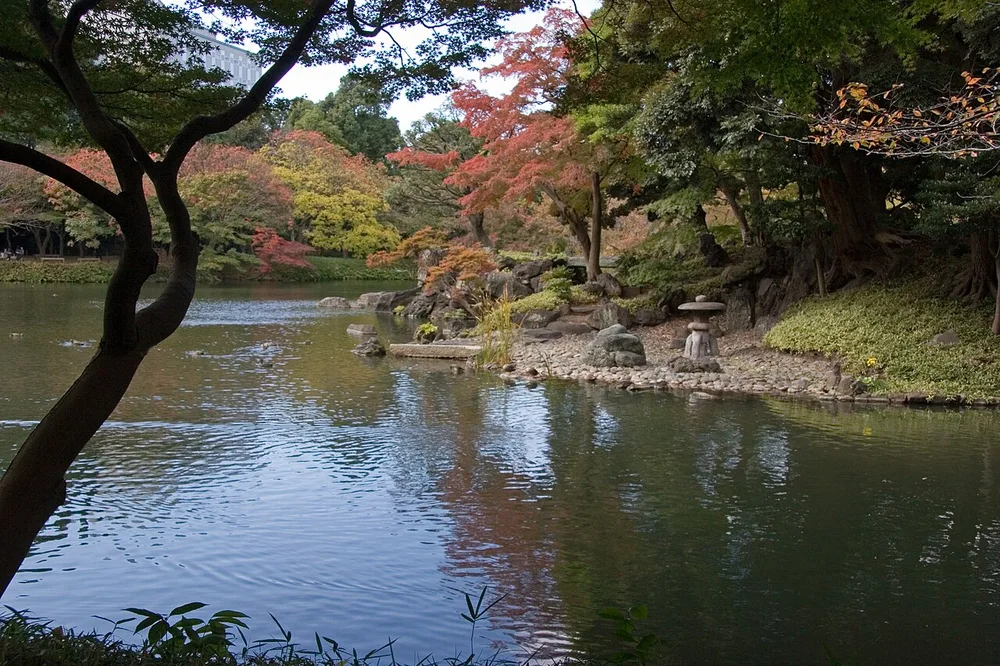
Kiyosumi Garden sits roughly three minutes on foot from Kiyosumi-Shirakawa Station Exit A3. Standard admission is ¥150, and a lap of the pond takes around 40 minutes, though an hour leaves comfortable breathing room for reflections and famous garden stones. On 19 November 2026, the Tokyo Metropolitan Park Association listed the garden's Japanese wax trees as changing colour. To photograph Nakanoshima's autumn tones, start along the bank of Daisensui Pond to gauge the whole tree before deciding whether to cross the Iso-watari stepping stones. With half a day to spare afterwards, pair the garden with Kiyosumi-Shirakawa's coffee scene, the Fukagawa Edo Museum, or the Museum of Contemporary Art Tokyo.
Start at Nakanoshima for Kiyosumi Garden's autumn colour
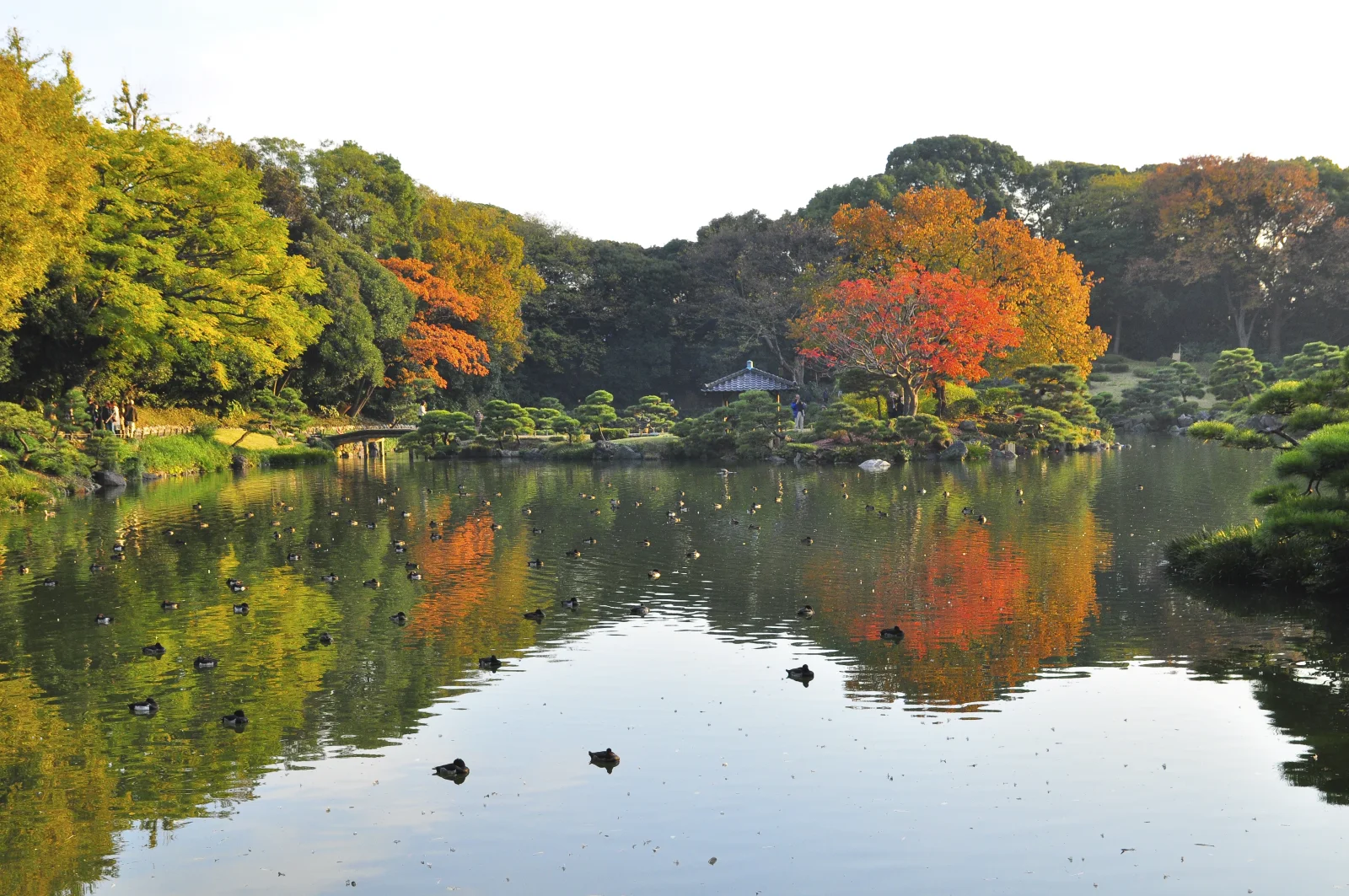
When checking autumn foliage at Kiyosumi Garden, find the entry for Kiyosumi Garden in the Tokyo Metropolitan Park Association's foliage chart and note which tree species is listed beneath it. In the 19 November 2026 (17:00 JST) update, the three tracked Japanese wax trees (hazenoki) were marked as changing colour, a stage placed just ahead of peak bloom in the legend. The accompanying report noted that leaves on Nakanoshima had already turned vermilion, predicting prime viewing from late November until the end of the month. You can inspect park photos and bulletins separately for maples and ginkgoes, as this row of the table tracks only the wax trees. Updates are scheduled on Mondays and Thursdays through 17 December, so travellers spending several days in Tokyo can slot the garden into a flexible morning.
From mid-November onwards, keep your eye on the Japanese wax trees first. The Kiyosumi Garden Service Centre highlights the large wax tree on Nakanoshima for its autumn display, as its crimson canopy stands out sharply against the surrounding pines from the opposite bank. For Japanese maples, pin the Nomura-momiji near the garden monument (Enki), previously featured in the park's stamp-rally notices, onto your mental map. Wax trees, maples, and ginkgoes turn at different speeds, so a single wide shot capturing all three often mixes red with green. If your trip spans late November and early December, check that week's park photos and pick your day according to whichever tree matters most to you.
When locating Nakanoshima, put away your phone map and look for the small arbour and pine clusters along the Kiyosumi-dori side of the pond. On the official map, Nakanoshima sits near Kiyosumi-dori with a footpath leading to a small pavilion. Tsurushima and Matsushima lie further out in the centre of the pond, so use the Ryotei pavilion extending over the water as your landmark to get your bearings. From a clear vantage point facing the middle of the pond, find the bank that frames the red foliage, pine branches, and open water together before walking over. Scanning hastily from near the entrance often limits your view to shoreline shrubs and boulders.
If your autumn visit is already fixed for late November, lock in a coffee stop or exhibition in Kiyosumi-Shirakawa as your second anchor so the garden keeps a flexible window. On days when green leaves still dominate, step back across the pond to play up the contrast between crimson trees and dark pines. After several rainy days when leaves begin to drop, shift your focus to the water's edge, spotting where fallen leaves gather between grass and stone, then follow the shore to find matching silhouettes. When a waterbird drifts past, even a single cluster of red leaves near the bank can anchor the ripples in your frame.
Kiyosumi Garden is a three-minute walk from Kiyosumi-Shirakawa Station Exit A3, with standard admission at ¥150. A complete 2026 guide covering autumn foliage progress, dated tickets, the pond loop and stepping stones, plus a half-day route linking local coffee roasters, the Fukagawa Edo Museum, and the Museum of Contemporary Art Tokyo.
Admission is ¥150: how to buy online tickets
Kiyosumi Garden normally opens at 09:00 and closes at 17:00 JST, with last entry at 16:30 JST. Arriving around 15:30 JST leaves enough time for an unhurried loop before the 17:00 JST closing bell. The garden closes from 29 December to 1 January, so anyone planning an indoor continuation over New Year will need to check the holiday schedules of neighbouring museums. If your group arrives separately, meet outside the main gate or by the service centre. There is only one public entrance and exit for the paid garden, bringing every circuit back to the same side.
Same-day tickets at the gate cost ¥150 for adults and ¥70 for visitors aged 65 and over (proof of age required for the concession). Primary school children and younger enter free; free admission for junior high school students applies to those living or attending school in Tokyo under the Japanese school system. Groups of 20 or more can buy discounted tickets at the counter for ¥120 per adult and ¥50 per visitor aged 65 and over. Holders of an eligible Japanese disability certificate and generally one companion enter free upon presenting the certificate as directed at the ticket counter. Standard counters accept transport IC cards and major credit cards, making walk-up visits straightforward.
Online booking runs through the Webket dated-ticket portal, launched on 17 August 2026, which sells standard adult and 65-and-over tickets only. Tickets open 31 days in advance and remain on sale until 16:00 JST on the day of visit. Present the QR code on your phone at the gate for staff to scan. Group tickets, concession vouchers, and annual passes are handled exclusively at the counter. If you have timed entry booked at your next stop, an online ticket skips the ticket queue, though you still check in at the main entrance.
Online refunds are accepted until 16:30 JST on the day of visit and are processed per payment transaction; once any ticket in an order has been scanned, the remainder of that booking cannot be cancelled. Groups travelling together who plan to enter at the same time can book on one order, while anyone with uncertain arrival times should buy individually. If you decide to walk over near 16:00 JST, online sales cut off only half an hour before last entry, so heading straight to the gate counter is simpler than fiddling with payment screens on the street.
A Kiyosumi Garden single-site annual pass costs ¥600 for adults and ¥280 for visitors aged 65 and over, valid for one year from issue. Against the standard single ticket, you break even on your fourth visit and save from the fifth onwards. The combined annual pass for all nine Tokyo Metropolitan gardens is ¥4,000 for adults and ¥2,000 for visitors aged 65 and over. Short-stay visitors should add up single-entry fares for the specific gardens on their itinerary, including any repeat visits. If you plan to visit Kiyosumi Garden just once, the ¥150 single ticket is the sensible choice.
How to spend an hour walking Daisensui Pond
Leave Kiyosumi-Shirakawa Station via Exit A3 and follow signs to the Kiyosumi Garden main gate. Both the Toei Oedo Line (E14) and Tokyo Metro Hanzomon Line (Z11) stop here. Official guidance estimates a three-minute walk from Exit A3, and the accessibility map marks street-level lift access at the same exit. The Hanzomon Line provides a direct ride from Otemachi, Suitengumae, or Oshiage. Coming from Monzen-Nakacho, it is just one stop on the Oedo Line, ideal for a morning stroll before hotel check-out if you are staying in eastern Tokyo.
Approaching from Ryogoku or Monzen-Nakacho along the main avenues, you can also take Toei Bus Mon 33 and alight at Kiyosumi-teien-mae. That route runs between Kameido Station and Toyomi Suisan Pier, so check the destination sign at the bus stop to confirm direction. From Akihabara, look for Toei Bus Aki 26 to Kiyosumi-Shirakawa-ekimae, which is a different stop from the garden entrance served by Mon 33. If your starting point sits near either bus stop and someone in your party prefers to avoid long underground stairs, compare the walking distance of a direct bus against a rail transfer. There is no visitor car park at the garden; nearby commercial car parks charge separately.
Once through the paid gate, head straight to the water's edge to orient yourself using the small arbour across the pond, the Ryotei pavilion extending over Daisensui Pond, and the islands clustered at the centre. Take a reference shot there, then shoot again from the opposite shore—the pond's full outline reads much more clearly than from a burst of photos taken at the entrance. Official guidance suggests 40 minutes for the loop; budgeting an hour gives you room for side paths or a brief pause while a narrow shore clears.
On your first pass, take the side path past the Taisho Memorial Hall and the dry landscape garden, then follow the shore towards Ashibe-no-hama. Along this stretch lie stones marked as Sado red jasper, plus views across the water towards Funatsuki-ishi. The bank shifts height every few steps, making it easy to compare how much of each boulder sits above or below the waterline. Where the path branches towards Nakanoshima, stay on the main trail a few paces until the view widens before turning back to photograph the trees. Treat the walk out to the small arbour as an out-and-back spur that rejoins the pond edge.
Continue round the pond past the artificial Mount Fuji mound and the dry waterfall. Marked "Mount Fuji" on the map, this gentle earthen hill sits above arranged rockwork at its base. You can read the cascade shape of the dry waterfall from the lakeside path by following the stepped stones. Beyond this section, the trail turns towards the iris beds and Jiyu Hiroba, momentarily leaving the main pond behind. Beside Jiyu Hiroba stands the Matsuo Basho haiku monument; before heading over to read it or rest on a bench, note which path brought you into the lawn so you can rejoin Daisensui Pond from the same side.
Returning to the water from Jiyu Hiroba, the area around the Ryotei pavilion offers clear sightlines to the foliage on the far bank. Built by the Iwasaki family to host Britain's Field Marshal Kitchener during his 1909 visit to Japan—and later comprehensively rebuilt—the pavilion was designated a Tokyo Selected Historic Building in 2005. Its main structure cantilevers over the water, casting a crisp band of shadow between the eaves and the pond from the opposite shore. Regular visitors admire the exterior from the walking paths; frame a wider stretch of water from across the pond to capture both roof and reflection, or walk close to examine its overhanging joinery. Entering the Ryotei requires a separate facility booking.
On the final stretch back to the gate, check the maples near the garden monument before deciding whether to detour onto the stepping stones. Follow Japanese signs reading Iso-watari or O-iso-watari—there is more than one section in the garden. Set low along the shoreline, these stones bring your eye level down to the water; companions staying on the main path can wait near the far end of the spur and meet you back on dry ground. If you only have 25 to 30 minutes, take in the full sweep of Daisensui Pond at the entrance, walk along one bank to a clear angle on Nakanoshima, and retrace your steps—even a short visit delivers a complete pond view.
Printed leaflets and an accessibility map are available at the garden, with the latter clearly marking step-free routes, gradients, and facilities. On weekends and public holidays, free guided tours run at 11:00 and 14:00 JST for around an hour (suspended in July and August, and subject to weather cancellation), explaining where the garden's famous stones were quarried and shipped from. Keep your coffee or lunch for after the tour so you do not have to rush back to the meeting point halfway through a loop.
Sticking to level paths with pushchairs, wheelchairs, or in rain
Visitors using a wheelchair can pick up the accessibility map at the service centre and follow the landward path along the Kiyosumi Park boundary towards Jiyu Hiroba. The official FAQ notes that roughly half of the garden loop is level, though not every surface is paved, so watch for puddles and minor undulations after heavy rain. Four wheelchairs are available to borrow at the service centre. Ask staff on the day which paths are open and whether a wheelchair is free before deciding whether to turn back at the lawn or linger along a wider section of bank. Return the same way rather than aiming for a full circuit.
Parents with pushchairs can follow the exact same route; if you want a closer look at the stepping stones, let one adult step onto the rocks while the other waits on a wider path. The garden map uses distinct line styles to separate stepping stones from wheelchair-accessible trails, as gaps that look like an easy stride can easily trap pushchair wheels. Wait until you reach the spacious lawns before letting toddlers walk independently, and hold hands firmly near the water. Check the map for accessible toilets and baby-changing facilities beforehand, and use station or marked garden facilities before entering narrower shoreline sections.
Skip the stepping-stone spurs whenever dew or rain leaves the rock surfaces slick. Some stones sit flush with the water, and looking down for footing while juggling a phone or a large umbrella narrows your field of vision. Capture opposite-bank reflections from wider gravel paths once everyone has steady footing. If you are carrying suitcases, leave them with your hotel concierge before setting out—dragging wheeled luggage across crushed gravel quickly wears thin. To regroup inside the garden, pick visible landmarks such as the Taisho Memorial Hall or Jiyu Hiroba.
Next door lies Kiyosumi Park, marked as an open park on maps and easily spotted by its Edo-style clock tower and broad plaza. If companions walk at different paces, enjoy the paid garden separately and reconvene in the open park afterwards. With energetic children, save running and play for the park plaza, and focus on the waterside views near the entrance inside the paid garden to avoid turning round on tight paths. Kiyosumi Park and Kiyosumi Garden have separate pins on map apps, so double-check the name before setting navigation.
Eating is permitted on benches and outdoor tables, though picnic sheets, alcohol, and pets are prohibited throughout the garden. On wet days when benches are scarce, finish your coffee before entering rather than juggling a hot cup round the pond. Meal service inside the Ryotei and Taisho Memorial Hall requires an advance venue reservation; for casual walks, save lunch for the surrounding streets of Kiyosumi and Shirakawa.
What to look for in flat light: stones and waterbirds
Daisensui Pond originally drew water from the Sumida River, shifting its shoreline with the tide. Today it is rainwater-fed, so checking the wind forecast matters far more than tide tables if you are chasing mirror-like reflections. When the water is glassy, leave empty pond space below the canopy to catch the reflection; once a breeze picks up, switch to close-ups of shoreline boulders and fallen leaves, where broken reflections often reveal subtle shifts in water depth. Without a tight schedule, pause for a minute until a waterbird swims through your frame.
Rocks from across Japan line the shore, shipped in by the Iwasaki family's own steamships—including Iyo blue stone, Kishu blue stone, Bitchu granite, and Sado red jasper. Notice the red jasper near the Taisho Memorial Hall, then see how boulders are stacked round the dry waterfall; linking stone colours to their placement is far more memorable than reading a list at the gate. Vivid autumn foliage often steals the spotlight from large rocks, whereas overcast light brings out the contrast between wet, dark stone near the water and dry stone above. Leave slippery moss undisturbed and zoom in from the main path.
Year-round residents listed by the garden include spot-billed ducks, grey herons, and cormorants, joined in winter by migratory tufted ducks and common pochards. If you are visiting with children, linger along an open stretch of bank to watch whether a bird is paddling or perched—guessing where it will swim next keeps younger visitors engaged. Use your phone's telephoto lens for distant birds rather than stepping onto cramped stones near the water, and let anyone carrying binoculars scout from a wide section of trail before calling the group over.
Casual travel snapshots and landscape photography are welcome without a permit. However, occupying a fixed spot for an extended period—whether commercial or private—requires an application at the service centre, with pre-wedding shoots and portrait-focused sessions cited as examples in park notices. Keep group photos to wider sections of the shoreline and step aside promptly once you have the shot. For low-angle reflections, crouching on the gravel path is far easier and safer than balancing on stepping stones.
Pair the morning garden walk with coffee for a half-day route
On a crisp weekend morning, enter between 09:00 and 09:30 JST and give Daisensui Pond an hour. That finishes the most light-sensitive part of the walk early, leaving the rest of the morning open for coffee or brunch according to everyone's appetite. If you want the 11:00 JST guided tour, grab coffee first or arrive at the main gate just before 11:00 JST. When companions need a proper sit-down rest, head straight to a cafe with indoor seating on exit; if you have a timed afternoon exhibition, walk towards the museum first, stop for lunch along the way, and save coffee for afterwards.
Blue Bottle Coffee's Kiyosumi-Shirakawa Flagship Cafe sits at 1-4-8 Hirano, Koto-ku, open daily from 08:00 to 19:00 JST. Early-morning arrivals who have already dropped bags at a nearby hotel can start with a cup here before the garden gates open, while visitors heading to the Museum of Contemporary Art Tokyo can fold Hirano and Miyoshi into their post-garden walk. If you are sticking close to Kiyosumi-Shirakawa Station, stay on the Shirakawa side so the museum, lunch, and your return train sit on one compact loop—walking out to the flagship cafe and doubling back to the station adds unnecessary mileage after a morning on your feet.
Converted from a warehouse, the flagship opened in 2015 as the Kiyosumi-Shirakawa Roastery & Cafe and now lists 47 seats along with Chinese-language menus. If meeting friends arriving separately, specify the Kiyosumi-Shirakawa Flagship Cafe in Hirano rather than just naming the station, or someone may wait at the garden gate by mistake. Allow a dedicated stop if you want to sit down and browse the menu; for takeaway only, swing past Hirano on your walk towards Miyoshi for the museum.
For one adult, combining Kiyosumi Garden with the permanent exhibition at the Fukagawa Edo Museum totals ¥550 in admission. Underground fares, coffee, and lunch add up separately, and your half-day spend shifts most depending on which afternoon exhibition you choose. Swapping the Edo museum for the two-exhibition plus collection pass at the Museum of Contemporary Art Tokyo brings combined entry to ¥3,150. If you only want a coffee before heading elsewhere in Tokyo, treat the ¥150 garden ticket as your fixed cost and order from the counter menu rather than forcing a preset half-day budget.
Families with young children can stroll as far round the pond as energy permits right after opening, grab a snack, and continue to the Fukagawa Edo Museum. Meeting friends at midday works well in reverse: let everyone explore their own priority solo in the morning, then meet at a single cafe or eatery in the afternoon. Coffee shops make natural anchor points here, though if your group has chosen a specific museum show, book timed tickets first and slot coffee into the gap so you are not racing from a cafe queue to a gallery entrance.
Rainy-day backup: start at the Fukagawa Edo Museum
Located at 1-3-28 Shirakawa, the Fukagawa Edo Museum is also about three minutes on foot from Exit A3. Stepping out of the garden onto Kiyosumi-dori, follow the arrow marked Fukagawa Edo Museum on the garden map across the street into Shirakawa 1-chome. When morning rain turns heavier, moving indoors here is far easier than waiting out a downpour by the pond. Galleries open from 09:30 to 17:00 JST, with last entry at 16:30 JST; admission is ¥400 for adults and ¥50 for primary through high school students.
Inside, full-scale wooden buildings recreate the streets of Fukagawa Saga-cho during the late Edo Tenpo era, with sound and lighting cycling smoothly from dawn to nightfall. Visitors can step right inside several shops and row houses—a tactile contrast to viewing the Ryotei pavilion from across a pond. Parents with children sensitive to sudden sounds or dim lighting can gauge the room from the outer gallery before walking down into the streetscape. Pairing both stops in one morning lets you connect Matsuo Basho's frog haiku at the garden with the everyday neighbourhood where Fukagawa residents lived, leaving you on the same side of the station for the afternoon.
The museum normally closes on the second and fourth Mondays of each month, unless a public holiday falls on that date. Monday 23 November 2026 happens to be both the fourth Monday and a national holiday, meaning the museum is open—and it is the final day of its 40th anniversary exhibition, which displays archival building plans and scale models showing how the Edo streetscape was constructed inside the hall under the regular admission fee. If you visit on 23 November, tour the galleries before lunch, and if staying late towards 16:00 JST, watch the separate last-entry cut-offs for both the garden and the museum.
Dedicate an afternoon to the Museum of Contemporary Art Tokyo
If your afternoon points to the Museum of Contemporary Art Tokyo (MOT), you will find it at 4-1-1 Miyoshi beside Kiba Park. Official Tokyo tourism guidance puts the walk at roughly nine minutes from Hanzomon Line Exit B2. Because Kiyosumi Garden lies on the Exit A3 side, allow a slightly longer stroll through the neighbourhood after leaving the gate. For travellers with older relatives in heavy rain, the Fukagawa Edo Museum right beside the original station exit saves a wet walk. If you fancy exploring Kiba Park afterwards, save the park for after the galleries rather than spending prime daylight hunting for the museum entrance.
Regular hours run from 10:00 to 18:00 JST, with last admission to galleries at 17:30 JST. The museum is open on Monday 23 November 2026 and closes on Tuesday 24 November 2026. On Friday 27 November 2026, an autumn evening opening extends hours until 20:00 JST (last entry 19:30 JST), offering free admission for students and discounted entry for adults and visitors aged 65 and over from 17:00 JST onwards with valid ID. To enjoy both spots unhurriedly on that date, enter the garden in the afternoon, stop for a bite in Kiyosumi-Shirakawa, and save the lit-up evening galleries for last—just mind each venue's separate closing time.
The two special exhibitions running in November 2026 close on different dates: Minami Tada runs until 6 December (¥1,600 standard), while Synchronic Constellations runs until 13 December (¥2,000 standard). A combined general ticket costs ¥3,000, covering both special shows plus the MOT Collection. If you only have time for one exhibition, buy a single-show ticket and decide upfront how much of the permanent collection you want to see. Anyone with dinner plans later that evening should budget time for a single gallery wing and save the second show for another trip.
Arriving in Kiyosumi-Shirakawa around 13:00 JST gives you time to walk the garden first and stroll straight across to MOT afterwards. If you reach the area after 15:30 JST and still want both stops, target an extended-hours date; on regular closing days, pick either the garden or the museum so you are not rushed out the door. After the galleries, use Exit B2 for the Hanzomon Line or walk back across towards Exit A3 for the Oedo Line.
Stamp rallies and evening illuminations depend on each garden's hours
The 2026 Tokyo Metropolitan Nine Gardens Autumn Stamp Rally runs from 10 October to 6 December, during which Kiyosumi Garden keeps its standard 09:00–17:00 JST daytime hours. Pick up a stamp card at any participating service centre or leaflet rack (one per person while stocks last). Stamps are placed inside the paid area, one per garden; pick up your card at entry and ask staff where the stamp sits so you can build it into your pond loop. Event rules note that re-entry on a used ticket is not permitted, so check with the service centre before stepping back through the gate.
If you are considering pairing Kiyosumi Garden with Rikugien on the same day, Rikugien's 2026 autumn night illumination runs from 25 November to 6 December between 18:00 and 20:30 JST, with last entry at 19:30 JST. Advance tickets cost ¥1,000 (online only), while same-day tickets are ¥1,200 (cash only at Rikugien's main gate between 18:00 and 19:30 JST). Staying in Kiyosumi-Shirakawa until 17:00 JST squeezes coffee, a train transfer, and meeting companions into the evening rush, so visit Kiyosumi Garden in the morning if you already hold evening tickets for Rikugien.
When choosing just one Tokyo garden for your trip, decide based on tree species and where your afternoon goes. If illuminated maples and evening events top your list, dedicate that day to a garden with night openings. If you want famous boulders, islands, and Japanese wax trees on a daytime ¥150 ticket—followed by an easy walk through eastern Tokyo—Kiyosumi's pond pairs seamlessly with the surrounding streets. Still comparing neighbourhoods across the city? Use Tokyo autumn foliage area itineraries to weigh other districts along the same rail lines.
Outside autumn foliage: revisit for winter craft and seasonal blooms
Daisensui Pond began as part of a private estate in Fukagawa. Yataro Iwasaki acquired the land in 1878 and opened it in 1880 as Fukagawa Shinboku-en, later channelling water from the Sumida River and adding renowned garden stones. During the 1923 Great Kanto Earthquake, the grounds served as a refuge despite heavy damage; the following year the Iwasaki family donated the less-damaged eastern half to the City of Tokyo, which restored and reopened it as a public garden in 1932. Standing by the garden monument overlooking the pond connects that history of private hospitality and disaster shelter before you walk over to the museum to explore another era of Fukagawa.
Once the Japanese wax trees drop their leaves, December and January bring winter pine maintenance listed on the garden's flower calendar: conical yukizuri snow ropes and straw komomaki trunk wraps. Families visiting around New Year (outside the 29 December–1 January closure) can follow a winter-craft circuit around the shore, noting grey stone against pine needles under overcast skies or rope shadows stretching across the water in winter sun. In colder weather, spend longer spotting waterbirds along the bank before ducking indoors to warm up rather than scheduling a second outdoor stop.
In early summer, head towards Jiyu Hiroba for Japanese irises, listed for June and July on the flower calendar—a completely different anchor from autumn's Nakanoshima. June hydrangeas also feature on the garden's bloom schedule, making the step-free path ideal for a rainy-day green walk before heading into the museum near the station. In April, check the leaflet for Somei-Yoshino and Sato-zakura cherry trees, adding a relaxed hour here to a wider Tokyo blossom route.
For travellers spending several nights on the east side of Tokyo, Kiyosumi-Shirakawa rewards a morning walk in the garden followed by an unhurried afternoon wandering through Shirakawa or Miyoshi. If your days mainly run along the Tozai Line—or you prefer dining out before heading over—Monzen-Nakacho links both the Tozai and Oedo lines just one stop away. Compare hotel walks, rail links, and local dining options in our Kiyosumi-Shirakawa and Monzen-Nakacho accommodation guide. For a simple half-day foliage trip, simply ride the E14 or Z11 line straight to the garden from wherever you are staying.
A few useful answers
Have the autumn leaves at Kiyosumi Garden changed colour by late November 2026?
In its 19 November 2026 (17:00 JST) update, the Tokyo Metropolitan Park Association listed the garden's tracked Japanese wax trees as "changing colour", noting in the same bulletin that the wax tree on Nakanoshima was forecast to peak from late November through the end of the month. For Japanese maples, add a walk past the garden monument.
Do I need to book Kiyosumi Garden tickets in advance?
You can buy tickets at the gate on the day or book dated tickets online via Webket. Admission is ¥150 for adults and ¥70 for visitors aged 65 and over. Online sales close at 16:00 JST on the day of use, and last entry is at 16:30 JST.
How long does it take to walk around Kiyosumi Garden, and can you skip the stepping stones in the rain?
The garden estimates around 40 minutes for a full circuit of the pond. Allow an hour if you want to linger for photos, and stick to the main gravel paths when rain makes the stepping stones slippery. Wheelchair users can cover roughly half the loop along the marked flat route.
Which exit at Kiyosumi-Shirakawa Station is best for Kiyosumi Garden?
Exit A3 serves both the Oedo Line (E14) and Hanzomon Line (Z11) and is roughly a three-minute walk to the garden gate. If you are heading straight to the Museum of Contemporary Art Tokyo, official Tokyo tourism guidance quotes about nine minutes on foot from Hanzomon Line Exit B2.
Does Kiyosumi Garden hold evening autumn illuminations in 2026?
For the 2026 autumn stamp rally, Kiyosumi Garden operates during daytime hours only, with last entry at 16:30 JST and closing at 17:00 JST. If you want an evening stop afterwards, the Museum of Contemporary Art Tokyo stays open until 20:00 JST on Friday 27 November.
Are guided tours available at Kiyosumi Garden?
Free guided tours run at 11:00 and 14:00 JST on Saturdays, Sundays, and public holidays, lasting about 60 minutes. Tours are suspended in July and August and may be cancelled in poor weather.
Official information and references
Sources used in this guide.
- Tokyo Metropolitan Park Association | Kiyosumi Garden Hours, Admission, Guided Tours and Overview
- Tokyo Metropolitan Park Association | Tokyo Metropolitan Parks and Gardens Autumn Foliage Updates
- Tokyo Metropolitan Park Association | Autumn Colour Bulletin for the Nakanoshima Japanese Wax Tree
- Tokyo Metropolitan Park Association | Notice on Dated Online Tickets for Kiyosumi Garden
- Tokyo Metropolitan Park Association | Kiyosumi Garden Frequently Asked Questions
- Tokyo Metropolitan Park Association | Kiyosumi Garden Map (PDF)
- Tokyo Metropolitan Park Association | Kiyosumi Garden Accessibility Map (PDF)
- Tokyo Metropolitan Park Association | Japanese Wax Trees at Kiyosumi Garden (PDF)
- Tokyo Metropolitan Park Association | Kiyosumi Garden Photography Guidelines
- Tokyo Metropolitan Park Association | Kiyosumi Garden Stamp Rally and Autumn Foliage Viewing Notice
- Tokyo Metropolitan Park Association | 2026 Nine Metropolitan Gardens Autumn Stamp Rally
- Tokyo Metropolitan Bureau of Transportation | Kiyosumi-Shirakawa Station Exits and Floor Map
- Koto City Cultural Foundation | Fukagawa Edo Museum Opening Hours and Permanent Exhibition
- Koto City Cultural Foundation | Fukagawa Edo Museum 40th Anniversary Exhibition and Admission
- Tokyo Convention & Visitors Bureau | Access to Museum of Contemporary Art Tokyo
- Museum of Contemporary Art Tokyo | Official Ticketing and Exhibition Schedule
- Tokyo Metropolitan Foundation for History and Culture | 2026 Autumn Museum Evening Opening
- Blue Bottle Coffee | Kiyosumi-Shirakawa Flagship Cafe Store Information
- Tokyo Metropolitan Park Association | Taisho Memorial Hall and Ryotei Pavilion Facility Use
- Tokyo Metropolitan Bureau of Transportation | Toei Bus Stops Around Kiyosumi-Shirakawa Station
- Tokyo Metropolitan Government Bureau of Construction | Kiyosumi Garden and Open Park Management Plan
- Koto City Cultural Foundation | Access to Fukagawa Edo Museum
- Tokyo Metropolitan Park Association | 2026 Rikugien Autumn Night Illumination
- Blue Bottle Coffee | Story of the First Japan Store Opening in Kiyosumi-Shirakawa