Miraikan in Odaiba is closed until 22 April 2027 and reopens the following day. Covers Geo-Cosmos, robots, space, disaster exhibits, Dome Theater Gaia booking, station access, pushchair and wheelchair info, plus rainy-day family alternatives.
- Region & Focus
- TokyoFamily attractions
- Reading Scope
- 17 min read · 8 chapters · 6 Q&As
- Official Verification
- 25 official sources checkedUpdated 22 November 2026
- Key Topics
- First tripNeighbourhoodsBooking
Chapter Route Map (tap any stop)
- Reopening 23 April 2027: How to Plan Around the Closure
- Closed or Raining: Which Station to Switch To
- Tickets and Which Dome Theater Gaia Pass to Book
- Geo-Cosmos: Walking Up Alongside the Earth
- Third-Floor Robots: Which Mission Suits an Eight-Year-Old?
- Fifth Floor: Step Inside the Space Station, Then Tackle One Disaster Exhibit
- Pushchairs and Wheelchairs: Build Rest Stops Into Your Route
- Telecom Center vs Tokyo International Cruise Terminal: Pick the Closer Stop
- Quick Q&A
Miraikan (the National Museum of Emerging Science and Innovation) in Odaiba is closed completely until 22 April 2027, reopening on Friday, 23 April 2027. If you are in Odaiba on a wet day before then, stay on the Yurikamome line until Odaiba-kaihinkoen Station and head straight into DECKS Tokyo Beach for LEGO builds and indoor rides. Once the museum reopens in spring, bring an eight-year-old to the Aomi waterfront and let them pick one headline experience to anchor the visit. To watch weather systems sweep across the planet, look for Geo-Cosmos in the soaring atrium. To solve missions alongside robots, block out a proper session for Nanairo Quest. To see how astronauts sleep, head straight to the fifth floor for the space station living quarters. And if you book a reserved seat in the sixth-floor Dome Theater, plan the rest of your route backwards from your screening time.
Reopening 23 April 2027: How to Plan Around the Closure
Miraikan sits at 2-3-6 Aomi, Koto-ku, Tokyo. Due to building and facility renovations, the museum announced a full closure running from 1 October 2026 through 22 April 2027. This is a winter-long refurbishment: both the permanent exhibitions and the Dome Theater are suspended, and even the museum shops and lounge spaces are shut to the public. Anyone who already has Miraikan pinned on a Tokyo map should mark those dates right on the list. If your trip falls on or before 22 April 2027, swap in a different anchor attraction straight away. Official full-closure notice
The reopening date is set for 23 April 2027. The museum has previewed new permanent exhibitions focused on genomes and the brain, a fresh Dome Theater film, an update to its original robot Keparan, and a redesigned children's play area. Restaurants, cafes, and the museum shop are also part of the overhaul. Opening on the same day, the special exhibition "Henshin" (Transformation) explores how technology alters our sense of the body and runs until 31 August 2027, with ticket prices yet to be announced. If your family likes letting children choose the day's focus, ask whether they would rather peek inside an astronaut's home or test out illusions of bodily transformation—their answer will decide which tickets and time slots you need. Reopening and exhibition renewal announcement, Special exhibition "Henshin" announcement
Old listings for "Birthday" and "The Man from the 9 Dimensions" still circulate online, along with pages for the robot research zone. Both former films, the "Robots in Research" corner inside "Hello! Robots" on the third floor, and the "Zero-One-An" display ended when the museum closed on 30 September 2026. If you are aiming for Dome Theater Gaia, note the sixth-floor location and reserved-seat booking rules now, then pick your film once the new programme goes live. For robot fans, look out for the "Ke" emblem on Keparan's chest, as the museum has named this original robot among its reopening updates.
You can still engage with Miraikan's content during the refurbishment. The museum's off-site events page lists dates, venues, and target ages for pop-up sessions, ranging from visits to live research labs to outdoor field observations. Those suit families based nearby who can match specific dates and routes. For short-stay visitors on a fixed itinerary, open the free Geo-Cosmos Online tool back at your hotel to spin and zoom the globe, tracking how clouds have moved over the past seven days. Have children spot Tokyo Bay or their home country on the globe and compare where the cloud cover is thickest, then save your daytime hours for indoor venues that are actually open. Miraikan off-site events during closure, Free Geo-Cosmos Online experience
Families visiting after the reopening can use the current floor guide to get their bearings: "Create Your Future" on 3F, "Explore the Frontiers" on 5F, and "Connected to Earth" spanning the atrium. Use that layout to estimate walking time between floors, then slot in newly added programmes from the schedule on the day. Anyone planning to see "Henshin" should carve out a dedicated window for it, since hands-on body exhibits involve queueing for your turn—unlike watching the globe together as a family. If you are sticking to the permanent exhibitions, letting your child pick either robots or space gives you a relaxed half-day pace.
Miraikan in Odaiba is closed until 22 April 2027 and reopens the following day. Covers Geo-Cosmos, robots, space, disaster exhibits, Dome Theater Gaia booking, station access, pushchair and wheelchair info, plus rainy-day family alternatives.
Closed or Raining: Which Station to Switch To
If you have already promised the children a trip to Odaiba, staying in the waterfront district saves the most transit time. Ride the Yurikamome to Odaiba-kaihinkoen Station and walk around 2 minutes to DECKS Tokyo Beach. From Tokyo Teleport Station on the Rinkai Line, both main venues put the walk at roughly 5 minutes. Both approaches include an uncovered stretch outside. When it is pouring, make DECKS your first stop of the morning, handle play and lunch under one roof, and head back via whichever railway line matches your return route.
For children aged three to ten, look at LEGOLAND Discovery Center Tokyo on 3F of the DECKS Island Mall. The attraction lists that age bracket as its core audience, requires adults to be accompanied by a child under standard entry rules, and sells tickets in advance. If your child loves building, book the first slot when their energy is highest. After the brick zones, team up in Miniland to spot Tokyo landmarks you have already visited—just dividing up which buildings to find keeps everyone busy. Keep lunch timing in mind too, as the official FAQ generally restricts re-entry on single-admission tickets. LEGOLAND Discovery Center Tokyo entry rules
If your group wants rides that spin and move, consider Tokyo Joypolis in the same building. Check everyone's heights first and go through the official ride guide for accompaniment rules: Halfpipe Tokyo has a 130 cm minimum, for instance, while the pirate-themed shooting ride requires a parent alongside anyone under 110 cm. If you only fancy one or two attractions, compare single-ride fees plus admission against an all-day pass, which only pays off if you are happy to queue for several rides. When siblings are very different heights, let each pick one eligible ride and agree on a meeting spot before buying tickets. Tokyo Joypolis attraction restrictions, Tokyo Joypolis ticket types
Travelling with toddlers and hoping to skip an extra attraction ticket? Plan lunch at the 2F food court inside DiverCity Tokyo Plaza. If the rain eases briefly, step out to the plaza to see the life-size Unicorn Gundam statue and challenge your child to find the most realistic mechanical joint. DECKS and DiverCity are separate shopping centres, so in heavy rain it is far easier to stay inside one rather than folding umbrellas and wrestling with pushchair rain covers between buildings. Treat the outdoor plaza as an optional extra you only walk out to if the sky clears. DiverCity 2F and plaza floor map
If it is science exhibits your child really wants—and you are staying near Ueno or have not left your hotel yet—pivot to the National Museum of Nature and Science in Ueno Park. Dinosaurs, minerals, and wildlife specimens easily fill half a day; note that Global Gallery B3F is currently closed for exhibition renewal, while the dinosaur halls sit on Global Gallery B1F. If exploring the Odaiba waterfront still matters to your itinerary, split the science museum and Tokyo Bay across two separate days. Spend one day on your feet in Ueno, and save Odaiba for toys, arcades, or a bayfront stroll rather than cramming two major indoor stops onto opposite ends of a cross-town transfer. National Museum of Nature and Science Ueno visitor guide, Global Gallery permanent exhibition floors
If you only discover the closure notice after arriving outside Miraikan, choose your next step by the nearest station. Families heading to DECKS can walk back to the Yurikamome, ride towards Shimbashi to Odaiba-kaihinkoen, and move lunch forward. If you only want DiverCity, judge by the rain whether to ride to Daiba Station first to shorten the walk. And if a child is already fast asleep in a pushchair, getting to the nearest station with a lift and picking a single indoor stop with decent food beats trying to salvage every pin on your original plan.
Tickets and Which Dome Theater Gaia Pass to Book
Standard opening hours on the official visitor guide are 10:00 to 17:00, with ticket sales and admission closing at 16:30. The museum normally closes on Tuesdays (opening when a Tuesday falls on a national holiday), closes for the year-end break from 28 December to 1 January, and occasionally opens on Tuesdays during school holidays. No entry or screenings are running during the current full refurbishment. When sketching a post-reopening budget, use the official standard-day fares below as your baseline, then select your exact date and slot on the ticket portal the week you travel. Opening hours, admission fees, and timed-entry tickets Checking the booking calendar on 22 November 2026 showed permanent exhibition slots for reopening day listed as 10:00 to 17:00 and marked "Pre-sale", with Dome Theater times not yet posted. Official 23 April ticket page
Permanent exhibition pricing breaks down by age from primary-school age up to under-18s, while pre-school children enter free. Every Saturday, under-18s also receive free permanent exhibition admission, though Dome Theater tickets remain charged by age. On a regular weekday, two adults and an eight-year-old pay ¥1,470 in total for the permanent exhibition, or ¥2,190 with one Dome Theater screening. On a Saturday, the same family pays ¥1,260 for the permanent exhibition alone, or ¥1,980 with the dome. For pre-schoolers, a separate seat in the dome costs ¥100, while sitting on an adult's lap is free; select the matching zero-yen ticket option as instructed when booking online.
The sixth-floor Dome Theater Gaia is listed as "Dome Theater" in the museum's booking menu. Viewers sit beneath a hemispherical screen where visuals curve overhead. To attend, select the "Permanent Exhibition + Dome Theater" combo ticket, or add a Dome Theater ticket if you already hold permanent entry; each combo includes one screening. According to official booking rules, online sales open one week prior to your visit with seat selection, and purchases cannot be changed or refunded. The outdoor counter only sells leftover same-day seats without seat selection, so decide whose phone will book everyone's seats together before splitting up. Official booking and ticket portal
Doors to the Dome Theater open 10 minutes before showtime, and latecomers are not admitted once the screening begins. With children in tow, write down the time you need to reach the sixth floor rather than the screening start time itself. Walking up or moving from 5F to 6F has to absorb toilet stops, lift queues, and parking the pushchair. Eating, drinking, photography, and swapping seats are prohibited inside, and you cannot step out and re-enter mid-show. If a child dislikes dark rooms or intense surround sound, spend a few minutes watching the open-atrium Geo-Cosmos first before committing to a dome screening on another trip. Dome Theater screening and entry rules
Wheelchair seating follows a separate process from standard online seat selection. Per Miraikan's English accessibility page, wheelchair spaces can be requested from one week before your visit until 17:00 on the preceding open day via the online enquiry form, and your booking is only confirmed once staff reply. You can also ask theatre attendants about English audio guides before doors open. If your child relies mostly on visuals to follow along, read the official programme summary beforehand and give them a one-sentence clue—whether today's show follows Earth, deep space, or the ocean—so they have something specific to watch out for. Wheelchair space booking and language services
Families skipping the dome have much more flexibility on the day. If you are undecided in the morning, you can buy permanent exhibition tickets at the museum on arrival. Once inside, two queue systems apply: Nanairo Quest uses timed-entry tickets for set slots, while Planetary Crisis and the quantum computing exhibit issue numbered tickets for sequential entry. Check any timed ticket against your next planned stop to avoid clashes, and use the wait on a numbered ticket to browse a nearby mini-exhibit on the same floor. Snap a quick photo of your paper ticket and ask your child to help spot the matching exhibit name or queue while you map out the next move.
| Ticket Type | Adults | Ages 6 to Under 18 | Pre-school Children |
|---|---|---|---|
| Permanent Exhibition | ¥630 | ¥210 | Free |
| Permanent Exhibition + 1 Dome Theater Screening | ¥940 | ¥310 | ¥100 (own seat) |
| Additional Dome Theater Ticket (requires permanent ticket) | ¥310 | ¥100 | ¥100 (own seat) |
Geo-Cosmos: Walking Up Alongside the Earth
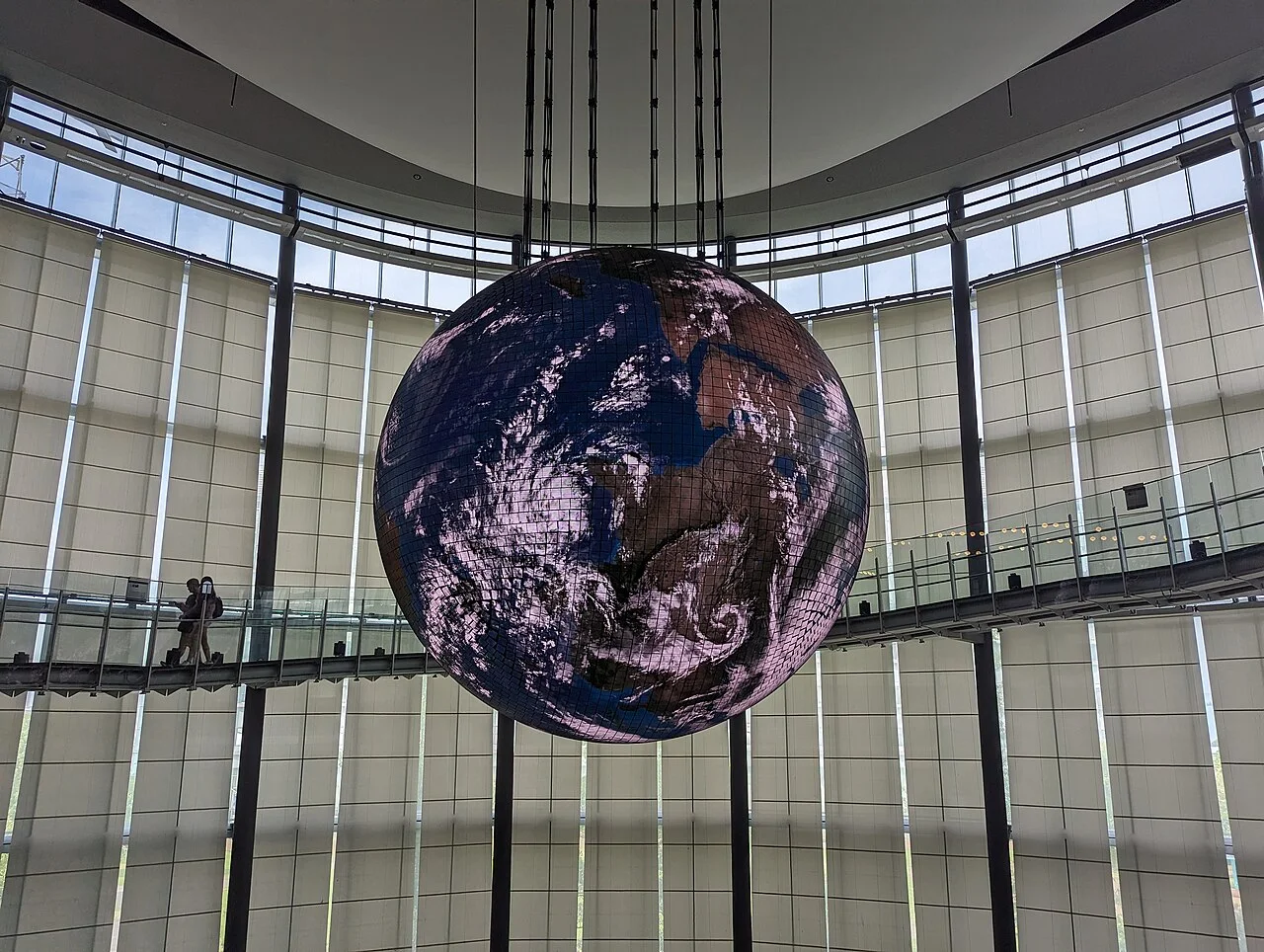
Miraikan's giant globe hangs in the soaring central atrium. Known as "Connected to Earth", this zone centres on Geo-Cosmos, which stays visible from the first floor all the way to the fifth. Start on 1F to take in the full sphere and see how high above the floor it floats. Move up to 3F and ask your child to sketch a coastline or photograph the cloud formations, then walk along the Oval Bridge towards 5F and hunt for that same patch again. Because the curve hides the far continents, every change of angle reveals a different slice of the planet—an easy activity for an eight-year-old before reading a single wall panel.
The sphere measures roughly 6 metres in diameter; during a previous overhaul, the museum lowered it from about 12 metres above the floor, replaced 10,362 panels, and rewired the display. Stand close and you can make out the individual tiled panels; step back a few paces and they blend back into seamless ocean. For children curious about how things are built, locate the suspension cables first and ask, "If one panel went dark, which angle would you spot it from first?" Zooming in on your phone photos later makes that detail easy to revisit. Geo-Cosmos specifications and renewal record
Daily imagery from weather satellites is projected directly onto the globe, while the base map tracks seasonal shifts in polar ice and vegetation. On a cloudy feed, pick one white cloud band to follow, then trace its edge down to the coastline. If it happens to be raining in Tokyo during your trip, challenge your child to point out whether clouds sit over Japan right now, then glance north towards the higher latitudes where seasons turn faster. Linking the rain outside to how satellites photograph storms from orbit connects naturally in one sentence.
Miraikan also turns water and ice cycles, surface temperatures, and social data into distinct globe programmes. On 3F, Geo-Scope lays those datasets out flat on interactive tables—tracking, for example, an Arctic tern's annual migration across the map. Where Geo-Cosmos invites the whole family to look up together, Geo-Scope lets you pause over one story, such as counting how many oceans that tern crosses along its route. If you want to catch a specific Geo-Cosmos film clip, check its atrium timetable separately from the 6F Dome Theater schedule, as both screening locations and ticketing differ. Geo-Cosmos globe programmes, Geo-Scope data display
Taking the curved ramp around the globe lets you pause whenever something catches your eye and step straight back into the galleries. If your child is mostly interested in taking photos, put them in charge of the camera, crouch down together to try two contrasting angles, and compare the shots side by side back at the hotel to see which makes Earth look roundest. Save the ramp for moments when everyone has the legs for a slow loop; if you are racing a dome slot or pushing a sleeping child, take the lift straight to 6F and save the globe for after the show. Just step aside from the main walkway when framing photos so others can pass.
| Floor / Area | What to Look For | Family Approach |
|---|---|---|
| 1F Entrance & Atrium | Geo-Cosmos, ticket desks, lockers | See the whole globe first, then head upstairs |
| 3F "Create Your Future" | Robots, Aging Park, Nanairo Quest, Information Desk | Pick up timed tickets first for long missions |
| 5F "Explore the Frontiers" | International Space Station, space research, disaster zones, nursing room | Start with whichever exhibit excites your child most |
| 6F | Dome Theater Gaia entrance | Arrive early according to your ticketed slot |
Third-Floor Robots: Which Mission Suits an Eight-Year-Old?
In the 3F permanent gallery "Create Your Future", start at "Hello! Robots" and spot Keparan with the "Ke" emblem on its chest. The exhibition also introduces PARO, a therapeutic robot shaped like a baby seal. Compare the two machines' expressions, movements, and the reactions they try to spark by starting with a familiar question: if a robot could do one job at home, would you want it to play alongside you or fetch things out of reach? The gallery highlights how robots are designed for very different roles as companions, so give your child time to explain their pick. Hello! Robots companions and exhibition guide
If your child is keen to spend a school-lesson's worth of time solving puzzles, you can plan "Nanairo Quest" around the museum's existing format once Miraikan reopens. Each group borrows a tablet and hunts for characters and clues inside a recreated future city. Route A ("Friend Robots") is recommended for primary-school age and up and takes around 40 to 60 minutes, while Route B ("Making Robots") and Route C ("Body Augmentation") run 60 to 80 minutes and target junior-high students and older. Anyone in Year 3 (around age nine) or below needs an adult along. An eight-year-old can take charge of finding the physical terminals while a parent reads out the prompts and talks through the choices together.
Timed-entry tickets for Nanairo Quest are issued on the day at the 3F zone. Visit the toilets before you start: under official rules, leaving mid-game means you cannot re-enter that session, and a full run takes considerably longer than neighbouring walk-up stops. Cross-check your booked Dome Theater slot first—if you start Route A at 11:00, a hypothetical 11:50 dome show collides with the game and its early check-in on 6F. In that case, shift the dome to the afternoon, or keep your dome slot and swap Nanairo Quest for the walk-up robots and Aging Park. Nanairo Quest tickets, ages, and duration
Also on 3F, "Aging Park" uses interactive stations to simulate how vision, hearing, movement, and memory can shift as people grow older. Walk through one sensory change together, then ask your child how big the lettering on a card to their grandparents ought to be, or where to stand so they can hear clearly. Tactile models showing different bone densities offer a concrete way in for hands-on learners. If queues are short, pick one station that sparks curiosity and save the rest of your energy for another theme. Aging Park exhibition overview
Travelling with younger children? Pin the Oyako Hiroba family play area—slated for renewal in the 2027 reopening—onto your museum map. Before closure, the space featured ramps for rolling objects and pegboards with cups and tubes to build custom ball runs: toddlers pick a ball and guess which bend it will drop out of while parents hand over the parts. Official guidance notes that timed-entry tickets apply on weekends, public holidays, and peak days. If you have both an eight-year-old and a pre-schooler, both Nanairo Quest and this play zone sit on 3F, so you can collect tickets and agree to meet back near the 3F Information Desk. Miraikan family play area
Fifth Floor: Step Inside the Space Station, Then Tackle One Disaster Exhibit
The fifth floor is labelled "Explore the Frontiers" on the museum map. With space-mad kids, head straight for "Inside the International Space Station". The gallery recreates a living module complete with sleeping bags strapped to the wall, a space toilet, and samples of astronaut food. Ask your child to compare where their pillow sits at home with why astronauts tether their sleeping bags vertically, then look around for everyday bedroom items that would float away. Starting from sleep and meals draws children in much faster than opening with the fact that the station orbits roughly 400 kilometres above Earth. International Space Station exhibition
From the living module, move to the LE-7A rocket engine model to bridge from daily life in orbit to how astronauts actually leave the ground. Miraikan's accessible route highlights this engine too, with handrails around the base so visitors can trace its sheer scale by touch. When time is tight, seeing just the habitat and the engine delivers a complete mini-story of getting up there and living there. Only if your child starts asking about distant stars should you continue into "The Unread Universe", where researchers probe space using light, gravitational waves, neutrinos, and particle accelerators. Tactile and audio exhibits guide, The Unread Universe
"The Unread Universe" wraps the gallery in sweeping observation footage, pairing each of its four research methods with an interactive station. At the gravitational-wave section, an eight-year-old can try the colliding black holes example. Headphones turn observation data into a few seconds of shifting audio—the very clue scientists listen for to identify the source. You do not need to explain the maths: simply mention that the sound translates raw signals into something human ears can hear, then let your child describe what they heard. Quiet models and artworks sit nearby for anyone needing a calmer pace.
Families curious about earthquakes and volcanoes can see how those forces unfold inside "Mission Survival: 10 Billion People". The exhibit connects Earth systems with human society inside a single central model backed by touchscreens for specific topics. If your children have never practised an earthquake drill at school, ask them to spot one hazard in the model first, then talk about where to look for exit signs in an unfamiliar hotel versus at home. If disaster imagery starts feeling heavy, step across to the space station or the 5F lounge, and save checking the hotel's emergency map for when you get back. Mission Survival: 10 Billion People exhibition guide
On the same floor, "Planetary Crisis" focuses squarely on climate change. Framed through real-life stories from Fiji, parts of the display combine spatial audio, wind, vibration, and heat alongside tactile 3D charts tracking temperatures and emissions. Children who enjoy sensory setups can watch the theatre segment first and then run their hands over the charts to separate dramatic effects from measured data. For family members sensitive to strong stimuli, ask staff which zones to skip and start with the tactile charts or the familiar globe downstairs. Under existing operations, this exhibit uses numbered tickets issued separately from Nanairo Quest's timed slots. Planetary Crisis overview
Pushchairs and Wheelchairs: Build Rest Stops Into Your Route
According to Miraikan's visitor services page, both pushchairs and wheelchairs can be borrowed at the 1F entrance counter. Lifts connect all floors, and floor maps are available at the 3F Information Desk. If you are bringing a wide pushchair or power wheelchair, check doorway dimensions in advance: the English accessibility page lists internal museum lift entrances at 100 cm wide, compared with 80 cm for the underground car park lift. Factor in whether you are arriving at street level or from the car park before planning your route. Pushchairs must be left in the designated buggy bay outside the 6F Dome Theater, so pull out anything you need before entering and repack after the show.
A nursing room and a quiet room sit on 5F, while nappy-changing tables are installed in multi-purpose toilets on every floor. The quiet room offers a low-stimulation space away from crowds and bright lights, though it is not soundproofed. A limited supply of sensory support items—including ear defenders, sunglasses, and tactile grip balls—can also be borrowed on the day at the 3F Information Desk. If your children already burned off energy elsewhere in Odaiba, mark the quiet room and toilets on your map as soon as you arrive. When planning two stops on 5F, put the lounge and quiet room between them for a breather.
Keep adults fuelled too by knowing where food and water are allowed. Under the pre-closure layout, dining and lounge areas were located on 1F, 5F, and 7F, where outside food may be eaten in designated zones. Special events occasionally occupy parts of these lounges, and cafe and restaurant operations are also slated for adjustment in the 2027 reopening. If one adult is with a pushchair while another takes an older child up to 5F, agree which lounge floor to meet on and wait until you reach it before unpacking snacks. Whoever still has energy after eating can head back to the rockets while the others take the lift straight down to 1F. Museum dining and lounge areas
Permanent exhibit labels are mainly in Japanese and English, and bilingual floor guides are available. If children want to lead the way from the ground floor, circle 3F, 5F, and 6F on the map and have them look for the signs reading "Geo-Cosmos" and "Dome Theater". Up on 5F, pair the English names with the physical models: spot "ISS" and hunt for the sleeping bags, or find "LE-7A" and look for the engine. If a whole floor plan feels overwhelming for younger readers, fold it to show only the next floor and symbol, then let them pick the next stop once you arrive. Accessibility and family facilities, Official floor map
Telecom Center vs Tokyo International Cruise Terminal: Pick the Closer Stop
Arriving on the Yurikamome from Shimbashi, your train reaches Tokyo International Cruise Terminal Station (U08) first, roughly a 5-minute walk from the museum. Coming from the Toyosu side, you reach Telecom Center Station (U09) first, about a 4-minute walk away. Because the two stops sit side by side, getting off at whichever arrives first saves a station hop with tired kids. Families travelling from Shimbashi still get window seats for the Rainbow Bridge and harbour views, while those coming from Toyosu can pair Miraikan neatly before or after Toyosu attractions. Miraikan listed walking routes
Both Tokyo International Cruise Terminal Station and Telecom Center Station have lifts linking street level, the ticket gates, and the platforms. When checking timetables or maps, search directly for "Miraikan" or the address "2-3-6 Aomi, Koto-ku, Tokyo"; searching only for "Terminal" in English can steer map apps towards the cruise ship building instead, so follow the station exit signs for the museum when pushing a buggy. You can also walk in about 15 minutes from Tokyo Teleport Station on the Rinkai Line from Shinjuku or Shibuya, though factor that extra stretch into your choice of line if it is raining or little legs are flagging. Yurikamome U08 station map, Yurikamome U09 station map
If you only have half a day after Miraikan reopens, allow two to three hours for one headline gallery plus unhurried wandering. For robot enthusiasts, head straight to 3F for the day's events and Nanairo Quest slots, filling any wait with Geo-Cosmos or Aging Park. Alternatively, make space your centrepiece: take the lift up to 5F for the ISS habitat and rocket engine, take a breather in the 5F lounge if needed, and stroll down the Oval Bridge ramp past the globe at the end. If you add a Dome Theater screening, make that your single fixed anchor and keep long quests optional so lift queues and toilet breaks never feel rushed.
Trying to fit a special exhibition, the dome, and the permanent galleries all into one visit? Put lunch cleanly between morning and afternoon rather than darting non-stop across 3F, 5F, and 6F. After an hour of intense focus on Nanairo Quest, give children a visual breather walking past the globe before tackling text-heavier displays after lunch. Before heading back into central Tokyo, decide together whether to eat dinner by the bay or return straight to your hotel. If you are stringing DiverCity, the waterfront, and Miraikan into one outing, use this Odaiba day plan to sequence the blocks and pick one outdoor stop you are happy to drop if the museum grabs everyone's attention.
| Station | Walk to Miraikan | Best Coming From |
|---|---|---|
| Yurikamome U08 Tokyo International Cruise Terminal | Approx. 5 min | Shimbashi, Shiodome, and the Odaiba side |
| Yurikamome U09 Telecom Center | Approx. 4 min | Toyosu and Ariake side |
| Rinkai Line Tokyo Teleport | Approx. 15 min | Direct Saikyo Line services or stations along the Rinkai Line |
A few useful answers
Is Miraikan open right now?
The entire museum, including the permanent exhibitions and Dome Theater, is closed from 1 October 2026 to 22 April 2027. Miraikan has announced it will reopen on Friday, 23 April 2027.
Do I need a Dome Theater ticket to see the giant Geo-Cosmos globe?
Geo-Cosmos hangs in the open atrium and is visible from the ground floor. A Dome Theater ticket buys a reserved seat inside the 6F Gaia theatre; if you want to explore the permanent exhibitions on 3F and 5F, you need a permanent exhibition ticket.
How long does Nanairo Quest take for an eight-year-old?
Route A, recommended by the museum for primary-school children, takes roughly 40 to 60 minutes. Timed-entry tickets are collected on the day at the 3F exhibition zone on a first-come, first-served basis, and children in Year 3 (around age nine) or younger must be accompanied by an adult.
Can I buy Dome Theater Gaia tickets on the day?
Remaining same-day seats are sold at the outdoor ticket counter, though you cannot choose your seats in person. According to the museum website, online sales with seat selection open one week before your visit, and no entry is permitted once a screening begins.
Which station is best for Miraikan with a pushchair?
If you are travelling from Shimbashi, get off at Tokyo International Cruise Terminal Station (U08) for a roughly 5-minute walk. Coming from Toyosu, alight at Telecom Center Station (U09) for a 4-minute walk. Both stations have lifts.
Where can we take children in Odaiba if Miraikan is closed and it rains?
Take the Yurikamome to Odaiba-kaihinkoen Station and walk about 2 minutes to DECKS Tokyo Beach. For children aged three to ten who love building, try LEGOLAND Discovery Center Tokyo; if you want rides, check the height and accompaniment rules at Tokyo Joypolis first.
Official information and references
Sources used in this guide.
- Miraikan full-closure dates and reopening announcement
- Miraikan 2027 reopening exhibitions, Dome Theater programme, and facility updates
- Miraikan special exhibition "Henshin" dates, venue, and ticket pricing status
- Miraikan off-site events during the refurbishment closure
- Miraikan opening hours, admission fees, combo tickets, and timed-entry passes
- Miraikan online ticket booking for permanent exhibitions and Dome Theater
- Miraikan Dome Theater entry rules and current screening status
- Miraikan Dome Theater Gaia technical specifications and overview
- Miraikan floor map and sensory map
- Miraikan Geo-Cosmos cloud imagery and globe programmes
- Miraikan Nanairo Quest recommended ages, timed-entry tickets, and duration
- Miraikan Aging Park interactive exhibition overview
- Miraikan International Space Station living quarters and research exhibits
- Miraikan disaster exhibition Mission Survival: 10 Billion People
- Miraikan climate exhibition Planetary Crisis
- Miraikan accessibility guide, pushchairs, nursing room, and quiet room
- Miraikan wheelchair seating booking and multilingual services
- Miraikan directions and walking times from nearby stations
- LEGOLAND Discovery Center Tokyo entry rules and target ages
- Tokyo Joypolis access and walking times from stations
- Tokyo Joypolis attraction height and accompaniment restrictions
- National Museum of Nature and Science Ueno visitor guide
- Miraikan Geo-Cosmos Online free interactive experience
- National Museum of Nature and Science Ueno Global Gallery permanent floors
- Miraikan online ticketing portal (reopening day status and fee details)