Compare the ¥500 permanent-collection ticket, current Turner exhibition and student and senior concessions. Plan free architecture areas, 2027 collection closures, online ticket terms, accessibility and a half-day Ueno route.
- Region & Focus
- TokyoAttractions
- Reading Scope
- 35 min read · 17 chapters · 6 Q&As
- Official Verification
- 16 official sources checkedUpdated 9 November 2026
- Key Topics
- BookingItinerariesNeighbourhoods
Chapter Route Map (tap any stop)
- Choose Western art, the current exhibition or architecture first
- How it differs from Tokyo National Museum, and whether to combine them
- The ¥500 permanent ticket: check each companion’s eligibility
- The Turner exhibition is open: ticket inclusions change in January 2027
- Student free dates, senior discounts and pair tickets
- Online tickets reduce counter time, but allow for entry queues
- Free days and evening openings in autumn and winter 2026
- Architecture visitors can reach the free Nineteenth-Century Hall
- In the forecourt, connect paving, sculpture and building
- Begin with the Matsukata Collection and choose a few works
- A small exhibition may be included with permanent admission
- Use your own phone for audio; architecture has a separate digital route
- Wheelchairs, pushchairs and companions who need a quieter pace
- Handle photography, bags and breaks before they interrupt viewing
- Plan CAFÉ Suiren before the last meal order
- Arrive from JR Ueno’s Park Exit, with one short park walk afterwards
- Friday and Saturday evenings: finish by 20:00
- Quick Q&A
For Western paintings and Rodin, start with the ¥500 permanent collection. For the Turner exhibition opening in autumn 2026, use its ticket to plan a same-day visit. Architecture visitors can begin with the free forecourt and Nineteenth-Century Hall, giving half a day in Ueno to a museum they actually want to explore.
Choose Western art, the current exhibition or architecture first
A rewarding half-day at the National Museum of Western Art gives enough time to one purpose: Western painting and sculpture in the permanent collection, a special exhibition, or Le Corbusier’s main building from forecourt to interior. These need different tickets. For the exterior, Nineteenth-Century Hall and shop, begin with free areas. Entering permanent galleries requires the ordinary ¥500 ticket. The current special exhibition has its own price; a permanent ticket alone does not admit you.
For a first visit without a particular exhibition in mind, the permanent collection is straightforward. The museum FAQ gives an average viewing time of about 1–1½ hours. Allow two to three hours with entry, forecourt and rests. For Turner’s landscapes or dialogue with contemporary art, centre the visit on the current Tate Turner exhibition, adding the permanent collection that day. A Turner ticket means no separate ¥500 permanent ticket is needed.
The museum is at 7-7 Ueno-koen. Its Japanese name is 国立西洋美術館 and its English name is The National Museum of Western Art. Use the full name for tickets, maps and meeting friends. Ueno also has Tokyo National Museum and Tokyo Metropolitan Art Museum, each with popular exhibitions. “See you at the Ueno art museum” can leave people at different counters.
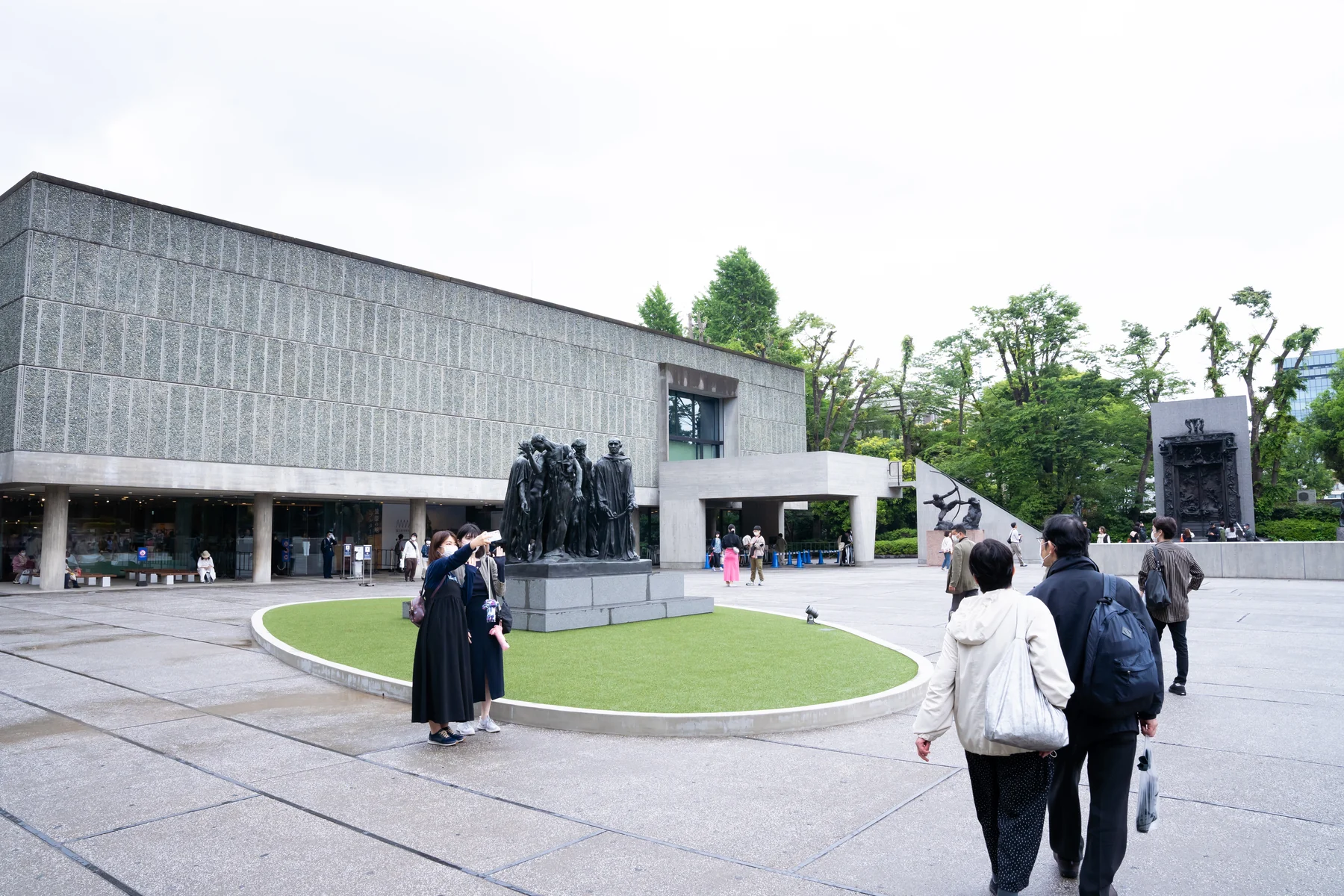
Compare the ¥500 permanent-collection ticket, current Turner exhibition and student and senior concessions. Plan free architecture areas, 2027 collection closures, online ticket terms, accessibility and a half-day Ueno route.
How it differs from Tokyo National Museum, and whether to combine them
The National Museum of Western Art focuses on Western paintings, sculpture, prints and drawings, with the main building an attraction itself. Tokyo National Museum suits Japanese art, crafts and archaeology. Choose the former for Monet, Rodin or changes across Western painting periods. Give the latter its own main slot for Buddhist sculpture, swords, ceramics and Japanese painting. Decide before buying.
Each museum has separate tickets, closing days and free-admission rules. The Western Art museum’s free permanent admission for ages 65 and over does not automatically apply at Tokyo National Museum. Turner admission also distinguishes upper-secondary pupils from junior-high pupils and younger children. A Tokyo National Museum ticket or another exhibition ticket does not admit you here. Any current reciprocal discount requires eligible tickets at specified counters; a discount is different from shared admission.
With half a day, choose one museum plus a meal or short park walk. Two consecutive visits add standing, reading and ticket handling at two entrances. For newcomers to art, young children and older people, the second can become a rush. For depth at both, give Ueno a full day with lunch between them and no tightly timed cross-city activity afterwards. See the Tokyo National Museum section of the Tokyo neighbourhood guide for that museum.
The ¥500 permanent ticket: check each companion’s eligibility
The official visitor information lists individual permanent admission at ¥500 for adults and ¥250 for university students. Upper-secondary pupils and younger visitors, anyone under 18, and those aged 65 or over enter free. Bring student identification for university rates and proof of age for age-based exemptions. List each family member’s age and school stage before buying. Students and staff at National Museum of Art Campus Members institutions have separate free eligibility with identification.
Two ordinary adults and an eight-year-old pay ¥1,000 for the permanent collection. One adult and a 68-year-old pay ¥500. These are admission examples, excluding food, transport and shopping. Buy online only for paying members and bring each exempt person’s documents; there is no need to buy extra tickets simply to enter together.
Holders of listed disability certificates and one companion enter the permanent collection free. The accessibility page accepts Mirairo ID; eligible visitors show proof at entry without joining the ticket queue. Overseas visitors with another document format can ask the service counter to assess it before paying. Groups of 20 or more use a separate reservation process. A ticket category needs 20 people for that category’s group rate; do not combine different eligibility categories into one discount.
| Visitor | Permanent collection | Turner exhibition | Conditions |
|---|---|---|---|
| Ordinary adult | 500 | 2,400 | Turner includes open permanent galleries on the same day |
| University student | 250 | 1,500 | Student ID; Turner free 4–19 November |
| Upper-secondary pupil | Free | 1,100 | Turner free 4–19 November with student ID |
| Junior-high-school pupil or younger | Free | Free | Bring age or school-stage proof |
| Age 65+ | Free | Ordinary rate; 2,000 during specified period | Show proof at the counter, 24 October–8 November |
The Turner exhibition is open: ticket inclusions change in January 2027
When checked on 27 October 2026, the special exhibition was “Turner from Tate: Sublime Painting in Dialogue with Contemporary Art”, running 24 October 2026–21 February 2027 in the special exhibition galleries. Admission is ¥2,400 for adults, ¥1,500 for university students and ¥1,100 for upper-secondary pupils; junior-high pupils and younger enter free. University and upper-secondary students must show student ID. The ¥2,200 adult advance sale ended on 23 October. That old advance price is no longer an available ordinary fare.
The exhibition places Turner alongside contemporary art. Listed works include The Fall of an Avalanche in the Grisons, a whaling oil painting, Olafur Eliasson’s glacier imagery and video by The Otolith Group. For landscape, light and natural forces, with time for video and thematic interpretation, it offers more than finding one familiar painting. For a quick look at Monet and Rodin, permanent galleries and forecourt fit better.
A Turner ticket includes the permanent collection on the viewing day, but permanent galleries close from 12 January–21 February 2027 during the exhibition. In autumn 2026, both can be visited together; from mid-January 2027, Turner remains available without that same permanent display. The visitor page separately projects permanent-collection maintenance through 19 March 2027. If the collection is the main reason to travel, avoid that closure.University students viewing the Turner exhibition free from 4–19 November 2026 pay an additional ¥250 for the collection; those meeting the collection’s free-admission conditions pay nothing.
Student free dates, senior discounts and pair tickets
Turner admission is free for upper-secondary and university students from 4–19 November 2026. Eligible visitors need not buy ahead: bring student ID to the museum ticket counter. Families visiting then should establish student eligibility before buying other adult tickets. Free student entry does not extend to accompanying adults. Junior-high pupils and younger use the exhibition’s existing free admission.
Visitors aged 65 or over can buy an adult Turner ticket for ¥2,000 at the museum counter on their visit day from 24 October–8 November 2026, with proof of age. This is a limited-period ¥400 discount. A 68-year-old enters the permanent collection free but still pays for Turner. Family members with different interests can choose separately and meet in the free hall or café.
The official exhibition ticket page also lists a ¥4,200 Rakuten Travel pair ticket, sold until 20 December 2026 and usable until 11 January 2027. Against two ordinary ¥2,400 tickets, it saves ¥600. Both people must want the exhibition and visit within that period. February 2027 visitors need ordinary tickets valid for their dates. The museum page still describes the ¥1,500 permanent-collection Passport but marks it sold out, so it is not a new purchase option for this trip.
Online tickets reduce counter time, but allow for entry queues
The museum links to official permanent-collection e-tix, currently selling tickets valid 1 October 2026–11 January 2027. Adult and university tickets admit one person once within that period, with no re-entry. Cancellations, changes, refunds and reissues are not accepted. A wrong category cannot be corrected simply by paying the difference. Confirm your date falls during gallery opening and check numbers before paying.
Official Turner e-tix says there is no advance reservation system. Crowding may bring entry limits or numbered admission tickets. Buying online removes the purchase-counter stage, but you may still wait at the exhibition entrance. Its ordinary ticket also gives one person one use during the exhibition, with no cancellation or changes after purchase. An untimed ticket still needs a margin before a fixed departure.
Both online tickets provide a QR code from the completion page or confirmation email link for phone display. Alternatively, print one A4 ticket per person, keeping the QR code and adjacent serial number clear. Payment options list VISA, Mastercard, JCB, AMEX and d-barai, with 3D Secure card authentication. Overseas visitors should prepare a suitable card and email access. Check the actual email and ticket rather than saving only the payment notification.
If companions arrive separately, decide who holds each ticket and retain the original reopening link. Before leaving the paid area for food or errands, ask staff about the route. Permanent e-tix explicitly prohibits re-entry. For meal or merchandise combinations, read the specified shop, collection deadline and change terms separately. A meal or product voucher is not another exhibition ticket.
Free days and evening openings in autumn and winter 2026
The permanent collection normally has Kawasaki Free Sunday on each month’s second Sunday, plus International Museum Day on 18 May and Culture Day on 3 November. For this autumn and winter, official free permanent-admission dates include 3 and 8 November, 13 December 2026 and 10 January 2027. The concurrent small exhibition is included. Use dates to adjust spending if the collection is your goal; Turner retains its own admission rules.
Ordinary opening is 9:30–17:30, extended to 20:00 on Fridays and Saturdays. Last entry is 30 minutes before closing. The FAQ says free permanent admission on the second and fourth Saturdays and after 17:00 on Fridays and Saturdays ended in April 2023. Evenings still suit an after-work or shopping visit, but use current prices rather than an old guide’s free-after-five advice.
The museum normally closes on Mondays. If Monday is a national or substitute holiday, it opens and closes the next working day. Turner specifically lists openings on 23 November 2026 and 11 January 2027, closures on 24 November and 12 January, plus 28 December 2026–1 January 2027. Exclude these closures from a New Year museum plan. Park access does not mean galleries are open. Allow entry queues on free days and weekends.
Architecture visitors can reach the free Nineteenth-Century Hall
Le Corbusier’s main building was completed in 1959. Together with its forecourt, it forms part of the architectural work inscribed as World Heritage in 2016: 17 sites across seven countries. The grey façade is a starting point. Inside, see how space develops around the central hall for a fuller understanding.
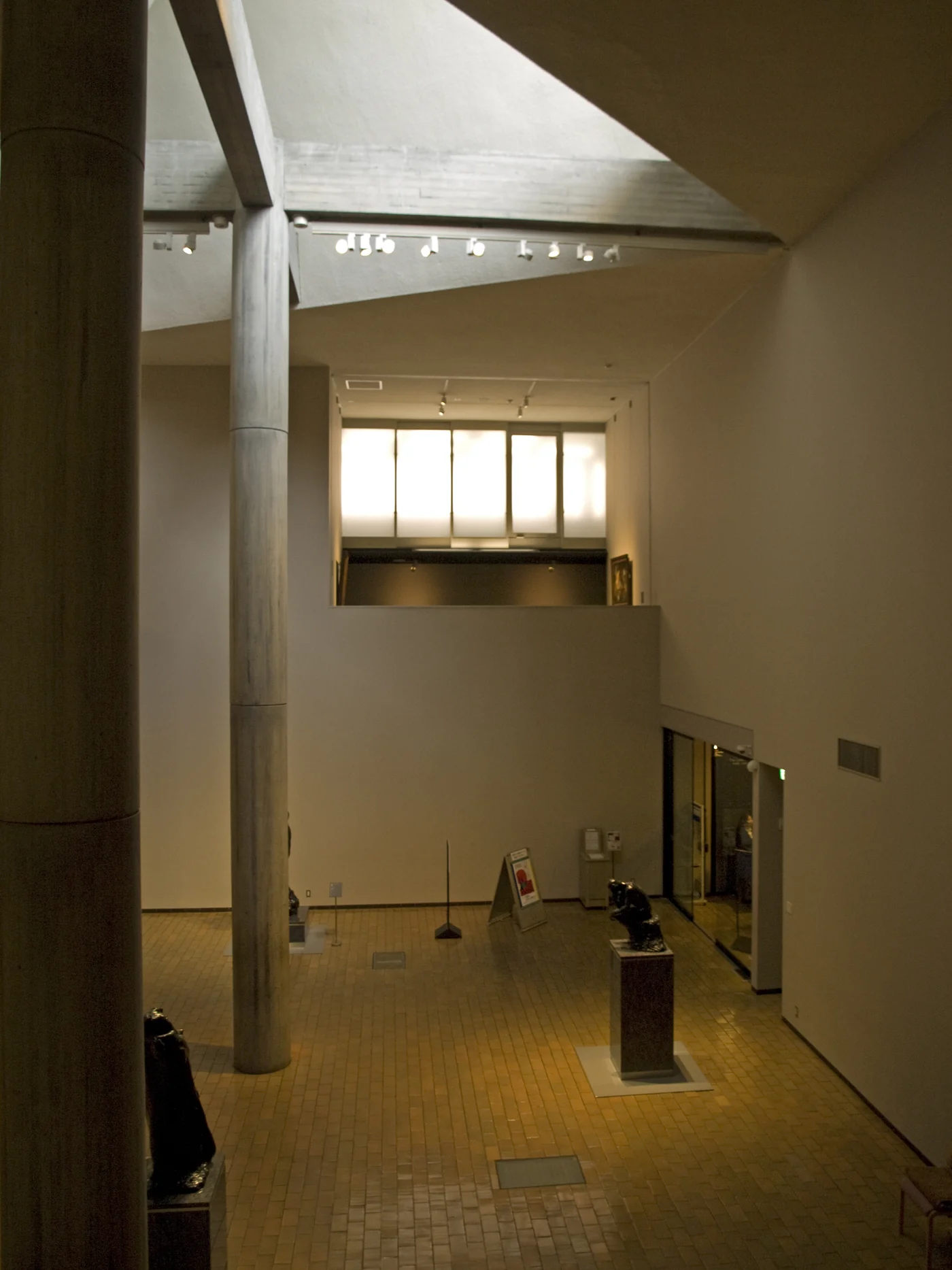
The official floor plan marks the main lobby, Nineteenth-Century Hall, CAFÉ Suiren and museum shop as the Free Zone, requiring no exhibition ticket. This gives a short architecture visit an interior component. Continuing into permanent galleries for fourteenth- to eighteenth-century painting, the Matsukata Collection and nineteenth- to twentieth-century art requires a permanent ticket or qualifying same-day special-exhibition ticket. Locate the ticket boundary in the lobby.
Distinguish the main building from later additions. The 1979 New Wing was designed by Kunio Maekawa’s architectural office. The 1997 special-exhibition building extends beneath the forecourt. Today’s museum was not all completed in 1959. Focus on the main building and forecourt for Le Corbusier, or follow special-exhibition signs for Turner. Find your chosen area on the plan and give the remaining time to art.
In the forecourt, connect paving, sculpture and building
The museum’s building guide says the 2020–2022 forecourt renovation sought to recover the original design intent, including western access, see-through fencing, positions of some Rodin sculptures and paving joints. As you approach from the park, observe the sightlines between sculpture, open ground and the main building.
From the west, look for a T-shaped line across the ground: one part leads towards The Gates of Hell, turning towards the building along the way. The museum describes these conspicuous joints as guiding visitors, restored using Modulor dimensions based on the human body and golden ratio. You need not memorise measurements. Follow the lines to see how people are led towards the architecture.
Rodin’s The Thinker, The Burghers of Calais and The Gates of Hell are useful landmarks. See their overall positions, then approach within permitted routes to examine poses, proportions and group relationships. There is no need to collect every camera angle. In rain, shorten this part and enter the hall, returning outside when conditions improve. The FAQ places separate restrictions on commercial photography and use of the forecourt’s Thinker. Treat personal souvenir pictures and commercial material separately.
Begin with the Matsukata Collection and choose a few works
The museum was founded around the Matsukata Collection. Kojiro Matsukata began collecting European art during the First World War, intending a museum in Japan. Economic crisis and war later scattered the collection. Works remaining in France were returned as a gift, leading to the museum’s establishment in 1959. This explains the importance of modern French painting and sculpture here.
The permanent collection ranges from the late medieval period to the twentieth century. The floor plan separates earlier painting, Matsukata holdings and nineteenth- to twentieth-century art. Choose two things to compare, such as clothing and light in portraits, religious narratives and everyday scenes, or painted colour and sculpted form. Each room then offers a specific way to look without requiring every panel.
With around an hour, stop at a few works that attract you and notice changing periods and subjects between rooms. With 1½–2 hours, add the prints and drawings room and architecture. For a favourite artist, consult the official current permanent-display list and floor plan before using collection records to read about works. Collection records and the current display list serve different purposes. Follow what is actually on view for the visit route.
A small exhibition may be included with permanent admission
From 20 October 2026–11 January 2027, the New Wing’s second-floor prints and drawings room hosts “Images of the Theatre: From Delacroix and Daumier to Toulouse-Lautrec and Klinger”. This small exhibition accepts a same-day permanent ticket, or a same-day Turner ticket during its opening period. Check venue and admission rather than buying another ticket merely because a title says “exhibition”.
About 50 works by 19 artists connect modern urban theatre culture, including Delacroix’s Hamlet series, Daumier’s audience scenes and theatre posters. Music, drama, printing and graphic-design enthusiasts can add it to the collection route. It also offers companions less keen on oil painting an approach through stages, publicity and spectators. Paper works have different scales and viewing distances; read a small group slowly rather than circling the whole room quickly.
The permanent collection also has features such as conservation displays in this period. A repeat visit can focus on preservation, restoration and presentation rather than subjects alone. Allocate time after collecting current information. For theatre works, begin on the New Wing’s second floor and shorten general painting. After a long Turner visit, choose just a favourite permanent section and preserve a seated rest.
Use your own phone for audio; architecture has a separate digital route
The permanent collection’s official audio guide covers 29 works through a phone browser, with no separate app. The museum recommends NMWA_Free_Wi-Fi. Bring your phone and earphones, find audio symbols and numbers beside works, then select them online. Numbers do not follow display order, and the page includes works temporarily off view during changes. Choose items rather than following every number from 1 to 29.
For architecture, “Explore World Heritage at Your Fingertips” provides digital content. The World Heritage corner in the Nineteenth-Century Hall has 3D architectural sections and spatial views. Five QR points cover the exterior and roof, hall, lighting gallery, former director’s office and stairs. Locations 3, 4 and 5 require permanent-collection admission. Alternate the phone’s otherwise unseen spaces with the architecture in front of you.
Roof and former-director’s-office views are digital experiences, not directions into publicly accessible spaces. With children, share one hall section view and choose a comprehensible structural detail. Adults studying further can read the building page at home and spend less entrance time setting up a phone. The museum does not lend phones or earphones for the ordinary audio guide. Bring both and sufficient battery.
Wheelchairs, pushchairs and companions who need a quieter pace
The accessibility information gives a step-free route from JR Ueno Station’s Park Exit. The main building’s ground floor has a multifunction toilet, ostomy facilities and a family toilet; basement level 2 of the special-exhibition building also has accessible toilets. Use the floor plan and show staff which galleries you need, following lift routes. The architectural ramp need not become everyone’s route.
Wheelchairs and pushchairs may be borrowed, subject to limited availability. The FAQ allows personal pushchairs, though crowding may restrict use. For a child with a fixed nap, familiar equipment and one main gallery area are easier than relying on loans. Infants may enter. Ask staff before a brief gallery exit to settle a child, distinguishing a temporary pause from leaving the museum for ticket handling.
Locate changing facilities on the main building’s ground floor or basement level 2 of the special-exhibition building, and ask the desk about the nursing room. Services include writing boards, Braille and tactile guides, and a Social Story using photographs and simple text to explain arrival and departure. Read it beforehand with family members who benefit from a familiar process. Six non-reservable tablets offer permanent-collection commentary in Japanese Sign Language with Japanese subtitles. Ask at the desk on arrival before choosing the viewing order.
The museum demonstrates its permanent-collection commentary in Japanese Sign Language with Japanese subtitles. Companions needing a loan tablet can preview its operation and commentary format, then ask at the service desk on arrival.
Handle photography, bags and breaks before they interrupt viewing
Photography of permanent-collection works is generally allowed, with exceptions. Flash and tripods are prohibited, and crowding may stop all photography. Loans from other museums are generally not photographable, so follow actual special-exhibition signs for Turner. Turn off flash and sounds, and record titles and artists instead of blocking labels for a whole-wall picture.
Use the museum’s refundable ¥100 lockers for large hand luggage, bringing a coin. Ask staff if lockers are full. On arrival day with suitcases, store them at the hotel or station first and treat the museum as a proper visit rather than a family packing area. There is no museum car park. Drivers need paid parking around the park and time for dropping off, entering and collecting the car.
Visitors cannot eat their own food on museum premises, including the forecourt. Arrange children’s snacks at a permitted place before entering, then use the café or eat a main meal after leaving. The shop needs no exhibition ticket. Buy catalogues and postcards afterwards, guided by works you liked. Companions not seeing exhibitions can wait in free areas. Agree on the main lobby or café entrance rather than an unspecified exit.
Plan CAFÉ Suiren before the last meal order
CAFÉ Suiren faces the courtyard and serves Western-style meals, cakes and set menus. It needs no exhibition ticket, accommodates wheelchairs, has limited high chairs and permits baby food. It can provide a seated family meal, subject to the actual queue. Neither individual nor group reservations are accepted, so a lunch seat cannot be secured in advance.
Ordinary hours are 10:00–17:30. Meals begin at 11:00 with last orders at 16:45; drinks and desserts finish ordering at 17:15. Fridays and Saturdays extend to 20:00, with meal last orders at 19:10 and café orders at 19:30. Food service can end early. Check the day’s notices before choosing exhibition or meal first. Leaving Turner at 19:30 may allow a drink but misses the meal cutoff.
For the permanent collection, view for 60–90 minutes and ask about routes before leaving the paid area, then use free spaces and the forecourt after lunch. With a non-re-entry permanent e-ticket, the simplest plan is all paid galleries first, followed by food, shop and hall. Architecture-only visitors can eat before the free areas without buying an exhibition ticket for the restaurant.
Arrive from JR Ueno’s Park Exit, with one short park walk afterwards
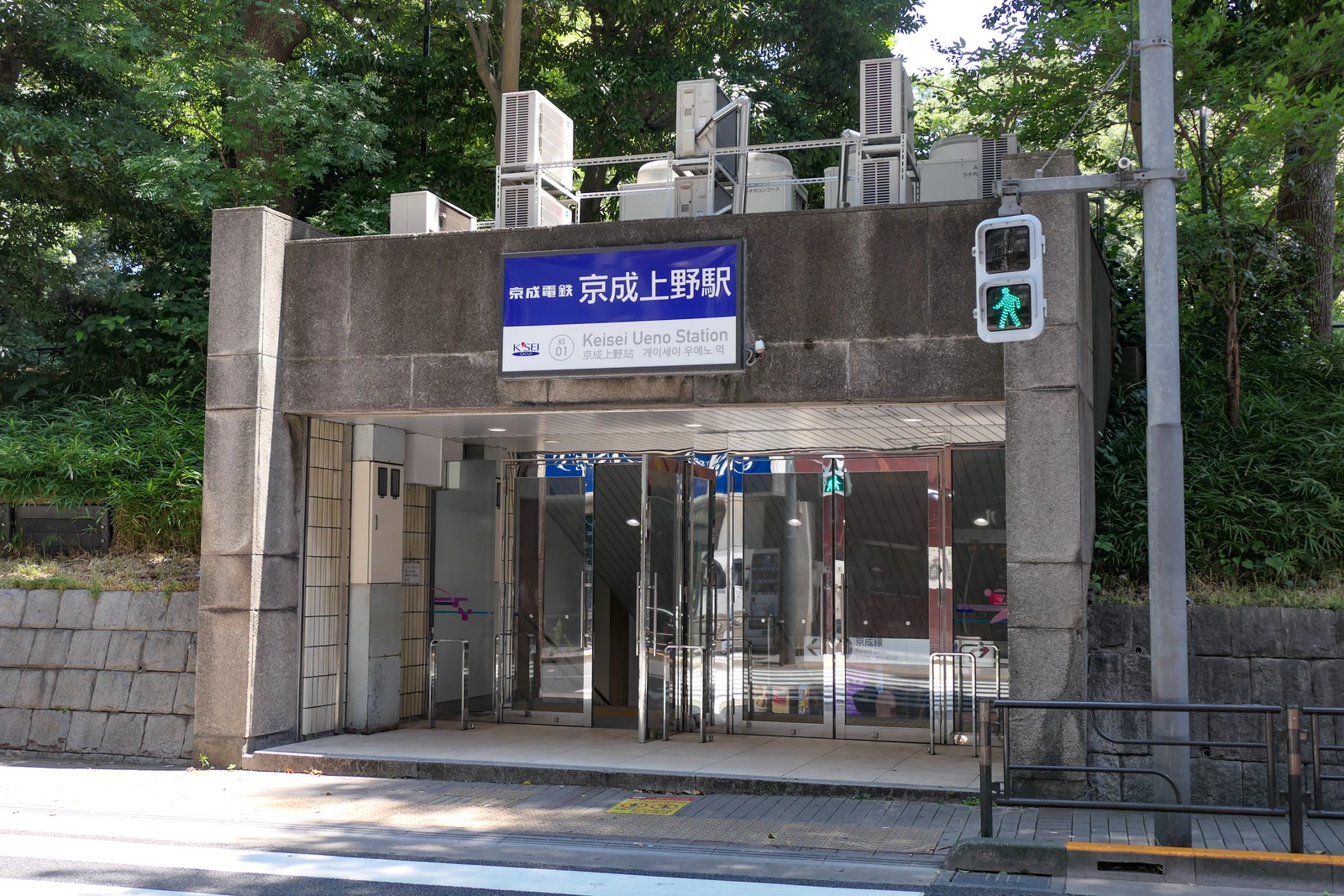
The official access page gives about one minute from JR Ueno Station’s Park Exit, seven minutes from Keisei Ueno and eight minutes from Ueno on the Tokyo Metro Ginza and Hibiya lines. These walks start at the relevant exits; JR passengers still need to reach the Park Exit. Metro arrivals need not transfer to JR to chase a one-minute claim. Walk towards Ueno Park from your own exit.
For a collection-focused morning, enter around 9:30, see the hall and paid galleries, and finish the main viewing around 11:30. After lunch, walk towards the fountain plaza and return according to energy. Slow readers can omit the park and stay inside. If entry queues delay you, move lunch later rather than rushing every gallery in the last half-hour.
For Turner, give it the morning’s fullest block. Eat afterwards, then decide whether you have energy for the included permanent collection. Keep the park optional, perhaps only the path to the fountain plaza. Do not add full zoo, Tokyo National Museum and Ameyoko visits. In rain, replace the walk with hall, shop and café. For other Tokyo areas on separate days, see the Tokyo half-day and full-day neighbourhood plans.
Friday and Saturday evenings: finish by 20:00
After work or shopping, arrive around 17:30 for main permanent works followed by the free hall. For Turner, arrive earlier to include queues, video works and gallery changes. The 19:30 last entry still leads to 20:00 closing. With only half an hour, narrow the viewing target or make a brief free-area visit and return for a full slot.
For dinner inside, work backwards from the 19:10 meal cutoff. The 20:00 museum closure is not the last restaurant order. For fixed meals, medication or children, eating before the galleries is usually easier. If you intend to return to a paid area after eating, check your ticket’s entry rules before scanning. Plan evening transport using the JR, Keisei or Metro direction you actually need. If separating for viewing, meet at a named point outside the entrance.
Before leaving, save current exhibition and closure dates, the original seller’s QR code and terms, access information and the floor plan. From 12 January 2027, choose an open Turner date if that is your goal. For the permanent collection, wait for the reopening announcement after the projected March maintenance period before choosing a date.
A few useful answers
Are the National Museum of Western Art and Tokyo National Museum the same museum?
No. They sell separate tickets. The former focuses on Western painting, sculpture and Le Corbusier’s building. Give Tokyo National Museum’s Japanese art, crafts and archaeology a separate main visit.
Do I need a ticket just for Le Corbusier’s architecture?
The floor plan marks the main lobby, Nineteenth-Century Hall, café and shop as free areas. Permanent galleries require a permanent ticket or a valid same-day special-exhibition ticket that includes them.
Do I need a separate permanent ticket with Turner admission?
Turner admission includes open permanent galleries on the same day. They are closed from 12 January–21 February 2027 during Turner’s run, so cannot be added then.
Is permanent admission still free after 17:00 on Fridays and Saturdays?
That measure ended in April 2023. Current evening opening ends at 20:00, with last entry at 19:30, under current prices and eligibility rules.
Can I cancel an online ticket or re-enter?
Official permanent e-tix prohibits cancellations, changes, refunds, reissues and re-entry. Official Turner e-tix also prohibits cancellation or changes after purchase and allows one person one use during the exhibition.
Which early-2027 dates should I avoid for the permanent collection?
The visitor page projects permanent-gallery maintenance from 12 January–19 March 2027. Turner runs on open days until 21 February. For the collection, choose dates using the reopening announcement after maintenance.
Official information and references
Sources used in this guide.
- Visitor information, prices, sold-out permanent Passport and closures
- Current Turner exhibition: dates, prices and student and senior offers
- Official Turner ticket types and sellers
- Official permanent e-tix: validity, QR codes and cancellation rules
- Official Turner e-tix: ordinary tickets and cancellation rules
- Free and ticketed areas: floor plan
- Main building, forecourt restoration and digital architecture
- Formation and return of the Matsukata Collection
- Current permanent displays and floor plan
- Theatre images small exhibition and accepted tickets
- Permanent-collection phone audio guide
- Accessibility facilities and Social Story
- Photography, infants, pushchairs and luggage FAQ
- CAFÉ Suiren hours and last orders
- Access from Ueno stations
- Official opening calendar