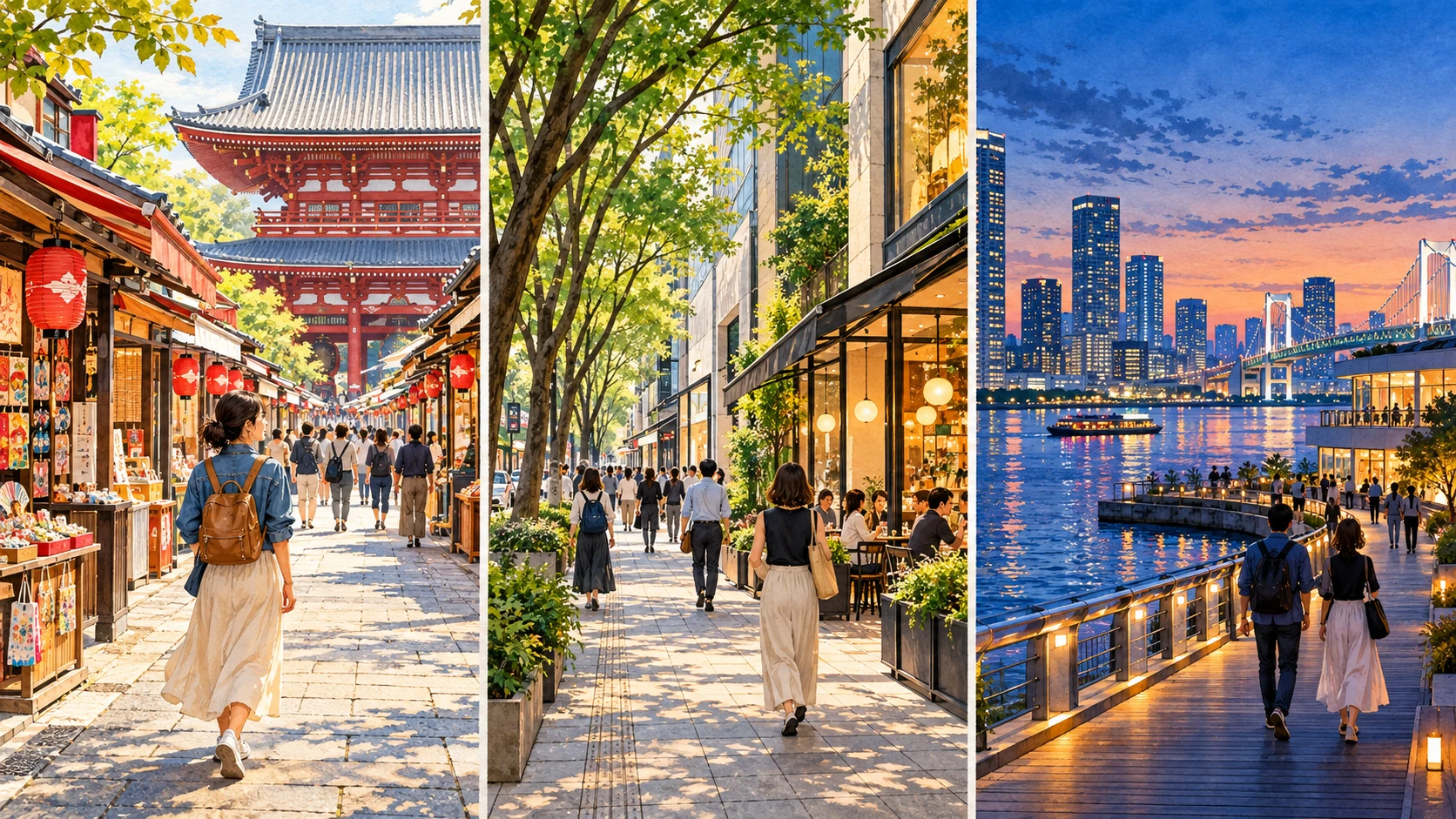
Choose one main Tokyo neighbourhood each day, then add a walk you can drop at any time. This guide connects food and shopping in Asakusa, Ueno, Shibuya, Ginza and the waterfront with museums, parks and seasonal evenings, so you can choose a manageable day for your interests, the weather and everyone's energy.
Choose the day's focus: old streets, shopping, a park or the waterfront
Tokyo neighbourhood plans often get out of hand when every place name is treated as a stop of equal size. Asakusa can mean a quick walk between Kaminarimon and the main hall, or half a day exploring side streets. If you visit the Tokyo National Museum in Ueno, the zoo, Akihabara and Asakusa should not all become convenient extras. Choose one thing you really want to do each day, then add a nearby final stop you can easily drop. That leaves more breathing room than crossing Tokyo repeatedly.
The neighbourhood half-days and alternative days here can each stand alone. Their suggested durations are editorial planning advice, not a tour timetable guaranteed to work. Start with Asakusa for temples and traditional shops; give Ueno the day's main block for Japanese art. For clothes and everyday goods, choose Shinjuku, Shibuya or Ginza. For outdoor space with children, compare Kichijoji, Odaiba and Tachikawa. In rain, make an indoor destination the main event rather than filling gaps with more train changes.
If your hotel is booked, choose a convenient rail direction from that base. If it is not, first see our comparison of Tokyo hotel bases and room types. The Tachikawa overnight branch here addresses whether a park visit justifies staying locally; the accommodation guide covers central Tokyo. For alternative days outside the city, including Kamakura, Mount Takao and Kawagoe, see Tokyo side trips and overnight plans.
- Temples, old streets and markets: Asakusa, Ueno, and Tsukiji and Toyosu.
- Clothes, everyday goods and food stops: Shinjuku, Harajuku and Omotesando, Shibuya, and Ginza and Hibiya.
- Parks, waterfronts and seasonal outings: Odaiba, Kichijoji, Tachikawa, and Rikugien.
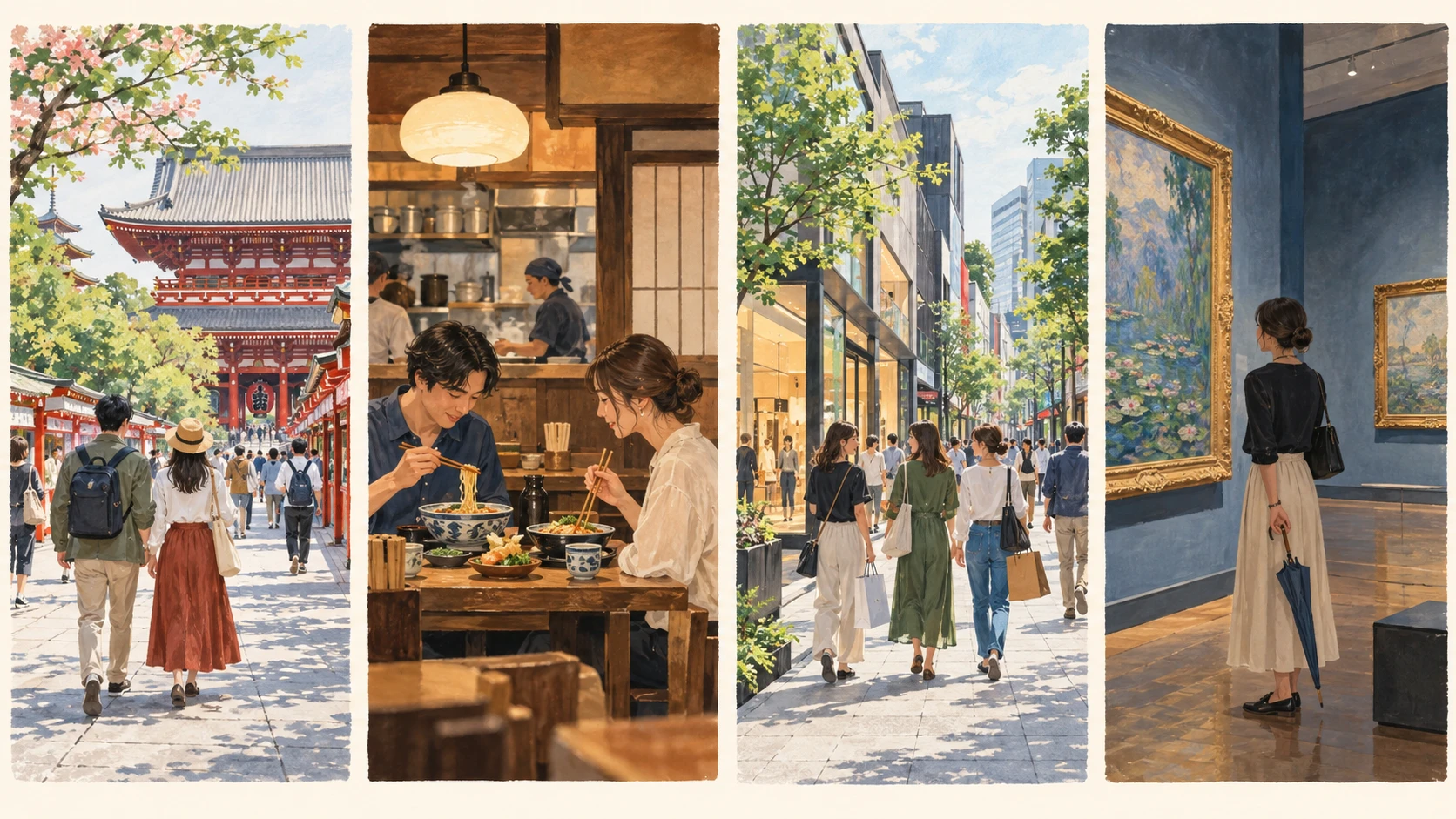
Place fixed appointments first, then check exits and the journey home
Plan only one core booking you cannot be late for, such as a special exhibition, observation deck or performance. Note the last entry, meeting entrance and ticket-change rules before fitting lunch and shopping around it. An evening event does not give you unlimited room for daytime sightseeing. On illuminated-garden or fireworks days, allow for dinner, toilets, collecting luggage and leaving the venue. The train journey shown on your phone does not include finding an exit, waiting for a lift or walking to a ticket office.
Stations with the same name may occupy different buildings. Asakusa's Ginza Line, Toei Asakusa Line, Tobu and Tsukuba Express entrances differ; JR Shinjuku, the private railways and Shinjuku-sanchome are too spread out for a vague 'meet at the station.' Save the destination's address and nearest exit, and choose a named landmark at street level as your meeting point. With a pushchair or large luggage, check lifts separately. A slightly longer level route can be more useful than a staircase shortcut that some people cannot use.
Compare passes against the railway systems you will actually ride. Tokyo Metro, Toei, JR, private railways, Yurikamome and the Rinkai Line are not all covered by a single subway ticket. Odaiba and Tachikawa are particularly easy places to travel beyond a pass's coverage. For short neighbourhood days, start with pay-per-ride travel using an IC card, then calculate alternatives with our guide to comparing Japanese rail tickets. Do not add a detour to somewhere you never wanted to visit just to use a pass.
An Asakusa half-day: visit the temple, then eat and shop
For a first visit, walk from Kaminarimon through Nakamise to Senso-ji's main hall, then explore the side streets and Sumida River waterfront. With only an hour, keep to the main temple route. Add lunch or the river with two to three hours; allow half a day if you want to browse Kappabashi's kitchenware shops. Early morning suits worship and architecture, but Nakamise's shops may not be open. If shopping is the priority, there is little reason to arrive extremely early for empty-street photos and then wait for shops to open.
Senso-ji's official access and opening information lists the main hall as normally open from 6:00 to 17:00, with a 6:30 opening from October through March. Being able to see the grounds at night does not mean the main hall, amulet counters or shops remain open. After arriving on the Ginza or Toei Asakusa Line, check which side of Kaminarimon you are on. Tsukuba Express Asakusa is a separate station.
Choose a seated meal of tendon, soba or a set lunch, then buy small treats such as ningyo-yaki cakes. If a famous old restaurant has a long line, switch to another nearby place with displayed prices and a clear menu rather than keeping children hungry for a checklist. Finish takeaway food where the shop permits it and keep the temple approach clear. In heavy rain, shorten the river walk and use covered shopping streets. The Ginza Line makes Ueno a possible addition, but after an extensive temple and Kappabashi visit, save Ueno's museum for another day.
For a seated meal, consider Asakusa Imahan's Kokusai-dori main restaurant at 3-1-12 Nishi-Asakusa. It is beside exit A2 of Tsukuba Express Asakusa, so allow a separate walk from Kaminarimon; it is not immediately outside every Asakusa station. The lunch menu lists the Hyakunen Gyudon beef bowl with red-miso soup and pickles at ¥2,200 including tax, limited to 20 servings daily. It suits a budget centred on one beef main dish, but lunch-menu reservations are not accepted and the restaurant may stop admitting diners early when full. A limited dish is not a guaranteed reserved meal. A sukiyaki set has its own price, and spending of ¥5,500 or more per person attracts a 10% service charge.
Ueno Park and Ameyoko: culture first, shopping afterwards
Ueno's park and shopping streets are close together, but its major attractions each deserve time, which makes overplanning easy. Enter the park from JR Ueno's Park Exit and choose the Tokyo National Museum or another museum you actually want to see. After lunch, walk toward Shinobazu Pond or Ameyoko, then leave by train from the Okachimachi area instead of repeatedly returning to the same exit.
Ameyoko is useful for comparing snacks, dried foods, everyday goods and clothing. Continue toward Okachimachi for larger stores such as Takeya. Choose seafood bowls, noodles, set meals or snacks according to seating and line lengths; a vendor's shouted offer does not establish the lowest price for every product. Package size, expiry date, refrigeration needs and the number of times you still have to move luggage matter more than the unit price alone.
The GO TOKYO Ueno guide treats the park, museums and Ameyoko as separate experiences. If your family chooses the zoo, let it replace the museum and add only a short afternoon walk. In rain, keep one museum and an indoor meal. Free access to the park does not mean every attraction inside is free, and a major ticketed museum is a poor place to arrive just before closing.
For a seated yoshoku lunch in the park, try Ueno Seiyoken's main yoshoku restaurant at 4-58 Ueno-koen. Beef stew, omelette rice or creamy crab croquettes can make a relaxed meal after a museum visit. This restaurant takes ordinary diners in arrival order rather than by reservation; last orders are 16:00 on weekdays and 17:00 on weekends and public holidays. The Hon-ten Grill at the same address is a separate French restaurant with reservation-only dinner. Do not mix up their menus and booking rules. Monday is normally the closing day, with holiday arrangements governed by current notices.
Tokyo National Museum: tickets, collection choices and year-end restrictions
On a first visit to the Tokyo National Museum, allow two to three hours for Japanese art and crafts in the Honkan, then add Heiseikan archaeology or the Gallery of Horyuji Treasures according to your interests. This is planning advice, not a museum-mandated visit length. Choose a few groups of ceramics, swords, Buddhist art or paintings to examine rather than rushing through every floor. Famous masterpieces are not a fixed year-round display list: works on paper and textiles rotate, so check the week's displays. An old Kukai exhibition found in a search is not evidence that it is currently running.
The museum's visitor information lists regular TNM Collection admission at ¥1,000 for adults and ¥500 for university students. High-school students and younger visitors, people under 18, and people aged 70 or above qualify for free regular admission with the required proof. Special exhibitions have separate prices. A special-exhibition ticket also admits you to the regular collection on the same day; a regular ticket does not work in reverse. Electronic regular-collection tickets do not require a fixed date or time and remain valid for two months after purchase. There is no need to buy an unwanted special exhibition merely to see the regular displays.
Normal hours are 9:30–17:00, extended to 20:00 on Fridays, Saturdays and Sundays followed by a public-holiday Monday; last admission is 30 minutes before closing. Check separate exceptions for special exhibitions and the Kuroda Memorial Hall. The museum normally closes on Mondays, moving closure to the next weekday when Monday is a holiday. There is an additional closure on 15 December 2026. Only the Gallery of Horyuji Treasures and Kuroda Memorial Hall open on 22–25 December, and the museum closes 26–31 December. Maintenance also affects the Toyokan and some Honkan rooms from 30 November. For a year-end visit, check which buildings admit visitors before deciding whether the day still suits your interests.
Suitcases have not been permitted inside since 1 August 2026, and security screening at the main gate began on 8 September. Going straight from arrival with a full suitcase is therefore unsuitable. The photography rules permit personal-use photography of some regular-collection works, excluding those marked otherwise. Special exhibitions generally prohibit photography, and flash, tripods and selfie sticks are not allowed. Choose postcards, catalogues and books after viewing the art, based on works you actually liked; do not shorten your museum visit to prioritise the shop.
To get to know a couple of named works in the collection before visiting, start with Hishikawa Moronobu’s Beauty Looking Back and Ogata Kōrin’s Wind God and Thunder God; the latter is designated an Important Cultural Property. These are collection examples for advance reading, not a statement that either work is currently on display. Before visiting, check the rooms and works in the museum’s current weekly exhibition listings. A collection list is not a guarantee of year-round display.
Akihabara: decide between electronics and character merchandise
Akihabara suits two to three hours of shopping with a clear purpose; not everyone needs a whole day. Start at JR Akihabara's Electric Town Exit. For electronics and accessories, choose larger shops that can explain specifications, warranties and return conditions clearly. For models, manga, games and secondhand collectibles, list the series and editions you want before visiting specialist floors. Products may occupy several levels, so indoor movement takes time too. Shops sharing a street are not automatically all manageable in one visit.
For secondhand purchases, check box condition, accessories, language, region restrictions and power specifications, and distinguish display items from stock available to buy. Without a shopping target, treat Electric Town as a brief streetscape stop before returning toward Ueno or Tokyo Station. Avoid following street touts into businesses with unclear charges. For themed cafés, check admission fees, time limits and minimum spending first; follow the venue's photography notices.
A seated lunch near the station or inside a shopping complex is more practical with children or older relatives than continuous standing and browsing. In rain, reduce outdoor wandering and explore one or two buildings thoroughly. If animation-character shops and large indoor facilities are your main interest, Ikebukuro may fit better. You do not need both districts on the same day merely to say you visited two anime areas.
Shinjuku: explore one side around the east or south exits
Organise Shinjuku by exit. The east side and Shinjuku-sanchome suit department stores and major fashion shopping; the south side suits station malls, sorting luggage and connections to long-distance transport. The west side leads toward office towers and electronics stores. Check brand floors at Isetan or another department store for luxury goods and cosmetics. For everyday clothes and gifts, select one or two station-area malls. Every crossing of the station adds navigation; a ten-minute circuit of every department store is unnecessary.
First decide whether your meal should be quick or restful. Ramen, curry and set meals fit between shopping stops; department-store restaurant floors make menu comparisons easier for groups. Before using a small bar or izakaya, ask about cover charges, smoking and whether children are admitted. Nightlife in the official Shinjuku area guide does not imply that every business suits families or that you can ignore the last train.
For a half-day, eat and browse department stores around Shinjuku-sanchome, then finish at the south-exit malls. If Shinjuku Gyoen is included, visit the garden before shopping so its closing time does not cut you short. In rain, drop the garden and keep an indoor route on one side. If friends split up to shop, agree on a specific mall entrance and meeting time instead of searching the whole station for one another just before dinner.
While shopping by the east exit, consider lunch at Acacia's Shinjuku main restaurant, 3-22-10 Shinjuku: turn left from underground exit B12b, then right into the lane at the first corner. Its signature dish is cabbage rolls simmered in chicken stock; omelette rice and cream croquettes are other yoshoku choices. It suits a rice-based meal without crossing to the west exit. Dining in and takeaway require different arrangements. Mobile takeaway orders can specify a collection time, but that does not reserve a restaurant seat, and you still need somewhere that permits eating after collection.
Shinjuku Gyoen: use seasonal garden hours, not a nightlife timetable
Shinjuku Gyoen suits travellers who want grass and trees between city outings. Enter through Shinjuku Gate, walk through the garden areas you like, then leave through the exit best placed for your next stop. If walking capacity is limited, choose one area and allow bench breaks rather than plotting a circuit of every garden. Unlike the shopping streets, which stay lively into the evening, this garden requires a check of last admission before a late-afternoon visit.
The Ministry of the Environment's admission information lists ¥500 for adults, ¥250 for people aged 65 or above and students at high-school level or above, and free admission for junior-high-school children and younger. From 1 October through 14 March, hours are 9:00–16:30, with last entry at 16:00. From 15 March through 30 September the usual closing time is 18:00, extended to 19:00 from 11 June through 31 July; last entry is always 30 minutes earlier. The garden normally closes Mondays and 29 December–3 January, moving a Monday holiday closure to the following day. Continuous opening is scheduled 25 March–24 April and 1–15 November.
Some busy cherry-blossom dates may require reservations; this year's procedure does not guarantee next year's. Keep Shinjuku Gyoen, Ueno Park and the Meguro River as alternative blossom options and choose one according to current flowering. Blooming, weather and crowd levels are separate considerations. Follow garden rules for food and activities rather than assuming a ticketed garden permits every kind of picnic. Eating a proper meal in Shinjuku-sanchome after leaving is more relaxed than rushing across the garden to find food before closing.
Meiji Jingu, Harajuku and Omotesando: a morning followed by an afternoon
Start this combination on Meiji Jingu's wooded approach, return to Harajuku for a meal after worship, then choose either Takeshita Street or Omotesando as the main shopping route. Takeshita Street emphasises small accessories, youth fashion and takeaway sweets. Omotesando and its side streets suit design labels, curated shops and longer café breaks. These are different browsing rhythms; with a pushchair, there is even less reason to keep doubling back through crowded narrow streets.
Meiji Jingu's gate hours vary by month: for example, 5:40–16:40 in October, 6:10–16:10 in November and 6:40–16:00 in December. Do not finish shopping after dark and only then try to enter the shrine. The separately charged Inner Garden and museum are not compulsory parts of worship. The main worship area is a walk from the entrance; respect worshippers and no-photography notices, and do not cut through woodland as a shortcut.
JR Harajuku and subway Meiji-jingumae are the most straightforward arrival points. If shopping ends in Omotesando, leave from Omotesando Station instead of walking back simply to reuse your arrival station. A crêpe is a snack rather than a family lunch; use a mall or seated restaurant for a proper meal. In rain, keep Omotesando's indoor shopping and save the long shrine approach for more settled weather.
A complete short shrine route can cover the planted forest, worship at the main sanctuary and the Nagadono amulet counter. Allow about 10 minutes from each entrance to the main sanctuary. The official worship instructions describe washing your hands, rinsing your mouth with water held in your hand, then washing your hands again; after making an offering at the sanctuary, bow twice, clap twice and bow once. Amulets at Nagadono, Kaguraden or the south counter can be chosen for prayers such as health, study or traffic safety, without treating a prayer as a guaranteed result. Another cultural detail is the Omikokoro poem slips: waka by Emperor Meiji and Empress Shoken, with explanations for daily reflection, rather than ratings of good or bad fortune. Goshuin are normally handled at Nagadono from 9:00 until closing, although the location can change that day. Do not wait until after an evening shopping trip to return.
For children to move around and everyone to sit down, add Yoyogi Park as a separate stop after the shrine. It is about a 3-minute walk from JR Harajuku or Meiji-jingumae; distinguish the park entrance from the shrine approach. The park is always open and general entry is free, while some facilities charge. Its lawns offer a different setting from the shrine, where unrestricted exercise and eating are not permitted. With only half a day, choose two of worship, a lawn break and Harajuku shopping. There is no need to add Meiji Jingu Gaien, which is elsewhere.
For noodles, AFURI Harajuku is on the ground floor of Grandeforesta, 3-63-1 Sendagaya. Its yuzu-shio ramen combines chicken and seafood stock with yuzu. This branch is entirely cashless and may close early if soup sells out. For an advance seat booking, pancakes or a longer brunch, compare bills Omotesando, on level 7 (7F) at 4-30-3 Jingumae. The restaurant accepts both reservations every day and walk-ins. It lies in a different direction from AFURI around Harajuku Station, so choose the meal before planning shopping. Book through the restaurant's official links: bills explicitly states that it does not work with AutoReserve.
Shibuya: leave room for the crossing, shops and booked experiences
For a Shibuya half-day, orient yourself near the crossing, then select one or two targets among PARCO, Hikarie, Scramble Square and the smaller Jinnan shops. Choose malls by their floors if you want character merchandise, fashion design or household goods. Someone who only wants to see the crossing need not follow hours of shopping. Cross normally and take photographs from places that do not block people; do not stand in the road waiting for another green light.
If you have booked a timed experience such as SHIBUYA SKY, fix check-in and security time first, then decide whether a walk toward Harajuku still fits. For weather and admission conditions at observation decks, teamLab and similar attractions, see our comparison of Tokyo observation decks, art and cruises. If one mall has already tired you out, eat dinner in Shibuya. A short distance on a map does not require you to walk all the way through Harajuku and Omotesando too.
The official Shibuya area information shows several JR, subway and private railway lines meeting here. The exit and destination direction matter more than simply reaching Shibuya Station. Dining options are numerous, but popular upper-floor mall restaurants still have lines. In rain or around dinner, find seating before deciding on another outing. After buying bulky goods, prioritise a lift-accessible route home rather than treating the number of shopping bags as an achievement.
Ikebukuro: keep character shops, Sunshine City and lunch on one side
Ikebukuro suits a clear interest in animation, games or indoor family attractions. On the east side, walk from the Animate area toward Otome Road and Sunshine City, choosing character shops or one paid attraction as the focus. The west side has theatres, plazas and another department-store district. Check which side of the station holds your target shops so you do not repeatedly haul shopping bags through it.
The official tourism guide to Ikebukuro and Sunshine City lists an aquarium, observation facilities and character shops, but these do not share one ticket or entrance. Specific character events may require numbered admission tickets, and paid attractions have their own operating and ticket rules. Reaching the mall does not give automatic entry to everything. If a child only wants merchandise for a particular character, do that first, then decide whether to add the aquarium.
Use the mall's restaurant floors for lunch, prioritising noodles, rice or grilled-meat sets everyone can accept. Save a popular ramen shop for a time when waiting and sitting separately are manageable. This district offers indoor alternatives in rain, although the route from station to mall still includes outdoor sections. With only two hours, drop the department stores on the other side. If Akihabara already supplied enough similar merchandise, replace Ikebukuro with a park or a neighbourhood with a different character.
For rich ramen by Ikebukuro's East Exit, Mutekiya at 1-17-1 Minami-Ikebukuro is about a 3-minute walk to the right from the exit. Pork-bone and soy-sauce broth with thick chashu slices defines the menu. There are only 17 counter seats. The official FAQ states that reservations are not accepted, payment is cash, and child seats are unavailable. Pushchairs and large luggage cannot be brought inside, and a group may not sit together. It suits a small party willing to wait. With young children or an exhibition deadline, a mall restaurant with tables is more realistic than assigning the queue a fixed half-hour.
Ginza, Hibiya and Yurakucho: make shopping and dinner a one-way walk
A Ginza day need not depend on expensive purchases. Arrive at Higashi-ginza or Ginza, browse department stores, stationery and everyday goods along Chuo-dori, then continue to Yurakucho or Hibiya for dinner. Choose a product category before comparing Mitsukoshi, Matsuya and GINZA SIX; otherwise similar floors can use up the time needed to try what you actually want. Luxury shops, basement food halls and galleries open at different times. Arriving in the morning does not mean every floor is open.
Distinguish booked restaurants, department-store dining and quick noodle or rice meals. Before a play or film, book a meal time that fits admission instead of betting on a popular restaurant's queue. Hibiya offers theatres, cinemas, malls and breaks; Yurakucho connects conveniently to JR for the journey home, while Ginza serves several subway lines. Use the official Ginza guide to check commercial facilities and transport directions.
For half a day, keep one department store, one street and a meal. With a full day, add Hibiya Park or a current exhibition. In rain, reduce street-level connections and combine shopping and dining in one building. Underground passages do not guarantee a completely dry route. Winter lights can be a short outing after dinner, but crossing to Roppongi or another Christmas market should replace a daytime shopping block.
After Hibiya Park, Hibiya Matsumotoro's 1F Grill & Garden Terrace, 1-2 Hibiya-koen, offers hashed beef, curry and omelette rice. This floor suits ordinary lunch or afternoon tea. Dining reservations are available after 17:00; ordinary lunch and tea seats generally cannot be reserved, except for one outdoor terrace party of up to 4. Choose the 3F restaurant separately for a more formal French meal. Its reservation system does not mean a spontaneous 1F visit avoids a wait, and outdoor seating is not a certainty in rain.
To include the Imperial Hotel, make it a specific meal at Parkside Diner on the main building's 1F rather than treating the whole hotel as an unrestricted sightseeing attraction. Its yoshoku options include pancakes and curry. At this check, the official special curry lunch costs ¥4,000 on weekdays and ¥4,200 on weekends and public holidays, including salad and coffee or tea, tax and service. Lunch runs 11:00–14:00 on weekdays and until 16:00 on weekends and holidays, fitting Hibiya Park or Ginza. Do not apply that price to other meal periods or limited menus.
For small design purchases, walk from Hibiya toward Shimbashi to Hibiya OKUROJI, 1-7-1 Uchisaiwaicho. Official access lists about 6 minutes on foot from the Hibiya exits of both JR Yurakucho and Shimbashi. Under the railway arches, GLEN CLYDE SOCKCLUB TOKYO specialises in socks, while Shetland Fox focuses on men's shoes. Those are different shopping tasks from Ginza cosmetics and luxury goods. Choose a shop or two before dinner in Shimbashi; this combines a Hibiya walk with Shimbashi browsing. The complex is outside Shimbashi's ticket gates, and individual shop hours differ.
For a cultural stop, visit Kabukiza, 4-12-15 Ginza, immediately by Higashi-ginza exit 3. With enough time, buy a performance ticket for that month's programme. On a short visit, see the exterior and browse kabuki goods at Kobikicho Plaza on B2F; buying souvenirs does not buy a theatre seat. For afternoon sweets, first check Shiseido Parlour's shop information and confirm the address, floor, opening days and reservation rules for the shop you plan to visit. If you only want boxed sweets, confirm which shop sells them too. Do not apply one shop's or floor's booking arrangements to another.
Nihombashi: shop for crafts and food with a purpose
Nihombashi suits tableware, chopsticks, dried foods, Japanese sweets and crafts. Start near Mitsukoshimae Station and COREDO Muromachi, cross Nihombashi Bridge toward Takashimaya, then leave from Nihombashi Station. Traditional shops, modern commercial buildings and neighbourhood history fit into one walk. There is no need to expect an 'old Tokyo' district made entirely of old buildings.
Choose a gift's purpose first: tea at home, cooking or sharing with colleagues all imply different quantities and storage needs. Check package size, expiry dates and your destination's import rules for seaweed, seasonings and sweets; consider weight and packaging for tableware. The official Nihombashi guide describes long-established businesses alongside modern malls. A historic brand does not mean every item is made in Japan: read the actual label.
Lunch might be soba, tempura or a mall restaurant. For a specific old-established restaurant, check afternoon breaks and queue procedures before deciding whether to eat or browse first. In rain, focus on two nearby commercial buildings. With children, place a seated break between shops. Tokyo Station is a possible onward connection, but before a Shinkansen departure, finish purchases and packing, then follow the station route back to the correct platform.
Shimbashi and Toranomon: choose small restaurants or a large complex
Shimbashi suits visitors looking for an after-work atmosphere, grilled skewers and izakaya, but not every family needs a bar crawl. Read menus in the station-area lanes and check smoking, cover charges, ordering requirements per person and whether children are welcome. For one dinner, choose a set-meal place or another restaurant; in either case, look for seating and clearly displayed prices. For shopping, focus on station-area household goods, food and Shiodome's commercial facilities rather than imagining another large luxury-shopping district.
If indoor space and varied dining matter more, make Toranomon Hills the half-day focus. T-MARKET is on B2 of Station Tower; Toranomon Yokocho is in Business Tower, a different building and floor. Specify both when meeting for a meal. The Toranomon Hills facility information lists hours by area. Early hours for T-MARKET do not establish breakfast service at every restaurant.
Toranomon Hills and Toranomon stations serve different lines. Use the official access directions for your actual building. Check the current exhibition and tickets separately for TOKYO NODE. Restaurants and hotels in a tower do not make every floor freely accessible for night views. In rain, stay within one tower for food and shopping. If Shimbashi still appeals at dusk, consider whether you really want a second meal.
About a 1-minute walk from Shimbashi's Ginza Exit, Kagawa–Ehime Setouchi Shunsaikan is at 2-19-10 Shimbashi. Kaorihime on 2F serves regional dishes such as Sanuki udon and Iyo sea-bream rice, suitable for a lunch main. Lunch is 11:00–15:00, last orders 14:30; dinner starts at 17:00 with a separate izakaya-style arrangement including sashimi. There is a service break between them. Afterward, 1F sells processed Setouchi seafood and regional sweets, while 2F also has everyday craft goods. Choose this for food gifts, and Hibiya OKUROJI for socks or men's shoes; Shimbashi need not become a department-store expedition. To reserve seats, an alternative is Ginza Lion Shimbashi, 2–3F of the Persa115 Building, 1-15-5 Shimbashi. Weekday lunch excluding public holidays includes yoshoku such as hamburger steak. Official online bookings cover seats and course meals, subject to date and availability. Non-course food and drinks incur an additional 10% from 31 December through 3 January.
For a seated Toranomon lunch, try Shokudo Toranomon Distillery in Toranomon Yokocho on Business Tower's 3F. Yakinapo fried spaghetti is a signature dish. This is a different tower from Station Tower's B2 T-MARKET. The official average budgets are ¥1,200–1,500 for lunch and ¥4,000–5,000 for dinner; these are average spending figures, not fixed set-menu prices. Weekday lunch last orders are 14:30, with dinner reopening at 17:00. Budget dinner separately for gin and izakaya food; non-drinkers can choose meals too. The restaurant's distilling equipment does not establish a free tour.
A short local visit can be Karasumori Shrine, 2-15-5 Shimbashi, about 2 minutes from JR's Hibiya Exit or 3 minutes from Karasumori Exit. It fits before a meal. Check that day's handling of goshuin and seasonal items rather than assuming a particular design is in stock. For a longer garden walk, choose Hama-rikyu Gardens instead. Otemon Gate is about 12 minutes from Shimbashi or 7 from Shiodome. Hours are 9:00–17:00, last entry 16:30, with admission ¥300 for adults and ¥150 for people aged 65 or above. Elementary-school children and younger, plus junior-high-school students living or studying in Tokyo, enter free. The garden closes 29 December–1 January. Schedule it before dinner; it is not a free nighttime park to visit after an izakaya.
Roppongi and Azabudai: choose art first, then shops and gardens
Roppongi Hills, Tokyo Midtown Roppongi and Azabudai Hills are three separate destinations. Shared words such as Hills or Midtown do not make them one building. For art, choose an exhibition first and eat in the same complex. For brands, design goods and gardens, keep one main shopping complex and an outdoor walk. Squeezing all three complexes and museums into half a day usually leaves little beyond moving around and finding lifts.
Roppongi Station serves the Hibiya and Toei Oedo lines; compare Nogizaka for Tokyo Midtown. For Azabudai Hills, use Kamiyacho exit 5 or Roppongi-itchome exit 4. Choose your target in Garden Plaza, Tower Plaza or the central plaza first, then follow on-site signs. Treat teamLab Borderless as a separate booked activity, not a free gallery included with shopping.
Azabudai's upper-floor Sky Lobby, restaurants and exhibition areas have their own access conditions. Old posts describing a free observation deck do not establish unrestricted access today. Families can use commercial floors for meals, toilets and breaks. In rain, reduce outdoor links between the three areas. If a Tokyo night view is the priority, book one facility explicitly open to visitors instead of asking at successive towers whether you can go upstairs.
For November 2026, also note the temporary-closure notice for Tokyo Midtown Roppongi. It closes early at 14:00 on 20 November, with some shop exceptions, and closes temporarily 21–23 November. Choose other dining and shopping on those dates and check passage closures even when passing through. Hotel services have separate contact arrangements; mall closure does not establish that all accommodation services stop.
After an Azabudai exhibition, Tonkatsu Kawamura, B1F of Garden Plaza B, offers a main dish with rice and soup, including pork-loin and tenderloin combinations or minced-meat cutlet sets. Official average budgets are ¥2,000–2,500 at lunch and ¥2,500–3,500 at dinner; these are spending ranges, with the bill determined by your order. There are 24 seats. Official information welcomes preschool children and pushchairs and lists takeaway and mobile ordering. A proper meal is available in the same area without another trip to Roppongi Hills.
Choose Azabudai shopping floors by purpose. MARK'STYLE on Tower Plaza's 4F stocks PILOT and Namiki pens alongside MARK'S planners and stationery, useful for small gifts. On the same floor, Ogaki Bookstore combines books, magazines, stationery, a gallery and café space for slower browsing. Both normally open 11:00–20:00. For stationery and books, concentrate on 4F before a meal downstairs. Check luxury-brand locations separately instead of walking through every Garden Plaza building.
For art at Roppongi Hills, make the target the Mori Art Museum on Mori Tower's 53F, checking tickets separately from Tokyo City View on 52F. At the 22 October 2026 check, the museum lists an installation closure from 24 September through 30 October, followed by Mariko Mori's exhibition (Japanese title: 燦燦), 31 October–28 March 2027. Normal hours are 10:00–22:00 Monday and Wednesday–Sunday, and until 17:00 Tuesday, with last admission 30 minutes before closing and exceptions on specified dates. To combine art with a Christmas market, check that day's closing time and exhibition ticket. Open Roppongi shops do not establish an open museum.
Ebisu, Nakameguro and Shinagawa: separate slow browsing from transfer time
Ebisu combines Garden Place, photography exhibitions or a leisurely lunch. Nakameguro focuses on the Meguro River, cafés in side streets, lifestyle shops and businesses under the railway. They can share a day, but with only half a day, explore one well. Reach Ebisu by JR or the Hibiya Line, and Nakameguro by the Tokyu Toyoko or Hibiya Line. A change of café does not require making Daikanyama another compulsory stop.
Meguro River crowds during cherry-blossom season differ completely from quieter periods. Choose one river section, then rest in a seated café. Do not block bridges or step into residential entrances for photos. The official Nakameguro guide helps distinguish riverbanks, side streets and the under-railway shopping area. Check the day's queue arrangements separately for a particular café. In rain, shorten the river walk and make an Ebisu exhibition or mall the focus.
Shinagawa works better for meals and shopping around an arrival or departure. Distinguish the Takanawa and Konan exits first. Ecute is inside the ticket gates, while atre and nearby restaurants outside the station have different access conditions. Leave time to return to your platform after buying a bento or gifts for the Shinkansen. A Tennozu canal walk needs separate transport and return time; the whole Shinagawa district is not within five minutes of the station. Use the Shinagawa and Tennozu area guide to understand the layout. With a fixed departure, a meal by the station is the safer fit.
An Ebisu half-day can start with the roughly 5-minute Skywalk route from JR's East Exit to Garden Place. Allow 60–90 minutes for one exhibition of interest at the Tokyo Photographic Art Museum, eat lunch, then browse TSUTAYA BOOKSTORE and TODAY'S SPECIAL on Center Plaza B1 before returning to the station. These durations are planning suggestions; check each exhibition's admission price. The museum normally closes Mondays, or the following weekday after a Monday holiday, and last admission is 30 minutes before closing. Without an exhibition, make it a 2–3-hour outing for lunch, books and lifestyle goods rather than stretching to Nakameguro to fill a day.
For a shorter Garden Place meal, Tokyo Bombay on BRICK END's 1F serves Kashmir and Bombay curries, with an official meal budget of ¥1,000–1,500. It has only 10 seats, takes no reservations and offers takeaway, suiting smaller parties. It is not a large restaurant where the whole family is guaranteed immediate seats and a long rest. Curries vary in style and heat, so order to your tolerance. The budget range does not mean all dishes have the same price.
For Nakameguro stationery, TRAVELER'S FACTORY, 3-13-10 Kamimeguro, is about 3 minutes from the South Ticket Gate. It specialises in travel notebooks, refills and customisable accessories, normally opening 12:00–20:00 and closing Tuesdays except public holidays. For books and coffee first, choose Nakameguro Tsutaya Books under the tracks at 1-22-10 Kamimeguro, beside the Main Ticket Gate. The bookstore opens at 10:00, while Starbucks starts at 7:00; café hours do not apply to the entire bookstore. A short river walk, lunch and books under the tracks can precede an afternoon TRAVELER'S FACTORY visit, avoiding a wait in residential lanes for its noon opening.
For seated yoshoku outside Shinagawa Station, Sarabeth's Shinagawa is on atre Shinagawa's 4F, 2-18-1 Konan, approached from the Konan Exit. French toast and eggs Benedict suit brunch. Before an evening train, the official menu also lists mains such as roast chicken and salmon; the Light Dinner set includes appetiser, main, bread and coffee or tea for ¥3,000 including tax. That is a dinner menu price, not a breakfast combination. Subtract dining and the walk back to the platform from your available time. If little remains, buy a bento rather than sacrificing your train buffer for a full set meal.
If staying in Gotanda, use Gotanda Shokudo on the 1F of Gotanda JP Building, 8-4-13 Nishi-Gotanda, including Acacia Gotanda JP. The restaurant lists about 3 minutes from JR Gotanda and a location beside Osaki-hirokoji on the Tokyu Ikegami Line. In Osaki, Gate City Osaki, 1-11-1 Osaki, is about 1 minute from the South Ticket Gate, with restaurants and shops for meals or everyday supplies around a hotel stay. These are convenient local amenities, not the same mall a minute from Shinagawa's Konan Exit. A Shinagawa transfer does not justify detouring to both stations for food.
Tsukiji or Toyosu: breakfast shopping and a wholesale market serve different aims
For small shops, breakfast and food shopping, Tsukiji Outer Market is the better match. Choose Toyosu Market to understand a modern wholesale market and its visitor routes. Tsukiji's wholesale operation moved to Toyosu, but its outer shops remain. They are separate destinations, and two seafood breakfasts do not require both in one day. Reach Tsukiji through Tsukiji or Tsukijishijo Station and continue to Ginza after eating. Toyosu Market mainly uses Shijo-mae on Yurikamome; the Toyosu Station area around LaLaport requires another move.
The Tokyo Metropolitan Central Wholesale Market's visitor information lists visitor corridors from 5:00 to 17:00, closed on market holidays. Check restaurant and shop hours individually. Online hours differ, so plan against the market operator's information and operating calendar. Unloading areas are not unrestricted sightseeing routes, and an afternoon arrival cannot show you a morning auction.
For a close view of the tuna auction, the official special tour uses advance applications and a lottery, rather than first-come entry. Confirm the application period and meeting arrangements before solving the early-morning journey. Without a successful application, choose the ordinary visitor corridors and breakfast instead of relying on luck that morning. Families need not disrupt an entire day because a market supposedly demands an extremely early start: normal breakfast hours and a short visit also work.
For Toyosu shopping, LaLaport and waterfront parks are separate choices; Senkyaku Banrai is another commercial and dining development. Prices, places to rest and hours vary between them. In rain, prioritise indoor market viewing and shopping; add a short waterside walk in good weather. Budget market meals separately from a paid art experience that evening. One seafood bowl's price does not predict the cost of a whole waterfront day.
Choose Tsukiji breakfast by food preference. Sushizanmai's main restaurant, 4-11-9 Tsukiji, suits seated sushi, about 3 minutes from Tsukiji exit 1 or Tsukijishijo A1. It lists 24-hour opening, no reservations, tables and child seats; do not apply other branches' reservation rules. For cooked food, compare Kitsuneya, 4-9-12 Tsukiji, for a bowl of beef offal simmered in Hatcho miso. Usual hours are 6:30–13:30, closed Sundays, public holidays and market holidays. This is a small street-side business: eat where staff direct you, without blocking market passages.
After breakfast, choose either more market shopping or a temple visit. Tsukiji Uogashi's Odawarabashi Building is at 6-26-1 Tsukiji, with fresh-fish and produce shops on 1F and the Uogashi Shokudo food hall on 3F. Official guidance asks general visitors to come after 9:00, leaving 5:00–9:00 for professional buyers, and prohibits eating on 1F. A 5:00 building opening is not a recommended tourist breakfast time. In another direction, check Tsukiji Hongwanji's visitor information and confirm its address, opening hours and arrangements for religious services before going. If you want to obtain an amulet, goshuin or fortune slip, ask the temple first whether it offers them; do not plan it as a goshuin collection stop without checking.
Odaiba: one indoor focus and a waterfront walk
Odaiba suits open waterfronts, malls and indoor entertainment. From Daiba or Odaiba-kaihinkoen Station, walk toward the water, then choose one of AQUA CiTY, DECKS or DiverCity for food and shopping. If Miraikan, the National Museum of Emerging Science and Innovation, is the priority, make that visit the focus and shorten the malls. Sharing the broad label 'waterfront' does not put every facility next door after you leave the train.
The official Odaiba guide lists Yurikamome and the Rinkai Line as rail approaches. Connect to Yurikamome from Shimbashi, or compare Tokyo Teleport Station from other hotel bases. Return by the route that fits your accommodation instead of looping back simply to reuse the arrival station. Neither the Rinkai Line nor Yurikamome should be assumed covered by an ordinary Tokyo subway pass.
For a scenic meal, check seating and waits first. To save time, use a mall restaurant with a clear menu; every meal need not carry a sea-view premium. Keep the waterfront walk for fine weather, and use indoor activities in one building in strong wind or rain. Family attractions have separate age and ticket conditions: check before promising children they can participate. After sunset, you still need to reach the station. Do not improvise a walk across the bay bridge as an evening extra suitable for everyone.
For brunch alongside a waterfront walk, bills Odaiba is on DECKS Seaside Mall's 3F, 1-6-1 Daiba. Ricotta pancakes offer a sweet main; eggs and lunch or dinner dishes are alternatives. The restaurant lists opening at 9:00 on weekdays and 8:00 on weekends and public holidays. Breakfast runs until 11:00, lunch until 17:00 and dinner from 17:00, so match the desired dish to its service period. Official seat reservations are available every day alongside walk-ins. Booking can help control departure time, but does not guarantee a sea-view or terrace table. In wind and rain, actual seating remains the restaurant's decision.
Kichijoji: allow time for Inokashira Park, shopping streets and the alleyways
Kichijoji naturally combines a park with everyday shopping. Walk from the station to Inokashira Park in the morning, return after lunch to Sun Road, Daiyagai and curated shops north of the station, then decide whether to visit Harmonica Yokocho at dusk. The park, malls and small shops each stand alone. With children, lengthen the park and shorten standing bars; dedicated shoppers can reverse the balance.
JR's Chuo and Sobu lines and the Keio Inokashira Line serve Kichijoji. Choose by your accommodation rather than detouring through Shinjuku to copy someone else's route. The official Kichijoji guide distinguishes the park from the shopping arcades. Keeping shops and cafés in rain does not make finishing the park compulsory. Without a confirmed Ghibli Museum reservation, do not treat it as a spontaneous stop you can enter during a walk.
Treat popular takeaway food such as Kichijoji SATOU's round minced-meat cutlets as an optional snack. Eat a proper meal first if the line is too long; quick purchases are not assured. Yokocho businesses are small, and some focus on drinks and light ordering. A larger group with a pushchair may prefer dinner in a station mall. Let current blossom or leaf conditions determine spring and autumn pauses. Even without flowers, this is still a complete park day.
Tachikawa and Showa Kinen Park: give them a day and choose the right gate
Showa Kinen Park is a separate alternative day in western Tokyo, not a central garden to reach on foot after Ginza. Travel to JR Tachikawa, then choose the gate for your goal. To reduce the walk to an entrance, take the Ome Line one stop to Nishi-Tachikawa. From central Tachikawa, GREEN SPRINGS or a local hotel, compare Tachikawa Gate. Reaching the park boundary on a map does not put you at the Japanese Garden.
The park's official event access information gives about 2 minutes from Nishi-Tachikawa Station to Nishi-Tachikawa Gate. From the north side of Tachikawa Station, you still need a separate walk to the paid entrance. These are journeys to the gate, with walking inside added afterwards. For spring flowers, locate the current main display. For autumn ginkgo trees, choose between the Canal and Katarai avenues. With children, prioritise lawns and playgrounds rather than chasing every flower field too.
Daytime hours change with seasons and events; recheck the current opening calendar before travel. Standard admission is ¥450 for adults, ¥210 for people aged 65 or above, and free for junior-high-school children and younger. This does not cover every rental, transport service or special nighttime viewing. A park this large needs real breaks. Plan a lunch or supply stop before choosing the final exit. In all-day heavy rain without an essential event, an indoor city day makes more sense than forcing a full circuit after reaching Tachikawa.
Showa Kinen Park's autumn nights: separate gates, garden tickets and the return trip
The announced 2026 Autumn Night Walk runs 29 October–29 November. Illumination is 16:30–20:30, the park closes at 21:00, and last entry is 20:30. Ticket sales end earlier than last admission, so do not arrive at the deadline. The official event page permits nighttime entry and exit only at Nishi-Tachikawa and Tachikawa gates. Daytime visitors who enter through Sunagawa or another gate must also move into the designated nighttime area under the rules.
Park admission covers the illuminated ginkgo avenues and Canal, while the Japanese Garden requires a separate nighttime viewing ticket. Online garden tickets are ¥1,200 for adults and people aged 65 or above, and ¥600 for elementary- and junior-high-school students. On-site tickets are ¥1,300 and ¥700 respectively, paid in cash; none are sold on-site when online tickets sell out. Online park-plus-garden tickets cost ¥1,600 for adults or ¥1,410 for those aged 65 or above. Preschool children do not need a garden ticket. The daytime garden does not require this night ticket. To stay for the evening session, leave the garden first and re-enter under nighttime arrangements.
The page says garden tickets go on sale one week before the visit date and lists 29 and 30 October as nights when park admission alone covers the Japanese Garden. If choosing 31 October, confirm with the ticket page or park rather than budgeting on free garden entry. For a daytime-plus-evening visit, leave the daytime Japanese Garden before 16:00 and re-enter under the night rules. You cannot simply remain inside waiting for the lights.
Cycling routes are unavailable at night. If you bring or rent a bicycle during the day, complete the necessary move and return first. The nighttime park bus costs ¥400 per adult or ¥200 per elementary- or junior-high-school student per ride and accepts only supported cashless payments. Waiting also takes time: it is not dependable rescue transport for a last-minute arrival. Choose Nishi-Tachikawa or Tachikawa as the exit before checking the train home. With children, viewing one ginkgo section can be enough; save the garden and long walks for another visit with more energy.
An overnight in Tachikawa: station convenience or a longer park stay
Returning to your original hotel after the night lights is usually still possible. Whether a local overnight is worthwhile depends on energy and the following day's direction. With just one park day, a hotel's reputation alone does not justify moving luggage twice. Staying in Tachikawa has practical value if you want a leisurely day-and-night visit and will continue toward Tama. Compare the complete price, beds, breakfast and cancellation deadline. A park-view label does not mean every nighttime activity can be clearly seen from the room.
JR-East Hotel Mets Tachikawa lists a 1-minute walk from JR Tachikawa's South Ticket Gate, useful when rail connections take priority. Its south-side position still requires a separate walk to the park entrance. The Mets room and stay conditions list the standard Twin at 21 square metres for 1–3 guests, with a 97 × 177 cm extra bed for the third guest. The Residential Style Twin is also 21 square metres but lists only 1–2 guests. For three people, check permitted occupancy and the third bed's length, not just 'twin' and floor area.
Mets permits one child per bed to share free only when the child is both aged 5 or younger and not yet in school. Elementary-school children and older pay the adult rate; 'preschool' alone does not make every 6-year-old free. The general official cancellation table charges 100% for bookings of up to 7 guests cancelled the day before, on the day or by no-show, but the booking channel or rate plan may specify different terms. If weather determines whether you attend the night event, include that cancellation cost in the comparison.
SORANO HOTEL is north of the station, with official access giving about 8 minutes on foot from Tachikawa's North Exit. It better suits a stay centred on GREEN SPRINGS and the park direction. The SORANO room information lists Premier Park View at 52 square metres for 1–3 adults. Its third bed combines a sofa and ottoman, rather than providing three identical standalone beds. Wa Modern can accommodate up to 4 adults on floor bedding, suiting families comfortable with that arrangement.
The SORANO room pages list up to two children aged 6 or younger sharing existing bedding; children aged 7 and above count as adults. However, the currently linked accommodation conditions dated 1 September 2026 additionally restrict this bed-sharing rule to children who have not yet started primary school, up to two per room. Eligible children incur no additional room charge; meals and other facilities cost extra. Do not rely solely on the broader age-only wording or assume free bed sharing for a 6-year-old already in primary school. That differs from Mets. Check ages, equipment and the actual room if you need a cot, pool use or late checkout. Breakfast and facilities depend on your own rate plan. Read cancellation deadlines and fees before paying. A potentially late park outing is not a reason to place a nonrefundable booking before confirming the price and terms.
Rikugien and autumn leaves: daytime and nighttime require separate entry
Rikugien suits a close look at a strolling landscape garden around a pond, rather than the uses of a broad lawn park. Walk from Komagome Station toward the main gate, checking that day's open entrances and route. Normal daytime hours are 9:00–17:00, last admission 16:30, with entry ¥300 for adults and ¥150 for people aged 65 or above. A day ticket achieves the main aim if you want trees and water in daylight. A night session is not what makes the visit worthwhile.
The 2026 special nighttime-viewing announcement lists 25 November–6 December, 18:00–20:30, last entry 19:30. The garden closes at 17:00 before reopening at 18:00. Advance online tickets cost ¥1,000; same-day online or on-site tickets cost ¥1,200, with cash only on-site. Elementary-school children and younger enter free. This is a separate night ticket, not permission to remain after a daytime visit. At the check, the exact sales-opening date was still to be announced. Do not reuse a previous year's ticket-sale date.
For Meiji Jingu Gaien's ginkgo avenue, take the Ginza Line to Gaienmae, or follow the JNTO avenue guide from Aoyama-itchome exit 1. Allow a relaxed pavement walk and photos, then eat on Aoyama-dori or continue shopping in Omotesando; this need not occupy a whole day. Observe traffic rules and current controls. Do not stand in the road for a centred photograph. In rain, use Omotesando's malls instead of waiting outside for one particular image.
The GO TOKYO autumn-leaves guide places the main central-Tokyo observation period around mid-November to early December. That is also an initial planning range for Gaien's ginkgo, while Rikugien usually leans toward late November to mid-December. These are customary ranges, not daily 2026 conditions or peak-colour forecasts. Mountain areas such as Okutama can turn earlier; their photos do not describe city gardens. Compare locations and tree species even within the same week. Historic photos cannot guarantee an all-yellow or all-red day. For alternatives, compare Showa Kinen Park's extensive walking with Shinjuku Gyoen's garden routes, then decide by admission, closing times and energy.
The Hachioji Ginkgo Festival suits half a day walking along Koshu-kaido, without adding central-Tokyo gardens that day. The official 2026 event information lists 21 November, 9:00–16:30, and 22 November, 9:00–16:00, at locations including Ryonan Park and the Tama Imperial Mausoleum approach. Use Nishi-Hachioji on JR's Chuo Line, or JR/Keio Takao. Choose a nearby stretch and venue rather than walking the entire road. The organiser's FAQ states that there is no parking and congestion is expected on National Route 20. Festival dates are fixed; fully yellow trees still depend on that week's conditions.
To combine ginkgo with Ueno or Yanaka–Nezu–Sendagi, plan a short walk on the University of Tokyo's Hongo Campus instead. The university describes an approximately 200-metre ginkgo avenue from the Main Gate to Yasuda Auditorium, a more practical central half-day link than crossing to Hachioji. The campus visitor rules limit visits to 7:00–18:00. Akamon's seismic work is scheduled through September 2027, so use the Main Gate or another open entrance. On holidays, the Main Gate's large doors close while the small gate has its own hours. Stay in open outdoor and common spaces and obey temporary restrictions. Visitor photographs are for personal use only and must not be posted to social media or YouTube. This remains a teaching and research campus, not a park guaranteeing unrestricted photography. Check leaf conditions that week too.
Cherry blossoms and summer fireworks: distinguish past dates from future plans
As of 22 October 2026, the main spring blossom season and all six 2026 fireworks dates below have passed. Use them to understand venues and planning, not as future ticket announcements. The 2027 dates, seating, restrictions and ticket sales require new notices from each organiser. Full cherry bloom does not fall on one fixed date annually either. Choose one or two among the Meguro River, Ueno, Shinjuku Gyoen and Inokashira Park according to current flowering instead of turning blossom lists into daily cross-city train chases.
The GO TOKYO cherry-blossom guide places the usual peak for many Tokyo blossoms in late March to early April. This is a travel-planning range, not next season's forecast. Later arrivals can consult Shinjuku Gyoen's cherry-variety information: Somei-yoshino usually starts in late March, while many double-flowered cherries reach viewing season in mid-April. Choosing a garden and later varieties gives more direction than visiting every riverbank in the same week, but still requires current flowering and admission checks.
For fireworks, choose a ticketed seat or an area explicitly permitted that year before planning dinner and departure. Bridges, embankments, residential streets and opposite-bank riverbeds may be restricted. Visible sky on a map does not confer permission to stay. With young children or reduced mobility, choose an area where entrances, seats, toilets and exit arrangements can be confirmed. Being near a station cannot eliminate weather cancellation or onward-transport risks.
Sumida's 2026 official advice warned of very heavy Asakusa Station crowds after the event and asked visitors to follow dispersal routes. Katsushika prohibited entry to the opposite riverbank on the Matsudo side in 2026; it is not a free crowd-avoidance recommendation. Makuhari is in Chiba City, requiring a separate JR Keiyo Line journey and walk from Kaihin-Makuhari. In 2026, everyone needed advance arrangements for their viewing zone. Jingu Gaien used designated venues and tickets; nearby streets were not free seats for setting up tripods.
- Adachi official checks: organiser's event-ended notice; 2026 routes and viewing areas.
- Sumida River official checks: 2026 event outline; 2026 venues and access; 2026 viewing rules.
- Katsushika official checks: day-of-event announcement, viewing restrictions, and 2026 access and viewing area.
- Edogawa official checks: ward event schedule; 2026 access and viewing area.
- Makuhari Beach official checks: event-ended notice; 2026 access; 2026 seating areas.
- Jingu Gaien official checks: 2026 event outline; 2026 access; 2026 tickets and viewing areas.
| Event | Official 2026 date and time | Planning decisions and official information |
|---|---|---|
| Adachi Fireworks | 30 May, 19:20–20:20 | Arakawa riverbank; cancelled in severe weather without postponement. The organiser has announced the event's end. The Senju and Nishiarai banks require different approaches. For 2026, the organiser specifically recommended Nishiarai Station and its bank because the Kita-Senju–Senju route was congested. Free and paid areas had defined boundaries; viewing while stopped on the embankment-top passage was prohibited. The organiser asked spectators to remain in place for about 30 minutes after the show before dispersing. |
| Sumida River Fireworks | 25 July, 19:00–20:30 | Two venues, with controlled dispersal after the event; see the 2026 outline. Venue 1 uses Asakusa, Oshiage, Tokyo Skytree and Hikifune; Venue 2 uses Asakusa, Kuramae, Ryogoku and Asakusabashi. Choose the approach and departure for the actual venue. Ordinary street viewing required moving with one-way controls; seating, stopping on bridges and reserving a place were not guaranteed. |
| Katsushika Noryo Fireworks | 28 July | Approach from Shibamata and avoid the prohibited opposite bank; see the day-of-event announcement and viewing restrictions. About 10 minutes from Shibamata, 15 from Shin-Shibamata or 20 from Kanamachi. A daytime Shibamata temple-approach walk can precede the same-bank venue. Paid reserved seats were available; confirm seat and entrance. Entry to the Matsudo-side opposite riverbank was prohibited. |
| Edogawa Fireworks | 1 August, 19:15–20:20 | Edogawa riverbank in front of Shinozaki Park; see the ward's schedule. About 15 minutes on foot from Shinozaki, 25 from Koiwa or Keisei-Edogawa, or 45 from Mizue. In 2026 the central venue was ticketed paid seating, inaccessible without a ticket. Shinozaki was the most congested approach; allow for walking and train waits afterwards. |
| Makuhari Beach Fireworks Festa | 1 August, 19:30–20:30 | Makuhari Seaside Park, Chiba City, with advance applications by viewing zone; the official site has announced completion. The usual walk from JR Keiyo Line Kaihin-Makuhari to the park is about 15–20 minutes. Seating zones and bus drop-offs differ. In 2026 you needed a paid-seat ticket or a successful free invitation-seat lottery allocation. The beach was not an unrestricted free zone for people without tickets. Footbridges also had timed closures that year. |
| Jingu Gaien Fireworks | 8 August, 19:30–20:30 | Designated venues including Jingu Stadium. The original 2026 notice specified 9 August postponement for severe weather. For Jingu Stadium, use Sendagaya, Shinanomachi or Kokuritsu-kyogijo; for Chichibunomiya Rugby Stadium, use Aoyama-itchome. Choose by the venue on your ticket. Both venues had paid reserved seating in 2026; some additional tickets restricted the stage or fireworks view. The organiser provided no free viewing venue, and occupying roads or pavements to watch was prohibited. |
Winter lights in 2026: choosing Hibiya, Marunouchi or Roppongi
Choose winter lights near dinner first. Hibiya pairs with Ginza and Yurakucho; Marunouchi pairs with Tokyo Station; Roppongi fits that day's museum or mall. Street illuminations generally allow more flexibility, while specific dining, skating and paid experiences have separate conditions. One free stroll does not make everything at a venue free.
HIBIYA Magic Time Illumination 2026 announces 12 November–28 February 2027, 16:00–23:00, but some elements, including the themed trees on the Step Plaza, end 25 December. The official Marunouchi 2026 event page lists festive themed events 12 November–25 December, while Marunouchi Naka-dori's lights continue until 14 February 2027. These are different end dates; the later date does not promise that all Christmas decorations remain.
Roppongi's MIDTOWN CHRISTMAS 2026 announces 26 November–25 December. It is a separate event from Roppongi Hills' Keyakizaka. Check the relevant organiser for a specific illumination or market instead of transplanting old hours. On Tokyo Station's Yaesu side, Midtown Yaesu's winter events run 19 November–25 December, with some winter lights continuing until 14 February 2027, 16:00–23:00. Do not arrive on the Marunouchi side only to discover your intended event is across the station.
For Roppongi Hills' Christmas market, the destination is O-Yane Plaza's Roppongi Hills Christmas Market 2026: 21 November–25 December, 11:00–21:00, with free admission and separate payment for food and goods. Its 10 shops offer Käthe Wohlfahrt decorations, mulled wine, sausages and Stollen. Visit a museum or mall first, eat snacks at the market, then see Keyakizaka's lights. The market opens 21 November, however, rather than on the 5 November start of Keyakizaka illumination. Officials warn that busy shop queues may be restricted. Free entry does not mean no waiting, and another organiser's paid Christmas-market ticket does not apply here.
Choose Omotesando's lights or Blue Cave according to your route. The former follows Harajuku and Omotesando shopping; the latter follows Shibuya Koen-dori toward Yoyogi Park's Keyaki avenue, not Nakameguro. The Tokyo Metropolitan Government's October 2026 bulletin previews Omotesando for 1–25 December as planned and Blue Cave for 11–27 December. However, the ARTE TOKYO announcement explicitly says some names and arrangements refer to previous editions, with formal details to come from each event organiser. At this check, the Blue Cave website still displayed its 2025 event-ended page, and readable detailed 2026 information could not be obtained from Omotesando's organiser site. Keep both as possible after-dinner walks, then fix dates, lighting hours and entrances after new announcements. Do not reuse 2025's 17:00–22:00 hours.
Tokyo Christmas Market: the 2026 venues are Shin-Toyosu and Shiba Park
The official Tokyo Christmas Market lists Shin-Toyosu and Shiba Park as its two 2026 venues, rather than simply repeating past venues at Hibiya Park or Jingu Gaien. When using old guides, check the year, organiser and address first. Roppongi and Marunouchi may hold their own festivities. Different organisers' tickets and hours do not combine into a universal Tokyo market pass.
The Shin-Toyosu event runs 20 November–25 December, opening at 16:00 on the first day and 11:00 thereafter, closing at 21:30 with last entry 20:30. The Shiba Park Onarimon Station-front Plaza event runs 4–25 December, opening at 16:00 on day one and 11:00 afterwards, closing at 22:00 with last entry 21:00. Its nearest exit is Onarimon A6; the Shiba Park name does not mean Shibakoen Station is the best arrival.
The organiser's prices and FAQ classify junior-high-school students and older as adults. Through 23 December, adult admission is ¥1,000 weekdays or ¥1,500 weekends, with Shin-Toyosu public holidays also listed at the weekend price. Elementary-school admission is ¥500. On 24 and 25 December, both venues charge ¥2,000 per adult and ¥1,000 per elementary-school child. Preschool children enter free; food and drinks cost extra. The announcement permits re-entry and suggests roughly three hours as a guide. At the check, ticket-sale information was still to be announced. Published event dates do not mean tickets are already available.
A market suits food, decorations and evening atmosphere as the main activity, rather than the lowest possible meal budget. Eat a little beforehand or confirm food children will accept before choosing hot drinks and snacks. Covered tent seating is limited. Events may proceed in ordinary rain but can be cancelled in severe weather. If you prefer no admission charge, neighbourhood lights still make a complete winter-evening walk. A 'must-see Tokyo Christmas' label need not trigger another long train journey.
Build three manageable days, each with an optional final stop
For a first Tokyo visit, combine three days with different directions. An eastern day centres on Asakusa worship and lunch, adding Ueno Park or Ameyoko in the afternoon. For a serious Tokyo National Museum visit, start in Ueno and move Asakusa to another day. A western day goes from Meiji Jingu through Harajuku and Omotesando, adding Shibuya only if energy remains at dusk. A city-shopping day explores either Nihombashi or Ginza in depth, then continues to dinner and current lights in Hibiya or Marunouchi.
On a repeat visit, replace one day with Kichijoji's park and small shops or Tachikawa's Showa Kinen Park. Use Odaiba as a replacement if you prefer the water rather than increasing the number of stops in one day. For Toyosu Market, assess the early start and that night's activity separately. Swap indoor and park days when weather worsens, but read cancellation terms for booked night sessions first. Not every order can be moved free of charge.
Break the budget down by actual behaviour: trains, paid facilities you really intend to enter, one seated proper meal, drinking water and flexible shopping. Cheap park admission does not make transport and food cheap. Free mall entry does not oblige a purchase. If someone can no longer walk comfortably, drop the optional end of the route rather than linking every attraction by taxi. Being able to enjoy dinner at day's end is often closer to the Tokyo trip you wanted than ticking two more names on a map.
A few useful answers
Can I visit Asakusa, Ueno and Akihabara in one day?
You can link brief stops, but drop at least one major area if visiting the Tokyo National Museum or shopping in depth. Asakusa worship and a Ueno Park walk make one kind of day; a substantial museum visit makes another. Do not combine them as though their time requirements were the same.
Does a Tokyo National Museum regular ticket include special exhibitions?
No. Regular admission is ¥1,000 for adults and ¥500 for university students; special exhibitions require separate tickets. A special-exhibition ticket includes the regular collection on the same day. Age-based free regular admission does not automatically apply to special exhibitions.
Can I bring a suitcase or take photographs at the Tokyo National Museum?
Suitcases have not been permitted inside since 1 August 2026. Some regular-collection works may be photographed for personal use, except those marked otherwise. Special exhibitions generally prohibit photography, and flash, tripods and selfie sticks are not allowed.
Can I enter Shinjuku Gyoen after 16:00?
From 1 October through 14 March, last entry is 16:00 and closing is 16:30. Other seasons differ. Check the day's opening and closures instead of planning the garden around Shinjuku mall hours.
Is ordinary admission enough for Showa Kinen Park's night lights?
It covers the ginkgo avenues and Canal, but the Japanese Garden normally needs a separate night ticket. The 2026 event runs 29 October–29 November. The official event page lists park admission alone for 29 and 30 October; for 31 October, confirm the garden-ticket conditions before buying.
Can a Rikugien day ticket cover the evening illumination?
No. The 2026 special nighttime viewing runs 25 November–6 December. The day session closes at 17:00, followed by re-entry at 18:00 with a separate night ticket. Last entry is 19:30 and the event ends at 20:30.
Is Tokyo Christmas Market 2026 still at Hibiya or Jingu Gaien?
The official Tokyo Christmas Market 2026 lists Shin-Toyosu and Shiba Park. Onarimon is the nearest station for the Shiba Park venue. Compare other organisers' markets and illuminations using each event's own announcement.
Can I use Tokyo's 2026 fireworks dates to book a 2027 trip?
No. All six 2026 event dates in this guide have passed and only explain venues and planning. Wait for each organiser's announcements on 2027 dates, tickets, entry and departure controls.
Which neighbourhoods are easier to adapt for children in rain?
Ikebukuro, Odaiba or a single large mall offer easier indoor alternatives, but paid attractions still have their own age, reservation and ticket conditions. Choose one theme children genuinely want and reduce cross-city transfers.
Should I change hotels to Tachikawa for just one Showa Kinen Park day?
Not necessarily. An overnight reduces movement more usefully when you attend a night event and continue toward Tama the next day. For only one park day, compare the cost of moving luggage and changing hotels.
Check with the source
Schedules, availability and rules can change. These official sources are the place to confirm details before you book.
- Senso-ji | Official access and main-hall opening hours
- GO TOKYO | Ueno neighbourhood guide
- Tokyo National Museum | Visitor information
- Tokyo National Museum | Photography rules
- GO TOKYO | Akihabara Electric Town
- GO TOKYO | Shinjuku area guide
- Ministry of the Environment, Shinjuku Gyoen | Admission information
- Meiji Jingu | Gate opening and closing times
- GO TOKYO | Shibuya area information
- GO TOKYO | Ikebukuro and Sunshine City travel guide
- GO TOKYO | Ginza guide
- GO TOKYO | Nihombashi area guide
- Toranomon Hills | Facility information
- Toranomon Hills | Official access directions
- Azabudai Hills | Kamiyacho exit 5 and Roppongi-itchome exit 4 access
- Tokyo Midtown Roppongi | Temporary-closure announcement
- GO TOKYO | Nakameguro guide
- GO TOKYO | Shinagawa and Tennozu area layout
- Tokyo Metropolitan Central Wholesale Market | Visitor information
- Tokyo Metropolitan Central Wholesale Market | Advance-application lottery for the special tour
- GO TOKYO | Odaiba travel guide
- GO TOKYO | Kichijoji guide
- Kichijoji SATOU | Round minced-meat cutlets
- Showa Kinen Park | Official event access information
- Showa Kinen Park | Current opening calendar
- JR-East Hotel Mets Tachikawa | Official hotel information
- JR-East Hotel Mets Tachikawa | Rooms and stay conditions
- SORANO HOTEL | Official access
- SORANO HOTEL | Room information
- Tokyo Metropolitan Park Association, Rikugien | 2026 special nighttime-viewing announcement
- Japan National Tourism Organization | Meiji Jingu Gaien ginkgo avenue guide
- GO TOKYO | Autumn-leaves season guide
- GO TOKYO | Cherry-blossom guide
- Ministry of the Environment, Shinjuku Gyoen | Cherry varieties
- Tokyo Midtown Hibiya | HIBIYA Magic Time Illumination 2026
- Official Marunouchi website | 2026 event information
- Tokyo Midtown Roppongi | MIDTOWN CHRISTMAS 2026
- Tokyo Midtown Yaesu | Winter events
- Tokyo Christmas Market organiser | Shin-Toyosu venue
- Tokyo Christmas Market organiser | Shiba Park Onarimon Station-front Plaza venue
- Tokyo Christmas Market organiser | Prices and FAQ
- Adachi tourism association | Organiser's event-ended notice
- Sumida River Fireworks | 2026 event outline
- Katsushika City | Day-of-event announcement
- Katsushika City | Viewing restrictions
- Edogawa City | Ward event schedule
- Makuhari Beach Fireworks Festa | Official event-ended notice
- Jingu Gaien Fireworks | 2026 official outline
- Official restaurant information | Asakusa Imahan Kokusai-dori main restaurant
- Official restaurant information | Ueno Seiyoken main yoshoku restaurant
- Official restaurant information | Acacia Shinjuku main restaurant
- Meiji Jingu official information | Omikokoro poem slips
- Official park information | Yoyogi Park
- Official restaurant information | AFURI Harajuku
- Official restaurant information | bills Omotesando
- Official restaurant information | Mutekiya
- Mutekiya official information | FAQ
- Official restaurant information | Hibiya Matsumotoro 1F Grill & Garden Terrace
- Official restaurant information | Parkside Diner
- Official complex information | Hibiya OKUROJI
- Official theatre information | Kabukiza
- Official café information | Shiseido Parlour Salon de Café
- Official shop information | Kagawa–Ehime Setouchi Shunsaikan
- Official restaurant information | Ginza Lion Shimbashi
- Official restaurant information | Shokudo Toranomon Distillery
- Official shrine information | Karasumori Shrine
- Official garden information | Hama-rikyu Gardens
- Official restaurant information | Tonkatsu Kawamura
- Official shop information | MARK'STYLE
- Official shop information | Ogaki Bookstore
- Official museum information | Mori Art Museum
- Official restaurant information | Tokyo Bombay
- Official shop information | TRAVELER'S FACTORY
- Official bookstore information | Nakameguro Tsutaya Books
- Official restaurant information | Sarabeth's Shinagawa
- Official complex information | Gate City Osaki
- Official restaurant information | Sushizanmai main restaurant
- Official market information | Kitsuneya
- Official market information | Tsukiji Uogashi
- Official temple information | Tsukiji Hongwanji
- Official restaurant information | bills Odaiba
- Hachioji Ginkgo Festival | Official 2026 event information
- Hachioji Ginkgo Festival | Organiser's FAQ
- University of Tokyo | Approximately 200-metre ginkgo avenue from the Main Gate to Yasuda Auditorium
- University of Tokyo | Campus visitor rules
- Official event information | Roppongi Hills Christmas Market 2026
- Official event information | Keyakizaka lights from 5 November
- Tokyo Metropolitan Government | October 2026 bulletin
- ARTE TOKYO | Organiser's announcement
- Blue Cave Shibuya | Official event website
- Edogawa Fireworks | Transport access
- GO TOKYO | 60th Katsushika Noryo Fireworks Festival
- Makuhari Beach Fireworks Festa 2026, 48th Chiba Citizens' Fireworks Festival, commemorating Chiba's 900th anniversary | Access
- Makuhari Beach Fireworks Festa 2026, 48th Chiba Citizens' Fireworks Festival, commemorating Chiba's 900th anniversary | Viewing seats
- 2026 Jingu Gaien Fireworks | Access
- 2026 Jingu Gaien Fireworks | Ticket information
- Sumida River Fireworks official website | Venue guide
- Sumida River Fireworks official website | Viewing rules
- Tokyo National Museum: Beauty Looking Back (A-60)
- Tokyo National Museum: Wind God and Thunder God (A-11189-1)
- Tokyo National Museum: this week’s collection exhibitions