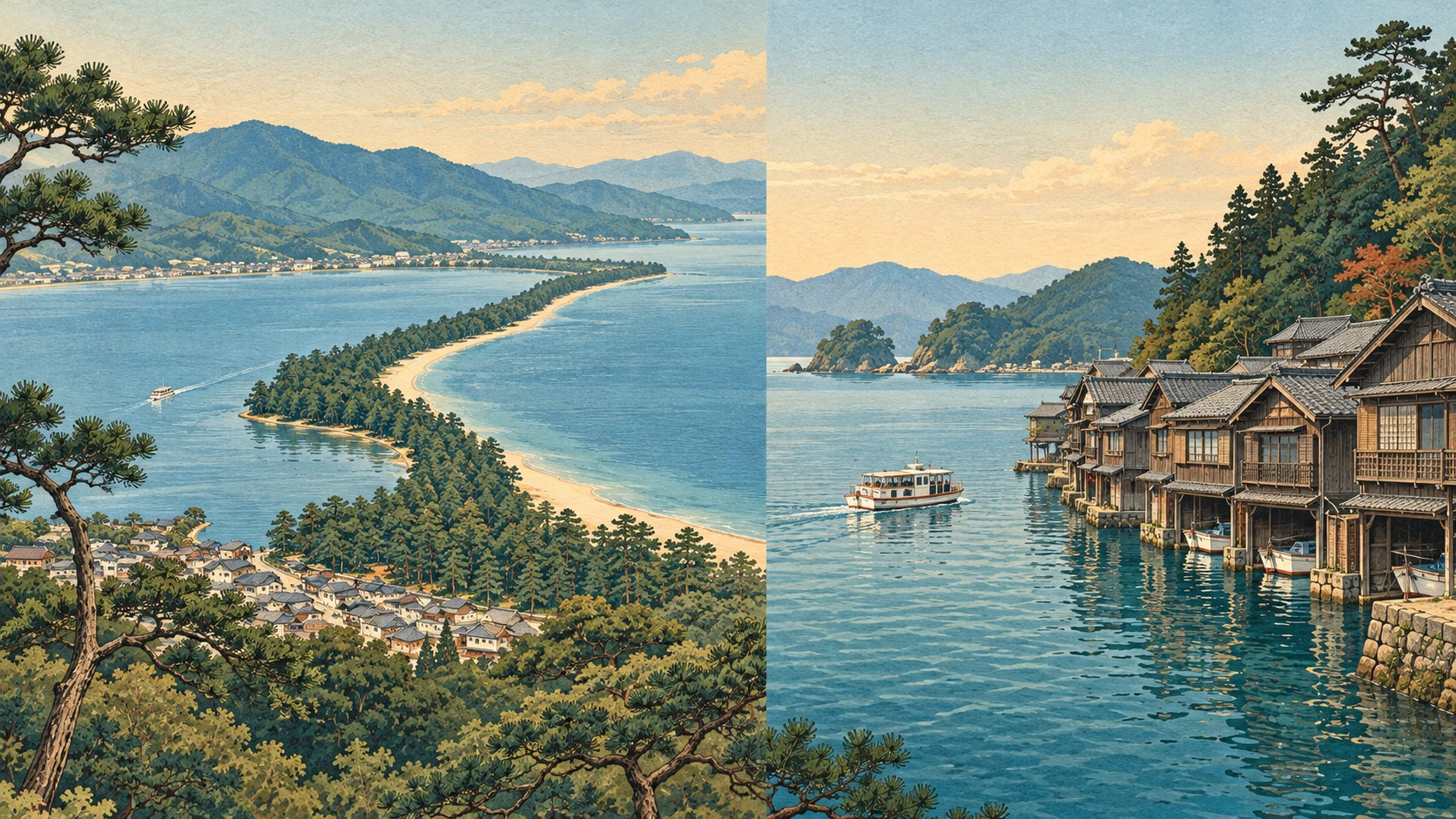
Decide whether to stay in Amanohashidate, add Ine or spend a night before choosing viewpoints, boats and buses. Your return journey, meals and check-in times determine how much fits.
Choose one viewpoint, or add a night in Ine?
Amanohashidate and Ine's funaya boathouses work well on the same northern Kyoto coastal trip, but need separate time allowances. Amanohashidate includes the sandbar, viewpoints on two shores and transport across the water; Ine adds a bus journey to the bay, a choice of boats and meal planning. With one day, choose one main viewpoint. To explore both shores without squeezing Ine, two days and one night are easier to arrange.
For a day trip from Kyoto or Osaka, I would check the return service before deciding whether to include Ine. Arrive near midday and try to fit in two hills, the entire pine-lined sandbar, an Ine cruise and dinner, and any queue can displace the next activity. Leaving out one stop buys time to sit, look at the sea and eat.
This guide uses official information available on October 22, 2026 to compare transport, passes and named accommodations. Times are planning references: weather, queues and unexpected suspensions require adjustments. If the wider Kansai itinerary is still undecided, choose your priorities first, then decide whether this coastal stretch needs one day or deserves an overnight stay.
Where Amanohashidate, Fuchu and Ine fit into the route
Monju, on the Amanohashidate Station side, is convenient for rail connections, station-area accommodation and Viewland. Fuchu lies across the sandbar and is the departure side for the Kasamatsu Park cable car. You can cross between the shores on foot through the pines, by bicycle or by boat. Each choice changes the time left for the hilltop, meals and Ine; changing transport is not an empty gap in the schedule.
Ine is farther north, and the Hide sightseeing-boat pier is separate from the central boathouse area's bus stop named Ine. Get off at Hide for the larger cruise returning to that same pier; get off at Ine for the streets, small boats near Shichimenyama and some accommodations. Check addresses before booking meals or a room. Reaching Ine town does not necessarily mean reaching your lodging's door.
The waterfront buildings also serve different purposes. The tourism association's explanation of funaya and main houses says boathouses originally stored boats and fishing equipment and provided working space. Residents often lived in main houses across the road, although some boathouses function as homes or separate living quarters. The roughly 230-building landscape includes daily work and private life; not every building is open for visits or overnight stays.
The trade-offs between one day, two days and a same-day return
An Amanohashidate day trip can be satisfying: arrive and leave by the station, visit one viewpoint, choose one way to cross between the shores and leave time for a meal. To add Ine, first remove the second viewpoint and a complete sandbar walk. Someone already in Amanohashidate that morning has different daylight available from someone leaving Osaka after 9:00; the same tight timetable will not suit both.
A two-day Amanohashidate–Ine trip can put the two shores on day one and the bus to Ine on day two. Alternatively, stay in Ine first and split the return journey between a stop in Amanohashidate and travel back to the city. The latter needs breakfast, checkout luggage and bus planning first. An evening by the bay offers a quieter stay, but does not remove transport constraints.
Adapt those trade-offs to your group. With a fear of heights, young children or a need for gentler access, reduce transfers first. If sleeping in a boathouse is the main goal, prioritise arrival and a reserved dinner. A slower approach to Kyoto's neighbourhoods can also help you decide whether to set these two days apart from the city itinerary, giving both city and coast an unhurried visit.
Kyoto to Amanohashidate: Hashidate train or highway bus?
From Kyoto, start by comparing rail with the direct highway bus. JR's description of the Hashidate service lists routes from Kyoto and Fukuchiyama toward Miyazu, Amanohashidate and Toyooka. Check the actual departure, stops and seating arrangements for your travel date. An old seasonal extra-train announcement is not enough to place the same departure in an October itinerary.
For buses, the current Kyoto route timetable and fares follow the October 1, 2026 revision and list six round trips daily. Kyoto Station 7:20 to Amanohashidate 9:25 takes a scheduled 125 minutes; the 8:20 and 9:00 departures arrive at 10:25 and 11:05. A scheduled arrival does not guarantee that a delayed bus will still connect with your intended boat or local bus.
The current Kyoto–Amanohashidate adult one-way fare is ¥3,400–3,900 depending on the date; the listed child fare is ¥1,800. Do not budget from the older prices still shown for travel through September. Arriving on the first bus at 9:25 leaves more room for Amanohashidate itself. For the later example combining Ine with a 9:00 start, stay the previous night or reduce the morning's activities.
From Osaka: three direct buses and different departure and arrival stops
A direct Osaka–Amanohashidate highway bus avoids intermediate transfers, but offers fewer departures than Kyoto. The Osaka route's stops after the October revision list departures from Hankyu Sanbangai at 9:30, 12:40 and 17:50, arriving in Amanohashidate at a scheduled 12:18, 15:12 and 20:22. Not every service stops at Shin-Osaka or Osaka Airport. Select the journey using your actual boarding stop.
Return departures from Amanohashidate are 7:13, 12:25 and 16:45, with scheduled arrivals at Umeda, in front of Hankyu Department Store, at 9:46, 14:58 and 19:28. This differs from the outbound Sanbangai boarding location. Taking the 9:30 bus in and the 16:45 bus back leaves just 4 hours 27 minutes locally: enough for a selective visit, but not an additional Ine round trip.
The current adult one-way fare from the main Osaka city stops to Amanohashidate is also ¥3,400–3,900, with children ¥1,800. Date bands use an S/A/B calendar; the child fare is half the A fare, not simply half that day's adult price. If connecting from Kansai Airport, use the airport transfer options for Osaka and Kyoto to plan the preceding night. Landing time is not arrival time at the highway-bus stop.
JR passes and local excursion passes cover different sections
Before using a JR pass to reach Amanohashidate, check its full product name. JR West's official Kansai WIDE information lists five consecutive days at ¥12,000 for adults and ¥6,000 for children ages 6–11; adult pricing starts at 12. Eligibility includes a foreign passport and Temporary Visitor status. Assess value using the actual covered journeys across your trip, rather than only one Kyoto round trip.
JR's official map includes the Kyoto Tango Railway sections Fukuchiyama–Miyazu, Miyazu via Amanohashidate to Toyooka, and Miyazu–Nishi-Maizuru. It does not include the Ine bus or sightseeing boats. Reserve JR seats first; an all-reserved-seat train has no unreserved car to look for. The five days run from 00:00 on the first day to 24:00 on the last, Japan time, rather than any 120 hours after purchase.
If you already hold this eligible JR pass, you still need to compare local transport around Amanohashidate and Ine. If not, list the trains you actually need and use a route-by-route comparison of Japanese rail tickets to check coverage. The official page still notes that prices may change, so check the version you purchase before departure. One pass name does not make it a ticket for every form of transport.
Amanohashidate–Ine passes: distinguish 1Day, 2Days and boat-and-bus tickets
The local Free Pass conditions in Tantetsu's excursion-ticket list price the Umi no Kyoto Amanohashidate–Ine Free Pass at ¥3,550 adult/¥1,780 child for 1Day, or ¥4,550/¥2,280 for 2Days. It covers the listed Tantetsu local and rapid trains and limited-express unreserved seating, specified buses, the crossing boat, Kasamatsu and the larger Hide cruise. Limited-express reserved seating and the Akamatsu service's supplementary ticket can still cost extra.
The 2Days notes specify two consecutive days, while a general field on the same page retains wording about validity on the boarding day. Check the ticket and version when buying; do not interpret it as 48 hours. A mobi digital ticket does not need a station exchange, while an online reservation may have a different redemption process. Channels such as RYDE can also set separate validity and refund terms. One ticket's procedure does not apply to all versions.
Tankai's separate two-day boat-and-bus ticket costs ¥3,500 adult/¥1,750 child and includes the listed local buses, boats, Kasamatsu and the Nariaiji mountain bus. It does not list Tantetsu trains; Nariaiji temple admission is additional. Viewland and private sea taxis are not automatically included because the ticket names sound similar. Mark the transport you will actually use, then compare the railway-inclusive and local boat-and-bus versions.
Match buses, the crossing boat and the Ine cruise to their purpose
The Amanohashidate sightseeing boat transports you between Monju and Fuchu. The Ine Bay cruise leaves Hide, circles the bay and returns to Hide. Both offer sea views, but serve different purposes. Small sea taxis in central Ine have their own skippers, boats and rules; their child fares and boarding locations cannot stand in for the larger Hide boat's conditions.
Buses likewise divide into ordinary local routes and the seasonal Ine Express. Local services make more stops and charge by the section travelled. The express operates within specified dates and stops, takes payment at the front door before travel and has no luggage hold. Crossing boats, viewpoints and either bus type can be combined, but each extra leg adds another queue, stop to locate and possible weather disruption.
The table includes only representative sections used in this guide. Child fares follow each operator's school-stage and ticket rules, not a universal half-price calculation; whether a free young child occupies a seat is another condition to check. If your trip must accommodate naps, bathroom breaks or large bags, fewer transfers leave more time somewhere you can sit and pause.
| Transport and route | Representative adult fare | What the journey does |
|---|---|---|
| Ordinary bus: Amanohashidate Station to Ine | ¥400 one way | A multi-stop route; shorter trips have their own sectional fares |
| Seasonal Ine Express: Amanohashidate to Ine | ¥1,200 one way | October 1–December 20, 2026; no reservations |
| Amanohashidate boat: Monju to Ichinomiya | ¥800 one way; ¥1,300 return | Crosses Aso Bay to the opposite shore |
| Large Ine Bay boat: circuit from Hide | ¥1,200 | About 25 minutes, returning to the same pier |
| Small Ine sea taxi | Association’s general fare ¥1,000 | Near Shichimenyama; confirm the chosen boat’s conditions |
The autumn 2026 Ine Express: fewer stops, but allow time to wait
This season's Ine Express timetable and boarding rules list daily operation from October 1 to December 20, 2026. Departures from Amanohashidate at 9:50, 10:50 and 12:50 reach Hide at 10:29, 11:29 and 13:29, then Ine four minutes later. Return departures from Ine at 12:30, 14:30 and 15:50 are scheduled to reach Amanohashidate at 13:13, 15:13 and 16:33. These seasonal times cannot simply be reused next year.
Individual adult tickets cost ¥1,200, with children half-price at ¥600. Board at the front and pay first using cash, supported contactless bank payments or QR payments; ¥10,000, ¥5,000 and ¥2,000 notes cannot be changed. The express cannot be reserved and may be full. It has no luggage compartment, and large cases may be refused, so settle luggage arrangements before an overnight boathouse stay.
The official page lists specific accepted excursion passes, including the two types discussed above, but you still need to show a valid ticket. The express's front-door advance payment is not the ordinary local-bus procedure. Conversely, another local departure does not mean a vehicle will collect everyone left behind by a full express at the same stop and time. Check the next service before leaving an attraction, rather than after missing your intended bus.
Local buses: ¥400 to Ine, with a separate short fare from Hide
The official Ine route fare matrix lists ¥400 adult from Amanohashidate Station to Ine. The Ine-wan-meguri Hide stop near the cruise pier belongs to the Hide-Kotsubo fare group, and its short hop to Ine costs ¥150. Not every stop along the route costs ¥400; nor should a ¥200 figure for a larger zone be substituted for this short trip. Confirm the actual stop name when boarding for the return.
The weekday and holiday local-bus timetables use different columns; holidays also include specified New Year and Obon dates. For example, Hide 12:37 to Ine 12:41 appears separately in weekday and holiday services at the same time, but those buses subsequently follow different routes. When connecting from boat to village, check direction and the correct stop rather than ignoring a note because two time boxes match.
Tankai's local-bus payment instructions explain cash, supported contactless bank cards and QR payments. With a bank card, tap on and off using the same card or the same mobile-payment device. Transport IC cards such as ICOCA are not accepted. Some vehicles or equipment may not support a method, so keep cash as a backup. This tap-on/tap-off process differs from paying first at the seasonal express's front door.
Viewland: match the ticket to the last uphill journey
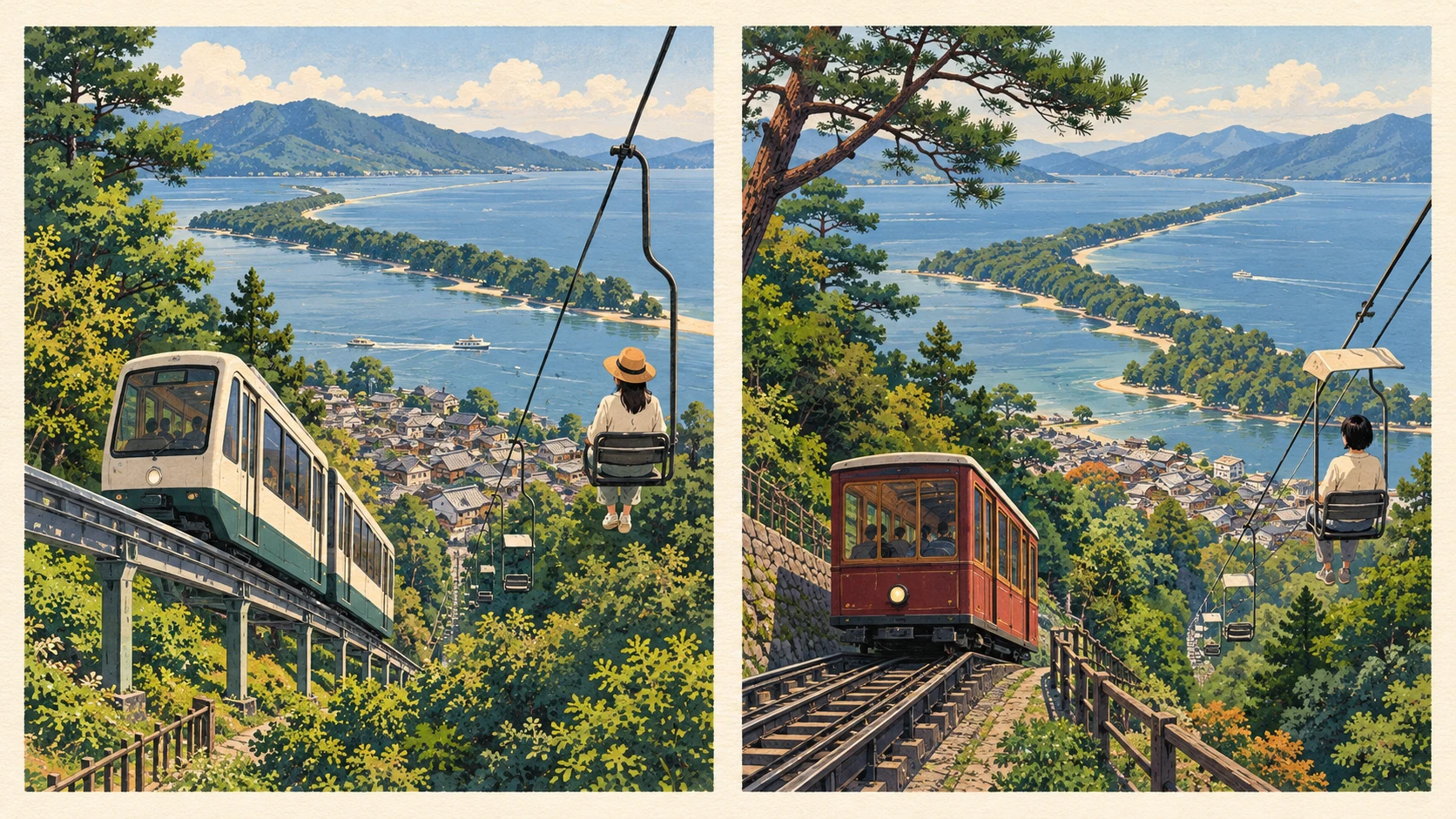
If visiting just one viewpoint, Viewland near Amanohashidate Station is easier to combine with rail or the highway bus. The operator's answers on station access and visit length give around five minutes on foot to the lower station, and about 40 minutes to an hour for the ascent, view and descent alone. Adding rides can take one to two hours. Queues add time: this is a planning allowance, not a promise to finish in an hour.
Viewland's current opening and admission information lists ¥1,000 for junior-high students and older and ¥500 for elementary-school children. Admission includes a return journey shared between its chairlift and monorail; one-way tickets are not sold, and you cannot walk or drive into the park. One child from birth through pre-elementary age is free per adult; additional young children pay the child fare. Amusement rides require separate tickets; the return ticket does not include every ride.
From October 1 to November 15, ticket sales are 9:00–17:00 and the park opens 9:00–17:30. From November 16 to February 15, sales end at 16:30 and the park at 17:00, still opening at 9:00. Last ticket sales, last ascent and park closing are three different times. To see the late-afternoon view, arrange the descent and dinner transport first; 17:30 is not a time to start heading uphill.
Chairlift, monorail and maintenance: choose access for your group
Viewland's conditions for its two uphill options give about six minutes for the single-seat chairlift and seven for the monorail. The monorail goes up at :00, :20 and :40, and down at :10, :30 and :50, first come, first served. Elementary-school children and older can use the chairlift independently. A younger child must sit on an adult's lap, held by the adult, with the child facing the direction of travel. Anyone uncomfortable with heights can choose the monorail instead of taking the chairlift for a photograph.
The monorail normally carries 40 people, with at most three wheelchairs per departure; wheelchair use reduces passenger capacity. A dedicated elevator at the lower station is available with staff assistance. This is not a reservable shuttle with a guaranteed seat. If only the monorail operates that day, waiting one extra departure can tighten your onward connection, so reduce hilltop rides and photo stops accordingly.
The inspection notice for October 21–22, 2026 suspends the chairlift after 15:00 on October 21 and until a planned 11:00 on October 22, with only the monorail running in that interval. A separate notice closes the entire park on April 13–15 and December 14–16, 2027. Those closures cannot be solved by taking the other uphill vehicle. Rearrange your visit if your date falls within one of these periods.
Kasamatsu Park is across the water: allow separately for Nariaiji
Kasamatsu Park's official services and fares price Fuchu–Kasamatsu at ¥400 adult one-way/¥800 return, with children ¥200/¥400. The ticket works on both the cable car and chairlift, so you can choose different methods up and down. The cable car takes around four minutes. The page gives both about six and about eight minutes for the chairlift; leave enough margin rather than treating the shorter figure as a precise guarantee.
The cable car operates 9:00–18:00 from March through October, until 17:30 in November and February, and until 17:00 in December and January, generally every 15 minutes. The chairlift operates 9:00–16:00 from March through November, with different winter periods and operating days, also subject to weather and maintenance. Looking only at the cable car's closing time can mean missing the chairlift you wanted.
You can continue to Nariaiji by mountain bus, but the extra ascent, temple visit, admission and return need separate time. The area-wide closure notice for December 18, 2026 includes the cable car, chairlift, Nariaiji mountain bus and associated shops for the whole day. With only one day and Ine also planned, the viewpoint's location on the far shore is not a good reason to add a temple visit automatically.
Cross by boat, pine-lined footpath or bicycle
The sightseeing boat connecting Monju and Fuchu gives about 12 minutes for Amanohashidate–Ichinomiya. Representative adult fares are ¥800 one-way/¥1,300 return, with children ¥400/¥650. It crosses Aso Sea to the opposite shore, rather than taking you to Ine. Timetables use weekday, holiday, seasonal and special-service markers, so check the departure you want rather than remembering a single fixed frequency.
For walking through the pines, the operator uses about an hour as an overview; photo stops, young children or rain can make it longer. Amanohashidate bicycle rental with return at either end lists a representative ¥500 for two hours and estimates about 15–20 minutes one-way. That estimate excludes viewpoints, meals and waiting for pedestrians, and is not a riding-time promise for every visitor.
If you enjoy walking, make one viewpoint and the pine-lined sandbar the day's focus; if you want to conserve energy, take the boat and use that energy on the other shore. Bicycle-and-boat combinations exist, but check return times, bike types and terms. Permission to return a bike across the sandbar does not make an ordinary Amanohashidate rental an e-bike package for riding all the way to Ine.
One viewpoint and Ine: an example starting with a night in Amanohashidate
This example assumes you stayed in Amanohashidate the previous night, the 2026 seasonal express is still operating and you can start at 9:00. Visit Viewland for the view, keep the descent and station return on schedule, then take the 10:50 express to reach Hide at 11:29. With maintenance or long queues, reduce amusement rides first. If you miss 10:50, recheck both bus and boat departures rather than running down stairs or rushing companions to make the connection.
If you catch the 12:00 Hide cruise, you return to the same pier around 12:25, then connect to the local bus from Hide at 12:37 to Ine at 12:41. The interval between the boat's return and the scheduled bus is 12 minutes. That includes disembarking, finding the exit, reaching the stop for the right direction and waiting. Any delay can break the connection. Choose a more generous boat departure or later bus if someone walks slowly.
Spend the afternoon walking Ine's streets and having lunch, then take the 15:50 express back, scheduled to reach Amanohashidate at 16:33. The itinerary includes only one viewpoint and no complete sandbar walk. Connecting to the 16:45 Osaka highway bus leaves a scheduled gap of just 12 minutes, which is not recommended as a reliable connection. Select city-bound tickets or a hotel dinner arrangement that can absorb road delays.
| Time reference | Plan | Condition to preserve |
|---|---|---|
| From 09:00 | Visit Viewland, descend and return to the station | Drop an activity if queues are long; rides are optional |
| 10:50 → 11:29 | Seasonal express: Amanohashidate to Hide | Unreserved; a full bus may prevent boarding |
| 12:00 → about 12:25 | Large-boat cruise from Hide | A cancellation or delayed departure changes what follows |
| 12:37 → 12:41 | Ordinary bus: Hide to Ine | A 12-minute interval is not a guaranteed connection |
| Afternoon | Streets, lunch and a rest | Have an alternative if a restaurant has queues or sells out |
| 15:50 → 16:33 | Seasonal express: Ine to Amanohashidate | Avoid tight connections to a city-bound service or dinner |
Two days and one night: separate the coast and the shores
With two days, first allow a full day for Amanohashidate's two shores: one hill, the crossing, lunch and a walk on the other side, then decide whether your energy allows a second viewpoint. Even arriving on Kyoto's earlier bus at 9:25 does not mean you were already on the hilltop at 9:00. Include lunch and boat waits, with a seated break during the afternoon.
Visit Ine on day two to separate the Hide cruise from the central streets, instead of chasing the same short connection. Staying in Amanohashidate lets you first ask to leave large bags and head out lightly. Staying in Ine means checking whether the lodging accepts luggage after checkout and how you will get it back to the station. Each has advantages; compare more than the view outside the window.
For a night in Ine, treat the check-in window and reserved dinner as the day's endpoint. If accommodation has no meals or prohibits cooking, starting to find a restaurant only in the evening may leave few choices. Arrange breakfast beforehand too, then check transport after checkout. Those details shape the value of the overnight stay as much as a single sea-view photograph.
The Hide Ine Bay cruise returns to the same pier after about 25 minutes
The larger Ine Bay sightseeing boat departing from Hide lists operation from 9:00 to 16:00, departing on the hour and half-hour for a roughly 25-minute circuit, subject to suspension in bad weather. Fares are ¥1,200 adult/¥600 elementary-school child. The page defines adults both as junior-high students and older and as age 13+, and children as elementary pupils ages 6–12. Ask the operator where school stage and age do not align; do not substitute JR's age-12 boundary.
One pre-elementary child is free per adult; additional young children pay the child fare. The boat circles the bay and returns to Hide rather than transporting you to the boathouse centre, so a local bus or another transfer remains after disembarking. Getting off the express at Ine does not put you outside this large-boat pier. Choose the boat first, then the bus stop, to avoid changing plans on arrival.
The operating notice dated October 21, 2026 reported normal service at that time. It establishes that announcement's status, not a guarantee of sailing every future day. Boat tickets, excursion passes and connecting buses are separate matters. If sailing is cancelled, use the time for accessible streets, arranged meals and your return, rather than substituting a small boat whose conditions you have not checked.
Small sea taxis: a different boarding point and boat-specific child prices
The association's skipper and fare information for Ine's small sightseeing boats says small groups of around five people or fewer may join without advance booking that day. Boarding near Shichimenyama parking is convenient; contact the skipper directly for a trip of about 25 minutes. The association's general cash fare is ¥1,000 adult/¥500 elementary child, with pre-elementary children free. This differs from the roughly 150-passenger Hide boat; these are not two ticket windows selling the same sailing.
The same information lists Herbie separately at ¥1,000 for elementary children and older. It has no roof and cannot operate in rain, and its acceptance hours vary by season, weekdays, holidays and sunset. Boats have capacities of 11 or 12, while AQUA's capacity differs between two association pages. Tell the skipper your group size and children's ages first. The general fare is not a promise for every boat.
The association's current-service and skipper-contact entry point is useful before choosing a boat. Even a walk-up service may have no boat available, be full or be cancelled by weather. If your priority is a quiet look at the boathouses, time on the streets has value in itself. Do not squeeze lunch, check-in or the bus buffer repeatedly just to fit in both types of cruise.
Walking around Ine: leave room for residents' daily lives
An Ine day visit can begin with an easy walk near the bus stop, but a view of the water does not make every entrance public. The tourism association's boathouse etiquette booklet identifies boathouses, main homes and land as private property requiring the owner's permission to enter. Respect privacy when photographing residents, work and laundry areas, and obtain consent before taking someone's picture.
Residents and buses share the streets. Do not line up across the roadway for photographs or obstruct passage with tripods, bags or fishing rods. When vehicles approach, move to a safe place, and take litter away. At a boathouse without signs inviting visitors inside, view the exterior from the public route; a closer waterside angle is not a reason to enter a private ramp or working area.
Ine's guidance on visiting a living community also asks for quiet at night and early in the morning, no idling parked vehicles and consideration for residents heading out to sea early. Overnight visitors should be particularly mindful of those hours. Tea by the water, quiet conversation and an early night preserve the calm of a stay better than treating empty streets as a late-night photo set.
Plan restaurant arrival times: Funaya Shokudo and Wadatsumi
Funaya Shokudo's own meal and cash-payment notices place it upstairs at 491 Hirata, with breakfast 8:30–10:00 and lunch from 11:00, last orders 15:00 and closing 16:00; Thursday is closed. It does not reserve seats and admits diners in arrival order. The page explicitly says it currently takes cash only, so the card-brand list retained farther down is not proof that cards are accepted now.
The association's September 2026 restaurant update instead gives breakfast until 9:30 and lunch last orders at 14:45, differing from the operator's page. Arrive early for breakfast and avoid the lunch cutoff. Have a meal alternative for queues, sellouts or unexpected closures. No seat has been held for you here, and an older travel review does not establish that a particular day will be queue-free.
For dinner, consider the hours and booking information for sushi restaurant Wadatsumi at Funaya Biyori: lunch 11:00–14:30, last orders 14:00; dinner 17:00–20:30, last entry 19:00 and last orders 20:00. Wednesday and other closure dates apply, and seasonal changes are possible. The menu depends on the catch. INE CAFE at the same address has drinks and light food, but lunch may have irregular closures and limited quantities; it is not a dependable dinner substitute.
Amanohashidate Hotel: separate twin beds, five-person capacity and room baths
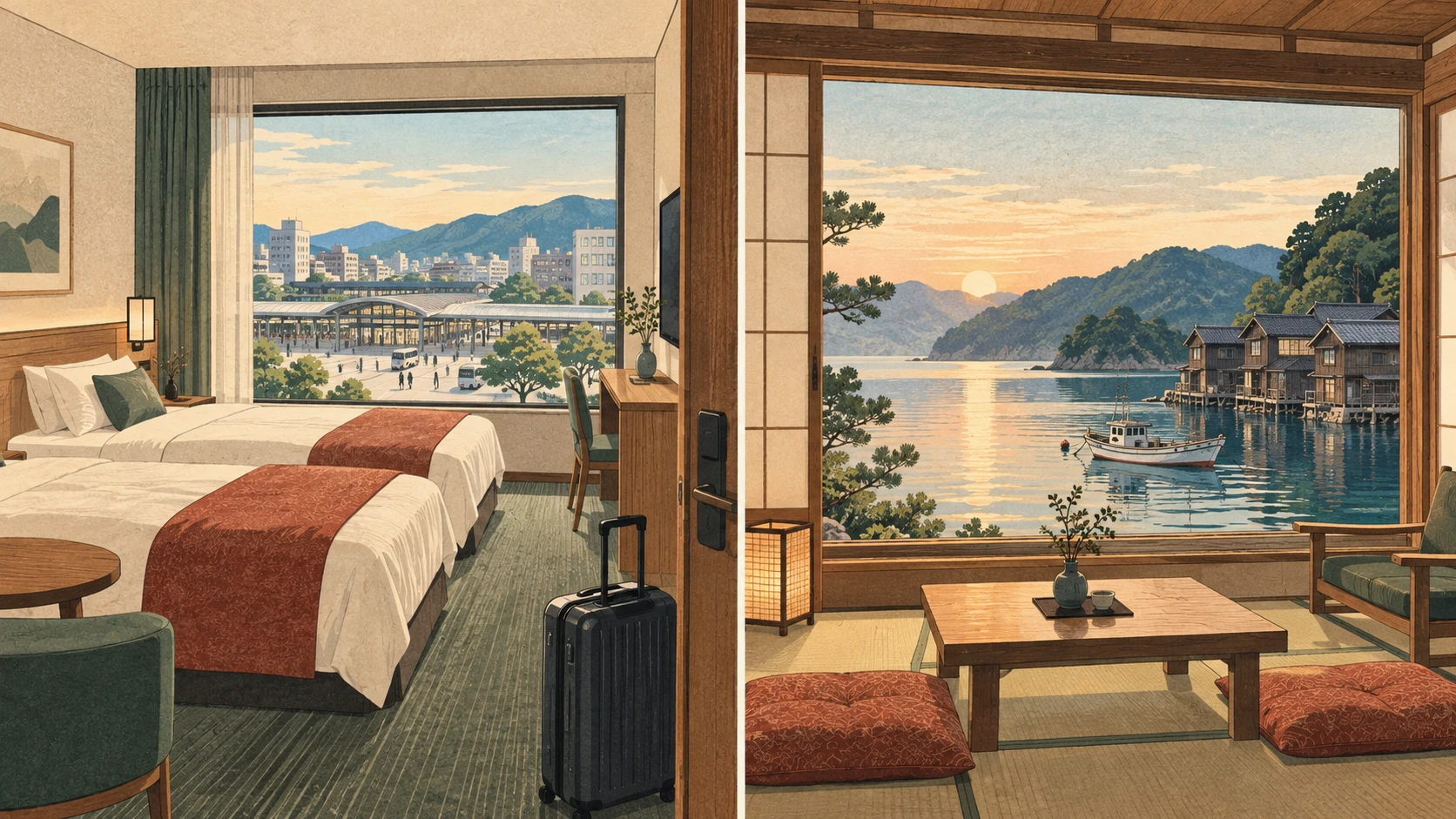
Amanohashidate Hotel's named room specifications list a 41-square-metre Japanese-Western room with a twin bedroom and Japanese room for one to five people. The sea-side Western twin is 28 square metres for one to two. Capacity for five does not mean five beds; families must confirm bedding arrangements for the third guest onward and children's bed use. Booking only the broad label “sea-view room” can conceal the difference between twin beds and one double bed.
Both the 88-square-metre special room with an open-air bath and the 48-square-metre Japanese room with a view bath accommodate one to five, but the operator explicitly says their room baths are not hot springs. The 48-square-metre room additionally specifies futons for the third guest onward. The hotel's natural-hot-spring information concerns the shared large bath. A hotel having an onsen does not establish that every private room bath uses hot-spring water.
Normal check-in is 15:00 and checkout 10:00; guests with dinner must contact the hotel if arriving after 18:00. The operator's meal-plan and breakfast-format information lists breakfast 7:00–9:00, normally buffet-style but potentially changed to a set meal without notice. Dinner depends on the plan and season. If also visiting Ine that day, match dinner and the journey back before adding another boat trip.
Monjusou: two beds in Mai rooms and different private-bath arrangements
Monjusou's first- and second-floor Mai-wing rooms each measure 45 square metres for up to four, with tatami and two Sealy beds; the first-floor room also has a terrace. The 92-square-metre Kaze no Midori, Umi no Midori and Sora no Midori special rooms combine twin beds, a Japanese room and an in-room open-air bath for up to four. Four adults wanting separate sleeping places must still confirm additional bedding rather than relying on capacity alone.
Monjusou's answers on pick-up, young children and baths give around three minutes on foot from the station, with pick-up requiring advance contact about arrival. Normal check-in is 15:00–18:00 and checkout 10:00; special rooms use 14:00 check-in and 11:00 checkout. Young children are accepted, but the ¥2,200 facility fee from birth through pre-elementary age excludes meals and bedding; bedding adds ¥2,200. Elementary- and junior-high-school pricing also differs.
The operator says it has no separately reservable private bath and suggests special rooms with an in-room open-air bath instead. The shared natural-hot-spring bath description cannot establish the water source of a room bath. Breakfast and dinner are generally in MON or a dining space rather than the guestroom, with dinner normally starting at 18:00, 18:30 or 19:00. Raise allergies when booking, rather than expecting a whole replacement meal to be prepared at the table.
Funaya no Yado Wako: one group daily, with starting prices per person
Wako's own property introduction describes a renovated second floor in a Taisho-era boathouse, hosting one group per day while retaining the boat ramp below. It offers a stay on the scale of the bay's everyday buildings, but photographs alone do not establish bed arrangements, accessibility or a private onsen. Get an explicit room response for those needs before deciding to pay.
The operator's Japanese tax-inclusive rate list gives starting prices for two, three or four guests at ¥17,600 per person on its regular-price dates, and ¥19,800 on Fridays, Saturdays and nights before holidays. Solo rates start at ¥35,200 and ¥39,600 respectively. The regular-date starting total is therefore ¥35,200 for two or ¥70,400 for four, not ¥17,600 for the entire building. Golden Week, Obon, New Year and specified festival or fireworks dates use separate prices.
The association's Wako accommodation conditions list one room for up to four, no meals, 15:00 check-in and 10:00 checkout. A bathtub is listed but does not establish hot-spring water. The three-month booking opening is stated only in that association listing; check the actual calendar and cancellation terms in the operator's order. The free ticket for Onishi parking, about 150 metres away, covers one entry for 24 hours, not unlimited re-entry.
Ine Atarashiya: two double beds and an elementary-school minimum
Funaya Inn Ine Atarashiya's room and house rules explicitly list two upstairs double beds, a washbasin, toilet and sofa. One or two guests have more space; with three or more, two people must share a double. Stair safety means only elementary-school children and older are accepted, with the operator also stating age six and up. Preserve the school-stage condition: reaching six alone does not establish that a preschool child is eligible. Children receive no discount.
Base prices are nightly totals: Monday–Thursday, one or two guests from ¥41,000, three from ¥51,000 and four from ¥60,000. Friday–Sunday and holidays start at ¥49,200, ¥61,200 and ¥72,000, varying by period. At 00:00 on the first of each month, bookings open for the whole month two months ahead: October 1 opens December, for example. That differs from the association's three-month note for Wako.
This is a room-only stay and cooking is prohibited, including electric hot plates. A refrigerator and microwave do not make it self-catering. It is around two minutes on foot from Ine bus stop, with stairs, low ceilings, limited insulation and airtightness in the old wooden building, and no television or loungewear. The formal check-in and luggage terms give 15:00–19:00 check-in, requiring contact for late arrival; absence after 21:00 without contact is a no-show. Booking requires advance credit-card payment, and luggage after checkout needs prior agreement.
For two meals, consider Yoshimuraya without expecting a renovated boathouse
The Ine tourism association's listing for cuisine ryokan Yoshimuraya places it at 143-1 Hirata, a traditional meal-focused inn on the inland side of the boathouse district. The association specifically cautions that it is not a beautifully renovated boathouse. The association lists tax-inclusive rates from ¥19,800 per person with breakfast and dinner, two rooms accommodating six in total, and 15:00 check-in/10:00 checkout. Total capacity across two rooms is not six people in each.
The association says a bath on the top, fourth floor overlooks the bay, but does not provide enough to establish bed types, a lift, an in-room bath or private-use arrangements. Make sure you are booking the property at 143-1 Hirata in Ine. If using two included meals to reduce uncertainty about eating out, first confirm meal times, children, stairs and cancellation rules before comparing it with room-only stays.
Write four questions together when comparing lodging: how many beds, who may stay, which meals are included and the latest arrival time. Sea views, building age and online starting prices do not answer them. First-time ryokan bookers can also use an approach to arranging dinner and bathing at a Japanese inn, rather than treating a scheduled meal as a restaurant ready whenever they arrive.
Cancellation and arrival deadlines deserve a read before payment
Amanohashidate Hotel's own terms table lists no-show or same-day cancellation at 100%, the previous day 50%, and two or three days before 30% for one to fourteen guests. The tourism association's hotel summary instead lists lower rates of 50%, 30% and 20%. Prioritize the operator and selected plan rather than treating the lower summary as a guarantee. Large groups, special offers and nonrefundable plans cannot simply use this row.
Monjusou's general rules are 100% for no-show or same-day cancellation, 80% one to two days before, 50% three to five days before and 30% six to ten days before, subject to different plan terms. Atarashiya lists 30% fourteen to eight days before, 50% seven to four days before, 80% three to two days before, and 100% the day before, same day or no-show. Their intervals differ; sharing an Ine–Amanohashidate itinerary does not give them one cancellation deadline.
Wako's association listing uses labels such as “up to 30 days before,” “up to 13 days before” and “up to three days before,” without clearly setting out mutually exclusive fee intervals. This guide does not fill the gap with “earlier cancellation is free.” Save your selected date, room type and cancellation conditions before paying, and clarify time zones and changes. The table points you to checks; your actual booking governs cancellation handling.
| Accommodation | Published general terms | Confirm before paying |
|---|---|---|
| Amanohashidate Hotel, 1–14 guests | No-show/same day 100%; previous day 50%; two/three days before 30% | Operator terms differ from the association summary; check special plans separately |
| Monjusou | One/two days before 80%; three–five days 50%; six–ten days 30% | Same day/no-show 100%; individual plans may differ |
| Atarashiya | 14–8 days before 30%; seven–four days 50%; three–two days 80% | Previous day/same day/no-show 100%; contact the property if late |
| Wako | Association lists cancellation charges, but date-range wording needs confirmation | Do not infer that cancellation is free 31 days before; read the operator’s booking terms |
Families and older travellers: decide beds, school stage and luggage together
For uphill transport with children, check each operator separately. Viewland allows elementary-school children to ride its chairlift alone; younger children must be held on an adult's lap. Kasamatsu is a different system, so do not transfer Viewland's age and lap-holding rules to the other hill. Explain fear-of-heights, wheelchair or pushchair needs to the chosen viewpoint first, then allow realistic waiting and access time.
A total guest count is not enough for a room booking. Two double beds shared by three or four people, two beds with extra futons in a Japanese room, and a four-person occupancy limit convey different information. Atarashiya's school-stage restriction, Monjusou's young-child facility fee and Wako's unconfirmed child conditions each stand separately. Put both ages and school stages in your enquiry to get a response you can actually use to book.
The seasonal express has no luggage hold, and a small lodging may not have anyone available to receive large bags. Arrange luggage before and after check-in at a station-area hotel and establish when a boathouse host is present. Convenience at Amanohashidate Hotel and Monjusou involves not just proximity to the station but whether your booking allows those handovers, rather than dragging cases through every transfer.
Cycling around Ine: reserved e-bikes are not free public bicycles
The association's Ine e-bike rental listing gives sport-bike prices of ¥5,000, ¥8,000 and ¥11,000 for one, two and three days, with city bikes ¥2,500, ¥4,500 and ¥6,500. It lists March–November operation and cash payment, with tax, insurance and compensation for unintentional bike damage included. This is published information updated July 23, 2026. Confirm bike types, child seats and availability for your date first.
The operator's current Ine pick-up and return arrangements require a reservation and contact before collection because staff are not permanently on site. Pickup starts at 9:00, with return by 17:00; other times need agreement. The location is near Hide pier, around three minutes from Ine-wan-meguri Hide bus stop or one minute from Hide-Kotsubo. It is not a bicycle you can find and take by walking through the central boathouse streets.
The association lists free cancellation through the previous day and 100% for same-day nonparticipation except for weather reasons. That does not mean you can abandon a booking without contacting anyone. The operator's partner location by Amanohashidate Station instead has Friday closure and pick-up from 9:30; do not mix the conditions. Before expanding a ride, consider fitness, hills, return time and darkness rather than adding a long peninsula journey to an already full cruise itinerary merely because the bike has assistance.
Amanohashidate weather and Ine in winter: prepare an adjustable version
Check that day's weather, visibility and operating notices separately before choosing an ascent or boat. General winter hours are not a daily forecast or a prediction of autumn colours or snow on a particular date. If mist or rain reduces the hilltop view, avoid repeating two viewpoints and save money and energy for indoor breaks, meals and streets you can safely reach.
Check chairlift, cable car, monorail and boats individually in winter rather than relying on a park's “open year-round” description. Kasamatsu's chairlift uses winter periods and weekday/holiday conditions, while Viewland has complete closure dates. This Ine Express announcement runs only through December 20, 2026. Outside it, rebuild the trip around ordinary buses and your lodging's reception terms; do not assume the same express timetable remains.
For a waterfront night, also consider the building's actual insulation, stairs and meals. A winter boathouse stay does not automatically combine snow with a warm onsen. If still choosing a month for the wider trip, consult choosing Japan's travel season around what you want to do, then check this area's specific transport. A movable half-day is more useful in uncooperative weather than tying every activity into one unchangeable sequence.
An adult budget example: separate local tickets and long-distance travel
Using the day-trip example after a night in Amanohashidate, individual adult purchases are Viewland ¥1,000, two seasonal express trips ¥2,400, the larger Hide boat ¥1,200 and the short Hide–Ine local bus ¥150: ¥4,750 in total. This excludes meals, lodging and travel from Kyoto or Osaka, and does not add a small sea taxi. It is not the cost of the entire trip.
If the chosen version is valid for your journey, the ¥3,500 local Tankai two-day boat-and-bus ticket plus Viewland's ¥1,000 totals ¥4,500, saving ¥250 against that example. The ¥3,550 railway-inclusive 1Day Free Pass plus Viewland totals ¥4,550, saving ¥200. Whether you need trains, or will use the crossing boat or Kasamatsu on day two, changes the choice. Included transport you never use does not become a travel experience merely by appearing on the pass.
Wako's starting total for two adults on its regular-price dates is ¥35,200; Atarashiya's Monday–Thursday nightly total for one or two starts at ¥41,000. Meals, beds and cancellation conditions still differ, so dividing by people alone does not identify the better stay. Put actual payments together and use itemising a Japan trip budget to leave room for food, luggage and changes, then decide where to spend the night.
Booking order: protect the return and dinner before filling gaps
First fix the city departure date, arrival in Amanohashidate and return. If staying overnight, confirm the minimum school stage, beds and latest check-in. Only then choose viewpoints, boats and passes. A local pass tying together activities cannot recover a missed dinner or the cost and inconvenience of new transport if no bus gets you to that meal.
Save separate addresses for the station, Hide pier, central Ine, your lodging and restaurants. Keep cancellation terms and emergency contacts. Distinguish bank cards from transport IC cards, and carry usable cash, especially for cash-only businesses and buses with varying payment support. Ask early about pick-up, allergy meals and luggage storage; entering a note does not mean the request has been accepted.
Finally check each operator's notices for the day. For suspensions, long queues or poor weather, preserve confirmed meals, check-in and the journey back, then adjust an optional second viewpoint or second boat. Amanohashidate and Ine reward time spent understanding them. A route completed calmly while leaving room for residents is more inviting to revisit than collecting every form of transport.
A few useful answers
Can I visit Amanohashidate and the Ine boathouses in one day?
With conditions. Staying in Amanohashidate the previous night allows an early start for one viewpoint, a Hide cruise and the streets of Ine. If a bus from Osaka only arrives near noon, keep the day in Amanohashidate rather than adding both viewpoints, the entire sandbar and Ine.
How long is the bus from Kyoto to Amanohashidate, and what does it cost?
The timetable effective October 1, 2026 lists Kyoto 07:20 to Amanohashidate 09:25, a scheduled 125 minutes. Adult one-way fares vary by date from ¥3,400 to ¥3,900; the child fare is ¥1,800. A scheduled arrival does not guarantee a connection after a road delay.
Can I add Ine to a same-day return trip from Osaka?
A bus arriving near noon leaves too little room for an unhurried round trip to Ine. The 09:30 Osaka departure is scheduled to arrive at 12:18; returning at 16:45 leaves four hours and 27 minutes. One Amanohashidate viewpoint and a nearby meal are easier to fit.
Does one Amanohashidate cable car ticket cover Viewland and Kasamatsu Park?
An ordinary return ticket for one viewpoint does not cover the other. Viewland’s ¥1,000/¥500 ticket includes its chairlift and monorail return journey and admission. Kasamatsu has a separate combined cable car/chairlift ticket costing ¥800 adult or ¥400 child return. Check each pass for the specific transport covered.
Is the Amanohashidate sightseeing boat the same as the Ine Bay cruise?
No. The Amanohashidate boat links the Monju and Fuchu shores, with a representative crossing of about 12 minutes. The large Ine boat leaves Hide Pier, cruises for about 25 minutes and returns to Hide. Small sea taxis near Shichimenyama are another option.
Do the ordinary bus and Ine Express have the same fare and payment rules?
No. The ordinary bus from Amanohashidate to Ine costs ¥400 adult; the seasonal express costs ¥1,200 one way, takes payment at the front door before travel, does not accept reservations and has no luggage hold. On ordinary buses, use the same bank card or device when tapping on and off. Transport IC cards such as ICOCA are not accepted.
Is an Amanohashidate–Ine pass always better value?
Not necessarily. Distinguish the 1Day/2Days Free Pass that includes Kyoto Tango Railway from the local Tankai two-day bus-and-boat ticket, then count your actual journeys. A similar pass name does not automatically include Viewland or private sea taxis.
Do all Ine sea taxis charge ¥500 for children?
No. The association’s general fare is ¥500 for primary-school children, but its Herbie entry specifically charges ¥1,000 for primary-school age and above. Boats also differ in weather limits, capacity and operating periods. Confirm with the skipper you will use.
Do all Ine boathouse stays provide dinner and private onsen?
Neither can be assumed. Wako and Atarashiya are room-only stays; Atarashiya prohibits cooking. A bathtub or open-air room bath does not establish that the water is a natural hot spring. Confirm the room, meals, bath water source and conditions of use.
Which accommodation accepts preschool children?
Check each property. Monjusou accepts young children but charges separately for facilities, meals and bedding. Atarashiya accepts primary-school children and older, also stated by the operator as age six and above. Ask Wako about its own young-child and bed-sharing rules rather than applying another property’s policy.
Can I wait until evening to look for food around the Ine boathouses?
That is risky. Arrange dinner before a room-only stay. Wadatsumi’s official page lists 19:00 as the latest dinner entry and has closed days; Funaya Shokudo does not provide that evening service. Cafe lunches can also have irregular closures or limited portions, so they are not a dependable dinner fallback.
Can I follow the same itinerary in winter or rain?
Recheck it. This 2026 express announcement only runs through December 20. Viewpoint transport has winter hours, maintenance and whole-park closures, while boats may stop in bad weather. Preserve meals, check-in and the return journey, then adjust viewpoints and cruises.
Check with the source
Schedules, availability and rules can change. These official sources are the place to confirm details before you book.
- Ine Tourism Association: how funaya and main houses are used
- JR West: Hashidate train route and rolling stock
- Tango Kairiku Kotsu: Kyoto highway bus, October 2026 timetable revision
- Tango Kairiku Kotsu: Osaka highway bus, current timetable and date-based fares
- JR West: official Kansai WIDE Area Pass information
- Kyoto Tango Railway: Amanohashidate and Ine 1Day/2Days tickets
- Tango Kairiku Kotsu: sightseeing bus-and-boat passes and combined tickets
- Tango Kairiku Kotsu: autumn 2026 Ine Express times, accepted passes and boarding rules
- Tango Kairiku Kotsu: Ine–Kamanyu route fares revised October 2024
- Tango Kairiku Kotsu: weekday and holiday local bus timetables
- Tango Kairiku Kotsu: local bus boarding and payment
- Amanohashidate Viewland: visit length, station walk and facilities FAQ
- Amanohashidate Viewland: seasonal hours, fares and parking
- Amanohashidate Viewland: chairlift, monorail and child riding conditions
- Amanohashidate Viewland: chairlift inspection on October 21–22, 2026
- Amanohashidate Viewland: two whole-park maintenance closures in 2027
- Tango Kairiku Kotsu: Kasamatsu Park cable car and chairlift times and fares
- Tango Kairiku Kotsu: Kasamatsu whole-day closure on December 18, 2026
- Tango Kairiku Kotsu: Amanohashidate cross-bay sightseeing boats and fares
- Tango Kairiku Kotsu: Amanohashidate bicycle hire, returns and charges
- Tango Kairiku Kotsu: Ine Bay cruises from Hide and school-age fares
- Tango Kairiku Kotsu: Ine Bay operating notice for October 21, 2026
- Ine Tourism Association: individual small-boat operators and fare conditions
- Ine Tourism Association: sea taxis and current operating information
- Ine Tourism Association: private boathouses, privacy and road etiquette booklet
- Ine Tourism Association: respecting residential space on a first visit
- Funaya Shokudo operator: meals, queues and cash payment notices
- Ine Tourism Association: Funaya Shokudo, updated September 2026
- Funaya Biyori: Wadatsumi and INE CAFE hours and reservations
- Amanohashidate Hotel: named rooms, beds, room baths and check-in times
- Amanohashidate Hotel: shared natural hot-spring baths and hours
- Amanohashidate Hotel: dinner plans and breakfast service
- Monjusou: Mai Wing rooms and open-air bath suites
- Monjusou: transfers, meals, young children, baths and cancellation FAQ
- Monjusou: shared hot-spring baths
- Funaya no Yado Wako: one party per day and the building
- Funaya no Yado Wako: operator’s Japanese tax-inclusive starting prices per person
- Ine Tourism Association: Wako capacity, room-only stays and cancellation wording
- Funaya Inn Ine Atarashiya: beds, minimum school age, prices and arrival conditions
- Funaya Inn Ine Atarashiya: accommodation, luggage and cancellation terms
- Ine Tourism Association: Yoshimuraya cuisine ryokan and two-meal stays
- Amanohashidate Hotel: child charges and cancellation terms PDF
- Amanohashidate Tourism Association: hotel details and a different cancellation summary
- Ine Tourism Association: e-bike prices, season and cancellation terms
- Kyoto eBikes: different hire and return conditions in Ine and at Amanohashidate Station