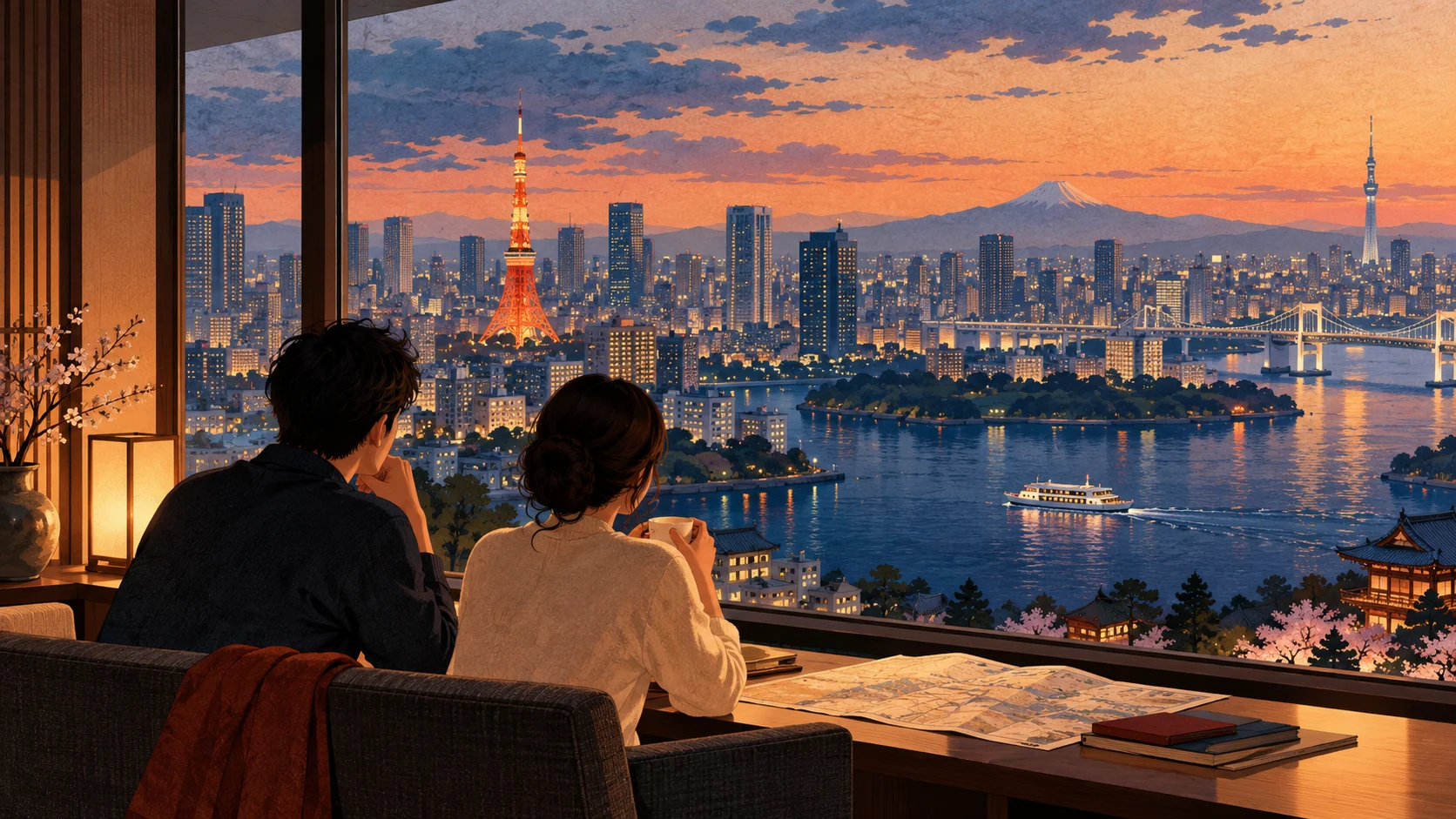
A Tokyo afternoon can belong to a skyline, art that changes with people, or streets seen from the water. Choose the experience you care about first, then compare tickets, companions, weather, and the journey back. This guide brings four observation decks, two teamLab venues, and three kinds of boat trip into one planning decision, explaining when a reservation helps and which entitlements, child rules, and refunds belong to each product.
Choose the view you want, then make one firm reservation
Before choosing a Tokyo observation deck, picture what you want to see: neighbourhoods spreading beneath you, Tokyo Tower framed by the night skyline, or Rainbow Bridge drawing closer from a boat. Each experience needs a different position and a different amount of time. A ticket up Tokyo Tower will not put the whole tower in front of your camera. An indoor window cannot fully replace the wind on an outdoor terrace. Decide which experience matters first; then ask whether another ticket would actually add anything.
Start by fixing just one admission or sailing time that you do not want to miss. Arrange walks, lunch, and shopping around it, with one activity you can drop. The time on an observation-deck or digital-art ticket usually governs entry, whereas a dining cruise leaves the pier on schedule. Train journey times on a map are an inadequate connection allowance: finding lifts, handling a pushchair, storing bags, and locating the right pier all use that apparent spare time.
Prices and general conditions use official information checked on 21 October 2026; the sunset route was checked separately on 22 October. All amounts are in yen. Choose a base using the Tokyo neighbourhood and accommodation guide, then pick a high-level view, an art venue you truly want to explore, or a boat trip. Counting attractions is less useful than answering this question: if the roof closes, your child dislikes the water, or the boat is cancelled, can you still enjoy the afternoon?
Compare Tokyo observation decks by your companions and plans
Tokyo Skytree suits travellers who want to study the city’s broad patterns while spending time around Oshiage and Asakusa. Tokyo Tower fits naturally with a walk around Shiba Park. Roppongi’s Tokyo City View puts tower views and exhibitions in the same area. SHIBUYA SKY offers a more immediate outdoor experience, but weather, belongings rules, and popular entry times affect the plan. A ranking can introduce the names; it cannot settle wheelchair access, a child’s ticket category, or whether you can change the booking.
The four paid options also use different pricing systems. Skytree and both teamLab venues have variable prices. SHIBUYA SKY distinguishes entry before and from 3 p.m., as well as online and counter purchases. Roppongi may charge differently when exhibition work limits part of the view. The table is a starting point, not an interchangeable price list: read each amount alongside its date, ticket type, age rules, and cancellation conditions. A starting price is not a fixed adult fare throughout the year.
If your budget allows one paid viewpoint, choosing somewhere near your hotel or that day’s walk is often more practical than chasing the highest platform. While reading Skytree’s current base tickets and add-ons, decide whether the Tembo Galleria really matters to you. For a free indoor city view, the Tokyo Metropolitan Government Building has its own opening calendar, explained later in this guide.
| Experience | Compare first | Key check before buying |
|---|---|---|
| Recognise neighbourhoods from above | Tokyo Skytree observation decks | Whether both the 350 m and 450 m areas are included |
| Walk near the red tower and optionally go up | Tokyo Tower | Main Deck and Top Deck Tour have different entitlements |
| Include Tokyo Tower in the skyline | Roppongi Tokyo City View | Indoor areas open and any exhibition-related restrictions |
| Experience the city from an open platform | SHIBUYA SKY | Roof status and cancellation before entry |
| Save money with an indoor city view | Tokyo Metropolitan Government Building observatories | North and South Observatory closure days differ |
Skytree’s 350 m and 450 m areas: buy the view you expect
The full height of Tokyo Skytree and the observation areas visitors can enter are different things. A standard visit takes you to the Tembo Deck; choose a ticket including the Tembo Galleria to go higher. “Floor 350” and “Floor 450” name areas by their height, not the 350th and 450th storeys of a building. If someone is uneasy at height, agree beforehand that stopping at the deck is fine. Going higher need not become a task everyone has to complete.
Current basic online prices start at ¥1,800 for adults and ¥900 for children for the Tembo Deck, or ¥3,000 and ¥1,500 for the deck plus galleria. The age labels are 15 and over versus 6–14, with an important exception based on the venue’s Japanese school-stage categories: junior high school students still use the child category, and high school students use the adult category. Children aged 5 and under, plus 6-year-olds who have not started primary school, enter free. Check that exception around birthdays and school transitions rather than treating every 15-year-old identically.
If you already hold a deck ticket and have entered the deck, a same-day galleria add-on may be available for ¥1,400 per adult or ¥700 per child. It is not a separate ticket from ground level directly to the galleria. Skytree’s floor, re-entry, and QR-code answers also distinguish the areas: you cannot repeatedly enter and leave the galleria, nor re-enter after returning to ground level. If the upper area is essential, an explicitly inclusive combination is safer than assuming an add-on will be available upstairs.
Skytree booking, counter fees, and date changes
Begin on the official ticket page by choosing the Tembo Deck or the deck-and-galleria combination, then check the actual visit date, party size, entry time, and total. Current basic admission tickets bought at the counter on level 4 (4F) or machines carry an additional ¥500 issuance fee per ticket. The galleria add-on bought inside the deck does not carry that fee. Compare the online date price and counter charge separately; prices for different dates or packages do not establish one universal percentage difference.
Save the full QR code and reservation details after purchase. The current official guidance permits a screenshot of an online ticket’s QR code, but security, lifts, and crowd queues may still take time. A late arrival can currently join the back of the queue being admitted that same designated day. This does not preserve your original place or permit a visit the next day. Avoid a tight arrival, and do not apply Skytree’s late-entry treatment to SHIBUYA SKY or a boat that departs on time.
Ordinary tickets bought through LINKTIVITY cannot simply be moved to another date or ticket type; cancel and buy again. The official cancellation rules by sales channel currently list a 0% charge at least 31 days before the visit, 20% from 30 days before until the admission start time, and 100% afterward. A separate fee-free condition applies within 59 minutes of purchase. Some Enjoy Packs and special-event tickets are non-cancellable; period-valid tickets sold by travel agents or hotels must be handled through the original seller. Identify the product before deciding what a rainy-day change would cost.
Tokyo Tower tickets: distinguish 150 m from 250 m
You can separate a ground-level walk and the tower’s evening lighting from the decision to go up. The Main Deck is at 150 m; the Top Deck Tour includes both 150 m and 250 m, so you do not need two full admission tickets. If photographing the tower from outside is your priority, keep ascent optional. Spending the whole evening high above the streets may suit you less than finding a favourite angle nearby.
Current Main Deck admission is ¥1,500 for adults, ¥1,200 for high school students, ¥900 for elementary and junior high school students, and ¥600 for younger children aged 4 and over. Online Top Deck Tour prices use different categories: ¥3,300 for ages 19 and over, ¥3,100 for 16–18, ¥2,100 for 7–15, and ¥1,500 for 4–6. Each corresponding counter price is ¥200 higher. School-stage categories for the Main Deck cannot automatically be substituted for the upper tour’s age bands, especially in a family with preschoolers and students.
The current Tokyo Tower fees and operating information list the Main Deck as normally open until 11 p.m., with last entry at 10:30 p.m. The final Top Deck Tour starts at 10:15 p.m., with viewing upstairs until 10:45 p.m. Last admission and closing are different times, and neither is a sensible starting allowance for a dinner reservation afterward. Decide when to leave if you also want souvenirs or a comfortable journey back to the hotel.
Top Deck reservations: keep premium extras separate
Follow the official Top Deck Tour page to the reservation for your date and time. Confirm that the Main Deck is included, then select each companion’s correct category. An ordinary Main Deck ticket or invitation does not itself admit you to the Top Deck Tour. If you already have another ticket, ask the original seller before paying again rather than assuming an upgrade for the difference will be offered. Allow for the guided timing, lift travel, and descent, not just time spent on the upper deck.
TOKYO DIAMOND TOUR is a separate product with benefits such as a dedicated lounge. Visiting the same 250 m level does not make its lounge and repeated same-day Main Deck access benefits of every Top Deck ticket. Whether those services help depends on your party and budget; ordinary Top Deck Tour entitlements may be sufficient for a higher view. Paying more does not necessarily improve your particular evening or remove every wait.
For newly purchased tickets, the official upper-deck booking and cancellation page currently states that changes, cancellation, and refunds are unavailable from two days before the visit, with a 100% cancellation charge. Strong wind, snow, or equipment inspections may lead to separate operator arrangements; follow the notification. A JCB logo alone also proves no discount: the general fees page points to cards issued outside Japan and a specified counter, while the offer period and eligible product still need checking.
Roppongi Hills: indoor views continue, but the public rooftop has closed
When researching Roppongi Hills observation tickets, first separate current admission from old descriptions of the rooftop Sky Deck. On 19 April 2024, the operator announced the end of general rooftop operations following a change in operating policy. This is not merely a rain closure. Today’s Tokyo City View centres on the indoor observation space on level 52 (52F) of Mori Tower; the Mori Art Museum on level 53 (53F) and other exhibition spaces have their own ticket conditions. An indoor ticket will not deliver the open-air helipad image in an outdated guide.
Roppongi remains worth comparing if you want Tokyo Tower within the cityscape, but exhibitions, installation work, and events can restrict parts of the view. The schedule checked on 21 October 2026 lists closures on 27 October and 10–12 November. Some exhibition-area passages will also be unavailable 28–30 October and 4–9 November. These are specific date arrangements, not evidence that the venue is always closed or always offers an unrestricted panorama.
Read the original announcement ending public Sky Deck operations, then the current indoor observation opening and price table. If the exhibition interests you, compare a combination ticket; if you chiefly want the city, establish which parts an ordinary observation ticket can reach. The two aims need not lead to the same purchase, and the Mori Art Museum’s free child admission rules cannot be transferred to the observatory.
Booking Tokyo City View and finding the Museum Cone entrance
The current ordinary indoor observation periods list adults at ¥2,200 online or ¥2,400 at the counter; children from age 4 through junior high school stage are ¥1,000 online or ¥1,100 at the counter. The restricted-view periods in late October and early November 2026 mentioned above instead list adults at ¥1,800 online or ¥2,000 at the counter. A lower amount may reflect reduced access rather than a bargain trick. Read the row for your date before its corresponding price.
The official online ticket system requires ID registration. Select Tokyo City View and the actual date, rather than accidentally booking the Mori Art Museum or another exhibition. At the venue, follow signs from the Museum Cone entrance on Hillside level 2 to the Mori Tower ticket and information area on level 3 (3F), then take the direct lift to level 52 (52F). Discount-voucher holders and tickets requiring exchange have their own steps. A reservation slot and online purchase do not remove every queue or on-site procedure.
The venue’s entrance and facilities FAQ covers storage, wheelchairs, and photography. Store large bags and umbrellas before entering the galleries. Distinguish handlebar mobility scooters from ordinary joystick-controlled powered wheelchairs when checking mobility equipment. Before paying, read the current official ticket answers on changes and cancellation: ordinary tickets cannot be changed or cancelled. If the organiser cancels an exhibition or event, the refund procedure will be announced separately. Another attraction’s rescheduling service does not establish one here.
SHIBUYA SKY tickets: two weeks ahead, with a 3 p.m. price boundary
SHIBUYA SKY admission currently goes on sale at midnight Japan time two weeks before the visit. Decide how essential sunset is before choosing the date; a sold-out popular slot does not imply a separate allocation of adult tickets at the counter. Ordinary adult online admission is ¥2,700 for entry through 2:59 p.m., or ¥3,400 from 3 p.m. The adult category normally starts at age 12, with an exception for 12-year-olds still in primary school. The price boundary follows entry time, not when you hope to start photographing sunset.
Child tickets currently cost ¥1,200 and are sold only at the counter on level 14 (14F), with the child present. Children aged 11 and under and 12-year-old primary school students require an accompanying ticket-holding guardian. Those aged 5 and under, plus 6-year-olds who have not started primary school, enter free. The official FAQ says child tickets remain on sale even when adult tickets have sold out; that does not create an adult place for a parent without a ticket. First secure the same valid entry slot for every adult, then follow the child-ticket procedure.
Start from SHIBUYA SKY’s current ticket types and prices, distinguishing ordinary admission, seasonal THE ROOF seat packages, and event tickets. The 2026 THE ROOF package does not admit anyone under 20, even with a parent. Ordinary observation admission’s child rules therefore do not make every extra available to children. New annual-pass purchases are also currently suspended; an old guide is no basis for treating that pass as an always-available fallback.
Rain, wind, and lateness at SHIBUYA SKY: decide before entering
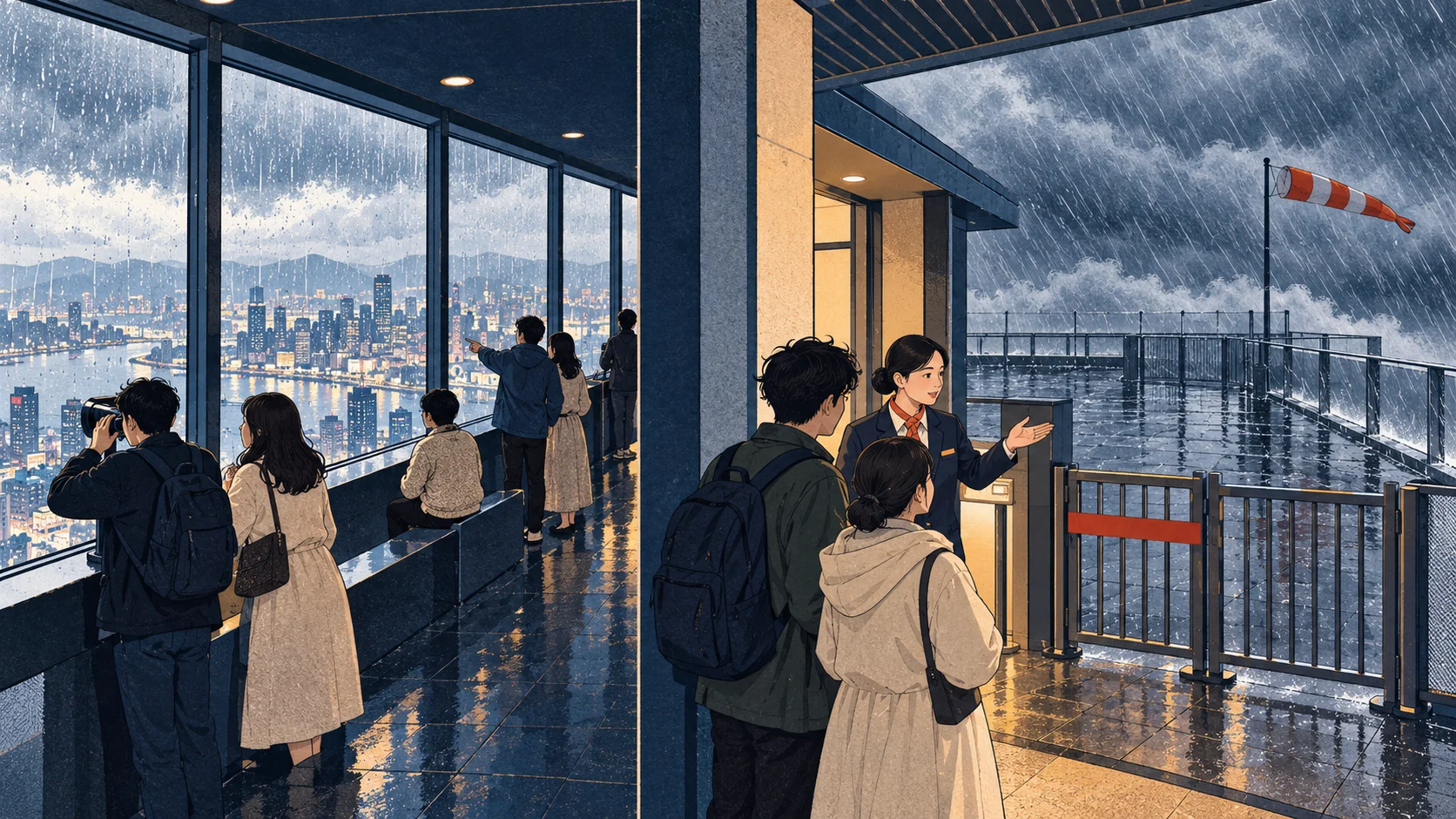
Strong wind, rain, snow, thunderstorms, unusually high temperatures, and other conditions may close the rooftop while the indoor corridor on level 46 (46F) remains open. Decide before entry whether you would accept the indoor experience instead of the open roof. Eligible online tickets currently allow free cancellation through the day before the visit. Same-day cancellation is normally unavailable; the free same-day service applies only under conditions such as the roof being closed at the designated entry time and the ticket not yet having been used for entry.
Eligible Webket tickets can be handled through My Page, but cancellation covers the whole payment transaction: you cannot refund just three tickets from one five-person order. A transaction mixed with non-cancellable tickets may also be ineligible. Official Trip.com, KKday, and Klook tickets have their own application instructions, and event conditions can differ. Once you have entered, rooftop closure brings no refund or discount. Cancellation may also become unavailable after a certain interval beyond the designated entry time. “We will decide when we get there” therefore still has consequences.
Check the official FAQ on rooftop closure and online-ticket cancellation before leaving and again before entering. For current conditions, consult the operator’s rooftop status announcements. Late arrivals may have to wait for a new designated slot, pay a difference, or be refused entry; Skytree’s same-day queue arrangement does not apply. General hours are listed as 10 a.m.–10:30 p.m., with last entry at 9:20 p.m.; check for changes on the day.
SHIBUYA SKY photos and family preparation: pack for the roof rules
For photographs at SHIBUYA SKY, reducing your equipment is more useful than carrying every accessory. Current ticket information prohibits bags, hats, headphones, food, tripods, and other listed items on the roof. Permitted belongings and camera attachments have conditions; indoor photography habits cannot simply be taken upstairs. Charge your phone and sort out a camera strap and bag storage before reaching the entrance, so you are not repacking while your companions stand waiting.
Pushchairs need special attention. Only venue loan pushchairs can be used on the roof; ask at the information desk on level 46 (46F), where availability is limited, and some areas remain inaccessible to them. Arriving with your own pushchair does not mean you can roll it around the entire roof. The operator recommends a baby carrier and prohibits unsafe viewing practices such as putting a child on your shoulders. If your child is sensitive to wind, afraid of heights, or needs a nap, accept an indoor-only visit or an early departure instead of lifting them unsafely for a photograph.
Other visitors share both indoor and outdoor spaces, and popular photo spots may require taking turns. One group picture and a view you enjoy are easier to fit into family time than every angle seen on social media. Recheck the roof belongings and child-equipment restrictions before packing. Ordinary admission has no general fixed length of stay after entry, but leaving ends the visit: you cannot re-enter. Think through food and rest before exiting.
Tokyo teamLab choices: Toyosu Planets and Azabudai Borderless are separate places
There is no single Tokyo teamLab ticket valid at every venue. Planets is in Toyosu, with its entrance near Shin-toyosu Station. Borderless is below ground at Azabudai Hills, near Kamiyacho and Roppongi-itchome. They occupy different neighbourhoods and use different booking systems and visiting formats. Save the full Japanese or English name, address, and date together; “teamLab afternoon” in a notebook is an easy way to arrive at the wrong entrance.
Planets includes barefoot, water-based, and bodily participation, so consider clothing, socks, mirrored floors, and a change of clothes for children. Borderless centers on exploring interconnected artworks without a fixed map, but it still has darkness, light and sound, mirrors, and some uneven spaces. That does not make it effortless for every visitor with mobility or sensory needs. Start with what your companions can comfortably participate in, then consider which photographs appeal to you.
Compare Planets’ current artworks and visiting notes with the official Azabudai Borderless description. A short Tokyo trip does not need both. If the differences interest you and you can give each enough time, put them on separate days or neighbourhood routes. Tickets are not interchangeable, and Toyosu’s lateness, accompanying-adult, and cancellation rules cannot be transferred to Azabudai.
Planets tickets: three possible changes do not mean a refundable booking
Planets currently lists ordinary timed admission at ¥3,800 for adults aged 18 and over, ¥2,800 for junior and senior high school students, and ¥1,500 for children aged 4–12, with free entry for ages 3 and under. Pricing is variable, so use the total on the actual calendar. The separate Premium Pass is listed at ¥12,000 per person aged 4 and over and has different admission arrangements; its priority and non-timed-entry benefits do not belong to ordinary tickets. Tickets are not sold on site. Even for a same-day visit, first check whether the official online system has availability.
Ordinary tickets bought directly from the official Ticket Store may have their date and time changed up to three times, no later than two hours before the original admission time. You cannot change only some tickets within one order. Distributed tickets not recalled, coupon conditions, and a sold-out replacement slot can also restrict changes. This is compatible with the no-cancellation, no-refund rule: moving an unused ticket under the allowed conditions is different from getting your money back. Travel-agent, convenience-store, and other sellers’ tickets require their original channel’s rules.
Choose the date, time, and numbers in each age category at the official Planets Ticket Store, checking that the order includes everyone before payment. For an eligible adjustment, find “Change Admission Date and Time” under My Tickets. An ordinary ticket’s entry window does not limit the entire visit to half an hour or guarantee no queue. For lateness, current guidance says to ask staff that same day during operating hours; last entry is one hour before closing. That is no reason to arrange a tight connection to a departing boat.
Planets clothing and small children: a ticket does not mean independent water access
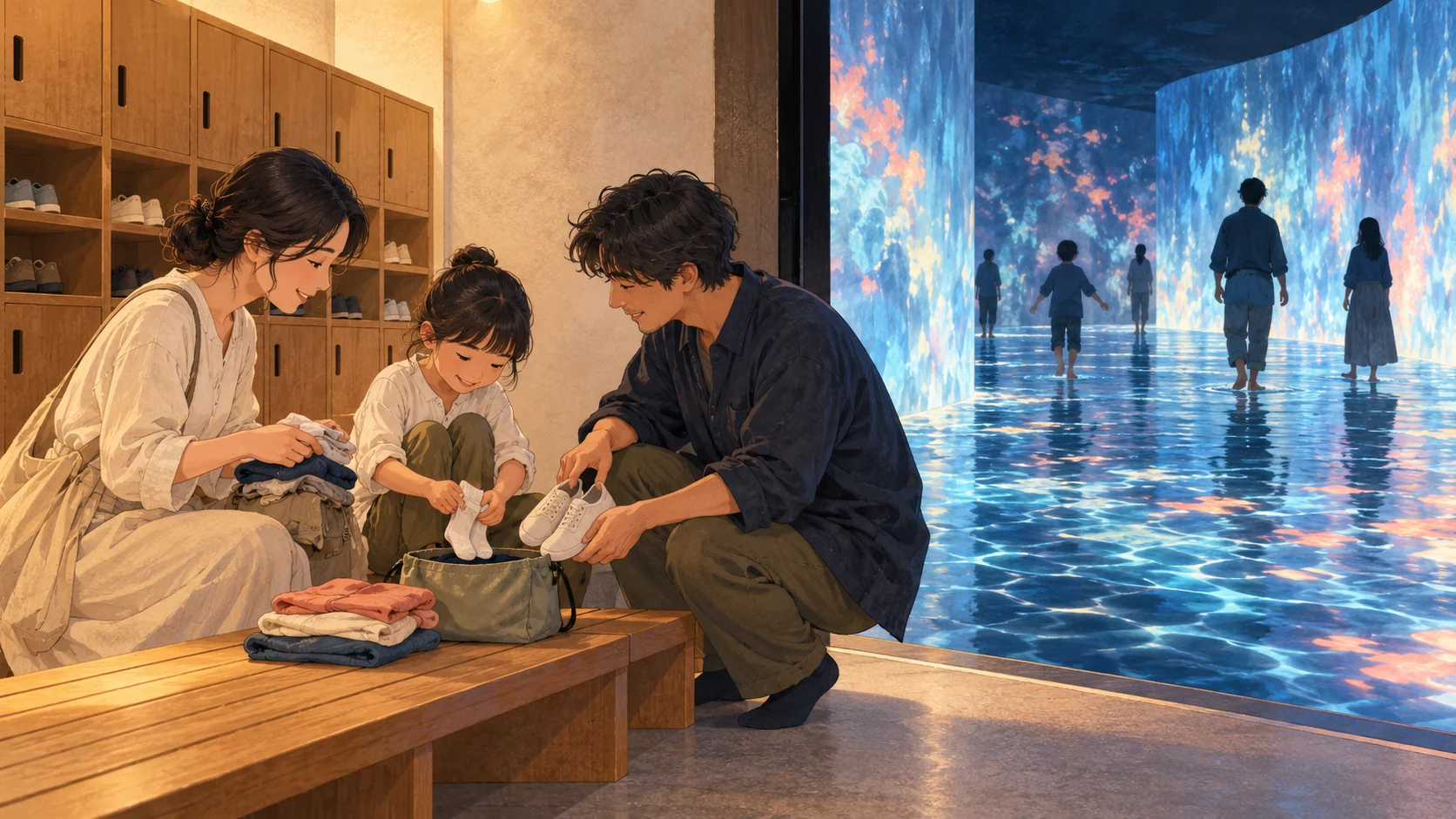
Planets’ Water area is experienced barefoot: deal with shoes, socks, and tights in the storage area, and expect water in some places to reach an adult’s knees. Easily adjusted trousers and spare clothes for a child matter more than an outfit chosen only for photographs. Mirrored floors can reflect under skirts; the venue offers measures such as loan shorts. Wet clothing can also affect access to later artworks. The water is an artwork setting, not a swimming pool or a place for unrestricted chasing and splashing.
Children under 13 require an accompanying guardian aged at least 18, with at least one adult for every three children, including those admitted free. The koi-on-water artwork has a separate condition for visitors whose inside-leg measurement from crotch to ground is under 40 cm: they must be carried by a guardian aged 18 or over, in a carrier or in the guardian’s arms as required. Ticket-age categories alone do not establish that a child may wade independently. A front baby carrier can be used; pushchairs must stay in the designated area. Divide walking, changing, and care responsibilities between the adults beforehand.
The Planets notes on water, clothing, and accompanying children also explain bypasses around some artworks. If a child is frightened of the dark or water, or does not want to remove socks that day, ask the staff rather than dragging them through every room. Explain the likely experience in advance and keep the option to leave an area. That usually gives both adults and children a more comfortable visit than repeated persuasion at the venue.
Wheelchair access at Planets varies by artwork
Wheelchair users should describe their equipment, transfer needs, and accompanying assistance before asking the venue to confirm a route. The official information offers venue wheelchairs and arrangements such as wheel covers for a visitor’s own chair. Some artworks nevertheless require a bypass or viewing from a designated position, while water artworks may require transfer to a special wheelchair. “Wheelchair admission available” does not promise no transfers or the same route as walking visitors through every room.
DMM’s current dedicated FAQ says the koi-on-water and some other water artworks require the ability to transfer to a water-use wheelchair. The venue does not provide a wheelchair-pushing service, so anyone needing assistance should bring a companion. Some climbing, jumping, or unusual-floor artworks can only be viewed. Mirrored spaces may also have restrictions associated with combined visitor-and-equipment weight or floor conditions. Establish whether participation will be comfortable before buying a non-refundable ticket, rather than waiting until your own wheelchair is being stored.
Read the artwork-specific Planets wheelchair FAQ alongside the current venue notes. They address different levels of detail: the general page describes equipment and arrangements, while the dedicated answers explain individual artwork restrictions. If your situation does not clearly fit the text, ask about the actual route. Companions should check their own ticket needs and allow time for moving belongings, protecting equipment, and resting.
Borderless tickets and accompanying children: leave time to explore
Borderless currently lists timed admission from ¥3,400 for adults aged 18 and over, ¥2,800 for ages 13–17, ¥1,500 for ages 4–12, and free for ages 3 and under. Adult and disability-category prices are variable. The separate ¥12,000 Flexible Pass offers greater flexibility on a specified date, but you must still arrive before that day’s last entry and queue; it is not unlimited repeated admission. Ordinary visits end when you leave, so dealing with meals and children’s bathroom needs beforehand helps.
Children of primary-school age and younger need an accompanying adult aged 18 or over, with at least one adult for every five children, including children admitted free. That differs from Planets’ one-per-three rule. There is no fixed touring map, so agree how to ask staff for help if someone gets separated before following moving light into different rooms. Otherwise children or older relatives may have difficulty finding the room you left. Rest areas are listed, but no in-venue nursing room is provided; ask about facilities available that day if needed.
Tickets bought directly from the official Borderless ticket site can be changed up to three times under its conditions. For timed tickets, act no later than two hours before the original admission time; for a Flexible Pass, the boundary is two hours before that day’s last admission. A change cannot switch ticket type or split an order. Ordinary purchases are non-cancellable; temporary closure has separate official refund arrangements, which do not also reimburse transport. If translated ticket information appears inconsistent, secure and check the actual online reservation rather than relying on an on-site purchase as a fallback.
Photography and sensory demands: use the official artwork video to prepare
Both Planets and Borderless permit ordinary souvenir photography, but that does not authorise a full camera rig or blocking an entrance. Official notes prohibit flash and restrict tripods, selfie sticks, and similar aids by length; commercial photography requires separate consent. Mirrors, dim light, and moving projections can also confuse camera settings. Take a few pictures with simple settings, then look around. Constantly adjusting a phone can mean missing the changes in the space itself.
Official artwork descriptions help explain why images change with people’s presence. The rooms, viewpoints, and visitor numbers in a film do not establish what your session will be like. Before departure, watch the official Planets highlight video below with companions to see projected light and imagery and visitors inside the artworks. Assess whether water-based or dimly lit areas suit a child using the current official visitor information and the child’s individual needs. The video supplements your understanding; tickets, available artworks, and physical participation conditions still come from current notes. Edited footage cannot demonstrate universal accessibility or an absence of waiting.
Borderless also warns about low ceilings, unstable footing, light, sound, and scents. Wheelchair and stretcher admission involves lift dimensions and restrictions at some artworks. Keeping your shoes on does not make the venue barrier-free. If a companion is sensitive to strong light or sound, first read the Azabudai venue’s safety, mobility-aid, and photography notes, decide whether the experience suits them, and select a slot with room for breaks. Their comfort comes first if they need to skip an area or leave early.
Tokyo Bay afternoon cruises: distinguish a 50-minute sailing from seasonal afternoon tea
Symphony’s ordinary Afternoon Cruise is currently scheduled for 3–3:50 p.m., a short sailing of about 50 minutes; some dates may instead use 3:10–4 p.m. The listed cake with coffee or tea costs ¥3,800 on weekdays or ¥4,300 on weekends and holidays. The coffee-or-tea-only plan costs ¥2,800 or ¥3,300, while cruise-only admission is ¥1,800 for adults or ¥900 for children. These are separate products, not one package automatically including a full tiered afternoon tea, unlimited food and drinks, and two hours on the water.
When searching for a Tokyo Bay afternoon tea cruise, first define what you want: a short trip with a cup of coffee, or a seasonal pastry menu for a celebration. The operator also sells seasonal Afternoon Tea products, potentially with separate menus, seating, and prices. The ordinary Cake Set’s ¥3,800 cannot price every afternoon-tea event. A short cruise fits more easily into half a day if sea air and bridge views are the aim; a leisurely multi-course experience calls for another product.
The current Symphony afternoon plan table states the specified food or drink, sailing, service, and tax included in each price; outside food and drinks are not accepted. The route passes areas such as Rainbow Bridge, but operations may change it. You cannot freely choose any ship or dining room. Check the product, time, and whether a window seat is actually guaranteed instead of relying on a photograph of dessert beside a window.
Sunset and dinner cruises differ in timing, meals, and eligible passengers
Symphony generally lists the Sunset Cruise at 4:20–6:20 p.m. and the Dinner Cruise at 7–9:30 p.m. A sunset sailing meets different light in different seasons; it cannot guarantee a sunset throughout the trip. Dinner focuses on night views, and a 7 p.m. departure cannot recover a winter sunset already gone. If sunset matters more than food, check the travel date’s sunset time before choosing an entry or sailing slot. A product name guarantees neither weather nor sky color.
If Odaiba and Rainbow Bridge are your priorities, Symphony’s sunset cruise description gives this sequence: depart Hinode, pass beneath Rainbow Bridge, then continue towards Odaiba and Shinagawa Wharf. After sailing around Tokyo Bay, the return leg offers deck views of Tokyo Tower and Tokyo Skytree beyond Rainbow Bridge. The official route map shows a round trip returning to Hinode, so plan to enjoy the full voyage aboard and disembark there. Treat this as a sightseeing cruise rather than a transport ticket for getting off partway at Odaiba; arrange any time ashore and the necessary transfers before or after the cruise. The official operating conditions allow cancellation or rerouting when weather or sea conditions may endanger safety. Odaiba views, bridge views and the planned route therefore remain subject to the arrangements for your sailing.
Examples from the current ordinary menus include the sunset Italian meal at ¥11,000 on weekdays or ¥12,000 on holidays, and the dinner Casual Plan at ¥15,000 or ¥16,000. Ingredients, course counts, and sailing lengths differ, so the gap is not simply an extra night-view charge. Additional drinks are usually separate in ordinary meal plans, though particular products may include a drink or alcohol. Treat a window seat as an entitlement only when that specific plan expressly guarantees one.
For families, eligibility comes before a child discount. The official Symphony answers on young children and seating say the dinner sailing does not accept preschool-age children. Sushi Kanon does not accept children below junior high school age. Dinner therefore requires at least primary-school stage, and Kanon at least junior high school stage. A children’s menu does not admit every age to every sailing. With a preschooler, first compare lunch, afternoon, or eligible sunset products, then check the individual plan.
Symphony boarding, confirmation, and cancellation: arrive 30 minutes early
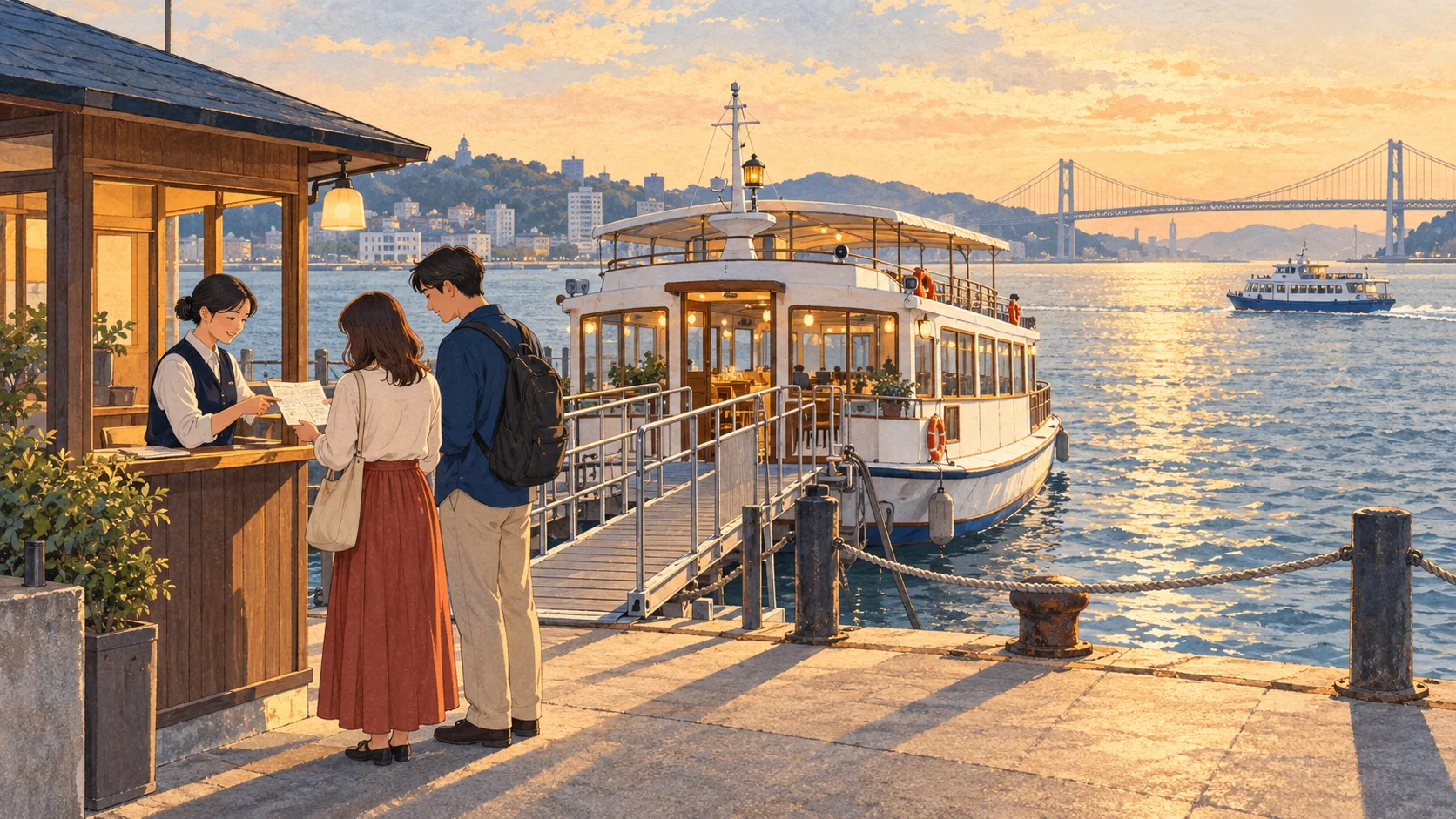
Symphony uses its own boarding and reception point at Hinode Pier. Official directions give about a one-minute walk from Yurikamome Hinode Station, or about 12 minutes from JR Hamamatsucho’s South Exit via the connecting passage. Searching only for “Hinode” risks joining another water-bus operator’s queue. The recommended arrival is 30 minutes before sailing; the party representative must complete procedures by 15 minutes before departure. One is an arrival allowance, the other a processing deadline. Even a paid booking does not make the ship wait for late passengers.
Ordinary reservations currently open at 10 a.m. Japan time on the same calendar date two months before sailing. After submitting an online inquiry, the official FAQ says a six-digit reservation number in the reply or telephone confirmation establishes the booking. A screenshot of the sent form does not. Payment methods and deadlines follow the selected plan and response. If submitting at night or close to sailing, confirm both acceptance and whether the meal can be prepared. Wheelchair users should contact the operator first: some spaces on level 4 (4F) are unavailable, and boarding and disembarking require accompanying assistance.
The ordinary individual-booking cancellation and change table lists ¥200 per person from booking through seven days before, 10% from six to two days before, 30% on the previous day and sailing day before departure, and 100% after departure. Meal or date changes are free once if made at least three days before; subsequent timing and changes incur the applicable charges. Private rooms and charter sailings have separate cancellation tables. Ordinary rain does not necessarily stop the cruise; typhoons and other conditions may change or cancel operations. Follow the operator’s notice rather than assuming a refund after deciding not to appear.
Tokyo yakatabune: distinguish shared trips, charters, and meals
A yakatabune may suit you if you want a Japanese meal and a longer sailing past bridges and the waterfront. But yakatabune names a type of boat, not one operator or a Tokyo-wide ticket. On Amitatsu’s shared sailings, two people can book together, while the whole sailing has a separate minimum passenger requirement. The ordinary trip lasts about 2½–3 hours, with departure from Asakusa’s Azumabashi or Harumi depending on the date. It is different from Symphony at Hinode; one saved navigation pin cannot serve both.
The current standard shared plan includes the meal, sailing, service, and specified all-you-can-drink selection. It costs ¥13,800 from junior high school stage, ¥10,800 for primary school children aged 10–12, and ¥7,800 with a children’s meal for ages 4–9. Ages 0–3 are free without a meal or seat. School stage matters, so a 12-year-old cannot automatically be classed as an adult. These are one operator’s shared-package prices, not prices for every yakatabune, unlimited monjayaki, or automatic substitutions for every dietary need.
Use the official Amitatsu shared-sailing and meal page to choose a scheduled date, then check the pier, meal, passenger numbers, and confirmation process. The page says vegetarian or specified ingredient adjustments must be requested by telephone by noon two days before, with an additional ¥1,000 adjustment charge per person. Severe allergies still require discussion with the operator. The operator video below shows the format of dining inside and viewing the waterfront; your actual ship, food, light, and route follow the booking.
Yakatabune changes, fireworks, and meeting points follow your specific sailing
Amitatsu’s ordinary shared-sailing cancellation table lists 20% from ten to three days before, 50% two days before, 80% the day before, and 100% on the day; date changes also incur these conditions. Different passages on the site describe some online cutoffs and minimum-passenger notification dates differently. Avoid applying at the last possible moment. Choose early and follow the operator’s reply and confirmation document rather than assuming one available calendar cell guarantees acceptance or one particular date for a not-enough-passengers notice.
An ordinary sightseeing cruise is not a fireworks-viewing ticket. For 24 October 2026, this operator announces a Sumida River and Skytree route for ordinary shared sailings, without Odaiba or a view of that day’s Tokyo Bay fireworks there. The fireworks event needs a separate package. This example shows why a product normally described as “Odaiba and Skytree” need not follow its usual route on an event date. Fireworks, cherry-blossom, and charter products may also use separate prices and cancellation conditions.
Before travelling, open the operator’s designated boarding-pier maps alongside the confirmation. Establish whether you need Azumabashi or Harumi and arrive ahead of that sailing’s meeting time. Handle children’s bathroom and clothing needs before boarding rather than doing several things in a narrow passage. If you cannot find the boat, contact the operator. A similar lantern or ship name does not identify your booking, and lateness does not promise a free switch to the next departure.
Tokyo water buses combine transport and views; a one-way ticket is not a dining cruise
For travel from Asakusa to Odaiba, Toyosu, or Hinode with views of riverbanks and bridges, compare TOKYO CRUISE water buses. Their scheduled-route tickets differ from dining cruises and should generally be treated as one-way transport over a specified section. Meals, a return trip, other boat companies, and theme-park transfers do not become included because a search result says “Tokyo Bay cruise.” For a different destination, check the departure pier, arrival pier, and ship again.
The current Himiko fare table for Asakusa to Odaiba, for example, lists ¥2,000 per adult and ¥1,000 per child for a sailing of about 50 minutes. This is not a common price for every ship and route. General categories are adult from age 12 and child from 6 to under 12, with conditions on free admission for young children and accompanying-adult numbers. The Asakusa–Toyosu route uses the LaLaport Toyosu landing, not a stop at the Planets entrance. A shared Toyosu place name does not remove the travel time after disembarking.
Check non-operating dates on the calendar as well as the current TOKYO CRUISE routes, ships, and fare table. The site also currently notes that boarding is unavailable at Hamarikyu and some ticket arrangements for reaching it differ. An old route map is no basis for hopping on and off anywhere. Make the boat one section of the day and keep rail or another return option, instead of shortening your shore walk to find a matching return sailing.
Water-bus online reservations: submitting the form is not payment confirmation
The ordinary TOKYO CRUISE reservation page lists online booking as opening on the first day of the calendar month before the sailing month. International visitors pay by credit card. The current instructions explicitly distinguish an application from a completed reservation: payment through the credit-card link in the subsequent email confirms it. If you only saved the application page, received no email, or encountered a payment error, check the messages and operator instructions. An unfinished application is not a reserved seat to claim at the pier.
Different pages describe the last booking time differently, and some routes do not accept advance reservations at all. Do not use “we can still book a few minutes before departure” as a planning guarantee. Complete the process early, save confirmation, and check that day’s operations notice. The reservation page directs changes to passenger numbers or other contents through cancellation and rebooking, potentially with a fee. Priority boarding for reservation holders still does not make the ticket valid at any pier, on any sailing, or after you miss the departure.
The current scheduled-boat cancellation policy lists no charge at least seven days before, 10% from six to two days before, 30% from the previous day until departure, and 100% afterward; group and event boats have separate tables. Do not apply “seven days ahead is free” to Symphony, whose corresponding ordinary individual-booking period still lists ¥200 per person. If weather stops the service, first read the handling for that sailing before seeking a refund or travelling overland. The ordinary table does not establish every service-cancellation compensation arrangement.
Compare family admission with the same two adults and eight-year-old
Family comparisons often go wrong by combining different child ages under one “child ticket.” The examples here consistently use two adults and one eight-year-old primary school student. They cover ordinary admission only, excluding meals, transport, accommodation, equipment storage, and special events. Variable-price products use the listed starting amounts, without a check of any particular date’s sale price. Replace the date and the child’s real category before using the total.
Skytree’s deck example is ¥1,800 × 2 + ¥900 = ¥4,500; the deck-and-galleria combination is ¥3,000 × 2 + ¥1,500 = ¥7,500. Planets is ¥3,800 × 2 + ¥1,500 = ¥9,100, while Borderless is ¥3,400 × 2 + ¥1,500 = ¥8,300. These compare tickets to different experiences, not a score for how much entertainment each yen buys. Water, the style of exploration, physical needs, and your child’s willingness should come before the price difference.
For SHIBUYA SKY entry through 2:59 p.m., the two online adult tickets plus a child ticket are ¥2,700 × 2 + ¥1,200 = ¥6,600. From 3 p.m., ¥3,400 × 2 + ¥1,200 = ¥8,000. Tokyo Tower Main Deck is ¥1,500 × 2 + the primary-school fare of ¥900 = ¥3,900. Online Top Deck Tour admission for this eight-year-old example is ¥3,300 × 2 + ¥2,100 = ¥8,700. For the wider cost, use the item-by-item Japan travel budget method and include drinks, meals, and the trip back.
| Two adults and one eight-year-old | Example admission-only total | Further check |
|---|---|---|
| Skytree Tembo Deck | From ¥4,500 | Visit-date price and counter issuance fees |
| Skytree deck plus galleria | From ¥7,500 | Same-day availability and combination entitlements |
| Planets ordinary timed entry | From ¥9,100 | Date price and one adult per three children |
| Borderless ordinary timed entry | From ¥8,300 | Date price and one adult per five children |
| SHIBUYA SKY entry through 2:59 p.m. | ¥6,600 | Adults online; child bought separately at the counter |
| SHIBUYA SKY entry from 3 p.m. | ¥8,000 | Matching entry slot and eligible cancellation terms |
| Tokyo Tower Main Deck | ¥3,900 | Elementary-school ticket category |
| Tokyo Tower Top Deck Tour online | ¥8,700 | The eight-year-old uses the 7–15 category |
Add food and transport back in: a cheaper boat ticket is not the whole budget
Two adults buying ordinary SHIBUYA SKY online admission from 3 p.m. pay ¥6,800 for tickets. An assumed ¥1,200 meal allowance each makes ¥9,200 before transport and shopping. Two weekday Symphony Dinner Casual Plans instead total ¥30,000 with the corresponding meals. If each adult sets aside another ¥1,000 for extra drinks, the provision is ¥32,000. These fund different evenings, meals, durations, and views; they are not a saving comparison between identical packages.
A three-person water-bus outing also costs more than the headline ¥2,000 adult fare. For the Himiko one-way example above, two adults and an eight-year-old pay ¥5,000. Add an assumed ¥3,000 family lunch and a combined ¥1,500 city-transport allowance, and the outing budget is ¥9,500. That transport reserve is your chosen amount, not a claim that some journey costs exactly ¥500 per person. It includes neither a return boat ticket nor airport transport.
For the same family, Planets’ ordinary admission starting total of ¥9,100 plus the same ¥3,000 food and ¥1,500 city-transport allowances gives a budget from ¥13,600. To reduce spending, remove unnecessary extras, choose one principal experience, or use an appropriate free observatory. Squeezing two reservations together is no requirement to justify tickets already bought. The first-trip guide to booking in a sensible order can help identify which costs are worth fixing in advance.
Three half-day routes that fit the right neighbourhoods
For an eastern-city viewpoint day, pair an Asakusa walk with Skytree. Keep meals and shopping flexible, fixing only the observation slot that matters most. If the boat is the priority instead, build around an available departure from Asakusa and walk near the arrival pier. Do not make Skytree’s galleria, an Odaiba restaurant, and a different company’s Hinode dining cruise three immovable appointments. Each fixed time removes another opportunity to adapt to crowds or weather.
For a Toyosu experience, let the Planets entry time determine brunch and transport, then assess children’s and older companions’ energy afterward. If you want Odaiba next, check overland travel or a suitable sailing that day. LaLaport’s landing and the Shin-toyosu art venue are different entrances, and leaving the gallery is not the same as being ready to board the next boat. If clothes are wet or a child needs rest, keep the shorter Toyosu version instead of crossing the city to finish a list.
For Azabudai and Minato, make Borderless the principal booking. After eating nearby, decide whether to see Tokyo Tower from outside or buy an appropriate observation ticket. For Roppongi indoor night views, check that day’s exhibition and accessible areas. If two firm bookings are necessary, start by allowing at least 90 minutes between the expected end of the first and check-in for the next, then extend it for the real route. This is a planning allowance, not an official transfer time or protection against every delay.
Rain and sunset: separate safe operation, visibility, and expectations
A dry sky does not guarantee an open roof. An open roof does not guarantee a clear Mount Fuji view or an orange sunset. Operators assess wind, thunderstorms, and equipment safety; photographers also care about clouds, haze, and visibility. Before buying, ask whether you would still pay for a grey cityscape. If not, choose an outing whose timing you can accept deciding closer to the day rather than expecting weather to create an automatic refund.
To stay from daylight into night, you might consider entry roughly 60–90 minutes before sunset after checking the venue’s stay rules and your energy. That is a suggestion, not a universally best time in every season. Winter sunsets are earlier, summer sunsets later, and wind chill or thunderstorms may close a roof early. Handle SHIBUYA SKY’s cancellation before entry, Skytree’s cancel-and-rebuy process, the Top Deck two-day restriction, and art venues’ ordinary no-refund terms separately. “We will move it to tomorrow if it rains” is not a shared rule.
Cruise weather handling differs again. Light rain may allow sailing, while strong wind or sea conditions may change the route or cancel the trip. Even a cancelled dining cruise does not guarantee another sailing at the same price that evening. A neighbourhood meal, indoor activity, or rest you would enjoy anyway makes a more adaptable fallback than another non-refundable purchase. Use the Japan seasons and weather-planning guide to frame the choice, then update it with official notices during travel week.
A free Tokyo viewpoint: check the Metropolitan Government Building calendar
The Tokyo Metropolitan Government Building observatories in Shinjuku offer views from 202 m above ground, making them a practical option for free Tokyo views or a free night skyline. General admission is free, using the dedicated lift from level 1 (the ground floor) of Main Building No. 1. That does not make transport, refreshments, or every special event free. Nor does this viewpoint replace the outdoor design, angle, or particular tower view of every paid deck. Choose it for the experience you want.
Current general South Observatory hours are 9:30 a.m.–10 p.m., with last entry 30 minutes before closing. The North Observatory normally closes at 5:30 p.m., with extended arrangements on South Observatory closure days. The South normally closes on the first and third Tuesdays, and the North on the second and fourth Mondays; national holidays bring adjustments, and year-end dates and equipment inspections may add closures. One saved year-round hours graphic cannot establish that both sides admit visitors every evening.
Before leaving, check the Tokyo Bureau of Finance observatory calendar and entry directions, allowing for the lift queue. The current guidance notes that waits of 20–30 minutes are common, but the day’s conditions vary; bad weather may also bring a temporary closure. Wheelchair users or visitors who cannot use stairs can ask a guard about an internal lift route. On holidays the entrance on level 2 (2F) may be closed, requiring the ground-floor (1F) main entrance. A free visit still deserves a comfortable arrival and departure.
Turn each ticket into a booking you can find and use
For every booking, record the full venue name, date, entry or departure slot, companions, ticket type, order or confirmation number, specified entrance, and cancellation deadline. Screenshot rules for QR codes vary. Do not crop essential ticket details, and keep a way to reopen the original order. Before splitting up, agree who holds the party’s tickets, whether you must enter together, and where to meet if a phone battery dies. That is clearer than everyone saving a separate image of uncertain origin.
For arrival day in Tokyo, check the flight and hotel bag arrangements before adding a non-refundable exhibition or a dining boat that leaves on time. Landing, immigration, baggage collection, city transport, and finding the pier are consecutive stages. The fastest train ride covers only one. The Narita and Haneda arrival guide for luggage, hotels, and late arrivals helps keep the first day realistic. For Disney, use the two parks’ ticket rules and full-day pacing separately; a coastline seen from a boat does not make a park a casual stop along the way.
Finally, agree on two versions with your companions: the one thing you most want in ordinary conditions, and what you will remove if someone is uncomfortable, tickets run out, or operations change. A view you can enjoy slowly, a meal you can sit down for, and enough time to return may be closer to your ideal Tokyo than three competing sunset slots. When changes are needed, return to the original sales channel and that sailing’s official notice. Keep the confirmation so the next part of the trip rests on arrangements you actually have.
A few useful answers
How should I choose just one Tokyo observation deck?
Start with the view you want and that day’s neighbourhood. Skytree shows the broad city, Tokyo Tower fits a ground-level walk, Roppongi puts the tower in the skyline, and SHIBUYA SKY offers an outdoor experience affected by weather. Compare the Metropolitan Government Building for free views. No fixed ranking suits everyone.
Can I add Skytree’s 450 m galleria after buying only the deck ticket?
After entering with a deck ticket, you may buy a galleria add-on if available, currently ¥1,400 for an adult or ¥700 for a child. It does not include the original ground-to-deck admission. Sales may stop because of capacity or restrictions, so do not treat it as guaranteed.
Do Skytree, Tokyo Tower, and SHIBUYA SKY use the same child categories?
No. Skytree has an age-15 boundary with junior-high/high-school exceptions. Tokyo Tower Main Deck uses school stages, while its upper tour lists age bands. SHIBUYA SKY normally counts ages 12 and over as adults, except 12-year-old primary school students. The rules for free admission for young children, accompanying adults, and extras also differ.
Is Roppongi’s rooftop Sky Deck closed only when it rains?
No. The operator announced the end of general rooftop operations in April 2024. Current indoor Tokyo City View admission on level 52 (52F) follows its date calendar, and exhibition work may restrict part of the view. Check the actual visit date.
Does a closed SHIBUYA SKY roof guarantee a refund?
No. Free same-day cancellation for eligible online tickets depends on conditions such as roof closure at the designated time and not having entered, with the procedure set by the sales channel. Entry ends the refund or discount option for roof closure. Eligible ordinary online tickets also have free cancellation through the previous day; counter and event tickets differ.
If SHIBUYA SKY adult tickets sell out, can a parent enter by buying a child ticket on site?
No. Child tickets follow the counter procedure on level 14 (14F) even when adult tickets are sold out, but the accompanying guardian still needs a valid adult ticket. A child ticket creates no extra adult place. A 12-year-old primary school student remains in the child exception.
Can I use a Planets ticket at Borderless instead?
No. Toyosu Planets and Azabudai Hills Borderless are separate venues with separate ticket systems. Ordinary purchases are generally non-cancellable. Conditional changes for official direct purchases must be made in the relevant system, not by switching venues.
Does a 30-minute teamLab ticket window mean I must leave after half an hour?
The window usually specifies entry, not a half-hour total visit. Operating hours, last entry, staff directions, and artwork operations still apply. Do not treat the end of the entry window as a confirmed exit time for connecting to a boat.
How many children can one adult accompany at each teamLab venue?
Planets requires at least one adult aged 18 or over for every three children under 13. Borderless requires one adult aged 18 or over for every five children of primary-school age and younger. Children admitted free count toward both limits. Water, pushchairs, mobility equipment, and particular artworks have further conditions.
Are Symphony afternoon tea, sunset, and dinner the same cruise?
No. The ordinary afternoon sailing lasts about 50 minutes, with distinct cake, coffee, and cruise-only products. Sunset is generally two hours, dinner 2½ hours, with different meals, seating, and prices. A seasonal Afternoon Tea package cannot be priced using the ordinary Cake Set.
Can a preschooler take Symphony’s dinner cruise?
The current dinner sailing does not accept preschool-age children. Sushi Kanon goes further and requires at least junior high school stage. Check other lunch, afternoon, or sunset products separately. A children’s meal somewhere on the site does not make every sailing available to all ages.
Is a Tokyo water-bus ticket confirmed when I submit the reservation form?
For the current credit-card process, confirmation requires payment through the link sent in the subsequent email. Check the successful confirmation, pier, and sailing. A TOKYO CRUISE one-way trip, Symphony dining cruise, and another operator’s yakatabune are separate products.
Check with the source
Schedules, availability and rules can change. These official sources are the place to confirm details before you book.
- Tokyo Skytree: current base tickets, ages, and counter issuance fees
- Tokyo Skytree: changes and cancellation by sales channel
- Tokyo Skytree: floors, re-entry, QR codes, and admission FAQ
- Tokyo Tower: current fees and opening hours
- Tokyo Tower Top Deck Tour: ticket types and cancellation
- Tokyo City View: announcement ending public rooftop Sky Deck operations
- Roppongi venues: date-specific openings, exhibitions, and price periods
- Roppongi venues: ticket, entrance, wheelchair, and storage FAQ
- SHIBUYA SKY: current tickets, children, and rooftop belongings
- SHIBUYA SKY: sale times, cancellation, late arrival, and operating FAQ
- SHIBUYA SKY operator: current announcements on X
- teamLab Planets: artworks, prices, changes, and visiting notes
- Planets official Ticket Store
- DMM: artwork-specific Planets wheelchair FAQ
- teamLab Borderless: venue, prices, accompaniment, and changes
- Borderless official ticket website
- Symphony: ordinary cruise times
- Symphony: short afternoon sailings and food or drink plans
- Symphony: sunset sailings and meals
- Symphony: dinner sailings and child restrictions
- Symphony: ordinary booking, boarding, and cancellation
- Symphony: reservations, confirmation numbers, seating, and young children
- Symphony: wheelchair boarding and unavailable spaces
- Amitatsu: shared sailings, meals, children, and cancellation
- Amitatsu: designated boarding-pier maps
- TOKYO CRUISE: current routes, ships, fares, and non-operating dates
- TOKYO CRUISE: online applications and payment confirmation
- TOKYO CRUISE: scheduled, group, and event cancellation tables
- Tokyo Bureau of Finance: free observatories, North/South calendar, and entry
- Roppongi online ticketing: changes, cancellation, and organiser-cancellation refunds
- Symphony | Sunset round-trip route map and sailing times