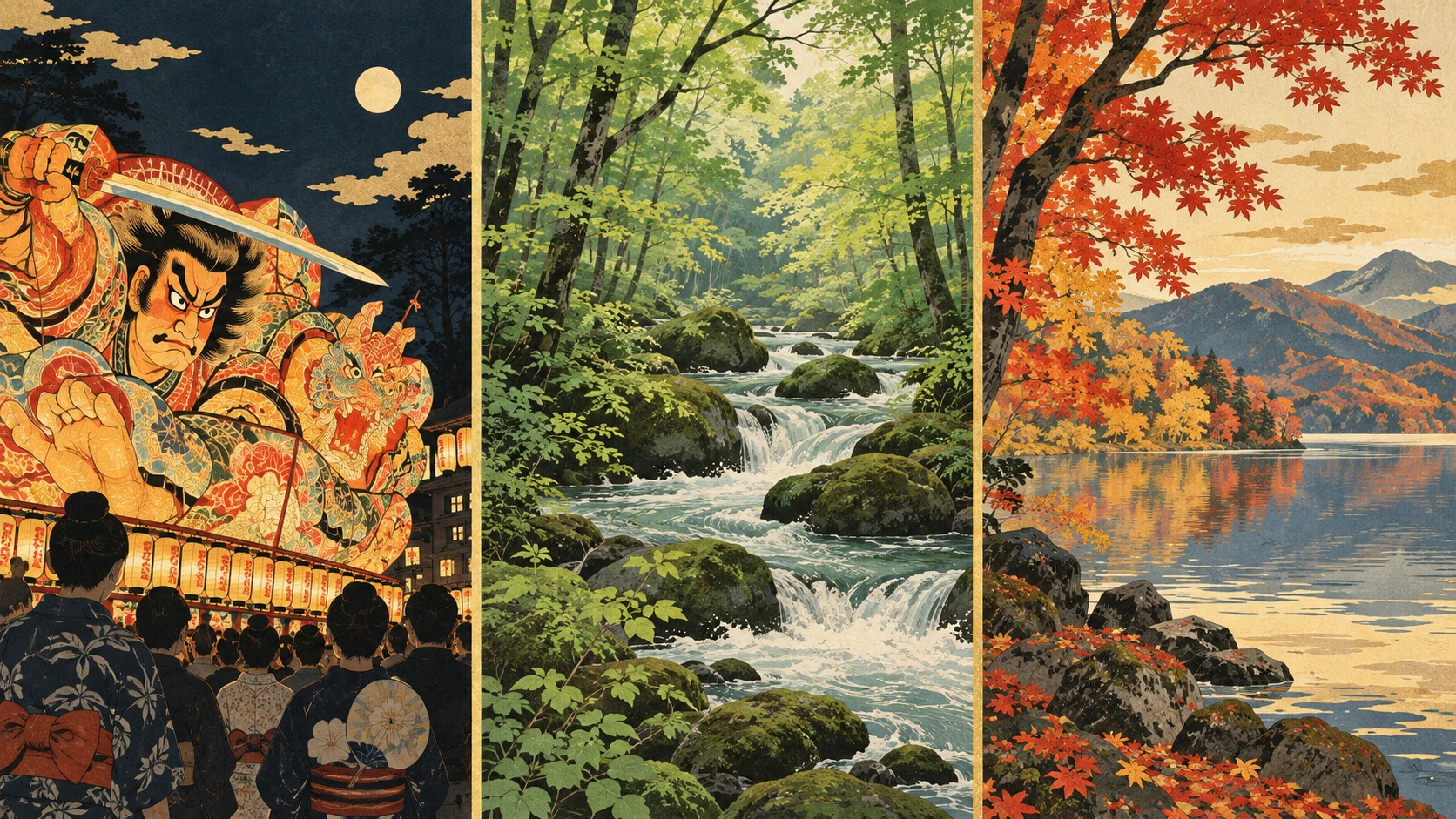
Choose August's lantern evenings or daytime beside the gorge and lake first. Then build a manageable Aomori trip around actual return services, room categories and transfer rules.
Start with the Aomori trip you want: summer evenings or autumn days
Aomori Nebuta Festival and Oirase Gorge can share a trip, but they call for quite different planning. For a festival visit, August evenings are the main event; daytime needs room for rest, dressing and meeting your group. For autumn foliage around Lake Towada, walking and buses take priority, with the return settled before sunset. Choose the experience you would most regret missing first. That tells you where to preserve flexibility in your accommodation and transport.
For a first independent visit to Aomori, compare three nights and four days: one or two city nights and one or two beside the gorge or lake. This is a useful starting itinerary, not a requirement to stay three nights. With only two days, narrow the plan to the city festival or a gorge day trip from Hachinohe. Avoid squeezing a night festival, a 14-kilometre walk and a lake cruise into neighbouring half days, leaving the last service to absorb every delay.
This guide separates years using official information available on 22 October 2026; all prices are in yen. The 2026 festival has ended. Its sales and timetables provide concrete comparisons, not tickets you can buy for 2027. If you are still allocating nights across Tohoku, begin by dividing your Japan trip around its main activities, then choose the city, gorge or lakeside bases below. Hotel descriptions here are not ratings based on personal stays.
Reading the dates: 2027 festival details are pending, and foliage has no guaranteed peak
The festival website and prefectural tourism page give the annual dates as 2–7 August. A traditional date does not confirm next year's seating, ticket release or procession arrangements. The organiser's annual reserved-seat information explicitly identifies its current information as 2026 and says 2027 details will be updated once decided. For next year, you can provisionally hold adjustable accommodation and a budget range; the June 2026 release is not an announcement of the next sale.
Fresh green leaves and autumn colours at Oirase follow natural seasons. Aomori's usual seasonal guidance places fresh greenery around mid-May to mid-June and autumn foliage around mid- to late October. These ranges help choose a season, but they are not daily peak forecasts for 2026. Streamside, lakeshore and higher ground can develop differently on the same day. If a particular colour matters, check updates close to departure and allow yourself to change the stretch you visit.
When searching for Aomori Nebuta Festival 2027, the useful answer distinguishes what is known from what remains undecided. For Oirase Gorge autumn 2026, the day's transport, weather and trail conditions matter more than the month in which an old photograph was taken. Put the hotel's cancellation deadline in your calendar and schedule another check before departure. Before the colours arrive or after leaves fall, water, rocks and forest remain, but expectations should follow the season rather than another year's photographs.
Aomori, Shin-Aomori and Hachinohe serve different parts of the journey
Aomori Station works well for a walkable city base and festival evenings. Shin-Aomori is the shinkansen arrival point; similar names do not make them the same meeting place beside one another. Check the booked address, station exit and luggage storage before heading to your hotel. If you must take a train to another station or city after the festival, work backward from the last service on your actual date rather than a daytime search result.
There are also two JR bus approaches to Oirase Gorge and Lake Towada, from Aomori and Hachinohe. The current JR Bus Tohoku route page lists Aomori's Mizuumi and Hachinohe's Oirase separately. Their booking arrangements and final seasonal services do not entirely match. If the gorge is your priority, compare arrival and departure through Hachinohe first. A Nebuta visit still needs enough evening time in central Aomori, whichever rail gateway you choose.
When choosing an airport or shinkansen, count the last leg as well: waiting for a bus, leaving bags, walking to the hotel and then reaching the activity. Cheaper or earlier long-distance transport may not connect with the day's only suitable mountain bus. With large bags or slower walkers, consider the first city night a buffer. Do not require everyone to complete long transfers and the entire gorge walk on the day they land.
Aomori Airport buses: match the timetable's validity period to your flight
Airport buses change with flight schedules. At the time of checking, the operator's page for Aomori Station–Aomori Airport separated 1 September–24 October 2026 from 25 October–30 November. The current table gives roughly 35 minutes from the station to the airport, excluding waiting, congestion and airport check-in. When your trip crosses into another validity period, reopen the corresponding table. That journey time is not a promise that every departure arrives within exactly those minutes.
The airport line currently has unreserved seating; a delayed flight does not guarantee a bus connection. Luggage space is limited, and crowds may mean waiting for the next bus. Agree that one person checks the bags while another confirms whether the intended departure is still usable. That is easier than one person boarding while another remains at baggage reclaim. Ask the operator about large equipment beforehand: accepting ordinary luggage does not imply capacity for every size.
Prepare smaller cash denominations or confirm the accepted transport IC card. From 1 October 2026, the operator says ¥10,000 and ¥5,000 notes cannot be changed onboard, and IC top-ups do not return change. This does not require cash on every trip; it prevents arriving with large notes as your only option. With a pass, separately check its precise official name, travel date and route eligibility. JR in the service name does not make all pass products interchangeable.
Three accommodation bases: festival nights, the gorge entrance and the lake
When deciding where to stay in Aomori, compare the journey back before comparing photographs. Around Aomori Station, you can plan to walk back after the festival and leave bags the next day. The gorge entrance lets you split a long arrival and a short walk over two days. Lake Towada's shore leaves room for mornings, evenings and cruises. There is no single best base: the practical difference is whether another transport connection still awaits when the day ends.
Without a car, distinguish a hotel transfer from a public scheduled bus. The former may require advance booking and be restricted to overnight guests; the latter follows individual service times. A hotel being able to collect you does not mean it can take you anywhere around the lake whenever you want tomorrow. Before staying at two properties, connect the intervening day's check-out, luggage and next pickup. Two mentions of a shuttle are not sufficient proof that the hotel-to-hotel move works.
For three people or a family, include sleeping arrangements: two beds and an extra bed are not the same as a Japanese room for four. A child sharing a bed does not make meals, transfers and cruises free. Use the room and meal checks for a first Japanese accommodation booking, entering each person's age, beds and meals before comparing totals for the same party. If one night is unavailable, try another base before buying a nonrefundable activity that forces the accommodation choice.
| Base | Best suited to | Questions before booking |
|---|---|---|
| Aomori Station and city centre | Nebuta and daytime city visits | Can you walk back at night, or must you catch the last train? |
| Gorge entrance and hot-spring area | Short gorge walks split across two days | Is the transfer guests-only, and do the middle gorge and lake need a separate bus? |
| Yasumiya or the western lakeshore | Cruises and lakeside mornings, evenings and stays | Which shore is the actual address on, and how do you connect the pier and hotel? |
What Aomori Nebuta is: lantern floats, hayashi music and haneto dancers
Aomori Nebuta centres on large illuminated figure floats moving through the streets with hayashi music and haneto dancing groups. Watching is more than waiting for a float to pass: turns, drums, calls and the movement of the whole group create its rhythm. Aomori Prefecture's festival introduction identifies it as a nationally designated Important Intangible Folk Cultural Property. Understanding that context helps you decide whether to sit and watch or dress according to the rules and participate.
For the festival's origin, the organiser does not present one legend as an established conclusion. The festival's explanation of its beginnings says the origin is uncertain and is commonly associated with Tanabata lantern-floating and a gradual combination with Tsugaru customs. Its name is also linked to changes in folk expressions about sending away sleepiness. Presenting these as possible historical connections is more accurate than using a single warrior story to declare the origin of the entire festival.
Do not mix Aomori City's nebuta with another city's festival names, routes or tickets. Keeping the Japanese name 青森ねぶた祭 in your notes helps identify the correct official website. For hotels, haneto clothing hire and road restrictions, confirm that the event is in Aomori City. Other Tohoku festivals can form another itinerary, but this guide's prices, gathering points and viewing arrangements apply to this event, not a common set of rules across the region.
Which evening to choose: 2026 start times varied by date
Using the published 2026 programme as an example, 2–3 August started at 19:00, 4–6 August at 18:45, and the 7 August daytime procession at 13:00. The organiser's dates and procession table separately lists the lead arrangements for children's and large nebuta. These are operating start times, not simultaneous arrival times in front of every seat. Once there, you still need the expected passing time for your position along the route.
7 August also has a maritime procession and fireworks in the evening; the 2026 programme listed fireworks at roughly 19:15–21:00. Watching daytime floats does not automatically provide evening viewing rights or put you in the correct waterfront position. Leave the afternoon for food, rest and moving between locations, rather than treating the daytime seat and nighttime fireworks as one place to remain all day. With only one evening, choose street lantern figures or the final harbour scene first, then compare lodging and ticket types.
On a first visit with older relatives or small children, arriving at the hotel early and eating before going out is usually more manageable than distant daytime sightseeing. Haneto participants also need time to collect clothing, dress and gather. Spectators need to consider toilets, raincoats and dispersal routes. Keep these planning principles for next year, but fill in detailed times after the official 2027 announcement. Copying 2026 weekdays and hours does not produce a confirmed new programme.
Route and free viewing: check that year's two starting points
The organiser's 2026 operations page explains that large nebuta move anticlockwise from two starting points on 2–6 August, while 7 August uses a different sequential arrangement. That does not fully match some general tourism descriptions still referring to all floats starting simultaneously. Choose a position from the starting points and passing times for the specific year. An old description cannot establish which corner will certainly see every float first.
You can watch without buying a seat in permitted areas where seating is not installed. However, the organiser warns of crowds and discourages reserving spaces days ahead or marking the ground with adhesive tape. Free viewing saves the ticket cost; it guarantees neither a view, a seat nor the whole family staying together. Photographers should leave a passage rather than place tripods or luggage in the way. If someone needs to sit, comparing official seats beforehand is more reliable than expecting a seat to become available on arrival.
Before going out, save the hotel, nearest usable toilet, party meeting point and exit direction on an offline map. While the procession moves, do not cross against the crowd to chase one float or enter a closed street for a photograph. Nighttime road restrictions affect taxis and transfers. Ask a booked driver to confirm where stopping will be possible; entering the hotel's usual front-door address does not establish that it will be accessible that evening.
Buying viewing seats: 2026 prices cannot fill in an unannounced 2027 sale
Currently verifiable Nebuta viewing-seat prices are for 2026: 4000 per person on 2–6 August, 4000 for 7 August daytime, and 9500 for the daytime-plus-fireworks package, including tax and a guide booklet. The annual ticket types and sales page distinguishes individual bookings for nine people or fewer from groups of ten or more. Seeing a group application deadline does not mean two travellers use that same purchase channel.
In 2026, individual evening seats had a 1–7 June lottery and general sales in two stages on 27 June and 18 July. 7 August products and wheelchair spaces had their own release dates. This history reminds you to track products separately next year; it is not an instruction to pay on those dates in 2027. With cancellable lodging, compare ticket confirmation, ticket refund limits and the hotel deadline side by side. Avoid one purchase still depending on a lottery after the other becomes nonrefundable.
The 2026 individual-seat PDF's young-child conditions allow children aged three and under to watch free on a lap, but a separate seat requires payment. This differs from haneto participation, hotel bed sharing and children's cruise fares. Two adults budgeting from 2026 ordinary seats would pay 8000 for one night; the daytime-plus-fireworks package would total 19,000. These are totals for different products. An extra 11,000 does not guarantee that the same combination will be available in the following year.
Raincoats, wheelchairs and departure: preparation continues after buying a seat
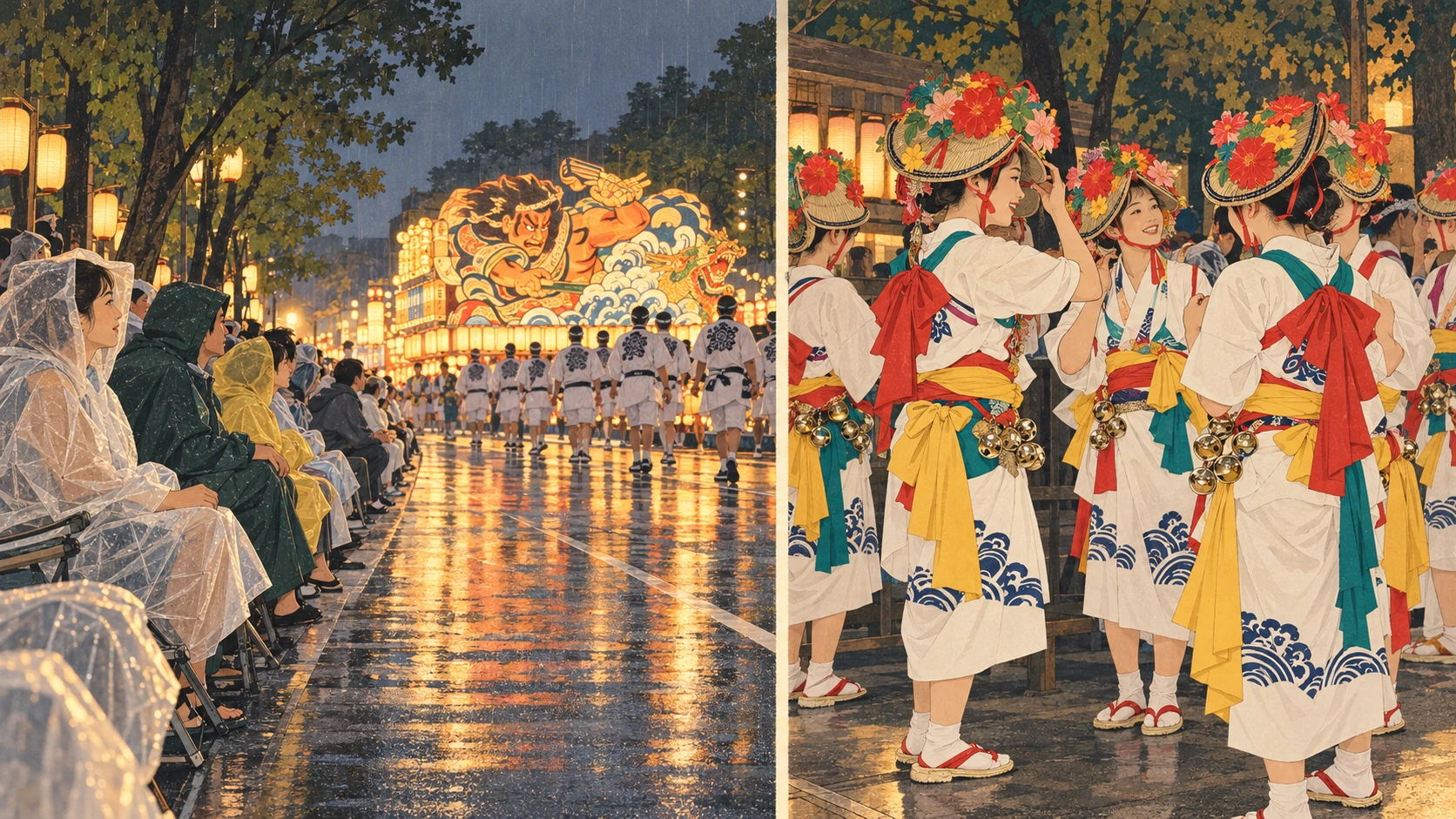
Viewing seats have no roof. The organiser's viewing questions and answers recommend raincoats and ask people not to block others' views with umbrellas. Some places use tubular-frame chairs and others raised temporary seating. A reserved place does not mean a rain canopy or indoor waiting area. Pack a raincoat, light outer layer, drinking water and tickets in a small bag, with wet items stored separately so you do not spend the entire departure reorganising things.
The 2026 wheelchair spaces cost 3200 for the user and 4000 per companion, with up to two companions per wheelchair user. The main provision is a place accessible to your wheelchair, not a wheelchair loan on arrival. One user and one companion total 7200 using this historical schedule. Ask about the position and access route before purchase if slopes, transferring or toilets matter. A discounted ticket's existence does not prove that the entire surrounding street is accessible.
Agree on departure options too. If one person feels unwell, does everyone return to the room or meet in a safe waiting place? Charged phones do not guarantee that people can find one another. Write down the hotel name and a meeting point rather than simply saying 'at the station.' With an early mountain bus the next morning, avoid filling the entire evening with events. Missing the final stretch to rest and leave on time is a reasonable itinerary choice.
Joining as a haneto: no registration, but correct clothing and timely arrival
Current rules allow free participation as a haneto without advance registration, check-in on the day or previous membership of a group. You must wear the proper haneto outfit and join a nebuta group while it is waiting to depart. The haneto participation instructions and rules require gathering on the seaward side of the Shinmachi–Yanagimachi intersection before the group starts. Joining partway through may be refused because of crowds. No registration does not mean you can arrive and dance at any time.
The outfit includes a hanagasa hat, a white-based yukata, shoulder ribbons and waist accessories, with white tabi socks and zori sandals also specified. Ask the rental shop about dressing, returns and sizing rather than substituting an everyday yukata for the full formal outfit. With children, check the shop's sizes and arrangements for the event year before committing the whole family. If someone does not want to dance, agree on viewing or returning to the room beforehand, instead of splitting up at the last moment as the group leaves.
Follow staff instructions during the procession, do not walk back against its direction or bring dangerous objects, and immediately clear a route for ambulances or fire engines. Disperse promptly after your participating group completes one circuit. You are moving inside a real festival procession rather than entering and leaving a stage freely. If you feel unwell, shoes rub or rain starts, watching is an option. Having paid for clothing is not a reason to force yourself through the whole route.
Haneto costs and energy: allow for dressing, returns and the next morning
The organiser's clothing reference gives roughly 10,000 to buy an outfit and about 4000 to rent one. These are estimates, not guaranteed prices at every shop or in every year. Ask a named rental shop whether dressing help, accessories, the hanagasa, a deposit and the return deadline are included, especially if you still have onward transport after the festival. Participation without a registration charge does not make all the evening's preparation free.
If two adults provisionally allow 4000 each for rental, clothing totals about 8000. This is a budgeting exercise based on the official general estimate, excluding transport, meals and shop-specific extras. A viewing-seat ticket is another option, not an obligatory purchase to add to every dancer's clothing. Agreeing to participate one night and watch another is usually simpler than trying to photograph from a seat and dance the entire circuit on the same evening.
Haneto movement, crowd density and late hours gradually use up energy. An afternoon in the city, an early meal, dressing and a later start next morning are usually easier for first-timers than walking Oirase that same morning. If only one person wants to dance, you can organise part of the evening separately while keeping a fixed meeting place. Travelling together does not mean doing every minute alike, but it does call for prior agreements on safety and transport.
A city hotel example: JAL City's Triple does not have three identical beds
As a named city-base example, Hotel JAL City Aomori gives about six minutes on foot from Aomori Station on its access page. That is an ordinary walking reference: festival closures, crowds and luggage can lengthen it. The advantage is getting around the city on foot, not a guarantee that a room overlooks the floats. Distance from the station is also different from distance to every activity location.
The Standard room table lists Twin rooms at 23.2–28.34 m² for one or two people, with 120 × 200 cm beds. Triple is 23.95 m² for three: two 110 × 200 beds and a 100 × 180 extra bed. Taller guests and three adults should notice that shorter extra bed rather than infer equal sizes from 'Triple.' A family of four can also ask about Connecting, two rooms of 23.2 m², which the hotel requires booking by telephone.
Confirm meals and the chosen rate's limits before arrival. A bed does not establish that breakfast is included, nor does a station location mean free luggage storage for any number of days. Obtain a specific hotel answer, particularly during the festival. For drivers, the current page lists parking in arrival order without advance reservations, plus height and dimension limits for the mechanical parking facility. Booking a room does not reserve a space; ask about legal alternatives nearby if necessary.
Outside festival dates, see the lanterns at Wa Rasse in the daytime
Autumn and winter visitors wanting to see the illuminated figures can plan Nebuta Museum Wa Rasse instead of expecting August's full street procession. The indoor exhibition and the parade are different experiences. The museum lets you examine shapes, scale and construction, but a visit should not be described as having attended the festival itself. It can also be a rainy-day city alternative after checking closures. Being indoors does not mean opening every day of the year.
The museum's currently published admission charges are 620 for adults, 460 for upper-secondary students and 260 for primary and lower-secondary students, using the school-stage categories in Japan's education system. Groups of ten or more paying together have another rate; individually paying visitors cannot apply that discount. Two adults total 1240, a different product from two ordinary 2026 festival seats at 8000, with no offset between them. The museum also says certain two- and three-facility combination tickets stopped being sold on 31 March 2025. An old account does not establish a current package sale.
The hours and closure page gives May–August as 9:00–19:00, last admission 18:30, and September–April as 9:00–18:00, last admission 17:30. Closures are 9–10 August for exhibit replacement, plus 31 December and 1 January. The shop and restaurant have different hours. Do not use restaurant closing time to calculate the museum's last admission; preserve that half-hour difference when arranging your return transport.
Four summer days: the festival first, with proper time for the gorge
One four-day summer plan is to arrive in Aomori, leave bags or check in and watch the festival on day one; rest and explore the city by day, then choose haneto or another viewing evening on day two; travel to the gorge accommodation on day three; and take a short walk before departing on day four. This is a suggested pace. The third day's connection depends on that year's buses and hotel transfers. Autumn 2026 times cannot guarantee a summer 2027 trip.
With only three days, favour one festival night and one gorge day, keeping the other day as arrival and departure margin rather than forcing in a full Lake Towada cruise too. If 7 August's daytime procession and evening events are your real priority, keep that day for the city and move Oirase before or after it. The event has a fixed time; if you change accommodation each day, allow time each day to check out and travel to the next place. Placing fixed-date activities before flexible walks usually works better than starting from a list of attractions.
Before departure, use separate checks for long-distance travel and the final connection to note where the bags will be, where you sleep and which service returns you each day. Moving to another city to save on lodging also requires comparing nighttime transport and lost rest. If the last train forces you away from the festival earlier than you want, the lower room rate may not meet the main purpose of the trip.
Oirase is not one photo stop: divide its 14 kilometres first
Oirase runs roughly 14 kilometres from Nenokuchi at Lake Towada toward Yakeyama. For planning, deciding where to get off, how far to walk and where to reboard is more useful than simply asking whether it is worth visiting. The prefectural tourism introduction to the stream helps establish greenery and autumn seasons; your actual stretch must match the day's conditions and services. Photographs of every attraction do not mean they all lie minutes from any single stop.
Watch the speed of the water, rocks, moss and forest rather than pursuing just one waterfall photograph. On a first visit, a slow short stretch can reveal more and remain adjustable to the party's stamina. Wear comfortable shoes with grip and carry rain protection you can stow. Wet banks, leaves and mud change walking speed. An app's uninterrupted walking time does not include photographs, toilets or stopping to put on another layer.
Before getting off, confirm the Japanese name of your return stop. Kumoi no Taki and Kumoi no Nagare are different; remembering only 'Kumoi' is insufficient. Oirase Keiryukan, the hot-spring area and Ishigedo are also distinct places. If luggage obstructs the walk, settle it with your accommodation first. Do not assume every stop along the stream has luggage storage, lunch or a toilet; check those facilities before setting off.
Short walks: Ishigedo to Kumoi no Taki, or a stretch near the lake
To see Oirase without walking its whole length, first compare Ishigedo to Kumoi no Taki. The local guided route presented by prefectural tourism describes a walk of about three kilometres to observe water, rock formations and plants. Its distance helps select a stretch, but the paid guided outing needs a separate booking with its operator. Walking the same route independently does not automatically include a guide, transport or a guarantee that it is open that day.
Closer to Lake Towada's entrance, consult the short lakeside approach listed by the environmental project: Shiraito no Taki to Nenokuchi, about 2.6 kilometres with a 50-minute walking reference. These two routes have different beginnings and endings. 'About three kilometres' does not make any stop suitable. To continue by boat from Nenokuchi, check direction, ticketing and an alternative for a cancelled sailing, adding waiting time. Walking minutes alone do not prove a cruise connection works.
If the group's pace is uncertain, set a turnaround point and latest arrival time at the bus stop beforehand. If slower than expected, shorten the walk instead of running at the end. When a trail section is restricted, seeing water from the road does not authorise walking in the roadway. Selecting a portion lets you observe with manageable effort. Two comfortable hours usually suit a first visit better than chasing the bus solely to complete 14 kilometres.
Longer walks: nine and 14 kilometres both need a transport buffer
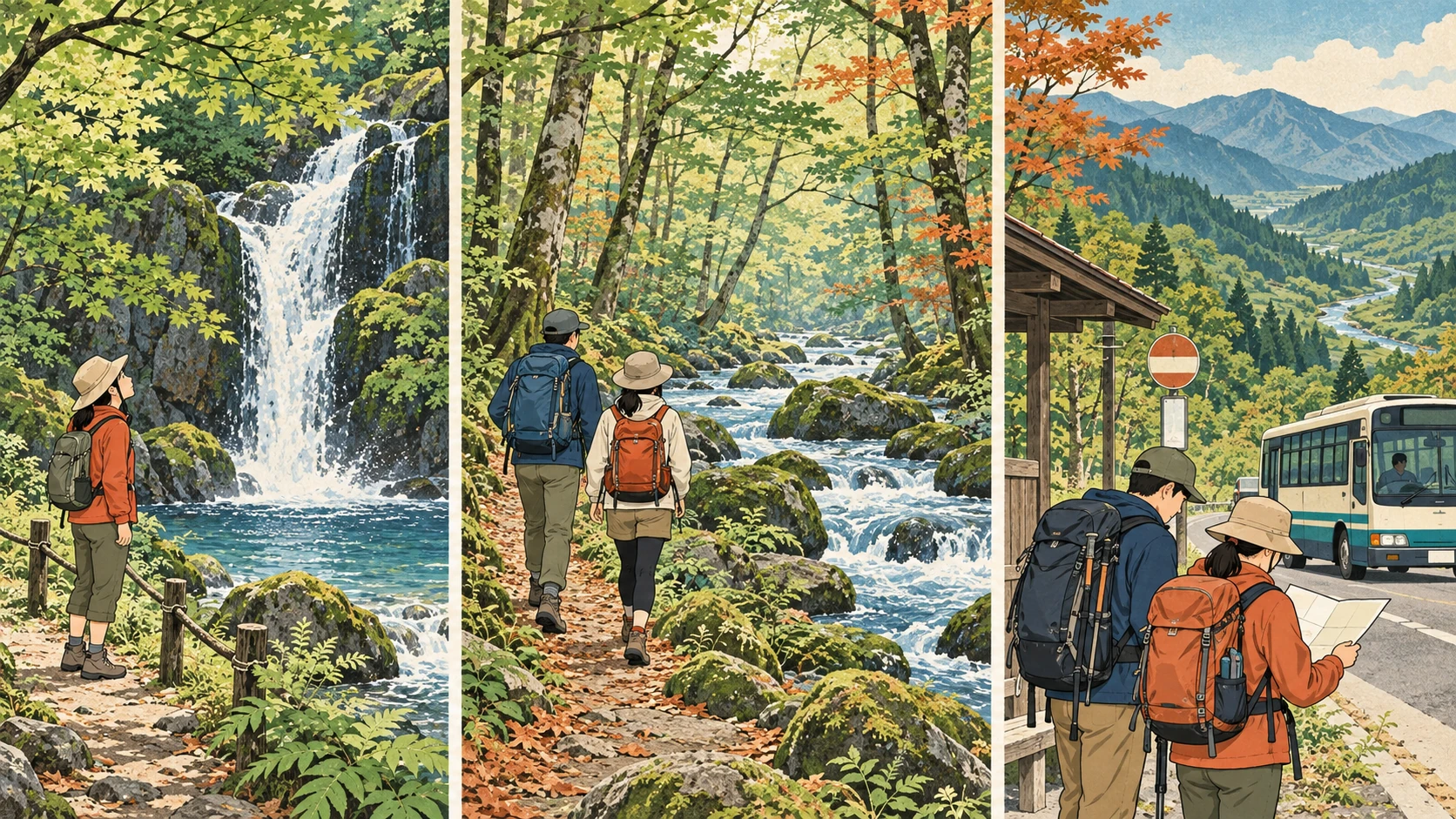
The Oirase environmental project's walking references give Ishigedo–Nenokuchi as about nine kilometres and three to four hours, and the stop in front of Oirase Keiryu Onsen's ski area–Nenokuchi as about 14 kilometres and four to five hours. These are route references, not deadlines every person must meet. Photographs, children and wet surfaces need extra margin. With just an afternoon left, do not automatically choose the whole length because 14 kilometres looks like half a day's task.
If nine kilometres take four hours and leave only minutes before the last bus, the plan has no tolerance for disruption. First choose an earlier return with an alternative if missed. If only one suitable departure exists, shorten the route and reach the stop with daylight and energy remaining. Fitness does not remove the risk of a full bus. Walking quickly cannot secure space for passengers boarding at an intermediate stop.
If direction is otherwise flexible, follow the official suggestion to walk upstream, facing the flowing water. Your return connection still matters more than one photographic angle. If your hotel shuttle only serves the middle stretch, you do not need a detour to the lake entrance simply to say you visited the start. On routes of different lengths, everyone should know where an early finish is possible and where they must continue to another stop. That makes flexibility something the party can actually use.
| Stretch | Distance and time reference | Planning point |
|---|---|---|
| Ishigedo–Kumoi no Taki | About 3 km; no duration guaranteed here | Compare a short guided or independent walk with stop-specific times |
| Shiraito no Taki–Nenokuchi | About 2.6 km and 50 minutes | Toward the lake entrance; add photography and boat waiting |
| Ishigedo–Nenokuchi | About 9 km and 3–4 hours | Allow meals, toilets, breaks and early arrival for the bus |
| In front of Oirase Keiryu Onsen ski area–Nenokuchi | About 14 km and 4–5 hours | Longer route; do not directly apply times to snow and ice |
Settle toilets, phone signal and weather before starting
The environmental project warns of weak mobile signal between Nenokuchi and Ishigedo and few toilets along the water. Identified facilities include Ishigedo Rest Area and the public toilets at Kise and Tamadare. Save the facilities and communication information beforehand. Temporary toilets and food trucks installed only for the traffic-restriction week cannot be treated as permanent October facilities or services available in another season.
Download the maps and times you need, carry water and simple food, and use a toilet before starting. With heavy rain or a published road or trail restriction, choose a short section confirmed open or stay around your accommodation and the city. An old reopening announcement does not prove all 14 kilometres are accessible today. Transfer operators also alter stops for weather and restrictions. The actual operator's information on the day matters more than old photographs.
Adjust the route immediately for signs, barriers and staff instructions; do not step past them for a photo. In winter, a snow-free walking table is not a safety guide: ice, equipment and guiding conditions need separate checks. For frozen waterfalls, compare formal winter activities, but the 14-kilometre and 50-minute examples here do not establish suitability in snow. Without appropriate transport and safe conditions, do not force completion of a route drawn earlier.
JR bus reservations: Hachinohe departures and the return work differently
Under current 2026 conditions, Oirase 21 and 23 from Hachinohe Station's west exit toward the gorge and Lake Towada require advance online reservations, including for JR EAST PASS and JAPAN RAIL PASS holders. The operator's reservation rules open booking three months before travel and close it 60 minutes before departure from Hachinohe. The separate 300-per-seat reservation charge is paid beforehand, with the fare paid on leaving. Those 300 do not buy the whole journey.
The page says Lake Towada–Hachinohe, Aomori–Lake Towada and Lake Towada–Aomori neither need nor accept reservations. Boarding at intermediate gorge stops is subject to available space. An outbound morning reservation from Hachinohe therefore does not hold your afternoon return, or guarantee reboarding after getting off at another stop for photographs. If a seat or luggage space is essential, clarify how each segment works and the connection risks before committing to it.
There are pass exceptions too. The current page accepts JR EAST PASS and JAPAN RAIL PASS but expressly excludes JR East-South Hokkaido Rail Pass and JR Tohoku-South Hokkaido Rail Pass. When comparing pass costs with the sections actually covered, check the complete official name of your product. A JR bus is not free with every pass. Even if the fare is covered, the reservation charge follows the operator's current conditions.
A car-free day from Hachinohe: four hours fifty minutes is not all walking time
Take the autumn table valid from 18 September 2026 as an example. Oirase 21 leaves Hachinohe's west exit at 10:00 and reaches Ishigedo at 11:44; returning Oirase 24 leaves Ishigedo at 16:34 and arrives in Hachinohe at 18:20. That leaves 4 hours 50 minutes between arrival and departure at Ishigedo, but lunch, toilets, photographs and arriving early for the bus all belong inside it. Do not treat the entire window as hiking time. For a short visit, walk beside the water from Ishigedo and turn back to the same stop in good time.
If walking one way to Kumoi no Taki, the current Hachinohe-bound bus leaves that stop at 16:25, nine minutes earlier than Ishigedo. The two stops cannot share just one 'return at 16:34' reminder. Read the autumn timetable's stop-by-stop columns alongside your walking start and finish. The three-kilometre direction allows longer pauses, but trail restrictions, feeling unwell or insufficient onboard space may still require shortening or changing the plan. A timetable example does not guarantee a connection.
The outbound Oirase 21 and return 24 in this example are listed through 17 November; other services may end earlier. For an onward shinkansen to Tokyo or Sendai, add delay and platform-access time after the scheduled 18:20 arrival. Do not choose a nonrefundable departure just a few minutes later. Staying in Hachinohe or choosing a later train reduces the pressure of worrying about a missed connection all day. Compare an extra night's value with the party's stamina and budget.
November season endings differ: Aomori, Hachinohe and the winter route
In the 2026 autumn table, several Mizuumi services between Aomori and Lake Towada run through 11 November. Hachinohe's Oirase 21, 22 and 24 run through 17 November, while 23 ends 16 November; partial-route services have their own dates. 'The bus runs in November' is therefore not enough to finish an itinerary. Check the service name, boarding stop and operating dates in each column. The latest date in the heading does not apply to every vehicle on the page.
More importantly, JR Bus's winter explanation explicitly says the winter Hakkoda from Aomori and Shin-Aomori ends at Sukayu and does not enter Oirase Gorge or Lake Towada. The new service starting 12 November is not the old lake route continuing under a different name. For a mid-November visit from Aomori to the gorge, the same 8:10 departure time does not establish the same destination.
For a winter gorge stay, consider the hotel's seasonal transfer or other transport with clearly confirmed operation, observing its own eligibility, reservation and endpoint. Before the last leg is confirmed, avoid noncancellable lakeside accommodation. Separating 'reaching the mountains' from 'reaching my particular hotel' makes the missing connection easier to identify than simply searching for any bus from Aomori to Lake Towada.
Bus costs: separate the fare, reservation charge and return stop
The current autumn fare list gives adult one-way fares from Hachinohe of 2380 to Ishigedo, 2490 to Kumoi no Taki and 3050 to Yasumiya at Lake Towada. From Aomori or Shin-Aomori, Ishigedo is 2820 and Yasumiya 3480. The section-by-section fare table on the same page is the basis for comparing endpoints. Do not quote the lakeside fare for someone walking only the middle gorge, or calculate your own distance-proportional fare for an earlier stop.
One adult paying ordinary current fares from Hachinohe to Ishigedo, walking to Kumoi no Taki and returning to Hachinohe pays 2380 + 2490 in fares plus 300 for the outbound seat reservation, totalling 5170. The same arrangement for two adults is 10,340. That excludes food, accommodation, guiding and the cost of a pass. Returning from Ishigedo instead gives 2380 × 2 + 300 = 5060, a difference of 110. That saving should not decide the walk; stamina and actual trail opening matter more.
With a pass, do not add the same covered fare twice, but do not treat the pass itself as costless. Compare a pass you would buy anyway separately from one purchased additionally for this segment. That makes value easier to judge. For child fares, groups and other discounts, look up the operator's named rules if you have not read your own eligibility conditions. Adult examples in this guide do not automatically set prices for minors.
Check the restriction year: the 2026 environmental event was in September and has ended
Searches for Oirase Gorge traffic restrictions mix autumn articles from different years. The environmental project's homepage now states that the 2026 event has ended and gives 7–13 September as its dates. That cannot be rewritten as a blanket driving ban in October 2026's foliage season. Historical dates help explain the system; they cannot replace the notice for your actual travel day or determine the restriction week in 2027.
Under that event's vehicle and operating-hour rules, weekday restrictions on 7–11 September 2026 were 10:00–16:00, with 12–13 September at 9:00–16:00. Large vehicles and certain others had exceptions on 7–12 September; 13 September included large vehicles too. These details apply to that event and show why a restriction does not necessarily affect every vehicle at every hour. With a new announcement, read the categories, dates and substitute transport rather than only a headline.
Drivers must still park correctly on ordinary days. Towada City's gorge parking reminder requires parallel parking within designated roadside spaces; capacity at Ishigedo, Choshi Otaki and elsewhere is limited. This is not permission to stop on any shoulder. When spaces are full, find another permitted place or shorten the walk rather than obstruct traffic for a photo. A hotel offering a shuttle also does not mean you can park there free all day.
Cycling as another option: check the 143-centimetre minimum and return time
For cycling between parts of the gorge, the current rental introduction specifies a minimum height of 143 centimetres, usual operation from early April to early November and hours of 9:00–16:30. However, the Oirase environmental project’s FAQ lists a 16:00 closing time for Nenokuchi only; plan to return your bicycle by the deadline at your chosen return point. Rental and return points include Yusuikan near Yakeyama, Ishigedo Rest Area and the JR Bus Nenokuchi station building. Whether they can supply a bicycle for your date depends on actual operation and stock. A child's age does not prove the required height, and a walking route does not automatically become a cycling route.
The basic four-hour charges are 3000 for an e-Bike, 2000 for a standard electrically assisted bicycle and 1000 for a city bicycle. e-Bikes are Yusuikan-only; the electrically assisted and city categories extend at 300 per 30 minutes. Two standard electrically assisted bicycles for four hours total 4000. Extending each by an hour adds 1200, making 5200. This example uses the current list, excludes guiding and transport, and still requires return within operating hours. If an old brochure differs, use current operator information.
Online reservations accept morning starts only, with no same-day booking. Do not arrive in the afternoon assuming a few taps will reserve a bike. Riders still need to manage road traffic, slippery surfaces and the return deadline. If companions mainly want to stop and examine moss, a short walk may suit them better than repeatedly finding a legal place to stop a bicycle. Nor is a bicycle guaranteed as an improvised replacement after missing the last bus.
Lake Towada cruises: distinguish one-way route A from the Yasumiya loop B
The 2026 cruise table separates two roughly 50-minute routes. A runs one way between Yasumiya and Nenokuchi; B leaves Yasumiya and returns there after its circuit. Check the operator's 2026 route and date table together with bus times. If luggage, your car or the return bus is at Yasumiya and you want an easy lake outing, compare B first. That avoids arriving in Nenokuchi before realising you need to get back.
Several 2026 A sailings are listed 24 April–5 November, such as Yasumiya 9:30–Nenokuchi 10:20 and the reverse 11:00–11:50. However, the 16:00 departure from Nenokuchi to Yasumiya is listed only through 9 October, not the entire foliage month. B departures at 10:15, 11:45, 13:15 and 14:40 run through 16 November; earlier and later departures have earlier seasonal endings. Even a single cruise table cannot be reduced to one overall final date.
Cruise and bus seasons differ. After early November, some buses may still reach Nenokuchi without an A sailing to cross the lake. To combine a one-way gorge walk with a boat, choose the sailing first, then work backward to the walking start and waiting allowance. Decide whether a land return exists if that boat is cancelled. When the whole trip relies on one final sailing, shortening the walk helps more than repeatedly hurrying your companions.
| Route and direction | Example times | Announced period for that sailing |
|---|---|---|
| A: Yasumiya to Nenokuchi | 9:30–10:20 | 24 April–5 November 2026 |
| A: Nenokuchi to Yasumiya | 11:00–11:50 | 24 April–5 November 2026 |
| Late A: Nenokuchi to Yasumiya | 16:00–16:50 | 24 April–9 October 2026; not usable in late October |
| B: Yasumiya to Yasumiya | 10:15–11:05 | 24 April–16 November 2026 |
Cruise fares and weather: children, upgrades and cancellations need separate checks
The cruise's current ordinary fares are 1760 for adults and 880 for primary-school pupils, with “primary school” referring to the school-stage category in Japan's education system. Each adult can bring one preschool child free; additional preschool children pay the child fare. This is not unconditional free travel for any number of children below school age. Give the adult and child numbers together when buying. Group fares are separately listed for 15 or more, not a basis for pricing an individual trip for two.
The Green cabin carries an additional charge, normally 550 for adults and 330 for primary-school pupils. It does not replace a 1760 ticket with a 550 ticket. Ordinary tickets for two adults and one primary-school pupil total 4400; upgrading all three adds 1430, giving 5830. This excludes other transport and any discounts. Check the selected route and current rules at purchase. Watching the scenery seated does not establish complete accessibility; ask the operator directly about mobility aids and boarding assistance.
The official timetable warns that fog, strong winds and other conditions can change or suspend services. Avoid making the boat the only link across the lake to a nonrefundable train. Keep time for a short Yasumiya walk and meal, or put the cruise in the middle of an overnight-stay day. The ticket office moved to Lake Towada's Puratto tourism exchange centre, normally opening at 9:00; service 51 sells tickets onboard from 8:30. Arriving early at the port still requires finding the correct ticket location for that departure.
Allowing half a day at the lake: how far to walk depends on your return point
Lake Towada can be a slow lakeshore stay rather than only the end of a gorge walk. Arriving through Nenokuchi, first confirm whether the next leg is a boat, bus or hotel. In Yasumiya, keep ticketing, meals and the return stop within the same practical area. The other shore looking close does not make it walkable around the lake. Anyone booked on the western shore particularly needs to confirm the pickup point.
For a first half-day visit, consider just one B cruise and a short Yasumiya walk, without adding the full nine-kilometre gorge section. If weather prevents sailing, leave time for safely accessible shore and indoor rest rather than inventing a long-distance replacement because the sightseeing list is incomplete. Put older companions' and children's time to sit directly into the itinerary. A vague 'adjust as needed' beside an ideal route does not actually provide rest.
Staying beside the lake gives more margin for morning or evening light than commuting from the city. It does not guarantee a lake-facing room, an unobstructed window or restaurant operation on every date. Separate wanting to walk by the lake from wanting to see it from inside your room. Choose a named room category and ask about the available walking access. That is more precise than searching the entire region for general Lake Towada hotel recommendations.
Oirase Keiryu Hotel rooms: a shower does not mean a private onsen
Hoshino Resorts Oirase Keiryu Hotel suits people wanting to stay at the gorge entrance and explore the middle stretch using guest transfers. The Japanese official room and facilities page lists Keiryu Washitsu at 44 m² for one to four people, with two 195 × 110 cm sleeping places and additional 200 × 110 places for the third and fourth guests. Its bathroom equipment lists a shower booth. A hotel having an onsen does not make this category a room with its own hot-spring bath.
For in-room hot-spring bathing, look specifically for Keiryu Twin with a Semi-Open-Air Bath: 44 m² for one or two people, two 205 × 140 cm beds. The official page lists only four rooms and says the thermal water comes from Hakkoda. This belongs to that named category, not all rooms measuring 44 m². With a child or third adult, equal floor area does not mean equal occupancy. Confirm the bookable party in the reservation system.
The current Japanese room description allows children aged six and under to share existing beds, capped at the number of adults per room. You must still enter actual children and the chosen rate to confirm; it does not make transfers, food and activities all free. The hotel offers different meal options, but securing a room does not automatically include a particular dinner. For late arrival, allergies or children's meal timing, obtain the restaurant's and accommodation plan's answer first. A room comparison is not a menu or a guaranteed table.
Two Hoshino transfer systems: station pickups and the gorge shuttle
The hotel's current station-transfer page requires reservations two days ahead, closing when full. Hachinohe is free, Aomoriya transfers require stays at both hotels, and Aomori Station is paid. In April–November 2026, one way from Aomori is 3500 for an adult, 2500 for ages 4–11, and 2500 for ages 0–3 using a seat; ages 0–3 without a seat are free. December 2026–March 2027 is 4000 for an adult and 2800 for ages 4–11 and seated ages 0–3; unseated ages 0–3 remain free. Check your eligibility before booking because directions and seasons differ.
The same page lists Aomori Station departure at 15:00, taking about 120 minutes in April–November and 150 in December–March. Hachinohe departs at 14:30 in April–November 2026 and at 14:00 in winter; the transfer leaves the hotel for Hachinohe at 11:00. This is a scheduled hotel transfer, not an hourly sightseeing bus. Shin-Aomori arrivals must reach Aomori Station themselves. For a morning gorge walk, find a matching public bus or stay the previous night. An afternoon pickup cannot deliver a morning hike.
Separately, the guests-only Keiryu Shuttle runs from the 15:00 service on 10 April 2026 through the 11:00 service on 25 November. It usually travels hourly along the middle gorge, with an earlier last service in November. It can be used before check-in and after check-out, but capacity is 27 and busy periods may mean waiting for the next one. Heavy rain or trail restrictions can change the route. Lake transport is different; this shuttle does not guarantee travel to Nenokuchi or Yasumiya.
A Lake Towada stay: Prince's Lake Side Twin and the western-shore onsen
Towada Prince Hotel is on Lake Towada's western shore in Kosaka, Akita Prefecture. It is neither Aomori City nor the same neighbourhood as Yasumiya's pier. The named Lake Side Twin category lists 25.5 m² for one to three people, with 110 × 203 cm main beds and a 110 × 185 extra bed for three-person occupancy. For a third adult's comfort, compare the extra bed's length and luggage space. 'Twin' does not mean three people occupy two original beds.
The western-shore onsen page lists one covered outdoor pool each for men and women, without an indoor hot-spring pool. Bathing is free for staying guests, but adults pay an additional 150 bathing tax. Do not turn an indoor washing area into a separate indoor bath. General day visitors pay 1200 for adults including bathing tax, 600 for primary-school pupils, and nothing for preschoolers. Information dated 1 July 2026 has different applications: a tax-inclusive day ticket does not waive the overnight guest's bathing tax.
The hotel's accommodation questions and answers list the same accommodation rate for children and adults; primary-school-age and younger children needing a bed are also charged. Do not import another hotel's bed-sharing rule for children aged six and under. Usual check-in is 15:00 and check-out 11:00, subject to the booked plan. For a quiet lakeside stay, confirm dinner, arrival time and next-day transport alongside the nightly price. This is not a city base where you can always step outside and find another restaurant.
Prince transfers: two days ahead for Hachinohe, the previous day for Yasumiya
The current Towada Prince access page links the 2026 transfer table and states that the service does not operate without reservations. Hachinohe requires booking two days ahead, while the Towadako stop in Yasumiya requires the previous day. These are different deadlines, not public buses you can board merely by joining a queue. Confirm travel day and passenger numbers when arranging the room. Do not step off a boat assuming the hotel vehicle is permanently waiting at the port.
Prince's page also summarises Hachinohe public-bus reservations, but check the actual bus against JR's latest operator information. A hotel's short explanation cannot replace the service-by-service timetable. Leave margin between a boat or bus arriving in Yasumiya and the hotel pickup departing. Ask beforehand what happens if the preceding leg runs late. Placing all transfers in the same minute turns a relaxing lakeside stay into a day spent chasing vehicles.
Lakeside hotels can close seasonally or for maintenance. Before booking winter, confirm that your specific dates really offer accommodation, meals and transfers. An official 2026 shuttle table does not establish confirmed 2027 services, and a late-autumn package does not establish year-round opening. If your dates are not listed, obtain a hotel answer before completing nonrefundable transport and lodging. Reaching Yasumiya independently is not equivalent to reaching a western-shore hotel when its transfer is still unconfirmed.
Four autumn days: separate time for the city, gorge and lake
A four-day foliage trip can arrive through Aomori or Hachinohe, leaving day one for the city and an indoor alternative; day two for a gorge section and accommodation; day three for another short walk or a boat from Yasumiya; and day four for returning to the station and onward travel. A nine-kilometre hike and lake cruise need not occupy one day, and heavy rain may prompt swapping the second and third day's priorities. Swapping still depends on confirmed transfers and sailings, not guaranteed last-minute availability.
For mid- to late October, record how much to walk each day and the actual return service, rather than tracking only Oirase's foliage peak. Crowds lengthen bus waits and photography stops. If you want early forest light, split breakfast, transfers and walking into stages so an early start does not cost an important meal in your accommodation plan. Companions who dislike early mornings can make separate arrangements; the entire family need not sacrifice rest for one photograph.
This route covers choices between Aomori City, the gorge and lakeshore, not a whole-prefecture tour including Hirosaki, Shirakami and Shimokita. Add nights to visit another area or remove a hotel move. Use season and main activities to choose travel dates, then compare long-distance arrangements. Three nights do not require changing rooms daily. One fewer packing session often releases time to stop and actually appreciate the scenery.
Thinking about winter: the lake bus ending does not end every hotel transfer
A winter Aomori trip needs a new transport plan, not just a thicker coat added to the autumn route. JR's winter Aomori line does not reach the gorge or lakeshore, while Hoshino separately lists reserved transfers for December 2026–March 2027. Their passengers, endpoints and charges differ. To stay for winter scenery, confirm accommodation and its transfer first, then research formal activities. Nonguests cannot treat a guests-only vehicle as a public route with freely purchasable tickets.
Do not simply use summer rental bikes or follow snow-free walking times to reach frozen waterfalls in winter. Check snow, surfaces, guided-activity equipment and whether the outing is actually running, allowing the plan to be cancelled or shortened. This guide assigns no prices to unannounced winter packages and promises no ice on a particular day. Separately confirming dates, transport and the activity avoids securing only a room before discovering that your desired experience is not arranged.
If your focus is just Aomori City and the lantern exhibition, a city base can reduce winter transfer complexity. Airport, railway and city walking conditions still depend on weather. Before a flight home or essential long-distance journey, prioritise a final night with easier-to-confirm transport rather than putting the entire return on a same-day mountain pickup. This is a choice about itinerary risk. Winter mountains require preparation different from autumn, rather than being impossible to visit.
Estimating the whole budget: official prices and your chosen room ceiling are different
Separate known transport and activities from a self-imposed accommodation ceiling. For two adults, one evening of ordinary 2026 festival seats gives a reference of 8000; the autumn bus example from Hachinohe to Ishigedo and back from Kumoi no Taki totals 10,340 for the same two. Together that is 18,340. It compares information from different periods, not a package available on any 2027 travel date. Accommodation, meals and intercity travel are also excluded.
You can set your own search ceiling, such as 'no more than 30,000 per night for one room for two.' Three nights at that limit would reserve 90,000 for lodging. This is a traveller assumption, not a hotel quote found for this article, nor proof that festival or foliage nights remain available at that price. Reprice the actual party, meals, taxes and cancellation conditions, then replace the assumption. A quiet weekday's lowest rate is not a budget for the most sought-after evenings.
Do not hide other costs behind apparent savings. Staying farther away may require leaving early; moving rooms means carrying bags; saving a bus fare by walking beyond your stamina can defeat the trip's purpose. With a limited budget, preserve the viewing evening or gorge section you most want and make other activities short walks or indoor visits. The unit of comparison is the entire itinerary, not the cheapest single ticket on a search page.
Bad-weather alternatives: stay near the same base with fewer connections
If it rains in the city, check Wa Rasse's opening before adjusting the walk. With heavy rain or a restricted gorge trail, prioritise safely reachable accommodation, rest and transport. Keep alternatives near your original base where possible. A sudden move to a distant city can add transfers and last-bus risk instead of solving the day. A cancelled cruise also does not require another water activity. Returning safely to the room matters more than completing a checklist.
In light rain when conditions permit walking, choose a short section, grippy footwear, a stowable raincoat and waterproof storage for belongings. Complete equipment does not authorise entering an officially restricted area. Photographers should leave pedestrian space and avoid occupying a narrow trail for long periods. Beautiful water and waterfalls do not make the edge safe. If companions separate for pictures, agree on boundaries nobody will cross before splitting up.
If return transport is cancelled, contact the actual carrier and your accommodation first rather than moving independently using old online times. Because middle-gorge signal is weak, settle checks at the hotel or station whenever possible. Keep hotel and transfer confirmation emails, operator contacts and an offline timetable together in one folder. When plans change, you can explain your date and location clearly instead of repeatedly guessing whether another vehicle will arrive.
Booking order: the event year first, then accommodation and the final connection
For the festival, confirm the year, preferred dates and whether to watch or join as haneto, then compare cancellable rooms. When official sales open, check ticket type and position before arranging long-distance transport that will not force an early departure. For the gorge, confirm season and arrival and departure stations, write down walking endpoints and the return service, then book accommodation and transfers in the same direction. Both approaches prevent a nonrefundable room payment before discovering that the essential transport is missing.
Cancellation rules belong to the actual rate, not only the hotel's homepage. Prepaid, nonrefundable, meal-inclusive and activity packages can have different deadlines. A boat or activity being cancelled does not automatically make another hotel's cancellation free. Before payment, save the terms in Japanese or your chosen language, the dates and party size. Confirm the third sleeping place, children's meals and included transport. Ask the seller about your specific situation rather than extending another inn's answer across the entire region.
Before departure, check four things again: whether event and transport notices still match your dates, whether roads or trails have new restrictions, whether transfers are confirmed, and whether the return has enough margin. Nebuta can be one lively evening; Oirase and Lake Towada can be just one comfortable piece of scenery. Clearly stating what the group can actually complete usually serves everyone's preferred pace better than increasing the number of attractions.
A few useful answers
Are Aomori Nebuta Festival 2027 viewing seats already on sale?
When checked, the official seating page still identified its information as 2026, with 2027 to be updated after confirmation. The annual 2–7 August tradition does not announce next year's prices, lottery or release dates.
Can I watch Nebuta without buying a seat?
You can watch in permitted areas without installed seats, but crowds mean neither a clear view nor seating is guaranteed. Do not reserve spaces days ahead or with tape. Follow the route for that year and instructions on site.
Do haneto need registration or membership of a group?
Current official guidance requires neither advance registration, check-in on the day nor previous group membership. Wear the proper haneto outfit and join a waiting group before it departs. Joining during the procession may be refused because of crowds.
Can I see Nebuta and autumn foliage on the same trip?
August's nighttime festival and the gorge's usual mid- to late October foliage are different seasons. In August, visit the gorge for green forest; in autumn, focus on the lake and daytime transport. Do not expect both seasonal experiences in one week.
Must I walk all 14 kilometres of Oirase Gorge?
No. Compare Ishigedo–Kumoi no Taki at about 3 km or Shiraito no Taki–Nenokuchi at about 2.6 km. Check that day's opening, your stamina and the return service first; completing the whole length is unnecessary.
Do JR buses from Hachinohe require reservations?
Current Oirase 21 and 23 departures from Hachinohe's west exit require reservations even with an eligible JR pass. The 300-per-seat reservation charge is separate from the fare. Returns and intermediate boarding depend on current space rules; reserving the outward trip does not reserve the return.
Was driving banned throughout Oirase's 2026 autumn-foliage season?
No. The 2026 environmental event's restrictions were 7–13 September, and the official site marks it ended. For October, check new notices for the actual date rather than applying rules from another year or month.
Can I still take a direct Aomori–Lake Towada bus in November?
It depends on the service and date. Several 2026 Aomori lake services run through 11 November. The winter Aomori and Shin-Aomori line ends at Sukayu, without entering the gorge or lakeshore. Hachinohe services have different final dates; the latest date on the page does not cover all buses.
Does the Lake Towada cruise return to the same port?
B leaves Yasumiya and returns there; A travels one way between Yasumiya and Nenokuchi. Both take about 50 minutes but serve different purposes and have different seasonal endings. Check where luggage, the car and your return stop are before buying.
Are all Oirase Keiryu Hotel transfers free?
No. The current Hachinohe transfer is free, Aomoriya requires stays at both hotels, and Aomori Station is paid. Reservations are two days ahead, closing when full; the middle-gorge shuttle is separately guests-only. In-room onsen access also depends on a named room category, not every room.
Is Towada Prince Hotel beside Yasumiya pier?
It is on the western shore in Kosaka, Akita Prefecture, so check the additional pier connection. Current hotel transfers require reservations: two days ahead for Hachinohe and the previous day for Yasumiya. Without reservations the service does not run.
How many days suit a first Aomori trip without a car?
Compare three nights and four days, with one or two city nights and one or two beside the gorge or lake. With just two days, narrow the trip to one theme. Actual event dates, buses, sailings and companions' stamina determine the final plan.
Check with the source
Schedules, availability and rules can change. These official sources are the place to confirm details before you book.
- Aomori Nebuta | 2026 viewing seats and pending 2027 update
- Aomori tourism | Stream seasons and bicycle rental conditions
- JR Bus Tohoku | Autumn services, reservations, fares and winter endpoint
- JR Bus Tohoku | Aomori Airport timetable validity and payment
- Aomori tourism | Nebuta background and dates
- Aomori Nebuta | Uncertain origins and festival history
- Aomori Nebuta | Annual operation, starting points and passing times
- Aomori Nebuta | Viewing, rain and wheelchair questions
- Aomori Nebuta | Haneto participation, formal clothing and gathering
- Hotel JAL City Aomori | Station walk and parking restrictions
- Hotel JAL City Aomori | Named Standard room types and beds
- Wa Rasse | Admission and discontinued combination tickets
- Wa Rasse | Seasonal hours and closures
- Aomori tourism | Short guided Ishigedo–Kumoi no Taki walk
- Oirase environmental project | Walking distances, facilities and 2026 restrictions
- Oirase environmental project | September 2026 event has ended
- Towada City | Designated parallel parking beside the gorge
- Towada Kanko Dentetsu | 2026 sailing-specific dates, routes and fares
- Towada Kanko Dentetsu | Children, ticket office and website-adopted video
- Hoshino Oirase Keiryu Hotel | Japanese room details, private baths and bed sharing
- Hoshino Oirase Keiryu Hotel | Station-transfer seasons, children and prices
- Hoshino Oirase Keiryu Hotel | Guest middle-gorge shuttle and limitations
- Towada Prince | Lake Side Twin and extra bed
- Towada Prince | Outdoor baths, overnight bathing tax and day admission
- Towada Prince | Children, check-in and facilities questions
- Towada Prince | Western-shore location and transfer booking deadlines
- Aomori Nebuta | 2026 individual-seat PDF and young children on laps
- Aomori Nebuta | Organiser and official-video entry point