An autumn 2026 guide to Yoro Valley by public transport: approach via Otaki by coach or the Ohara rail replacement bus, plan Awamata Falls and the open 600-metre Nakase section, and use weekday connection examples, bathing prices and return routes.
- Region & Focus
- KantoSide trips
- Reading Scope
- 33 min read · 16 chapters · 6 Q&As
- Official Verification
- 14 official sources checkedUpdated 27 October 2026
- Key Topics
- ItinerariesRail travelSeasons
Chapter Route Map (tap any stop)
- In autumn 2026, approach via Otaki, then choose the falls or hot spring district
- Separate the place names: Yoro-Keikoku Station, Awamata-no-Taki and Kazusa-Nakano
- After the Kominato suspension, replacement services still stop short of the valley entrance
- Coach from Tokyo Yaesu to Otaki: plan the local connection as part of the same journey
- JR Sotobo Line to Ohara, then the Isumi replacement bus: change at Otaki
- Reading the weekday timetable: some buses go to the station, others to the falls
- Awamata Falls: allow for the entrance, descent and return climb
- Enter Nakase from Kyoei Bridge and return after 600 metres
- Remove Omoshirokyo, Umegase and Mount Daifuku from the autumn hiking list
- Combine the falls with Goriyaku-no-Yu: choose an opening day and return stop first
- A workable day: reach the falls early and return to Otaki in the afternoon
- Arriving in Otaki before noon: a longer Awamata stay and a later return
- Read the return destination: a bus to Yoro-Keikoku Station cannot connect to suspended trains
- Autumn leaves and illuminations: leave the river in daylight on a day trip
- With children or older relatives, allow for steps and waiting and visit one fewer area
- An overnight stay gives time for dinner and transfers, not an extra closed trail
- Quick Q&A
For Yoro Valley in autumn 2026, plan both journeys via Otaki before choosing Awamata Falls or the Nakase hot spring district. The Kominato Railway suspension, replacement service terminus and out-and-back paths each have different conditions. Set your return connections first to see how much time remains for the river and a bath.
In autumn 2026, approach via Otaki, then choose the falls or hot spring district
If you are visiting Yoro Valley without a car in autumn 2026, plan transport from the Otaki side first. Kominato Railway trains are suspended between Kazusa-Ushiku and Kazusa-Nakano, breaking the former route from Goi all the way to Yoro-Keikoku Station. Adding together the old times for Tokyo to Goi, the local train and the waterfall bus misses the most important change. For Awamata Falls, first compare the coach from Tokyo Yaesu to Otaki with the JR Sotobo Line to Ohara, the Isumi Railway replacement bus to Otaki and a connecting Kominato local bus.
This trip works better with one main area for the day. Combine the falls and a day-use hot spring on the Awamata side, or the red bridge, Kobundo remains and a short riverside walk around the hot spring district and Nakase. Travel between the two areas by bus. Sights along the same river on a map do not form an open hiking route. For a first visit with a same-day return to Tokyo, focus on Awamata Falls. If return connections do not work, save Nakase for another visit.
Transport and path information was checked through 27 October 2026. Ichihara City’s live notice, with its main text updated on 26 October, says weekday replacement services terminate at Kocha Jidosha-mae, before Yoro-Keikoku Station. Otaki Town’s notice of 20 October lists the open parts of Nakase, Takimeguri and Omoshirokyo. These answer different questions: how to reach the valley, and which parts you can walk. Before buying tickets, read Ichihara City’s transport update and Otaki Town’s path restrictions, then use the timetable guidance below to assemble your route.
| Main aim | Getting there and back | What fits in one day |
|---|---|---|
| Awamata Falls and a bath | Buses via Otaki, returning to the same side | A short waterfall walk, lunch and bathing on an opening day |
| Nakase and the hot spring district | A local bus from the Otaki side towards Yoro-Keikoku Station | An out-and-back walk from Kyoei Bridge, Kannon Bridge surroundings and a meal |
| A local railway ride | Plan the operating Goi–Kazusa-Ushiku section separately | A different day from valley sightseeing |
| Autumn illuminations | Arrange accommodation transfers or book the return vehicle first | Focus on the evening views and an overnight stay; avoid rushing between both areas for the last bus |
An autumn 2026 guide to Yoro Valley by public transport: approach via Otaki by coach or the Ohara rail replacement bus, plan Awamata Falls and the open 600-metre Nakase section, and use weekday connection examples, bathing prices and return routes.
Separate the place names: Yoro-Keikoku Station, Awamata-no-Taki and Kazusa-Nakano
Yoro Valley spans Ichihara City and Otaki Town. The station name refers to a wider sightseeing area. Awamata Falls is upstream in Awamata, while the Nakase trail is near the hot spring district. Each requires further local travel after arriving at Yoro-Keikoku Station. Kazusa-Nakano was the meeting point of the Kominato and Isumi railways. For now, plan around bus operations there. Joining the two railway lines on a map does not give you a working heritage train trip across the Boso Peninsula.
Keep the Japanese stop names when checking buses. The falls entrance uses Awamata-no-Taki (粟又ノ滝); Awamata (粟又) and Awamata/Goriyaku-no-Yu (粟又・ごりやくの湯) are separate stops. For Nakase, look for Kobundo-iriguchi (弘文洞入口); the hot spring district also has Onsenkyo-iriguchi (温泉郷入口). Your inn may be near one stop and far from the other area. Save the accommodation address, actual arrival stop and return stop separately. A named bus stop is a clearer meeting point than “the valley entrance”.
On the Otaki side, distinguish Otaki Station, Otaki Oribu-mae (大多喜オリブ前) and the coach stop Otaki (大多喜). Arriving from Ohara on the Isumi replacement bus, changing at Otaki Station is usually the clearest option. After the coach, follow the signs to the local bus stop at Otaki Oribu-mae. Find the boarding point before using spare time to buy water or food. Similar shopping centre and station names can otherwise leave you waiting on the wrong side.
After the Kominato suspension, replacement services still stop short of the valley entrance
Ichihara City’s notice updated on 26 October states that trains are suspended between Kazusa-Ushiku and Kazusa-Nakano until further notice. Weekday replacement buses or taxis run to Kocha Jidosha-mae. The Satoyama Torocco sightseeing train has resumed between Goi and Kazusa-Ushiku. If you want a local railway ride, make the operating section a separate trip. If you want the falls, establish the onward connections first. A railway operating somewhere along its line does not mean you can ride it to Yoro Valley.
The replacement service ends before the station forecourt. Roads, walking and local buses remain after that point. With older relatives, a pushchair or a fixed return time, use the Otaki approach rather than trying every form of recovery transport. If you need the replacement route, call Kominato Railway on 0436-21-6771 with your travel date and ask about the terminus and available departures. Establish both journeys before setting out.
Ichihara City also says Prefectural Road 81 from the Ichihara side is closed near Ishigami, requiring a diversion via Otaki. This affects taxi and transfer routes. Do not use a phone’s shortest walking route at the replacement terminus to try to cross the closed road section. Give the taxi operator the full inn or waterfall entrance name so they can use open roads. If you already hold a Boso cross-peninsula ticket, ask which transport it covers and how the suspended section is handled before deciding whether to keep the itinerary.
Coach from Tokyo Yaesu to Otaki: plan the local connection as part of the same journey
Otaki Town’s coach information updated on 18 August 2026 lists about 80 minutes from Tokyo Yaesu to Otaki via the Tokyo Bay Aqua-Line. The one-way Tokyo–Otaki fare is ¥2,100 for adults and ¥1,050 for children. This covers the coach leg, not the journey to the falls. Return coach fares for two adults alone total ¥8,400. Add local buses, food and bathing before deciding between a day trip and an overnight stay.
The local tourism website’s transport recovery guide of 16 October directs coach passengers from the Otaki stop to the local bus at Otaki Oribu-mae. Some services go directly to Awamata/Goriyaku-no-Yu or Yoro-Keikoku Station. Others go only towards Otaki depot or Kazusa-Nakano and require another change. Read the destination and stops before boarding. A bus with “Otaki” in its route may only complete a short town-centre leg.
Choose a departure from Yaesu that connects with a local bus, allowing time for road congestion and the walk between stops. On an autumn foliage weekend, a connection of only a few minutes can turn into a long wait in Otaki. A useful fallback is a later service that still allows you to complete the day. For the return, first fix the local bus arrival in Otaki, then choose the coach. If you want dinner in Tokyo at a set time, shorten either the falls visit or the bath so your journey does not depend on the day’s final connection.
JR Sotobo Line to Ohara, then the Isumi replacement bus: change at Otaki
If you prefer rail to eastern Boso, take the JR Sotobo Line to Ohara, the Isumi Railway replacement bus to Otaki Station and a Kominato local bus from there. The Otaki tourism recovery guide lists this route into the valley. Search JR services from your actual Tokyo accommodation station. A limited express requires both the basic fare and the limited express supplement. Allow for the walk between Tokyo Station’s underground platforms and other lines; otherwise your transfer allowance may barely get you to the ticket gates.
Isumi Railway trains are currently suspended throughout the line. Replacement buses use the timetable and boarding maps revised on 1 April 2026. Weekday examples include Ohara 07:50 to Otaki 08:33 and Ohara 08:45 to Otaki 09:28. Weekend and public holiday examples include 07:45 to 08:28 and 09:00 to 09:43. These cover only Ohara to Otaki. Read the valley bus timetable separately: an arrival in Otaki at 09:28 still needs an onward connection.
Isumi’s official information says replacement buses use the roundabout outside Otaki Station. Since April, they have operated in conjunction with Kominato local buses between Otaki and Kazusa-Nakano. Specified season tickets, one-day passes and Boso cross-peninsula tickets have their own arrangements. Without these tickets, pay separately for the Kominato local bus leg. The waterfall branch is charged according to the section travelled; Isumi replacement transport entitlements do not extend automatically to Awamata.
For a first visit, changing towards the valley at Otaki is easier to follow. Continuing to Kazusa-Nakano can mean different termini, a wait for a sightseeing bus or another local connection. If Kazusa-Nakano Station is part of your trip, allow time there and for the next service. If you simply want to reach the falls earlier, choose the bus connection that works. Before returning to Ohara, allow time in Otaki for the toilet, water and finding the stop. Replacement buses do not depart whenever you arrive.
Reading the weekday timetable: some buses go to the station, others to the falls
Otaki Town’s weekday bus PDF dated 1 April 2026 separates the two directions across its pages. For the outward journey, follow one column down. The character 止 marks that service’s terminus; arrows indicate places it passes. The 09:50 from Otaki Station ends at Nakano Station at 10:10. It does not continue to Awamata. Picking out 09:50 and 10:50 without following the column can join two different services into one imaginary bus.
One weekday morning option is the 08:40 from Otaki Station via Kazusa-Nakano and the Oikawa area, arriving at Yoro-Keikoku Station at 09:17. Change to the 09:45, which reaches Awamata-no-Taki at 09:59. This timetable example requires a change and a 28-minute wait outside the station. The 07:50 from Ohara reaches Otaki at 08:33, leaving only seven minutes for the 08:40. With children, or if you want more margin, choose an earlier arrival in Otaki or stay somewhere convenient the previous night.
There is also a weekday bus from Otaki Station at 13:00, reaching Awamata-no-Taki at 13:35 via Kazusa-Nakano. If you arrive in Otaki before noon, eat in town and make this your main journey. Once at the falls, focus on Awamata and leave out Nakase. Saturdays, Sundays and Japanese public holidays have their respective timetables. Local tourism information lists additional sightseeing buses on Sundays, public holidays and during the tourist season. Do not treat these as regular weekday extras. Match the date and services into a complete return trip when choosing your day.
| Boarding stop and departure | Alighting stop and arrival | How to use it |
|---|---|---|
| Otaki Station 08:40 | Yoro-Keikoku Station 09:17 | A morning detour to the station; another bus is needed |
| Yoro-Keikoku Station 09:45 | Awamata-no-Taki 09:59 | Connects with the row above; not the same bus direct from Otaki |
| Otaki Station 09:50 | Nakano Station 10:10 | Terminates here; does not go direct to the falls |
| Otaki Station 13:00 | Awamata-no-Taki 13:35 | An outward service for an afternoon in Awamata |
| Awamata-no-Taki 13:52 | Nakano Station 14:06 | Terminates at Nakano; change to the 14:40, arriving in Otaki at 15:07 |
| Awamata-no-Taki 17:16 | Otaki Station 17:57 | Return to town after a long afternoon; connect separately for Tokyo |
Awamata Falls: allow for the entrance, descent and return climb
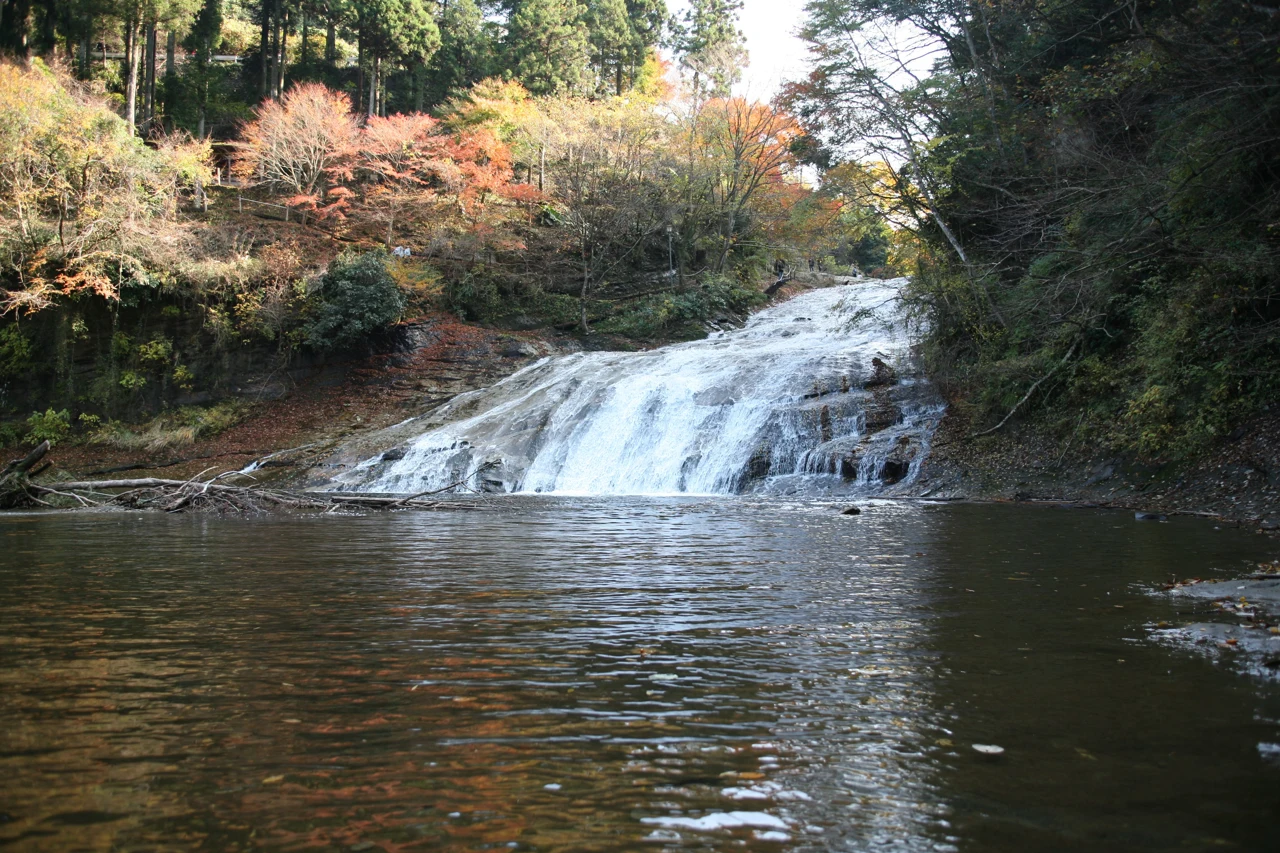
At Awamata Falls, water slides down a gently sloping rock face about 100 metres long, framed by trees and the river. The town’s attraction page announced on 10 July that walking around the falls had resumed. The October path notice defines the open section more precisely. On arrival, read the access signs at the entrance, then follow the open route down to the viewing area. You still need to climb back to the bus stop.
The falls are free to visit. Having no ticket queue does not leave every minute after the bus arrives available for photographs. Finding the entrance, using the steps, letting others pass, going to the toilet and returning to the stop all take time from the same visit. Allow about an hour for viewing and a short walk. If you want to photograph the water for longer, or someone climbs slowly, allow more time and drop the next area.
From the Awamata Falls side, the Takimeguri trail is open only to a turnaround about 100 metres along. Entry from the Kozawamata side is prohibited. Return to your original entrance at the turnaround. Do not book a pickup at a downstream stop expecting to walk through. Older descriptions of a 4.3-kilometre, roughly 90-minute waterfall circuit do not describe the currently open section. For a full day’s hiking, choose an open destination rather than looking for a way through after reaching the falls.
Baron’s CHANNEL filmed Awamata Falls on 9 October 2026. The first 3 minutes 45 seconds show the falls, rock bed and surrounding riverbanks.
Enter Nakase from Kyoei Bridge and return after 600 metres
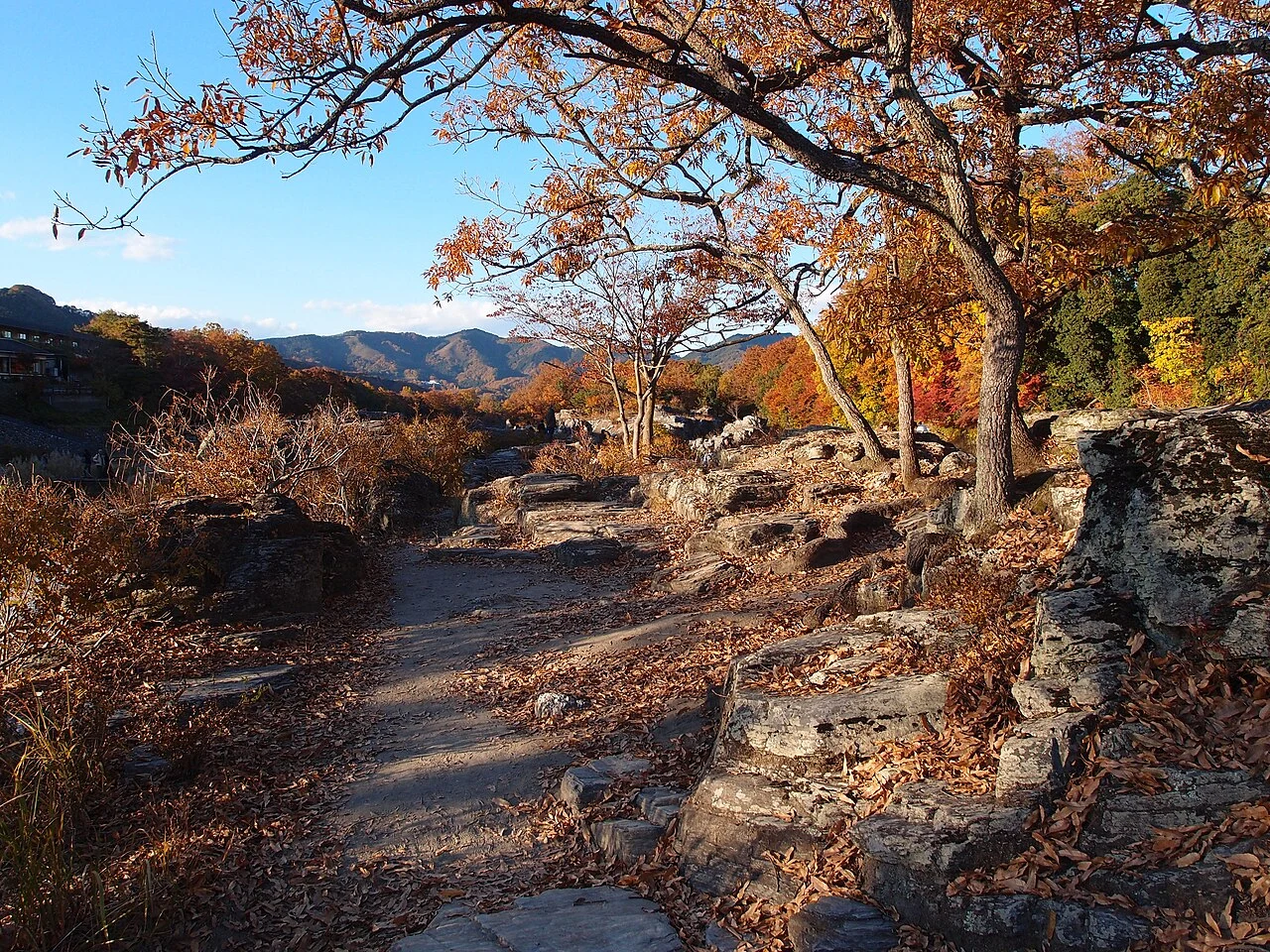
The Nakase trail is near the hot spring district, with access from the Kyoei Bridge side. The town’s original attraction description gives a length of about 1.2 kilometres, but the restrictions dated 20 October allow only about 600 metres, ending before the second set of stepping stones. The Kobundo remains can be seen. Some slopes are closed because of collapses, and the trail cannot be entered from Kannon Bridge. Plan to enter and leave at Kyoei Bridge, allowing time and energy to walk the same section twice.
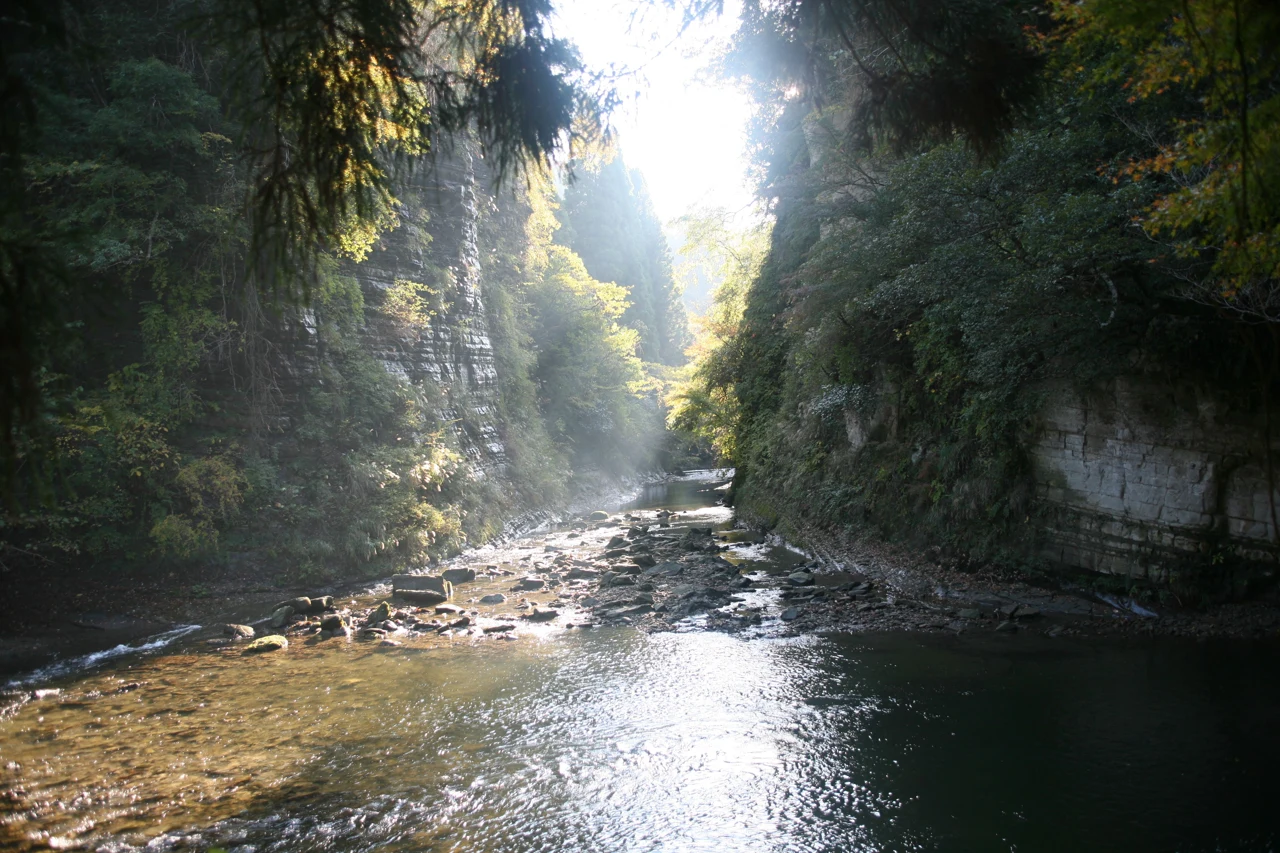
To see the Kobundo remains, start around Kobundo-iriguchi and identify the road and entrance towards Kyoei Bridge. Follow the signs down to the river. Take time over the rock walls, river bends and tree shadows rather than trying to reach the barrier. Stay on the open path at ropes, fences and slope-closure signs. Do not stand on damaged river crossings for photographs. If someone cannot manage stepping stones or the descent to the river, shorten their visit to an easily reached spot and agree a clear return time for the others.
To see the red arched Kannon Bridge, approach separately by road through the hot spring district. Visiting the bridge and surrounding streets is different from descending to Nakase at that end. Ichihara City’s current FAQ also recommends a street walk from Yoro-Keikoku Station via Keikoku Bridge or Hoei Bridge and Shiratori Bridge to Kannon Bridge, taking about 90 minutes out and back. This suits a day centred on the station and hot spring district. If you have already walked Nakase and want to follow this route back to the station, add your meal and rest stops. The official return time does not cover your whole itinerary.
Remove Omoshirokyo, Umegase and Mount Daifuku from the autumn hiking list
The Omoshirokyo trail is fully closed because its stepping stones are damaged. Entry is prohibited from both Kozawamata and Iwaibara, as Otaki Town’s notice of 20 October explicitly states. Old photographs and circuit maps are no reason to try the other end. This also affects plans that link the falls with surrounding woodland into a longer route. Use the time freed by removing Omoshirokyo for a meal in Awamata or an earlier return to Otaki.
Both the ridge and stream hiking routes in Umegase Valley are closed after large-scale landslides. Ichihara City’s notice says restoration before the 2026 autumn foliage season is difficult. Chiba’s official tourism website also lists Umegase as closed to entry, with the Mount Daifuku nature trail and observation deck closed. For autumn colours, use the area around Awamata Falls, the open Nakase section or the street walk recommended by Ichihara City. There is no need to search for another entrance at a closed trailhead.
These closures have a clear effect: Yoro Valley offers short walks and bathing this year, with less scope for long hikes. If your main aim is four hours on mountain trails, replace this day with another open route. If you want the falls and river, two or three unhurried hours still have a purpose. Decide what you want to do first, then choose a shorter valley visit, an overnight stay or another nearby destination. Do not join every green line on the map just to fill time.
Combine the falls with Goriyaku-no-Yu: choose an opening day and return stop first
For a bath after your walk, consider Takimien Kenko Mura Goriyaku-no-Yu upstream from Awamata. The official website places it about 800 metres upstream of the falls. The bus terminus Awamata/Goriyaku-no-Yu is separate from the waterfall stop. Use open paths between the river, bathhouse entrance and bus stop; do not seek a shortcut along closed riverside paths. To reduce walking, arrange arrival and departure at the bathhouse stop and use a connecting bus for the falls visit.
The website’s current bathing prices are ¥1,200 for adults, ¥800 for primary school children and ¥600 for younger children aged three and over. A bath towel and small towel rental set costs ¥200, and indoor clothing costs ¥300. Bathing alone for two adults and one primary school child totals ¥3,200; three towel sets add ¥600. Budget separately for food and transport. Day use runs from 10:00 to 18:00, with last admission at 17:00. It is usually closed on Wednesdays; when Wednesday is a public holiday, closure moves to the preceding or following day. The dining room closes on Wednesdays and Thursdays. Match the date against the website calendar.
The facility prohibits entry by people with tattoos, including temporary tattoo stickers and body paint. Anyone who enters in error and then leaves receives no refund. Children still in nappies cannot enter the baths; they may use showers or a baby bath brought by the family. Pets are not allowed. These rules affect how a family splits up and eats, so decide before boarding the bus. If someone cannot bathe, do not assume an unchosen outdoor spot will serve as their two-hour rest area. Returning to town early for a meal together is another reasonable choice.
Allow time after bathing to dry your hair, dress, collect your shoes and walk to the bus stop. Closing at 18:00 says nothing about which bus you can catch. If you choose the 17:14 departure from the bathhouse terminus, finish bathing and getting ready earlier. If you must return to the waterfall stop first, add that journey too. Arriving just before last admission leaves little room for a leisurely bath when your bus departs soon afterwards.
A workable day: reach the falls early and return to Otaki in the afternoon
If you can reach Otaki Station before 08:40 on a weekday, use the morning plan: take the 08:40 local bus to Yoro-Keikoku Station at 09:17, then the 09:45 to Awamata-no-Taki at 09:59. Visit the falls and short open path, then have lunch. Leave the waterfall stop at 13:52 for Nakano Station, arriving at 14:06. Change to the 14:40 and reach Otaki Station at 15:07. Keep the 28-minute wait between the outward buses free; do not add a walk away from the stop. You can also ask an Otaki taxi operator in advance about transfers to reduce waiting or changes.
From arrival at 09:59 to departure at 13:52, you have nearly four hours on the Awamata side. The falls, lunch and a rest fit comfortably. Adding a bath means shortening photography and lunch, then working backwards from the actual bathhouse departure. On a Wednesday when the bathhouse is closed, or when its dining room is shut, eat at another open business or finish earlier. You do not need a closed trail to fill four hours. If someone needs a long midday nap, simplify this plan to the falls and lunch.
Leave a short castle-town walk or onward transfer until you are back in Otaki. For Tokyo via JR Ohara, the weekday replacement timetable includes Otaki 16:30 to Ohara 17:11, leaving a buffer after your 15:07 arrival. For a coach, check departures to Tokyo from the Otaki coach stop and allow time to reach it. The morning plan needs an early start. A leisurely breakfast in central Tokyo does not fit the same day. If connections from your starting point fail, use the afternoon plan below or stay overnight.
Arriving in Otaki before noon: a longer Awamata stay and a later return
If you choose the replacement bus from Ohara at 08:45, arriving in Otaki at 09:28, eat and rest in Otaki before the weekday 13:00 local bus to Awamata-no-Taki at 13:35. The long town-centre wait suits people who already want time in Otaki. If the falls are your only aim and you dislike waiting, book a taxi from Otaki to Awamata or choose a date with an early arrival. The 09:50 terminating at Nakano is not a direct waterfall bus that shortens the wait.
Arriving at 13:35 and leaving at 13:52 gives only 17 minutes, making even the descent, viewing and climb hurried. A fuller public transport plan leaves the afternoon in Awamata. Take the 17:16 from the waterfall stop to Otaki Station at 17:57, then the Isumi replacement bus at 18:30 to Ohara at 19:11, followed by JR to your accommodation. This example shows the cost of arriving late: you can give the river a proper visit, but you return to Tokyo later than on a typical day trip.
In late autumn, daylight fades early. Complete the riverside walk while it is light, rest in an open facility afterwards and reach the stop on time. With small children, cold-sensitive companions or anyone unwilling to wait for a local bus after dark, book an earlier pickup or stay at an inn with a reliable transfer. If a late dinner will not work for the group, choose another nearby destination that morning rather than letting afternoon transport disrupt everyone’s meal times.
Read the return destination: a bus to Yoro-Keikoku Station cannot connect to suspended trains
First decide whether you need Otaki, Kazusa-Nakano or only Yoro-Keikoku Station. The weekday timetable has a 13:47 departure from Awamata-no-Taki to Yoro-Keikoku Station at 14:03. A different bus five minutes later, at 13:52, terminates at Nakano Station at 14:06. You then need the 14:40 to reach Otaki at 15:07. Similar times lead to completely different destinations. For Tokyo via Ohara or a coach, follow the full Otaki-bound column rather than boarding the 13:47 simply because it is earlier.
If you board the wrong bus to Yoro-Keikoku Station, check the next available leg on arrival and ask the driver or depot. Do not walk along railway tracks or closed roads to chase a connection. Local buses at the station do not mean trains are running to Goi that day. During the suspension, reaching Kazusa-Ushiku from the valley requires separate working replacement transport and road access. Save a stop photograph, full Japanese destination, planned departure and fallback on your phone before leaving. Everyone can then identify the right bus even after splitting up to shop.
Kominato’s Otaki depot, 0470-82-2821, can answer a specific question such as “Awamata-no-Taki to Otaki Station on this date”. Ask about the weekday or weekend/public holiday service, departure time and any change, keeping the Japanese stop names. If a departure is cancelled or road conditions interfere, return earlier or use a vehicle whose availability is confirmed. An unbooked taxi is not a standing mountain backup. If you miss the last connection, do not turn up at an unarranged inn expecting a room. Decide while transport and accommodation providers are still reachable.
Autumn leaves and illuminations: leave the river in daylight on a day trip
Autumn colours around Awamata and the hot spring district are usually at their best from late November to early December. When planning in late October, choose a date within that season, then check conditions during the week of travel. Tree species, light and wind affect photographs even within the same day. Water and rock remain worth seeing in the green season or before full colour. If a valley full of red leaves is your sole aim, settle the date before buying transport tickets or non-refundable accommodation.
Ichihara City’s notice text dated 26 October announces illuminations from 23 November at Kannon Bridge, Awamata Falls and Kengaikyo. Evening viewing needs a separate way back to your room; the daytime return examples at 13:52 and 17:16 do not serve that purpose. Choose accommodation near the actual viewing area, then ask about dinner times, walking routes and available transfers. Staying on the Nakase side does not automatically provide transport to Awamata’s evening views.
Illuminations do not lift path closures. Sections requiring a turnaround by day remain restricted at night. Lighting is provided at viewing locations, not on every riverside route. Day visitors can usually accommodate different walking speeds more easily by completing the falls visit and allowing a daylight return to the stop. If you want Tokyo night views, decide on a short walk near dinner after returning to the city. Plan mountain and city evening travel separately.
With children or older relatives, allow for steps and waiting and visit one fewer area
The open Awamata section may be short, but the entrance still sits above the river. Nakase has uneven ground and river crossings too. Use a pushchair at stations or on level streets, then decide who will look after it and the luggage before descending. Avoid leaving one person carrying both a child and a pushchair on wet steps. With knee problems in the group, one main area and a seated meal suit the day better than the falls, Nakase and the station street walk together.
Deal with children’s needs before a long wait: use the toilet and refill water at the departure station, have a snack during a change and choose an open place with seating for lunch. Before the bathhouse, check nappy and tattoo rules. Its dining room also closes on Thursdays, so relying entirely on it for lunch can force a change at the door. For a return involving several connections to Tokyo, carry a warm outer layer and a few snacks to make the final wait easier.
Grippy shoes, a backpack that leaves both hands free and easily packed rainwear are more useful than heavy luggage. After rain and rising river levels, the town may close even the normally open sections. Eat or rest at an open facility, leave early or switch to an indoor Tokyo day before setting out. If you are still at your accommodation, changing the day is better than improvising at the river. Leave large luggage at your Tokyo accommodation and take only overnight essentials if staying, so each transfer does not involve moving a full suitcase.
An overnight stay gives time for dinner and transfers, not an extra closed trail
Staying overnight suits a bath, an unhurried dinner or illuminations. Before choosing a room, locate the inn in the correct area: waterfall-side inns suit Awamata, while hot spring district inns are nearer Kannon Bridge and Nakase. Ichihara City’s current operating list includes Takimien, Kawanoya and Mochinoki among inns open as usual. Check access and plans with the particular inn you want. An Otaki Town address does not mean the falls are within walking distance.
Without a car, ask which stop the inn collects from, at what time, whether booking is required and where it drops you the next day before choosing by price. The designated transfer station might be Otaki, Kazusa-Nakano or somewhere else. Transfers do not extend automatically with every transport change. Enter children’s ages, meals and bedding needs clearly. Dinner start times on half-board plans also limit your outward journey. Arriving at the falls at 13:35, taking photographs, bathing and moving to accommodation on the other side can make dinner tight. On an overnight day, give the afternoon directly to the inn.
Read cancellation terms for the chosen date and plan, especially autumn foliage weekends, limited room types and prepaid bookings. Local trains can be suspended while an inn remains open as usual. Whether your own route or date change is free depends on the booking. Pay once the terms work for you and keep an official contact number. Arrange next-day transport to Otaki or Ohara first. Do not force Umegase or Mount Daifuku into the time after breakfast. The extra night has a clear use in steady meals, rest and a stretch of river scenery.
A few useful answers
Can I take Kominato Railway directly from Goi to Yoro Valley in autumn 2026?
Trains are suspended between Kazusa-Ushiku and Kazusa-Nakano. Ichihara City’s notice of 26 October gives the weekday replacement terminus as Kocha Jidosha-mae. For the falls, prioritise a local bus connection from the Otaki side.
Can I walk the whole Takimeguri trail at Awamata Falls now?
You can walk around the falls and about 100 metres along the trail from the waterfall side before returning. Entry from Kozawamata is prohibited.
Can I walk Nakase from Kannon Bridge to Kyoei Bridge?
Currently, enter from Kyoei Bridge and turn back at about 600 metres, before the second set of stepping stones. You cannot enter from Kannon Bridge. The Kobundo remains can be seen; collapsed slope areas are closed to entry.
Are Umegase and Omoshirokyo suitable for autumn leaves in 2026?
Both are closed. Umegase’s ridge and stream routes are closed because of landslides. Entry to Omoshirokyo is prohibited from both Kozawamata and Iwaibara.
How do I return to Otaki after arriving in Awamata on a weekday afternoon?
The weekday timetable dated 1 April 2026 lists Awamata-no-Taki 13:52 to Nakano 14:06, then a change to the 14:40 arriving in Otaki at 15:07. Another service leaves at 17:16 and reaches Otaki at 17:57. The nearby 13:47 departure goes instead to Yoro-Keikoku Station.
How much does bathing at Goriyaku-no-Yu cost?
The official website lists adults at ¥1,200, primary school children at ¥800 and younger children aged three and over at ¥600. Towel set hire costs ¥200. The usual closing day is Wednesday; the dining room closes on Wednesdays and Thursdays. See the operating calendar for public holiday changes.
Official information and references
Sources used in this guide.
- Ichihara City: live Yoro Valley sightseeing and transport notices
- Otaki Town: path restrictions dated 20 October 2026
- Otaki Town: Awamata Falls
- Otaki Town: Nakase walking trail
- Official Chiba tourism: Awamata Falls and Umegase/Mount Daifuku closures
- Otaki Town: local transport and taxi contacts
- Otaki Town: Tokyo coaches and current fares
- Isumi Railway: April 2026 replacement buses and boarding points
- Isumi Railway: replacement bus timetable dated 1 April 2026
- Otaki Town: current local bus timetable portal
- Otaki Town: weekday local bus timetable dated 1 April 2026
- Wakuwaku Otaki: transport recovery and Otaki connections, 16 October 2026
- Goriyaku-no-Yu: opening times, prices and admission rules
- Kominato Railway: official website and contact information