On a first Shikoku trip, five days in two areas is easier to enjoy fully than a different city every night. Kagawa and Tokushima suit udon, gardens and whirlpools; Matsuyama and Kochi offer castle towns, hot springs and the Pacific coast. Iya and Shimanto each need their own last stretch of transport. Choose the day you most want to protect, then select airports, overnight bases and how to get around.
Choose two areas for five days; add one more base for seven
Kagawa, Tokushima, Kochi and Ehime have city bases in Takamatsu, Tokushima, Kochi and Matsuyama, but straight-line distances tell you little about a Shikoku journey. Crossing the central mountains, getting from a station into a valley and reaching a boat terminal each place different demands on your time. Changing hotels every day also means repeatedly storing luggage, finding bus stops and checking dinner arrangements. If your aim is to tick off all four prefectures in five days and four nights, the first things you lose are usually unhurried meals, hot springs and room to adjust for the weather.
Here, five days means five calendar days including arrival and departure, assuming arrival around midday on day one and departure in the afternoon on the last day. If your flights arrive later or leave earlier, remove activities at either end rather than treating those dates as full sightseeing days. To visit Iya, replace a city day and stay closer to the mountains; to paddle the Shimanto River, add a night in Nakamura or near the activity base. Prices and service conditions in this guide were checked on October 22, 2026. The routes are planning examples, not packages with seats already reserved for you.
| Priority experience | Suggested area | Main trade-off |
|---|---|---|
| Udon, gardens and Naruto whirlpools | Five days: Takamatsu and Tokushima | Leave out Matsuyama and the Shimanto River |
| Castle towns, Dogo Onsen and Katsurahama | Five days: Matsuyama and Kochi, using different arrival and departure airports | Keep a day for the journey between cities |
| Iya Valley and Shimanto river activities | Seven days or more, with valley accommodation matched to transport | Four city bases alone do not cover these places |
| Stay in all four prefectures and keep time in the valleys | Add nights and check each intercity service day by day | Do not let one transport pass dictate every destination |
From Takamatsu Airport: check whether your hotel is near the station or Kawaramachi
Kotoden’s Takamatsu Airport bus runs into the city, but if your hotel is near Kawaramachi or Ritsurin Garden, there is no need to go all the way to JR Takamatsu Station and double back. Following the October 1, 2026 fare change, the adult fare is ¥1,000 to Ritsurin Koen-mae or Kawaramachi, and ¥1,300 to Takamatsu-Chikko, JR Takamatsu Station or the ferry boarding area; children pay half fare. Compare room prices using the stop you will actually use. Over several nights, shorter walks and fewer transfers can matter more than a small saving on the first night’s room.
Timetables are updated in periods to match flights: October 1–24 and October 25–November 30 use different versions. All bus seats are unreserved. The operator explicitly warns that a full bus may mean waiting for the next one, and connections with trains, ferries or other buses are not guaranteed. Avoid committing to an irreplaceable island ferry or Iya bus immediately after landing. For the return journey, work back from your airline’s check-in deadline rather than cutting it fine using the journey time on a map. Check the current stop-by-stop fare table for prices and payment methods.
From Matsuyama Airport: JR Matsuyama, Matsuyama City and Dogo are different stops
Before booking in Matsuyama, distinguish JR Matsuyama Station from Iyotetsu’s Matsuyama City Station (Matsuyamashi). They are separate stations. If you want evening walks in Dogo, the JR station need not be somewhere you pass through every day. The Matsuyama Airport bus currently charges adults paying cash ¥1,000 to JR Matsuyama Station or Matsuyama City Station, and ¥1,200 to Okaido or Dogo Onsen Station. With the specified nationwide transport IC cards or the Mican app, those fares are ¥980 and ¥1,180 respectively. Do not assume that discount applies to every credit-card payment.
Check services going directly to Dogo separately from those terminating at Matsuyama City Station. Iyotetsu’s Dogo access guide gives approximately 40 minutes for the direct airport journey and approximately 25 minutes by city tram from JR Matsuyama Station; allow extra time for traffic and waiting at transfers. Staying near the JR station can help if you are taking an intercity train the next day. For Matsuyama Castle, the shopping streets and Dogo, compare Okaido or Dogo itself to reduce journeys back for your luggage.
Which journeys suit rail, and what does a Shikoku pass actually cover?
Start by considering rail between Takamatsu, Kotohira, Tokushima, Matsuyama and Kochi, but reaching a station does not mean reaching the attraction. Naruto Station is not the whirlpool cruise terminal, Oboke Station is not the vine bridge entrance, and Nakamura Station is not every Shimanto activity operator’s meeting point. List the intercity journeys you will actually make each day, then price city trams, airport buses, rural buses and activity transfers separately. That shows you which part of the cost a pass can reduce.
The ALL SHIKOKU Rail Pass is for foreign visitors entering Japan with Temporary Visitor status. JR Shikoku’s August 6, 2026 revision notice says that the version sold from October 1 retains only three- and seven-day passes; four- and five-day passes are no longer sold. A five-day trip therefore calls for comparing individual tickets, concentrating pass-covered travel into three days, or paying for seven days. Its core coverage is ordinary-car non-reserved seating on JR Shikoku and Tosa Kuroshio Railway, plus Kotoden and Tosaden rail and tram services. Airport and regular buses cost extra. Check the Honshu-side journey from Okayama, reserved seats and sightseeing-train supplements separately; Iyotetsu’s city trams are also outside the current coverage.
The Shodoshima ferry and Shodoshima Olive Bus were removed from passes sold from October 1. Tickets bought by September 30 retain their original Takamatsu–Tonosho ferry and island-bus coverage, excluding scheduled sightseeing buses. If you substitute a day on Shodoshima, use the purchase date to identify the terms, rather than looking only at the travel date. The specified QR products bought through Klook or Trip.com do not need to be exchanged for paper tickets; traditional sales channels still have different exchange arrangements. An electronic document might be a QR travel ticket or a voucher awaiting exchange, so identify which you received. For a fuller comparison, see how to compare Japan rail tickets journey by journey.
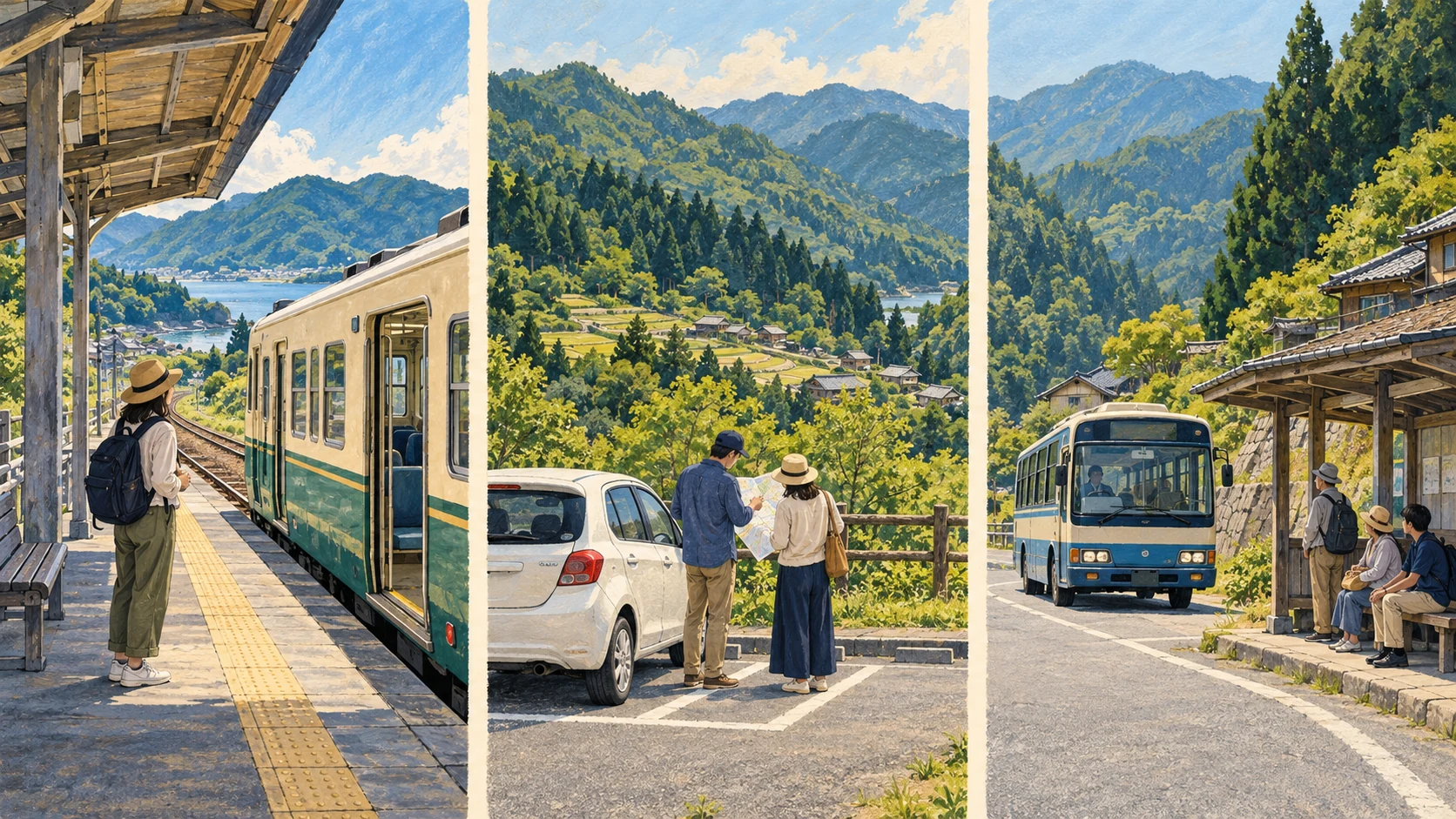
A rental car helps with the last stretch; it does not turn five days into an island circuit
A car is most useful when it connects valley accommodation, riverside activities and luggage. If you are staying only in central Takamatsu and Tokushima, it also brings collection and return procedures, parking costs and the restriction that the driver cannot drink. Holders of Taiwan-issued licenses must carry the valid original license and an accepted Japanese translation as required. Licenses issued elsewhere may require different documents. JAF explains driving eligibility by issuing country or region; “an international license” is not a single answer for every visitor. Have the rental company confirm your documents and vehicle category before departure too.
Budget separately for the rental, collision-damage waiver, non-operation charge (NOC) coverage, fuel, the ETC card and tolls, parking, one-way returns and child seats. For example, Toyota Rent a Car’s insurance guide distinguishes waiving an insurance excess from waiving the NOC. Buying extra coverage does not automatically protect you when the rental agreement is breached. Photograph existing scratches at collection, confirm the accident-reporting procedure and required fuel level, and return the car before heading to the airport terminal on your final day.
Searching for a Shikoku driving pass may bring up SEP, formally the San’in-Setouchi-Shikoku Expressway Pass. NEXCO West’s SEP must be used with an ETC card through a participating rental company. Its three- to ten-day plans do not include the car rental, and the Honshu–Shikoku bridge roads and certain urban expressways are among the excluded roads. The five-day plan is currently listed at ¥12,700. Days run from midnight to 23:59, rather than following the rental car’s rolling 24-hour periods. If most of your activities use ordinary roads and valleys, it may not save money; compare tolls between the actual interchanges first.
An eastern five-day example: three nights in Takamatsu and one in Tokushima
After arriving in Takamatsu on day one, store your luggage and choose shopping streets and an udon meal to suit your hotel’s location, leaving flexibility for flight delays. Visit Ritsurin Garden on the second morning. If you have the energy, consider Yashima in the afternoon; otherwise stay in town. On day three, go to Kotohira and make Kotohiragu Shrine the main activity, eating after the climb before returning to Takamatsu. Do not squeeze in Naoshima too: the port and shrine follow different routes, and the ferries will not wait for you to descend.
Move to Tokushima on day four, leave your bags and plan Naruto around the tide table. If the best tide window is too early, spend the third night in Tokushima instead, or swap your Takamatsu activity days. Keep day five for central Tokushima, a daytime Awa Odori Kaikan performance or the station area before departing. A round trip through Takamatsu Airport means returning toward Takamatsu on the last day and reducing time in Tokushima. If leaving by highway bus through Kansai, check the services and luggage rules separately. This route prioritizes understandable journeys; it does not promise a large whirlpool on any particular day.
| Day | Main activity | Overnight base |
|---|---|---|
| 1 | Arrive in Takamatsu, store luggage and eat in town | Takamatsu |
| 2 | Ritsurin Garden; choose either Yashima or more city time | Takamatsu |
| 3 | Kotohira and Kotohiragu Shrine | Takamatsu |
| 4 | Move to Tokushima; time Naruto around the tides | Tokushima |
| 5 | Central Tokushima and onward departure transport | Depart according to your flight |
A western five-day example: Matsuyama and Kochi, with a light transfer day
Flying into Matsuyama and out of Kochi, or the reverse, can reduce backtracking, but first check which flights and airport connections you can actually book that season. Two airports being geographically convenient does not establish that either has a direct flight from your origin. On day one, visit Okaido or Dogo after arriving in Matsuyama; devote day two to Matsuyama Castle and hot springs. Leave day three for the journey to Kochi, followed by only Hirome Market or a short walk.
For that journey, compare the Whale Express jointly operated by Iyotetsu and Tosaden. It picks up at JR Matsuyama Station, Okaido and Matsuyama City Station, with an adult one-way fare to Kochi of ¥4,000. It uses reservations and assigned seats throughout; boarding without a reservation is possible only if seats remain that day. Reserved tickets must be purchased by the day before travel. One example in the current timetable leaves JR Matsuyama Station at 11:30 and reaches Kochi Station Bus Terminal at 14:00, allowing a morning hotel checkout. When booking, select a service actually on sale for your travel date. JR Shikoku Bus also runs a different highway route from Matsuyama to Kochi, so keep the companies’ tickets and departure times separate.
On day four, divide your time between Kochi Castle, the city and Katsurahama. If you add the Sakamoto Ryoma Memorial Museum, reduce other indoor visits. Allow a departure buffer on day five. If you must fly home from Matsuyama, return there on day four, reducing Kochi to one night and a smaller area. If you would rather avoid the intercity journey, spending all five days in Ehime is reasonable too. The Shimanto River is not an effortless extra on this route: if it is your priority, make the five-day trip Kochi plus Nakamura instead.
Seven days: add Iya or Shimanto, rather than treating both as side trips
The most useful way to spend the two extra days is to add a valley base, rather than two more city hotels. For example, two nights in Takamatsu, one in Iya or Oboke, two in Kochi and one transport base chosen around your airport can connect gardens, a valley and Kochi’s city sights. Confirm your inn’s transfers, local buses and the direction of departure the next day before committing to Iya. A mountain overnight also deserves time for bathing and dinner, rather than arrival after dark followed by an early-morning exit.
If Shimanto is your aim, give both Kochi and Nakamura proper stays, and avoid changing prefectures on your river-activity day. Seven days still does not mean all four prefectures, both valleys and offshore islands fit comfortably. To plan a complete circuit, put every intercity journey, last stretch of transport and accommodation meal time into your calendar, then decide how many more nights you need. Treat Shodoshima or Naoshima as a replacement day using the Seto Inland Sea island and port guide; the same date cannot also count as a Takamatsu city day.
A day in Takamatsu: Ritsurin Garden first, then decide on Yashima after checking the return
Ritsurin Garden deserves an unhurried morning. The official visitor guide lists admission at ¥500 for adults, ¥170 for elementary and junior-high students, and free for preschool children. October hours are 6:00–17:30; December and January hours are 7:00–17:00. Summer opening times are not a winter timetable. There is no lighting inside the garden, so arriving close to closing turns a visit into a rush. Leaving large bags at your hotel is often easier: garden lockers and luggage storage have quantity, size and fee limits.
For afternoon views over the Seto Inland Sea, consider Yashima, but JR Yashima Station, Kotoden-Yashima Station and the summit sights are in different places. Check the current Yashima summit shuttle bus timetable and note the final part of your journey down before planning Dankorei and summit walks. With older relatives, rain or tired legs, the garden and city are enough. Gardens, hilltop sights and shopping streets involve different walking demands; there is no need to keep going until all three close just to increase the attraction count.
Sanuki udon: choose between a city meal and a dedicated rural visit
Without a car, choose a shop on a route you already plan to use. Teuchi Judan Udon Baka Ichidai is in Takamatsu’s Taga-cho. The Kagawa tourism association’s shop listing gives usual hours of 6:00–18:00, closed on New Year’s Day, making it an option for a city-day meal; check separate year-end and New Year notices. Kama-butter is a particular dish, rather than something everyone must enjoy: look at hot or cold options, portion sizes and toppings before ordering, especially if butter and egg do not suit your group.
A dedicated visit to Yamagoe Udon in Ayagawa belongs on a daytime rural route. Its official FAQ lists hours of 9:00–13:30, closing on Sundays and Wednesdays even when they fall during holiday periods, with no table reservations. It may finish earlier when demand is greater than expected. That makes it unsuitable as a guaranteed dinner after an afternoon climb at Kotohiragu. Pick one priority shop and a backup in the same area. Skipping a bowl is usually better for the trip than rushing between queues and mountain roads.
On the menu, kake is udon in broth; bukkake uses a smaller amount of sauce poured over the noodles; zaru comes with a dipping sauce. Kamatama is another style, mixing hot noodles with egg. Hot and cold choices still depend on the individual menu. For a self-service example, see Kagawa’s introduction to Sakaeda Honten, where customers warm their own noodles and add broth and condiments. Choose the noodle style and size, then follow the shop’s route for side dishes and payment. Ask staff to demonstrate unfamiliar equipment. Self-service does not mean every shop expects you to warm the noodles yourself; follow the instructions on site.
An udon tour need not be a contest to visit the most shops. Ordering, payment and tray-return systems differ, so read the signs before choosing soup noodles, dipping noodles or kamatama. For wheat, egg or seafood allergies, ask about the broth and toppings individually; appearance does not establish that a dish is vegetarian. Drivers and passengers can take turns buying food and looking after bags, but do not wait in a neighboring shop’s parking area or on the road. If the available parking is full, use your backup or return later.
Kotohira and Kotohiragu: make the 785 steps a destination, not a transfer filler
From JR Kotohira Station or Kotoden-Kotohira Station, a walk through town still separates you from the approach; the climb starts at the stone steps. The Kotohiragu visitor guide puts the main shrine at 785 steps and the more distant inner shrine at 1,368. Agree on how far your group wants to walk before starting, rather than discovering different fitness levels halfway up. Steps become slippery in rain, and high summer calls for avoiding the hottest hours. With small children, allow for carrying them and taking breaks.
The main shrine, a meal in the town below and some snacks can fill a rewarding Kotohira day. Museum admissions are separate from shrine visits, so check opening hours and last entry if you want to go inside. The Kotohira tourism association also warns that pedestrians are prohibited on parts of the vehicle roads and that other roads are restricted to authorized users. Do not take an apparent shortcut simply because it looks shorter on a map. Check your return train before deciding to continue to the inner shrine. Stopping at a suitable point when tired or unwell does not diminish the day.
Staying in Tokushima: a station base helps transfers; check the third bed in a triple room
An overnight base in Tokushima should work for your Naruto return, evening Awa Odori show and next intercity journey. The station area is convenient with luggage for JR or highway buses; the Shinmachi River and Kaikan area suit evening walks. Consider coastal accommodation separately if you are driving and concentrating on Naruto’s coast. Sharing “Tokushima” in the name does not make two places equally easy to reach at night.
As a concrete comparison, the Superior Twin at JR Hotel Clement Tokushima is listed as 27 or 28 square meters for one to three guests. For three guests, one bed is a sofa bed, rather than three identical beds. The hotel connects to JR Tokushima Station. Its access and parking guide lists a standard guest parking rate of ¥1,300 per car per night, covering 24 hours from entry, changing to ¥1,800 on August 12–15; designated free-parking packages are separate. Breakfast inclusion, whether a child uses a bed and cancellation deadlines depend on the booking selected. Room capacity alone does not establish that a child stays free.
Awa Odori: plan the summer street festival separately from Kaikan shows
You do not have to build the whole trip around the summer festival to see Awa Odori. Awa Odori Kaikan offers daytime and evening performances. Its 2026 official rate sheet lists usual daytime starts at 11:00, 14:00, 15:00 and 16:00, lasting 40 minutes, at ¥1,300 for high-school students and older and ¥700 for elementary and junior-high students. The usual evening show runs 20:00–20:50, at ¥1,600 and ¥800 for those groups respectively. Choose one performance before arranging dinner or the return from Naruto; there is no need to cut time from other activities just to fit both shows into one day.
Regular performances do not mean identical shows run every day of the year. The formal fees and closure sheet lists closure on the second Wednesday of February, June, September and December, moving to the following day when it is a public holiday. Regular performances stop on August 11–15, and year-end and New Year suspensions differ for daytime shows, evening shows and the museum. For the summer city festival, consult that year’s venues, tickets and traffic restrictions separately. Last year’s program cannot guarantee an unpublished program for the next year.
The summer festival offers a choice between paid seating and free street performances. As an example, the official arrangements for the already-finished 2026 festival put paid venues at Aibahama, Minami-Uchimachi and Konyamachi on August 12–15, with separate sessions from 18:00 to 19:40 and 20:20 to 22:00. Ryogoku-Honcho and Shinmachibashi were free venues, running 18:10–22:00. If you need a fixed viewing position or someone cannot stand for long, compare reserved-seat tickets at a paid venue first. Free venues suit flexible movement, but require extra time for crowds and leaving. Those dates and sessions illustrate the choice; a 2027 trip still needs that year’s official announcement.
Naruto whirlpools: check the tide before choosing a boat and a city departure time
Naruto’s whirlpools are a tidal phenomenon, with no fixed rule that they are largest at noon every day. Open the operator’s tide table for your date to choose a sailing before arranging land transport. Without a car, take a Tokushima Bus route 97 service on the Naruto Park Line that goes via the sightseeing port, boarding at Naruto-ekimae (鳴門駅前) outside JR Naruto Station. Get off at Naruto sightseeing port (鳴門観光港) for a cruise from Kameura sightseeing port; allow about 20 minutes for the bus ride. At the official Tokushima Bus timetable portal, find the Naruto Park Line, choose the weekday or weekend/public-holiday table for your date, and also read the special-holiday notes. Match the Naruto-ekimae and port times in the same column, then check the inbound (上り) table for the return. A “↓” in the port’s row means that service does not stop there; a destination of Naruto Park alone is not enough. Work backward from your chosen sailing so you can complete ticketing at least 10 minutes before departure, with extra time for bus waits and queues in busy periods. Check both journeys before planning city activities. If wind or waves cancel sailings, switch to city or indoor activities, but another type of boat is not guaranteed to operate that same day.
Naruto Kanko Kisen operates the larger Wonder Naruto and smaller Aqua Eddy, with voyages of about 30 and 25 minutes respectively. The reference fares listed on the official East Tokushima tourism page are ¥1,800 for adults and ¥900 for elementary-school children on the large boat, or ¥2,400 and ¥1,200 respectively on the small boat. The page does not state when these fares apply, and they do not establish the price for your travel date; confirm the amount with the operator before booking. The small boat has only 46 seats and requires a reservation. The official booking and boarding FAQ says the large boat does not need a reservation, while online reservations for the small boat close four days before sailing; call to confirm for nearer dates. Complete boarding procedures at least 10 minutes before either sailing, earlier in busy periods. Wheelchair users can board the large boat, but stairs and space restrictions make the small boat unsuitable.
At the time checked, the operator also announced that Aqua Eddy would stop for statutory inspections on December 1–23, 2026. Do not plan it from the ordinary timetable during that period. If you prefer to stay on land, check the opening status of Naruto Park and Uzu-no-Michi separately. Seeing the sea from above differs from a boat cruise and remains affected by the tide window. For anyone uncomfortable on boats or unable to manage stairs, choose a suitable viewing method before arriving at the port rather than trying to change tickets there.
Iya without a car: confirm the bus back before leaving Oboke Station
Iya’s difficult part usually starts after the railway journey. From JR Oboke Station, check local buses toward Kazurabashi Yumebutai or Hotel Iya Onsen, including whether the specific service actually passes your destination. Miyoshi’s official vine-bridge page gives a walk of approximately five minutes from the Kazurabashi Yumebutai stop. That stop, a particular hotel, Iyaguchi Station and the Oku-Iya Double Vine Bridges are not interchangeable. Note at least one workable return bus before deciding when to eat, bathe or cross the bridge.
If you have no car and want several scattered sights in one day, compare Shikoku Kotsu’s scheduled Oboke–Iya sightseeing bus. It runs on specified operating dates, not every day. The page checked lists ¥13,000 for adults and ¥12,250 for children and travelers with disabilities, including the listed attractions and lunch; online purchases close two days before departure. The timetable changed on August 8, 2026, so an old leaflet is no longer the right basis.
For an overnight valley inn, confirm the exact station, pickup time, reservation requirement and final transfer, rather than asking only whether a shuttle exists. Dinner at an inn is normally another fixed point in the day, and late arrival may affect it. Unless the inn has agreed, do not assume it can serve dinner later. A local public bus and a hotel transfer are different services; missing one does not mean the other will automatically fill the gap.
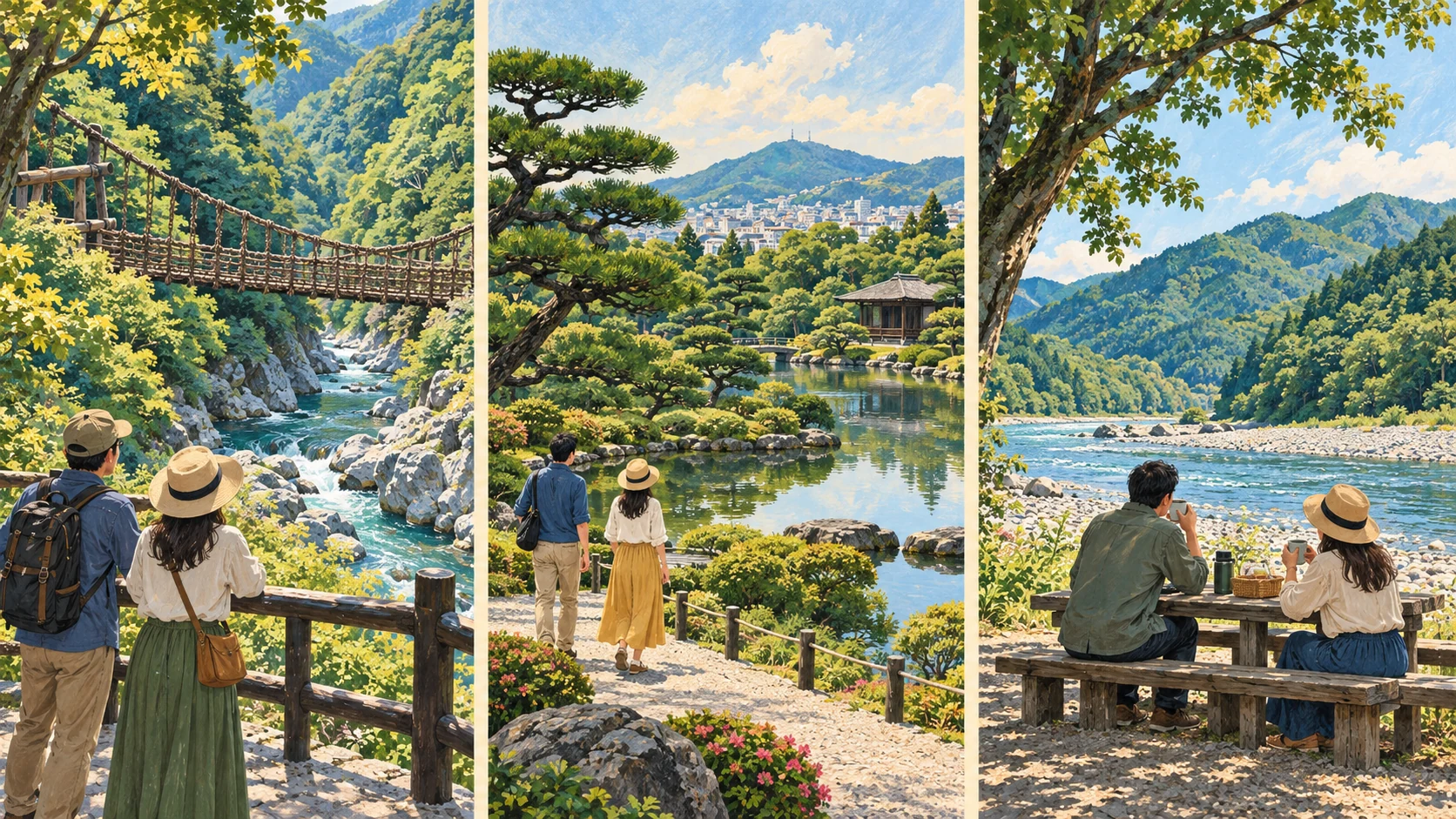
Iya’s vine bridge and the Oboke cruise: bridge, road and river conditions differ
Iya-no-Kazurabashi costs ¥550 for adults, defined here as junior-high students and older, ¥350 for elementary-school children and nothing for preschool children. Parking an ordinary car at nearby Kazurabashi Yumebutai costs another ¥500. The bridge deck is not a level sidewalk. If heights or balance are a concern, view it from a public viewing area instead of feeling obliged to cross. The Oku-Iya Double Vine Bridges are much farther into the mountains; similar names do not make them a second bridge you can walk to. Drivers should navigate to the actual parking area, rather than mistaking Miyoshi’s tourist-information telephone listing for the attraction’s location.
Miyoshi’s road FAQ distinguishes the route from Oboke via Prefectural Road 45 from the valley route through Iyaguchi. Large buses can use the former as far as the vine bridge, while the latter has tighter vehicle restrictions. That does not mean the first route has no bends or weather risks. If you are unfamiliar with mountain driving, enter and leave in daylight and avoid improvised shortcuts for one more viewpoint. When fog or heavy rain develops on the return, ending earlier is better than searching for parking in the dark.
The Oboke Gorge sightseeing boat is on the Yoshino River, a different location from the vine bridge over the Iya River. From September 1, 2026, fares are ¥1,800 for adults and ¥900 for children aged three through elementary school. The usual return cruise takes about 30 minutes, operating 9:00–17:00 with the final departure at 16:30. Neither individuals nor groups need advance reservations. High water, strong winds or storms may cancel sailings, while low water may shorten the route; life jackets are compulsory. Its no-reservation rule does not apply to Shimanto houseboats or kayak tours.
Kochi city: climb the castle in the morning and leave time to find a market seat
Kochi Castle and Hirome Market fit the same city day. Visiting the castle before lunch is usually more comfortable than climbing steps immediately after a meal. The castle keep and Kaitokukan usually open 9:00–17:00, with last entry at 16:30, and close December 26–January 1. Admission is ¥500 for visitors aged 18 and over; those under 18 enter free with proof of age. Distinguish the free park from the paid keep, and do not assume that seeing the castle exterior after dark means the keep remains open.
The castle FAQ says there are 158 steps from Otemon Gate to the honmaru, with more stairs inside the keep and no toilets in the keep or Honmaru Palace. Older visitors and families can prepare in the park before deciding whether to enter the tower. For a gentler route, town walks and exhibitions can replace the climb; the same complete castle ascent need not suit everyone.
Hirome Market contains multiple businesses and shared dining space. The venue’s usual hours are 10:00–23:00 Monday–Saturday and 9:00–23:00 Sunday, but individual shops can close earlier or take different days off. For katsuo no tataki, check seating and menus before splitting up to buy food. The whole market is not one restaurant holding a family table for you. Drivers and anyone tasting alcohol should agree their roles in advance. If taking a bus to Katsurahama later, allow time to walk to the stop too.
Choose a Kochi base around the next day’s departure. Compare the Kochi Station area for an early JR train or intercity bus, or accommodation within walking distance of the castle and Hirome Market if eating and strolling in the old town are your priorities. Drivers should include parking charges and nighttime access conditions in the room comparison, then leave their luggage before walking to the market. These are transport and daily-route choices, not evidence that every hotel offers the same child, breakfast or parking arrangements.
Katsurahama and Ryoma: allow half a day for the coast and memorial museum
Katsurahama is outside central Kochi’s walking area. The prefectural tourism access page gives approximately 30 minutes by regular bus from Minami-Harimayabashi to the terminus, followed by about five minutes on foot. The MY Yu Bus takes approximately 70 minutes from JR Kochi Station via Godaisan. The first is more direct; the second suits stops along the way. Compare the route, rather than just the ticket name. For the Sakamoto Ryoma Memorial Museum, allow separately for the uphill walk and admission. The coastal statue and museum are different places.
The Kochi Prefectural Sakamoto Ryoma Memorial Museum usually opens 9:00–17:00, asks visitors to enter by around 16:30 and suggests approximately 90 minutes for its main and new buildings together. Adult admission is ¥900 during special exhibitions and ¥500 at other times; high-school students and younger enter free. During a special exhibition, there is no permanent-exhibition-only ticket. If understanding Ryoma’s era is your priority, reserve those 90 minutes first and then choose the length of your coastal walk, rather than squeezing the museum into whatever time remains before the return bus.
The MY Yu Bus has Godaisan and Katsurahama tickets with different coverage. The Godaisan ticket cannot be used on Tosaden’s Katsurahama route; check the current terms for the Katsurahama ticket’s designated-route benefit. Seats cannot be reserved or assigned, and a full bus may leave ticket holders unable to board, so avoid relying on the final return service. Katsurahama is a scenic coast: official guidance prohibits swimming and warns of sudden high waves. Walk with children on safe paths rather than moving into the reach of waves for a photograph.
For Shimanto, choose Nakamura or Nishitosa: the bases are not interchangeable
Central Kochi and the lower Shimanto River are separate areas for a stay. Nakamura Station suits town accommodation, lower-river submersible bridges and activities toward Tadenokawa. Choose Nishitosa for scenery and activity sites farther upstream. Put the operator’s actual meeting address on a map before booking, rather than searching only for accommodation “near the Shimanto River.” Nakamura, Ekawasaki and Shimanto Town are not the same place. Similar names do not mean a hotel will transfer you to another part of the river.
Without a car, use rail for the main journey, then a prearranged taxi, an operator-confirmed transfer or the Shimanto River Bus. The tourism association describes one return journey a day, so plan around its operating dates and timetable. Boats and canoe activities along the route cost extra and require reservations. It can support a planned riverside day, but it is not a city loop bus you can board whenever you arrive. If an activity is canceled, keep a meal, walk or early return to your accommodation in Nakamura as an alternative, rather than suddenly turning a more distant riverbank into a compulsory stop.
Submersible bridges and houseboats: leave time by the river and space for local traffic
A submersible bridge brings you close to the river, but may also remain a road used by residents. Give way when vehicles approach, and do not treat the bridge as a photography platform for parking or spreading out bags. With high water, a closure notice or a request from staff to leave, view the river from somewhere permitted instead. Drivers should locate parking first and approach on foot; a picture does not require taking a rental car onto a narrow bridge. Water color and flow after rain differ from publicity photographs. Calm reflections are not included in a reservation.
For a seated river view, consider Yakatabune Nattoku’s regular houseboat service: usually 40–50 minutes, ¥2,200 for adults, ¥1,100 for elementary-school children and free for preschool children, with departures listed on the hour from 9:00 to 16:00. Reservations are required two days beforehand, and you should arrive 10 minutes before departure. A listed hourly departure does not mean every slot still has space. The booking guide explicitly says the form is only a provisional request: a telephone or email confirmation from the operator establishes the booking. Full lunch sailings may also affect regular services. Weather and river conditions can cancel departures, so provide contact details that work while traveling.
Shimanto kayaking: match boat type, child eligibility and cancellation rules to the operator
Kawarakko’s river kayak tour provides a specific comparison. A single kayak costs ¥6,000 for an adult or ¥5,000 for a junior-high student or younger, with eligibility from elementary-school grade three or a height of at least 140 cm. A tandem kayak costs ¥9,500 for two adults or ¥8,500 for one adult and one child of junior-high age or younger, for participants aged five and over with at least one adult. These are separate boat restrictions: do not apply the tandem’s age-five threshold to a single kayak, or choose an unsuitable boat for a child on total price alone.
The morning session usually runs 9:30–about 12:00, with check-in completed by 9:00; the afternoon runs 13:00–about 15:30, with check-in by 12:30. The fee lists the boat, paddle, life jacket and other equipment, with a helmet also specified for kayaks. The day’s river conditions determine the route, so no particular bridge is guaranteed. Bring clothes that can get wet, footwear covering your toes, a towel, a change of clothes and drinking water, with separate waterproof protection for your phone. The operator excludes pregnant participants, anyone who has been drinking and anyone who will not follow the guide’s instructions. Those are participation conditions for this tour.
The operator’s rules explain that rain does not necessarily stop the activity, while heavy rain, thunderstorms or river levels may cause cancellation. Have the operator confirm how weather-related cancellation fees are handled; do not decide for yourself that rain means both your accommodation and activity can be canceled free. For a brief introduction to paddling, look separately at the experience in front of the facility within the supervisor’s visible area. It is not the same downriver tour, and its transport, price and meeting time differ.
Matsuyama Castle: the ropeway ticket excludes the keep, and walking remains uphill
A ropeway or single-seat chairlift takes you up Matsuyama Castle’s hill, but slopes and stone steps still lead onward to the honmaru and keep. The official visitor guide lists keep admission at ¥520 for adults or ¥160 for elementary-school children, and round-trip ropeway or chairlift fares at ¥520 for adults or ¥260 for children. These are separate charges. The single-seat chairlift is for elementary-school children and older and stops in rain. With younger children or anyone needing a more stable boarding option, consider the ropeway. A ticket valid for either service does not establish that everyone may use the chairlift.
The keep usually opens 9:00–17:00, extending to 17:30 in August and closing earlier at 16:30 in December and January; last entry is always 30 minutes before closing. It closes for cleaning on the third Wednesday of December. The official guide also allows approximately 30 minutes from the ground floor of the Shinonomeguchi station building to the keep ticket office. Do not arrive at the foot of the hill just before last entry. After the castle, make Okaido or Dogo your other main focus. Shimonada’s sunset is better given a separate half-day than squeezed into an afternoon already containing a castle climb, bathing and rural trains.
Dogo’s three bathhouses: choose Honkan, Asuka-no-Yu or Tsubaki-no-Yu
Choose Dogo Onsen Honkan if you want to enter the historic building. For bathing alone, the Kami-no-Yu downstairs course costs ¥700 for adults or ¥350 for ages 2–11, with 60 minutes of use, usually 6:00–23:00 and final ticket sales at 22:30. Upper-floor (2F) rest-seat courses and Tama-no-Yu courses have different baths, rest areas and services. The cheapest ticket does not grant free use of every floor. Honkan is a public bathhouse, not accommodation; its reservable private rooms are rooms for relaxation, not private bathing pools.
The Asuka-no-Yu ground-floor (1F) bath costs ¥610 for adults or ¥300 for ages 2–11, with 90 minutes of use. For a family to use an upper-floor (2F) special bathroom, reserve it and pay ¥2,040 per group plus ¥1,690 per adult or ¥830 per child. Two adults and one child therefore cost ¥6,250; ¥2,040 is not the whole family’s total. Soap cannot be used in the special bathroom: wash in the ground-floor (1F) communal bath. Bathing in both places and resting still share the same total 90-minute period.
Tsubaki-no-Yu costs ¥500 for adults or ¥200 for ages 2–11, usually opens 6:30–23:00 with final ticket sales at 22:30, and allows up to one hour of use. Shampoo, conditioner and body wash are not provided, while changing lockers and hair dryers require small cash payments. It suits visitors who have brought toiletries and mainly want a bath. Each building has its own character; choosing one for the evening is enough, without repeated changes of clothes to collect all three names. Ask the bathhouse in advance about any health or facility-use questions.
| Bathhouse | Adult / ages 2–11 | Basic ticket duration |
|---|---|---|
| Honkan, Kami-no-Yu downstairs | ¥700 / ¥350 | 60 minutes |
| Asuka-no-Yu, ground-floor (1F) bath | ¥610 / ¥300 | 90 minutes |
| Tsubaki-no-Yu | ¥500 / ¥200 | Up to one hour |
Staying in Dogo: compare rooms, beds and meals separately from public baths
The most immediate benefit of staying in Dogo is avoiding the final city connection after bathing, with relaxed street walks in the morning and evening. If your budget is tighter or you leave by JR the next day, Okaido or a station base can still work with a half-day visit to Dogo. Compare the total prices of dinner-and-breakfast, breakfast-only and room-only plans, then see whether dinner timing fits. Meals, child charges and cancellation terms can differ between plans at the same inn.
For example, Yamatoya Honten’s room page separates its 45-square-meter Standard Japanese Room, with a main 10-tatami room, from the 15-square-meter Relax Single and Deluxe Twin rooms of at least 40 square meters with two double-size beds. For anyone avoiding floor seating or futons, compare Western-style rooms first; for separate living space, examine the Japanese-room layout. An in-room bathroom does not automatically mean an in-room hot spring. Nor do two double beds establish that four people can stay for the same price. Enter the actual guest count and children’s ages in the booking system.
Dogo’s public baths and your accommodation are separate services. Official reservations for Asuka-no-Yu’s special bathrooms can be requested from 90 days before use; same-day inquiries must be by phone or in person. There is a final telephone confirmation before the reserved session, and visitors are asked to check in at the ticket office approximately 10 minutes early. Arrange dinner, bathing and hotel check-in together so photographs or transport delays do not cost you a reservation. For the inn’s cancellation charges, keep the dates and percentages of your chosen plan rather than substituting another inn’s or bathhouse’s rules.
Shimonada Station: find a return train before deciding to wait for sunset
Shimonada is a working railway station. From JR Matsuyama Station, take a local train on the Yosan Line via Iyoshi (伊予市) and Mukaibara, then along the coastal Ai-aru Iyonada Line (愛ある伊予灘線) to Shimonada. Do not choose only by a destination of Yawatahama or Uwajima: check that the route goes via Shimonada and Iyo-Nagahama rather than inland via Uchiko. Iyo City’s official tourism page gives about 50 minutes by local train as a reference; actual journey times depend on the service, connections and waiting. Open MyDia (マイ・ダイヤ) from JR Shikoku’s train-time inquiry page, and enter Matsuyama (松山) and Shimonada (下灘) to check both journeys. Then use the Shimonada station timetable to identify the direction “伊予市/松山方面” (toward Iyoshi/Matsuyama) and the “伊予市のりかえ” note requiring a transfer at Iyoshi; not every service is direct. Use this station table for direction and transfer notes, while confirming services for your travel date through the journey results and operating notices. If waiting for sunset, make the sunset time, next return train and dinner compatible. If the wait afterward is long, daylight sea views may better suit your companions’ energy and comfort.
Iyo City’s parking notice asks drivers to use Shimonada Community Center or the designated municipal temporary parking area, not neighboring roads. Give passengers priority on the platform, and do not cross the safety line or enter the tracks for photographs. For maintenance, distinguish the date and the coastal or inland route: JR Shikoku’s notice dated August 18, 2026 says the December 7–10 work affects the inland route via Uchiko, and explicitly states that coastal trains between Iyoshi and Iyo-Ozu will continue to run. A notice of “Yosan Line maintenance” alone does not mean Shimonada services are suspended. Before departure, check JR Shikoku’s operating information and the applicable dates again; this notice does not guarantee there will be no temporary changes on other dates.
Sightseeing trains and ordinary trains: book seats, meals and stops separately
Sightseeing trains such as Iyonada Monogatari and Shikoku Mannaka Sennen Monogatari suit a day when the train ride is the activity. Choose the date and direction first, buy the required travel tickets, then arrange meals. For example, JR Shikoku’s Iyonada Monogatari booking guide requires a basic-fare ticket, limited-express ticket and Green Car ticket for ordinary seats in cars one and two, with different ticket requirements for the private room in car three. Even with a rail pass, check which components cost extra. e5489 does not accept reservations for the Fiore Suite private room in car three or for meals. When buying tickets for your service, confirm the seat type and fares effective October 2, 2026 rather than reusing old guidebook amounts.
For Iyonada Monogatari, meal tickets are sold separately; when buying one, you must present all travel tickets required for the selected service’s full journey or buy them at the same time. JR Shikoku’s meal-ticket page gives the ordinary sales deadline as four days before travel; the JR Shikoku Travel Reservation Center and JR Shikoku Tour website require ten days. Check the conditions for the tabiwa channel separately, and do not treat a meal ticket as the travel tickets needed for the journey. If you need a children’s meal, first check the available menu and application method. Checking the meal channel as soon as you choose the train gives more options than trying to add food two days before departure.
For photographs at Shimonada, distinguish a brief stop built into the train’s schedule from getting off independently and staying as long as your return plan permits. Use JR Shikoku’s official portal to find the specific train’s timetable and ticket rules, including where boarding and alighting are allowed. If reserved seats are full, choose an ordinary train and adjust your stay around the return service. Confirm meals and seats separately so you can leave the day to the view from the window.
Seasons, wet-weather plans and budgets: replace an activity rather than rebuilding the trip
Winter changes the hours of city sights, hot springs and gardens. Mountain areas become dark earlier and may face road and transport restrictions; autumn visits to Iya also need to match mountain driving, daylight and arrival time at your inn. Summer castle climbs, Kotohiragu’s steps and food queues need more water and rest, and Naruto’s sea breeze does not guarantee relief from the heat. With a typhoon, strong wind or a rising river, protect accommodation and departure transport first, then switch to town walks, exhibitions or shopping streets. Do not keep chasing boats or entering the mountains just to use a ticket.
Start the budget with known costs that are hard to reduce: airport transfers, intercity travel, accommodation and activities booked in advance. Add local transport, daily meals and cash for small purchases. At Matsuyama Castle, the adult keep ticket of ¥520 plus a ¥520 round-trip ropeway ticket totals ¥1,040 before city transport to the hill. Asuka-no-Yu’s special bathroom combines a group charge with per-person charges; its smallest single figure is not a family budget. Room rates vary by date. Compare the same dates, guest numbers, meals and cancellation or change conditions.
Finally, save each night’s accommodation address, the next day’s first essential service, activity meeting point and cancellation contact on your phone. It helps if every companion knows the day’s destination when you split up briefly to buy food or use a restroom. Shikoku rewards some unallocated time: sitting by a river, choosing food before eating in the market or walking back to your room after a bath are things that become possible when you leave out one more intercity stop.
A few useful answers
Can I spend five days in Shikoku without driving?
Yes. Start with Takamatsu and Tokushima, or use different arrival and departure airports for Matsuyama and Kochi. Iya and Shimanto require buses, taxis or confirmed operator transfers beyond the railway stations; do not squeeze every region into five days.
Does the Shikoku rail pass cover Iyotetsu in Matsuyama?
No. Iyotetsu is outside the current ALL SHIKOKU Rail Pass rail and tram coverage, and airport buses cost extra too. Check the travel dates for a three- or seven-day pass, whether your product is paper or a specified QR ticket, and reserved-seat or sightseeing-train supplements.
Are the Naruto whirlpools visible at any time?
No. Check the tide table for your actual date before choosing the sailing and land transport. Weather and sea conditions also affect whirlpools and departures. Aqua Eddy needs a reservation and has an announced inspection suspension on December 1–23, 2026.
Can I walk from Iya’s vine bridge to the Oku-Iya Double Vine Bridges?
Do not treat them as neighboring attractions. On a first visit without a car, concentrate on Oboke and Iya-no-Kazurabashi and confirm both outward and return buses. Oku-Iya requires separate transport and date planning.
Do Shimanto houseboats need reservations?
It depends on the operator. Nattoku’s regular service in this guide requires a reservation two days ahead. Its form is provisional until the operator replies to confirm. The Oboke cruise’s no-reservation rule does not apply.
Can I stay overnight or rent a private bath at Dogo Onsen Honkan?
Honkan is a public bathhouse without overnight accommodation. Its private rooms are rooms for relaxation, not private bathing pools. For family bathing, compare Asuka-no-Yu’s upper-floor (2F) special bathrooms, including reservations and both group and per-person charges.
Is Shimonada’s sunset a good plan on the day I fly home?
It is usually unwise to link an uncontrollable sunset, infrequent returns and a flight too tightly. Plan it on a Matsuyama overnight day, first checking stopping trains, maintenance notices and the return before deciding to wait for sunset.
Does SEP include every bridge road into and out of Shikoku?
No. SEP excludes roads outside its coverage, including the Honshu–Shikoku bridge roads, and does not include the rental car. Use it through a participating rental company with an ETC card and compare the actual interchanges and calendar days needed.
Check with the source
Schedules, availability and rules can change. These official sources are the place to confirm details before you book.
- Takamatsu Airport bus: period-specific timetables and boarding conditions
- Takamatsu Airport bus: fares revised October 1, 2026
- Iyotetsu: Matsuyama Airport bus
- Iyotetsu: access to Dogo
- JR Shikoku: latest notices
- JAF: driving eligibility by license-issuing country or region
- Toyota Rent a Car: insurance and non-operation charges
- NEXCO West: SEP coverage, prices and validity days
- Kagawa tourism association: Ritsurin Garden visitor guide
- Kotoden Bus: Yashima summit and other route timetables
- Kagawa tourism association: Udon Baka Ichidai
- Yamagoe Udon: opening and reservation FAQ
- Kotohiragu: guide to the main shrine
- Kotohira tourism association: shrine access and road restrictions
- JR Hotel Clement Tokushima: twin rooms
- JR Hotel Clement Tokushima: access and parking
- Awa Odori Kaikan: official performance information
- Awa Odori Kaikan: performance fees and closure PDF
- Naruto Kanko Kisen: boat types, journey times and fares
- Naruto Kanko Kisen: reservations and boarding FAQ
- Naruto Kanko Kisen: tide tables
- Miyoshi official tourism: Iya-no-Kazurabashi
- Miyoshi official tourism: road and transport FAQ
- Shikoku Kotsu: scheduled Oboke–Iya sightseeing bus
- Oboke Gorge Mannaka: cruise prices and operating conditions
- Kochi Castle: admission fees and opening hours
- Kochi Castle: steps and facilities FAQ
- Hirome Market: hours and notices
- Kochi tourism: access to Katsurahama
- Kochi tourism: MY Yu Bus ticket types and restrictions
- Kochi tourism: Katsurahama swimming prohibition and wave warning
- Shimanto tourism association: Shimanto River Bus
- Yakatabune Nattoku: regular houseboat sailings
- Yakatabune Nattoku: booking confirmation and cancellation notices
- Kawarakko: river kayak types and participation requirements
- Kawarakko: reservations and weather rules
- Matsuyama Castle: hours, keep admission and ropeway fares
- Dogo Onsen Honkan: tickets and relaxation rooms
- Asuka-no-Yu: tickets and special bathroom reservations
- Tsubaki-no-Yu: prices and bathing supplies
- Yamatoya Honten: Japanese- and Western-style rooms
- Iyo City: designated parking for Shimonada Station
- JR Shikoku: concentrated daytime maintenance on the Yosan coastal line in 2026
- JR Shikoku: official sightseeing train portal
- Dogo Onsen: official video introducing the three bathhouses
- JR Shikoku: ALL SHIKOKU Rail Pass changes from October 2026
- Iyotetsu: Matsuyama–Kochi Whale Express
- Sakamoto Ryoma Memorial Museum: hours and admission
- JR Shikoku | Iyonada Monogatari booking guide
- JR Shikoku Bus: Matsuyama–Kochi Nangoku Express
- Kagawa tourism association: self-service at Sakaeda Honten
- Awa Odori organizer: schedule for the finished 2026 festival
- Tokushima Bus | Official timetables and route-map portal
- Tokushima Bus | Naruto Park Line weekday and weekend/public-holiday timetable, April 1, 2026 revision
- Tokushima Bus | Naruto Park area route map, March 17, 2026
- Iyo City official tourism | JR Shimonada Station and reference local-train journey time
- JR Shikoku | Train-time and fare inquiry page
- JR Shikoku | Shimonada station timetable and transfer notes
- JR Shikoku | Matsuyama station timetable and coastal route
- JR West | MyDia train-time search
- JR Shikoku | August 18, 2026 maintenance notice, officially published by Uwajima City
- JR Shikoku | Operating-information portal
- East Tokushima official tourism | Cruise-fare information, applicability date not stated
- JR Shikoku | Iyonada Monogatari fares effective October 2, 2026 (PDF)
- JR Shikoku Tour | Iyonada Monogatari meal tickets