Which side of Kuromon Market should you stay on? Compare Nippombashi Station's Exit 10 and elevator access, luggage routes from Kansai Airport, and verified quad room bed layouts, co-sleeping rules, and laundry facilities at APA Tower, Kuromon Crystal, and Holiday Inn.
- Region & Focus
- OsakaHotels and stays
- Reading Scope
- 16 min read · 12 chapters · 5 Q&As
- Official Verification
- 23 official sources checkedUpdated November 19, 2026
- Key Topics
- Where to stayKyoto, Osaka & Kansai
Chapter Route Map (tap any stop)
- Break Kuromon Market's Surroundings into Three Distinct Pockets
- Nippombashi Station Exits & Elevators: Plan Your Luggage Path First
- With Luggage from Kansai Airport: Nankai to Namba, Then One Subway Stop
- Arriving from Shin-Osaka or JR Namba: Midosuji Line to Sennichimae Line
- Quad Room Beds: Check Three Numbers on Official Hotel Pages
- Two Adults, Two Kids: Co-Sleeping Age Rules Drive the Total Cost
- Cooking or Laundry: Check Official Facility Pages Hotel by Hotel
- Market Hours Vary by Individual Shop and Day of the Week
- Getting Back to Your Hotel at Night: Three Smooth Routes
- Early Flights and Departures: Which Side Saves More Time
- One Base or a Hotel Split: Connecting to Nara, Kyoto & USJ
- Pre-Booking Verification Checklist
- Quick Q&A
Before booking a hotel near Kuromon Market, lock in three decisions first: which station you will arrive at with large suitcases, whether you want to hit the market stalls right as they open for breakfast, and how many real beds your group actually needs. Nippombashi Station's street-level elevators are concentrated in three spots: the East Ticket Gate, the Central-South Ticket Gate, and Exit 2. Meanwhile, the Kuromon Market Association's official access guide points to Exit 10 as a roughly 5-minute walk. If you are riding the Nankai Railway in from Kansai International Airport, transferring inside the station for one stop on the Sennichimae Line is far easier than hauling heavy bags across wide surface intersections. Quad rooms also require careful checking beyond the translated room name on booking portals: you need to verify actual bed counts on the official room pages for APA Hotel & Resort Osaka Namba Ekimae Tower's four-bed connecting rooms, Kuromon Crystal Hotel's four single beds, and Holiday Inn Osaka Namba's 39.1 m² family room. Work through the location, elevator exit, and bed count in that order before comparing prices, so you do not end up carrying luggage up flights of stairs just to save a few hundred yen.
Break Kuromon Market's Surroundings into Three Distinct Pockets
Kuromon Market is a north-south covered shopping arcade stretching roughly 580 meters along Nipponbashi 2-chome, with its northern entrance opening directly onto busy Sennichimae-dori. Rather than treating the whole neighborhood as one uniform zone, divide your hotel search into three distinct pockets: the Market North Entrance (along Sennichimae-dori and Exit 10), the Mid-to-South Market Edge (toward Sakaisuji and Kintetsu-Nippombashi), and the Namba Station Side (around Nankai Namba and Osaka Metro Namba). Each pocket runs on a completely different morning-to-night rhythm, and no single block gives you both effortless early-market access and nonstop late-night dining right outside your door.
Staying near the Market North Entrance stacks all its advantages in the morning. According to the market association's store directory, popular tuna restaurants open as early as 8:00 AM and close by 4:00 PM, heritage dried-goods shops roll up their shutters at 9:00 AM, and the official North Entrance Information Center opens at 9:00 AM with free seating and restrooms right at the arcade mouth. Basing yourself here lets you grab breakfast before tour groups pack the aisles. The trade-off is that the block quiets down sharply after dark: most market stalls shut by early evening, leaving you to walk back toward Namba for sit-down dinners or rely on nearby convenience stores.
The Namba Station Side shifts all the convenience to evenings and airport transit days. Nankai Namba Station connects directly to Kansai Airport trains, while Dotonbori and Shinsaibashi's restaurants and drugstores are all an easy walk away—making arrival day with heavy suitcases and departure morning to the airport much smoother. The catch is that visiting Kuromon Market the next morning requires a one-stop ride on the Sennichimae Line or a longer surface walk. Meanwhile, the Mid-to-South Market Edge borders Sakaisuji and Kintetsu-Nippombashi, making it a smart fit for travelers continuing to Nara or switching hotels mid-trip. On the official member map, the northwest corner of the market sits right beside Exit 10 on Sennichimae-dori, with Kintetsu-Nippombashi just to the northwest—use that layout as your yardstick when judging real walking distances.
Studying the market's internal floor plan also highlights the gap between staying at the north end versus the middle. The main arcade runs straight north to south with narrow side alleys branching east and west: seafood stalls and sit-down eateries cluster toward the north end and along the main spine, while groceries and drugstores lean toward the south. The market's only marked free rest area and public restrooms are inside the North Entrance Information Center. Guests staying mid-arcade have to walk past half the stalls just to reach the prime breakfast spots, whereas guests at the north end can step right into the information center and start browsing immediately.
| Mornings & market access | Evenings & departure day | Best suited for | |
|---|---|---|---|
| Market North Entrance (Exit 10 side) | Roughly 5-minute walk from station to north gate; catch stalls right as they open | Stalls close early; dinner usually means walking toward Namba | Stays of 2+ nights built around early market breakfasts |
| Mid-to-South Market Edge | Walk straight into the arcade without crossing major roads; shifts toward Sakaisuji and Kintetsu | Close to Kintetsu-Nippombashi for hotel swaps or day trips to Nara | Multi-city itineraries wanting minimal luggage transfers |
| Namba Station Side | Take the Sennichimae Line one stop to Nippombashi first | Walk home from Dotonbori dinners; direct rail link to Kansai Airport | 3-day/2-night trips including Universal Studios Japan or Kyoto |
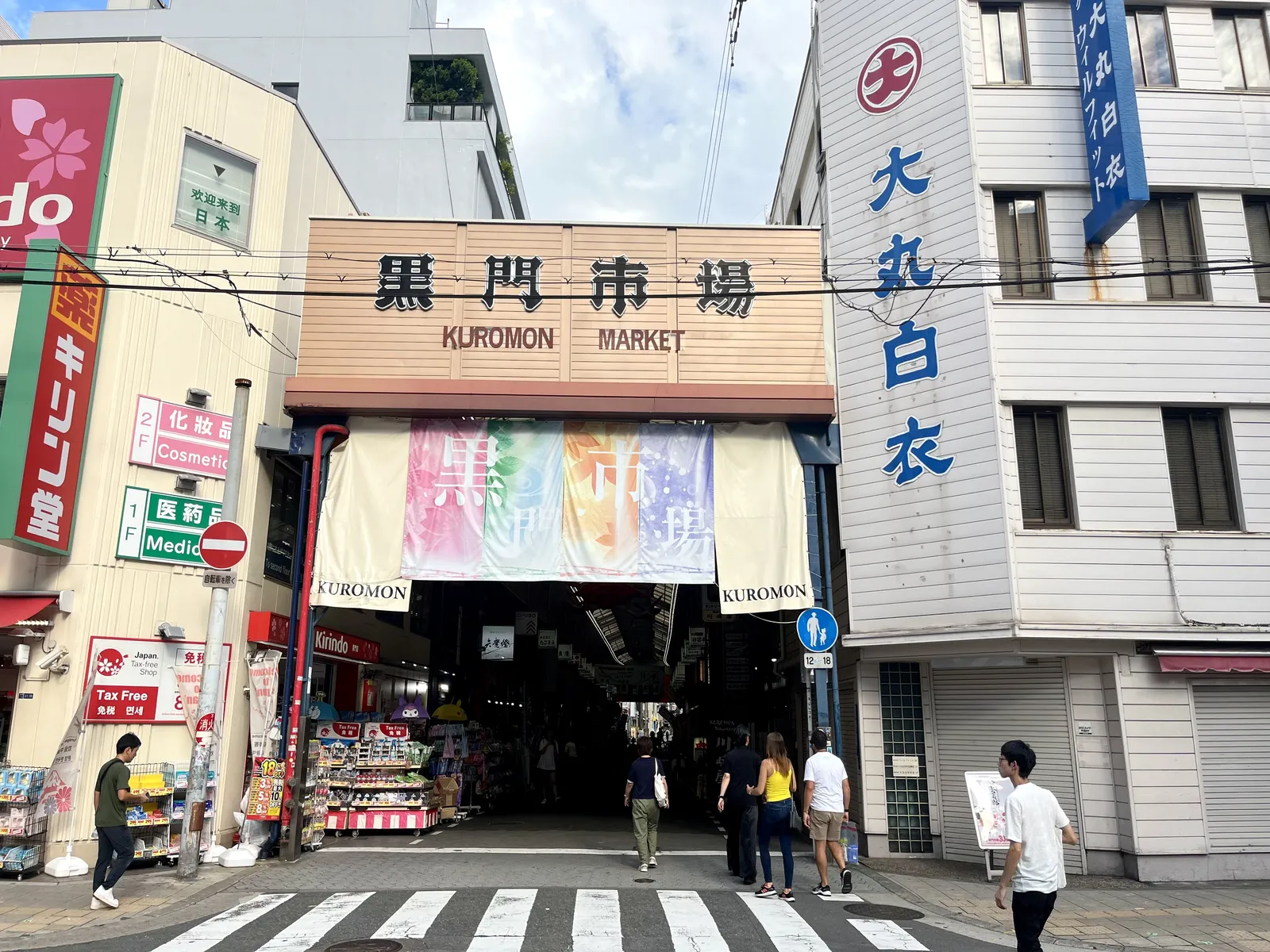
Which side of Kuromon Market should you stay on? Compare Nippombashi Station's Exit 10 and elevator access, luggage routes from Kansai Airport, and verified quad room bed layouts, co-sleeping rules, and laundry facilities at APA Tower, Kuromon Crystal, and Holiday Inn.
Nippombashi Station Exits & Elevators: Plan Your Luggage Path First
Osaka Metro Nippombashi Station is an interchange between the Sennichimae Line (S17) and Sakaisuji Line (K17), linked underground to Kintetsu-Nippombashi Station. The station's official exit directory assigns both Kuromon Market and Nipponbashi Den Den Town to Exit 10, located on the southeast corner of the Nipponbashi intersection right at the edge of the market district. If you are traveling light with just a backpack, Exit 10 is the fastest way up.
The problem is that Exit 10 relies on stairs and has no elevator. According to Osaka Metro's official station layout map, elevators are located in only three spots: near the East Ticket Gate (serving street level and B1 near Exit 7 and the National Bunraku Theatre), at Exit 2 (connecting the Sennichimae Line and Sakaisuji Line platforms), and near the Central-South Ticket Gate (connecting street level, B1, and the Kintetsu transfer concourse near Exit 5). Osaka Metro's official accessible routes pair these elevators into two step-free paths from the Sennichimae Line platform to street level: via the East Ticket Gate or via the Central-South Ticket Gate.
If you are rolling a 28-inch suitcase, choose your elevator based on which subway line you arrive on. Coming from Namba on the Sennichimae Line, do not head toward Exit 10's stairs; exit through the East or Central-South Ticket Gate, ride the elevator to street level, and wheel your bags east along the flat Sennichimae-dori sidewalk toward Exit 10 and the market. If you are coming south on the Sakaisuji Line from Umeda or Tenjimbashisuji 6-chome, use the Exit 2 elevator inside the paid area to transfer directly to the Sennichimae Line without hauling bags up to the street and back down.
If you arrive late at night on an evening flight, do not rely on daytime habits alone. Nippombashi Station's map notes individual operating hours for each ticket gate, and some secondary exits lock their shutters early at night. The same map shows coin lockers clustered around Exit 1, Exit 3, and the Central-North Ticket Gate—useful to note if you want to drop daypacks before grabbing food in the market during a transit stop.
Travelers arriving from Nara or Mie on the Kintetsu Line will find the Central-South elevator easiest, since Kintetsu-Nippombashi and the subway share an underground concourse and that elevator opens right beside the Kintetsu transfer hall. Families with strollers or wheelchairs should also note that the station's accessible multi-purpose restroom is on the east side, in the same direction as the East elevator. Finally, most hotels in this district list their exact recommended exit on their official websites (for instance, Sotetsu Grand Fresa Osaka-Namba specifies Exit 6 of the subway/Kintetsu station, a 2-minute walk)—follow the hotel's access page rather than generic map-app pins.
With Luggage from Kansai Airport: Nankai to Namba, Then One Subway Stop
Following the Kuromon Market Association's official access diagram, the smoothest route from Kansai International Airport is to take the Nankai Electric Railway to Nankai Namba Station (Nankai lists about 38 minutes on the Rapi:t Limited Express and 44 minutes on the Airport Express, while the market's diagram rounds Nankai travel to the 30-minute range), walk roughly 5 minutes to Osaka Metro Namba Station, ride the Sennichimae Line one stop (about 3 minutes) to Nippombashi, and walk around 5 minutes from Exit 10 (or use an elevator exit if you have suitcases). Almost every segment has elevator access, with the main walking stretch being the underground passageway linking Nankai Namba to Metro Namba.
Once you get off at Nankai Namba Station, resist the urge to rush out to the street. Station staff are posted at the 2F Central Ticket Gate and 3F North Ticket Gate, while the 2F South Ticket Gate stays open until 11:30 PM. Nankai's station diagram clearly marks platform elevators, street-level elevators, and accessible transfer paths to the subway on both the 2F and 3F concourses. Pass through the ticket gates and follow the subway signs straight into the underground transfer corridor to stay indoors the entire way.
Inside Osaka Metro Namba Station, you also have step-free options. The station lists seven official accessible routes; for travelers with heavy suitcases, the most practical lead from the North Ticket Gate to elevators at River Place, the Maruito Namba Building, or the OCAT building, or straight into the NAMBA WALK underground shopping mall. If you are transferring from the Midosuji or Yotsubashi Line onto the Sennichimae Line, dedicated interior transfer elevators keep you off the stairs. Following the signage adds a few dozen meters of flat walking but spares you any heavy lifting.
If your bags are manageable and you would rather skip waiting for a one-stop subway ride, walking through the underground mall is a dry alternative. NAMBA WALK connects directly to Exits 2, 3, and 4 at Nippombashi Station: enter from Namba's North Ticket Gate, stroll east through the covered arcade, and head up to Sennichimae-dori at Nippombashi Exits 2, 3, or 4—far more pleasant than wrestling an umbrella in heavy rain. For a full comparison of Nankai trains, JR services, and airport buses from KIX into the city, see our Kansai Airport to Osaka transfer guide; this guide focuses on getting your bags from Namba to your hotel.
If you land mid-afternoon weighed down by suitcases and do not want to lose your first day, use a two-step approach: follow the elevator route straight to your hotel to check in or drop your bags, then walk back out empty-handed to explore Kuromon Market or Dotonbori. From the Namba side, bouncing back to the market takes one quick subway stop; from a market-side hotel, it is right out the door. Making baggage drop-off your first move frees up hours of relaxed sightseeing.
Arriving from Shin-Osaka or JR Namba: Midosuji Line to Sennichimae Line
Travelers arriving at Shin-Osaka Station by Shinkansen from Tokyo or Hiroshima have a straightforward path: ride the Osaka Metro Midosuji Line for about 15 minutes directly to Namba, then transfer inside the station to the Sennichimae Line for a 3-minute ride to Nippombashi. Namba Station provides step-free elevator transfer corridors between the Midosuji and Sennichimae platforms, so neither strollers nor two large suitcases require stair climbing.
If you take the JR Hanwa and Kansai Airport lines from Kansai Airport (about 40 minutes) to JR Namba Station, you will arrive on the west side inside the OCAT building. OCAT has large elevators straight to street level and counts as one of Namba Station's seven official accessible routes. However, crossing from JR Namba to the Metro Sennichimae Line involves a noticeably longer indoor-and-surface walk than transferring from Nankai Namba, so build in extra buffer time if your bags are heavy. Conversely, staying right next to JR Namba turns that distance into an advantage: APA Hotel & Resort Osaka Namba Ekimae Tower notes on its access page that it sits 1 minute from JR Namba, 1 minute from OCAT, and 2 minutes from Metro Exit 30, letting you drop bags immediately before riding one stop empty-handed to the market.
Domestic arrivals landing at Itami Airport also connect cleanly. Per Kuromon Market's official access chart, you can ride the airport limousine bus about 25 minutes straight to Namba Station, then walk 5 minutes into Metro Namba for the Sennichimae Line—or ride the Osaka Monorail 12 minutes to Senri-Chuo and switch to the Midosuji Line for about 30 minutes. Taking the bus keeps large suitcases stowed in the luggage bay until the final 5-minute walk at Namba.
Quad Room Beds: Check Three Numbers on Official Hotel Pages
When booking for a family of four or four friends, never click "book" based solely on a booking site's room title. Open the hotel's official room page and verify three hard numbers: official maximum occupancy, actual bed count, and individual bed width. Many third-party sites label a twin room as a "quad room" simply because four people are allowed to squeeze in. Take two verified options on either side of the neighborhood: in Nipponbashi 1-chome (a 3-minute walk from Nippombashi Station, on the block just west of the market's side alleys), Kuromon Crystal Hotel offers a 36 m² Connecting Room joining two adjacent rooms—its official page explicitly lists four single beds for 1 to 4 guests, giving everyone their own bed.
On the Namba Station side, APA Hotel & Resort Osaka Namba Ekimae Tower offers two different connecting quad categories with nearly identical names but very different sleeping setups. The 28 m² "T-T Connecting Quad Room" features four 110 cm single beds for 2 to 4 guests, with two separate bathrooms and toilets connected by an interior door—meaning four independent beds and zero bathroom bottlenecks. By contrast, the 22 m² "S-S Connecting Twin Room" holds two 140 cm double beds for 1 to 4 guests, which puts two adults per 140 cm bed when booked for four. Because APA Tower sits 1 minute from JR Namba and 7 minutes from Nankai Namba, it minimizes luggage hauling—just check whether you are reserving the T-T or S-S code.
Beyond bed count, on-site amenities widen the gap between properties. APA Tower operates 805 guest rooms on the scale of a large urban resort: its 2F restaurant serves breakfast from 6:30 AM to 2:00 PM, the 40F sky-view restaurant serves breakfast until 10:00 AM, and guests get access to the Genyo-no-Yu public bath (3:00 PM–1:00 AM and 6:00 AM–10:00 AM). Eating early or soaking after a long market walk happens inside the same building. By comparison, neither Kuromon Crystal Hotel nor Holiday Inn Osaka Namba lists a public bath on their official pages, so bathing stays in-room—worth factoring in for families.
Along Dotonbori, Holiday Inn Osaka Namba lists a 39.1 m² "Premium Quad Room" aimed at families and groups, with 3:00 PM check-in, 11:00 AM check-out, and free luggage storage—offering noticeably more floor space than standard business hotels. However, the room page does not publish the exact bed count or bed widths (other rooms on the same page only specify single or double beds). Before booking for four, email or call the property to confirm how many actual beds are inside rather than guessing.
Surveying the rest of the Kuromon Market and Namba area shows just how rare true four-bed rooms are. Sotetsu Grand Fresa Osaka-Namba tops out at triple rooms (two 110 cm beds plus a sofa bed or extra bed); Swissotel Nankai Osaka allows one extra bed in a twin room for ¥10,000, capping occupancy at three adults; Cross Hotel Osaka's Cross Triple fits three 110 cm beds into 27 m²; and The OneFive Osaka Namba Kuromon (a 2-minute walk from Kuromon Market via Nippombashi Exit 5) also maxes out at triple rooms. Rather than cramming into an ambiguously described quad room, booking two standard twin rooms often gives clearer pricing and far better sleep—put both options side by side in a spreadsheet before deciding.
| Hotel & location | Room type | Beds & occupancy | Additional conditions |
|---|---|---|---|
| APA Tower (Namba side, 1 min from JR Namba) | T-T Connecting Quad Room (28 m²) | 4 beds × 110 cm; sleeps 2–4 guests | Two bathrooms + interior door; 1 preschooler sleeps free per bed |
| APA Tower (Namba side) | S-S Connecting Twin Room (22 m²) | 2 beds × 140 cm; sleeps 1–4 guests | 2 guests per bed at full occupancy; in-room microwave |
| Kuromon Crystal (Market area, 3 min from Nippombashi) | Connecting Room (36 m²) | 4 single beds; sleeps 1–4 guests | Two adjoining rooms; bed width and check-out time not listed online |
| Holiday Inn Osaka Namba (Dotonbori side, ~6 min from Namba stations) | Premium Quad Room (39.1 m²) | Listed for families/groups; bed setup not published | Check-in 3:00 PM, check-out 11:00 AM; free luggage storage |
| Reference: Sotetsu Grand Fresa / Swissotel / Cross / The OneFive | Largest room: Triple | 110 cm twin beds + sofa bed or rollaway | Swissotel extra bed ¥10,000; ages 12 and under sleep free in existing beds |
Two Adults, Two Kids: Co-Sleeping Age Rules Drive the Total Cost
For families traveling with two children, each hotel's age cutoff for co-sleeping (bed-sharing without an extra bed) often swings the final bill more than the nightly rate itself. Across all APA properties, one preschool child per bed may share a bed with an adult free of charge. In APA Tower's T-T four-bed room, two adults and two kids each get their own bed; if both children are preschool-age, you can even save money by booking a twin room or sharing the S-S room's two 140 cm beds without feeling cramped. Kuromon Crystal Hotel's FAQ also notes that preschool children co-sleep for free, and pairing that policy with its four-single-bed Connecting Room prevents anyone from getting kicked out of bed at night.
Full-service hotels typically set a much higher age limit. At Swissotel Nankai Osaka—directly connected to Nankai Namba Station—children aged 12 and under stay free when sharing existing beds, and a twin room can add one extra bed (¥10,000) to accommodate a third occupant. Whether a family of four fits into one room comes down strictly to the kids' ages: if both are 12 or under, you have flexible options, whereas older children require two rooms. The hotel also offers free online reservations for baby cribs for children under 2 years old and under 15 kg, a helpful perk for families with strollers who want direct airport-train access.
Convert these bed policies into total out-of-pocket cost before comparing rates. For two adults and two children, APA's four-bed room adds zero extra-bed fees, Swissotel may require a ¥10,000 nightly rollaway fee, and Kuromon Crystal charges per room with preschoolers free. Because international booking engines sometimes calculate "children staying free" differently from Japanese hotel rules, verify your children's eligibility on the hotel's official website first, then inspect the checkout breakdown to avoid surprise surcharges at the front desk.
Run a quick test with a common family pairing—say, an 8-year-old and a 5-year-old. Under APA's rules, only the 5-year-old qualifies as a preschooler, so the 8-year-old requires their own bed; booking the T-T four-bed room solves it cleanly with one bed per person. Under Swissotel's rules, both children are 12 or under and co-sleep free, so a twin room plus one extra bed works on paper—though besides paying ¥10,000 per night for the rollaway, you should check the floor plan to see how much space remains for open suitcases. The same family faces wildly different costs depending on which policy applies, making five minutes of official-site checking well worth the effort.
Cooking or Laundry: Check Official Facility Pages Hotel by Hotel
Many travelers picture buying Wagyu beef and fresh seafood at Kuromon Market to cook back in their hotel room, yet none of the mainstream hotels verified inside the market block include kitchens. Kuromon Crystal Hotel's facility page lists only a 1F front desk and breakfast area, and neither The OneFive nor HOTEL B Suites lists stoves or washing machines on its room pages. Anything you bring back from the market needs to be cooked on-site by the vendor, ready-to-eat sashimi, or cold items that fit inside a standard mini-fridge. Dropping "must have a kitchen" from your filter makes finding a hotel right by the market far easier.
If you are staying three or four nights and need coin laundry or a microwave for ready-made food, shift your search slightly toward Namba or Yotsubashi. Sotetsu Grand Fresa Osaka-Namba explicitly lists on-site coin-operated laundry machines and microwaves on its website. APA Tower puts microwaves right inside select rooms (such as triple rooms), though its official page does not list coin laundry facilities. If an in-room washer-dryer and induction kitchenette are non-negotiable, our Osaka neighborhood and hotel guide already covers four-person apartment-style hotels in nearby Yotsubashi—instead of forcing a fit next to the market, stay in Yotsubashi and ride the subway one stop over in the morning.
If you plan to run one last load of laundry on check-out morning, line up each hotel's check-in and check-out times too: Sotetsu typically runs 3:00 PM check-in and 11:00 AM check-out; APA sets 10:00 AM check-out for non-members (11:00 AM for members); and Kuromon Crystal staffs a 24-hour front desk with luggage storage before check-in and after check-out. Picking a hotel with its own coin laundry keeps your final morning from turning into a race against a 10:00 AM deadline.
Market Hours Vary by Individual Shop and Day of the Week
Kuromon Market does not open or close on a single synchronized schedule; the association lists separate hours and regular closing days for each member store. Comparing a few representative shops shows the spread: a popular tuna restaurant opens at 8:00 AM and closes at 4:00 PM (or earlier if sold out), a traditional dried-goods shop operates 9:00 AM to 5:00 PM almost daily except for a few days at New Year's, a tamagoyaki (rolled omelet) shop runs 10:00 AM to 5:00 PM and closes an hour earlier on Saturdays, and a heritage tea shop stays open 9:00 AM to 5:00 PM with a five-day break over year-end and New Year's. Under the same roof, opening times stretch from early morning to 10:00 AM.
The North Entrance Information Center keeps clear, predictable hours: open daily from 9:00 AM to 6:00 PM, equipped with free rest seating, restrooms, and a currency exchange machine. If you arrive early and your target stall hasn't rolled up its shutters yet, wait comfortably at the information center and mark your must-visit stalls on the market map—an especially practical meeting spot when traveling with seniors or young kids.
Working backward from those hours keeps you from showing up to closed shutters: arriving at 7:00 AM leaves very few stalls open, fresh tuna bowls and grilled skewers start firing up after 8:00 AM, and arriving between 9:00 AM and 10:00 AM catches roughly 90 percent of the arcade open. For popular seafood spots, watch for "until sold out" notes rather than waiting until 3:00 PM or 4:00 PM; meanwhile, supermarket-style produce shops and drugstores inside the arcade stay open later, so you do not need to squeeze everyday shopping into the morning rush. For sit-down lunch spots around the arcade, check the Kuromon section of our 3-day Osaka itinerary and time your visit accordingly.
If your trip falls on a weekend or around Japan's year-end and New Year holidays, double-check shop holidays before setting out. Individual stalls take different weekly days off scattered across Monday through Sunday, and multiple shops close consecutively around New Year's—while spots like the omelet shop and some produce stalls shorten hours or close on Saturdays. A quick glance at the member shop cards on the Kuromon Market homepage that morning prevents wasted trips.
Getting Back to Your Hotel at Night: Three Smooth Routes
Once market shutters roll down in the evening, guests staying near the north entrance typically head toward Namba and Dotonbori for dinner. Three easy routes bring you home afterward: if your feet are tired, ride the Sennichimae Line one stop from Namba back to Nippombashi and walk up from Exit 10; if you want an evening stroll without heavy bags, follow the north bank of the Dotonbori Canal east back toward your block; and if it is windy or raining, enter NAMBA WALK from Namba's North Ticket Gate and walk underground to Nippombashi Exits 2, 3, or 4.
Kuromon Market looks completely different after dark, with rows of steel shutters pulled down and alleys lit only by streetlights and vending machines. Walking back at night, stick to bright, busy Sennichimae-dori or the NAMBA WALK underground arcade for easier navigation and better visibility. Guests staying on the Namba Station side skip this walk altogether—at APA Tower, for example, the Genyo-no-Yu public bath stays open until 1:00 AM (reopening at 6:00 AM), so you can head straight back from dinner for a soak and take the subway one stop to the market in the morning.
For late-night cravings, several supermarket-style shops inside the market block stay open late alongside convenience stores spaced all along Sennichimae-dori, making it simple to pick up cold drinks, fruit, or bento meals. Check your room's equipment before buying food that needs reheating: select rooms at APA Tower include an in-room microwave, while Kuromon Crystal equips rooms with refrigerators—another payoff from checking facility lists early.
If you land at Kansai Airport on a late flight and reach central Osaka past midnight, verify both hotel check-in cutoffs and station gate closures beforehand. Kuromon Crystal's FAQ notes that check-in is accepted until 2:00 AM with a 24-hour front desk, allowing late arrivals at Nippombashi to check in smoothly. On the transit side, remember that Nankai Namba's 2F South Ticket Gate closes at 11:30 PM; after that hour, exit via the Central or North Ticket Gate, take the Sennichimae Line one stop to Nippombashi, ride the Central-South elevator to street level, and walk along Sennichimae-dori to your hotel.
Early Flights and Departures: Which Side Saves More Time
On departure day, hauling shopping bags and heavy suitcases back to Kansai Airport makes the Namba Station side shine. Nankai's Rapi:t Limited Express and Airport Express start running early in the morning from Nankai Namba Station, and hotels clustered beside the station sit just minutes from the ticket gates—Swissotel Nankai Osaka notes a roughly 2-minute walk to the 3F North Ticket Gate, while APA Tower is about a 7-minute walk to Nankai Namba. Guests staying near Kuromon Market simply add one subway stop from Nippombashi to Namba before transferring to Nankai, so leaving 15 minutes earlier gives plenty of cushion.
If you have an afternoon or evening flight on check-out day, take advantage of hotel luggage storage to buy yourself half a day of easy wandering. APA Tower offers free same-day luggage storage (items must be picked up the same day), Kuromon Crystal stores bags at the front desk both before check-in and after check-out, and Holiday Inn provides a free luggage room. Leave your big suitcases behind after check-out, stroll empty-handed through Kuromon Market for dried kombu or one last seafood meal, then pick up your bags on the way to the airport instead of squeezing rolling luggage between narrow market stalls.
One Base or a Hotel Split: Connecting to Nara, Kyoto & USJ
If you have three nights in Osaka and love morning markets, choose between staying put or splitting hotels based on how much moving luggage bothers you. One smart split is spending arrival night near Namba Station to skip extra transfers, checking out the next morning to ride one stop to the market pocket for two nights—giving you two straight mornings of stepping right out into breakfast—or placing your market stay in the middle and bookending with Namba. Note also that 36 to 39 m² connecting and family rooms around Kuromon Market (like Kuromon Crystal and Holiday Inn) often leave more floor space for opening two or three large suitcases than compact station-connected business rooms.
Staying on the Nippombashi side also pays off on regional day trips. To visit Nara, you do not need to backtrack to Namba: Kintetsu-Nippombashi Station sits right on the west side of the market, and Exit 4 at Metro Nippombashi directly connects to the Kintetsu line, putting direct trains within easy reach once you check Kintetsu's timetable. Heading north toward Kyoto is equally direct via the Sakaisuji Line from Nippombashi—transferring to the Keihan Railway at Kitahama or riding through-service trains onto the Hankyu Kyoto Line without fighting through Namba's crowds.
The one day trip where Nippombashi feels less convenient is Universal Studios Japan (USJ), which requires backtracking through Namba to connect onto the JR Osaka Loop Line and Yumesaki Line. If a family of four wants to line up early at the park gates, moving to a hotel near Universal City the night before is often worth the switch. We break down park tickets and early-entry timing in our Universal Studios Japan ticket and entry guide and compare park-area hotels in our Osaka neighborhood and hotel guide; splitting your nights along the three-pocket framework keeps fatigue to a minimum.
A practical 3-day/2-night blueprint brings it all together: on Day 1 afternoon, take Nankai into Namba, drop suitcases at a Namba-side hotel, dine in Dotonbori, and soak in the hotel bath. On Day 2 morning, check out and take the Sennichimae Line one stop to drop bags at a four-bed connecting room near the market, graze south from the North Entrance for brunch, and head back to Namba for yakiniku dinner. On Day 3 morning, grab breakfast and dried-goods souvenirs in the market, collect your bags, take the Central-South elevator down to Nippombashi Station, and transfer one stop at Namba straight to Kansai Airport. Across all three days, you only move heavy luggage three times, and never more than a single subway stop.
Pre-Booking Verification Checklist
Before clicking "pay," spend three minutes checking five essentials: whether the actual bed count and bed widths comfortably fit four adults or two adults and two kids; whether the official occupancy limit includes co-sleeping children; which nearby station exit has an elevator (using the official station diagram rather than phone GPS); whether coin laundry and microwaves exist in-room or on-site; and the rules for luggage storage before check-in and after check-out. Only compare nightly prices once a hotel clears all five checks—never trade a few hundred yen in room rate for hauling suitcases up long flights of stairs.
Always verify terms on the hotel's own website, opening both the "Rooms" page and the "Access" page separately. The Rooms page shows exact bed counts, widths, and occupancy caps, while the Access page lists the nearest station, specific exit number, and walking minutes—together they form your reliable baseline. Whenever an official page omits a key figure (such as bed widths at Kuromon Crystal or exact bed counts in Holiday Inn's quad room), email, call, or run a four-guest search in the hotel's direct booking engine before locking it in; if you cannot get a clear answer, leave it off your shortlist.
Watch one final hidden cost buried in cancellation terms. At Kuromon Crystal Hotel, for example, canceling 7 to 2 days before check-in incurs a 50% charge, while canceling the day before or on arrival day forfeits 100%; APA and other major chains also separate non-refundable early-bird rates from flexible plans. Whenever travel dates or group headcount might still shift, write the cancellation deadline right alongside the nightly rate in your comparison sheet—saving a couple thousand yen on a prepaid rate rarely covers the penalty of a last-minute schedule change.
A few useful answers
Which exits at Nippombashi Station have elevators?
Exit 10, the closest exit to the market, primarily uses stairs. Nippombashi Station's official map marks three elevator locations: near the East Ticket Gate (by Exit 7 and the National Bunraku Theatre, connecting street level to B1), at Exit 2 (linking the Sennichimae and Sakaisuji Line platforms), and near the Central-South Ticket Gate (by Exit 5, connecting street level, B1, and the Kintetsu transfer concourse). If you have large suitcases, take the East or Central-South elevator up to street level and walk along the flat sidewalk to the market.
Is Namba or Nippombashi closer to Kuromon Market?
If your priority is stepping straight out into the market for an early breakfast before tour buses arrive, staying on the Nippombashi Station side puts you closest—about a 5-minute walk from Exit 10 according to the Kuromon Market Association. If your itinerary leans heavily toward late-night dining in Dotonbori and Shinsaibashi, or you want a seamless walk from the Nankai airport train straight into your lobby, the Namba Station side is more convenient; you can simply ride the Sennichimae Line one stop over to Nippombashi the next morning.
Do quad rooms near Kuromon Market actually give four guests four separate beds?
Not always, so check each hotel's official room page before booking. APA Hotel & Resort Osaka Namba Ekimae Tower's "T-T Connecting Quad Room" has four 110 cm single beds, and Kuromon Crystal Hotel's 36 m² Connecting Room has four single beds—both give every guest their own bed. However, APA's "S-S Connecting Twin Room" only has two 140 cm double beds for up to 4 guests, meaning two people share each bed. Holiday Inn Osaka Namba's 39.1 m² Premium Quad Room does not list an exact bed count online, so confirm directly with the hotel before reserving.
What is the easiest way to get from Kansai Airport to a hotel near Kuromon Market with heavy luggage?
Take the Nankai Electric Railway from Kansai International Airport to Nankai Namba Station (about 38 minutes on the Rapi:t Limited Express or 44 minutes on the Airport Express). Follow the accessible route signs inside the station to transfer to the Osaka Metro Sennichimae Line, ride one stop to Nippombashi Station, and use the East or Central-South Ticket Gate elevator to reach street level. The only noticeable walk is the connecting passageway between Nankai Namba and the subway station.
Can you find late-night food if you stay right next to Kuromon Market?
Most seafood stalls and prepared-food vendors inside the covered arcade close before dusk, so it is best to have dinner around Dotonbori or Namba before heading back. For late-night snacks, fruit, or microwavable meals, you can rely on late-night supermarket-style shops within the market block and the dense cluster of convenience stores lining Sennichimae-dori.
Official information and references
Sources used in this guide.
- Kuromon Market | Official Access Guide (5-minute walk from Exit 10 and airport route map)
- Kuromon Market Association Member Shop Map (February 24, 2026 PDF)
- Kuromon Market | Member Store Hours and Regular Holidays
- Osaka Metro | Nippombashi Station (S17) Information and Accessible Routes
- Osaka Metro | Nippombashi Station Exit and Surrounding Area Guide (Exit 10 for Kuromon Market)
- Osaka Metro | Nippombashi Station Map PDF (Three Elevators and Ticket Gate Locations)
- Osaka Metro | Namba Station (S16) Accessible Entrance and Exit Routes
- Nankai Electric Railway | Namba Station Information (Ticket Gates and Elevator Facilities)
- Nankai Electric Railway | Kansai Airport Travel Times (Approx. 38 min by Rapi:t, 44 min by Airport Express)
- APA Hotel & Resort Osaka Namba Ekimae Tower | Guest Rooms (T-T Connecting Quad Room, S-S Connecting Twin Room)
- APA Hotel & Resort Osaka Namba Ekimae Tower | Access (JR Namba, OCAT, Osaka Metro Exit 30)
- APA Hotels | Member Check-out and Check-in Hours
- APA Hotel & Resort Osaka Namba Ekimae Tower | Luggage Storage Policy
- APA Hotels | Free Co-Sleeping Policy for Preschool Children
- Kuromon Crystal Hotel | Guest Rooms (36 m² Connecting Room, 4 Single Beds)
- Kuromon Crystal Hotel | FAQ (Luggage Storage, Child Co-Sleeping, Cancellation Policy)
- Holiday Inn Osaka Namba | Guest Rooms (39.1 m² Premium Quad Room)
- Holiday Inn Osaka Namba | Hotel Information (Check-in/Check-out, Luggage Storage)
- Sotetsu Grand Fresa Osaka-Namba | Guest Rooms (Max 3-Guest Room Types and Sofa Beds)
- Sotetsu Grand Fresa Osaka-Namba | Access (Kintetsu-Nippombashi and Osaka Metro Nippombashi Exit 6)
- Swissotel Nankai Osaka | FAQ (Twin Room Extra Bed and Child Co-Sleeping)
- Cross Hotel Osaka | Cross Triple Room
- The OneFive Osaka Namba Kuromon | Hotel Info (Nippombashi Exit 5, 2-min Walk to Kuromon Market)