Booking a river-view room in Nakanoshima, staying in Kitahama, or basing near Grand Cube Osaka? Compare areas by hotel access, station exits, and late-night returns, plus shuttles, Osaka accommodation tax, and a half-day riverside route.
- Region & Focus
- OsakaHotels and stays
- Reading Scope
- 19 min read · 9 chapters · 7 Q&As
- Official Verification
- 35 official sources checkedUpdated November 22, 2026
- Key Topics
- Where to stayNeighborhoodsBooking
Chapter Route Map (tap any stop)
- Choose Your End of Nakanoshima First
- Pick Your Return Station and Exit First
- Five Key Hotels and Their Exact Entrances
- What a River-View Upgrade Actually Buys You
- Walking From Kitahama Across the Bridge to Central Public Hall
- West-End Museums and Rainy-Day Plans
- Connections From Kansai Airport, Shin-Osaka, and Kyoto
- Put Dinner on Your Way Back to the Hotel
- Compare Bookings All the Way to Checkout
- Quick Q&A
To pick the right hotel in Nakanoshima, start with the bridge you will cross every day. For morning strolls through the rose garden and coffee across the river, look around Yodoyabashi or Kitahama. If you want a short walk home after evening museum visits, stay near Watanabebashi. Only base right next to Keihan Nakanoshima Station if you are commuting to the Osaka International Convention Center. Travelers set on a river view should check floor plans to verify which direction the windows actually face. Especially when arriving from Kansai Airport with luggage, knowing which stop to exit and where you cross the water matters far more than simply seeing "Nakanoshima" in the hotel address.
Choose Your End of Nakanoshima First
Narrow Nakanoshima Island sits wedged between the Dojima River to the north and the Tosabori River to the south. At the east end stand Nakanoshima Park, Osaka City Central Public Hall, and the Nakanoshima Library; moving west brings you to the museum cluster in Nakanoshima 4-chome, and farther west sits the Osaka International Convention Center. Dozens of hotels list "Kita-ku, Nakanoshima" as their address, yet dragging rolling suitcases from the station feels completely different depending on the block. Zoom in on the booking map until you can see the hotel's front entrance, then mark the nearest station and the bridge you will use daily.
For morning walks to the rose garden, focus on Yodoyabashi and Naniwa Bridge. Naniwabashi Station on the Keihan Nakanoshima Line sits right beside Central Public Hall, while Yodoyabashi Station on the Midosuji Line sits just south across the Tosabori River. Even if you stay on the south bank, crossing one bridge puts you straight into the park, and you can step off at Yodoyabashi on your way back at night. Continuing east leads toward Tenjinbashi and Tenmabashi—handy as a starting point for Osaka Castle Park, though it adds extra walking every day if your plans revolve around the western museums.
Kitahama lines the south bank of the Tosabori River, facing the park across the water. Coming up from Sakaisuji Line Kitahama Station onto Sakaisuji Avenue puts you right by the Osaka Exchange and the stone lion statues guarding Naniwa Bridge. Hotels along this stretch typically carry Chuo-ku Kitahama or Koraibashi addresses. Waterfront rooms look directly across toward Central Public Hall, while properties a few blocks inland trade river views for quick station access and larger layouts. If your ideal morning starts with grabbing coffee before strolling across a bridge, the south bank is far more convenient than staying out by the convention center.
For the National Museum of Art, Osaka, the Nakanoshima Museum of Art, Osaka, and the Osaka Science Museum, base near Watanabebashi through Taminobashi. High-rise hotels and underground concourses anchor the island side of Watanabebashi, with the museum cluster just a short walk west. This pocket works well when you want to linger at exhibitions until closing time, or when travel companions want to split up for the afternoon and reconvene for dinner. If only one person is museum-hopping, nearby Higobashi Station connects straight north to Nishi-Umeda or south to Namba on the Yotsubashi Line.
Keihan Nakanoshima Station anchors the western tip of the island, right beside the Osaka International Convention Center (also known as Grand Cube Osaka). Pick this end if you need to check into conference sessions or drop materials back in your room midday. Some hotels here run free shuttles to JR Osaka Station, though if you have an early morning JR train, factor in the first shuttle departure plus the walk inside Osaka Station to your platform. Searching for "Nakanoshima" versus "Nakanoshima Station" pulls up very different hotel clusters—if your sights are set on the rose garden, type Naniwabashi into your map search as well.
If Nakanoshima is just a single-day museum stop on your itinerary, stay where you will catch trains most often. Back-to-back morning day trips to Kobe or Himeji are much easier from JR Osaka Station, while nightly dinners in Dotonbori pair better with Namba on the Nankai Line for airport runs. Nakanoshima and Kitahama truly pay off when you give the riverside at least one full afternoon and morning. For a broader citywide comparison of transit hubs and nightlife districts, see our where to stay in Osaka guide.
Booking a river-view room in Nakanoshima, staying in Kitahama, or basing near Grand Cube Osaka? Compare areas by hotel access, station exits, and late-night returns, plus shuttles, Osaka accommodation tax, and a half-day riverside route.
Pick Your Return Station and Exit First
From Yodoyabashi on the Midosuji Line, Umeda is one stop north, and Namba is three stops south via Hommachi and Shinsaibashi. Shin-Osaka for the Shinkansen sits on the same line. If your days are spent in galleries and your nights in Dotonbori, boarding at Yodoyabashi makes getting home effortless. Hotels closer to Higobashi can reach Namba on the Yotsubashi Line instead, though its Namba platforms lie farther west and require a noticeable walk from the Midosuji Line side. Pin your dinner spot before choosing which station entrance to head toward.
One stop north of Higobashi is Nishi-Umeda. Despite the nearly identical name to Umeda, the two belong to the Yotsubashi and Midosuji lines respectively, and each connects to JR Osaka Station along a different corridor. When transferring from JR to Conrad Osaka, follow signs specifically for the Yotsubashi Line and Nishi-Umeda. If you are coming from Hankyu Osaka-Umeda Station, budget extra walking time inside the complex, especially with bags or when hunting for elevators.
Kitahama Station connects both the Sakaisuji Line and the Keihan Main Line. Nippombashi Station sits directly down the Sakaisuji Line, putting Kuromon Market within a single ride. To reach Osaka Castle from Kitahama, ride the Keihan Main Line one stop to Tenmabashi, or walk east along the riverfront to Tenmabashi and follow signs toward Otemon Gate. According to the 2026 Osaka Castle Park map, walking from Tenmabashi Station to the castle keep takes roughly 19 minutes; if you prefer a gentler, step-free route, start at Tanimachi 4-chome and enter through Otemon Gate. Full gate-by-gate directions are covered in our Osaka Castle Park and Keep guide.
Going west to east, the Keihan Nakanoshima Line stops at Nakanoshima, Watanabebashi, Oebashi, Naniwabashi, and Tenmabashi, where it merges with the Keihan Main Line coming through Yodoyabashi and Kitahama. Kitahama and Naniwabashi sit directly opposite each other across the Tosabori River. If you are on the park side heading to Nippombashi, simply walk across Naniwa Bridge to Kitahama Station for the Sakaisuji Line instead of detouring via Tenmabashi. Inside stations, watching for the Japanese signage alongside the romaji for Watanabebashi and Naniwabashi makes street exits much easier to track than relying on translated map labels alone.
Always plan elevator routes using the railway operators' station maps. Keihan lists exact elevator and accessible restroom locations for every Nakanoshima Line stop on its website. For Central Public Hall, official directions recommend Yodoyabashi Exit 1 (about 5 minutes) or Naniwabashi Exit 1 (about 1 minute), and the venue's access page marks the basement exhibition hall entrance and step-free path so strollers and wheelchairs do not have to search around the main facade.
A standard adult Osaka Metro fare up to 3 km is ¥190. If you are only making one round-trip to Namba and walking the riverside the rest of the day, simply tap an IC card. For heavy transit days, the adult Enjoy Eco Card costs ¥820 on weekdays and ¥620 on weekends and national holidays, covering Osaka Metro and designated city buses. At ¥190 per ride, the pass pays off starting on your fifth weekday ride or fourth weekend ride. IC fares on Keihan and JR are separate, so a round-trip to Kyoto does not count toward the pass total.
Five Key Hotels and Their Exact Entrances
Conrad Osaka occupies Festival Tower West in Nakanoshima 3-chome, directly linked to Higobashi Station Exit 4 and Keihan Watanabebashi Station Exit 13. From Watanabebashi, take the elevator up to the 1st floor, exit the automatic doors, and follow the driveway to the hotel entrance. Arriving via Higobashi, follow the underground passage near the Yotsubashi Line north ticket gates before heading up to ground level. Look carefully for "West" on your first visit, as map pins for the nearby concert hall or opposite tower can easily send you into the wrong building.
At the western tip, RIHGA Royal Hotel Osaka, Vignette Collection connects underground directly to Keihan Nakanoshima Station right beside the Osaka International Convention Center. Its free shuttle bus from JR Osaka Station boards near the Sakurabashi Exit: per the hotel's schedule, buses depart Osaka Station from 7:45 AM to 10:30 PM and the hotel from 7:30 AM to 10:15 PM, running every 15 minutes from both ends. On major conference days, build in one extra departure cycle if your group needs to arrive together. Once shuttles stop for the night, grab a taxi from Umeda, or ride the Keihan Line straight into Nakanoshima Station's underground walkway.
Mitsui Garden Hotel Osaka Premier sits closest to the art museums, about a 3-minute walk from Watanabebashi Exit 2 or 5 minutes from Higobashi Exit 2. It also runs its own free 23-seat shuttle from beneath the elevated tracks outside JR Osaka Station's Sakurabashi Exit—no reservations are taken, and if a bus fills up, you wait for the next one. Note that the property has announced a rebranding to Mitsui Garden Hotel Osaka Nakanoshima Premier on February 26, 2027, the same day Mitsui Garden Hotel Osaka Dojimahama Premier opens nearby; during the transition, verify your hotel by its Nakanoshima street address and the name on the shuttle bus.
Guests at Mitsui Garden Premier get free access to its top-floor public bath from 3:00 PM to 9:00 AM the next morning (bring towels from your room). That wide window works for two types of travelers: late diners who want a soak before bed, and early risers who prefer bathing before the rest of their group wakes up. If higher room tiers charge mainly for views or lounge access, weigh whether you will actually be inside the room during those hours versus simply wanting an evening soak at a lower base rate.
For a hot spring on the south bank, look at Onyado Nono Osaka Yodoyabashi in Chuo-ku Kitahama 2-chome, roughly 3 minutes from Sakaisuji Line Kitahama Exit 2 or 5 minutes from Midosuji Line Yodoyabashi Exit 1. From the Keihan underground concourse, Exits 20 (Yodoyabashi) and 21 (Kitahama) put you about a 1-minute walk from the hotel, though both exits close after 10:30 PM. Upstairs is a gender-segregated natural hot spring bath, where the hotel enforces a no-tattoo policy. If the onsen is your main reason for booking, tally how many people in your party can actually use it before paying extra for the stay.
Hotel Brighton City Osaka Kitahama offers a practical alternative right by Sakaisuji Line Kitahama Station, with every guest room measuring at least 20 square meters plus triple rooms on offer. When traveling as three adults with three suitcases, verify the actual bed count and check whether the third bed is a full fixed bed or an extra fold-out. For families, enter your children's exact ages when searching: free co-sleeping is limited to one child under 12 per room, and qualifying families should compare room-only versus breakfast-included rates side by side.
| Hotel | Official Nearest Station Access | What to Check Before Booking |
|---|---|---|
| Conrad Osaka | Direct link to Watanabebashi Exit 13 or Higobashi Exit 4 | Use room floor maps to check which direction windows face |
| RIHGA Royal Hotel Osaka | Direct underground link to Keihan Nakanoshima Station | Walk to convention center; take hotel shuttle to JR Osaka Station |
| Mitsui Garden Hotel Osaka Premier | 3 min walk from Watanabebashi Exit 2; 5 min from Higobashi Exit 2 | Free guest public bath; renames on February 26, 2027 |
| Onyado Nono Osaka Yodoyabashi | 3 min walk from Kitahama Exit 2; 5 min from Yodoyabashi Exit 1 | South-bank stay with indoor natural hot spring bath |
| Hotel Brighton City Osaka Kitahama | About 1 min walk from Sakaisuji Line Kitahama Station | Triple rooms available; all rooms at least 20 square meters |
What a River-View Upgrade Actually Buys You
Before paying extra for a water view, check where the building sits. On the island itself, north-facing rooms look over the Dojima River and south-facing rooms overlook the Tosabori River; in Kitahama on the south bank, river-facing rooms look north back toward the island. If you want the red-brick facade of Central Public Hall framed by water, aim for angles facing the eastern end. For bridge spans and skyscrapers around Watanabebashi and Higobashi, look at mid-island or opposite-bank towers while checking whether neighboring buildings stand between your window and the river. Cross-referencing listing photos against a satellite map quickly reveals which river lies below.
Compare floor height and window orientation separately, even within the same hotel. On Conrad Osaka's floor plans, the 50-square-meter Deluxe Room and 50-square-meter Premium View Room can both sit on floors 33 to 37—identical footprint, identical height range, different direction. Open the room page's floor map to see which side of the tower corresponds to which category. If a specific view matters, send a message with your bed preference, guest count, and the exact bridge or river you hope to face, asking which bookable room type matches.
For daytime views of bridges, boats, and strolling pedestrians, whether the river actually appears in the room photo matters more than distant skyline depth. For night skylines, look for window-side seating. If you are celebrating one special evening and plan to enjoy the view from your room, keep the hour before sunset free on your schedule. On packed days spent at Osaka Castle and Dotonbori where you only return around midnight, putting that upgrade money toward twin beds, extra floor space, or a flexible cancellation rate delivers far better value.
On a three-night stay, compare the total price of three nights in a view room, three nights in a standard room, and a split reservation at the same property. Splitting bookings can require checking out and back in mid-stay—if anyone in your group wants an afternoon nap, laundry time, or desk space for a laptop that day, weigh the savings against hours without a room. If you want dinner with a panorama instead, compare the price of one on-site restaurant meal against the multi-night room upgrade before locking in your stay.
Walking From Kitahama Across the Bridge to Central Public Hall
Leaving a Kitahama hotel, head first to the south foot of Naniwa Bridge. The Osaka Exchange stands right along Sakaisuji Avenue; architecture fans can detour past the Kitahama Retro building before stepping onto the bridge. One easy rhythm is using breakfast as your turnaround point: cross into the park early while paths are quiet, return to the south bank for breakfast, and hop on the train from Kitahama afterward. If you arrive in the evening, eat dinner around Yodoyabashi or Kitahama, pick up convenience-store supplies before closing, and save your riverside coffee walk for the next morning.
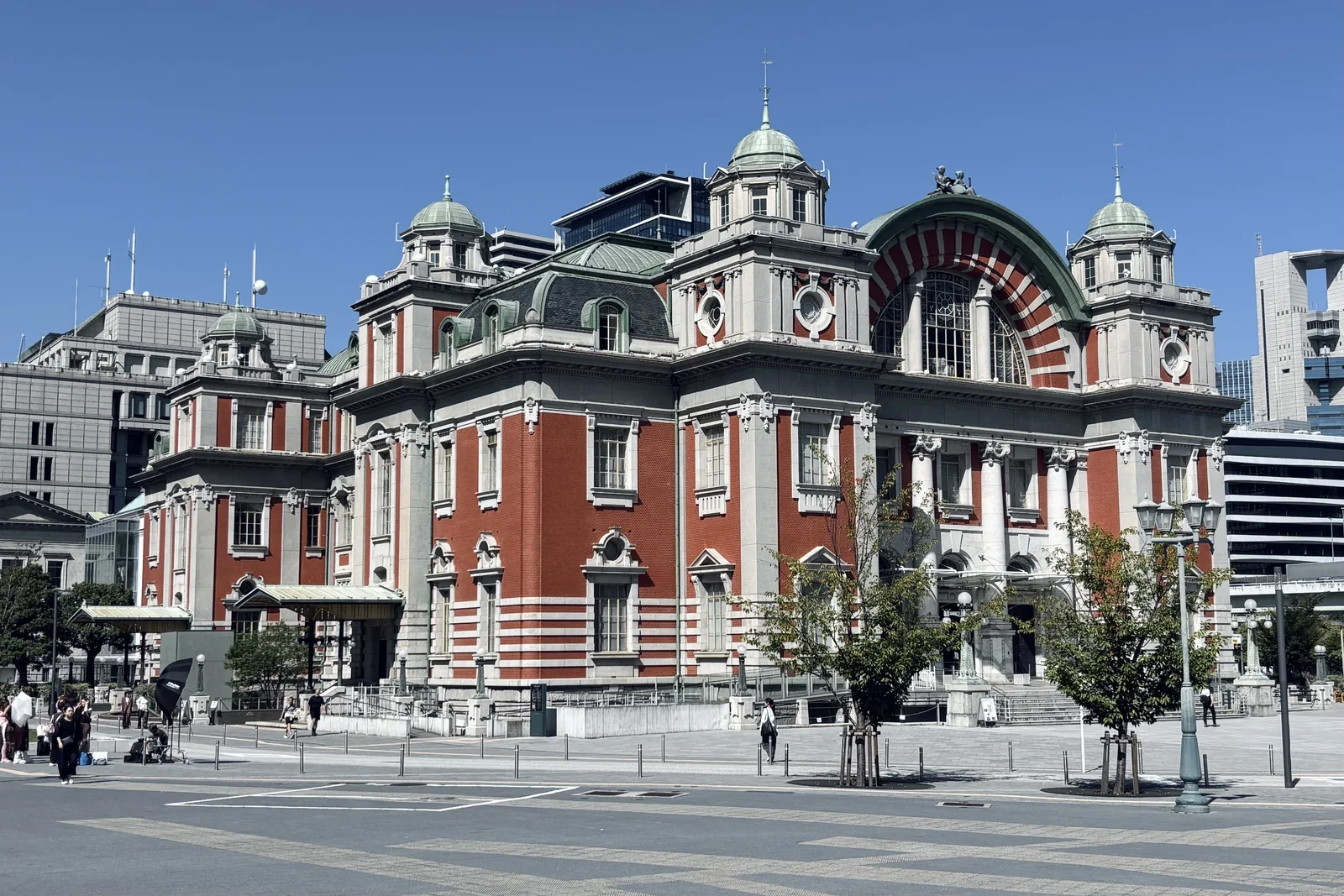
Completed in 1918, Osaka City Central Public Hall pairs red brick with white stone trim, and the front plaza gives you the clearest view of the grand arched window above the main entrance. After admiring the exterior, head down to the basement exhibition room for archival photos, salvaged restoration materials, and construction history. Free-access areas and the exhibition room are open to walk-in visitors, while rental halls such as the main assembly room require booking a guided tour on the official website. The exhibition room runs 9:30 AM–8:00 PM and closes the fourth Tuesday of each month (shifting to the next weekday if it falls on a holiday); it opens as usual on December 22, 2026, and closes December 27 through January 4 for year-end holidays.
Just east of the public hall sits the Museum of Oriental Ceramics, Osaka, right outside Keihan Naniwabashi Exit 1. Hours are 9:30 AM–5:00 PM (last entry 4:30 PM), generally closed Mondays or the following Tuesday when Monday is a holiday. Pairing the ceramics galleries with the rose garden fills a relaxed morning nicely, and the short walk between the public hall and the museum keeps you mostly sheltered if drizzle sets in. Staying in Kitahama puts this museum directly across the bridge right after breakfast.
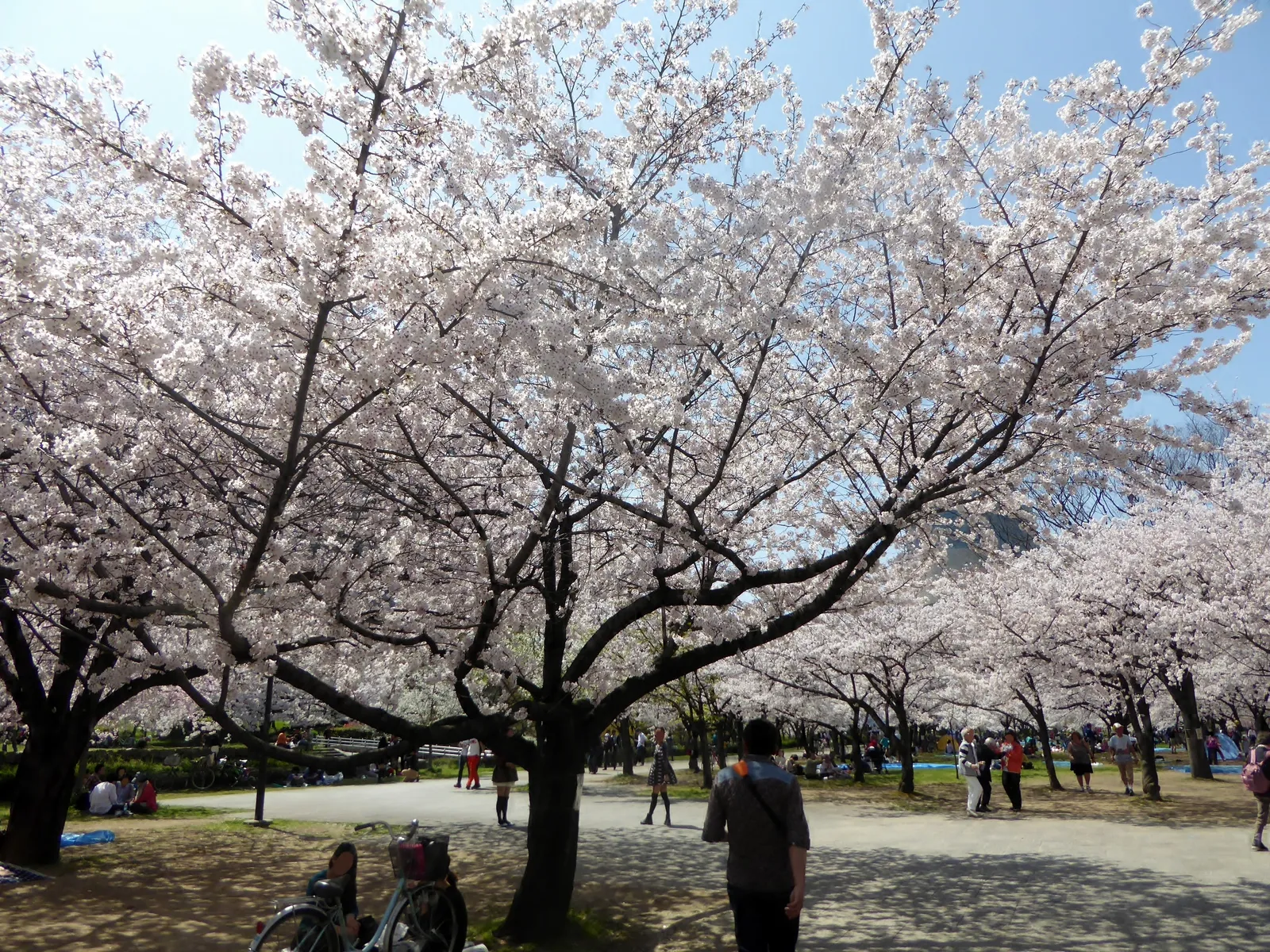
Time the rose garden for bright daylight. Osaka City notes peak spring and autumn blooms typically land around mid-May and mid-October; when the roses are out, stroll the garden first and loop back past Central Public Hall. If traveling with older relatives or a stroller, picking just one or two stops among the hall, the library exterior, and the park keeps the pace comfortable. South-bank guests can cross onto the island over one bridge and return over another, letting your lunch choice decide which side you walk back to.
Families with children can pair the park walk with Nakanoshima Children's Book Forest right next door outside Keihan Naniwabashi Exit 3. Admission is free, with standard hours from 9:30 AM to 5:00 PM; it closes Mondays (or the following weekday after a holiday). Timed-entry reservations are available online alongside limited same-day walk-in spots on regular days, though walk-ins are paused on certain event dates. If two families want to enter together, coordinate the same time slot in advance; if slots are full, take a loop through the rose garden and cross back to Kitahama for lunch.
To see the island from the water, Aqua-Liner river cruises board at Yodoyabashi Port, Hachikenyahama Pier near Tenmabashi, or Osaka Castle Port. You can build a one-way transit leg into your route—boarding at Yodoyabashi and disembarking at Osaka Castle Port to join the park's east walkways—which takes roughly 35 minutes and costs ¥1,700 for adults or ¥850 for elementary school students, bought on-site at the pier that day (note that Yodoyabashi Port accepts cashless payment only). Boats are covered and operate in light rain, though high winds or heavy downpours can suspend or reroute service. Because boarding involves stepping across a height gap between dock and boat, stick to bridge walks if anyone in your group struggles with stairs.
West-End Museums and Rainy-Day Plans
The National Museum of Art, Osaka sits in Nakanoshima 4-chome, marked above ground by a soaring steel-frame entrance over underground galleries. Walk about 5 minutes from Watanabebashi Exit 2, 10 minutes from Higobashi Exit 3, or roughly 15 minutes from Yodoyabashi Exit 7 per museum estimates. In light rain from Yodoyabashi, you can walk above ground past the landmark buildings around Higobashi; in a downpour, using Watanabebashi cuts outdoor exposure to a minimum and makes both exits and doors easy to spot during evening rush hour with bags in tow.
Standard hours at the National Museum of Art are 10:00 AM–5:00 PM (last entry 4:30 PM), extending to 8:00 PM on Fridays (last entry 7:30 PM), with closures on Mondays (or Tuesday after a Monday holiday). In late November 2026 it closes briefly for exhibition changeover before reopening December 1, and it closes December 28 through January 4, 2027 for the New Year break. Collection gallery admission changes starting December 1 for the run through March 22, 2027: ¥1,000 for adults and ¥500 for university students, while high school students, visitors under 18, and seniors 65 and over enter free with ID. The concurrent special exhibition through March 14, 2027 costs ¥1,800 for adults and ¥1,200 for university students, and includes same-day entry to the collection galleries.
Right next door rises the dark monolithic volume of the Nakanoshima Museum of Art, Osaka—watch closely on map apps so you do not mix up the two museum names. It typically opens Tuesday through Sunday from 10:00 AM to 5:00 PM (last entry 4:30 PM), with pricing set per exhibition. When visiting both museums, schedule around exhibition dates first and book timed-entry slots earlier in the day. Arriving in Osaka on a Friday afternoon? Take advantage of the National Museum's Friday night hours first. Around New Year's, double-check each museum's exact holiday calendar before locking in your hotel, as closure dates differ across venues.
The Osaka Science Museum stands on the same block, usually open 9:30 AM–5:00 PM with exhibition hall last entry at 4:30 PM. Adult admission is ¥400 for the exhibition hall and ¥600 separately for the planetarium, where no late entry is allowed once a show starts. If half your group wants planetarium stars and the other half wants contemporary art, split up with separate tickets and set an unmistakable ground-level meeting spot outside. Both the National Museum of Art and the Science Museum typically close on Mondays, so families arriving for a Monday night stay should save this indoor cluster for Tuesday morning before checkout.
In midsummer heat, walking along the exposed riverbank from the park to the west-end museums turns into a long stretch in direct sun. Split the day instead: hit the rose garden early, save one museum for the afternoon, and plan lunch near your hotel or Watanabebashi so you can drop by the room to cool off. In winter river winds, knock out the west-end museums first, hop on the Keihan Nakanoshima Line to Naniwabashi, and decide there if you want to continue into Central Public Hall. If anyone in your group walks slowly, put dinner and the next morning's first stop on the same side of the river so you are not crossing the same bridge two days in a row.
Connections From Kansai Airport, Shin-Osaka, and Kyoto
For hotels at the western end of the island, take the JR Kansai-Airport Express HARUKA from Kansai Airport to Osaka Station and walk to the Sakurabashi Exit for your hotel shuttle. Because the HARUKA uses Osaka Station's underground platforms, expect a walk inside the terminal before reaching street level. On evening arrivals, estimate immigration clearance to see which train you will catch, then check whether your arrival at Osaka Station makes the last shuttle or calls for a taxi. Because RIHGA Royal and Mitsui Garden Premier use different boarding spots, buses, and timetables, save your hotel's official access page offline so you can walk straight to the right pickup point with your luggage.
If staying near Yodoyabashi, ride the Nankai Line to Namba and transfer to the Midosuji Line toward Umeda. For Kitahama hotels close to the Sakaisuji Line, Nankai passengers can transfer directly at Tengachaya onto the Sakaisuji Line to Kitahama, avoiding the longer cross-station walk at Namba. Double-check stopping patterns and seat rules before boarding, as the limited express Rapi:t and regular Airport Express follow different ticketing. Arriving by Shinkansen at Shin-Osaka? East-end guests can ride the Midosuji Line straight to Yodoyabashi, while west-end guests can hop one JR ride to Osaka Station and catch a hotel shuttle. See our Kansai Airport transfers guide for full line comparisons and transfer tips.
For Kyoto itineraries centered on Gion, Sanjo, or Fushimi-Inari, Yodoyabashi and Kitahama give you a direct jump onto the Keihan Main Line. Trains bound for Demachiyanagi serve Gion-Shijo, while trips to Fushimi-Inari require checking the timetable for trains that actually stop there (local and semi-express services rather than limited expresses). Guests in Watanabebashi or Nakanoshima start east on the Keihan Nakanoshima Line and change onto the Keihan Main Line at Tenmabashi or Kyobashi; on the return trip, look at train headsigns marked for Yodoyabashi or Nakanoshima. For Kyoto Station, Arashiyama, or onward Shinkansen transfers, heading out of JR Osaka Station on the JR Kyoto Line is usually simpler.
If Kyoto is only a single day trip, switching hotels mid-stay purely for river views rarely saves effort. Board the Keihan Line at Kitahama in the morning, linger over dinner in Kyoto, and know your return station and final walk before heading back. Guests on the eastern half of Nakanoshima can step off at whichever return train fits best—Kitahama or Yodoyabashi—and walk back over a familiar bridge. At the western end, if you are returning late and face a transfer wait, check train headways first to decide between grabbing a taxi at Umeda or waiting for the connecting Nakanoshima Line train.
Put Dinner on Your Way Back to the Hotel
Around Watanabebashi, Festival Plaza offers an easy anchor at the end of the day. Both Festival Tower and Festival Tower West house basement-level shops and dining, with restaurants and a convenience store right in the west tower where you can grab breakfast items or drinks on your way back from the station. If you are eating after the National Museum of Art's Friday night 8:00 PM closing, pad your reservation time to cover the walk over. Traveling with tired kids? Pick up dinner along the underground concourse and bring it upstairs instead of waiting for a restaurant table.
Around Yodoyabashi, set your evening meetup inside Yodoyabashi odona, directly connected to the subway station—companions riding the Midosuji Line back from Umeda and walkers crossing over from Central Public Hall meet cleanly under one roof. To see how the two rivers frame Nakanoshima from above, head to the 30th-floor observation space in nearby Yodoyabashi Station One (also connected to the station), open 10:00 AM–11:00 PM with its cafe bar operating until 9:00 PM. Booking a basic standard room and saving that view for dusk gives you the panorama without the nightly room premium.
From December 11 to 25, 2026, OSAKA Hikari-Renaissance projects light shows onto the east facade of Central Public Hall from 5:30 PM to 9:30 PM (last round starts 9:20 PM), alongside evening festivities around Naniwabashi. If seeing the projections is high on your list, staying on the east end or near the south-bank bridges makes getting home effortless. With a stroller, eat dinner beforehand and agree on which riverbank your group will regroup on afterward. After December 26, you can still catch lights along the Suitoro waterfront promenade beside Osaka City Hall—for the season, illuminations along that stretch run until 1:00 AM on January 1 (listed locally as 25:00 on December 31).
When combining Namba and Nakanoshima on the same day, let your hotel address dictate your route home: ride the Sakaisuji Line from Nippombashi back to Kitahama, or take the Yotsubashi Line back to Higobashi near Watanabebashi. If staying out by the convention center, remember to count the final walk from the subway platform to your room door. When you are out late with kids, pick one return station everyone can still walk from—or simply hail a taxi straight from near the restaurant to your hotel's front entrance rather than splitting up at a transfer hub.
Compare Bookings All the Way to Checkout
With dozens of room types per property, lock four variables before comparing nightly rates: exact dates, actual guest count, matching bed configuration, breakfast, and cancellation deadline—then add the accommodation tax. When comparing two-bed layouts, look closely at floor area differences between single-bed double rooms and two-bed twins. Always enter three adults if three are staying; many booking platforms show two-person base rates in search results and only reveal the third-person surcharge at checkout. For families, filter by children's exact ages, bed needs, and meal inclusions from the very first search.
Osaka Prefecture's current accommodation tax applies to stays from September 1, 2025 onward, calculated per person per night on the taxable room charge: exempt under ¥5,000, ¥200 for ¥5,000 to under ¥15,000, ¥400 for ¥15,000 to under ¥20,000, and ¥500 for ¥20,000 or more. The taxable base includes service charges and mandatory cleaning fees, while meals and consumption tax are excluded. If two guests pay ¥16,000 per person per night for three nights, the accommodation tax adds ¥2,400 total. Whenever a booking site notes that local taxes are payable at the hotel, fold that amount back into your price comparison.
When booking for older travelers, trace the full path from station platform to room door: check which side of the street has the station elevator, look at step-free entry into the hotel lobby, note elevator transfers, and check bathroom step-overs. If someone needs a shower chair, bedside transfer clearance, or wheelchair turning space, email those exact measurements to the hotel and ask which specific rooms accommodate them. Groups splitting up during the day should request two room keys at check-in and agree on a clear lobby landmark. Using a major hotel's front entrance as your taxi drop-off pin works far better than pasting a street address into a group chat.
For stays of four nights or longer, check in-house coin laundry machines, valet laundry cutoff times, or nearby laundromats before booking. Given similar square footage, enough aisle space to open two suitcases flat beats a slightly wider bathroom counter. Conference attendees checking in daily should verify when sessions wrap up and scope out dinner spots that can seat the whole group nearby. Before an early flight, work backward from your departure gate cutoff to decide whether to stay in Nakanoshima on your last night or move closer to an airport rail line.
If you arrive before check-in time, plan one light nearby stop: drop bags at an east-end hotel and walk over to Central Public Hall's plaza, or leave suitcases on the west end and visit a gallery. The same strategy works on checkout day—store bags with the front desk and pick one attraction within an hour's round-trip. If your next train to another city leaves on a tight schedule, eat breakfast near the hotel and take the shortest direct route straight to the station.
A few useful answers
Which station is most convenient for staying in Nakanoshima, Osaka?
For easy rides to Umeda, Shinsaibashi, and Namba, choose Yodoyabashi on the Midosuji Line. To stay near the art museums, pick Watanabebashi or Higobashi. If you are attending events at the Osaka International Convention Center, look right by Keihan Nakanoshima Station.
How far is Kitahama from Nakanoshima?
Kitahama sits on the south bank of the Tosabori River, directly across Naniwa Bridge from Osaka City Central Public Hall and Nakanoshima Park. Kitahama Station serves the Sakaisuji Line and Keihan Main Line, while Naniwabashi Station on the park side serves the Keihan Nakanoshima Line.
Which Watanabebashi exit should I use for Conrad Osaka?
The hotel's official access directions point to Exit 13 at Keihan Watanabebashi Station or Exit 4 at Osaka Metro Higobashi Station. From the Keihan exit, take the Festival Tower West elevator up to the 1st floor and follow the signs to the hotel entrance.
How many subway stops is it from Nakanoshima to Namba?
From Yodoyabashi on the Midosuji Line, Namba is three stops south via Hommachi and Shinsaibashi. From the west end of the island, you can also take the Yotsubashi Line from Higobashi straight to Namba. From Kitahama, the Sakaisuji Line runs directly to Nippombashi for Kuromon Market.
How do I get from Nakanoshima to Osaka Castle?
From Kitahama, ride the Keihan Main Line one stop east to Tenmabashi, or walk along the river from the east end of Nakanoshima Park. The official 2026 Osaka Castle Park map estimates about a 19-minute walk from Tenmabashi Station to the castle keep. For a gentler, step-free approach, take the subway to Tanimachi 4-chome and enter via Otemon Gate.
How do I pick a river-view room in Nakanoshima?
On the island, north-facing windows overlook the Dojima River and south-facing windows overlook the Tosabori River. In Kitahama on the south bank, river-view rooms face north toward the island. Check the hotel's official floor map and room photos first, then confirm with the property which bookable category faces the bridge or building you want to see.
Where can I eat or pick up essentials at night in Nakanoshima?
Around Watanabebashi, head to Festival Plaza; around Yodoyabashi, Yodoyabashi odona connects directly to the station. If you have dinner in Namba, match your return train to your hotel's nearest line: Yodoyabashi on the Midosuji Line, Higobashi on the Yotsubashi Line, or Kitahama on the Sakaisuji Line.
Official information and references
Sources used in this guide.
- Osaka Metro Routes, Stations, and Station Maps
- Osaka Metro Regular Fares
- Osaka Metro Enjoy Eco Card Coverage and Pricing
- Keihan Electric Railway Route Map and Stops
- Keihan Electric Railway Accessibility Facilities and Station Maps
- Conrad Osaka Access Guide
- Conrad Osaka Guest Rooms and Floor Guide Factsheet
- RIHGA Royal Hotel Osaka Location and Access
- RIHGA Royal Hotel Osaka Shuttle Bus Schedule
- Mitsui Garden Hotel Osaka Premier Access and Renaming Notice
- Mitsui Garden Hotel Osaka Premier Guest Public Bath
- Mitsui Garden Hotel Osaka Dojimahama Premier Opening Information
- Onyado Nono Osaka Yodoyabashi Access and Exit Hours
- Onyado Nono Osaka Yodoyabashi Hot Spring Bath Policy
- Hotel Brighton City Osaka Kitahama Rooms and Family Plans
- Osaka City Central Public Hall Architecture and Exhibition Room
- Osaka City Central Public Hall Access and Accessible Exhibition Entrance
- Osaka Convention & Tourism Bureau: Osaka Exchange and Kitahama District
- Osaka City Nakanoshima Park Rose Garden and Bloom Seasons
- The Museum of Oriental Ceramics, Osaka Visitor Information
- Nakanoshima Children's Book Forest Admission and Reservations
- Osaka Aqua-Liner Routes, Fares, and Boarding Information
- Osaka Castle Park 2026 Park Map
- Osaka Castle Park Step-Free Route to the Castle Keep
- The National Museum of Art, Osaka Access, Hours, and Admission Fees
- The National Museum of Art, Osaka November 2026 Exhibition Changeover Calendar
- Nakanoshima Museum of Art, Osaka Hours and Ticketing
- Osaka Science Museum Hours and Admission Fees
- JR-WEST Kansai Airport Rail Access Guide
- Nankai Electric Railway Kansai Airport Station and Train Services
- Nakanoshima Festival City Shops and Restaurants
- Yodoyabashi odona Mall and Station Access
- Yodoyabashi Station One Observation Floor Hours
- City of Osaka 2026 Nakanoshima Winter Illumination Announcement
- Osaka Prefecture Accommodation Tax Rates and Taxable Scope