Where should you stay near Kuromon Market? Compare Nippombashi Station Exit 10 and lift access, step-free luggage routes from Kansai Airport, and verified quad room bed counts, child-sharing rules and laundry facilities at APA Tower, Kuromon Crystal Hotel and Holiday Inn.
- Region & Focus
- OsakaAccommodation
- Reading Scope
- 16 min read · 12 chapters · 5 Q&As
- Official Verification
- 23 official sources checkedUpdated 19 November 2026
- Key Topics
- Where to stayKyoto, Osaka & Kansai
Chapter Route Map (tap any stop)
- Break the Kuromon Market Area into Three Distinct Corners
- Nippombashi Station Exits and Lifts: Plan the Luggage Route First
- From Kansai Airport with Luggage: Nankai Rail Plus One Metro Stop
- Arriving via Shin-Osaka or JR: Midosuji Line to Sennichimae Line
- Quad Room Beds: Check Three Numbers on the Official Room Page
- Two Adults and Two Children: Bed-Sharing Rules Decide the Real Price
- Cooking or Doing Laundry: Check Facilities Hotel by Hotel
- Market Hours Vary by Stall and Day of the Week
- Getting Back at Night: Three Straightforward Routes
- Early Flights and Departures: Which Side Works Better
- One Base or Split Stay: Connecting Nara, Kyoto and Universal Studios Japan
- Pre-Booking Checklist
- Quick Q&A
Before booking a hotel near Kuromon Market, settle three practical questions: which station your heavy luggage will arrive at, whether you plan to hit the market stalls at opening time for breakfast, and how many beds your group actually needs. Nippombashi Station's street-level lifts sit at the East Ticket Gate, the Central-South Ticket Gate and Metro-operated Exit 2, whereas the Kuromon Market Association's access guide directs foot traffic via Exit 10, about five minutes away on foot. Arriving from Kansai Airport on the Nankai line and transferring one stop on the Sennichimae Line saves dragging suitcases across busy surface intersections. When booking for four, never rely solely on translated room names on booking platforms—verify the four-bed connecting layouts at APA Tower, the four single beds at Kuromon Crystal Hotel, and the 39.1 sq m family room at Holiday Inn directly on each hotel's official room page. Lock in your corner, lift exit and bed configuration first, and you will avoid hauling bags up flights of stairs just to save a few hundred yen.
Break the Kuromon Market Area into Three Distinct Corners
Kuromon Market is a covered north-south shopping arcade stretching roughly 580 metres along Nippombashi 2-chome, with its northern entrance opening directly onto busy Sennichimae-dori. Rather than treating the neighbourhood as one uniform zone, divide your hotel search into three corners: the Market North Entrance (along Sennichimae-dori and Exit 10), the Mid-Market and South Side (towards Sakaisuji and Kintetsu-Nippombashi), and the Namba Station Side (around Nankai Namba and Metro Namba). Each corner runs on a completely different day-to-night rhythm, and almost no single spot gives you effortless access to both dawn market breakfasts and late-night dining.
Staying by the Market North Entrance puts all the advantages in the morning. Official trader listings on the Kuromon Market website show popular tuna specialists opening at 08:00 and closing by 16:00, long-standing dried-goods merchants rolling up their shutters at 09:00, and the official North Entrance Information Centre opening at 09:00 with free rest seating and toilets right at the arcade mouth. Basing yourself here lets you eat before coach groups arrive, though the trade-off is that the immediate streets turn quiet swiftly after dusk; once most stalls shut in the late afternoon, a proper sit-down dinner usually means walking back towards Namba or relying on avenue convenience stores.
The Namba Station Side front-loads convenience for evenings and airport transit. Nankai Namba Station links directly to Kansai Airport trains, while Dotonbori and Shinsaibashi's restaurants and pharmacies sit within easy walking distance—making arrivals with heavy cases and final-day dashes to the airport effortless, at the cost of a one-stop hop on the Sennichimae Line (or a surface walk) to reach the market each morning. Meanwhile, the Mid-Market and South Side hugs Sakaisuji and Kintetsu-Nippombashi, suiting travellers continuing to Nara or switching hotels mid-trip. On the official Kuromon Market Association map, the arcade's north-western corner sits right beside Exit 10 on Sennichimae-dori, with Kintetsu-Nippombashi Station just to the north-west—use that map as your baseline ruler for true walking distances.
Looking closer at the internal layout on the association map clarifies the difference between staying at the north end versus the middle. The main arcade runs straight north to south with side lanes branching east and west; seafood and sit-down dining stalls cluster along the northern section and main spine, whereas household goods and chemists lean towards the south, and the market's only marked free rest area and public toilets sit inside the North Entrance Information Centre. Guests staying mid-market must walk half the length of the arcade before reaching popular breakfast counters, while north-end guests turn one corner straight into the information centre—a small detail that shapes how smooth every morning feels.
| Corner | Mornings and the Market | Evenings and Airport Access | Best Suited For |
|---|---|---|---|
| Market North Entrance (Exit 10 side) | About 5 minutes from the station to the north gate; first in line at opening stalls | Stalls close early; dinner usually means walking back to Namba | Two or more nights focused on early market breakfasts |
| Mid-Market and South Side | Step into the arcade without crossing main roads; close to Sakaisuji and Kintetsu lines | Near Kintetsu-Nippombashi for hotel moves or direct trains to Nara | Multi-city itineraries with a single luggage transfer |
| Namba Station Side | One stop on the Sennichimae Line to Nippombashi | Walk home from Dotonbori dinners; direct rail link to Kansai Airport | Short three-day stays or trips with a Universal Studios Japan or Kyoto day out |
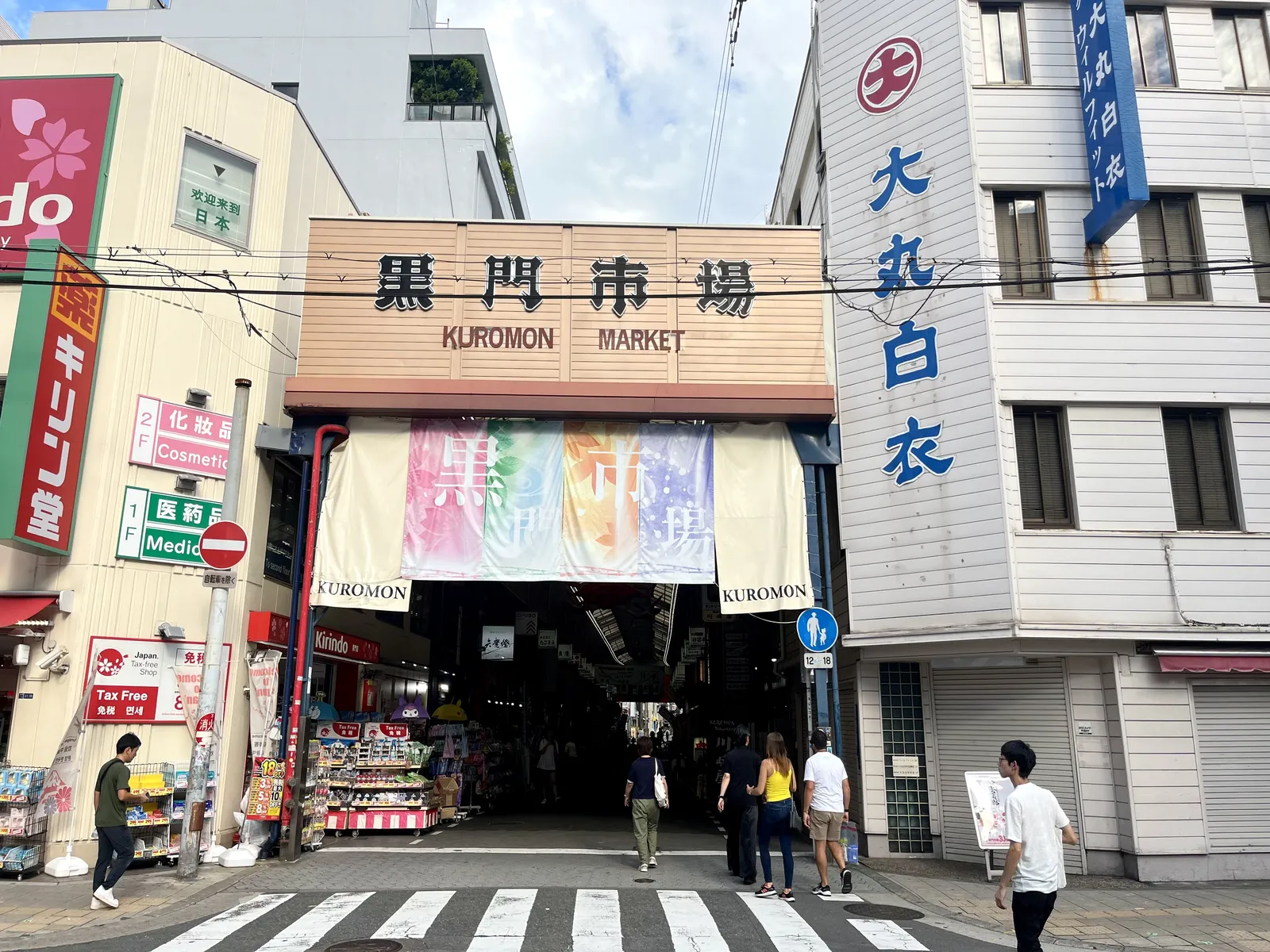
Where should you stay near Kuromon Market? Compare Nippombashi Station Exit 10 and lift access, step-free luggage routes from Kansai Airport, and verified quad room bed counts, child-sharing rules and laundry facilities at APA Tower, Kuromon Crystal Hotel and Holiday Inn.
Nippombashi Station Exits and Lifts: Plan the Luggage Route First
Osaka Metro Nippombashi Station serves as the interchange between the Sennichimae Line (S17) and Sakaisuji Line (K17), and connects underground to Kintetsu-Nippombashi Station. The station's official exit directory assigns both Kuromon Market and Den Den Town to Exit 10, positioned on the south-eastern corner of the Nippombashi intersection right beside the market block. Travelling hands-free or with a daypack, Exit 10 is easily the quickest way up.
The catch is that Exit 10 consists mainly of stairs and has no lift. According to Osaka Metro's official station layout diagram, lifts are installed at only three points: beside the East Ticket Gate (connecting street level and the B1 concourse towards Exit 7 and the National Bunraku Theatre), at Metro-operated Exit 2 (linking the Sennichimae Line and Sakaisuji Line platforms), and beside the Central-South Ticket Gate (linking street level, the B1 concourse and the Kintetsu transfer hall near Exit 5). Osaka Metro's barrier-free guide stitches these three lifts into two fully step-free paths to the street: from the Sennichimae Line platform up via the East Ticket Gate, or via the Central-South Ticket Gate.
If you are wheeling a large 28-inch suitcase, split your route by the line you ride in on. Arriving on the Sennichimae Line from Namba, resist heading straight for Exit 10's staircase; instead, take the East Ticket Gate or Central-South Ticket Gate lift to ground level and roll along the flat Sennichimae-dori pavement east towards Exit 10 and the market. Arriving from Umeda or Tenjimbashisuji 6-chome on the Sakaisuji Line, use the lift at Exit 2 inside the station to transfer onto the Sennichimae Line level rather than going up to the street and back down.
Travellers landing on red-eye or late-night flights should not rely on daytime habits alone. Nippombashi Station's layout chart lists specific operating hours for each ticket gate, with minor exits shuttered earlier at night. The diagram also marks several banks of coin lockers around Exit 1, Exit 3 and the Central-North Ticket Gate—handy if you are passing through between check-outs and want to browse Kuromon Market unencumbered before boarding your next train.
Visitors arriving from Nara or Mie via Kintetsu will find the Central-South lift the smoothest option, as Kintetsu-Nippombashi shares the underground concourse and the Central-South lift connects directly to the Kintetsu transfer hall without forcing you outdoors. Families pushing a buggy or travelling with a wheelchair should also note that the station's accessible multi-purpose toilet sits on the east side, on the same path as the east lift. Finally, hotels in this district state their exact recommended exits online—for example, Sotetsu Grand Fresa Osaka-Namba specifies a 2-minute walk from Metro and Kintetsu Exit 6—so follow your hotel's access page rather than generic map apps.
From Kansai Airport with Luggage: Nankai Rail Plus One Metro Stop
Per the Kuromon Market Association's official access map, the cleanest airport-to-market transfer is taking the Nankai Electric Railway to Nankai Namba Station (Nankai lists roughly 38 minutes on the Rapi:t Limited Express and 44 minutes on the Airport Express, while the market diagram rounds the Nankai leg to around 30 minutes), walking roughly 5 minutes to Osaka Metro Namba Station for one stop (about 3 minutes) on the Sennichimae Line to Nippombashi, and walking 5 minutes from Exit 10—or from a lift exit if you have suitcases. Almost the entire journey is step-free by lift, with the main legwork concentrated in the underground link between Nankai Namba and Metro Namba.
Once inside Nankai Namba Station, avoid rushing blindly out to the street. Station staff are posted at the 2F Central Ticket Gate and 3F North Ticket Gate, while the 2F South Ticket Gate remains open until 23:30; Nankai's station map clearly marks dedicated platform lifts, street-level lifts and the barrier-free corridor over to the underground network. After clearing the ticket barriers with your bags, follow the Metro signage into the connecting passage to stay indoors on smooth floors.
Osaka Metro Namba Station also provides complete step-free routing. Seven barrier-free access routes are published for the station; the most practical ones with large luggage run from the North Ticket Gate to street level via the River Place lift, the Maruito Namba Building lift or the OCAT Building lift, or from the North Ticket Gate straight into the NAMBA WALK underground shopping arcade, alongside internal lift links connecting the Midosuji and Yotsubashi lines to the Sennichimae Line. Follow the signs carefully and you will never need to carry bags up long stairs—the only price is a few dozen extra metres of indoor walking.
If your bags are light and you would rather skip re-entering the Metro for a single stop, walking through the underground arcade is a dry alternative. NAMBA WALK connects directly to Exits 2, 3 and 4 at Nippombashi Station, so you can enter from Namba's North Ticket Gate, stroll east underground, and emerge onto Sennichimae-dori at Nippombashi Exit 2, 3 or 4—far pleasanter than juggling an umbrella on rainy days. For a wider breakdown of Nankai trains, JR services and airport buses into the city, see our Kansai Airport to Osaka transfers guide; here, the focus is purely on handling luggage once you reach Namba.
If you arrive laden with suitcases and want to salvage your first afternoon, split the arrival into two clean moves: follow the lift route straight to your hotel to drop bags or check in, then head back out empty-handed to Kuromon Market or Dotonbori. Staying in Namba puts you one stop away from the market, while staying beside the market puts you steps from the arcade—making bag drop your first priority buys back hours of relaxed sightseeing.
Arriving via Shin-Osaka or JR: Midosuji Line to Sennichimae Line
Travellers arriving by Shinkansen from Tokyo or Hiroshima at Shin-Osaka Station have a straightforward route: ride the Osaka Metro Midosuji Line for about 15 minutes to Namba, then transfer inside the station to the Sennichimae Line for roughly 3 minutes to Nippombashi. Namba Station provides dedicated lift-equipped transfer corridors between the Midosuji and Sennichimae platforms, keeping pushchairs and pairs of large suitcases off the stairs.
Coming from Kansai Airport via the JR Hanwa Line and Kansai Airport Line takes around 40 minutes to JR Namba Station, dropping you inside the OCAT Building on Namba's western edge. OCAT has a large lift straight to street level and counts among Metro Namba's seven official barrier-free routes, though the indoor-and-surface trek from JR Namba across to the Sennichimae Line platform is noticeably longer than transferring from Nankai Namba—allow extra minutes if your bags are heavy. Conversely, hotels right beside JR Namba become effortless: APA Hotel & Resort Osaka Namba Ekimae Tower lists a 1-minute walk from JR Namba, 1 minute from OCAT and 2 minutes from Metro Namba Exit 30, letting you dump bags first and hop one stop to the market hands-free.
Domestic arrivals at Itami Airport connect just as neatly: following the market access guide, take the airport limousine bus roughly 25 minutes to Namba Station front and walk about 5 minutes into Metro Namba for the Sennichimae Line, or ride the Osaka Monorail 12 minutes to Senri-Chuo and switch to the Midosuji Line for around 30 minutes. With the coach option, heavy suitcases stay in the underfloor hold until the final 5-minute stroll into the station.
Quad Room Beds: Check Three Numbers on the Official Room Page
When booking for a family of four or four friends, never trust third-party platform labels at face value—open each hotel's official room page and check three concrete figures: maximum official occupancy, actual bed count, and the width of every bed. Many booking sites list a twin room that squeezes four guests as a "quad room", leaving two adults sharing a narrow mattress. Take two verified options: in the market block at Nippombashi 1-chome (a 3-minute walk from Nippombashi Station, on the same block as the market's west lanes), Kuromon Crystal Hotel offers a 36 sq m Connecting Room that joins two rooms into one unit with 4 single beds for 1 to 4 guests, guaranteeing a separate bed apiece.
Over on the Namba Station side, APA Hotel & Resort Osaka Namba Ekimae Tower sells two connecting room types with deceptively similar names and completely different sleeping setups. The T-T Connecting Quad Room measures 28 sq m with four 110 cm single beds for 2 to 4 guests, giving you two full bathrooms and toilets joined by an internal door so nobody queues for the shower; the S-S Connecting Twin Room measures just 22 sq m with two 140 cm double beds for 1 to 4 guests, meaning four guests sleep two to a 140 cm bed. Because APA Tower sits 1 minute from JR Namba and 7 minutes from Nankai Namba, it minimises luggage hauling, so double-check whether you are selecting T-T or S-S before paying.
Shared facilities widen the gap just as sharply as bed counts. APA Tower operates on a full resort scale with 805 guest rooms, serving breakfast in its 2F restaurant from 06:30 to 14:00 and in its 40F sky restaurant until 10:00, alongside the guest-only Genyo no Yu large public bath open 15:00 to 01:00 and 06:00 to 10:00. Eating early or soaking tired legs after walking the market happens without leaving the building; by contrast, neither Kuromon Crystal Hotel nor Holiday Inn lists a large public bath online, leaving bathing to in-room tubs—worth weighing if you are travelling with children.
Close to Dotonbori, Holiday Inn Osaka Namba features a 39.1 sq m Premium Quad Room pitched at families and groups, with 15:00 check-in, 11:00 check-out and a free luggage storage room, offering noticeably more floor space than standard business hotels. However, its room page leaves the exact bed count and widths unstated (other rooms on the same page only list single or double beds), so email or contact the property to verify the exact bed setup before reserving for four.
Scan the rest of Kuromon Market and Namba and genuine four-bed rooms prove rare. Sotetsu Grand Fresa Osaka-Namba tops out at three guests (two 110 cm beds plus an extra bed or sofa bed), Swissotel Nankai Osaka caps twins at three guests with an extra bed costing ¥10,000, Cross Hotel Osaka's 27 sq m Cross Triple holds three 110 cm beds, and The OneFive Osaka Namba Kuromon—just a 2-minute walk from both the market and Nippombashi Exit 5—likewise stops at triple rooms. Rather than cramming into an unverified quad room, booking two standard twin rooms often brings clearer pricing and far better sleep; put both totals side by side in a spreadsheet before deciding.
| Hotel and Location | Room Type | Beds and Capacity | Other Verified Conditions |
|---|---|---|---|
| APA Tower (Namba side, 1 min walk from JR Namba) | T-T Connecting Quad Room, 28 sq m | 4 beds x 110 cm; 2-4 guests | Two bathrooms/toilets plus internal door; 1 pre-school child free per bed |
| APA Tower (Namba side) | S-S Connecting Twin Room, 22 sq m | 2 beds x 140 cm; 1-4 guests | 2 guests per bed when sleeping four; in-room microwave |
| Kuromon Crystal Hotel (Market block, 3 min walk from Nippombashi) | Connecting Room, 36 sq m | 4 single beds; 1-4 guests | Two adjoining rooms; bed widths and check-out time not listed online |
| Holiday Inn Osaka Namba (Dotonbori side, ~6 min walk from Namba stations) | Premium Quad Room, 39.1 sq m | Listed for families/groups; exact bed layout not published | Check-in 15:00, check-out 11:00; free luggage storage room |
| Comparison: Sotetsu Grand Fresa / Swissotel / Cross / The OneFive | Maximum triple rooms | 110 cm twin beds plus sofa bed or extra bed | Swissotel extra bed ¥10,000; children 12 and under free sharing beds |
Two Adults and Two Children: Bed-Sharing Rules Decide the Real Price
When travelling with two children, each hotel's age cut-off for free bed-sharing (known as soine in Japan) often swings the final bill more than the nightly rate. Across all APA properties, one pre-school child per bed stays free when sharing with an adult: in APA Tower's T-T four-bed room, two adults and two children each take their own bed, whereas if both children are pre-schoolers you can save money in a twin room, or split comfortably across the two 140 cm beds in an S-S connecting room. Kuromon Crystal Hotel's FAQ likewise states that pre-school children stay free when sharing beds, and its four-single-bed connecting room removes any risk of restless little feet kicking adults out of bed.
Full-service hotels tend to set far higher age limits. Directly above Nankai Namba Station, Swissotel Nankai Osaka lets children aged 12 and under share existing beds free of charge, and a twin room can accommodate one rollaway extra bed (¥10,000) to bring capacity up to three paying guests. Whether a family of four fits in one room hinges on the children's ages: if both are 12 or under you have flexible options, whereas older children require booking two rooms. The hotel also allows free online reservations for cots for infants under two years old and under 15 kg—helpful for parents with pushchairs who want direct airport train access.
Before comparing quotes, convert every bed rule into a total stay price. For two adults and two children, APA's four-bed quad avoids extra-bed surcharges altogether, Swissotel may add ¥10,000 per night for a rollaway, and Kuromon Crystal charges by the room with pre-schoolers free. International booking portals sometimes calculate non-bed-occupying children differently from hotel websites, so classify your children against the hotel's official wording first before trusting checkout totals at the front desk.
Run a quick test case with an eight-year-old and a five-year-old and the gap is immediate. Under APA's policy, only the five-year-old qualifies as a free pre-schooler while the eight-year-old requires their own bed, making the T-T four-bed room the cleanest choice so all four sleep separately. Under Swissotel's policy, both children are 12 or under and qualify for free bed-sharing, meaning a twin plus one extra bed works on paper—though besides the ¥10,000 nightly fee, you should check the floor plan to see how much floor space remains to open suitcases once the rollaway goes in. Spending five minutes checking official rules pays for itself immediately.
Cooking or Doing Laundry: Check Facilities Hotel by Hotel
Many travellers picture buying wagyu beef and fresh shellfish in Kuromon Market to cook back in their room, yet none of the mainstream hotels verified inside the market block provide kitchens. Kuromon Crystal Hotel's facilities page lists only a ground-floor reception and breakfast area, while The OneFive and HOTEL B Suites show no hobs or washing machines on their room pages. Anything bought at the market for your room must realistically be cooked to order by the vendor, ready-to-eat sashimi, or chilled snacks tucked into a mini-fridge for later; drop "must have a hob" from your filter list and room hunting gets far easier.
If you are staying three or four nights and need laundry machines or a microwave to heat takeaways, look slightly further towards Namba or Yotsubashi. Sotetsu Grand Fresa Osaka-Namba explicitly lists coin-operated washing machines and microwaves on-site, while select rooms at APA Tower include an in-room microwave (though its website lists no coin laundry). If an in-room washer-dryer and induction kitchenette are non-negotiable, our where to stay in Osaka overview already vets four-person serviced apartments around Yotsubashi—far better to base yourself there and hop one Metro stop in for breakfast than hunt for facilities the market hotels do not have.
Anyone planning a final laundry cycle around check-out should line up check-in and check-out times early. Sotetsu typically runs 15:00 check-in and 11:00 check-out, APA sets 10:00 check-out for non-members (11:00 for members), and Kuromon Crystal operates a 24-hour front desk with luggage storage both before check-in and after check-out. Choosing a property with coin laundry inside the building keeps your morning schedule from colliding with a tight 10:00 departure.
Market Hours Vary by Stall and Day of the Week
Kuromon Market does not run on a single opening or closing bell; its association website lists opening hours and regular closing days stall by stall. Spot-checking established traders shows the spread: a popular tuna specialist opens from 08:00 to 16:00 and closes early once sold out; a traditional dried-goods merchant trades 09:00 to 17:00 year-round except for a few days at New Year; a specialist tamagoyaki shop opens 10:00 to 17:00 and shuts an hour earlier on Saturdays; and a heritage tea merchant keeps 09:00 to 17:00 with a five-day New Year break. Inside the same arcade, opening times span from early morning right through to 10:00.
The official North Entrance Information Centre sets out its own reliable schedule: open daily from 09:00 to 18:00 with free seating, toilets and a foreign-currency exchange machine. If you arrive early before your target stalls raise their shutters, take a seat here while mapping out your stops on the arcade guide—it is the easiest meeting point when exploring with older relatives or young children.
Timing your visit backwards from those hours prevents wasted trips: at 07:00 almost nothing is open, after 08:00 freshly sliced tuna rice bowls and charcoal skewers start coming off the grill, and arriving between 09:00 and 10:00 catches roughly 90% of shops open for business. Watch for "until sold out" notes on popular seafood counters rather than leaving them until 15:00 or 16:00, while supermarket-style grocers and pharmacies inside the arcade stay open later for everyday supplies. Specific sit-down lunch spots inside the market are covered in our three days in Osaka itinerary, making it easy to slot your visit into the right window.
If your dates fall on a weekend or around Japan's year-end and New Year holidays, check individual stall holidays before setting out. Regular days off are scattered across Monday through Sunday, and multiple traders close for several days around New Year, while places like omelette and produce stalls often trim Saturday hours—a quick glance at the association's directory tiles each morning saves a detour.
Getting Back at Night: Three Straightforward Routes
Once the market shuts down around dusk, guests staying near the north entrance still tend to head towards Namba or Dotonbori for dinner. Three simple routes bring you home afterwards: if your feet ache, take the Sennichimae Line one stop from Namba to Nippombashi and exit via Exit 10; if you want a post-dinner stroll with light bags, walk east along the north bank of the Dotonbori Canal; and if it is windy or raining, enter NAMBA WALK via Namba's North Ticket Gate and resurface at Nippombashi Exits 2, 3 or 4.
After dark, the Kuromon Market arcade looks worlds apart from its daytime bustle—once the metal shutters roll down, the lanes are lit only by streetlamps and the glow of vending machines. Walking back at night feels brighter and more straightforward along busy Sennichimae-dori or through the underground arcade. Guests staying on the Namba Station side avoid this altogether: APA Tower's Genyo no Yu bath stays open until 01:00 and reopens at 06:00, letting you soak right after dinner and save the one-stop ride to the market for morning.
For late-night cravings, several supermarket-style shops within the market block stay open late alongside the dense run of convenience stores lining Sennichimae-dori, so picking up cold drinks, fruit or microwave bento boxes is effortless. Just check your room spec before buying hot food: select APA Tower rooms include a microwave, whereas Kuromon Crystal provides an in-room fridge—another payoff for checking official room lists ahead of time.
Arriving into Kansai Airport on a late flight means checking both hotel check-in cut-offs and station gate hours. Kuromon Crystal Hotel's FAQ confirms check-in is accepted until 02:00 JST (listed as 26:00) with a 24-hour front desk, allowing smooth late arrivals at Nippombashi; on the rail side, note that Nankai Namba's 2F South Ticket Gate closes at 23:30, after which you simply exit via the Central or North gates, ride the Sennichimae Line one stop to Nippombashi, and take the Central-South lift up to Sennichimae-dori.
Early Flights and Departures: Which Side Works Better
When it is time to haul souvenir-stuffed bags back to Kansai Airport, the Namba Station side doubles in value. Nankai's Rapi:t Limited Express and Airport Express depart Nankai Namba from early morning, and nearby hotels sit just minutes from the barriers—Swissotel Nankai Osaka sits roughly 2 minutes on foot from the 3F North Ticket Gate, and APA Tower is only 7 minutes from Nankai Namba. Guests staying beside Kuromon Market simply add one metro leg from Nippombashi back to Namba before transferring to Nankai; allow an extra 15-minute buffer on departure morning and the trip stays completely unhurried.
If your flight leaves in the afternoon or evening, using hotel bag storage effectively buys back half a day. APA Tower offers free same-day luggage storage (items must be collected the same day), Kuromon Crystal stores bags at reception both before check-in and after check-out, and Holiday Inn provides a dedicated luggage room. Drop your cases at reception after check-out, slip back into Kuromon Market hands-free for dried kelp or one final seafood lunch, and collect your bags before heading to the station rather than wedging wheeled luggage down narrow market aisles.
One Base or Split Stay: Connecting Nara, Kyoto and Universal Studios Japan
For a three-night stay in Osaka centred on morning markets, decide whether to stay put or split bases according to how much luggage shuffling you can tolerate. One smooth approach is spending night one beside Namba Station to keep airport arrival effortless, then moving one stop the next morning to a market-side hotel for two nights of doorstep market breakfasts; another is sandwiching the market stay between Namba nights. Market-area properties such as Kuromon Crystal and Holiday Inn offer 36 to 39 sq m connecting or family rooms, often leaving noticeably more floor space to open two or three large suitcases than compact station-top business rooms.
For regional day trips, staying on the Nippombashi side quietly pays dividends. Heading to Nara requires no detour back to Namba: Kintetsu-Nippombashi Station sits right on the market's western flank, with Nippombashi Exit 4 marked directly as the Kintetsu connecting entrance for straightforward direct trains listed on Kintetsu's timetable. Heading towards Kyoto is equally neat via the Sakaisuji Line north from Nippombashi—transfer at Kitahama to the Keihan Railway or stay on direct through-services onto the Hankyu Kyoto Line without fighting through Namba's main concourse crowds.
The one day trip that turns awkward from Nippombashi is Universal Studios Japan, which requires heading via Namba onto the JR Osaka Loop Line and changing to the JR Yumesaki Line—a tiring commute for a family chasing rope-drop entry, where shifting to a park-side hotel the night before often makes more sense. Ticket options and early-entry timing are set out in our Universal Studios Japan ticket guide, with park hotel picks in the where to stay in Osaka guide; splitting your stay along those three-corner lines keeps travel fatigue to a minimum.
To put that into practice, consider a ready-made three-day, two-night plan: land on day one afternoon and take the Nankai train into Namba, drop heavy suitcases at your Namba hotel, eat around Dotonbori and unwind in the public bath; check out on day two morning, ride one stop on the Sennichimae Line to stash bags in a four-bed connecting room by Kuromon Market, work your way south through the arcade for brunch, and head back to Namba for yakiniku dinner; on day three morning, grab breakfast and dried goods in the market, collect your bags, take the Central-South lift down into Nippombashi Station, and ride one stop back to Namba for the airport train. Over three full days, your suitcases move just three times, and never more than one Metro stop.
Pre-Booking Checklist
Before clicking pay, spend three minutes running through five checks: whether actual bed counts and bed widths comfortably fit four adults or two adults and two children; whether published room capacities include bed-sharing children; whether the nearest station exit has lift access confirmed on the official station map rather than a phone app; whether coin laundry and microwaves exist in the room or building; and how pre-check-in and post-check-out luggage storage works. Clear all five hurdles before comparing nightly rates, so you never end up carrying heavy bags up stairs to save a few hundred yen.
Always verify every detail on the hotel's own website, opening both the Rooms page and the Access page side by side: the Rooms page locks down true bed numbers, bed widths and guest limits, while the Access page confirms the exact nearest station, exit number and walking minutes. Whenever an official page leaves key specifics blank—such as Kuromon Crystal Hotel's exact bed widths or Holiday Inn's quad bed count—email, call or run a four-guest search on the hotel's direct booking engine before placing it on your shortlist.
One final hidden cost sits inside cancellation terms. At Kuromon Crystal Hotel, for instance, cancelling seven to two days before arrival incurs a 50% fee, rising to 100% the day before or on check-in day, while APA and major chains split rates between non-refundable advance deals and flexible plans. If your travel dates or headcount might still shift, record cancellation deadlines alongside prices in your comparison sheet—saving a few thousand yen on an advance rate is rarely worth losing an entire night's deposit if plans change.
A few useful answers
Which exit at Nippombashi Station has a lift?
Exit 10 is the closest to the market, but it relies mainly on stairs. According to the Nippombashi Station map, lifts are located in three places: by the East Ticket Gate (near Exit 7 and the National Bunraku Theatre, connecting street level and B1), at Metro-operated Exit 2 (linking the Sennichimae Line and Sakaisuji Line platforms), and by the Central-South Ticket Gate (near Exit 5, connecting street level, B1 and the Kintetsu concourse). If you have large suitcases, take the East or Central-South lift to street level and walk along the pavement to the market.
Is it better to stay in Namba or Nippombashi for Kuromon Market?
If you want to step straight out into the market for an early breakfast, staying on the Nippombashi Station side puts you closest—the official Kuromon Market access guide lists a 5-minute walk from Exit 10. If your trip centres on Dotonbori and Shinsaibashi nightlife, or you want to wheel your bags straight off the Nankai Airport train into your lobby, the Namba Station side is easier and only one stop away on the Sennichimae Line the next morning.
Do quad rooms near Kuromon Market always give four guests four separate beds?
Not necessarily—always check the hotel's official room page. The T-T Connecting Quad Room at APA Hotel & Resort Osaka Namba Ekimae Tower has four 110 cm beds, and the 36 sq m Connecting Room at Kuromon Crystal Hotel has four single beds, giving every guest their own bed. By contrast, APA Tower's S-S Connecting Twin Room sleeps up to four across two 140 cm double beds (two guests per bed), while Holiday Inn Osaka Namba's 39.1 sq m Premium Quad Room does not specify bed count online and must be confirmed with the hotel before booking.
What is the easiest route with heavy luggage from Kansai Airport to a hotel near Kuromon Market?
Take the Nankai Electric Railway from Kansai Airport to Nankai Namba Station (around 38 minutes on the Rapi:t Limited Express or 44 minutes on the Airport Express), follow the step-free signs indoors to the Osaka Metro Sennichimae Line, ride one stop to Nippombashi Station, and use the East or Central-South Ticket Gate lift to reach street level. The only stretch requiring much walking is the underground passage between Nankai Namba and Metro Namba.
Can you buy late-night food if you stay right next to Kuromon Market?
Most seafood stalls and cooked-food vendors inside Kuromon Market wind down before evening, so it is best to have dinner around Dotonbori or Namba before walking back. For late-night snacks, fruit or microwave meals, there are late-opening supermarket-style grocers inside the market block and plenty of convenience stores along Sennichimae-dori.
Official information and references
Sources used in this guide.
- Kuromon Market | Official Access Guide (5-min walk from Exit 10 and airport route map)
- Kuromon Market Association Member Shop Map (24 February 2026 PDF)
- Kuromon Market | Member Shop Opening Hours and Closing Days
- Osaka Metro | Nippombashi Station (S17) Station Information and Barrier-Free Routes
- Osaka Metro | Nippombashi Station Exits and Surroundings (Exit 10 = Kuromon Market)
- Osaka Metro | Nippombashi Station Layout Map PDF (Three Lifts and Ticket Gates)
- Osaka Metro | Namba Station (S16) Barrier-Free Entrance and Exit Routes
- Nankai Electric Railway | Namba Station Information (Ticket Gates and Lifts)
- Nankai Electric Railway | Travel Times from Kansai Airport (Rapi:t ~38 min, Airport Express ~44 min)
- APA Hotel & Resort Osaka Namba Ekimae Tower | Guest Rooms (T-T Connecting Quad, S-S Connecting Twin)
- APA Hotel & Resort Osaka Namba Ekimae Tower | Access (JR Namba, OCAT, Metro Exit 30)
- APA | Member Check-out and Check-in Times
- APA Hotel & Resort Osaka Namba Ekimae Tower | Luggage Storage Notice
- APA | Free Bed-Sharing Policy for Pre-School Children
- Kuromon Crystal Hotel | Guest Rooms (36 sq m Connecting Room, 4 Single Beds)
- Kuromon Crystal Hotel | FAQ (Luggage Storage, Child Bed-Sharing, Cancellation Policy)
- Holiday Inn Osaka Namba | Guest Rooms (39.1 sq m Premium Quad Room)
- Holiday Inn Osaka Namba | Hotel Information (Check-in/out, Luggage Storage)
- Sotetsu Grand Fresa Osaka-Namba | Guest Rooms (Maximum Triple Room and Sofa Bed)
- Sotetsu Grand Fresa Osaka-Namba | Access (Kintetsu-Nippombashi and Metro Nippombashi Exit 6)
- Swissotel Nankai Osaka | FAQ (Twin Room Extra Bed and Child Bed-Sharing)
- Cross Hotel Osaka | Cross Triple Room
- The OneFive Osaka Namba Kuromon | Hotel Information (Nippombashi Exit 5, 2-min walk to Kuromon Market)