How to explore Noboribetsu Jigokudani for free: ride the Donan Bus from JR Noboribetsu Station to link Hell Valley, Lake Oyunuma, the natural footbath, and the hot spring town—plus 2026–27 winter road closures, Bear Park vs. Marine Park Nixe, day-use baths, and where to stay.
- Region & Focus
- Noboribetsu
- Reading Scope
- 17 min read · 11 chapters · 5 Q&As
- Official Verification
- 35 official sources checkedUpdated November 22, 2026
- Key Topics
- First tripItinerariesRail travel
Chapter Route Map (tap any stop)
- How to Walk Jigokudani, Starting at the First Observation Deck
- Extending the Walk to Oyunuma and the Natural Footbath
- 2026–27 Winter Road Closures: Trails vs. Roads
- Getting to Noboribetsu Onsen from Sapporo and New Chitose Airport
- Where to Park: Two Options Between Jigokudani and Town
- Noboribetsu Bear Park: Best When Spending Half a Day in Town
- Marine Park Nixe vs. Date Jidaimura: How to Sequence Them
- Gokuraku-dori and Enma-do: Strolling Downhill
- Day-Use Soaks: A ¥500 Sento or a Multi-Spring Grand Bathhouse
- Where to Stay Overnight: Working Backward from Luggage and Dinner
- Pacing Half-Day, Full-Day, and Two-Day Trips
- Quick Q&A
On your first visit to Noboribetsu Jigokudani, walk from the hot spring town to the crater observation deck, then follow the open boardwalk toward Tessen-ike. Entry to Jigokudani is free, and the Donan Bus from JR Noboribetsu Station to Noboribetsu Onsen costs ¥450 one way for adults. With half a day, focus on the crater, Gokuraku-dori street, and one day-use bathhouse. With a full day, choose between the forest trails and Noboribetsu Bear Park. Starting December 2026, the road to Lake Oyunuma closes from the Jigokudani side, so winter visitors can keep their route to the observation deck and hot spring town, or visit the aquarium next to the train station instead.
How to Walk Jigokudani, Starting at the First Observation Deck
JR Noboribetsu Station sits on the coast, while Jigokudani lies inland in the mountain town of Noboribetsu Onsen. Once you arrive in town, walk from the bus terminal along Gokuraku-dori toward Dai-ichi Takimotokan, then follow the Jigokudani signs uphill in front of the hotel. If your bus stops at Daiichi Takimoto-mae, get off there to skip part of the shopping street. Set your map's first pin to the Noboribetsu Park Service Center: the observation deck sits right beside it, and the Jigokudani Parking Lot enters and exits here.
The first observation deck overlooks the entire volcanic crater. According to the Noboribetsu Tourism Association, the basin was formed by volcanic activity on Mount Hiyori and measures about 450 meters across and 11 hectares in area. From the railing, you can trace the pale valley floor, exposed orange-brown rock walls, and forested ridge behind them at distinct elevations. White steam drifts with the wind and occasionally hides the lower basin. For clear photos of the valley floor, stay at this upper deck until a breeze parts the steam—walking farther into the valley narrows your angle.
A paved ramp leads from the service center to the observation deck, with an official maximum grade of 8%. Travelers with strollers, wheelchairs, or limited mobility can treat this deck as the main viewpoint and exit the same way. To continue deeper in, follow signs for the Jigokudani Promenade and Tessen-ike. The wooden boardwalk brings you down alongside steaming hot-spring runoff and ends at a small platform near Tessen-ike. Visitors must pass single-file along narrower stretches, so wait for wider spots beside the railings before stopping for photos.
The tourism association's walking map lists the Jigokudani Promenade at 568 meters, or roughly 10 minutes of straight walking. On a first visit, budget 35 to 50 minutes to cover the deck, boardwalk, and return trip. Tessen-ike is a small geyser inside the valley; the tourism association notes that tall spouts have been rarer in recent years, making the hot-spring stream running beneath the boardwalk the real highlight. If you are with children or older travelers and the planks look slick or crowded, viewing the whole basin from the entrance platform still gives clear views of the rock walls and fumaroles.
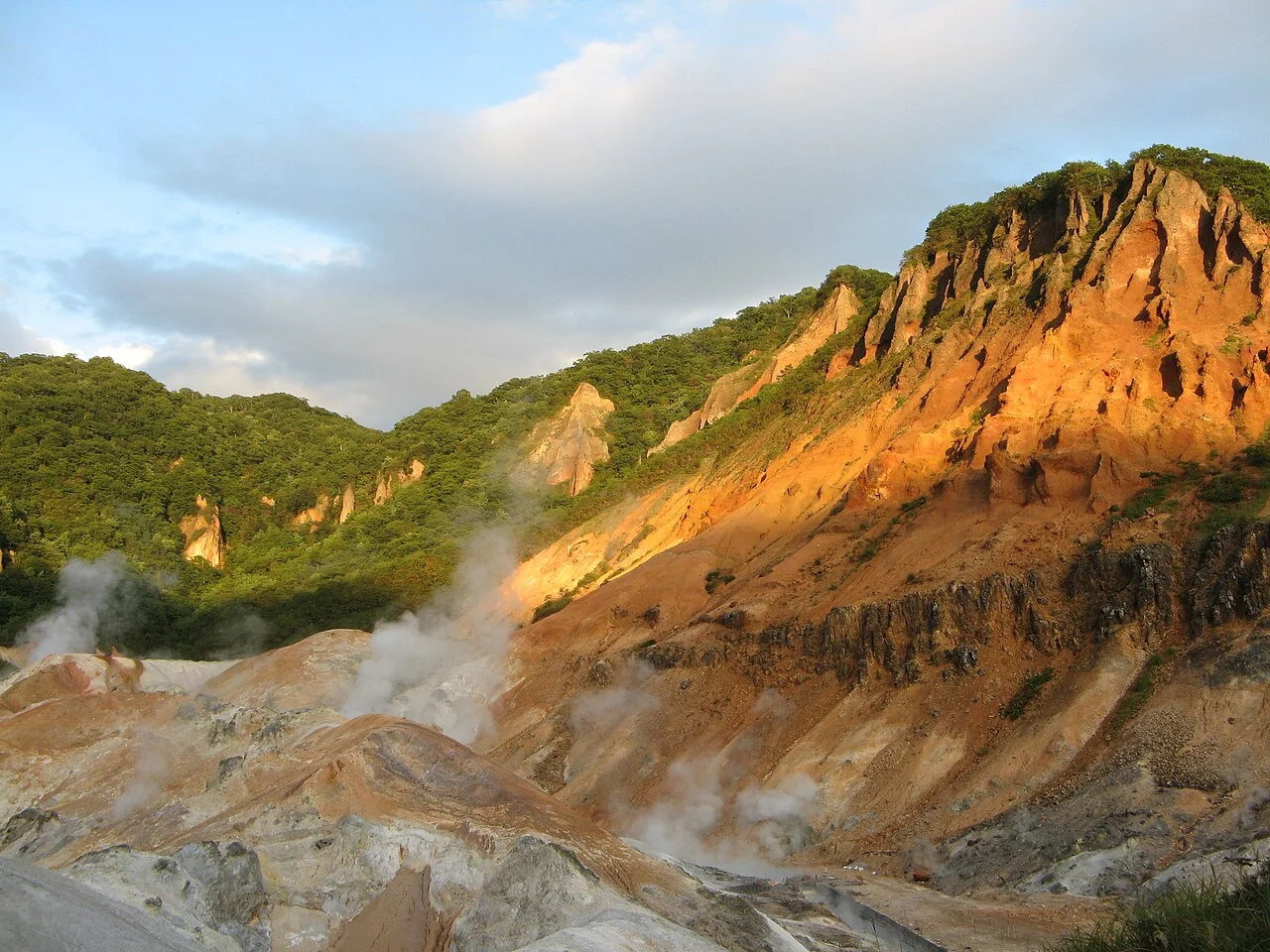
How to explore Noboribetsu Jigokudani for free: ride the Donan Bus from JR Noboribetsu Station to link Hell Valley, Lake Oyunuma, the natural footbath, and the hot spring town—plus 2026–27 winter road closures, Bear Park vs. Marine Park Nixe, day-use baths, and where to stay.
Extending the Walk to Oyunuma and the Natural Footbath
After returning from Tessen-ike to the valley mouth, you can branch onto the forest trails heading toward Oyunuma. Check the trail map at the entrance before setting off, since the Oyunuma Promenade, Oyunuma No. 2 Promenade, and Oyunumagawa Nature Trail mark distinct segments. Set aside about two hours for the full loop, factoring in hills, photo stops, and the walk back into town from the footbath side. To link the whole route cleanly, head from Jigokudani to Oyunuma, view Okunoyu beside it, then follow the downstream Nature Trail out past Sekisuitei back to town streets.
Oyunuma sits at the base of Mount Hiyori as a crater lake formed by a steam explosion. Lookouts show gray-black water and an uneven shoreline, while Okunoyu is a smaller steaming pond nearby. Around the parking area, stick to designated viewpoints and stay behind the railings. The natural footbath sits farther downstream, where overflow from Oyunuma feeds a forest river outfitted with wooden seating for soaking your feet. Save both "Oyunuma" and "Oyunumagawa Natural Footbath" in your map app ahead of time so you are not hunting for the shoe-removal deck after reaching the lake.
Pack a small towel, pants that roll comfortably above your calves, and an extra pair of dry socks after rain. Find a spot for your shoes on the wooden deck first, and test the water temperature with your toes before letting kids sit at the edge. Anyone pressed to catch a bus or train will save time by entering and exiting directly from the footbath side—use "Ashiyu Iriguchi" (Footbath Entrance) or "Noboribetsu Sekisuitei" as your navigation target. The footbath has no parking lot of its own, so drivers either connect on foot from the Oyunuma Parking Lot or leave the car at a compliant lot in town and walk the whole way.
2026–27 Winter Road Closures: Trails vs. Roads
The Hokkaido Iburi General Subprefectural Bureau closes Prefectural Road 350 (the Kuttara Lake Park Line) in two stages. On November 9, 2026 at 15:00, the stretch between the Oyunuma gate and the Naka-Noboribetsu side closes first. On December 1, 2026 at 15:00, the closure extends toward the hot spring town to the Jigokudani gate, remaining in place on the schedule until April 16, 2027 at 10:00. Noboribetsu City's winter road list also schedules Municipal Road Oyunuma Line 1 to Okunoyu for closure from December 1 through April 16. Winter drivers should cross the Oyunuma Parking Lot off their map options and park at Jigokudani or in town.
The Jigokudani observation deck stands outside the closed road zone. Mountain trails toward Oyunuma may carry separate closure notices, while the footbath retains a pedestrian entrance on the Sekisuitei side. In snowy weather, start with the route from the service center to the deck, and add the Tessen-ike boardwalk only if it is open and footing feels secure. For the footbath, walk from town to the Sekisuitei-side entrance and return the same way if open; if a closure sign is posted at the trailhead, head back to Gokuraku-dori for a day-use bathhouse instead.
In addition, Noboribetsu City announced on November 20, 2026 that river-improvement work on the Jigokudani River will keep parts of the roadway near Jigokudani under alternating single-lane traffic through late March 2028. Standard construction hours run 10:00 to 17:00, generally pausing on weekends. Build that single-lane delay and car-pickup time into your schedule whenever driving back down to catch a train or flight. On autumn foliage weekends, if uphill traffic stalls before the valley, pull into a public lot down in town and walk up through the shopping street.
Winter boardwalks often accumulate packed snow, with ice forming on turns and in shaded corners. Prioritize slip-resistant footwear and free hands over carrying bulky camera gear. When snow falls heavily and visibility drops, wrap up after watching the steam from the first observation deck. If you have daylight the following morning, finishing the walk after breakfast beats searching for snowy trail junctions after dinner.
Getting to Noboribetsu Onsen from Sapporo and New Chitose Airport
From Sapporo, board the JR Limited Express Hokuto or Suzuran to Noboribetsu Station. Both trains run with all-reserved seating, so reserve outbound and return seats ahead of time. Enter "Noboribetsu" as your destination; after passing through the station gates, walk to the "Noboribetsu-ekimae" bus stop out front. Once your return train is booked, count backward from departure to pick your connecting bus. Save both timetables on your phone so you can tell at a glance whether you have time for a meal in town or need to head down the mountain.
Standard JR reserved seats go on sale one month before the travel date at 10:00 JST. Around Year-End and New Year holidays or on early weekend departures, secure adjacent train seats first, then match your bus. Noboribetsu Station's new station building and elevator-equipped overpass are open, so travelers hauling large suitcases can head straight for the elevators. If you have time before the bus, the Noboribetsu City Tourism Exchange Center "Nupuru" next door offers tourist information and a first-floor lounge open 9:00 to 17:30 daily (closed December 29 to January 3). Same-day luggage storage costs ¥700 per piece with pickup by 17:00. Guests staying in the hot spring town who want to tour the aquarium hands-free can drop bags at the desk before 14:00 for delivery to town lodgings at ¥1,500 per piece. Day-trippers planning an evening soak should bring luggage up to the onsen area and store it there so you are not racing a 17:00 pickup cutoff.
Donan Bus lines NA, NB, NC, and ND serve the corridor between Noboribetsu-ekimae and the onsen district with slight stop variations. The operator lists an adult one-way fare of ¥450 to "Noboribetsu Onsen" and about 27 minutes end-to-end on the route page, though actual travel time depends on the specific departure. Some buses terminate at the Noboribetsu Onsen terminal, while others continue to "Noboribetsu Onsen Chuo," "Daiichi Takimoto-mae," "Park Hotel-mae," and "Ashiyu Iriguchi." If you have bags and are staying at Dai-ichi Takimotokan or Sekisuitei, catching a bus that goes past the terminal saves an uphill haul. For the return trip, check the timetable from the onsen area to Noboribetsu Station, reading down from the column for your boarding stop. None of these buses accept Suica or Kitaca; NA and NB accept Visa contactless tap, while cash is simplest on other departures.
Traveling by JR from New Chitose Airport requires taking the Rapid Airport train to Minami-Chitose and transferring to a limited express bound for Noboribetsu. Make sure your transfer reads "Minami-Chitose"—dropping "Minami" sends you to downtown Chitose instead. Expand the full itinerary when booking tickets so both the Minami-Chitose transfer and the station-front bus connection fit comfortably, and build in buffer time for immigration and baggage claim. For winter flights landing close to dinner, save your hotel's address and phone number on your phone so you can hand them to a taxi driver if you miss the bus.
Donan Bus also runs the Kosoku Noboribetsu Onsen Airport-go straight to the hot spring town, which spares transfers when you have large suitcases or a hotel near a drop-off stop. Under the operator's Fare A table for December 2026 through March 2027, adult one-way tickets cost ¥2,400 between New Chitose Airport and Noboribetsu Onsen, while the direct "Kosoku Onsen-go" from Sapporo costs ¥3,800 one way. Both routes require online reservations that close two hours before the bus leaves its origin terminal—even if you board at an intermediate stop. On the winter schedule, for example, the Airport-go leaves International Terminal Stop 86 at 14:10, stops at Domestic Stop 29 at 14:11 and Domestic Stop 2 at 14:13, and reaches Noboribetsu Onsen at 15:18. International arrivals can head straight to Stop 86, and departures back to the airport drop off by terminal. The same timetable lists the Sapporo direct bus departing Sapporo-ekimae Stop 7 at 13:40 and arriving at Noboribetsu Onsen at 15:20, with the return leaving the main Noboribetsu Onsen stop at 9:30. Riding this direct bus both ways works best for overnight stays; Sapporo day-trippers hoping to see Jigokudani in the morning gain far more daylight by taking JR plus the local bus.
Where to Park: Two Options Between Jigokudani and Town
Searching "Jigokudani Parking Lot" brings you right to the valley entrance, making it the easiest option if someone in your group prefers to skip the long uphill walk from town or if you are only making a brief stop. The Natural Parks Foundation lists parking at ¥500 for standard passenger cars. When the Oyunuma Parking Lot is open, one parking ticket covers a single entry at both lots, so hold onto your receipt when leaving Jigokudani. The Oyunuma road restricts vehicle width, so cars 2 meters or wider must use the Jigokudani Parking Lot. Even if you drive between the two areas, you will still walk around the crater, lake, and footbath, and you only pay parking once up front.
If your plans combine lunch, souvenir browsing, and a soak, use the newer municipal "Noboribetsu Onsen Parking Lot" in town as a backup. Open 24 hours, it charges ¥500 during regular periods and ¥800 during peak periods per 24 hours from entry, with roughly a 15-minute walk up to Jigokudani. Because it is a city-run lot using license-plate payment, the shared Jigokudani–Oyunuma ticket does not apply here. On busy autumn weekends, check the queue approaching the crater; if cars are already backed up onto the main street, park down in town and walk up along Gokuraku-dori. Early risers chasing clear morning crater light can park at Jigokudani first and walk down for shopping before returning to the car. Before check-in, ask your ryokan how early you can park or drop bags so you don't drive the mountain road twice.
Drivers visiting for autumn foliage can add Shin-Noboribetsu Ohashi bridge on the way into or out of town. The vermilion bridge spans the Noboribetsu River gorge, and parking at one end leads onto a lookout path where you can view the valley safely off the roadway. If leaves around the bridge have mostly dropped, shift your focus to the rock walls at Jigokudani and the water and forest line at Oyunuma instead of concentrating every stop in one spot. Because late-autumn light fades early, visit the gorge lookout first and finish with lunch or a soak in town. On a tight one- to two-hour drive, prioritize Jigokudani and save the bridge for a quick pull-off on your way toward the next city.
Driving from Sapporo toward Lake Toya leaves comfortable time for a short Jigokudani loop before checking into a lakeside hotel. If you want to hike the full forest trail, eat lunch in Noboribetsu Onsen, and explore Lake Toya without rushing, split them across two days. Even by rail, map all the way to your final door: Noboribetsu Station connects by local bus to the onsen town, and Toya Station requires another bus transfer out to the lakefront. Base dinner reservations on door-to-door travel times rather than just the express train ride between JR stations.
Noboribetsu Bear Park: Best When Spending Half a Day in Town
The base station for the Noboribetsu Bear Park ropeway sits right inside the hot spring town. Admission includes the roughly 7-minute round-trip gondola ride up the mountain: ¥3,200 for adults, ¥1,600 for ages 4 through grade 6, and free for ages 3 and under. The park estimates 60 to 90 minutes for a visit, so block out two hours on your schedule to cover walking over from Jigokudani, queuing for the ropeway, seeing the Ezo brown bears and museum, and riding back down. If your group only wants a quick look at the bears before descending, spot the return ropeway entrance as soon as you reach the summit so you can pace the rest of your visit.
Hours run 9:30 to 16:30 (last entry 15:50) from October 21 to April 20, and 9:00 to 17:00 (last entry 16:20) from April 21 to October 20. Statutory ropeway inspections and facility maintenance will close the park from April 5 to April 23, 2027, with reopening on April 24. Strong winds or thunderstorms can also suspend the ropeway, which is the only passenger link to the summit. If high winds are in the forecast, keep the aquarium or a day-use bathhouse in mind as your backup until operations are confirmed.
Wheelchair users should check in at the base ticket office so staff can guide you to the dedicated boarding route. Because gondola doors are narrow, the park generally asks visitors to transfer into a facility-provided wheelchair and requires at least one companion on board. Parts of the summit still involve stairs, including the museum's second floor and the rooftop Lake Kuttara observatory. Families with mixed mobility can agree to meet outside the museum while stair-climbers head up for the lake view. Free wheelchair and stroller rentals are available, and diaper-changing tables are installed in designated restrooms at both the base and summit.
Marine Park Nixe vs. Date Jidaimura: How to Sequence Them
Noboribetsu Marine Park Nixe is about a 5-minute walk from JR Noboribetsu Station, giving train travelers arriving from Sapporo in the rain an immediate indoor stop. Its castle-style main building houses the aquariums and exhibits, and you can time dolphin or penguin appearances around the daily show schedule. Several shows and walkways between buildings are outdoors, so focus on the main indoor halls during heavy rain. Open 9:00 to 17:00 (last entry 16:30), the park closes for maintenance from April 12 to April 16, 2027. Admission is ¥3,200 for adults (junior high and up), ¥1,600 for ages 4 through elementary school, and free for ages 3 and under.
With kids, pick one priority show first and fit the remaining tanks around it. On a JR day trip, visit the aquarium in the morning, catch the station-front bus up to Jigokudani in the afternoon, and return straight from town. Overnight guests can flip the order: check out, come down the mountain, store luggage at the aquarium, tour the park, and catch your next train. Suitcases too large for coin lockers can be checked at the entrance building service desk for ¥500 per piece (accepted 9:00 to 16:30, pickup by 17:00; keep electronics and valuables with you), leaving enough margin to cross the station overpass afterward.
Noboribetsu Date Jidaimura sits partway between the train station and the hot spring town, making it easy to visit before heading up the mountain if you want Edo-era streetscapes, ninja shows, or period theater. Donan Bus timetables list both "Noboribetsu Jidaimura-mae" and "San-ai Byoin Noboribetsu Date Jidaimura-mae"—boarding a bus that stops at the former drops you closer to the gate. Read down a single column on the official timetable to verify the exact stop. Admission is ¥3,300 for adults, ¥1,700 for elementary students, and ¥600 for ages 4 through preschool. Winter hours (November 1 to March 19) close at 16:00 with last entry at 15:00, and maintenance closes the park from March 8 to March 11, 2027. To catch live theater, plan backward from showtimes upon arrival and save shop browsing for the gaps. Limiting paid parks to one per day keeps you from rushing between curtain times.
Anyone visiting in early April 2027 needs to check overlapping maintenance schedules. From April 5 to April 11, both Bear Park and Dai-ichi Takimotokan are closed, so start at Marine Park Nixe near the station. From April 12 to April 15, Nixe closes as well, leaving daytime plans best focused on the short Jigokudani loop, Gokuraku-dori, and Yumoto Sagiriyu. If riding the Bear Park ropeway is your group's top goal, push the trip to April 24 or later after reopening.
| Attraction | Location | Best Way to Schedule |
|---|---|---|
| Noboribetsu Bear Park | Ropeway base station in the hot spring town | Pair with Jigokudani while already in town; budget two hours for the ropeway and summit |
| Noboribetsu Marine Park Nixe | About a 5-minute walk from JR Noboribetsu Station | Tour the indoor aquarium first on rainy days, then ride the bus up once the weather clears |
| Noboribetsu Date Jidaimura | Between JR Noboribetsu Station and the hot spring town | Catch a bus stopping right at the gate and anchor your visit around daytime theater shows |
Gokuraku-dori and Enma-do: Strolling Downhill
Walking back from Jigokudani past Dai-ichi Takimotokan feeds straight onto Gokuraku-dori, the downhill shopping and dining street leading back to the bus terminal. To see the crater first, take the bus up to "Daiichi Takimoto-mae," then link Sengen Park, Enma-do, and the shops on your walk back down. If your group wants lunch right away, get off near the "Noboribetsu Onsen" terminal, browse the street first, and walk uphill afterward. If you split up on the way back, pick the bus terminal or a single storefront as your meeting point rather than trying to find each other up by the crater.
The mechanical Enma-daio statue inside Enma-do was originally built as a float for the Noboribetsu Jigoku Matsuri festival. Outside festival days, performances run inside the pavilion—listed by the tourism association at 10:00, 11:00, 13:00, 15:00, 17:00, 20:00, and 21:00, subject to cancellation in bad weather. Stop for a few minutes if a show is about to start; if you have an hour to wait, grab lunch first. Nearby Sengen Park features a natural geyser that the tourism association describes as erupting roughly every three hours. If you hear it rumbling or spot rising steam as you walk past, pause by the information board; otherwise, spend that time out on the crater trails.
If you are staying overnight and feel like stepping out again, "Onibi-no-Michi" (Demon Fire Path) lights up the Jigokudani Promenade and observation deck year-round from sunset until 21:30. Walking up from town shows soft lanterns tracing the contours of the boardwalk, and the first observation deck alone gives a clear view. Walking the trail once in daylight makes the return path much easier to read after dark. Day-trippers hoping to see the lights need to check both the last local bus and last JR train—the late Enma-do shows and closing hours of the illumination are easiest for overnight guests.
Day-Use Soaks: A ¥500 Sento or a Multi-Spring Grand Bathhouse
For a quick soak right after walking the crater, stop at Yumoto Sagiriyu on Gokuraku-dori. Current regular bathing rates are ¥500 for adults and ¥180 for children, open 9:00 to 21:00 with last admission at 20:30. This public hot-spring bathhouse lets you soak in both sulfur and alum mineral waters. Budget one hour to undress, wash, soak, and dry your hair, and bring your own towel. A regular bath ticket gets you into the tubs; using the paid lounge requires a one-day pass (¥710 adults, ¥300 children; lounge open until 20:00). Visitors who spent the day walking in winter boots often save the soak for last so they can slip into dry socks before boarding the bus.
Dai-ichi Takimotokan's day-use bath turns soaking into the centerpiece of your afternoon. It features five distinct spring qualities for ¥2,500 per adult and ¥1,500 per child, including both bath and face towels plus access to the heated indoor pool (swimsuit rental extra). Hours run 9:00 to 21:00 with last entry at 18:00, no advance reservation required for general day-use guests, though the hotel closes April 5 to April 15, 2027. Situated right below Jigokudani, it pairs easily with morning trails, lunch downhill in town, and an afternoon soak. Watch the gap between last admission and bus times so you don't pay at 17:55 while trying to catch an 18:00 departure.
The price gap between a free footbath, a local sento, and a hotel grand bath comes down to how much time you want to spend inside. If only one person in your group wants to bathe, arrange to meet back on Gokuraku-dori so everyone walks down to the bus terminal together afterward. Families heading into Dai-ichi Takimotokan with kids eager for the pool should enter early and pack swimsuits in a day bag before leaving your hotel. Because Jigokudani itself is free, putting your main budget into one bathhouse you will actually linger in creates a complete half-day outing.
Where to Stay Overnight: Working Backward from Luggage and Dinner
Traveling with older relatives or heavy luggage, look first at Noboribetsu Grand Hotel right beside the "Noboribetsu Onsen" bus terminal—about a one-minute walk, with 15:00 check-in, 10:00 check-out, and a garden open-air bath plus indoor baths open after dinner. If evening crater walks are your priority, Dai-ichi Takimotokan sits farther uphill for effortless day and night access to the Jigokudani entrance. Because the property spans multiple wings, check its room pages for bed layouts and bath routes. Choose the Grand Hotel to minimize uphill walking; choose Takimotokan for repeated walks to the crater and Enma-do.
Sekisuitei sits up near the natural footbath, roughly a 15-minute uphill walk from the onsen bus terminal according to the hotel. When booking this part of town, take a local bus continuing to "Ashiyu Iriguchi" or grab a taxi from the terminal. Sekisuitei also operates a reservation-only guest shuttle from New Chitose Airport departing at 14:30 and 17:00—standard fare is ¥1,000 one way, or ¥500 one way if you book your stay directly through the hotel's official website or by phone. For late-afternoon flights, compare the airport meetup cutoff and hotel arrival time before locking in a dinner-inclusive plan.
Early-morning flyers should check the outbound airport schedule first. Sekisuitei's shuttle departs the hotel at 10:00 and reaches New Chitose at 11:00, and public highway buses also concentrate departures for morning airport arrivals. If those arrival times fall too late for your airline's check-in window, put Noboribetsu at the start of your Hokkaido trip and spend your final night near the airport or in Chitose. That order also keeps departure mornings calm in winter if you are hauling ski gear, returning a rental car, or flying internationally.
Staying down near the coastal JR station makes sense before an early train or morning aquarium visit, though heading back up to the onsen town at night adds another bus or taxi leg. To catch the 20:00 Enma-do show or walk Jigokudani after sunset, staying in the hot spring town lets you walk straight back to your room. Lock in check-in and check-out dates, headcount per room, and dinner times before comparing rates. For room breakdowns and meal options, see our Noboribetsu Onsen hotel guide.
Pacing Half-Day, Full-Day, and Two-Day Trips
For a half-day trip from Sapporo, take an early limited express and connecting bus, walk uphill from Daiichi Takimoto-mae or the terminal, and finish the Jigokudani observation deck and Tessen-ike boardwalk during daylight. Stop for lunch on the walk downhill—if restaurants along the upper street are full, continue toward the bus terminal for more options. Leave a window for a quick bath or souvenir shopping before the return train. Skipping paid parks frees up time for the crater trails and one convenient bathhouse, and makes it easy to duck indoors early if rain moves in.
With a full day for Jigokudani and the natural footbath, head up in the morning while your legs are fresh for the forest climb. Take in Oyunuma and Okunoyu, follow the stream down to the footbath, and exit along the Sekisuitei side for lunch in town. Spend the afternoon at a bathhouse or Bear Park depending on your return bus. If you want an unhurried visit at Bear Park, trim the morning to the short Jigokudani loop and save Oyunuma for a future overnight trip. During winter road and trail closures, swap the mountain walk for Gokuraku-dori and a day-use soak so everyone stays together comfortably.
Family and three-generation trips usually snag in the afternoon, when kids want live shows, older travelers need a break, and an early hotel dinner looms. Start right from Noboribetsu Station with morning shows at Marine Park Nixe, then ride the bus up together to see the crater. Anyone avoiding slopes or stairs can wait at the first observation deck while the rest of the group walks to Tessen-ike and meets back at the same spot. Stroll downhill together toward the terminal and pick either lunch or a soak—not both. If Bear Park is the family centerpiece, every transfer stays inside the hot spring town, making it easy to split up and reunite along Gokuraku-dori.
Arriving from the airport in the afternoon for a one-night stay, check in, drop your bags, stroll Gokuraku-dori, and walk up to the nearest observation deck before dinner. Save the next morning's energy for the short crater loop or the footbath if you missed it the night before. Guests continuing on to Lake Toya can head straight to their next hotel. Travelers returning to Sapporo or continuing to Hakodate should lock in onward train seats and hotel arrival times first, then fit a final Noboribetsu walk neatly between check-out and your bus departure.
A few useful answers
Do you need a ticket to visit Noboribetsu Jigokudani?
The Jigokudani observation deck and open trails are free. Drivers using the Jigokudani Parking Lot pay ¥500 per standard passenger car. Noboribetsu Bear Park, Noboribetsu Marine Park Nixe, and the bathhouses charge separate admission.
How do you get from JR Noboribetsu Station to Jigokudani?
Take the Donan Bus outside the station to Noboribetsu Onsen for ¥450 one way (adult). Buses that continue to Daiichi Takimoto-mae drop you even closer to the valley entrance. Suica and Kitaca IC cards are not accepted on this route.
Can you still visit the Oyunumagawa Natural Footbath in winter?
There is a separate pedestrian entrance on the Sekisuitei side. If that trail is closed, visit a bathhouse in the hot spring town instead. Starting December 1, 2026, Prefectural Road 350 to Oyunuma is scheduled to close from the Jigokudani gate side until April 16, 2027.
Which is better on a rainy day: Noboribetsu Bear Park or Marine Park Nixe?
Choose Noboribetsu Marine Park Nixe beside JR Noboribetsu Station, since its main aquarium exhibits are indoors. Bear Park includes outdoor areas and its ropeway can suspend service in high winds or thunderstorms, making it better suited to clear weather alongside Jigokudani.
Is Jigokudani worth visiting if you only have one hour?
One hour covers the Noboribetsu Park Service Center, the first observation deck, and the open Tessen-ike boardwalk, excluding bus transit to and from the train station. Getting off at Daiichi Takimoto-mae saves walking time from the town center.
Official information and references
Sources used in this guide.
- Noboribetsu Tourism Association | Jigokudani & Observation Deck
- Noboribetsu Tourism Association | Hot Spring Town & Trail Walking Map
- Noboribetsu Tourism Association | Oyunuma
- Noboribetsu Tourism Association | Oyunumagawa Natural Footbath
- Noboribetsu Tourism Association | Winter Promenade Closures & Access
- Iburi General Subprefectural Bureau | FY2026 Winter Road Closures
- Noboribetsu City | FY2026 Winter Municipal Road Closure Notice
- Noboribetsu City | Jigokudani River Construction Traffic Restrictions
- Donan Bus | Noboribetsu-ekimae to Noboribetsu Onsen
- Donan Bus | Noboribetsu Onsen to Noboribetsu-ekimae
- Donan Bus | Kosoku Noboribetsu Onsen Airport-go & Sapporo Direct Bus Fares and Timetable
- JR Hokkaido | Trains Between New Chitose Airport, Noboribetsu, and Muroran
- Natural Parks Foundation | Jigokudani & Oyunuma Parking Lots
- Noboribetsu Tourism Association | Opening of Noboribetsu Onsen Parking Lot
- Noboribetsu Bear Park | Admission, Ropeway & Hours
- Noboribetsu Marine Park Nixe | Admission & Luggage Storage
- Noboribetsu Marine Park Nixe | Walking Access from JR Noboribetsu Station
- Noboribetsu Date Jidaimura | Admission & Winter Hours
- Noboribetsu Tourism Association | Enma-do Performance Schedule
- Noboribetsu Tourism Association | Sengen Park Geyser
- Noboribetsu Tourism Association | Onibi-no-Michi (Demon Fire Path)
- Yumoto Sagiriyu | Bathing Fees & Lounge Facilities
- Dai-ichi Takimotokan | Day-Use Hot Spring Admission
- Dai-ichi Takimotokan | FAQ & Day-Use Bath Hours
- Noboribetsu Grand Hotel | Large Baths & Open-Air Baths
- Noboribetsu Sekisuitei | Access & Guest Shuttle Bus
- Noboribetsu Tourism Association | Tessen-ike Overview
- JR Hokkaido | Reserved Seat Ticket Release Schedule
- JR Hokkaido | New Noboribetsu Station Building, Overpass & Elevator Opening Notice
- Noboribetsu City | Station-Side Tourism Exchange Center & Luggage Storage
- Noboribetsu City | Noboribetsu Onsen Parking Lot Fees & Hours
- Noboribetsu Tourism Association | Shin-Noboribetsu Ohashi Bridge
- Noboribetsu Grand Hotel | Access, Check-In & Check-Out
- Noboribetsu City Tourism Exchange Center Nupuru | Luggage Storage & Delivery
- JR Hokkaido | All-Reserved Limited Express Trains