How to visit Noboribetsu Hell Valley (Jigokudani) for free via Donan Bus from JR Noboribetsu Station, linking the crater, Oyunuma Pond, natural footbath and onsen town—plus winter closures, Bear Park vs Marine Park Nixe, day-use baths and where to stay.
- Region & Focus
- Noboribetsu
- Reading Scope
- 17 min read · 11 chapters · 5 Q&As
- Official Verification
- 35 official sources checkedUpdated 22 November 2026
- Key Topics
- First tripItinerariesRail travel
Chapter Route Map (tap any stop)
- Getting Around Hell Valley: Start at the First Observation Deck
- Extending Your Walk to Oyunuma Pond and the Natural Footbath
- 2026–27 Winter Closures: Separate Road Access from Footpaths
- Getting from Sapporo and New Chitose Airport to Noboribetsu Onsen
- Where to Park: Hell Valley vs the Onsen Town
- Noboribetsu Bear Park: Best When Spending Half a Day in Town
- Marine Park Nixe and Date Jidaimura: Which End to Visit First
- Gokuraku-dori and Enma-do: Exploring Downhill
- Day-Use Hot Springs: A ¥500 Sento or Multi-Spring Hotel Baths
- Where to Stay Overnight: Work Backwards from Luggage and Dinner
- How to Pace Half-Day, Full-Day and Two-Day Trips
- Quick Q&A
For a first visit to Noboribetsu Hell Valley (Jigokudani), walk up from the onsen town to the crater observation deck, then follow the open boardwalk towards Tessen Pond. Entry to the valley is free, and the Donan Bus from JR Noboribetsu Station to Noboribetsu Onsen costs ¥450 one-way for adults. With only half a day, focus on the crater, Gokuraku-dori shopping street and one day-use hot spring bath. With a full day, choose between the forest walking trails and Noboribetsu Bear Park. From December 2026, the prefectural road to Oyunuma Pond closes from the Hell Valley side, so winter visitors can trim their route to the observation deck and town—or stop by the aquarium next to the station instead.
Getting Around Hell Valley: Start at the First Observation Deck
JR Noboribetsu Station sits on the coast, while Hell Valley lies inland up in the mountains at Noboribetsu Onsen. Once you arrive in town, walk from the bus terminal along Gokuraku-dori towards Dai-ichi Takimotokan, then follow the signs uphill for Jigokudani (Hell Valley) in front of the hotel. If your bus continues to the Dai-ichi Takimoto-mae stop, getting off there lets you skip part of the shopping street. Set your map's first pin to the Noboribetsu Park Service Centre: the observation deck sits right beside it, and the Hell Valley car park is accessed from here too.
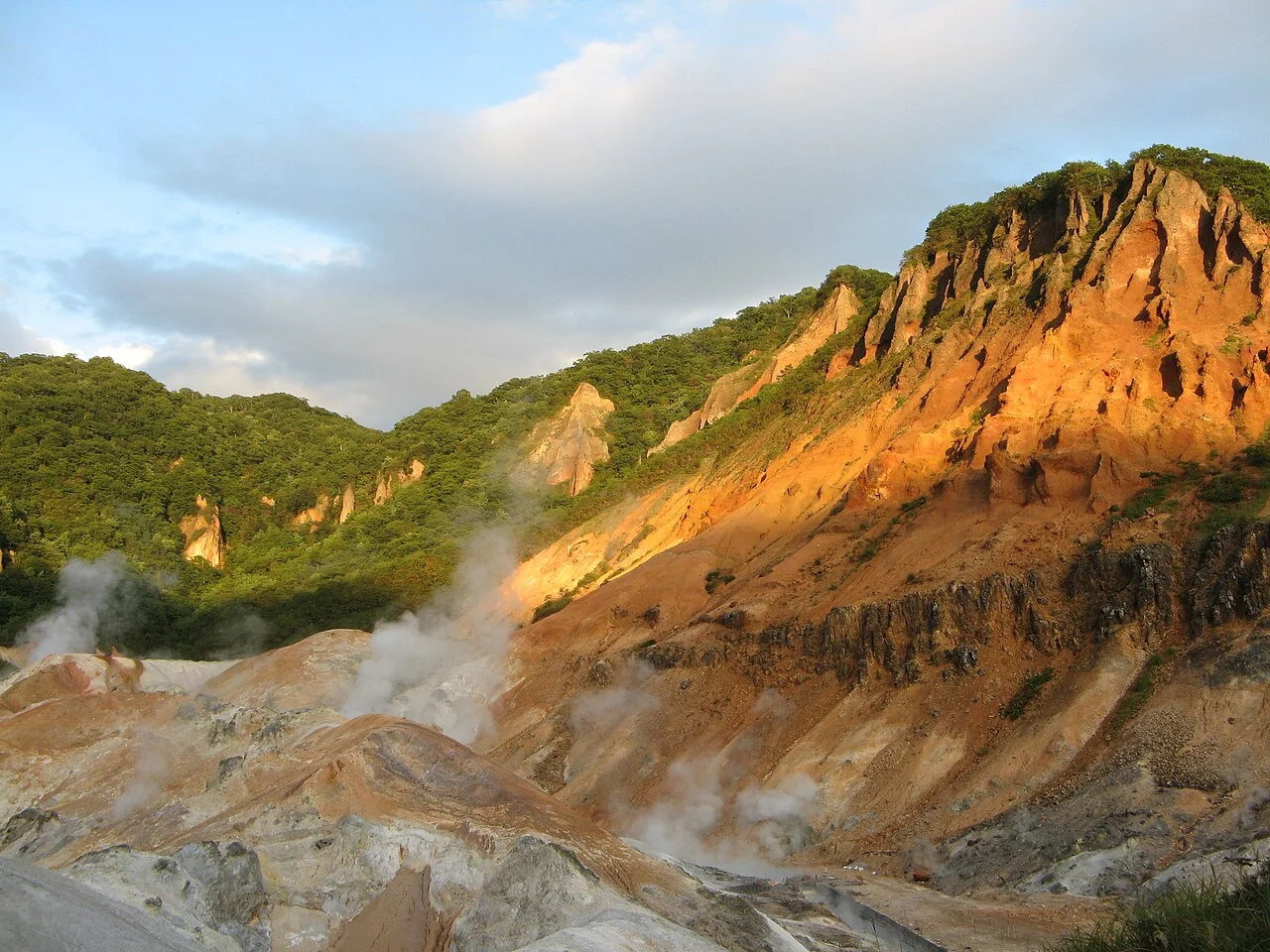
The first observation deck gives a full view across the volcanic crater. According to the Noboribetsu Tourism Association, the basin was formed by volcanic activity on Mount Hiyori and measures roughly 450 metres across, covering about 11 hectares. Standing at the railing, you can trace the pale valley floor, exposed orange-brown rock walls and surrounding forest at different elevations. White steam drifts with the wind and occasionally shrouds the entire lower basin. For clear shots of the valley floor, stay put at this deck until a gust clears the steam; heading down into the valley itself narrows your field of view.
A sloped path leads from the service centre to the observation deck, with an official maximum gradient of 8%. Visitors with pushchairs, wheelchairs or anyone preferring to avoid long inclines can make this deck their main viewpoint and return the same way. If you plan to continue, look for signs pointing to the Jigokudani Walking Trail and Tessen Pond. The wooden boardwalk along the valley floor brings you close to steaming mineral-rich runoff and ends at a small viewing platform beside Tessen Pond. Path widths require visitors to pass single file in places, so wait for wider railside sections before stopping for photos.
The association's walking map lists the Jigokudani Walking Trail at 568 metres, or roughly 10 minutes on foot. On a first visit, allow 35 to 50 minutes for the deck, boardwalk and return trip—a far more realistic pace than raw walking time. Tessen Pond is a small geyser inside the valley; the tourism association notes that tall spouts have been seen less often in recent years, so the real draw of this stretch is watching hot spring water course beneath the boardwalk. If you are travelling with children or older relatives and find the planks slick or crowds backing up, turn back after taking in the panorama from the entrance deck, which still gives clear views of the crater walls and fumaroles.
How to visit Noboribetsu Hell Valley (Jigokudani) for free via Donan Bus from JR Noboribetsu Station, linking the crater, Oyunuma Pond, natural footbath and onsen town—plus winter closures, Bear Park vs Marine Park Nixe, day-use baths and where to stay.
Extending Your Walk to Oyunuma Pond and the Natural Footbath
After looping back from Tessen Pond to the valley entrance, you can branch onto the forest trails leading towards Oyunuma Pond. Check the trail map at the entrance first, as several junctions split off along the way: the Oyunuma Walking Trail, Oyunuma Second Walking Trail and Oyunuma River Nature Trail each cover different segments. Set aside roughly two hours for the full walk, accounting for gradients, viewpoints and the walk back into town from the footbath end. For the complete circuit, head from Hell Valley to Oyunuma, view neighbouring Okunoyu Pond beside it, and continue down the nature trail past the Sekisuitei hotel side to rejoin paved streets.
Oyunuma sits at the foot of Mount Hiyori and is a crater lake formed by phreatic steam eruptions. From the viewpoint you can take in its dark grey water and jagged shoreline, while Okunoyu is a smaller steaming pool nearby. Around the car park area, stick to designated viewing spots inside the railings to see both ponds. Further downstream lies the natural footbath, where hot overflow from Oyunuma feeds a forest stream fitted with wooden benches for soaking your feet. Save both Oyunuma and Oyunuma River Natural Footbath separately in your map app so you are not hunting for where to take off your shoes once you reach the pond.
Bring a small towel, trousers you can roll above the calf and—after rain—a spare pair of dry socks. At the wooden deck, choose a spot for your shoes first and test the water temperature with your toes before letting children near the benches. If you are short on time for a bus or train, entering and exiting directly from the footbath side is quicker; search for the Ashiyu-iriguchi bus stop or Noboribetsu Sekisuitei for navigation. The footbath has no dedicated car park of its own, so drivers either walk in via the trail from the Oyunuma car park or leave their vehicle in a legal town car park and walk the whole way.
2026–27 Winter Closures: Separate Road Access from Footpaths
Hokkaido's Iburi Subprefectural Bureau closes Prefectural Route 350 (Lake Kuttara Park Line) in two stages. First, the stretch from the Oyunuma gate towards Naka-Noboribetsu closes at 15:00 on 9 November 2026. Then, at 15:00 on 1 December, the closure extends down towards the onsen town as far as the Jigokudani gate, scheduled to last until 10:00 on 16 April 2027. Noboribetsu City's winter closure list also includes Municipal Road Oyunuma Line 1 leading to Okunoyu, scheduled to close from 1 December to 16 April. Winter drivers should remove the Oyunuma car park from their navigation options and park at Hell Valley or in the onsen town instead.
The Hell Valley observation deck sits outside the closed road section. Mountain trails towards Oyunuma may carry separate trail-closure notices, while the natural footbath retains pedestrian access from the Sekisuitei side. In snowy weather, start with the path from the service centre to the observation deck, and add the valley floor towards Tessen Pond only if it is open and footing feels secure. For the footbath, walk in from the onsen town via the Sekisuitei entrance and return the same way if open; if a closure sign is posted there, head back to Gokuraku-dori for a day-use bathhouse instead.
Separately, Noboribetsu City announced on 20 November 2026 that parts of the roadway around Hell Valley will operate on alternating single-lane traffic through late March 2028 due to river improvement works on the Jigokudani River. Standard work hours run from 10:00 to 17:00, with work generally paused at weekends. When driving downhill from the car park to catch a train or flight, build extra time into your schedule for single-lane delays and retrieving your vehicle. On busy autumn foliage weekends, if traffic is already backed up along the uphill approach from town, park in a public town car park and walk up via the shopping street.
Winter boardwalks often accumulate packed thin snow, with ice forming on bends and shaded sections. Prioritise grippy soles and keeping both hands free over carrying camera gear. In heavy snow or poor visibility, take in the steam from the first observation deck and leave it there. If you have daylight the next morning, saving the rest of the walk until after breakfast is far safer than navigating icy junctions after dinner.
Getting from Sapporo and New Chitose Airport to Noboribetsu Onsen
From Sapporo, take the JR Hokuto or Suzuran limited express to Noboribetsu Station. Both services are all-reserved seating, so book your outward seat from Sapporo in advance and reserve your return leg at the same time. Enter Noboribetsu as your destination, exit the ticket gates on arrival and walk out to the Noboribetsu Ekimae bus stop in front of the station. If you already hold a reserved return train ticket, count backwards from that departure time to choose your connecting bus down from the mountains. Save both train and bus schedules on your phone so you can tell at a glance whether you have time to eat in the onsen town or need to head down earlier.
Standard JR reserved seats go on sale one month prior to travel at 10:00 JST. For early departures over New Year or weekends, lock in adjacent seats on the limited express first and plan your bus connection around its arrival time. Noboribetsu Station's new station building and lift-equipped footbridge are now in service, so travellers with large suitcases can head straight for the lifts. If you have a wait between your train and bus, the Noboribetsu City Tourism and Exchange Centre Nupur right beside the station offers tourist information and a lounge on the ground floor. Daytime hours are 09:00 to 17:30 (closed 29 December to 3 January). Same-day luggage storage is ¥700 per piece with collection until 17:00. Overnight guests staying in the onsen town who want to visit the aquarium hands-free can drop bags at the counter before 14:00 for same-day delivery to town accommodation at ¥1,500 per piece. Day-trippers planning an evening soak in the hills are better off taking their bags up to the onsen area and storing them there, avoiding an early collection deadline on the way back.
Donan Bus routes NA, NB, NC and ND all serve the Noboribetsu Station to Noboribetsu Onsen corridor, with slight differences in stops. The operator lists the adult one-way fare to Noboribetsu Onsen at ¥450 and an end-to-end journey time of roughly 27 minutes, though exact departure and arrival times vary by route. Some buses terminate at the Noboribetsu Onsen terminal, while others continue to stops including Noboribetsu Onsen Chuo, Dai-ichi Takimoto-mae, Park Hotel-mae and Ashiyu-iriguchi. Guests with luggage staying at Dai-ichi Takimotokan or Sekisuitei can save an uphill haul by catching a service that stops right outside. For the return journey, check the onsen area to Noboribetsu Station timetable starting from the column for your specific boarding stop. Suica and Kitaca IC cards are not accepted on any of these buses; Visa contactless works on routes NA and NB, while cash is easiest on all other services.
By rail from New Chitose Airport, take the Airport Rapid train to Minami-Chitose first and change there for a limited express to Noboribetsu. The interchange is Minami-Chitose—drop the 'Minami' and you will end up in central Chitose instead. When searching rail connections, expand the full itinerary to check both the transfer buffer at Minami-Chitose and the bus connection outside Noboribetsu Station. If you also need to clear immigration and collect checked bags on arrival, leave margin for a meal or luggage handling. For winter arrivals close to dinner, save your hotel's address and phone number on your phone beforehand so you can show them to a taxi driver if you miss the last bus.
Donan Bus also runs the Highway Noboribetsu Onsen Airport-go direct to the onsen town, which is handy if you have heavy luggage or are staying near one of its drop-off stops. Under the operator's Category A fares from December 2026 to March 2027, New Chitose Airport to or from Noboribetsu Onsen is ¥2,400 one-way for adults, while the Sapporo Kosoku Onsen-go highway bus is ¥3,800 one-way over the same period. Both require online booking, closing two hours before departure from the service's origin stop—even if you board partway along the route. On the winter airport timetable, for instance, the bus leaves International Terminal bay 86 at 14:10, calls at Domestic Terminal bay 29 at 14:11 and bay 2 at 14:13, and reaches Noboribetsu Onsen at 15:18. Arrivals at the international terminal head straight to bay 86; on the return leg, pick the stop matching your departure terminal. The same published timetable shows the direct Sapporo service leaving Sapporo Ekimae bay 7 at 13:40 and reaching Noboribetsu Onsen at 15:20, with the return bus departing Noboribetsu Onsen's main stop at 09:30. Using this direct pair in both directions suits an overnight stay; Sapporo day-trippers wanting morning time at Hell Valley get far more daylight by taking JR plus the local bus.
Where to Park: Hell Valley vs the Onsen Town
Searching for 'Jigokudani Parking' brings you right beside the valley mouth, ideal if anyone in your group struggles with the long hill up from town or if you only want a quick stop at the crater. The Natural Parks Foundation sets the fee for standard passenger cars at ¥500. While the Oyunuma car park is open, the same ticket covers one entry at each car park, so keep your receipt when leaving Hell Valley. Because the Oyunuma road has a width restriction, vehicles 2 metres wide or more must use the Hell Valley car park. Even if you drive between the two sections, you will still be walking around the valley mouth, pond viewpoints and footbath, though you only pay parking once.
If you are combining lunch, souvenir shopping and a bath, the newly opened municipal Noboribetsu Onsen Car Park in town is a practical alternative. Open 24 hours, it charges ¥500 in regular periods and ¥800 in peak periods per 24-hour stay from entry, and sits about a 15-minute walk from Hell Valley. Because it is a separate municipal facility using number-plate payment, the combined Hell Valley and Oyunuma ticket does not cover it. On autumn weekends, watch the queue at the valley mouth: if cars are already backing up into town, park near the shopping street and stroll up Gokuraku-dori. Early risers aiming for clear morning shots of the crater walls can park at Hell Valley first and walk back down to town for shops later without moving the car. Staying overnight? Ask your hotel in advance how early you can park or drop bags so you do not have to drive back down and up the mountain road.
Drivers visiting during autumn foliage can include the Shin-Noboribetsu Bridge on the drive in or out. Its vermilion span crosses the Noboribetsu River gorge, with a parking area at one end leading to a lookout where you can view the valley safely away from roadside traffic. If leaves around the bridge have mostly dropped, use the valley mouth for rock walls and Oyunuma for water reflections and forest edges so all your photos do not look the same. Late-autumn daylight fades early, so visit the gorge lookout first before heading into the onsen town for lunch or a soak. If you only have an hour or two by car, prioritise Hell Valley and save the bridge for a quick stop on your way out towards your next destination.
Driving from Sapporo towards Lake Toya leaves plenty of time for a short Hell Valley loop before checking into a lakeside hotel. If you want to hike the full Noboribetsu forest trail and linger over lunch in town before seeing Lake Toya properly, split the two over two days. When planning by rail, remember to calculate door-to-door timings to your actual destination rather than station-to-station express times: Noboribetsu Station requires a bus transfer up to the onsen, and Toya Station needs its own onward connection to the lakeside before dinner service begins.
Noboribetsu Bear Park: Best When Spending Half a Day in Town
The lower ropeway station for Noboribetsu Bear Park sits right in the onsen town. Admission includes the return seven-minute gondola ride up the mountain: ¥3,200 for adults, ¥1,600 for ages four to primary school year 6, and free for children aged three and under. The park estimates 60 to 90 minutes for a visit; factoring in the walk over from Hell Valley, ropeway queues, seeing the Ezo brown bears and museum, and riding back down, block out two hours in your itinerary. If you simply want to see the bears and head straight back down, locate the return boarding gate at the summit first before deciding how long to spend in the remaining exhibits.
Opening hours are 09:30 to 16:30 (last entry 15:50) from 21 October to 20 April, and 09:00 to 17:00 (last entry 16:20) from 21 April to 20 October. The park is scheduled to close from 5 to 23 April 2027 for statutory ropeway inspection and maintenance, reopening on 24 April. Strong winds or thunderstorms can also halt the ropeway—and the gondola is the sole public route up and down the summit. If high winds are forecast, keep Marine Park Nixe or a day-use bathhouse in mind and wait for operating updates before heading up.
Wheelchair users should report to the lower ticket office first so staff can guide them through the step-free route. Because gondola cabin doors are narrow, the park generally asks visitors to transfer into a facility-provided wheelchair, and at least one companion is required for boarding. There are still flights of stairs at the summit, including to the second floor of the museum and the rooftop Lake Kuttara observation deck. Families wanting both the bears and the lake view can agree to regroup outside the museum while those able to climb stairs head up. Free loan wheelchairs and pushchairs are available, and accessible toilets at both the base and summit have baby-changing facilities.
Marine Park Nixe and Date Jidaimura: Which End to Visit First
Noboribetsu Marine Park Nixe is about a five-minute walk from JR Noboribetsu Station, giving train arrivals from Sapporo an immediate indoor option on wet days. The main aquarium sits inside a castle-style building; after touring the tanks and galleries, time your visit around the daily dolphin or penguin shows. Parts of the shows and walkways between buildings are outdoors, so focus on the indoor exhibits during heavy rain. Hours are 09:00 to 17:00 (last entry 16:30), with a maintenance closure from 12 to 16 April 2027. Tickets are ¥3,200 for adults (junior high school age and above), ¥1,600 for ages four to primary school, and free for ages three and under.
If you are visiting with children for the shows, pick one must-see performance first and fit the surrounding galleries before and after it. On a JR day trip, visit Marine Park Nixe in the morning, take the bus up from outside Noboribetsu Station for Hell Valley in the afternoon, and ride back down from the onsen town. Staying overnight works neatly in reverse: check out in the morning, head down the hill, leave your bags at the aquarium's storage desk and catch your onward train straight after your visit. Bags too large for coin lockers can be checked at the entrance building information counter for ¥500 per item (accepted 09:00 to 16:30, collect by 17:00; keep electronics and valuables with you). Leave time after picking up your bags to cross the station footbridge.
Noboribetsu Date Jidaimura sits halfway between the station and the onsen town, making it an easy stop on the way up if you want Edo-period streetscapes, ninja shows or period theatre. Donan Bus timetables list two similarly named stops—Noboribetsu Jidaimura-mae and San-ai Byoin Noboribetsu Date Jidaimura-mae; the former drops you right outside the gate. Check the official timetable column for your journey to be sure your bus actually calls at Noboribetsu Jidaimura-mae. Admission is ¥3,300 for adults, ¥1,700 for primary school pupils and ¥600 for children aged four to pre-school. In winter (1 November to 19 March), the village closes at 16:00 with last entry at 15:00, and maintenance closures run from 8 to 11 March 2027. If you want to watch the live theatre shows, work backwards from that day's showtimes on arrival and fit shops and street strolls into the gaps. Keep paid attractions to one per day so you are not rushing between show schedules.
Visitors coming in early April 2027 need to watch overlapping maintenance closures. From 5 to 11 April, both Bear Park and Dai-ichi Takimotokan are closed, making Nixe near the station the clearest paid stop. From 12 to 15 April, Nixe closes too, leaving a short Hell Valley walk, Gokuraku-dori and Yumoto Sagiriyu as your main daytime options. If riding the ropeway to see the bears is your family's top priority, schedule your trip for 24 April or later once it reopens.
| Attraction | Location | Best Way to Fit It In |
|---|---|---|
| Noboribetsu Bear Park | Ropeway base station in the onsen town | Allow two hours while already in town after Hell Valley |
| Noboribetsu Marine Park Nixe | About 5 minutes on foot from JR Noboribetsu Station | Start indoors in the rain, then take the bus uphill if skies clear |
| Noboribetsu Date Jidaimura | Between JR Noboribetsu Station and the onsen town | Catch a bus stopping at the main gate and plan around daytime shows |
Gokuraku-dori and Enma-do: Exploring Downhill
Walking back from Hell Valley past Dai-ichi Takimotokan feeds directly onto Gokuraku-dori, the sloping main street leading down to the bus terminal, lined with shops and places to eat. If you want to see the crater first, ride the bus up to Dai-ichi Takimoto-mae and stroll downhill past Sengen Park, Enma-do and the storefronts on your way back. If your group prefers lunch first, get off near the Noboribetsu Onsen terminal, browse the street and walk uphill afterwards. Splitting up on the return leg is easy too: agree to meet at the terminal or outside a specific shop rather than trying to find each other beside the crater.
The mechanical Enma Daio statue inside Enma-do was originally built as a float for the Noboribetsu Hell Festival. Outside festival dates, it performs inside the pavilion; the tourism association lists daily showtimes at 10:00, 11:00, 13:00, 15:00, 17:00, 20:00 and 21:00, subject to cancellation in bad weather. If you arrive right on a performance, pause for a few minutes; if there is nearly an hour to wait, grab a meal first. Nearby Sengen Park features a natural geyser that erupts roughly every three hours according to the tourism association. If you hear the rumble or spot white steam as you pass, linger by the noticeboard; otherwise your time is better spent on the crater trails.
If you fancy an evening stroll after checking in, the Onibi-no-Michi ('Demon Fire Path') illuminates the Hell Valley walking path and observation deck year-round from sunset until 21:30. Walking up from town reveals lights winding along the valley contours, and the first observation deck already gives a strong view—easier to navigate if you walked the route in daylight earlier. Day-trippers hoping to stay for the illuminations should check the last bus and last JR train separately; the later Enma-do shows and final illumination hours are best left to overnight guests.
Day-Use Hot Springs: A ¥500 Sento or Multi-Spring Hotel Baths
For a straightforward post-walk soak, try Yumoto Sagiriyu on Gokuraku-dori. Standard bath admission is currently ¥500 for adults and ¥180 for children, open 09:00 to 21:00 (last entry 20:30). This hot-spring sento (public bathhouse) lets you soak in both sulphur and alum spring waters. Set aside an hour to undress, wash, soak and dry your hair, and bring your own towel. Basic bath tickets cover the pools; if you want access to the paid lounge, buy the one-day pass (¥710 for adults, ¥300 for children; lounge open until 20:00). After walking all day in winter boots, save the soak for last so you can slip into dry socks before heading down to catch your train.
Day-use bathing at Dai-ichi Takimotokan turns the bath itself into the main event. Featuring five different spring types, day entry costs ¥2,500 for adults and ¥1,500 for children, including bath and face towels plus access to the heated indoor swimming pool (swimwear costs extra). Open 09:00 to 21:00 with last admission at 18:00—no booking required for standard day entry, though the facility is closed from 5 to 15 April 2027. Located right beside Hell Valley, it pairs easily with morning trails, lunch downhill in town and an afternoon soak. If you are catching a bus afterwards, note the gap between last entry and leaving the building so you are not rushing in at 17:55 only to aim for an 18:00 bus.
The price gap between the free footbath, a local sento and a major hotel bathhouse reflects how much time you plan to spend there. If only one person in your group wants to bathe, arrange to meet on Gokuraku-dori so they can walk straight to the bus terminal afterwards. If the whole family wants Dai-ichi Takimotokan and the kids want the pool, arrive earlier in the day and pack swimwear in your day bag. Since Hell Valley itself is free, putting your budget into one well-chosen bathhouse rounds out a satisfying half-day in Noboribetsu.
Where to Stay Overnight: Work Backwards from Luggage and Dinner
Travelling with older relatives or heavy suitcases? Look at Noboribetsu Grand Hotel right beside the Noboribetsu Onsen bus terminal. It is roughly a one-minute walk from the terminal, with check-in at 15:00 and check-out at 10:00, plus a garden open-air bath and large indoor baths to enjoy after dinner. If your priority is seeing the crater lit up at night, Dai-ichi Takimotokan up at the top of town makes walking to the Hell Valley entrance effortless by day or night. Its guest rooms span several wings, so check room pages for bed layouts and walking distance to the baths. Choose the terminal area to minimise uphill walking; choose the upper end if you plan to dip in and out of the crater and Enma-do multiple times.
Noboribetsu Sekisuitei sits out towards the natural footbath, roughly a 15-minute uphill walk from the main bus terminal according to the hotel. When booking here, look for local buses continuing to Ashiyu-iriguchi or take a taxi from the terminal. Sekisuitei also operates a reservation-only shuttle for staying guests from New Chitose Airport, officially departing at 14:30 and 17:00. The regular airport shuttle fare is ¥1,000 one-way, or ¥500 one-way for guests who book accommodation directly via the hotel's official website or by phone. On later flights, check the shuttle meeting and hotel arrival times carefully—if your stay includes dinner, pick a shuttle that gets you there in time for service.
If you have an early flight home, check the first morning departures back to the airport first. Sekisuitei's shuttle departs the hotel at 10:00 and arrives at New Chitose Airport at 11:00, and public highway buses likewise cluster around mid-morning airport arrivals. If those arrive later than your airline's check-in deadline, spend your first night in Noboribetsu upon landing in Hokkaido and stay near the airport or Chitose on your final night. That order also makes life easier in winter if you are travelling with ski gear, returning a rental car or catching an international flight with early bag drop.
Elsewhere in Noboribetsu city, staying near the coastal station suits early limited express departures or a morning visit to the aquarium, though heading back up to the onsen town in the evening adds an extra bus ride. If you want to catch the 20:00 Enma-do show or Hell Valley after dark, sleeping in the onsen town is far simpler. Lock in your check-in and check-out dates, headcount per room and dinner slot first before comparing room rates. For a closer look at room types and meal plans, see our Noboribetsu Onsen hotel guide.
How to Pace Half-Day, Full-Day and Two-Day Trips
For a half-day day trip from Sapporo, catch an early limited express and connecting bus up to Dai-ichi Takimoto-mae or the main bus terminal, then cover the Hell Valley observation deck and Tessen Pond in daylight. Have lunch on the walk downhill—if places along the slope are full, head closer to the bus terminal for more choice. Leave time for a quick soak or souvenir shopping before your return train. Skipping paid attractions keeps your schedule focused on the crater trail and a single convenient bathhouse, and makes it easy to duck indoors if rain starts.
To spend a full day combining Hell Valley and the natural footbath, start uphill in the morning while your legs are fresh for the forest trails. After viewing Oyunuma and Okunoyu, follow the stream down to the footbath, then return along the Sekisuitei side to the onsen town for lunch. In the afternoon, choose between a hot-spring soak or Bear Park depending on your return bus. If you prefer a relaxed visit to Bear Park, stick to the short Hell Valley loop in the morning, ride the ropeway after lunch and save Oyunuma for a future overnight trip. During winter road and trail closures, swap the mountain path segment for Gokuraku-dori and a day-use bath, which also keeps mixed-pace groups together.
Multi-generational or family trips most often stall in the afternoon—children want shows, older relatives want a breather, and fixed hotel dinner times do not wait. Starting from Noboribetsu Station, schedule Marine Park Nixe in the morning, then ride up together for the crater. Less mobile family members can wait comfortably at the first observation deck while others walk down to Tessen Pond if conditions permit, meeting back at the same spot. From there, stroll downhill together along the main street for either lunch or a bath—not both. If Bear Park is the main goal, everyone stays centred in the onsen town and can split up and regroup easily along Gokuraku-dori.
For an overnight stay arriving from the airport in the afternoon, drop your bags at check-in, browse Gokuraku-dori and walk up to the first observation deck before dinner. Use the following morning, while energy is high, for whichever short crater walk or footbath trip you skipped the night before. Heading onwards to Lake Toya? You can move straight to your next hotel. If returning to Sapporo or continuing to Hakodate, lock in your train seat and check-in time first, then fit one final Noboribetsu stroll into the window between check-out and your bus.
A few useful answers
Do you need a ticket for Noboribetsu Hell Valley?
Entry to the Hell Valley observation deck and open walking trails is free. Drivers using the Hell Valley car park pay ¥500 per standard passenger car. Bear Park, Marine Park Nixe and individual bathhouses charge separate admission.
How do I get from JR Noboribetsu Station to Hell Valley?
Exit the station and board a Donan Bus to Noboribetsu Onsen; the adult one-way fare is ¥450. Services that continue past the terminal to Dai-ichi Takimoto-mae drop you even closer to the valley entrance. Suica and Kitaca IC cards are not accepted on these buses.
Can you still visit the Oyunuma River Natural Footbath in winter?
The footbath has its own pedestrian entrance on the Sekisuitei hotel side. If trail closures are in effect, switch to a day-use bathhouse in the onsen town instead. From 1 December 2026, Prefectural Route 350 to Oyunuma closes from the Jigokudani gate side and is scheduled to remain closed until 16 April 2027.
Which is better for a rainy day: Bear Park or Marine Park Nixe?
Choose Marine Park Nixe next to JR Noboribetsu Station on a rainy day, as most exhibits are indoors. Bear Park includes outdoor areas and its ropeway can suspend operations in strong winds or thunderstorms, making it better suited to clear days paired with Hell Valley.
Is Hell Valley worth visiting if I only have one hour?
One hour is enough for the service centre, first observation deck and the open trail to Tessen Pond, excluding transit to and from the station. If arriving by bus in the onsen town, starting your walk from Dai-ichi Takimoto-mae saves the most walking time.
Official information and references
Sources used in this guide.
- Noboribetsu Tourism Association | Hell Valley (Jigokudani) and Observation Deck
- Noboribetsu Tourism Association | Onsen Town and Trail Walking Map
- Noboribetsu Tourism Association | Oyunuma Pond
- Noboribetsu Tourism Association | Oyunuma River Natural Footbath
- Noboribetsu Tourism Association | Winter Trail Closures Around Hell Valley
- Iburi Subprefectural Bureau | FY2026 Winter Road Traffic Regulations
- City of Noboribetsu | FY2026 Winter Municipal Road Closure Notice
- City of Noboribetsu | Jigokudani River Improvement Traffic Restrictions
- Donan Bus | Noboribetsu Ekimae to Noboribetsu Onsen Timetable
- Donan Bus | Noboribetsu Onsen to Noboribetsu Ekimae Timetable
- Donan Bus | Noboribetsu Onsen Airport-go and Sapporo Direct Bus Fares and Timetable
- JR Hokkaido | Trains for New Chitose Airport, Noboribetsu and Muroran
- Natural Parks Foundation | Hell Valley and Oyunuma Car Parks
- Noboribetsu Tourism Association | Opening of the Noboribetsu Onsen Car Park
- Noboribetsu Bear Park | Admission, Ropeway and Opening Information
- Noboribetsu Marine Park Nixe | Park Guide and Luggage Storage
- Noboribetsu Marine Park Nixe | Access on Foot from JR Noboribetsu Station
- Noboribetsu Date Jidaimura | Admission and Winter Opening Hours
- Noboribetsu Tourism Association | Enma-do Performance Schedule
- Noboribetsu Tourism Association | Sengen Park Geyser
- Noboribetsu Tourism Association | Onibi-no-Michi (Demon Fire Path)
- Yumoto Sagiriyu | Bathing Fares and Lounge Information
- Dai-ichi Takimotokan | Day-Use Hot Spring Information
- Dai-ichi Takimotokan | FAQ and Day-Use Bath Hours
- Noboribetsu Grand Hotel | Indoor Baths and Open-Air Rotenburo
- Noboribetsu Sekisuitei | Access and Guest Shuttle Bus
- Noboribetsu Tourism Association | Tessen Pond Conditions
- JR Hokkaido | Reserved Seat Ticket Release Schedule
- JR Hokkaido | Opening of New Noboribetsu Station Building, Footbridge and Lifts
- City of Noboribetsu | Station-Side Tourism Exchange Centre and Luggage Storage
- City of Noboribetsu | Noboribetsu Onsen Car Park Fees and Hours
- Noboribetsu Tourism Association | Shin-Noboribetsu Bridge
- Noboribetsu Grand Hotel | Access, Check-In and Check-Out
- Noboribetsu City Tourism and Exchange Centre Nupur | Luggage Storage and Delivery
- JR Hokkaido | All-Reserved Limited Express Services