Walk from Minami-Otaru Station to the Otaru Music Box Museum, Kitaichi Glass, and Otaru Canal. Check free recitals at Building No. 2, Yu-kobo craft fees, Kitaichi Hall's lamp lighting, and glass studio bookings.
- Region & Focus
- Otaru
- Reading Scope
- 24 min read · 9 chapters · 7 Q&As
- Official Verification
- 21 official sources checkedUpdated 22 November 2026
- Key Topics
- First tripNeighbourhoodsWinter
Chapter Route Map (tap any stop)
- Alight at Minami-Otaru and Walk Sakaimachi Street to Otaru Station
- Three Floors at the Main Building and the Steam Clock Outside
- Free Recitals at Building No. 2: Which Lunch Slot to Avoid?
- Making a Music Box at Yu-kobo: Factor In Drying Time
- Kitaichi Glass Building No. 3 and the 09:00 Lamp Lighting
- Kitaichi Glass Studio: Choosing Between Sandblasted Glasses and Bead Accessories
- Only Two or Three Hours to Spare? Choose by Priority
- How to Test Music Boxes and Choose One as a Gift
- Short Indoor Legs for Rain or Snow, and the Canal at Dusk
- Quick Q&A
For a first visit to the Otaru Music Box Museum, alight at JR Minami-Otaru Station, start at Marchen Crossroads, walk along Sakaimachi Street to Kitaichi Glass and the canal, and catch a train back to Sapporo from JR Otaru Station. If you want to hear antique music boxes, plan your schedule around the free live recitals at Building No. 2. To make your own box to take home, book Yu-kobo first and slot browsing and coffee either side of your session. Kitaichi Glass also spans several retail halls, a lamp-lit cafe, and a glassmaking studio—anyone keen to catch the 09:00 lamp lighting can begin straight at Building No. 3.
Alight at Minami-Otaru and Walk Sakaimachi Street to Otaru Station
Coming from Sapporo, set your outbound destination to Minami-Otaru and board your return train at Otaru Station, which sits closer to the canal. Both stations lie on the JR Hakodate Main Line; trains bound for Otaru call at Minami-Otaru first before reaching Otaru. Some departures from Sapporo Station terminate at Teine or Hoshimi, so look for "Otaru" on the departure board and check the stopping pattern before boarding. From New Chitose Airport, selected Airport services run directly to Otaru—again, check the final destination when choosing a train. If your itinerary connects with flights or intercity trains, see how to transfer between New Chitose Airport, Sapporo, and Otaru.
After leaving Minami-Otaru Station, turn left down the slope; the Otaru Tourism Association walking route estimates about 7 minutes on foot from the station to the Main Building. Search for "Marchen Kosaten" on your map to locate Marchen Crossroads—once you spot the clock and the brick building, you have arrived. If you have booked Yu-kobo, save "Tezukuri Taiken Yu-kobo" on your map; it sits at 1-1-5 Irifune, an easy walk from the Main Building. For Building No. 2, save "Otaru Music Box Museum No. 2 Antique Museum". Searching only for "Otaru Orgel Doh" often routes you to the Main Building or the Sakaimachi branch near the canal.
If you have already booked a canal cruise, plan to eat near Otaru Station first, or intend to store luggage at Otaru Station, starting from Otaru Station is simpler. Once you have finished your station-side meal or cruise, walk south along Sakaimachi Street towards the Main Building. Heading back to Minami-Otaru Station from the Main Building at the end of your visit means walking uphill. After snowfall, or when travelling with older relatives or a pushchair, walking downhill from Minami-Otaru and boarding at Otaru Station takes less effort. If you have left bags in lockers, factor in the time to backtrack from the shopping street, or take a short taxi ride back.
On a brief stop, pick one unmistakable entrance as your meeting point. If part of your group wants to browse glass at Building No. 3 while others attend a recital at Building No. 2, split up for one stop and regroup at the Sakaimachi Street entrance of Building No. 3. From there, head towards Asakusabashi Bridge if the canal is next. Anyone carrying bulky bags or fragile glassware can also wrap up early and head towards the station. For tips on pairing this stretch with the former Temiya Line, a canal cruise, or lunch by the station, check how to spend a day around Otaru Canal and Sakaimachi Street.
Walk from Minami-Otaru Station to the Otaru Music Box Museum, Kitaichi Glass, and Otaru Canal. Check free recitals at Building No. 2, Yu-kobo craft fees, Kitaichi Hall's lamp lighting, and glass studio bookings.
Three Floors at the Main Building and the Steam Clock Outside
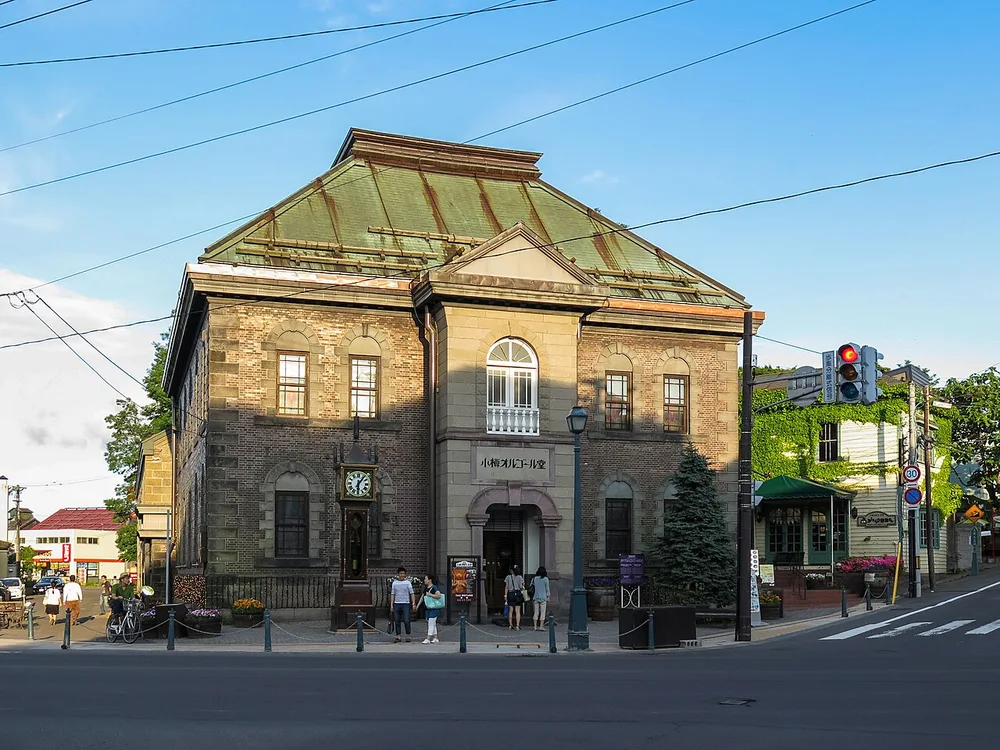
Located at 4-1 Sumiyoshicho, the Main Building generally opens from 09:00 to 18:00 JST, with the second and third floors closing slightly earlier at 17:45. Built in 1915 as the headquarters of rice merchant Kyosei Co., Ltd., the building is designated by Otaru City as Historic Landmark No. 17. Admire the arched windows and brown brick exterior by the entrance, then step inside and look up along the colonnade to take in the soaring atrium and second-floor gallery. If you only have 20 or 30 minutes, stay on the ground floor to sample a few music boxes and watch the clock outside.
The front of the ground floor showcases Japanese designs including jewellery boxes, kaleidoscopes, and Aizu lacquerware. The central area offers lighter everyday picks, grouping glass, wooden, illuminated, and animated models in one section. If you want a compact box to open daily at home, narrow down your preferred tunes and sizes on the ground floor first. Companions looking for character merchandise or animal figurines should head up to the "Yume no Oto" corner and animal gift section on the third floor, where the exposed roof trusses are also worth a glance. When splitting across floors, meeting back at the ground-floor entrance saves more time than trailing along every counter together.
If mechanical movements fascinate you, set aside quiet time for the second floor. The high-end gallery stocks Japanese ORPHEUS and Swiss REUGE pieces and takes custom orders. Further towards the front, an animated scale model illustrates the history of music boxes—ask a member of staff to run it if you would like to see it in motion. Afterwards, look down from the gallery railing at the warm lighting and displays on the ground floor. If you arrive in the late afternoon with specific luxury models in mind, head straight upstairs so you have time to listen and ask about pricing before the upper floors close.
Installed in 1994 in front of the Main Building, the steam clock was crafted by Raymond Saunders, who also built the famous steam clock in Gastown, Vancouver. Otaru's clock stands 5.5 metres tall; its dial runs on electricity while a boiler feeds steam to five top-mounted whistles that chime every 15 minutes. To catch a performance, simply note the top of the hour and every quarter-hour after it. If the next chime is still some way off, browse the nearby shops first and step back outside just before it sounds. The steam and whistle notes emerge from the very top, so keep the crown of the clock in frame when filming.
To capture both the main entrance and the clock in one shot, step across to the pedestrian space on the far side of the crossroads for better perspective. If you only want to hear the chime, stand beside the entrance away from the street corner and doorway foot traffic. When visiting with children sensitive to loud sounds, watch the steam from the outer edge of the junction and move on after one chime. If someone in your group prefers not to wait, they can browse the ground floor while photographers pop out ahead of the next chime, then continue down Sakaimachi Street together.
Free Recitals at Building No. 2: Which Lunch Slot to Avoid?
The Antique Museum stands at 6-13 Sakaimachi, usually opens until 18:00, and charges no admission. Six scheduled recitals run daily at 10:00, 11:00, 12:00, 14:00, 15:00, and 16:00, each lasting 15 minutes. If you arrive after 12:15, the next session is not until 14:00—leaving an ideal window for a sit-down lunch, glass shopping, or waiting for a craft workshop piece to dry. If you reach Otaru after 15:00, treat 16:00 as your final recital, head to Building No. 2 first, and leave shopping at Kitaichi Building No. 3 until afterwards.
During each recital, a member of staff introduces the historic instruments. One highlight is the 1908 Aeolian pipe organ, formerly housed in a manor in Yorkshire, England, demonstrated live using perforated paper rolls. The visible facade pipes are purely decorative; around 690 sounding pipes sit concealed inside, driven by air. Children can join in by spotting where the paper roll is loaded, distinguishing the decorative pipes from the hidden mechanism, and listening for when the sustained notes enter.
Cylinder music boxes pluck tuned steel teeth with pins set on a revolving drum, whereas disc music boxes use interchangeable metal discs driven by gears to play each melody. Both designs are easy to tell apart in the display cases. Listen closely during the demonstration to hear how the plucked, pointillist notes layer together compared with the sustained tones of the pipe organ. The whole visit comfortably fits well under an hour. If some in your group want to study the mechanical instruments while others simply want souvenirs, split up after the recital between the exhibition hall and the retail floor.
When buying a music box to take home, always audition the exact model you intend to buy. The museum's large antiques differ completely in size, construction, and acoustics from tabletop boxes, so the recital hall's resonance is no guide to selecting a small movement. If your sole goal in Otaru is picking up a specific tune for a friend, head straight to the Main Building or the canal-side Sakaimachi branch. Conversely, if antique automata are your priority, shift your browsing time to Building No. 2 and tour the collection right after the recital.
Making a Music Box at Yu-kobo: Factor In Drying Time
If you want full freedom over your tune and ornaments, book "Topping Free". This booking reserves your seat, and you choose the base, melody, and figurines in store; the studio lists prices from around ¥4,000, varying by base and decorations. Arrange your pieces across the lid first—checking that your hand will clear them when winding the key or lifting the lid—before gluing everything down. Selecting parts and assembling takes about 30 to 90 minutes, followed by roughly 30 minutes of drying time before you return with your collection slip. Slow browsers can easily spend 2 hours from selection to pick-up.
For a predictable schedule and budget, book a "Topping Kit". Set options cost ¥2,700 for the round white base, ¥3,000 for the hand-crank box, ¥3,300 for the clear dodecagonal box, and ¥5,500 for the illuminated dome. When booking online, you pre-select your model, melody, and coloured decorative sand, with available tunes tied to each kit. If a family wants the same song in different casings, check the overlapping tune list before booking. Assembly takes roughly 30 minutes plus around 30 minutes to dry. Online bookings close the day before, and requests within 3 days of the visit are taken by telephone only; Topping Free accepts walk-ins if seats are available.
Because both workshops involve small parts and adhesives, they are aimed primarily at primary-school ages and upwards, and Yu-kobo requires children of primary-school age or younger to work alongside a guardian. With younger children, let them pick the melody and place the ornaments while an adult handles the glue and tiny pieces. If two children want one box each, register both participants when booking. Companions who prefer not to sit through the session can stroll to the Main Building for the steam clock during the 30-minute drying window while one person collects the finished boxes and meets everyone near Kitaichi Glass.
To assemble the sound-making mechanism yourself, choose "Movement Assembly". Open to secondary-school ages and upwards, classes generally run at 09:15, 11:00, and 15:00 with a maximum of 6 participants per session. Prices are ¥3,300 for an acrylic frame, ¥3,630 for an open wooden box, ¥3,960 for assembly with decorations, and ¥6,160 for a designated natural or brown wooden box. You select the tune and case when registering. During the class, you fit the damper spring into the movement, align the steel comb with the pinned cylinder, and mount the unit inside the box. Mechanism-only assembly takes around 60 minutes to take away immediately; adding decorations takes about 90 minutes plus roughly 30 minutes of drying.
Movement Assembly and stained-glass workshops are suspended from 20 to 24 November 2026, from 20 December 2026 to 15 January 2027, and from 1 February to 31 March 2027. If you plan to make a music box over New Year or in February and March, check availability under Topping Free and Topping Kit instead. Yu-kobo normally stays open until 18:00, with the store timetable listing 16:30 as the last workshop check-in. To take your piece home the same day, pick a slot with ample time for both crafting and collection—especially avoid starting the 2-hour Topping Free session right at the end of the afternoon.
Glass fusing is another Yu-kobo option, taking around 15 to 30 minutes at ¥2,200 plus postage. You arrange coloured glass beads on a base plate for the studio to kiln-fire and ship to you later. Yu-kobo's stained-glass nightlight workshop starts at roughly 3 hours, making it a main activity in its own right for a half-day visit. Anyone hoping to sandblast a drinking glass should book Kitaichi Glass instead, as Yu-kobo's sandblasting workshop is currently suspended due to equipment failure. If taking your souvenir straight onto the train matters most, stick to air-dry music boxes or small bead accessories from Kitaichi's studio.
Kitaichi Glass Building No. 3 and the 09:00 Lamp Lighting
Search "Kitaichi Glass Sangokan" (Kitaichi Glass Building No. 3) on your map; the street address is 7-26 Sakaimachi. Housed in the former Kimura Warehouse built in 1891, it originally stored fishing gear. Kitaichi Glass traces its roots to kerosene lamps and maritime equipment, having begun producing glass fishing floats in 1910. The Country Floor inside Building No. 3 still displays oil lamps and glass floats—seeing them inside the historic stone warehouse tells the story of Otaru far better than a quick snapshot of the signboard outside. Before buying one for your home, picture where it will sit and check what size fits comfortably in your luggage.
For tableware, browse Building No. 3's Japanese, Country, or Western floors depending on whether you are hunting for sake cups, everyday tumblers, or lighting. To compare crystal cuts, clarity, and refraction, walk down to the Crystal Hall at 6-7 Sakaimachi. When a glass catches your eye, inspect the rim thickness, feel its weight in your hand, and judge the capacity with your usual drink in mind. If you plan to compare several shops, note down the item code, price, and store name as you go, then return once you have decided so you are not carrying fragile glass all afternoon.
Kitaichi Hall inside Building No. 3 operates as a cafe from 09:00 to 17:30, with food and drink orders taken from 09:30 to 17:00. To watch staff light all 167 kerosene lamps one by one, arrive in the designated viewing area between 09:00 and 09:30; entry is first-come, first-served and capped once full. Travellers who simply want coffee beneath the glowing lamps can skip the opening rush and return after visiting the Main Building or a recital. Hot meals at Kitaichi Hall are normally served only on Thursdays, Saturdays, and Sundays from 11:00 to 14:50, so plan lunch elsewhere on other days and treat this stop as a coffee or dessert break.
The lamp lighting happens early in the morning. If you do not mind an early start, catching the 09:00 lighting followed by the 10:00 recital at Building No. 2 pairs effortlessly, leaving relaxed time between them for a stroll and a warm drink. If you arrive in Otaru close to midday, there is no need to force coffee and shopping into the same stop—prioritise the 12:00 recital or your booked workshop first, then decide between drinks or glassware. Splitting up is simple too: coffee drinkers can wait at the Building No. 3 entrance while shoppers rejoin them at an agreed time.
Kitaichi Glass Studio: Choosing Between Sandblasted Glasses and Bead Accessories
Kitaichi Glass's Hands-On Studio is at 7-8 Sakaimachi. For a practical piece with custom motifs, go for sandblasting: choose a glass and decorative stickers, arrange your layout on the surface, and sandblast the exposed areas into a frosted finish. Kitaichi also accepts selected glassware bought at its other Otaru branches—ask staff to inspect the shape before heading to the studio. Otherwise, picking your blank glass right at the studio saves an extra stop and puts the full cost on one bill.
The Express Sandblasting course takes around 30 minutes per person, costing ¥1,200 for the workshop fee plus ¥1,800 and up for the glass, and includes 3 pattern stickers at ¥80–¥150 each. Those who enjoy layering designs or arranging lettering carefully can book the longer 40–90 minute course at a ¥1,300 workshop fee, with the glass and stickers priced separately—the studio cites roughly 45 minutes for 4 stickers as a guide. When a group makes one glass each, choosing blanks, planning layouts, and blasting takes noticeably longer than for a solo visitor, so leave breathing room before your next stop.
For two people each making an express sandblasted glass using the lowest-priced blank and three base-tier stickers, expect ¥3,240 per person, or ¥6,480 in total; larger glasses add the price difference. Families keeping an eye on costs can collaborate on a single shared glass featuring initials, the travel date, or motifs chosen together. If children are set on making and taking home their own keepsake, letting everyone craft a small glass bead accessory also avoids carrying several bulky tumblers.
For a light, pocket-sized souvenir, try the "Tonbodama Arrangement" workshop, pairing pre-made lampwork glass beads with fittings to create hair ties, necklaces, charms, or bracelets. A hair tie takes around 15 minutes (¥200 workshop fee plus ¥60 for the fitting), with individual beads priced from ¥80 to ¥2,000. Charms take about 30 minutes and bracelets around 50 minutes. Decide first how you will wear or hang the piece, choose your focal bead, and add accent colours around it. If you want to wear a necklace immediately for photos, avoid leather-cord styles whose glue takes roughly 24 hours to cure and pick a clasp-fastened design instead.
Standard bookings can be made via the web form, telephone, or email by 17:00 two days prior. Telephone enquiries are accepted the day before, and walk-ins are welcome when seats remain. To lock in a morning slot, wait for the studio's confirmation email before locking in other timed commitments. The last regular sandblasting session starts at 15:00, and the last glass bead session at 15:15. If your visit runs into the afternoon, decide between the studio and Building No. 2 early—a 15:00 workshop clashes directly with the 15:00 recital, whereas finishing your craft first sets you up neatly for the 16:00 recital.
If you only have time for one class, pick Yu-kobo for a playable keepsake, or Kitaichi's glass beads for minimal luggage weight and a quick turnaround. Save sandblasting for when you genuinely have space for a drinking glass you will use at the dining table. If you want to do both studios, book Yu-kobo in the morning, stay nearby during the drying period, and move on to Kitaichi after collection—or do glass in the morning and leave the longer music box session for the afternoon. Break around midday so children can eat and rest while adults pack finished pieces securely into daypacks.
Only Two or Three Hours to Spare? Choose by Priority
If shopping is your main aim, arrive at Minami-Otaru around 10:00, walk to the Main Building for the next quarter-hour steam clock chime, sample two or three music boxes, and stroll to Building No. 2 for the 11:00 or 12:00 recital. Glass enthusiasts can continue to Building No. 3, while anyone without specific glassware targets can simply follow Sakaimachi Street down to the canal. This loose plan keeps lunch flexible, requires no paid reservations, and lets you linger wherever something catches your eye. If you reach the Main Building later than planned, go straight to Building No. 2 for the recital and decide afterwards whether to loop back for boxes.
For a craft-focused half-day, anchor your timeline around the workshop booking. With an 11:00 Topping Kit slot, arrive at Yu-kobo to pick up your kit, finish around 11:30, and collect it near 12:00—right as the noon recital starts. To avoid rushing, catch the 14:00 recital after collecting your box and having lunch, or attend the 10:00 recital before your workshop. Topping Free takes longer, and its drying window fits neatly with browsing one neighbouring shop. Walking all the way to the canal only to turn back for one more store simply means carrying fragile boxes twice over the same pavement.
Arriving from Sapporo in the afternoon works best by picking any two of Building No. 2, the Main Building, and Kitaichi Glass, saving daylight for the canal. If your companions only want small gifts, walk from Otaru Station towards Asakusabashi Bridge and drop into the Otaru Music Box Museum Sakaimachi Branch at 1-21 Sakaimachi. You can also browse the in-house "OTARU MUSIC" studio there before stepping straight out to the canal. There is no need to walk down to Marchen Crossroads if you prefer keeping to that end, whereas visitors keen to see the Main Building's brick facade and steam clock should ride straight to Minami-Otaru and start there.
Besides the early lamp lighting, the Kitaichi Venezia Museum offers another clear timed indoor stop. Located at 5-27 Sakaimachi, it opens from 09:00 to 17:00 (last entry 16:30); admission is ¥700 for adults, ¥500 for upper-secondary and university students, and ¥300 for primary and lower-secondary pupils. It closes on 30 November 2026 for an exhibition changeover, though the ground-floor shop remains open. Head to Building No. 3 if buying tableware is your goal, or buy a museum ticket if you want to spend time among Venetian glass art and period rooms. Photography is generally prohibited inside the galleries, though families can take souvenir photos beside the ground-floor gondola where permitted.
How to Test Music Boxes and Choose One as a Gift
If you have a specific melody in mind, start with the song title. Japanese shop labels may differ from the English or international titles you know—especially for anime inserts, film themes, and classical pieces—so keep both the original Japanese title and artist on your phone screen to show staff. Once they locate the tune, ask to hear the exact box model you intend to buy, checking which phrase of the melody it begins on and whether the loop matches what you expect. If you know a recipient's favourite character, narrow down options on the third floor first, then pick a casing size that suits where they will keep it.
When comparing two boxes, audition them in similar surroundings. Listen closely to the resonance, bass notes, and tone quality once the lid is opened. Wooden, glass, and clear acrylic cases feel and project sound differently, and some boxes sound noticeably richer resting on a tabletop than held in the palm of your hand. If other shoppers are testing boxes nearby, note your top two picks on your phone and ask a staff member to play them one after the other. Comparing two arrangements of the same melody—or two songs inside the same case—makes it far easier to pick one you will genuinely enjoy hearing.
Before buying for children, check how the mechanism winds and plays. Hand-crank models only play while turned, which appeals to kids who enjoy controlling the tempo themselves. Wind-up boxes play hands-free once wound and suit a bedside shelf or desk. For someone who will use a jewellery box only occasionally, check the storage compartment depth and where the winding key sits. Up on the second floor, ask clearly which high-end pieces can be auditioned and which are made to order; if you need to take your purchase home on this trip, confirm stock availability, gift boxing, and after-sales contact details before considering a bespoke order.
When buying both glassware and music boxes, decide upfront who will carry each bag. Kitaichi Glass wraps its own glassware and offers simple ribbons, gift cards, and traditional Japanese gift envelopes, plus paid shipping services. If your choice depends on whether a store can ship internationally to your home country—or where a fused-glass piece from Yu-kobo needs to be sent—have staff check the destination and postage before paying. Travellers switching hotels the next day should also align delivery timing with their accommodation schedule. On a one-night stay or tight rail connection, compact boxes and glass beads travel far more smoothly than sorting out courier forms at the till.
If carrying glass onto a flight yourself, ask the counter to wrap items for cabin luggage and label each box clearly. Back at your hotel, wedge music boxes and glasses upright so cardboard boxes cannot knock together inside your bag, and never tuck heavy drink bottles or bulky snacks into the bottom of the same tote. When buying several gifts in identical boxes, mark each outer carton with the recipient's name or tune straight away so you can hand them out at home without unwrapping the shop's protective paper.
From 1 November 2026, Japan's tax-free shopping system operates on a refund-at-departure model: eligible visitors pay the tax-inclusive price in store. Present your passport at participating tax-free shops, depart Japan within 90 days of purchase, and present the registered items for customs inspection at the airport so the retailer can refund the consumption tax. Ask at the till how the refund will be credited. If you plan to ship items abroad while also claiming tax-free status, raise both points before paying, as departure verification requires the goods to leave Japan with you—and make sure you have enough budget at checkout for the full tax-inclusive total.
Short Indoor Legs for Rain or Snow, and the Canal at Dusk
In rain or snow, break your walk between the station and the shops into short hops. Alight at Minami-Otaru and walk to the Main Building; if the wind is biting outside, step straight in and cross to Building No. 2 just before a recital. Leave purchased glassware with the shop while they wrap it and collect everything on your way back past that end of the street. Take extra care on the downhill slope from Minami-Otaru and at zebra crossings after snow—winter boots with good grip matter more than squeezing in one extra shop. In a blizzard, freezing rain, or icy underfoot conditions, skip the canal walk and head straight back to the station from the shopping street.
For the 2026–27 Blue Canal illumination, lights run from 1 November 2026 to 31 January 2027 between Asakusabashi Bridge and Chuo Bridge, glowing from dusk until 22:30. Finish shopping and pick up your wrapped parcels before dark, then follow the northern end of Sakaimachi Street straight onto Asakusabashi Bridge. Arrive around sunset to catch the blue reflections while faint colour still lingers in the sky, or linger over dinner first and take photos after dark—just bookmark your return train times to Sapporo beforehand.
Visiting in February aligns with a different winter festival. Otaru Snow Light Path 2027 is announced for 6–13 February, sitting on separate dates from the Blue Canal that ends in late January. To pair daytime craft shops with the evening lanterns during that week, arrive by train in the afternoon and lock in the 16:00 recital or an earlier glass workshop. Remember that Yu-kobo's Movement Assembly class is suspended throughout February, so reserve your budget and time for a Topping Kit or Topping Free session instead if you want to craft a music box.
Travellers with pushchairs or wheelchairs should cluster neighbouring stops together. Inside the Kitaichi Venezia Museum, a lift connects all exhibition floors, though the entrance ramp is removed in winter due to snow and ice. For baby changing facilities, Kitaichi Glass officially lists the ladies' toilets at the Crystal Hall and on the ground floor of the Venezia Museum; ask at the museum's ground-floor desk if you need to use the accessible toilet on the third floor. In rough weather, keep the outing simple—a quick listen at the steam clock, one well-chosen shop, and a warm drink—letting your group's pace dictate how many stops to keep.
If you are staying overnight in Otaru, split timed indoor activities from weather-dependent strolling across two halves. Tackle browsing, recitals, and workshops today, and keep a drier morning for the canal and historic warehouse exteriors. Whether you want an easy start for the 09:00 lamp lighting or a quick walk home after photographing the Blue Canal at night, choosing to stay near the canal or Otaru Station directly shapes how smoothly you drop off shopping bags and haul luggage the next day. On a day trip from Sapporo with a dinner reservation back in town, work backwards from your target train and allow generous time for the walk back to the station.
A few useful answers
Which station is closer to the Otaru Music Box Museum?
If you want to visit the Main Building first, take the train to JR Minami-Otaru Station, turn left out of the exit, and walk downhill for about 7 minutes. From there, continue along Sakaimachi Street past Kitaichi Glass to Otaru Canal and JR Otaru Station—an ideal half-day loop from Sapporo.
Do you need tickets for the recitals at Music Box Museum Building No. 2?
Admission is free. Recitals are scheduled daily at 10:00, 11:00, 12:00, 14:00, 15:00, and 16:00 JST, with each session lasting roughly 15 minutes.
Does the steam clock only chime on the hour?
The steam clock outside the Main Building chimes a melody on its steam whistles every 15 minutes. For a wide shot pairing the clock with the brick facade, step across to the pedestrian space at Marchen Crossroads.
Can you make a music box at Yu-kobo on the day without booking?
Topping Free accepts walk-ins when seats are open; assembly takes around 30–90 minutes, plus roughly 30 minutes for the glue to dry. Topping Kit reservations close the day before (telephone only within 3 days of your visit), while Movement Assembly runs on fixed class times and has scheduled suspension dates.
Where can you watch Kitaichi Glass's oil-lamp lighting?
Head to Kitaichi Hall inside Building No. 3 at 7-26 Sakaimachi between 09:00 and 09:30, where entry is first-come, first-served. From the designated viewing area, you can watch staff light the oil lamps one by one; cafe food and drink orders open from 09:30.
Where should you go to make a drinking glass in Otaru?
Visit the Kitaichi Glass Hands-On Studio at 7-8 Sakaimachi. The Express Sandblasting course takes around 30 minutes per person and costs ¥1,200 plus the blank glass and pattern stickers. Yu-kobo's sandblasting workshop is suspended due to equipment failure, though it still offers glass fusing and other classes.
Which indoor spots are easiest to plan over New Year in Otaru?
Focus on the Music Box Museum Main Building, Building No. 2 recitals, and Kitaichi Glass's retail halls or cafe. Note that Yu-kobo's Movement Assembly and stained-glass courses are suspended from 20 December 2026 to 15 January 2027. The Blue Canal illumination runs until 31 January 2027, lighting the stretch between Asakusabashi and Chuo Bridges from dusk.
Official information and references
Sources used in this guide.
- Otaru Music Box Museum Shop Locations and Opening Hours
- Otaru Music Box Museum Main Building Floor Guide
- Otaru Music Box Museum Steam Clock
- Otaru Music Box Museum Building No. 2 Antique Instrument Recitals
- Yu-kobo Topping Free Craft Workshop
- Yu-kobo Topping Kit Craft Workshop
- Yu-kobo Movement Assembly Workshop
- Yu-kobo Glass Craft Workshops
- Kitaichi Glass Shop Directory
- Kitaichi Glass Building No. 3 Kitaichi Hall
- Kitaichi Glass Hands-On Studio
- Kitaichi Glass Visitor Service Guide
- History of Kitaichi Glass
- Kitaichi Venezia Museum Opening Hours and Admission
- Otaru City Designated Historic Landmarks List
- Otaru Tourism Association Minami-Otaru and Sakaimachi Walking Route
- Otaru Tourism Association Minami-Otaru Station Downhill Route
- Otaru Tourism Association Blue Canal 2026–27
- Otaru Tourism Association Otaru Snow Light Path 2027
- JR Hokkaido Rapid Airport Service: Sapporo and Otaru Section
- National Tax Agency Japan: Tax-Free Shopping Refund Reform