Take Dohoku Bus routes 39 or 42 from Biei Station to Shirogane Blue Pond and Shirahige Falls. Includes half-day schedules, fares, ¥1,000 parking fee, 2026–27 illumination hours, plus Shirogane Onsen and Furano connections.
- Region & Focus
- Furano and Biei
- Reading Scope
- 22 min read · 12 chapters · 5 Q&As
- Official Verification
- 20 official sources checkedUpdated November 22, 2026
- Key Topics
- ItinerariesWinterSeasons
Chapter Route Map (tap any stop)
- Where Blue Pond, Shirahige Falls, and Shirogane Onsen Sit
- Catching Dohoku Bus 39 or 42 from Biei Station
- ¥800 One-Way Fares and When the Day Pass Pays Off
- A Morning Bus Loop for Both Sights, with Lunch Back in Town
- Where to Park by Car and the ¥1,000 Per-Entry Fee
- 2026–27 Illumination Hours and Two Nighttime Stops
- Winter Biei View Bus for Blue Pond and Biruke Forest
- Windless Mornings for Blue Water, After Dark for Snow
- How to Pair Shirogane Onsen, the Roadside Station, and Bogakudai
- Multigenerational Trips, Strollers, and Cold-Night Pacing
- Pairing Biei with Furano: Pick Day or Night in Shirogane
- Handling Heavy Rain, Missed Buses, or Deep Snow
- Quick Q&A
To photograph bare trunks against blue reflections, plan Shirogane Blue Pond for a windless morning before heading upstream to Shirahige Falls. Once winter freezes and blankets the pond, the nighttime draw shifts to floodlights sweeping over snow and standing timber. Dohoku Bus takes about 22 minutes from Biei Station to Blue Pond, and roughly 4 minutes between the two stops. Daytime route buses link both sights easily, whereas winter nights revolve around the return bus: after the October 2026 timetable revision, the last regular bus from Blue Pond back to Biei Station leaves at 18:05, meaning March and April illumination start times fall right against or even after that departure.
Where Blue Pond, Shirahige Falls, and Shirogane Onsen Sit
Heading from Biei Station toward the Shirogane area, you pass Michi-no-Eki Biei Shirogane Biruke, Shirogane Blue Pond, and then Shirogane Onsen. Blue River Bridge and Shirahige Falls are at the hot-spring village stop. Biei Town's map puts the roadside station about 1.8 km from Blue Pond, and Blue Pond about 2.5 km from Shirahige Falls. Drivers can pull over at each stop, whereas bus riders must treat every exit as a separate connection: the drive between stops takes only a few minutes, but buses can be more than an hour apart. Save the Japanese stop names alongside your map pins and timetables.
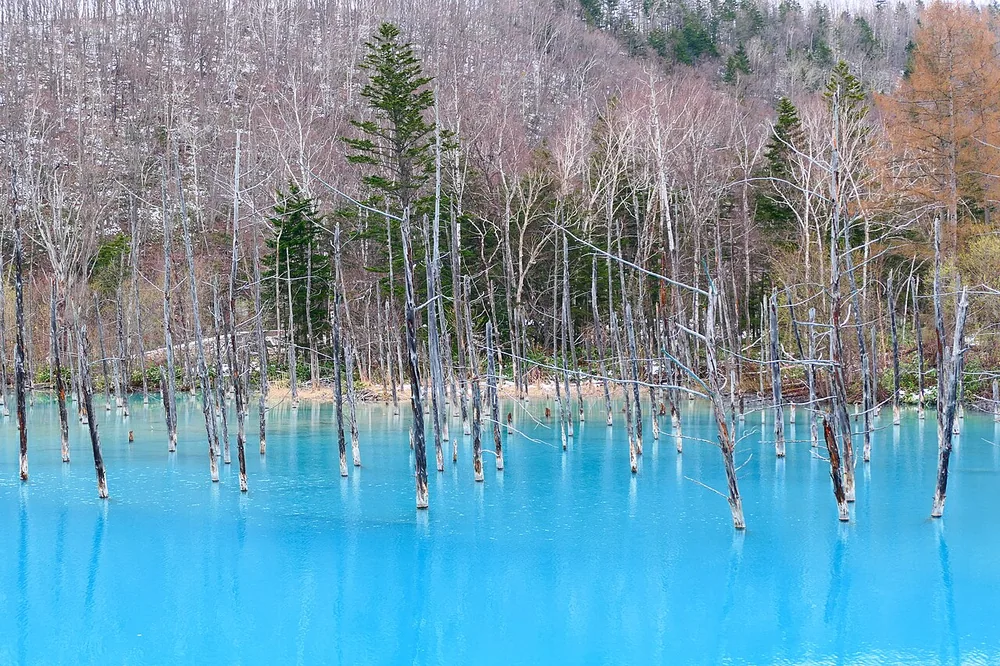
Shirogane Blue Pond formed during volcanic erosion-control works tied to Mount Tokachidake. Water pooled behind a check dam, gradually flooding and killing the larch trees standing there. Upstream at Shirahige Falls, the scenery shifts to a flowing gorge. Groundwater seeps through fissures in the rock face and drops roughly 30 meters in slender white streams into the Biei River below. Seeing both together shows how the same mountain water first holds still among standing trunks and then carves down through the valley.
On a first visit, allow 30 to 45 minutes at Blue Pond, including the walk between the parking lot or bus stop and the viewing trail. Shirahige Falls is mainly viewed from the bridge, a 3-minute walk from the bus stop, where 20 to 30 minutes is plenty for an unhurried look. These are on-site viewing windows only; drivers need extra time to enter and exit parking, and bus riders need buffer time for waiting. If the pond is muddy right after rain stops, cut your pondside time short and spend the daylight examining the waterfall cliffs and gorge instead.
Take Dohoku Bus routes 39 or 42 from Biei Station to Shirogane Blue Pond and Shirahige Falls. Includes half-day schedules, fares, ¥1,000 parking fee, 2026–27 illumination hours, plus Shirogane Onsen and Furano connections.
Catching Dohoku Bus 39 or 42 from Biei Station
JR Furano Line's Biei Station connects Asahikawa and Furano. Exit the station and look for the bus stop beside Asahikawa Shinkin Bank signed for Shirogane Onsen and Aoi-ike, rather than waiting with taxi passengers in the front rotary. Route 39 (Shirogane Line) runs from Asahikawa to Shirogane via Biei Station, while Route 42 (Biei-Shirogane Line) operates out of Biei Station. Both drop you at Shirogane Aoi-ike Iriguchi for the pond and Shirogane Onsen for the falls. On timetables, keep Michi-no-Eki Shirogane Biruke and Shirogane Aoi-ike Iriguchi separate; getting off early at the roadside station leaves you about 1.8 km short of the pond.
The stop heading toward Shirogane is not in the same spot as the stop heading back toward Asahikawa. To continue from Blue Pond to the falls, wait for a bus signed for Shirogane Onsen or Youth Friendship Center (Seishonen Koryu no Ie); to return to Biei, take the opposite direction. When you arrive at Blue Pond, check the return stop location, where to cross the road, and snow conditions right away—especially at night—and count backward from walking time to decide when to leave the water's edge. Save departure times in Japan Standard Time (JST) and screenshot the date, stop name, and return direction, as zooming out on a map makes roadside stops along the same road look deceptively close.
Travelers staying in Asahikawa can also board Route 39 directly from Asahikawa Station Stop 9. Under the October 1, 2026 timetable, the 09:40 departure from Asahikawa Station passes Biei at 10:34 and reaches Blue Pond at 10:56—ideal if you want a one-seat ride up the mountain. If you transfer at Biei in both directions, you can pick between Routes 39 and 42 to match JR Furano Line arrivals, with two return options as well. Keep in mind that Route 42 terminates at Biei Station: on the regular timetable, the last direct bus from Blue Pond to Asahikawa leaves at 14:45, more than three hours earlier than the final bus back to Biei.
Dohoku Bus station diagrams state that cash and supported contactless payment cards are accepted, while transit IC cards are not. If paying cash, bring small coins, take a numbered boarding ticket when getting on, and match that number to the onboard fare display when alighting. Pass holders should follow the ticket instructions and show it to the driver. Keep paper or mobile bus tickets separate from your JR train ticket—riding the train from Asahikawa does not include the Blue Pond bus segment.
¥800 One-Way Fares and When the Day Pass Pays Off
According to the station fare chart, adult one-way fares are ¥800 from Biei Station to Blue Pond, ¥900 from Biei Station to Shirogane Onsen, and ¥220 between Blue Pond and Shirogane Onsen. A simple round-trip to Blue Pond costs ¥1,600, and a round-trip to Shirahige Falls alone costs ¥1,800. Starting at Biei, stopping at Blue Pond, catching a later bus up to the falls, and riding straight back from Shirogane Onsen to Biei totals ¥1,920 across three rides. Only if you stop at Blue Pond a second time on the way back—four separate rides totaling ¥2,040—does the ¥2,000 adult day pass beat buying single tickets.
The Biei-Shirogane Area 1-Day Free Pass gives unlimited hop-on, hop-off rides on Routes 39 and 42 between Biei Station and Shirogane Onsen for ¥2,000 (adults) or ¥1,000 (children). It is sold at Shiki no Johokan, GIOVANNI near the station, and on the official Dohoku Bus ticketing page. Even if you only visit the pond and falls once each, paying ¥80 more than single fares buys flexibility to add an unplanned stop at Shirogane Biruke for lunch or weather delays. Note that the pass covers multiple boardings on the same day, not extra departures—you still ride the exact same timetable.
Direct rides from Asahikawa Station cost ¥1,600 to Blue Pond and ¥1,630 to Shirogane Onsen. Anyone using the Biei-Shirogane day pass needs a separate ticket for the Asahikawa-Biei leg. For families or groups, tallying individual adult and child point-to-point fares against car rental, fuel, and parking gives a clearer cost picture than comparing a single pass price. Nighttime sightseeing buses are a separate product booked through a different reservation page.
A Morning Bus Loop for Both Sights, with Lunch Back in Town
On the regular weekday and holiday timetable effective October 1, 2026, take the 10:34 Route 39 bus from Biei Station to reach Blue Pond at 10:56. Catch the 11:27 Route 42 bus at Aoi-ike Iriguchi up to Shirogane Onsen, arriving at 11:31, then board the 12:02 Route 39 bus back to Biei Station at 12:30 (the same bus continues to Asahikawa Station, arriving at 13:27). That gives roughly 30 minutes between stops at each sight, suitable for a short walk and photos. In winter snow, slower footing means the walk between the bus stop and the pond eats into that half-hour window.
For more time at the pond, arrive at 10:56 and wait for the 12:16 Route 39 bus up to Shirogane Onsen, arriving at 12:20, then catch the 13:16 Route 42 bus back to Biei Station at 13:44. That adds nearly an hour at Blue Pond while leaving just under an hour at the falls; if you plan to eat or soak in an onsen, choose a later return bus. Always lock in your return stop and departure first, then calculate how long you can linger by the water. Special timetables apply over the year-end and New Year holidays, so check Dohoku Bus's holiday notice for those dates.
If you are carrying heavy luggage, leave bags in lockers or storage at Asahikawa or Biei before queuing at the bus stop. Because this itinerary involves multiple boardings, traveling with a small daypack is far easier. Save lunch for the streets around Biei Station, where you can sit down indoors instead of holding takeout in the cold at the pond entrance. If continuing to Furano, remember that 12:30 and 13:44 are arrival times at Biei Station—you still need buffer time to get off the bus, cross into the station, and find your local JR Furano Line train toward Furano. If an incoming train delay makes you miss the 10:34 bus, shorten your pond stay and re-anchor your waterfall connection rather than forcing the rest of the original schedule.
Where to Park by Car and the ¥1,000 Per-Entry Fee
Driving from central Biei takes about 20 minutes along Hokkaido Prefectural Route 966 toward Shirogane. Turn left at the junction near Kaikugama onto the Bibougahara-Biruke Line, then follow signs left into the Blue Pond parking lot. Driving back from Shirogane Onsen, turn right near Kaikugama onto the same town road. Dividers channel traffic near the lot entrance, so if your GPS tells you to cut right into the lot from the near side, follow on-site road signs around to the designated entrance. Save separate pins for the pond itself and the parking lot so passengers do not confuse the water viewpoint with the driveway turnoff.
Starting July 1, 2026, Blue Pond parking is charged per vehicle, per entry: ¥1,000 for standard, compact, and kei cars; ¥300 for motorcycles; and ¥6,000 for large vehicles 6 meters or longer. Standard cars and large buses use separate entrances. Take a ticket on entry, pay at the pre-exit payment machine after your walk, and drive out through the gate. If you visit in the morning for reflections and return at night for the illumination, budget for two entries; driving down from the waterfall lot and re-entering Blue Pond also triggers a new gate fee.
Biei Town lists Blue Pond parking hours as 07:00 to 19:00 from April 23 to October 21, 2026, and 08:00 to 21:30 from October 22, 2026 to April 21, 2027. For Shirahige Falls, use the free public lot in front of Shirogane Tourist Center; for Biruke Forest, park in the public lot at Michi-no-Eki Shirogane Biruke. Each facility has its own entrance. The tourism association notes that 13:00 to 15:00 on clear days is peak congestion at Blue Pond. Before setting out, check Biei Town's live crowd map; if Blue Pond has a queue while Shirogane is clear, drive upstream to the falls first and loop back to the pond later.
Mountain roads turn colder than town after dark, with black ice and reduced visibility during snowfall. First-time winter drivers should keep driving to daylight hours and book a sightseeing bus or taxi for night visits, and always verify snow tires when picking up a winter rental car. If blowing snow hides lane lines and road edges, stay in your lodging area rather than trusting a GPS arrival estimate to chase the lights. Clear snow and ice off headlights, mirrors, windows, and the roof before pulling out so you can spot pedestrians and snow-bank delineator poles around lot entrances.
2026–27 Illumination Hours and Two Nighttime Stops
This season's illuminations at Blue Pond and Shirogane Biruke Forest run from October 22, 2026 to April 21, 2027, ending nightly at 21:00. Start times are 17:00 in October and November, moving earlier to 16:30 in December, then shifting to 17:00 in January, 17:30 in February, 18:00 in March, and 18:30 in April. Blue Pond's lighting sequence cycles roughly every 15 minutes, switching to a winter program once snow accumulates and the surface freezes. Subtract walking time to and from the path when planning, and leave extra buffer after one full cycle to wait for your bus or walk back to the car.
Shirahige Falls is lit year-round from sunset until 21:00, rather than following Blue Pond's fixed monthly start times. Drivers and travelers with pre-booked transport in December can catch Blue Pond at 16:30 first, then head up to Shirogane Tourist Center to view the lit gorge from the bridge. In other months, anchor a two-stop evening around Blue Pond's published start time and leave drive time in between. If Biei Town cancels the Blue Pond illumination due to weather, redirect your evening ride toward town or your hotel and visit the falls in daylight on another day.
On regular Dohoku Bus service from Biei Station, the 17:15 Route 42 bus reaches Blue Pond at 17:37, leaving just 28 minutes before the final 18:05 return bus arrives back at Biei Station at 18:30. From December through February the pond is already lit when you step off, though subtracting the walk, positioning, queues, and early boarding leaves only enough time for a brisk look. In February, arriving at 17:37 sits only 7 minutes past switch-on, and catching an earlier bus means figuring out where to wait until dark. In March, lights come on at 18:00—5 minutes before the last bus—and in April they start after the last bus has already left, so either book a round-trip taxi or drive yourself.
Anyone staying in Asahikawa or Furano must check onward JR Furano Line trains after 18:30. Bus and train schedules do not always align neatly, so plan dinner near Biei Station if there is a long layover. If you want to stay past 20:00 for night photography, lock in your pickup time, parking-lot meeting point, and destination before leaving town in the afternoon; spots in Shirogane are spread out at night, and finding spontaneous transport from the pond is much harder than at Biei Station. When traveling by transit on winter nights, split the two illuminated sights—seeing the falls by day and the pond at night—instead of rushing both before the last bus.
| Dates | Illumination Hours |
|---|---|
| 2026/10/22–11/30 | 17:00–21:00 |
| 2026/12/01–12/31 | 16:30–21:00 |
| 2027/01/01–01/31 | 17:00–21:00 |
| 2027/02/01–02/28 | 17:30–21:00 |
| 2027/03/01–03/31 | 18:00–21:00 |
| 2027/04/01–04/21 | 18:30–21:00 |
Winter Biei View Bus for Blue Pond and Biruke Forest
Biei Town Tourism Association's Biei View Bus illumination tour runs on Fridays and Saturdays from November 20, 2026 to February 13, 2027, excluding January 1 and 2, 2027. Buses depart Shiki no Johokan beside Biei Station at 16:35, returning at 18:30 from November through January and at 19:00 in February (when an extra stop at Biei Senka is added). The route visits Biruke Forest and Blue Pond, giving about 30 minutes at the pond—or 35 minutes in February. Save Shirahige Falls for a separate daytime trip on Route 39 or 42.
Fares start at ¥4,000 for ages 12 and up and ¥2,000 for ages 4 to 11; children aged 3 and under ride free on a lap or pay the child rate if occupying a seat. Online reservations close two days before departure, and the checkout page shows the exact total once you select your date and party size. If your incoming train risks missing the 16:35 meetup, compare the 17:15 and 18:05 regular Dohoku Bus option instead, keeping in mind both are ticketed separately. Families with young kids can layer up inside Shiki no Johokan before boarding, with fixed viewing stops already timed out once you get on.
If you cancel a booked illumination tour two or more days ahead, a ticketing cancellation fee of ¥400 per adult and ¥200 per child applies; canceling the day before incurs 40% of the tour fare (including ticketing fee), same-day cancellation is 50%, and no-shows or cancellations after departure are 100%. When natural disasters prevent safe operation, follow the organizer's official notice. Note that the tourism association also runs a separate Christmas Tree Shuttle that only visits the lone tree in the fields—make sure to select the listing labeled Light-up Course if you want Blue Pond.
Windless Mornings for Blue Water, After Dark for Snow
According to the Biei Town Tourism Association, aluminum-rich upstream water from Shirogane mixes with the Biei River, creating suspended particles that scatter shorter wavelengths of light and give the pond and nearby stream their signature blue hue. Whether the surface reads vivid blue, greenish, or muted gray changes with cloud cover, wind ripples, snowmelt, and recent rain. Spring snowmelt and heavy rain often turn the water cloudy, so picking a clear, calm morning matters far more for clean reflections than chasing the exact calendar month of photos you saw online.
Once on the viewing path, scan the surface with your eyes first to see which side holds the cleanest reflection. Shifting just a few steps along the open walkway changes where standing trunks line up with their mirror image; frame wide to include the far tree line, or fill more of the frame with water to isolate the bare trunks. Front lighting makes the blue color easy to read, while side- and backlighting pick out fine twigs and bright water highlights. Midday still works for trees and water, though under harsh summer sun you can wait for a passing cloud to soften glare or tighten your framing to crop out the brightest reflection.
On a smartphone, tap to focus on the brightest patch of water or sunlit bank and pull exposure down slightly to keep water texture intact. With a camera and polarizer, shoot one frame preserving the reflection before rotating the filter to compare: cutting glare can deepen the apparent water color, but it also erases the mirrored trees, so pick one look per shot. Even under overcast skies the pond can hold strong color—focus on tighter compositions of green and gray tones rather than trying to push every photo to the same neon blue.
In autumn, use foliage along the bank to frame the water; finding a bright stand of leaves often matters more than chasing light on the opposite shore. Early winter sometimes combines open water, thin ice, and shoreline snow, yielding three distinct textures on a sunny day. Once snow seals the pond completely, shift your focus to how floodlights sweep through the trees and cast branch shadows across the snowpack. Cold drains batteries fast, so keep spares in an inner pocket and seal cameras or phones in a bag before stepping into heated indoor spaces to let them warm up slowly.
In low light at night, it is easy to stare at a screen and lose track of footing. Plant your feet on packed, level ground before holding your phone with two hands or framing a shot, then step aside to keep the walkway clear. When tour groups arrive, move back to a quieter spot instead of crowding the front rail for a second lighting cycle. Regardless of snow depth, stay inside the designated viewing zone and never step past the path onto the pond. Travelers planning drone flights must apply to the managing authority in advance following Biei Town Tourism Association's Blue Pond drone-permit instructions.
How to Pair Shirogane Onsen, the Roadside Station, and Bogakudai
Shirahige Falls pairs naturally with a stroll through the hot-spring village. Shirogane Tourist Center has public restrooms, and signs from the falls entrance lead straight to Blue River Bridge. A brief stop on the bridge is usually enough: look upstream for white threads pouring out of the cliffside and downstream along the narrow gorge. When snow covers the deck, watch for icy patches; slower walkers can pause near the near end of the bridge and let crowds pass before moving out, rather than blocking the middle. Keep small children away from the outer railing, and keep both adults and cameras inside the bridge rails if lifting a child for a photo.
If you want a longer stay in Shirogane, schedule an onsen soak right after viewing the falls in daylight. Day-use bathing hours vary by ryokan, so confirm last entry time, whether day visitors are accepted that day, and which bus gets you out afterward before riding up from Blue Pond. Overnight guests should anchor their afternoon around check-in and dinner times, and verify whether baths stay open late enough for a soak after night photography. If catching an early train the next morning, confirm hotel shuttle times, reservation rules, and drop-off points at Biei Station before booking.
Michi-no-Eki Shirogane Biruke sits on the Biei side of Blue Pond, making it a convenient restroom stop by car or a break on the drive back. The tourism association lists hours as 09:00–18:00 from June to August, 09:00–17:00 from March to May and September to November, and 10:00–17:00 from December to February, closing December 31 through January 3 and opening mornings only on December 30. The pondside shop opens 11:00–16:00 from December to March and closes December 31 and January 1. Since both daytime facilities follow their own hours rather than the outdoor lighting schedule, pick up hot drinks or eat dinner in Biei before heading out at night.
Mount Tokachidake Bogakudai Observation Deck sits higher up past Shirogane Onsen and makes a rewarding detour when mountain visibility is clear, the road is open, and you have extra daylight. For 2026–27, Hokkaido Prefectural Route 966 closes in winter sections: Shirogane Gate to Bogakudai Gate closes from 11:00 on October 19, 2026, and Shirogane Onsen Gin-ei Gate to Bogakudai Gate closes from 11:00 on December 1, 2026, with both sections scheduled to remain shut until 11:00 on April 23, 2027. Because the mountain pass toward Kamifurano is impassable during this window, return from Shirogane Onsen through central Biei and take National Route 237 instead. Those closures begin above the hot-spring village, leaving the approach from Biei to Blue Pond and the falls open.
Multigenerational Trips, Strollers, and Cold-Night Pacing
You can see the water and withered larches as soon as you enter Blue Pond's viewpoint—there is no need to walk all the way to the far end of the trail just to get a shot. When traveling with kids or older relatives, gather at the first open viewing area with a clear sightline, and let anyone who wants extra angles walk farther ahead. Agree on a meeting point at the shop, trail entrance, or return bus stop so slower walkers do not feel pressured to keep up along narrow paths. At Shirahige Falls, center your stop around Shirogane Tourist Center and Blue River Bridge—use the restrooms first, step onto the bridge, and head right back inside or to the vehicle to warm up.
Wheelchair and stroller users should check Biei Town Tourism Association's accessibility guide and Blue Pond walking map ahead of time to verify slopes, path surfaces, and turnaround spots from the drop-off point. If anyone in your group needs extra time boarding or exiting buses, choose a daytime gap longer than one bus cycle so a full 30-minute visit still leaves an unhurried walk back to the stop. Cut the walk shorter in deep snow, and only remove gloves to shoot once you have solid footing on level ground. Grippy waterproof boots and a windproof outer shell matter far more than packing an extra lens. Sightseeing buses cut out long roadside waits, though you still walk after getting off—save quick snapshots until you reach a steady spot.
If your group only wants one nighttime outing, choose Shirahige Falls on windy nights or during snowmelt, since you can step off in the hot-spring village and view the lit gorge straight from the bridge. Save the full Blue Pond trail at night for travelers specifically looking for bare trees, snowfields, and shifting lights. When combining daytime water colors and evening illuminations on the same day, build an indoor break in between—lunch in central Biei, hotel check-in in Shirogane, or an onsen soak beats standing by a roadside bus stop waiting for dusk.
Pairing Biei with Furano: Pick Day or Night in Shirogane
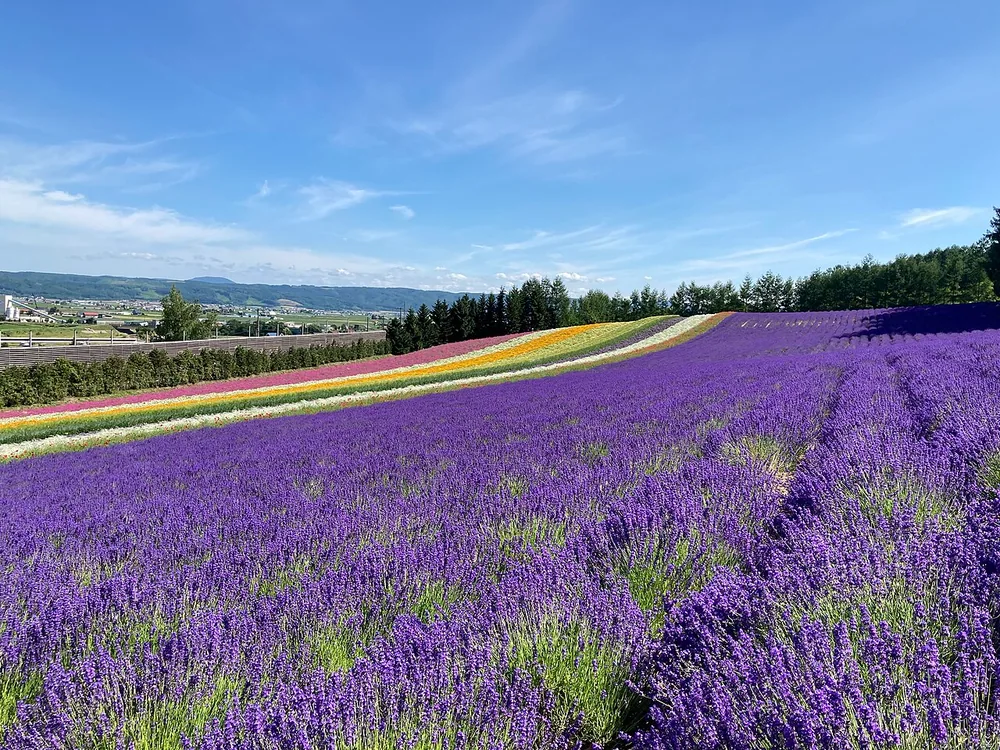
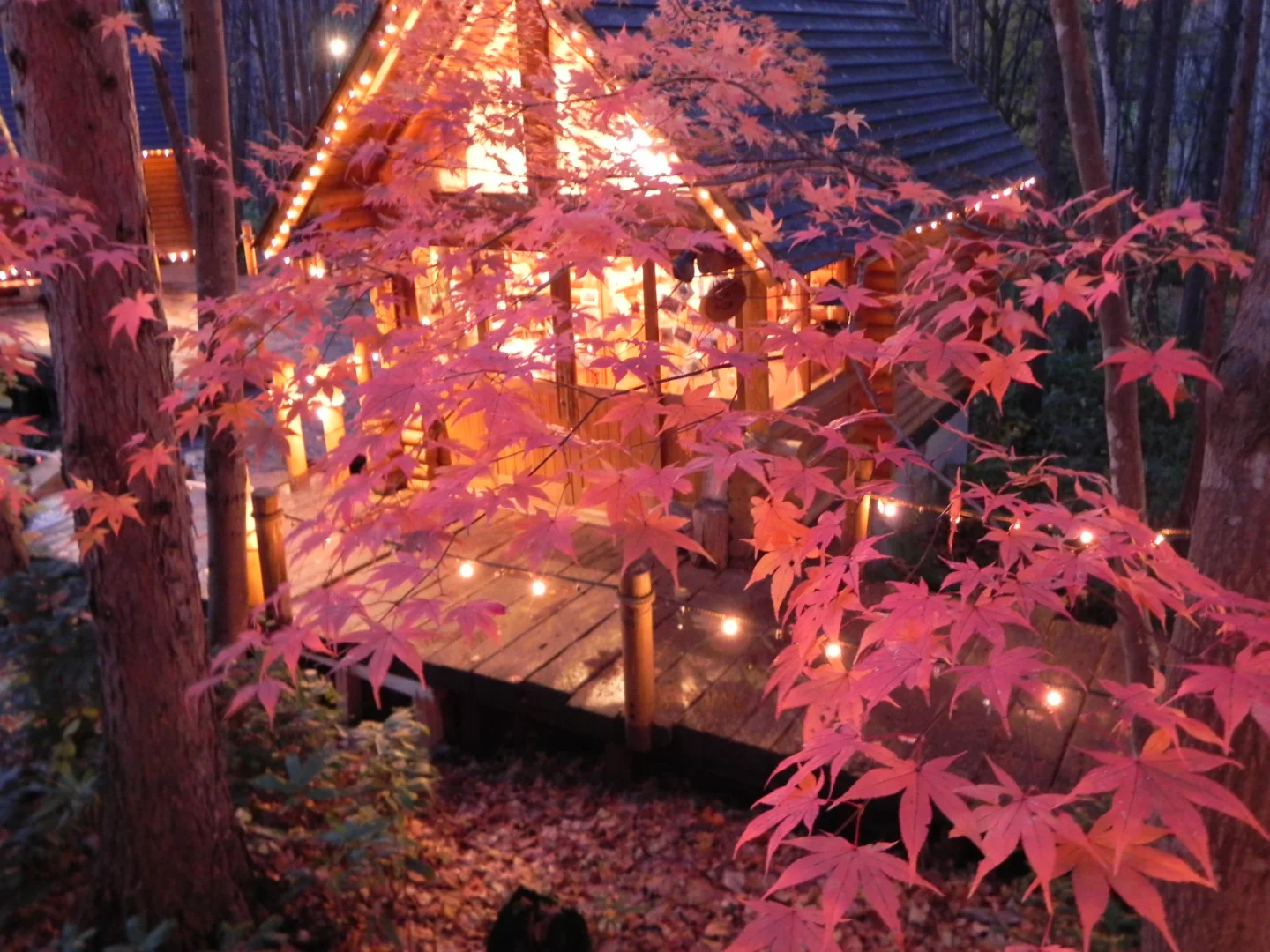
From late spring through early autumn, the smoothest self-drive loop hits Blue Pond and Shirahige Falls in the morning, returns to Biei for lunch, and heads south on National Route 237 to either Shikisai no Oka or a flower farm in Nakafurano before finishing in central Furano or around New Furano Prince Hotel. If you stay until dusk in Furano, save the woodland cabins and boardwalks of Ningle Terrace for right before dinner. Putting Blue Pond in the morning lets you enjoy flower fields later without pushing the pond visit into the afternoon bottleneck. For a transit-only flower itinerary, see our car-free Furano and Biei flower routes.
To make the same-day connection without a car, lock in a daytime bus back from Shirogane to Biei first, then transfer to a JR train to Furano. Ningle Terrace sits on hotel grounds roughly 6 km from JR Furano Station—about 12 minutes by taxi per the hotel, or reached via Furano Bus's Lavender-go stops serving New Furano Prince Hotel. Check return bus times before exploring the forest so you know when to wrap up. Per the hotel's maintenance calendar, Ningle Terrace closes for autumn upkeep from November 5 to November 26, 2026, reopening at 12:00 on November 27, and individual craft shops keep their own days off; if your late-November visit hits the closure, keep your evening light-up plans in Shirogane instead.
Staying in Furano while visiting Blue Pond on a winter night requires at least two transit legs out (Furano to Biei, then up to Shirogane) and two legs back. Since the sightseeing bus returns to Biei at 18:30 or 19:00, dining in Furano afterward depends on catching a late connection. Beyond JR trains, Furano Bus's Lavender-go regular timetable (April 2026 edition) includes a 20:17 departure from Biei Station reaching Furano Station at 21:03; it boards at the Biei-eki stop on the opposite side of the tracks via the pedestrian overpass. Even so, eating dinner in Biei is far more relaxed if you are overnighting in central Furano. Travelers determined to see both lit-up areas at night do best splitting stays—one night in Shirogane and one night in Furano, visiting Ningle Terrace the next afternoon—so you catch each spot at its own switch-on time.
If you are based in Asahikawa, the Shirogane sights work cleanly as a standalone half-day trip with direct daytime return buses to Asahikawa. On days with a flight or reserved intercity train, put the longer Shirogane excursion first and save Asahikawa city stops for after you get back. To link Asahikawa, Furano, and Daisetsuzan across one trip, match your overnight bases to our Asahikawa, Furano, and Daisetsuzan itinerary. Winter day-trippers coming from Sapporo should count backward from their reserved return train out of Asahikawa, locking in the connecting Furano Line train first and then the Shirogane bus so daytime transfers stay comfortable.
Handling Heavy Rain, Missed Buses, or Deep Snow
The night before you go, save a single screenshot containing your outbound and return bus stops at Aoi-ike Iriguchi, return times from Shirogane Onsen to Biei, and your hotel shuttle contact details. If you spot a JR train delay in Sapporo or Asahikawa, you will know immediately whether to adjust your outbound ride or your return bus from Shirogane. If you arrive at Blue Pond behind schedule, skip stopping at the roadside station. And if the next bus puts you at the pond near 16:00 after the last direct bus to Asahikawa has already left, take a downhill bus to Biei Station and ride the JR Furano Line back to Asahikawa.
If morning breaks with heavy rain, pack the camera away and make Shirahige Falls your main stop. When low clouds blanket the mountainside, save summit views for a clearer day; if the pond looks murky, spend more time around Biei's station streets or in a planned onsen. Light snow still rewards a brief walk to the nearest pond viewpoint, but in deep snow or poor visibility, skip combining forest trails and mountain roads on the same night. If you miss the 17:15 bus from Biei Station, stay in town or take a train back to your hotel; if switching to a taxi at night, arrange the pickup, drop-off, and meeting spot in advance.
Should you detour into Biei's patchwork hills for photos on the way back, draw a clear line between farmland and public roads. Biei Town Tourism Association's visitor etiquette asks travelers to stay on roads and designated viewpoints—never cross field boundaries for a closer shot of lone trees. Boundary lines disappear under snow, so pull completely into designated parking areas that leave room for pedestrians and passing cars. Fold tripods away on icy paths so you keep one hand free for railings.
A few useful answers
Do Shirogane Blue Pond and Shirahige Falls charge admission?
General admission is free at both sights. Starting July 1, 2026, Blue Pond parking costs ¥1,000 per entry for standard cars, while Shirahige Falls offers free public parking in front of Shirogane Tourist Center.
Can you walk from Blue Pond to Shirahige Falls?
The two sights are about 2.5 km apart. At night, during snowfall, or when catching the last bus, ride the Dohoku Bus or pre-arranged transport instead—the bus takes about 4 minutes from Aoi-ike Iriguchi to Shirogane Onsen, and about 3 minutes returning.
Can I see the March 2027 Blue Pond illumination by regular bus from Biei Station?
In March, lights turn on at 18:00 and the last regular bus departs Aoi-ike Iriguchi at 18:05, leaving only enough time to wait at the bus stop. Arrange a round-trip taxi or drive yourself if you want a proper look at the illumination.
Does the winter Biei View Bus illumination tour visit Shirahige Falls?
The 2026–27 winter illumination tour stops at Shirogane Biruke Forest and Blue Pond, adding Biei Senka in February. Visit Shirahige Falls separately on Dohoku Bus Routes 39 or 42 to Shirogane Onsen.
Does Blue Pond stay blue in the rain?
Spring snowmelt or heavy rain can turn the water cloudy. Check recent updates from the Biei Town Tourism Association once the rain passes, and save calm, sunny hours for reflections.
Official information and references
Sources used in this guide.
- Biei Town | 2026–27 Illumination Schedule for Blue Pond, Biruke Forest, and Shirahige Falls
- Biei Town | Blue Pond Parking Fees and Seasonal Operating Hours
- Dohoku Bus | Kaguraoka, Biei & Shirogane Weekday Timetable (Effective Oct 1, 2026)
- Dohoku Bus | Kaguraoka, Biei & Shirogane Weekend & Holiday Timetable (Effective Oct 1, 2026)
- Biei Town Tourism Association | Biei Station Bus Boarding Map & Segment Fares (Effective Oct 1, 2026)
- Biei Town Tourism Association | Biei-Shirogane Area 1-Day Free Pass
- Biei Town Tourism Association | 2026–27 Winter Sightseeing Bus Routes, Fares & Reservations
- Biei Town Tourism Association | Shirogane Blue Pond Formation, Access & Accessibility Map
- Biei Town Tourism Association | Shirogane Blue Pond Seasonal Conditions
- Biei Town Tourism Association | Driving Route and Junction to Blue Pond Parking Lot
- Biei Town Tourism Association | Shirahige Falls, Shirogane Tourist Center & Bus Stop
- Biei Town Tourism Association | Michi-no-Eki Shirogane Biruke Operating Information
- Biei Town Tourism Association | Blue Pond Shop Hours and Closures
- Kamikawa General Subprefectural Bureau | 2026–27 Winter Road Closure Schedule (Items 13 & 33: Route 966)
- New Furano Prince Hotel | Autumn 2026 Maintenance Closures Including Ningle Terrace
- New Furano Prince Hotel | Access from JR Furano Station
- Furano Bus | Lavender-go and Local City Routes
- Biei Town Tourism Association | Walking, Cycling & Visitor Etiquette Pamphlets
- Biei Town | Live Crowd Map and Sightseeing Guidelines
- Biei Town Tourism Association | Blue Pond Drone Permit and Facility Information