How to visit Matsunoo Taisha in Kyoto: vantage points for the Joko, Kyokusui, and Horai gardens, sake barrels, the Kamenoi spring, the Statue Hall, combo tickets, Hankyu rail access, Arashiyama connections, and Saiho-ji winter closures.
- Region & Focus
- KyotoShrines and temples
- Reading Scope
- 19 min read · 12 chapters · 4 Q&As
- Official Verification
- 27 official sources checkedUpdated November 22, 2026
- Key Topics
- ItinerariesRail travelSeasons
Chapter Route Map (tap any stop)
- What to Do First at Matsunoo Taisha
- Reading the Torii, Romon Gate, and Main Sanctuary from Outside
- Blue-Green Schist Ties All Three Gardens Together
- Starting with the Two Boulders of the Joko Garden
- Following the Stream in Kyokusui and the Pond Edge in Horai
- Carved Wooden Deities and a Muromachi Map in the Statue Hall
- Connecting the Sake Barrels, Sugidama, and Kamenoi Spring
- Timing a Visit Around Festivals or Yamabuki Blooms
- Getting There from Kyoto Station, Shijo-Karasuma, and Arashiyama
- Pairing with Saiho-ji on a Half-Day Loop
- Adding Arashiyama Without Shortchanging the North Bank
- Adjusting for Rain, Older Travelers, or a One-Hour Window
- Quick Q&A
Give Matsunoo Taisha a solid block of daylight if you come for the gardens. Landscape architect Mirei Shigemori divided Shofuen into three gardens - Joko, Kyokusui, and Horai - and one combo ticket also covers the Statue Hall. From Shijo-Karasuma, ride the Hankyu line to Katsura, transfer to the Hankyu Arashiyama Line, and get off at Matsunoo-taisha Station, about a three-minute walk from the gate. Budget roughly 90 minutes for a dedicated garden visit. If you have a reservation at Saiho-ji, lock in your sutra-copying and entry slot first, then fit Matsunoo Taisha either before or after.
What to Do First at Matsunoo Taisha
Pass through the torii gate and the two-story Romon gate, pay your respects at the worship hall, then choose a direction. Facing the mountain from the entrance, the Sake Museum (Osake no Shiryokan) sits to the left of the approach, and the Horai Garden lies to the right. The Kyokusui Garden, Joko Garden, and Statue Hall sit farther back toward the mountainside. Horai is closest to the gate; head toward the mountain if you want to see how the Joko Garden recreates the sacred boulders of Mount Matsuo. Matsunoo Taisha Shrine Grounds Map
General entry to the shrine grounds is free. A combo ticket covers the three Shofuen gardens and the Statue Hall for ¥500 adults, ¥400 students, and ¥300 children. Both open at 9:00 AM, closing at 4:00 PM on weekdays and Saturdays and at 4:30 PM on Sundays and national holidays. The Kyoto Prefecture Tourism Federation lists the Sake Museum as free to enter from 9:00 AM to 4:00 PM. When a Saturday falls on a national holiday, follow the holiday closing time. Matsunoo Taisha Garden Admission
Kyoto City tourism listings give grounds opening hours of 5:00 AM to 6:00 PM, making early morning a good option for a quiet visit. If you want to enter the three gardens, arrive near 9:00 AM and use the minutes before opening to explore the torii, Romon gate, and worship hall. Coming from Arashiyama in the afternoon, aim to reach the shrine by 2:30 PM on weekdays or Saturdays so you have time to buy tickets, browse the indoor hall, and walk back to the entrance. On Sundays, the extra 30 minutes is best saved for your last garden.
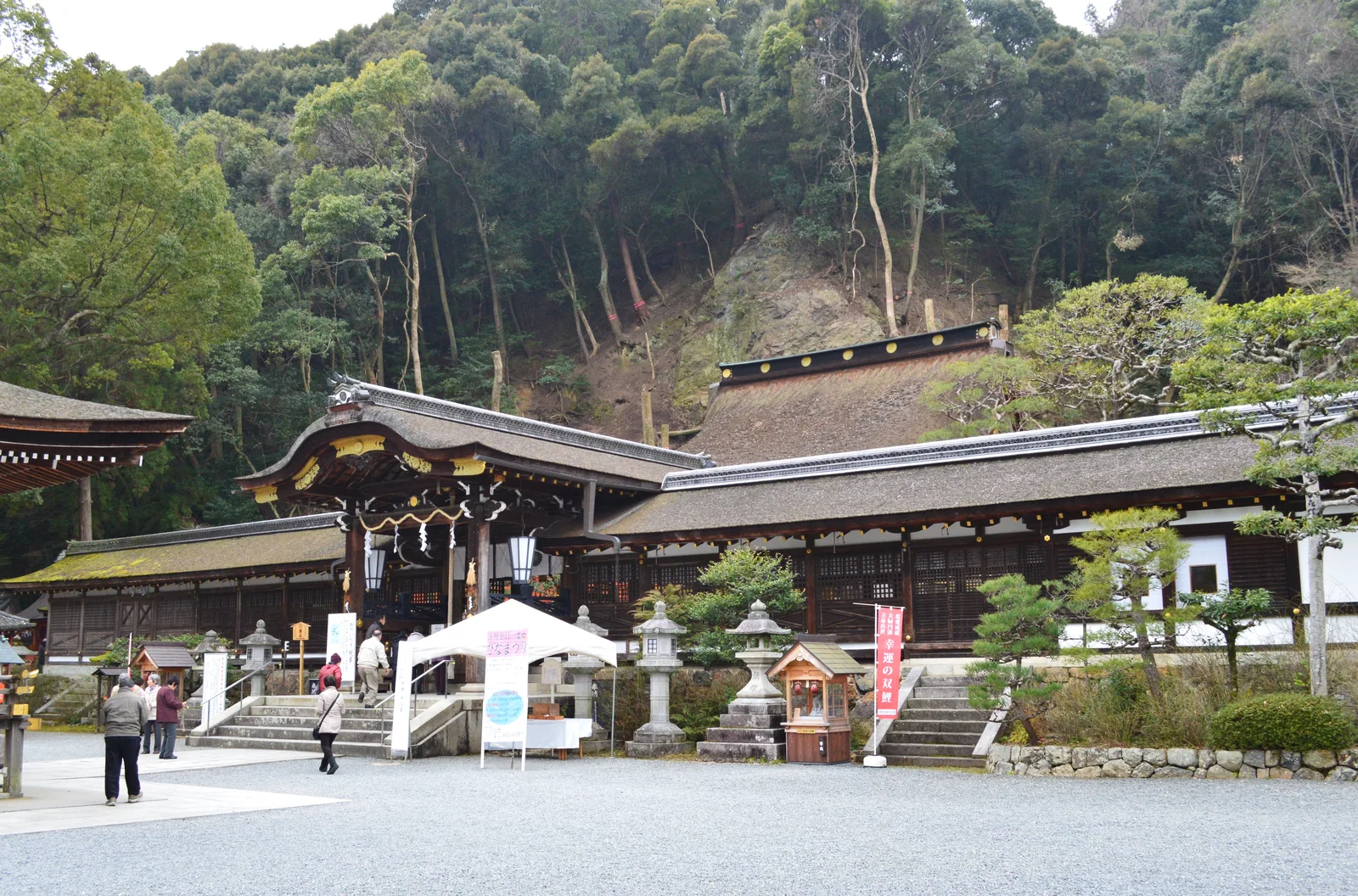
In the main courtyard, the worship hall stands in front and the main sanctuary (honden) rises behind it, built right against the foot of the hillside. Lift your gaze slightly above the altar and you can see how the honden roof clears the rooflines of the worship hall and surrounding structures. Designated an Important Cultural Property, the honden dates to 1397 according to shrine records, with Kyoto City archives noting major repairs in 1542. Its distinctive architectural style is called Matsuo-zukuri. In good light, stepping back a few paces lets you frame both tiers of roofs against the wooded slope.
Before splitting up at the gate, agree on which parts to see together. The main shrine worship and the wall of donated sake barrels sit right by the entrance and courtyard, making them easy to cover as a group. Anyone buying tickets for the Statue Hall can loop back from the mountainside to regroup along the approach. If you are heading to Saiho-ji or Tenryu-ji in the afternoon, set a firm departure time first and decide how to divide your remaining minutes between the gardens, the Statue Hall, and the spring.
| Area | Admission | Regular Hours |
|---|---|---|
| General shrine grounds | Free | 5:00 AM-6:00 PM (per Kyoto City listings) |
| Shofuen Three Gardens (Joko, Kyokusui, Horai) & Statue Hall | Combo ticket: ¥500 adults, ¥400 students, ¥300 children | 9:00 AM-4:00 PM (until 4:30 PM on Sundays & national holidays) |
| Sake Museum | Free | 9:00 AM-4:00 PM |
How to visit Matsunoo Taisha in Kyoto: vantage points for the Joko, Kyokusui, and Horai gardens, sake barrels, the Kamenoi spring, the Statue Hall, combo tickets, Hankyu rail access, Arashiyama connections, and Saiho-ji winter closures.
Reading the Torii, Romon Gate, and Main Sanctuary from Outside
Across the red torii gate along the approach, bundles of sakaki branches hang from the sacred straw rope (shimenawa). The shrine calls this practice wakikanjo - 12 bundles in a regular year and 13 in a leap year, tied to an old custom of reading monthly crop prospects. Step back a little to spot the row of branch bundles under the rope. You can photograph the red pillars together with the hanging greenery, or walk past and look back to see the bundles silhouetted against the approach road. Fresh green at the start of the year, the leaves naturally darken by winter.
Guardian statues flank the Romon gate, and wooden ladles are tucked into the wire mesh around them. The shrine identifies these as prayer ladles. Alongside the brewery names on the sake barrels, they are one of the easiest votive offerings to spot. Because they sit right before the worship courtyard, they give you something to look over while waiting for companions. Once inside the courtyard, look up at the roof ridges first and compare the front and rear eaves. The shrine's architecture notes point specifically to the karahafu gable at the end of the honden's box ridge - an undulating curve peaking in the center and sweeping down at both sides that you can try to pick out from the courtyard.
To see the main sanctuary up close, join the shrine's special guided entry (tokubetsu sanpai). Admission is ¥1,000 per person (free for preschool-age children and younger) and includes a priest's explanation and purification ceremony lasting about 20 minutes. Standard times are 10:00 AM, 11:30 AM, 1:30 PM, and 2:30 PM, suspended from January 1 to 7, with schedule adjustments possible on festival days. For the 10:00 AM slot, visit the nearby Horai Garden right when gates open at 9:00 AM, return to the worship hall for the tour, then finish with the Statue Hall and the two mountainside gardens. This fee is separate from the garden combo ticket. Matsunoo Taisha Architecture & Special Entry
If you stay in the general courtyard, study the rooflines first and then step up to the worship hall to inspect its beams and pillars. Matsunoo Taisha's architecture guide distinguishes the medieval carvings on the honden from Edo-period structures such as the worship hall and Romon gate. After viewing the honden, look back toward the Romon gate and move to the opposite side of the courtyard to see how the front and rear roofs overlap.
Blue-Green Schist Ties All Three Gardens Together
The three gardens of Shofuen were completed in 1975. Although Joko, Kyokusui, and Horai each draw on a different era of Japanese garden design and shrine history, they are contemporary works built as a single group. Shrine records note that more than 200 pieces of bluish-green stone - chlorite schist from the Yoshino River in Shikoku - were used across the three gardens. Placing that same stone above dwarf bamboo, beside a winding stream, or as islands in a pond changes both its visual weight and where your eye travels. If you are short on time, following how the stone is used is easier than reading every date on the plaques.
On dry days the schist looks paler, while damp surfaces bring out sharper color contrasts and mineral grain. You will see tall standing stones, flat slabs, and smaller rocks edging the water. Frame one wide shot in each garden to show the overall layout and save close-ups for the rock texture. One photo per garden makes a clean comparison: the vertical reach of Joko's stones, the curve of Kyokusui's channel, and the pond and far bank of Horai.
Starting with the Two Boulders of the Joko Garden
At the Joko Garden, look first for the two large standing boulders centered deep in the layout. The shrine interprets them as representing the deities Oyamakui-no-kami and Ichikishimahime-no-mikoto, surrounded by smaller rocks for attendant gods and groundcover dwarf bamboo evoking high-mountain flora. The tallest boulder pulls your eye immediately, but once you locate both main stones, trace the stepping heights of the outer rocks to see how the composition funnels your gaze back to the two central boulders. It is also an easy game to play with kids: stand along the path, find the two main rocks, and see whether everyone points to the same pair first.
The design takes its cue from iwakura - sacred rock formations high on Mount Matsuo. According to shrine tradition, before any buildings stood here, people worshiped at massive boulders near the top of Osugidani valley on the mountain. In 701, Hata no Imiki Tori was ordered to build a shrine at the mountain's base, bringing the mountain deities down to the present site. The mountain boulders and the garden represent two distinct places. After a 2018 typhoon caused landslides and downed trees along the trail, the shrine abolished group hikes to the mountain iwakura, so use the Joko Garden to picture that mountain faith and keep your walking to the accessible grounds below. Matsunoo Taisha Iwakura & Trail Notice
Even if you have already seen plenty of gardens in Kyoto, Joko makes a strong starting point because two upright boulders tell the origin story of the shrine in one glance. From the designated viewing edge, read the arrangement straight on first, then shift slightly along the walkway to change the angle. Standing side by side, it is easy to compare which stone each person notices first, though photographers should step back to a wider section of the path so others can pass.
Following the Stream in Kyokusui and the Pond Edge in Horai
The Kyokusui Garden drops your gaze from tall boulders down to ground level. Kyokusui means a winding stream, inspired by the poetry banquets of Heian-era aristocrats. The Kyoto Prefecture Tourism Federation describes the Mitarashi River winding along the base of the mountain with stones scattered slightly higher up the bank. Walk a few steps along the viewing path and notice how the schist blocks sometimes hide the channel and sometimes let it reappear. To trace the flow clearly, pick a spot where you can see both the stone banks and the bends ahead and behind, rather than lingering in a narrow bottleneck.
Joko and Kyokusui sit right next to each other on the shrine map and pair naturally. Joko's upright rocks grab attention first, while Kyokusui's rock groupings pull the eye along the curving water and toward the hillside beyond. At a bend in the stream, trace where the water heads next, then glance back to see which stone hides the upstream stretch. Both gardens rely on the same blue-green schist, showing how shifting stone placement changes how you move through the space.
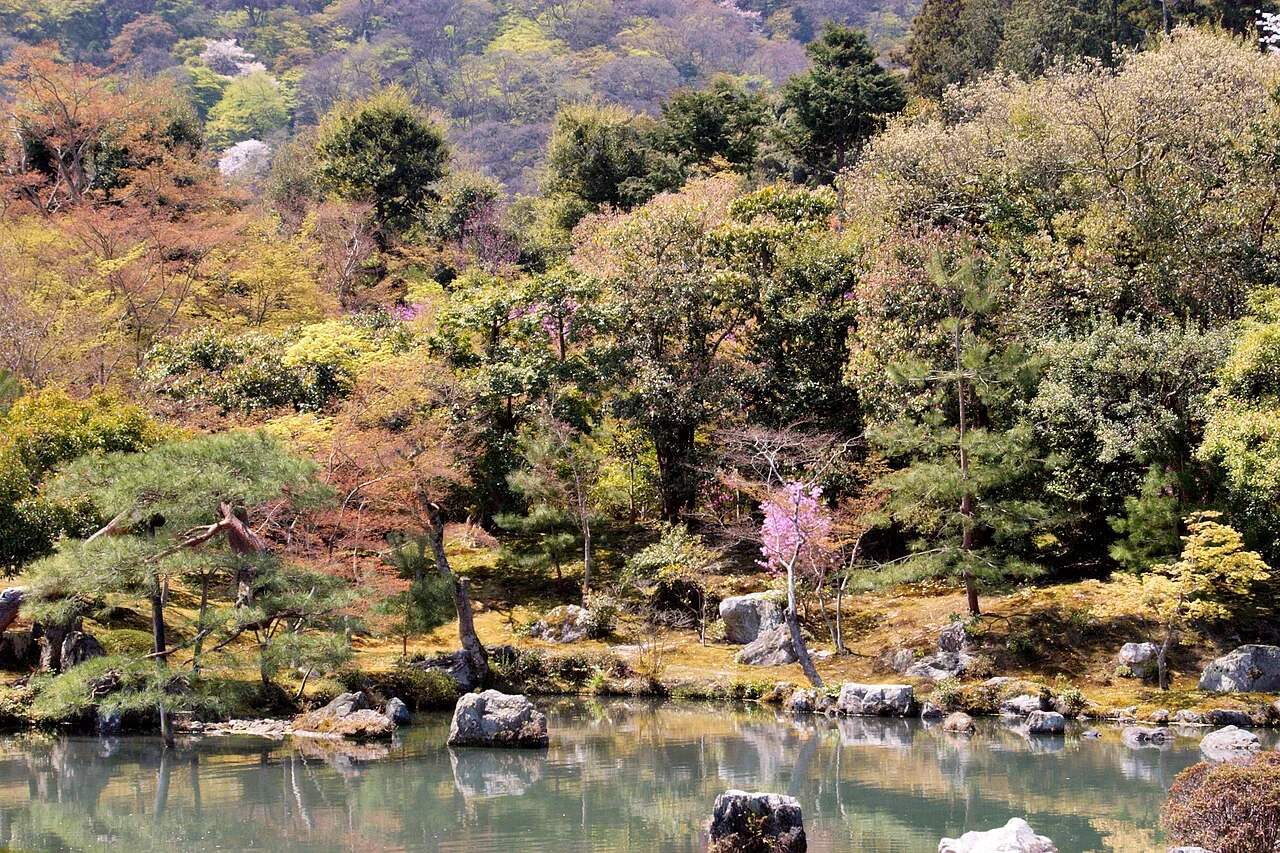
The Horai Garden opens the water out into a pond shaped, as the shrine describes it, like a crane spreading its wings. Horai refers to the mythical isle of immortals, and the garden adapts the Kamakura-period strolling pond style so islands and rocks reveal themselves bit by bit as your angle changes. Your first impression is the water surface and far bank, and walking along the pond edge reveals more than trying to take in the whole crane outline from one spot. If a travel companion only wants to see one garden, choose Horai for water and reflections; save time for Joko and Kyokusui farther toward the mountain if you want to see how the gardens reflect shrine history.
In overcast or rainy weather, wind and raindrops break up the pond reflections and change how the garden photographs compared to sunny days. If rain gets heavy enough to keep one hand on an umbrella, shorten your time by the pond, put the camera away through the narrow sections, and spend the extra minutes inside the Statue Hall. The same adjustment works well in early spring or winter: catch your favorite outdoor angles first, then leave unhurried time indoors to read the plaques.
Carved Wooden Deities and a Muromachi Map in the Statue Hall
The Statue Hall displays 21 Shinto deity statues. Three life-sized seated figures from the early Heian period are Important Cultural Properties carved primarily from single blocks of wood (ichiboku-zukuri). The museum identifies the older male deity as Oyamakui-no-kami, the female deity as Ichikishimahime-no-mikoto, and the younger male deity as their divine child. Compare their proportions up close - look at the shoulders, sleeves, and crossed knees to appreciate how much depth a single trunk of wood can hold. Putting the camera away here makes it easier to stand still and take in the dating labels.
The remaining 18 statues originally came from auxiliary shrines on the grounds and mostly date from the late Heian to Kamakura periods. Look for traces of original pigment, a figure with an inscription on its base dated Koji 2 (1143), and statues depicting deities in Buddhist monk robes. Anyone interested in shinbutsu-shugo (the historical blending of Shinto and Buddhism) can focus on those stylistic contrasts. With children, counting the three life-sized figures and hunting for one statue dressed differently leaves a stronger impression than rushing past all 21.
To the left of the entrance hangs a shrine precinct map from the early Muromachi period alongside the genealogy of the Higashi priestly family. Having already seen the worship hall, Romon gate, and hillside outside makes it much easier to orient yourself on the old map. On the right hang four-season photographs of Matsunoo Taisha by photographer Katsuhiko Mizuno. On a rainy off-season visit, spend ten extra minutes here matching the historic layout on the map against a corner of the grounds you walked past earlier. Matsunoo Taisha Statue Hall
Connecting the Sake Barrels, Sugidama, and Kamenoi Spring
To make sense of the shrine's sake heritage, start by picking out a few familiar brewery names on the stacked sake barrels. As the Kyoto Prefecture Tourism Federation notes, brewers from across Japan donate these barrels as hono - offerings of sake or symbolic barrels presented to the deity. Reading the brand names and prefectures on the labels helps separate this wall of offerings from a retail display at a Kyoto bottle shop. Follow that thread into the Sake Museum to see how the brew is made, then continue to the spring to see where the water comes from.
A spherical cedar-needle ball (sugidama) hangs at the Sake Museum entrance. Inside, brewing tools, diagrams, and videos trace the bond between Matsunoo Taisha and sake making alongside a step-by-step look at the brewing process. With kids, turn it into a quick scavenger hunt: find the rice-steaming gear first, then look for the vessels used for fermentation and bottling. Save any close look at the sake cups and vessels for last, since their shapes make more sense once you have seen the production stages. Covered from the weather, the museum is also a welcome break during sudden showers or when someone in your group needs a rest from standing in front of the outdoor barrels with an umbrella. Matsunoo Taisha Sake Museum
Follow the side of the main sanctuary toward the mountain foot to find the Kamenoi spring in front of Reiki Falls. Shrine records explain that brewers draw this spring water as motomizu - starter water blended into their brewing supply - and Kyoto City notes the longstanding belief that adding it keeps sake from spoiling. Looking from the spring up into the wooded ravine behind it makes it instantly clear why the sanctuary, mountain, and water source sit clustered together. If someone is filling bottles, wait off to the side rather than stepping between their containers and the spout for a photo.
The name Reiki appears on the waterfall as well, linked to a shrine story about an auspicious turtle spotted in the valley that prompted the imperial court to change the era name to Reiki. If you also spot the turtle statue visitors rub for good luck on the grounds, you can connect the two stories. The precinct map labels Kamenoi as water tied to longevity and renewal, showing how a single spring carries multiple meanings in local faith. Walking here right after reading about raw ingredients in the Sake Museum is the cleanest way to link the donated barrels back to the landscape.
If you only have half an hour, focus on the approach to photograph the barrels or note brewery names, then head back to the courtyard for the shrine buildings. If you want to know what happens before sake goes into the cask, prioritize the Sake Museum. Later, when you visit the Fushimi sake district, comparing the vats, tools, and labels you saw at Matsunoo against Fushimi's brewery displays gives you far more context than just looking at rows of barrels in both places.
Timing a Visit Around Festivals or Yamabuki Blooms
After the autumn rice harvest, sake brewing enters a new cycle. Matsunoo Taisha holds the Kami-u Matsuri on the first Day of the Rabbit in November, when brewers pray for safe fermentation and take home large wooden talismans to enshrine at their breweries, followed by the Chuyu Matsuri on the middle Day of the Rooster in April to give thanks at the end of the season. Shrine listings include miso, soy sauce, and vinegar makers and sellers alongside sake brewers. Seeing those two ceremonies shifts your view from a tourist wall of barrels to how breweries structure their entire year. In 2026, the Kami-u Matsuri took place on November 1 at 11:00 AM. Matsunoo Taisha Brewing Festivals
Spring's signature bloom at Matsunoo is yamabuki (Japanese kerria). The Kyoto Prefecture Tourism Federation lists the banks of the Ichinoi River as the prime spot, typically peaking in late April. If flowers are your main goal, check the stream between the Romon gate and the main sanctuary first to find clear water-and-blossom angles before deciding whether to buy garden tickets. For a post-cherry-blossom morning in western Kyoto, yamabuki and Mirei Shigemori's blue-green schist pair effortlessly. During the Shinko-sai festival, processions cross the Katsura River by boat (funatogyo), which requires setting aside extra time down by the riverbanks. If your priority is quietly studying the gardens, stick to a regular day.
Matsunoo Taisha also hosts monthly tea gatherings (Kencha-kai). The shrine's 2027 schedule sets the first two sessions for January 17 and February 7, from 9:00 AM to 3:00 PM. Walk-in tea tickets cost ¥2,000, annual passes are ¥8,000, and gatherings pause in July and August. During Saiho-ji's winter maintenance closure, the February 7 tea gathering pairs neatly with a morning at Matsunoo Taisha before taking the Hankyu line on to Arashiyama. Tea tickets are separate from garden admission. Matsunoo Taisha 2027 Tea Gathering Schedule
Getting There from Kyoto Station, Shijo-Karasuma, and Arashiyama
From Kyoto Station, take the Karasuma Subway Line to Shijo Station and follow signs underground to Hankyu Karasuma Station. Ride the Hankyu Kyoto Line to Katsura, transfer to the branch train bound for Arashiyama, and get off one stop past Kamikatsura at Matsunoo-taisha Station (HK97). Travelers staying near Shijo-Karasuma or Kawaramachi can board directly at Hankyu Karasuma or Kyoto-kawaramachi. Shrine estimates put the trip from Kyoto Station at around 40 minutes including transfers. If you are trying to reach the gardens before last entry, build in extra minutes for the underground walkway, platform change at Katsura, and wait for the branch train.
The station has East and West ticket gates. Exiting the Arashiyama-bound platform from Katsura via the West Gate puts you roughly a three-minute walk from the shrine. Trains back toward Katsura use the opposite platform. Hankyu's station map shows only stairs connecting the two platforms inside the fare gates, so anyone with a stroller or wheelchair should enter through the outer gate matching their direction of travel. The East Gate is unstaffed, with an intercom available if you need assistance. Returning from Arashiyama, you can skip the interior stairs by exiting the Katsura-bound platform directly via the East Gate and walking outside to the shrine. Hankyu Matsunoo-taisha Station Map
For a one-seat ride from Kyoto Station, take Kyoto City Bus 28 bound for Arashiyama / Daikakuji and get off at Matsunoo-taisha-mae. Riders near Shijo-Omiya can catch the same Line 28 there, while Line 29 runs from Shijo-Karasuma toward Rakusai Bus Terminal. On the return trip, check the bus stop direction signs at Matsunoo-taisha-mae: take Line 28 back to Kyoto Station or Line 29 back to Shijo-Karasuma. Standard City Bus routes like Line 28 charge a flat fare of ¥230 for adults and ¥120 for children per ride, with outbound Line 28 buses signed for Arashiyama and Daikakuji. Kyoto City Bus Matsunoo-taisha-mae Timetable
Kyoto Bus routes also serve Matsunoo-taisha-mae. From Kyoto Station, take Line 73 bound for Kokedera / Suzumushidera, or Line 83 on weekdays. Coming from Sanjo-Keihan or Shijo-Kawaramachi, look for Line 63. Compared with City Bus routes, Kyoto Bus has the advantage of continuing directly to the Kokedera / Suzumushidera stop near Saiho-ji. Because many buses bound for Arashiyama turn off earlier, checking the route number and final destination saves you from boarding a bus that stops short of Matsunoo or Kokedera. Kyoto Bus Matsunoo Taisha Guide
In autumn 2026, select Kyoto Bus services entering and leaving Arashiyama from the Kiyotaki side ran detours. Kyoto City Bus also announced weekday detours from November 2 to 27 between 10:00 AM and 4:00 PM on the north bank of Arashiyama affecting Kyoto Station-bound Line 28 and other routes. When the Arashiyama Tenryu-ji-mae stop for Kyoto Station-bound Line 28 is suspended, board instead at the westbound Arashiyama (Togetsukyo North End) stop. To head from the north bank to Matsunoo, you can also walk across Togetsukyo Bridge to Hankyu Arashiyama Station and ride one stop to Matsunoo-taisha. Kyoto City Bus Autumn 2026 Weekday Detours
Pairing with Saiho-ji on a Half-Day Loop
Saiho-ji's standard daily admission (hibi sanpai) requires advance application no later than the day before your visit. The visit begins with sutra copying and worship in the main hall before touring the moss garden, taking roughly 60 minutes total. Groups of three or four must split into separate online accounts or postcard applications, and groups of five or more cannot apply. General admission is restricted to ages 13 and up, while children 12 and under may only enter on designated Children's Days. If your family trip does not align with a Children's Day, swap Saiho-ji for Tenryu-ji's garden, which still pairs cleanly with Matsunoo Taisha on the same day. Saiho-ji Daily Admission
With a 10:00 AM slot at Saiho-ji, plan to move on after 11:00 AM and reach Matsunoo Taisha before noon for worship and the three gardens. That keeps your main hall appointment focused on sutra copying while leaving the rest of the morning flexible. From the Kokedera / Suzumushidera stop, Kyoto Bus services headed toward Arashiyama and central Kyoto run to Matsunoo-taisha-mae. The Kyoto Prefecture Tourism Federation notes the two sites sit roughly 0.9 km apart in a straight line; walking along local streets takes about 20 minutes at a relaxed pace, so give yourself a small buffer. Going the opposite way from Matsunoo to Saiho-ji uses the same stops, just make sure the bus is headed toward Kokedera / Suzumushidera.
If you draw a 1:30 PM Saiho-ji slot, visit Matsunoo in the morning instead. Arrive around 9:30 AM to see the three gardens and Statue Hall, break for lunch before noon, and check in at Saiho-ji afterward. That sequence gives you enough time for both gardens without rushing afterward. If you still have energy later, take a bus from Saiho-ji back to Matsunoo-taisha Station and ride the Hankyu line one stop to Arashiyama for an evening river walk and dinner.
Traveling purely by train works too. Saiho-ji lists Hankyu Kamikatsura as the nearest station, about a 15-minute walk away. For a morning Saiho-ji visit, transfer at Katsura to the Arashiyama Line, get off at Kamikatsura, and either walk back to Kamikatsura afterward or walk straight up the road to Matsunoo Taisha. If you prefer to minimize walking, Kyoto Bus's Kokedera / Suzumushidera stop is about three minutes from the temple gate, while Kyoto City Bus's Suzumushidera / Kokedera-michi stop is roughly a ten-minute walk. Because both stop names include Kokedera, double-check the bus operator when looking up timetables. Saiho-ji Access & Visitor FAQ
From January 12 to February 26, 2027, Saiho-ji suspends standard daily admission for grounds maintenance, offering special visits such as Zen and Art gatherings in February instead. If you want the classic sutra-copying and moss-garden pairing, plan your trip outside those dates. Should your dates fall inside the closure, tour Shofuen at Matsunoo Taisha in the morning and cross to Tenryu-ji in Arashiyama after lunch - you still get two distinct gardens to compare without adding another bus leg to Kokedera.
Adding Arashiyama Without Shortchanging the North Bank
Matsunoo-taisha is one stop from Hankyu Arashiyama, which drops you on the south side of Togetsukyo Bridge. If you only want lunch and views of the bridge and Katsura River, walking out to Arashiyama Park and the bridgehead is all you need. Crossing Togetsukyo Bridge to the north bank is only necessary for Tenryu-ji, the Bamboo Grove, or the Randen tram. On your itinerary, break "one stop to Arashiyama" into two distinct legs - arriving on the south bank and walking across the bridge - so nobody treats the stations on opposite sides as the same exit, especially when traveling with kids, older relatives, or a group.
Tenryu-ji's garden is generally open 8:30 AM to 5:00 PM with last entry at 4:50 PM, costing ¥500 for high school students and adults and ¥300 for elementary and middle school students. Compared with Shofuen, Sogenchi Pond opens to a wider sweep of water backed by the Arashiyama hills right inside the frame. Leaving Matsunoo after 2:30 PM, pick just two stops between Togetsukyo Bridge and Tenryu-ji's garden, continuing out the north gate into the Bamboo Grove only if everyone still has energy. Viewing the Cloud Dragon ceiling painting in the Dharma Hall requires a separate ticket and follows its own open dates, with January 2, 2027 listed as closed; garden-focused visitors should time their arrival to the garden ticket window. Tenryu-ji Hours & Access
Starting early in the Bamboo Grove works in reverse just as well. Take JR or Randen to the north bank first thing, walk the grove, then follow Nagatsuji-dori back down to Togetsukyo Bridge and cross to the Hankyu line for a quieter afternoon at Matsunoo's Sake Museum and gardens. If Tenryu-ji is on your list, visit it in the morning with the Bamboo Grove so you do not have to cross the bridge twice. The tightest squeeze on that reverse route is lunch - eat on the north bank before crossing rather than trying to squeeze in a meal, the bridge walk, and a timed entry at midday.
For a garden-focused half-day that skips Arashiyama crowds altogether, ride Hankyu back from Matsunoo-taisha to Katsura and pair it with Katsura Imperial Villa. Because the Imperial Household Agency requires timed reservations with limited capacity, secure your villa slot first and place Matsunoo Taisha before or after it. At Katsura Imperial Villa, stepping-stone paths link pavilions and teahouses around a central pond - a sharp contrast to Mirei Shigemori's standing boulders and winding stream at Matsunoo. If villa slots are booked out, continuing up the Hankyu Arashiyama Line to Arashiyama keeps transit straightforward. Imperial Household Agency: Katsura Imperial Villa
Choose your route back into central Kyoto based on which riverbank you end on. Staying on Arashiyama's south side makes it easy to take Hankyu back to Katsura and connect onto the Kyoto Line for Shijo-Kawaramachi or Osaka. Finishing near Tenryu-ji or the Bamboo Grove puts you closer to JR Saga-Arashiyama Station for Kyoto Station or Randen Arashiyama Station for Shijo-Omiya. Because JR and Randen serve completely different lines, confirm the exact station name if your group splits up - never shorten Saga-Arashiyama and Arashiyama to the same name. Kyoto City Saga-Arashiyama Access Guide
If you are staying overnight in Arashiyama, stroll along the river before checkout, leave your bags at your hotel, and ride one stop from Hankyu Arashiyama to Matsunoo for the gardens. Travelers catching a Shinkansen straight from Kyoto Station after Arashiyama can also visit Matsunoo the afternoon before checking in, then ride JR direct from the north bank back to Kyoto Station after checkout without dragging luggage across Togetsukyo Bridge to reach Hankyu and the subway.
Adjusting for Rain, Older Travelers, or a One-Hour Window
In light rain, buy the combo ticket, take a brief look outdoors at Joko and Kyokusui, and head into the Statue Hall. If the downpour picks up, move to the Sake Museum near the entrance so your second half shifts from outdoor water features to covered brewing displays. Fold up umbrellas and rain gear before leaving the museum and decide then whether to walk around to the spring and waterfall behind the sanctuary. If paths are puddled and stone steps slick, skip the back hillside and take the shorter walk back out through the courtyard.
The Kyoto Prefecture Tourism Federation's accessibility listing marks the Sake Museum as wheelchair accessible. If someone in your party needs to avoid stairs and long periods of standing, make the museum your main stop right inside the gate. When splitting up, set the open space just inside the torii as your meeting point so ticket holders can visit Kyokusui and Joko and return straight down the approach. Because Saiho-ji's garden paths cannot accommodate wheelchairs, keeping Matsunoo's indoor museum on the schedule and pairing it with the flat south riverbank in Arashiyama works much better.
With only an hour to spare, match the loop to your main interest. For sake heritage, pay respects at the worship hall, inspect the donated barrels, tour the Sake Museum, and add the spring only if time allows. For gardens, buy the combo ticket and head straight to Joko and Kyokusui toward the mountain, pausing on the way back where you can take in the Horai pond from the path. If everyone wants photos, time to read statue labels, or a stop at the amulet counter, budget 90 minutes instead of squeezing right up against your next departure. Store large bags at your hotel or starting station so gates, stone steps, and narrow paths stay effortless.
In clear weather, crossing Togetsukyo Bridge from Matsunoo to Arashiyama makes an easy walk. In rain, cold wind, or when legs are tired, limit Arashiyama to the south riverbank and take the Hankyu train straight back. Save the Bamboo Grove for another morning starting from JR Saga-Arashiyama Station. Taking time to finish the gardens and statues you already paid for at Matsunoo Taisha beats rushing across town only to reach the north-bank ticket windows right as they close.
A few useful answers
Is admission to Matsunoo Taisha free?
General access to the shrine grounds and the Sake Museum is free. A single combo ticket covers the three Shofuen gardens and the Statue Hall for ¥500 adults, ¥400 students, and ¥300 children.
What are the three gardens in Shofuen?
The Joko Garden evokes the sacred mountain boulders (iwakura), the Kyokusui Garden centers on a winding stream inspired by Heian-era court banquets, and the Horai Garden is viewed along a strolling pond. All three are contemporary works designed by Mirei Shigemori.
How do you get from Matsunoo Taisha to Arashiyama?
Board an Arashiyama-bound train at Hankyu Matsunoo-taisha Station and ride one stop to Hankyu Arashiyama Station. Because Tenryu-ji and the Randen Arashiyama stop sit on the north side of Togetsukyo Bridge, walk from the station to the bridgehead and cross on foot.
Can you visit Matsunoo Taisha and Saiho-ji on the same day in winter 2027?
Saiho-ji suspends standard daily admission (hibi sanpai) from January 12 to February 26, 2027, holding special visits in February instead. To combine Matsunoo Taisha with Saiho-ji's regular sutra-copying and moss-garden visit, go outside those dates and apply for Saiho-ji no later than the day before.
Official information and references
Sources used in this guide.
- Matsunoo Taisha | Shrine Grounds Map
- Matsunoo Taisha | Shrine Architecture, Wakikanjo, and Special Sanctuary Entry
- Matsunoo Taisha | Garden & Statue Hall Admission, Hours, and Sacred Spring
- Matsunoo Taisha | Mount Matsuo Iwakura and Trail Closure Notice
- Matsunoo Taisha | Statue Hall Exhibits and Hours
- Matsunoo Taisha | Sake Museum
- Matsunoo Taisha | Shrine History and the Hata Clan
- Matsunoo Taisha | Access, Shrine Buildings, and Group Visits
- Matsunoo Taisha | Kami-u Matsuri and Chuyu Matsuri Brewing Festivals
- Matsunoo Taisha | 2027 Tea Gathering (Kencha-kai) Schedule Notice
- Kyoto City Official Travel Guide | Matsunoo Taisha, Grounds Hours, and Main Sanctuary
- Kyoto City Official Travel Guide | 2026 Matsunoo Taisha Kami-u Matsuri
- Kyoto Prefecture Tourism Federation | Matsunoo Taisha, Yamabuki Blooms, and Accessibility
- Kyoto Prefecture Tourism Federation | Sake Museum Admission Info
- Hankyu Railway | Matsunoo-taisha Station Platforms, Gates, and Timetable
- Hankyu Railway | Matsunoo-taisha Station Map
- Kyoto City Transportation Bureau | Matsunoo-taisha-mae Stop Lines 28 & 29
- Kyoto City Transportation Bureau | City Bus Routes and Flat-Fare Zones
- Kyoto City Transportation Bureau | Standard City Bus Fares
- Kyoto City Transportation Bureau | Autumn 2026 Weekday Arashiyama Bus Detours
- Kyoto Bus | Matsunoo Taisha Routes and Boarding Guide
- Kyoto Bus | Autumn 2026 Arashiyama Detour Notice
- Saiho-ji | Daily Admission, Application Rules, and 2027 Winter Closure
- Saiho-ji | Age Limits, Accessibility, and Bus/Train Stops
- Tenryu-ji | Garden, Buildings, and Cloud Dragon Painting Admission
- Imperial Household Agency | Katsura Imperial Villa Visit Guidelines
- Kyoto City Official Travel Guide | Saga and Arashiyama Access Guide