Plan half a day in northwest Kyoto, starting with Kinkaku-ji's pond, steps and photography rules. Compare Ryoan-ji's rock garden with Kitano Tenmangu, its market on the 25th and the 2026 Odoi autumn garden, with bus directions, child admission and routes for older visitors and strollers.
- Region & Focus
- KyotoShrines and temples
- Reading Scope
- 30 min read · 12 chapters · 4 Q&As
- Official Verification
- 20 official sources checkedUpdated November 22, 2026
- Key Topics
- ItinerariesSeasonsRail travel
Chapter Route Map (tap any stop)
- With half a day, choose the rock garden or the shrine
- Kinkaku-ji admission and hours: ¥500 for adults, including high school students
- Pause at Kyoko-chi Pond: study the three floors, then change your viewpoint
- Beyond the pavilion: the full garden route or a return before the steps
- Arrange luggage, lunch and photography before you leave
- Choose the bus direction: direct from Kyoto Station or via Kitaoji
- Kinkaku-ji to Ryoan-ji: one transfer, two ways to view a garden
- At Ryoan-ji, study the open gravel, walls and pond as well as the rocks
- Kinkaku-ji to Kitano Tenmangu: worship first, then amulets and seasonal gardens
- Work backward from the last thing you want to do
- The market on the 25th and the 2026 Odoi maple garden change the plan
- Let your companions and the weather set the second stop's length
- Quick Q&A
Kinkaku-ji, Ryoan-ji and Kitano Tenmangu all lie in northwest Kyoto, but treating them as three quick photo stops makes for a poor half-day trip. Kinkaku-ji follows a garden path. Ryoan-ji rewards time spent quietly looking at its rock garden. Kitano Tenmangu changes with the market on the 25th, the plum garden and the autumn maple garden. For a first visit, pair Kinkaku-ji with one of the other two. To see all three properly, allow a longer day that includes lunch, transport and any seasonal garden.
With half a day, choose the rock garden or the shrine
Choose Kinkaku-ji and Ryoan-ji to compare a golden pavilion beside a pond with a dry landscape garden. Both are temples, but you experience them differently. At the first, you move along a path and see how the building relates to the water. At the second, you pause in front of the Hojo hall and study the white gravel and groups of rocks. If your companions like Japanese gardens, this pairing leaves more time than crossing to eastern Kyoto for another temple.
Choose Kinkaku-ji and Kitano Tenmangu to visit the deity of learning, examine shrine decoration or buy an amulet. Entry to the shrine's ordinary grounds is free. Skipping the seasonal garden reduces admission costs and keeps the second stop flexible. Families with students preparing for exams can focus on prayers for success. If you are accompanying older relatives to the Golden Pavilion, shorten the second stop to a visit in front of the main sanctuary as their energy allows. There is no need to walk to every small shrine to increase the number of sights.
If you plan to enter the Odoi autumn maple garden in 2026, treat Kitano Tenmangu as a major stop that requires a ticket, walking and time. An ordinary shrine visit and the maple garden need separate time slots. For an evening garden visit, Kinkaku-ji alone works well during the day. Have lunch and a rest before continuing to Kitano, and save Ryoan-ji for another morning. This gives you daylight for the buildings and evening light in the garden without chasing three closing times.
The half-day allocations below are itinerary suggestions. Start with four to five hours for two visits, one transfer and a meal. Add time for a stroller return route, children's breaks or the maple garden. With only three hours and luggage still to collect at Kyoto Station, one main sight and a meal are more practical. Count the time from your accommodation, the wait for transport and the walk to the actual entrance. Nearby points on a map then become a workable route.
Plan half a day in northwest Kyoto, starting with Kinkaku-ji's pond, steps and photography rules. Compare Ryoan-ji's rock garden with Kitano Tenmangu, its market on the 25th and the 2026 Odoi autumn garden, with bus directions, child admission and routes for older visitors and strollers.
Kinkaku-ji admission and hours: ¥500 for adults, including high school students
Kinkaku-ji is formally called Rokuon-ji. Its famous golden building is the reliquary hall known as the Golden Pavilion. The temple's current ordinary visiting hours are 9:00–17:00, year-round. Admission is ¥500 for adults, including high school students, and ¥300 for elementary and junior high school students. Plan around the 9:00 opening if you want to start here in the morning. Kiyomizu-dera's early opening hours do not apply here.
For two adults, one high school student and one elementary school student, ordinary admission to Kinkaku-ji totals ¥1,800. At Ryoan-ji, the next possible stop, the high school student pays a separate ¥500 rate. The temples classify the same child differently, so calculate each admission separately. Kinkaku-ji has no general group discount; parties of 30 or more use group admission arrangements. Visitors with documents listed by the temple, such as a disability certificate or rehabilitation certificate, can present the original on the day to request a reduction or exemption. Groups can apply in advance through the temple's procedure.
Kinkaku-ji accepts cash and several cashless methods through Omairi Pay for admission. This does not cover amulets, other shrine or temple items, or goshuin calligraphy stamps. If you usually pay only by phone, keep cash for anything you want to obtain. The admission ticket is for the public garden route. Focus on the pavilion's exterior by the pond, the garden and sights along the path; you do not need to set aside time to enter the pavilion or go upstairs.
The temple lists 17:00 as the end of visiting hours. Arriving at the last moment leaves too little time for the garden. If you also want to visit Ryoan-ji or Kitano's main sanctuary, put Kinkaku-ji earlier in the day so you can manage the next site's last admission and closing time. For special events on your travel date, use the temple's notices to check which areas are open. Allowing time to visit is more useful than rushing the final stretch at the gate.
Pause at Kyoko-chi Pond: study the three floors, then change your viewpoint
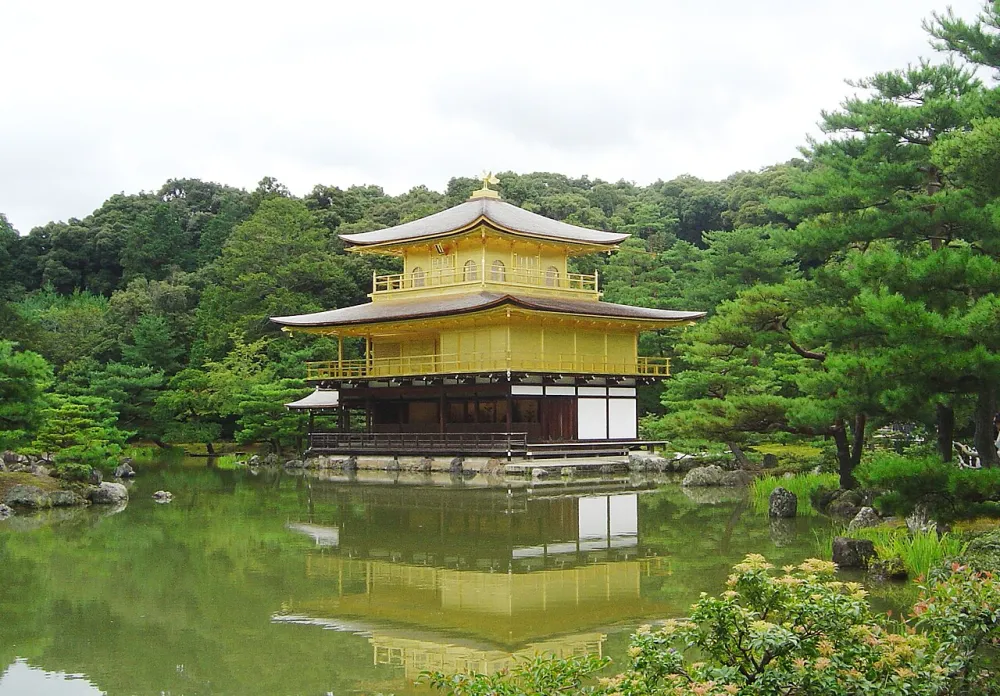
After entering the garden, first pause to see how Kyoko-chi Pond relates to the reliquary hall. Water, island rocks and trees surround the Golden Pavilion, so there is more to look at than its gold walls. Take in the whole pond before examining the differences between the floors. This reveals more of the garden than immediately seeking the exact angle of a photo you saw online.
The temple's grounds guide explains that gold leaf covers lacquer on the second and third floors. The first floor, Hosui-in, uses the shinden style of aristocratic residences. The second, Choondo, uses a warrior residence style. The third, Kukkyōchō, follows the Chinese style of a Zen Buddhist hall. From the pond, look for the different materials and colors of the lower and upper floors, and the phoenix on the roof. Each floor has its own appearance. For children who have little patience for a long history lesson, start by asking which floor is not covered in gold.
The pond's islands and rock groups also form part of the garden. Looking only at the pavilion can hide its place within the larger pond landscape. Widen your view to compare the open water, trees along the shore and proportions of the building. Wind breaks up the reflection; rain brings out wet stone banks and the roof's outline. Stay on the marked route when choosing a viewpoint. Do not step over ropes or block the path while waiting for a reflection.
If others have stopped beside the pond, use an allowed viewing space to examine the building's details, then move forward with the line. Families with a wheelchair or stroller should make this the main part of their visit. Steps farther along the route require a choice between completing the garden and returning along the route without major level changes. Decide at the entrance whether everyone will turn back together, so you do not lose track of one another at the steps.
Beyond the pavilion: the full garden route or a return before the steps
After the pond, shift your attention from the broad view of the building to smaller features. The official grounds guide lists Rikushu-no-matsu, Ginga-sen, Gankasui, Ryumon Falls, Anmintaku Pond, Sekkatei and Fudo-do. Save the map if you want to follow the full route, then use signs to visit the areas actually open that day. You do not need to turn the visit into a roll call of every named feature.
Ginga-sen Spring lies behind the pavilion. The temple links it to the tradition that Yoshimitsu used its water for tea; nearby Gankasui is said to have supplied water for washing his hands. After the open pond view, notice where the springs sit on the hillside and how the garden's viewpoints change. Read these traditions through the temple's guide. Do not plan to drink or collect the spring water.
Sekkatei, later on the route, is a historic teahouse within the garden. Treat it separately from the option of paying for tea and a rest along the way. At narrow stretches and steps, let people pass before stopping. Photograph names on the map and read their background back at your accommodation. That is easier on this uneven route than looking down to research every story as you walk.
The temple gives clear guidance for wheelchair users, visitors with walking difficulties and strollers. A route with fewer large level changes reaches the side of the Golden Pavilion. Turn back before the steps and leave through the visitor entrance. This route does not circle the whole garden and exit at the far end. If your family splits into a group continuing ahead and a group returning, agree on a meeting point outside the entrance first. Someone should accompany anyone who needs help.
Kinkaku-ji offers loan wheelchairs and a multipurpose restroom. Wheelchairs cannot be reserved and are available only if one is free when you arrive. If you have your own wheelchair, plan to use the return route described above. For older relatives who can walk only short distances, an on-site loan should not be the only basis for the visit. The shorter route gives a full view of the pavilion and pond. Others can return with them and save energy for the second stop or lunch.
Arrange luggage, lunch and photography before you leave
Kinkaku-ji has neither luggage storage nor lockers. Leave large bags at your accommodation or a station storage facility before taking transport here. You must carry your belongings from the entrance to the pond and on the later steps, so a suitcase is poorly suited to this route. If you are changing accommodation that day, decide when to drop off and collect bags before choosing a morning or afternoon visit. Avoid leaving companions and luggage at different stations.
The temple also states that there is no place to eat a boxed lunch inside the garden. Eat at a restaurant outside the grounds before or after visiting. The pond, stone steps and garden corners are not picnic spots. For a morning visit to both temples, have breakfast before the first and lunch after the second. If a young child needs an early meal, eat after Kinkaku-ji and move Ryoan-ji to the afternoon. A meal is part of the itinerary; it need not wait until every temple and shrine is finished.
Kinkaku-ji's photography rules are stricter than many visitors expect. The permitted use is casual photography with a small camera for personal enjoyment. Photography intended for publication to others, including on social media, and commercial use are prohibited. Group photographs, video livestreaming and drone flights are also prohibited. If your main aim is to make a public video or social media content, organize filming around the temple's rules and focus on viewing and worship inside the garden.
These rules also affect how your group moves. Do not have one person stand by the pond to photograph everyone in turn while the rest block the path. If some want to read signs and others want only a short walk, agree on the pace outside the entrance. This is easier than repeatedly calling for one another inside. Small dogs and cats must be in a cage or carrier with both head and body fully enclosed. Holding them or using a sling does not meet the rule. Assistance dogs may accompany visitors.
Choose the bus direction: direct from Kyoto Station or via Kitaoji
Kinkakuji-michi is the city bus stop named on the temple's access page. Services include 12, 59, 205 and M1. There is still a walk from the stop to the temple entrance, so navigate to the entrance rather than planning only around the bus arrival time. Identify the stop for your return direction when you arrive. This saves studying signs across a crowded street after the visit.
From Kyoto Station, check city bus 205 toward Kinkaku-ji and Kitaoji Bus Terminal if you want to avoid a transfer. Route 205 is a loop, and buses with the same number travel in different directions. Check both the destination and the route before boarding. A direct ride is easy to follow for families with children and light bags. It also means spending longer on the road, where congestion can cut directly into your visiting time.
Another option is the Karasuma subway line to Kitaoji Station and Bus Terminal, then a 204, 205 or M1 toward Kinkaku-ji. The transport bureau's current stop page separates 204 services toward Takano and Ginkaku-ji from those toward Kinkaku-ji and Enmachi. Route 205 also has Kawaramachi-dori and Nishioji-dori directions. Choose a service displaying Kinkaku-ji. Using the subway first puts more of the city crossing on rail. This works well if you stay near the Karasuma line or want to reduce a long bus journey.
From the Shijo Kawaramachi or Sanjo Keihan area, compare that day's 12 and 59 services. Route 59 is especially useful if Ryoan-ji is your second stop. The best service depends on your hotel and departure time. Search from your hotel door to Kinkakuji-michi, then compare fewer transfers with less walking for your group. There is no need to detour to Kyoto Station to meet up.
For departure, the Kinkakuji-michi stop page lists 59 toward Ryoan-ji and Yamagoe, 204 and 205 toward Kitaoji, and 205 to Kyoto Station via Nishioji Shijo, among other directions. To reach the Karasuma line, go to Kitaoji and transfer to the subway. For Ryoan-ji, choose the service heading there. The boarding stop and direction matter more than memorizing route numbers. Do not join the nearest queue simply because it says 205.
Kinkaku-ji to Ryoan-ji: one transfer, two ways to view a garden
Ryoan-ji lies southwest of Kinkaku-ji. Walk between them along Kinukake-no-michi, or take bus 59 from Kinkakuji-michi toward Ryoan-ji and Yamagoe and get off at Ryoanji-mae. Walking makes the road part of your outing; the bus saves energy for the temple. The bus is usually more practical in strong summer sun, rain, or after your group has completed Kinkaku-ji's full garden. Waiting for it is not wasted time. The distance already walked affects how much attention you can give the rock garden.
Ryoan-ji lists visiting hours of 8:00–17:00 from March 1 to November 30, and 8:30–16:30 from December 1 to the end of February. Its FAQ separately lists gate closing times of 17:30 and 17:00 for those seasons. Plan your arrival around the visiting hours, not the later gate closing. Ordinary admission is ¥600 for adults, ¥500 for high school students and ¥300 for elementary and junior high school students. There is no group discount. Goshuin service is usually 9:00–16:00; allow time within your visit if you want an entry in your stamp book.
The family described above—two adults, one high school student and one elementary school student—pays ¥2,000 at Ryoan-ji, making ¥3,800 for both temples, plus transport and lunch. For a party of ordinary adults, the two temples total ¥1,100 each. These are separate admissions, not a combined ticket. If your family is interested in only one type of garden, visit one temple and use the other admission budget for a more relaxed meal.
The temple's FAQ estimates about 30–40 minutes for an ordinary visit. Allow around an hour if you want to sit by the rock garden and walk beside the pond; this adds room to look at your own pace. Visiting Ryoan-ji first uses its earlier opening, before continuing to Kinkaku-ji. This order suits anyone who wants to head out before 9:00 without waiting outside Kinkaku-ji's gate.
At Ryoan-ji, study the open gravel, walls and pond as well as the rocks
Ryoan-ji's famous rock garden is the Hojo Garden, with 15 rocks set in white gravel. The temple lists the groups from east to west as five, two, three, two and three. First look at the distance between them, then at the empty space around them. Concentrating only on counting every rock can obscure how the same gravel surface gains depth from different positions. This garden invites you to pause, unlike the moving views beside Kinkaku-ji's pond.
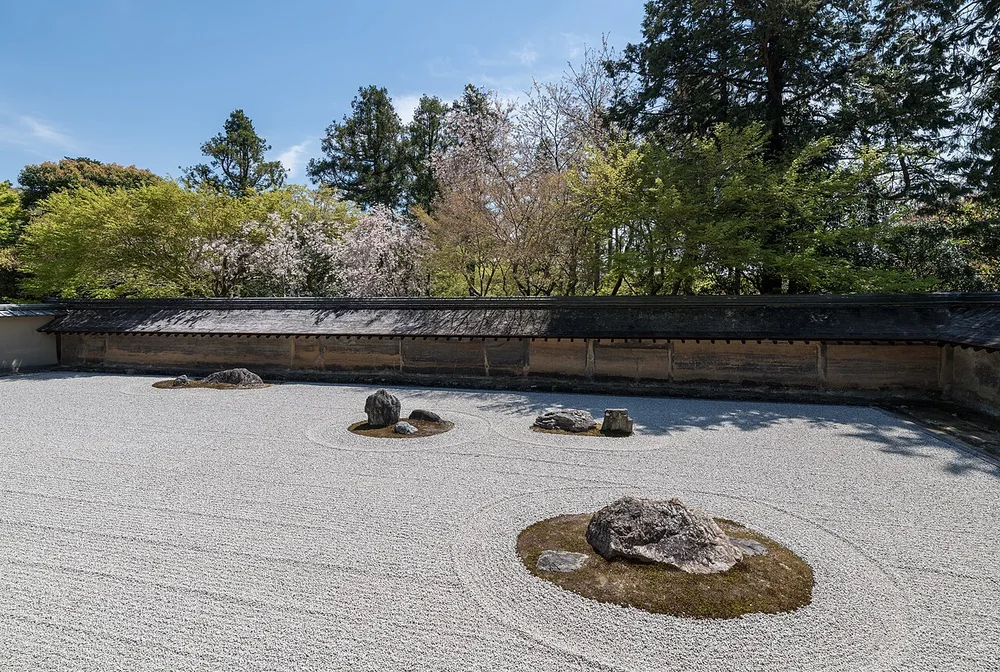
The temple offers several readings of the creator's intention and introduces names such as the Tiger Cubs Crossing. For most visitors, it is useful to look at the rocks, gravel and earthen walls first, then read the explanations. Each rock need not have one fixed symbolic meaning. Children can look for the closest group or widest area of white gravel. Those interested in design can study how the walls frame the view. Both approaches work in the same space.
One detail is easy to miss. The official explanation says the garden surface slopes slightly toward the southeast corner at the left rear of the Hojo for drainage. The wall on the right also gradually lowers into the distance to create depth. These lines reveal more of the design than counting rocks alone. Move your gaze from the gravel patterns near you to the boundary, then back to the rocks. The small, apparently flat garden controls several layers of depth.
After the south-side rock garden, follow the public route to other views around the Hojo. The grounds guide describes a tsukubai water basin bearing an inscription read as 'I know only contentment.' The square mouth at its center supplies a shared character element for the four surrounding characters. It is a good detail to identify together. The Zorokuan teahouse is normally closed, so do not make entering it a required activity. Spend time in the open gardens instead of waiting at a closed entrance for another indoor space.
Kyoyo-chi Pond offers a landscape on another scale. The temple connects it with the period when the site was a villa of the Tokudaiji family. Seasonal plants and waterbirds can be seen from the banks. Watch from the paths; do not chase birds or throw food into the water. Keep both parts of the visit: quiet time at the rock garden, then a walk by the pond after leaving the building. Ryoan-ji becomes more than a photograph of white gravel.
Kinkaku-ji to Kitano Tenmangu: worship first, then amulets and seasonal gardens
Kitano Tenmangu lies south of Kinkaku-ji and chiefly enshrines Sugawara no Michizane. Ordinary access to the grounds is free, normally 7:00–17:00. The grounds also open at night during the maple garden illuminations. Sankomon Gate, in front of the main sanctuary, closes 30 minutes before that day's closing time. For an ordinary daytime visit, finish worship before 16:30, then explore the surrounding area. The amulet office normally opens 9:00–16:30, extended to 20:00 during the maple garden illuminations. Prayer applications are accepted 9:00–16:00. Plan purchases and formal prayers around their separate service hours.
From Kinkakuji-michi, take 205 or 204 south along Nishioji-dori, get off at Kitano Hakubaicho and walk. The shrine's current access page gives a five-minute walk from Keifuku Kitano-Hakubaicho Station. Allow additional time for the bus stop's location, road crossings and the walk to the main sanctuary. Kitano Tenmangu-mae is a different bus stop. It serves travelers on specified routes such as 50 from Kyoto Station or 51 and 203 from Imadegawa. Do not treat the two stops as the same place.
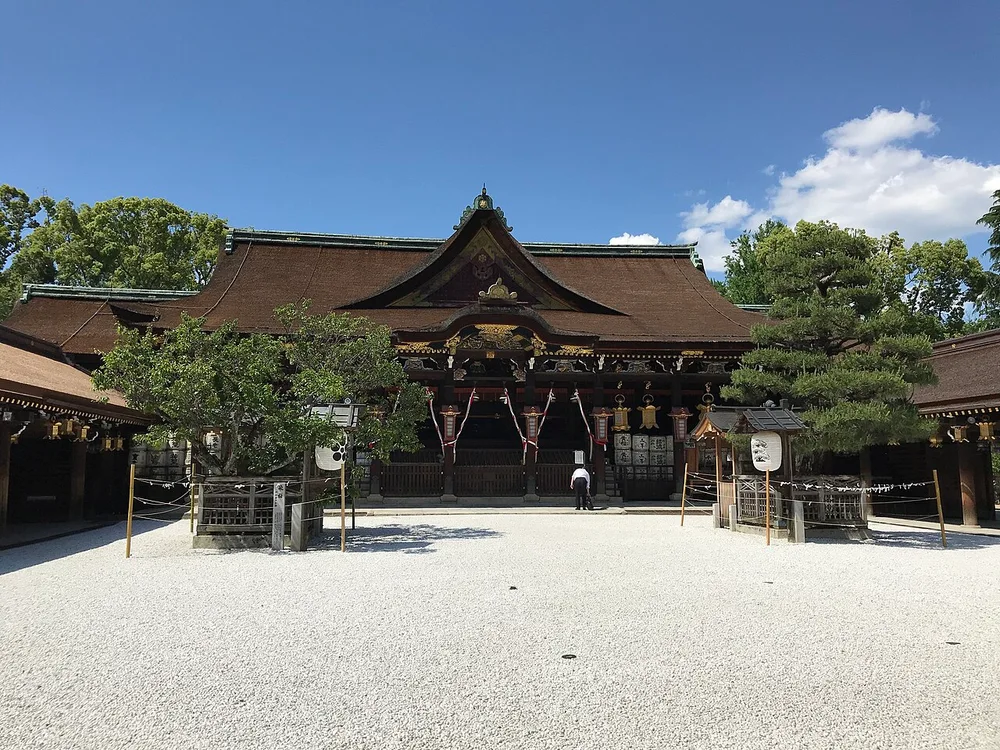
On a first visit, enter through the first torii on Imadegawa-dori, follow the approach through the Romon gate, then continue to Sankomon and the main sanctuary. The main sanctuary uses the connected arrangement known as yatsumune-zukuri, also called gongen-zukuri: the main hall and worship hall are linked by an intervening space. The present building was constructed by Toyotomi Hideyori in 1607. Ordinary worship takes place in front of the worship hall. To study the decoration, look at the curved roof, karahafu gable and gold details, then compare the carvings on Sankomon. This is a different architectural visit from Kinkaku-ji's pond views.
Allow separately for any amulets, ema prayer plaques or goshuin you choose. If some family members want formal prayers and others only an amulet, put the required service hours first at this second stop. Others can then decide whether to accompany them or rest outside the grounds. An ordinary visit does not require the procedure for an organized group prayer. For a family with students taking exams, the shrine can be the main purpose of the trip, with its own time rather than whatever remains after Kinkaku-ji.
The official entrance-area livestream used by the shrine's website shows the road and pedestrian traffic in front of the first torii.
Work backward from the last thing you want to do
For a morning pairing of Kinkaku-ji and Ryoan-ji, allow 9:00–10:00 at Kinkaku-ji, travel to Ryoan-ji after 10:00, then spend about an hour at Ryoan-ji before lunch. This gives the first stop room and places the walk or bus wait between the temples. If you leave Kyoto Station at 9:00, move the whole plan later according to your arrival, including lunch. You do not need to hurry through the garden to preserve a neat clock time.
In the reverse order, Ryoan-ji's 8:00 opening from March to November lets you visit before continuing to Kinkaku-ji, which opens at 9:00. This suits travelers staying in western Kyoto who want an early start. In winter, Ryoan-ji opens at 8:30. With transfer time between the temples, you should no longer need to wait for Kinkaku-ji to open. For the Karasuma line afterward, take a Kitaoji-bound service from Kinkakuji-michi rather than returning to Ryoan-ji for your original bus.
For an afternoon pairing of Kinkaku-ji and Kitano, first decide whether you want to worship in front of the main sanctuary or obtain a goshuin. Put both before 16:30 and finish Kinkaku-ji earlier. To enter the daytime session of the 2026 maple garden, reach its entrance before admission ends at 15:40. Evening visitors can separate the shrine visit and garden into two parts, with a meal or rest between them, then enter after sunset. There is no need to wait continuously by the torii.
To see all three, plan a longer day: start at Ryoan-ji, continue to Kinkaku-ji, then visit Kitano Tenmangu after lunch. The shrine approach and perhaps a seasonal garden remain after the second transfer, so do not book lunch across Kyoto. If you already have a fixed lunchtime reservation downtown, keep the two temples in the morning and make a separate afternoon plan from the center. Seeing two places properly is more useful than delaying lunch and the return journey for a third.
The market on the 25th and the 2026 Odoi maple garden change the plan
The 25th of each month is Kitano Tenmangu's festival day. Stalls line the approach, and the grounds are illuminated after sunset. The shrine's access page also states that visitor parking is unavailable that day; use public transport. For the market, continue to Kitano after Kinkaku-ji and leave out Ryoan-ji. Allow separate time for stalls, food and worship. Choose a date other than the 25th for a quieter architectural visit. Market-day crowds differ from those of an ordinary shrine visit.
The historic Odoi autumn maple garden is a separately ticketed area. In 2026 it opens October 31–December 6, 9:00–16:00, with last admission at 15:40. Special evening visits run November 13–December 6, from sunset to 20:00, with last admission at 19:40. Ordinary adult admission, including junior high school students, is ¥1,500; elementary school students pay ¥700 and preschool children enter free. Tea and a sweet are included. When comparing family costs, note that junior high school students pay the adult rate here, unlike Kinkaku-ji's schoolchild rate.
The Odoi is a surviving earthwork from Toyotomi Hideyoshi's time. The garden offers views down over the maples from higher ground and upward from below. Exploring both levels requires energy for slopes and steps. Plan ordinary shrine access separately from garden walking if you have a stroller or wheelchair. Ramps within the shrine grounds do not mean every part of the Odoi can be reached on wheels. Tripods are prohibited in the garden, and evening photography must keep paths clear.
The ordinary grounds illumination on the 25th and the maple garden's evening visit are separate arrangements. The first accompanies the monthly festival; the second requires entry under the 2026 seasonal dates and ticket rules. For night maples, settle your garden entry time first. The amulet office stays open until 20:00 during the maple garden illuminations, giving another opportunity to buy amulets. Sankomon, in front of the main sanctuary, closes 30 minutes before that day's closing time. Schedule worship and garden entry by their own hours.
Plan the plum garden for late winter or spring. The shrine's annual events guide describes its usual opening as early February to late March, with the Plum Blossom Festival and outdoor tea ceremony on February 25. For the 2027 plum season, wait for that year's garden and tea ceremony announcements before choosing tickets. You can already plan ordinary worship; autumn garden prices are not a spring tea ceremony estimate. Choose the Treasure Hall according to the current special opening. The July–September 2026 summer exhibition listed on the website has ended and does not belong in an itinerary from late October onward.
Let your companions and the weather set the second stop's length
With a stroller at Kinkaku-ji, the pond view followed by a return before the steps is the easiest route to coordinate for everyone. Anyone completing the garden can meet the others outside the entrance. If Kitano is next, its FAQ lists access without steps through the ramp beside the Romon and through the east gate. The north gate has steps. Choose the suitable entrance before heading to the main sanctuary to avoid doubling back. Wheelchair users attending formal prayers inside should ask staff for help under the shrine's arrangements. Moving through the grounds and entering for prayers require different arrangements.
Wheelchair users who prefer Ryoan-ji's rock garden can plan with the services listed by the Kyoto Prefecture Tourism Federation. Staff guide access to view the garden, and an accessible restroom is available. Visitors arriving by car who have walking difficulties can ask parking staff about parking closer to the rock garden. Consider these arrangements when choosing between the temples. If some companions can use stairs and others can walk only short distances, agree on the entrance requiring assistance and the meeting plan before entering. The same official information lists a tactile rock garden model and Braille inside the building for blind or partially sighted visitors. Ask staff where to use them so everyone can take part.
Kitano Tenmangu has no dedicated nursing room. For an unexpected need to nurse or change a diaper, ask at the shrine office or the Bundokaikan reception. Families with young children should keep the outing within a manageable half day. Attend to those needs before leaving, eat and rest after the first stop, and avoid requiring a full garden visit once children are tired. Finding differences between the pavilion's floors, looking at Ryoan-ji's rock groups or writing a wish at Kitano can each make a clear memory. Choose one or two.
If you keep Kinkaku-ji on a rainy day, focus on the shorter pond route. Take wet steps slowly farther along, and keep umbrellas from blocking the path when opening or closing them. Ryoan-ji's building and rock garden can be the second stop, but the walk from the bus stop to the entrance and through the grounds to the Hojo is still outdoors. If heavy rain makes walking unsuitable for your companions, canceling the second stop is more practical than repeated trips between stations and temple gates. Wear comfortable shoes with good grip, and follow signs for removing shoes inside buildings.
In midsummer, skip the road walk between the temples and take bus 59, saving your walking for the gardens you came to see. Ryoan-ji ends visiting hours earlier in winter, so put it first in an afternoon route before continuing elsewhere. Waiting for snow on the Golden Pavilion reduces flexibility. The temple's FAQ points visitors to weather forecasts and its live camera for snow in the grounds. Base an ordinary visit on the walking conditions that day.
Plan your return from whichever place you finish. From Ryoan-ji, the temple gives a seven-minute walk to Keifuku Ryoanji Station. From Kitano Tenmangu, walk to Kitano-Hakubaicho or take a bus toward your accommodation from Kitano Tenmangu-mae. If you next need to collect luggage, fix the collection time and onward station journey first, then use the remaining time for the market or sweets. If lunch is still uneaten, children are tired or rain begins, shorten the second stop to the one thing you most want to do.
A few useful answers
How do I get to Kinkakuji from Kyoto Station?
Take city bus 205 toward Kinkakuji and Kitaoji Bus Terminal. Get off at Kinkakuji-michi and walk to the temple entrance. You can also take the Karasuma subway line to Kitaoji Station and change to bus 204, 205, or M1 bound for Kinkakuji.
How much does Kinkakuji cost, and when is it open?
Kinkakuji is open year-round from 9 a.m. to 5 p.m. Admission is ¥500 for adults and high school students and ¥300 for elementary and middle school students.
Can I visit Kinkakuji with a stroller or wheelchair?
Follow the route with fewer changes in level to the Golden Pavilion, then turn back before the stairs and leave through the entrance. The temple lends wheelchairs on arrival when available, without reservations.
Should I pair Kinkakuji with Ryoanji or Kitano Tenmangu in half a day?
Choose Ryoanji for its rock garden. You can walk between the temples or take bus 59 from Kinkakuji-michi to Ryoanji-mae. Choose Kitano Tenmangu to pray or buy a good-luck charm, with free entry to the main shrine grounds.
Official information and references
Sources used in this guide.
- Kinkaku-ji: current access, visiting hours and admission
- Kinkaku-ji: grounds guide
- Kinkaku-ji: accessibility, photography, luggage and boxed lunch rules
- Ryoan-ji: official visitor information
- Ryoan-ji: FAQ and gate closing times
- Ryoan-ji: sights in the grounds
- Ryoan-ji: interpreting the rock garden's design
- Ryoan-ji: perspective in the rock garden
- Ryoan-ji: access
- Kitano Tenmangu: visiting hours and access
- Kitano Tenmangu: main sanctuary and Sankomon
- Kitano Tenmangu: 2026 Odoi autumn maple garden
- Kitano Tenmangu: annual events and festival on the 25th
- Kitano Tenmangu: accessibility and facilities for young children FAQ
- Kyoto City Transportation Bureau: directions from Kinkakuji-michi
- Kyoto City Transportation Bureau: directions from Kitaoji Bus Terminal
- Kyoto City Transportation Bureau: bus 205 from Kyoto Station to Kinkaku-ji
- Kyoto City Tourism Association: Ryoan-ji rock garden and access
- Kyoto Prefecture Tourism Federation: current Ryoan-ji admission, seasonal hours and accessibility
- Kitano Tenmangu official website: entrance livestream from Kyoto City Tourism Association