Kyoto ended Arashiyama Hanatouro in 2021, and the 2026 Arashiyama Tsukitoro closed on November 8. Plan late-November through December evenings around Hogon-in's night foliage, the Sagano Romantic Train, or Randen's Kimono Forest, with station routes and rainy-day museum backups.
- Region & Focus
- Kyoto
- Reading Scope
- 20 min read · 9 chapters · 6 Q&As
- Official Verification
- 31 official sources checkedUpdated November 22, 2026
- Key Topics
- SeasonsItinerariesRail travel
Chapter Route Map (tap any stop)
- Hanatouro, Tsukitoro, or Kimono Forest: Which Event Name to Search
- What a Tsukitoro Ticket Covers and How the 2026 Rules Worked
- See Togetsukyo Bridge by Day and Leave the Riverbank Before Dark
- Planning an Evening at Hogon-in: Entrance Route and Tickets
- Train of Lights: Booking a Sagano Scenic Departure You Can Actually See
- Timing the Kimono Forest Around Dinner
- Picking the Right Return Station for Kyoto Station, Shijo, or Osaka
- Rainy-Day Museum Plans and Year-End Closure Dates
- Should You Stay Overnight in Arashiyama? Pair Your Hotel with Dinner and Tomorrow's Line
- Quick Q&A
Kyoto held the final edition of Arashiyama Hanatouro in December 2021. Its successor along the Bamboo Grove, Arashiyama Tsukitoro, ran from September 30 to November 8 in 2026 and has also wrapped up for the year. From late November to early December, save an evening for autumn foliage illuminations at Hogon-in. From mid-to-late December, book a Sagano Scenic Railway departure timed for the Hozukyo Gorge lights. If you just want an easy stroll before heading back to central Kyoto, cross Togetsukyo Bridge before dark and walk from the north end to Randen Arashiyama Station to see the Kimono Forest.
Hanatouro, Tsukitoro, or Kimono Forest: Which Event Name to Search
The Kyoto City Tourism Association announced the end of the Kyoto Hanatouro program in 2021. The final Arashiyama Hanatouro ran from December 10 to 19, 2021, with lights on from 17:00 to 20:30. If search results show those December dates, mention the Bamboo Grove and Togetsukyo Bridge lighting up together, or describe an evening path lined with lanterns down to the river, check the publication year. That route belongs to the discontinued event. For a December 2026 visit, check operating schedules separately for temples, railways, and stations.
In 2026, Arashiyama Tsukitoro took place around Saga Tenryuji Tateishicho in Ukyo Ward, focusing its lighting on the Bamboo Grove path. Kyoto City's official event page listed roughly 1 km of illuminated path, while Keihan Group separately noted bamboo art installations visible only inside a paid zone. Anyone who has walked past Nonomiya Shrine by day will recognize the Bamboo Grove setting. To look up tickets, entrance gates, or artwork maps, search using the official event name "Arashiyama Tsukitoro" for organizer maps, and save Togetsukyo Bridge for a daytime riverside walk.
The Kimono Forest sits right inside Randen Arashiyama Station, making it the easiest spot to find. Look straight across the street from Tenryu-ji's main gate and you will see the Randen station and shopping complex entrance. Older Hanatouro photo galleries often grouped the Bamboo Grove, the river, and the station together, even though the three spots are in different areas. The station lights can be visited on an ordinary evening, whereas Bamboo Grove illuminations depend on Tsukitoro's seasonal run, and bridge views depend on daylight, river reflections, and surrounding street lighting.
As of November 22, 2026, Kyoto City's Tsukitoro page is marked as ended, and 2027 dates have not been announced. If you are planning a fall 2027 trip specifically around Tsukitoro, book Kyoto hotels with flexible cancellation. If your travel month is already locked in, build your itinerary around fixed sights like Tenryu-ji, Togetsukyo Bridge, and the station first, then slot in evening tickets once organizers announce dates. For December trips, check each year's schedule separately for temple night openings and illuminated trains.
| What to See | Dates & Hours | Location |
|---|---|---|
| Hogon-in night autumn foliage | November 13 – December 6, 17:30–20:30 (last entry 20:00) | Hogon-in (Tenryu-ji sub-temple) |
| Hozukyo Gorge illuminated route | October 24 – December 29 (closed December 16), lights from 16:30 | Designated Sagano Scenic Railway trains |
| Kyo-yuzen kimono light pillars | Lit from dusk; main zone until 21:00 (winter hours may vary) | Randen Arashiyama Station |
| Bamboo Grove Tsukitoro | Ended November 8, 2026; 2027 dates TBA | Saga Tenryuji Tateishicho |
Kyoto ended Arashiyama Hanatouro in 2021, and the 2026 Arashiyama Tsukitoro closed on November 8. Plan late-November through December evenings around Hogon-in's night foliage, the Sagano Romantic Train, or Randen's Kimono Forest, with station routes and rainy-day museum backups.
What a Tsukitoro Ticket Covers and How the 2026 Rules Worked
During its 2026 run, Tsukitoro opened daily from 18:00 to 21:00, with Kyoto City's archived event page listing last admission at 20:40 and cancellations in severe weather. You could stroll along the illuminated Bamboo Grove route, while paid tickets granted entry into the exhibition zone displaying bamboo art installations. The roughly 1 km distance covered the full lit stretch; how long your visit took depended on entry lines, how often you stopped along the path, and whether you walked the paid zone. If someone in your group only wants to see the Bamboo Grove at night, you can meet up afterward at Randen Arashiyama Station while ticketed visitors tour the artworks.
In 2026, same-day admission cost ¥1,500 per person, cash only, sold at a ticket booth inside the Bamboo Grove. Kyoto City's listing noted sales began at 17:50, with free entry for ages 12 and under. Online guaranteed-entry tickets sold through EX Tabisaki Yoyaku cost ¥2,000, a ¥500 premium to lock in a slot for that evening. If you only have one night in Kyoto and need to coordinate around dinner reservations, paying for a guaranteed-entry ticket makes sense when a similar system is used. If your schedule has another free evening—or you are happy to swap the paid exhibition for the free station lights—skip the advance surcharge and check the line on-site.
Save both the ticket booth and your return station as separate pins on your map. Kyoto City Official Travel Guide estimates a 10-minute walk to the 2026 venue from either JR Saga-Arashiyama Station or Randen Arashiyama Station, and 15 minutes from Hankyu Arashiyama Station. If your companions are already at the Bamboo Grove while you are still at the Hankyu platform, you still have a bridge and a stretch of Nagatsuji-dori between you. Meet at a station or on the main street before entering rather than swimming against crowd flow inside the grove.
See Togetsukyo Bridge by Day and Leave the Riverbank Before Dark
From JR Saga-Arashiyama Station, exit on the south side to head toward the Bamboo Grove. Right outside, you will spot Torokko Saga Station for the scenic train; follow signs from there toward the Bamboo Grove, which connects along the way to Nagatsuji-dori. For a half-day loop, start near Nonomiya Shrine, enter Tenryu-ji through the North Gate from the Bamboo Grove side, walk through Hyakkaen Garden to Sogenchi Pond Garden, and exit the main gate onto Nagatsuji-dori right across from Randen Arashiyama Station. Walking south reaches Togetsukyo Bridge; if you plan to visit Hogon-in or the Saga Arashiyama Museum of Arts & Culture, stay on the north bank. Guests staying near Hankyu Arashiyama Station on the south bank can run the loop in reverse.
Tenryu-ji sells garden tickets at its North Gate. Regular garden hours are 8:30–17:00 with last entry at 16:50; admission is ¥500 for high school students and adults, ¥300 for elementary and junior high students, and free for preschoolers. Adding the Daihojo and temple buildings costs an extra ¥300, with last entry at 16:30. If you only have an hour, focus on Sogenchi Pond and Hyakkaen Garden near the North Gate. Arrive earlier if you want to tour the buildings—late afternoon arrivals often find the garden ticket window still open after indoor building access has already closed.
From November 14 to 30, 2026, Tenryu-ji held early-morning garden entry, opening the garden gate at 7:30 while the North Gate kept its usual 8:30 opening. If you are staying nearby and want quiet morning photos of the garden, enter via the garden reception from the main-gate side on Nagatsuji-dori. If you want the Bamboo Grove first, walk the grove at 7:30 and enter Tenryu-ji through the North Gate at 8:30. In winter, viewing the Cloud Dragon ceiling painting in the Hatto (Dharma Hall) requires a separate ¥500 ticket; it is normally open on weekends and public holidays, plus daily runs in spring and autumn, and Tenryu-ji lists the Hatto as closed on January 2, 2027. If you are only visiting for the dragon painting, navigate directly to the reception on the west side of the Hatto.
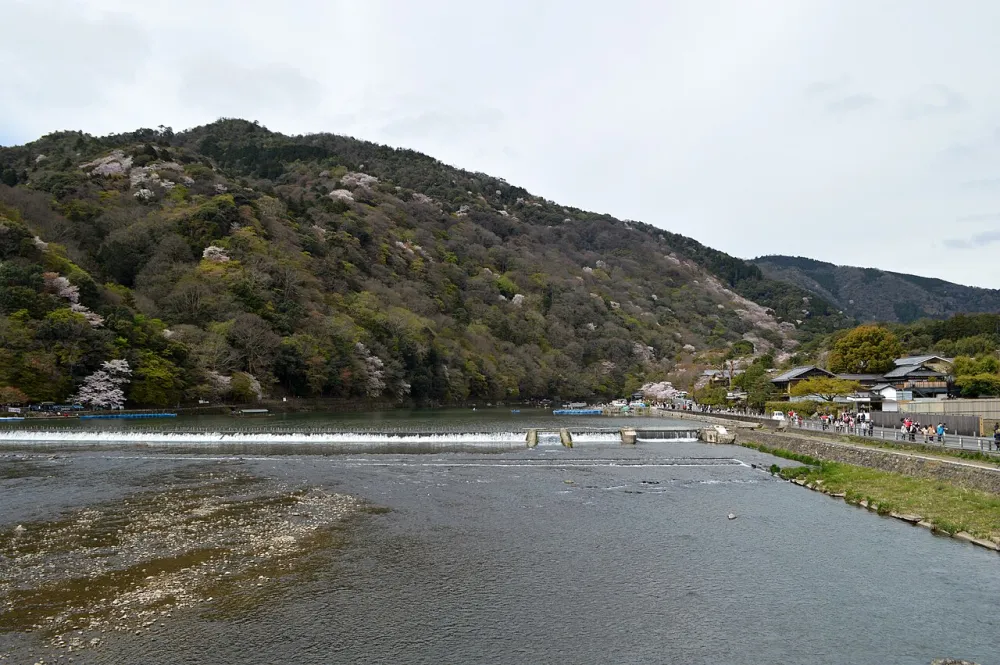
From Togetsukyo Bridge, afternoon daylight brings out the layers of the ridgeline, the stone weir, and the river surface. Before stopping on the bridge for a photo, check that pedestrians behind you have room to pass. To fit both the bridge and the mountains in one frame, walk upriver along the north bank or look back from Nakanoshima Park on your way toward the Hankyu station. If foot traffic stalls on the bridge, step off at the bridgehead before stopping. Anyone planning to ride the Randen tram after night foliage should shoot their bridge photos on the north bank during daylight to avoid crossing the windy bridge an extra time.
Kyoto City Official Travel Guide's Saga-Arashiyama crowd map shows live camera feeds for the Bamboo Grove and the north end of Togetsukyo Bridge. If the north bridgehead looks packed while the Bamboo Grove has breathing room, visit the grove first and circle back to the river later. On November 21–23 and 28–29, 2026, one-way pedestrian rules and partial street controls applied around Nagatsuji-dori, with staff directing Bamboo Grove walkers toward Oku-Saga or the Kameyama area of Arashiyama Park. On weekdays between November 16 and 27, Kyoto City Bus and Kyoto Bus routes also faced detours. When time is tight, stick to trains, follow on-site staff directions, and skip hunting for relocated bus stops.
Planning an Evening at Hogon-in: Entrance Route and Tickets
Hogon-in's 2026 autumn night special viewing runs from November 13 to December 6, opening at 17:30 with last admission at 20:00 and closing at 20:30. Night tickets are ¥1,000 for adults and ¥300 for elementary and junior high students. Daytime garden viewing runs October 3 to December 6 from 9:00 to 17:00 (last entry 16:45), at ¥700 for adults and ¥300 for elementary and junior high students. Day and night sessions are separate: daytime visitors must exit, and evening guests re-enter on a night ticket. If you only pick one session, go by day for the borrowed scenery, moss, and rock details, or at night for lit maples and garden stones.
Hogon-in sits on the southwest side of the Tenryu-ji complex. Set your map specifically to "Hogon-in" and walk upriver along the north bank from Togetsukyo Bridge before turning onto the lane leading to the temple. Searching only for "Tenryu-ji" often steers you to the main gate on Nagatsuji-dori or the North Gate by the Bamboo Grove. If you tour Tenryu-ji by day and Hogon-in at night, grab a snack near Togetsukyo Bridge in between, then follow the north bank straight to Hogon-in's ticket booth. Anyone with sore knees will have an easier walk coming directly from Randen Arashiyama Station than crossing from Hankyu Station and looping around the Bamboo Grove.
On weekends, time your arrival around dinner so you are not stuck in peak opening lines. If you want dinner back in downtown Kyoto, arrive at Hogon-in early and book your restaurant for after you return to Shijo or Kyoto Station. To dodge the opening-gate rush, eat early in Arashiyama or one stop back, then aim to reach Hogon-in around 18:30–19:00—still plenty of time before the 20:00 cutoff. If lines on a peak foliage weekend look too long, swap in a riverside walk or the Kimono Forest instead of scrambling to find another temple still admitting visitors.
To see the maple reflections from the Shoin study or the sliding-door paintings in the Main Hall, book the 2026 early-entry package sold on EX Tabisaki Yoyaku for ¥3,000. It opens 17:00–17:30 with last entry at 17:20; you must exit the Shoin and Main Hall by 17:30, after which you can stay in the garden until 20:30. If you only want the illuminated garden, stick to the standard night ticket. With an early-entry ticket, wrap up Togetsukyo Bridge and afternoon tea before 16:00 and leave buffer time for the riverside walk to the ticket gate so you do not miss indoor access.
The garden's Shishi-iwa (Lion Rock), moss beds, and maples reward a slow pace—keep moving with the path flow and wait for a clear gap before stopping for photos. Shoes with grippy soles beat heels on stone paths in the dark. For visitors with preschoolers or walkers, Tenryu-ji's garden in daylight is easier to navigate, while evening plans can be simplified to the Kimono Forest inside Randen Station where seating and trains are right at hand. Also check the fine print on daytime combo passes: Randen's combined garden and Main Hall discount ticket is built for daytime visits, so budget separately for night admission.
Train of Lights: Booking a Sagano Scenic Departure You Can Actually See
Sagano Scenic Railway schedules its Hozukyo Gorge illuminations from October 24 to December 29, 2026, with the entire line closed on December 16. Lights turn on at 16:30 and stay lit through the final train. According to the railway's press release, illuminated viewing starts from Sagano No. 16 departing Torokko Kameoka Station at 16:30. To ride the full lit stretch outbound from Arashiyama, look up evening extra trains from Torokko Saga to Torokko Kameoka and verify the exact date, direction, and departure time before buying. You can also ride out to Kameoka in the afternoon and take a later train back toward Saga.
A second pair of extra evening trains runs on December 5 and 6, 2026. For example, booking Train No. 91 departs Torokko Saga at 18:26 and reaches Torokko Kameoka at 18:54. Catching Train No. 92 back requires a separate return ticket: it leaves Kameoka at 18:59 and returns to Saga at 19:28, leaving just a 5-minute transfer with staff guiding passengers between trains for a dedicated round-trip light viewing. If you want to dine or walk around in Kameoka, buy a one-way ticket and walk about 10 minutes from Torokko Kameoka Station to JR Umahori Station for the JR Sagano Line back. When you are only doing one night attraction, pick a return route heading straight toward your hotel rather than holding out for the latest departure.
JR Saga-Arashiyama Station and Torokko Saga Station sit side by side; leave through the JR South Exit to find the scenic train platform. Another stop, Torokko Arashiyama Station, sits on the west side of the Bamboo Grove, a longer walk from Randen Arashiyama Station involving stairs and platform access. Sagano Scenic Railway's FAQ notes that passengers holding tickets departing from the earlier Torokko Saga Station may also board at Torokko Arashiyama. Still, if Bamboo Grove crowd controls force detours, boarding at the terminal next to the JR South Exit makes timing far easier—and do not walk into the Randen ticket gates just because your ticket says "Arashiyama."
Online tickets go on sale one month before the travel date at 00:00 JST. Station counters sell same-day tickets only, and Torokko Hozukyo Station has no same-day ticket window. Kyoto City's night-tourism guide lists standard 2026 adult one-way fares at ¥880. If your group wants to sit together, lock in available seats for both the outbound and return legs first before booking dinner afterward.
The Christmas trains on December 19 and 20 follow a separate booking system. Reserved 4-seat blocks cost ¥6,700 per group for 1 to 4 passengers (toddlers on an adult's lap do not count toward the four). Online reservations run from 10:00 JST on November 19 through 23:59 JST on December 16, with no same-day sales. On both days, show your mobile e-ticket at Torokko Saga Station between 16:10 and 16:50; the train departs at 17:10, reaches Hozukyo at 17:24 for roughly a 30-minute stop, and returns to Saga at 18:12. This special train boards only at Saga, makes no passenger stops at Torokko Arashiyama, and does not run to Kameoka. Split four ways it is ¥1,675 per person, while two riders still pay the full ¥6,700 block—worth it only if you specifically want that 30-minute station-light photo stop.
If you take a regular evening train, do not count on station shops for dinner on arrival. The railway's December 2026 operating calendar shows the Kameoka station shop closing at 15:30 and the matcha cafe closing at 14:15. At the Saga end, the Diorama Kyoto Japan railway model museum closes at 17:00 with last entry at 16:30. Families arriving early at Saga can tour the diorama first; for departures after 18:00, grab snacks and use the restrooms before check-in. If you ride outbound and transfer to JR at Umahori, save dinner for around Kyoto Station.
The current scenic train rolling stock is scheduled to retire after service on December 29, 2026, with new trainsets debuting on March 1, 2027. This year-end season is the last chance to ride the classic carriages. Travelers waiting for the new trains can plan a daytime Hozukyo trip from March onward and watch for next year's autumn illumination announcements. Waiting on open platforms on winter evenings gets brisk, so travelers sensitive to the cold should book enclosed window cars and give themselves time to layer up at the station.
Timing the Kimono Forest Around Dinner
Randen Arashiyama Station's Kimono Forest displays Kyo-yuzen textile patterns inside roughly 600 acrylic pillars. Kansai Electric Power's guide lists the main areas lit from dusk until 21:00, with select sections staying lit until 23:00 (winter hours may vary). To take in the full walk without rushing, arrive before dinner once dusk settles, well ahead of the 21:00 shutoff. For night photos, let passing pedestrians clear and step to the side of the walkway to frame the patterns and reflections, leaving platform edges and ticket gates clear for riders.
The Kimono Forest weaves right alongside the station shopping complex, where shops, illuminations, and trains run on separate clocks. The Kyoto Prefecture Tourism Federation lists general complex hours as 10:00–18:00, with second-floor restaurants stopping orders earlier and individual tenants keeping their own hours. If you want to eat nearby, scout open times earlier in the afternoon. Families with young kids on a set dinner schedule can eat in Arashiyama first and stroll the Kimono Forest afterward. Riders taking Randen round-trip from central Kyoto can also wait to eat back around Shijo-Omiya or after transferring at Karasuma instead of chasing last-order deadlines in Arashiyama.
Randen Arashiyama Station's rooftop terrace normally opens 11:00–17:00 (last entry 16:30), requires a voucher from participating shops, and may close during snow or severe weather. To shoot an overhead view of the station and pillar grid, go up in the afternoon; evening visitors get plenty from ground level. If you want to try the station footbath, stop by the information counter earlier in the day for a ¥250 ticket, which includes a towel. Do the footbath before dusk so you have time to dry off and put shoes and socks back on comfortably before catching your train.
Picking the Right Return Station for Kyoto Station, Shijo, or Osaka
If your hotel is near Kyoto Station or you are catching a Shinkansen next, JR Saga-Arashiyama Station saves transfers. From Kyoto Station, board from platforms marked for the Sagano/San-in Line; both Rapid and Local trains stop at Saga-Arashiyama, taking about 11 minutes on a Rapid per Kyoto City's transit guide. On the return trip, look for Kyoto-bound trains: JR West lists Platforms 1 and 2 as primary, with select Kyoto trains using Platform 4. Check departure boards carefully so you do not board a train heading away toward Kameoka or Sonobe. JR station maps also mark elevator routes at both North and South exits for travelers with luggage, strollers, or wheelchairs.
If you are staying near Shijo-Omiya or exploring along the Randen line, Keifuku Electric Railroad's Arashiyama Main Line runs straight to Shijo-Omiya in about 24 minutes. Standard flat fares across the line are ¥250 for adults and ¥120 for children aged 6 to 11. From Shijo-Omiya, you can walk across to Hankyu Omiya Station. To connect to the Kyoto Subway Tozai Line, get off at Randen-Tenjingawa and transfer to Uzumasa-Tenjingawa Station. To transfer to the Kitano Line, change at Katabiranotsuji—note that red times on the Randen timetable mark trains without a direct Kitano Line connection there.
Keifuku's timetable combines trains bound for Shijo-Omiya with trains marked for Saiin termination; if you plan to transfer to the Hankyu line at Saiin, either works, while riders going all the way to Shijo-Omiya should watch for unmarked departures. Save the weekday or weekend/holiday timetable for your travel date before heading out. A simple round-trip on Randen costs ¥500 for adults. A combined Subway + Randen 1-day pass costs ¥1,300 for adults and pays off only if you ride both networks multiple times that day; budget JR or Hankyu fares separately.
According to Keifuku's A13 station timetable published in November 2026, the last train to Shijo-Omiya on both weekdays and holidays leaves at 23:17, followed by 23:32, 23:47, and 00:07 trains that terminate at Saiin. If your hotel is near Shijo-Omiya and you plan a late dinner, treat the 22:47 as your target so you still have a backup train. Anyone transferring to Hankyu at Saiin needs to factor in the walk between stations and Hankyu's own last-train cutoff.
Hankyu Arashiyama Station works best for hotels along Shijo-Kawaramachi and Karasuma, or travelers heading straight to Osaka-Umeda after their evening walk. From the north end of Togetsukyo Bridge, cross south over the river and walk past Nakanoshima Park to the station. Hankyu Arashiyama has a single ticket gate; ride toward Katsura and transfer there for Kyoto-Kawaramachi or Osaka-Umeda. If you are carrying large suitcases and plan to use Hankyu, stay on the south bank or along Shijo so you are not hauling bags through the north-bank Bamboo Grove and Nagatsuji-dori at night. Starting at Kyoto Station by day and returning via Hankyu at night also turns the bridge crossing into a natural one-way walk.
Searching "Arashiyama Station" on a map app can pull up either Keifuku (Randen) or Hankyu, while JR appears as "Saga-Arashiyama Station." Save separate pins for Keifuku Arashiyama, Hankyu Arashiyama, and JR Saga-Arashiyama South Exit. Check the last train toward Kyoto Station, transfer times at Katsura, and Randen's evening terminals before setting out, and include walking time from your last attraction to the platform. When someone in your group walks slowly, finish the evening on the same side as your return line: end near Torokko Saga for JR, at the Kimono Forest for Randen, or by Togetsukyo Bridge for Hankyu.
Rainy-Day Museum Plans and Year-End Closure Dates
When rain picks up, walk upriver along the north bank from Randen Arashiyama Station to the Saga Arashiyama Museum of Arts & Culture (SAMAC). Hours are 10:00–17:00 (last entry 16:30), with admission at ¥1,000 for adults and university students, ¥600 for high schoolers, and ¥400 for elementary and junior high students. Fans of the Ogura Hyakunin Isshu poetry anthology or Nihonga painting can easily spend a full afternoon inside. If the rain eases afterward, walk back along the river to the north end of Togetsukyo Bridge and return up Nagatsuji-dori to Randen; if it stays cold and wet, head straight back to central Kyoto for dinner knowing you caught a major indoor sight during the worst of the weather.
SAMAC's Kyoto-themed special exhibition runs through February 28, 2027. Part 1 runs until December 14, 2026—the window to catch the Rakuchu Rakugai-zu folding screens. The museum closes December 15 for exhibit rotation and reopens for Part 2 on December 16. Other closures include December 30, 2026 through January 1, 2027, plus January 19, February 9, and February 21, 2027. Free curator talks run at 11:15 on January 17 and February 14; pair one with a morning visit so you still have daylight for a riverbank stroll afterward.
From January 30 to February 28, 2027, Part 2 of SAMAC's Kyoto exhibition overlaps with Part 1 of the Fukuda Art Museum's "Timeless Code: Modern to Edo" exhibition. Fukuda pairs contemporary artists like Yayoi Kusama and Yoshitomo Nara alongside Edo-period masters like Ito Jakuchu and Maruyama Okyo; single adult admission is ¥1,600, or ¥2,400 for a two-museum combo ticket. Both museums sit within an easy walk of each other. On a rainy half-day, buy the combo ticket at your first stop, tackle the museum where you plan to linger longest first, and make sure you enter the second museum before 16:30. Both close on February 9, 2027; on February 21 when SAMAC is closed, dedicate the afternoon to Fukuda.
December 16 is the Sagano Scenic Railway's scheduled closure day, which happens to be the exact day SAMAC reopens for Part 2—an easy indoor swap in the same neighborhood. On December 30 and 31, both the Train of Lights and SAMAC are closed. On those two afternoons, build your day around Tenryu-ji and Togetsukyo Bridge, then wrap up at dusk under Randen Station's kimono pillars. If rain pours all day, start indoors at Tenryu-ji's temple halls, chain museum visits around their daily hours, and save the riverfront and Bamboo Grove for a clearer half-day.
Arashiyama's open riverfront gets chilly fast in late autumn and winter, and standing still on Togetsukyo Bridge for photos or waiting on friends cools you down much faster than walking. Pack warm layers and spare socks in an accessible daypack when traveling with kids, and steer clear of slick stone steps and the water's edge after rain. For anyone with limited mobility, walking from Randen Station to Tenryu-ji's main gate by day and returning to the station's night lights keeps everything on one flat street. Check JR or Hankyu barrier-free station maps ahead of time if using a wheelchair or stroller, and meet inside station concourses rather than on crowded bridges, shopfronts, or narrow Bamboo Grove bends.
Should You Stay Overnight in Arashiyama? Pair Your Hotel with Dinner and Tomorrow's Line
If you just want one evening out in Arashiyama before visiting Fushimi or catching a Shinkansen the next morning, stay near Kyoto Station. You only need to walk back to JR Saga-Arashiyama Station without hauling bags near the Bamboo Grove and back. Guests based around Shijo-Karasuma can take Randen to Shijo-Omiya for Hankyu Omiya, or ride JR to Nijo and switch to the Subway Tozai Line depending on their hotel block. Every hotel change eats up luggage drop-off and pickup time, so on a single-afternoon visit, keep your base in the city and spend those extra hours on dinner or earlier river views.
If you want an early start at Tenryu-ji plus fast access to JR or the scenic train, Hotel Binario Saga Arashiyama sits about a 1-minute walk from JR Saga-Arashiyama's South Exit and roughly 3 minutes from Randen Saga Station. You can drop bags upon arrival before heading out, and stepping off an evening train at Torokko Saga puts you right back in your hotel neighborhood. Walk down to the bridge before dusk for river views before turning in. Compared with riverside ryokan, staying by the station trims the morning trek with luggage when catching an early reserved scenic train.
Staying at the south end of Togetsukyo Bridge follows a different rhythm. Arashiyama Onsen Hanaikada sits right on the south side of the bridge, ideal for bundling a ryokan kaiseki dinner, hot-spring bath, and quiet morning river walk into one night. Hanaikada opens bookings 6 months ahead, with year-end and New Year reservations opening October 1. Because of dinner prep, check-in is required by 19:00; arrivals past 19:30 lose dinner service with no refund. Pair a ryokan stay with Hogon-in before check-in—or save night temples for another evening. Taking the 18:26 scenic train round-trip puts you back in Saga at 19:28, too late to walk across the bridge before the 19:30 dinner cutoff; choose a station hotel or book a room-only plan instead.
If you do want one night in Arashiyama, match the north or south bank to where you will start the next morning. Drop bags at the JR South Exit in the morning, spend the afternoon at the Bamboo Grove, Tenryu-ji, and the north bank, sleep on the Saga side, and catch an early train out the next day. Alternatively, arrive via Hankyu on the south bank, watch sunset from the bridge, dine at your ryokan, and cross north to the temples the next morning. Both sequences tie your dinner timing directly to your train line. To compare room types and riverside vs. station views, read Where to Stay One Night in Arashiyama: Togetsukyo Bridge vs. Station Hotels.
A few useful answers
Is Arashiyama Hanatouro still held in December 2026?
No. Kyoto held the final Arashiyama Hanatouro in December 2021. For early December 2026, Hogon-in holds its night autumn foliage viewing through December 6. Later in the month, the Sagano Train of Lights runs through December 29, except for a scheduled closure on December 16.
When will Arashiyama Tsukitoro take place in 2027?
As of November 22, 2026, 2027 dates have not been announced. The most recent edition ran from September 30 to November 8, 2026. Look up "Arashiyama Tsukitoro" in official Kyoto event listings for next year's schedule once released.
Was last entry for the 2026 Tsukitoro at 20:30 or 20:40?
Kyoto City's archived 2026 event listing states last admission at 20:40 and closing at 21:00. Same-day tickets were ¥1,500 cash on-site, while advance guaranteed-entry tickets were ¥2,000.
If I only pick one December evening activity, should I choose Hogon-in or the scenic train?
Through December 6, pick Hogon-in if you want to stroll an illuminated maple garden at your own pace. Later in December—or if you prefer seated sightseeing—book a Sagano Scenic Railway departure timed for the Hozukyo Gorge lights. Standard adult fares are ¥880 one-way, and round-trip rides require two separate tickets.
Which Arashiyama station should I use to get back to Kyoto Station or Osaka?
Take the JR line toward Kyoto from JR Saga-Arashiyama Station for Kyoto Station. For Osaka-Umeda, cross south over Togetsukyo Bridge to Hankyu Arashiyama Station and transfer at Katsura onto the Hankyu Kyoto Line. Randen Arashiyama Station sits across from Tenryu-ji's main gate and runs mainly to Shijo-Omiya.
Where can I go if I only have one hour after dark?
The Kimono Forest inside Randen Arashiyama Station is the easiest fit. Main zones typically stay lit until 21:00 and select sections until 23:00, though winter hours may vary. If you are returning via JR, factor in the walk from the Randen station lights over to JR Saga-Arashiyama Station.
Official information and references
Sources used in this guide.
- Kyoto City Tourism Association | Arashiyama Hanatouro Discontinuation Notice
- Kyoto City Official Travel Guide | 2026 Arashiyama Tsukitoro Dates, Hours & Tickets
- Keihan Group | 2026 Tsukitoro Venue & Paid Exhibition Zone
- Kyoto Night Tourism YOI-YOI | 2026 Autumn Night Special Viewings & Illuminations
- Hogon-in | 2026 Autumn Day & Night Viewing, Fares & Entry Rules
- Sagano Scenic Railway | 2026 Train of Lights & Extra Evening Services
- Sagano Scenic Railway | 2026 Christmas Special Train
- Sagano Scenic Railway | Fares & Online Ticket FAQ
- Sagano Scenic Railway | 2027 New Rolling Stock Debut Notice
- Keifuku Electric Railroad | Randen Route Map & Station Timetables
- Keifuku Electric Railroad | Randen Standard Fares & Day Passes
- Keifuku Electric Railroad | How to Ride & Transfer on Randen
- Keifuku Randen Arashiyama Station | Kimono Forest & Station Facilities
- Kansai Electric Power | Kimono Forest Lighting & Illumination Hours
- Kyoto City Official Travel Guide | Three Rail Access Routes to Saga-Arashiyama
- Kyoto City Official Travel Guide | Arashiyama Crowd Forecast & Live Cameras
- Kyoto City Official Travel Guide | November 2026 Traffic & Pedestrian Controls
- JR West | Saga-Arashiyama Station Exits & Barrier-Free Access
- Hankyu Railway | Arashiyama Station Katsura-Bound Timetable & Map
- Tenryu-ji | Garden, Temple Buildings, North Gate & Early Morning Entry
- Saga Arashiyama Museum of Arts & Culture | Hours & General Admission
- Saga Arashiyama Museum of Arts & Culture | 2026–2027 Kyoto Special Exhibition & Closures
- Hotel Binario Saga Arashiyama | South Exit Access & Stay FAQ
- Arashiyama Onsen Hanaikada | Togetsukyo Bridge South-End Location
- Arashiyama Onsen Hanaikada | Booking Window & Dinner Check-In Cutoff
- JR West | Saga-Arashiyama Station Layout & Platforms
- Kyoto Prefecture Tourism Federation | Randen Arashiyama Station Complex Hours
- Sagano Scenic Railway | Transferring to JR Umahori Station from Kameoka
- Sagano Scenic Railway | December 2026 Station Shop & Diorama Hours
- Fukuda Art Museum | 2027 Timeless Code: Modern to Edo Exhibition & Combo Ticket
- JR Central | Hogon-in Early-Entry Session & Pricing