Arashiyama Hanatouro ended in 2021, and the 2026 Arashiyama Tsukitoro closed on 8 November. For late November through year-end, plan Hogon-in Temple night illuminations, the Sagano Scenic Railway or Randen's Kimono Forest, with three-station routes and wet-weather backups.
- Region & Focus
- Kyoto
- Reading Scope
- 20 min read · 9 chapters · 6 Q&As
- Official Verification
- 31 official sources checkedUpdated 22 November 2026
- Key Topics
- SeasonsItinerariesRail travel
Chapter Route Map (tap any stop)
- Hanatouro, Tsukitoro and Kimono Forest: Which Event Name to Search
- What a Tsukitoro Ticket Covers: Reading the 2026 Rules
- Togetsukyo Bridge by Day: Leave the Riverbank Before Dusk
- An Evening at Hogon-in Temple: Getting to the Gate & Buying Tickets
- Hikari no Genso Ressha: Booking Scenic Trains That Catch the Lights
- Kimono Forest and Dinner: Timing Your Evening Best
- Returning to Kyoto Station, Shijo and Osaka: Picking the Right Station
- Wet-Weather Museum Plans & Winter Closure Dates
- Should You Stay Overnight in Arashiyama? Match Dinner to Your Morning Train
- Quick Q&A
Kyoto's Arashiyama Hanatouro held its final edition in December 2021. Its successor in the Bamboo Grove, Arashiyama Tsukitoro, ran in 2026 from 30 September to 8 November and has also wrapped up for the year. If you are visiting from late November into early December for night-time autumn maples, save your evening for Hogon-in Temple. For illuminated Hozukyo Gorge views in mid-to-late December, book an evening Sagano Scenic Railway departure confirmed for the lighting window. If you just want an easy stroll before heading back into town, cross Togetsukyo Bridge before dusk and walk up from the bridgehead to see Kimono Forest at Randen Arashiyama Station after dark.
Hanatouro, Tsukitoro and Kimono Forest: Which Event Name to Search
The Kyoto City Tourism Association announced the end of the Kyoto Hanatouro programme in 2021. The final Arashiyama Hanatouro ran from 10 to 19 December 2021, with lights on from 17:00 to 20:30. If search results still show those dates, describe the Bamboo Grove and Togetsukyo Bridge lit together, or outline an evening walk from 17:00 down to the riverbanks, check the article's publication year. That route belongs to a discontinued event; for December 2026, look up individual temple, railway and station timetables instead.
Arashiyama Tsukitoro's 2026 venue centred on Saga Tenryuji Tateishicho in Ukyo Ward, focusing illumination along the Bamboo Grove. Kyoto City's event page noted roughly 1 km of lit pathway, while the Keihan Group highlighted bamboo art installations restricted to the ticketed exhibition zone. Anyone who has walked past Nonomiya Shrine by day can use the Bamboo Grove to get their bearings. Search for the official map published under Tsukitoro to check ticket booths, entrances and artwork positions, and keep Togetsukyo Bridge for a daytime riverside walk.
Kimono Forest is the easiest to spot, standing right inside Randen Arashiyama Station directly across the main street from Tenryu-ji's Main Gate, beside the station shopping arcade entrance. Older Hanatouro photo galleries often combined the bamboo grove, riverfront and station into a single album, even though those three scenes sit in separate spots. You can drop by the station pillars any evening, whereas bamboo grove lighting depends on each year's Tsukitoro dates, and bridge photos depend on daylight, river reflections and street lighting on the night.
As of 22 November 2026, Kyoto City's Tsukitoro page marks the 2026 season as ended, with 2027 dates yet to be announced. If you are planning an autumn 2027 trip around Tsukitoro, keep flexible cancellation terms on your Kyoto accommodation. If your travel dates are already fixed, build your itinerary around year-round sights—Tenryu-ji, Togetsukyo Bridge and the station—and add evening tickets once organisers publish the schedule. For December visits, verify autumn foliage illuminations and scenic railway dates separately each year.
| What to See | Dates & Hours | Where to Go |
|---|---|---|
| Hogon-in Temple night maples | 13 November–6 December, 17:30–20:30 (last entry 20:00) | Hogon-in Temple (Tenryu-ji sub-temple) |
| Illuminated Hozukyo Gorge views | 24 October–29 December (closed 16 December), lights on from 16:30 | Designated Sagano Scenic Railway evening trains |
| Kyo-yuzen kimono light pillars | Dusk to 21:00 in main areas (winter hours may vary) | Randen Arashiyama Station |
| Bamboo Grove Tsukitoro | 2026 season ended 8 November; 2027 dates TBA | Saga Tenryuji Tateishicho |
Arashiyama Hanatouro ended in 2021, and the 2026 Arashiyama Tsukitoro closed on 8 November. For late November through year-end, plan Hogon-in Temple night illuminations, the Sagano Scenic Railway or Randen's Kimono Forest, with three-station routes and wet-weather backups.
What a Tsukitoro Ticket Covers: Reading the 2026 Rules
During the 2026 Tsukitoro run, the event opened daily from 18:00 to 21:00; Kyoto City's archived page lists 20:40 as last entry, with cancellation in severe weather. Walking the lit Bamboo Grove path was open, while a paid ticket granted entry into the exhibition zone housing bamboo art installations. The 1 km figure covers the full illuminated stretch, though how long you spend depends on entry queues, pauses along the path and whether you tour the paid zone. If someone in your group only wants to glimpse the lit bamboo after dark, arrange to meet at Randen Arashiyama Station while ticket-holders visit the exhibition.
In 2026, on-the-day admission cost ¥1,500 per person (cash only) from a booth inside the Bamboo Grove, opening at 17:50, with free entry for children aged 12 and under. Advance guaranteed-entry tickets sold online via EX Tabisaki Yoyaku cost ¥2,000—a ¥500 premium to secure a specific evening slot. Paying extra makes sense under similar ticketing rules if you have only one night in Kyoto and tight restaurant or train bookings. If you have a spare evening or are happy swapping the paid zone for the station lights, skip the surcharge and judge the queue on arrival.
Save both the ticket booth and your return station as separate map pins. Kyoto Travel estimates a 10-minute walk to the 2026 venue from either JR Saga-Arashiyama Station or Randen Arashiyama Station, and 15 minutes from Hankyu Arashiyama Station. If your companions are already at the bamboo grove while you are still on the Hankyu platform, a bridge and a stretch of Nagatsuji-dori Street lie between you. Regroup at a station or along the main street before entering rather than pushing against the crowd to find each other.
Togetsukyo Bridge by Day: Leave the Riverbank Before Dusk
To walk from JR Saga-Arashiyama Station towards the Bamboo Grove, take the South Exit. Torokko Saga Station sits just outside; follow signs for the Bamboo Grove, which joins Nagatsuji-dori along the way. For a half-day loop, start near Nonomiya Shrine, enter Tenryu-ji through its North Gate from the bamboo grove side, stroll through Hyakka-en Garden to Sogenchi Pond Garden and exit via the Main Gate directly onto Nagatsuji-dori opposite Randen Arashiyama Station. Head south towards Togetsukyo Bridge and remain on the north bank if continuing to Hogon-in or the Saga Arashiyama Museum of Arts and Culture. Visitors staying near Hankyu Arashiyama Station can walk the same loop in reverse from the south bank.
Tenryu-ji's North Gate sells garden tickets. Standard garden hours are 8:30–17:00 (last entry 16:50), at ¥500 for high school students and adults, ¥300 for primary and junior high pupils, and free for pre-school children. Access to the Main Hall (Daihojo) and adjoining temple buildings costs an extra ¥300, with last entry at 16:30. If you only have an hour, focus on Sogenchi Pond and Hyakka-en near the North Gate. Arrive earlier if you want to see inside the halls, as indoor admission closes before the garden gate does.
From 14 to 30 November 2026, Tenryu-ji offered early-morning garden entry from 7:30, while the North Gate kept its usual 8:30 opening. Guests staying nearby for early-morning photography entered via the Main Gate side off Nagatsuji-dori; those wanting the Bamboo Grove first could walk the grove at 7:30 and enter the garden at 8:30 through the North Gate. To see the Cloud Dragon ceiling painting in the Dharma Hall (Hatto) during winter, a separate ¥500 ticket applies—normally open at weekends and on public holidays alongside daily spring and autumn seasons, with Tenryu-ji noting closure on 2 January 2027. If visiting solely for the painting, set your map pin to the reception desk on the west side of the Dharma Hall.
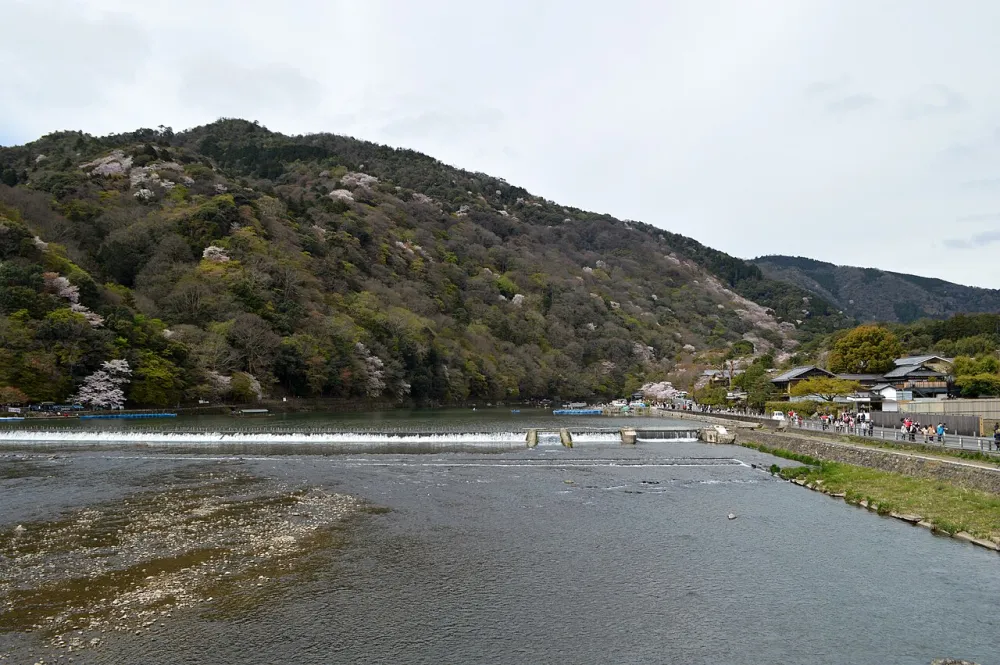
Views from Togetsukyo Bridge of the wooded mountain ridges, stone weir and Katsura River read best in clear afternoon daylight. Before stopping on the bridge for photos, check there is space for pedestrians to pass behind you. To frame both bridge and hills together, walk upstream along the north bank or look back from Nakanoshima Park on the walk towards Hankyu Station. Whenever foot traffic stalls behind cameras, step off onto the bridge approach before pausing. If you plan to take Randen after night illuminations, capture your bridge views from the north bank by day to save crossing the windy bridge twice.
Kyoto Travel's Saga-Arashiyama Comfort Map shows live camera feeds for both the Bamboo Grove and the north end of Togetsukyo Bridge. If the bridge approach is packed while the bamboo path still flows, visit the grove first and return to the river later. On 21–23 and 28–29 November 2026, one-way pedestrian systems and partial road restrictions operated around Nagatsuji-dori, with marshals guiding walkers through the bamboo grove towards Oku-Saga or the Kameyama area of Arashiyama Park. Kyoto City Bus and Kyoto Bus routes may also divert on weekdays between 16 and 27 November. When time is tight, travel in and out by rail and follow on-site marshals rather than hunting down relocated bus stops.
An Evening at Hogon-in Temple: Getting to the Gate & Buying Tickets
Hogon-in Temple's 2026 special night viewing runs from 13 November to 6 December, opening at 17:30 with last entry at 20:00 and closing at 20:30. Temple notices list night admission at ¥1,000 for adults and ¥300 for primary and junior high pupils. Daytime special garden viewing runs from 3 October to 6 December, 9:00–17:00 (last entry 16:45), at ¥700 for adults and ¥300 for primary and junior high pupils. Day and night sessions are cleared separately: daytime visitors must exit and re-enter with a night ticket. If choosing just one session, daytime shows off the borrowed scenery, moss and rockwork details, while evening highlights illuminated maples and garden stones.
Hogon-in sits on the southwest side of Tenryu-ji. Search specifically for "Hogon-in Temple" in your maps app, walk upstream along the river from the north end of Togetsukyo Bridge and turn into the side lane leading to the gate. Typing just "Tenryu-ji" frequently routes you to the main gate on Nagatsuji-dori or the North Gate by the bamboo grove. Combining Tenryu-ji by day with Hogon-in at night? Stop for a bite near Togetsukyo Bridge between sessions and walk along the north bank to the ticket desk. Anyone with sore knees will find walking straight from Randen Arashiyama Station shorter than crossing the bridge from Hankyu or looping around the bamboo grove.
At weekends, decide whether to queue before or after dinner. If you plan to eat back in central Kyoto around Shijo or Kyoto Station, book a later table and join the Hogon-in queue early. To dodge the initial surge when gates open, dine first in Arashiyama or one stop back and arrive around 18:30–19:00, leaving comfortable headroom before last entry. If peak autumn weekend queues look daunting, substitute a riverside walk or the station illuminations rather than dashing across town for another temple's cut-off.
To see autumn maple reflections from the Shoin study or sliding-door paintings in the Main Hall, EX Tabisaki Yoyaku sold a 2026 priority early-entry ticket at ¥3,000, opening 17:00–17:30 with last entry at 17:20. Visitors must vacate the Shoin and Main Hall by 17:30, though you may remain in the garden until 20:30. Standard night admission is enough if you only want the illuminated garden. On a priority ticket, finish Togetsukyo Bridge and afternoon tea well before 16:00 so you allow walking time from the riverbank to the gate and don't miss indoor access.
Shishi-iwa (Lion Rock), the moss carpets and maples reward a slow pace; follow the one-way path and wait for clear space behind you before pausing for photographs. Grippy flat soles handle dark stone garden paths far better than heels. If visiting with pre-schoolers or a walking frame, choose Tenryu-ji's garden in daylight and keep evening sightseeing to Randen's Kimono Forest, where seating and your train home share one concourse. Check the terms on discounted Hogon-in daytime passes: Randen combined garden-and-hall packages cover daytime entry only, so budget separately for night admission.
Hikari no Genso Ressha: Booking Scenic Trains That Catch the Lights
The Sagano Scenic Railway schedules its Hozukyo Gorge illumination from 24 October to 29 December 2026, with a full-line closure on 16 December. Lights switch on at 16:30 and stay lit until the final train. Official press releases list trains from Sagano No. 16 departing Torokko Kameoka Station at 16:30 onwards as illuminated services. To see the full gorge lit outbound from Arashiyama, search for evening extra trains from Torokko Saga to Torokko Kameoka and verify the date, direction and departure time before purchasing. Alternatively, ride out to Kameoka in the afternoon and save the later departure for the return trip to Saga.
A second pair of extra trains runs on 5 and 6 December 2026. For instance, No. 91 leaves Torokko Saga at 18:26 and reaches Torokko Kameoka at 18:54. Connecting onto No. 92 (departing Kameoka at 18:59, arriving back at Saga at 19:28) requires a separate return ticket and leaves just five minutes to change—best treated as a dedicated round trip for the lights, following platform staff guidance. If you want dinner or a stroll in Kameoka, buy a single ticket, walk roughly 10 minutes from Torokko Kameoka Station to JR Umahori Station and return on the JR Sagano Line. When fitting just one evening attraction into your night, choose a route that lands you back on the right line for your hotel rather than chasing the very last train.
JR Saga-Arashiyama Station and Torokko Saga Station stand next to one another; take the JR South Exit to find the scenic railway platforms. Torokko Arashiyama Station lies on the western edge of the Bamboo Grove, involving a walk from Randen Arashiyama Station plus platform stairs. According to the Sagano Scenic Railway's FAQ, tickets booked from the earlier Torokko Saga terminus can also be used to board at Torokko Arashiyama. If bamboo grove crowd controls are in force, boarding at the JR South Exit terminus makes timing far easier to manage—and avoid walking into the Randen ticket barriers just because your ticket prints "Arashiyama".
Online tickets go on sale at 00:00 JST one month before the travel date. Station ticket windows sell same-day tickets only, and Torokko Hozukyo Station has no same-day ticket window. Kyoto's 2026 night-tourism guide lists standard adult fares at ¥880 one way. To guarantee seats together, select available places for both outbound and return legs in one sitting before booking dinner.
The Christmas Trains on 19 and 20 December follow a separate ticketing system: ¥6,700 per group of four seats for one to four passengers (toddlers sitting on an adult's lap are not counted). Online reservations run from 19 November at 10:00 JST to 16 December at 23:59 JST, with no same-day sales. On both dates, check in with your mobile e-ticket at Torokko Saga Station between 16:10 and 16:50; the train departs at 17:10, pauses at Hozukyo at 17:24 for around 30 minutes and returns to Saga at 18:12. This special runs strictly out-and-back from Saga without boarding or alighting at Torokko Arashiyama or continuing to Kameoka. Four travellers split it to ¥1,675 per person, while a couple still pays the full ¥6,700 group rate—worth the extra spend only if you want that extended station lighting photo stop.
If taking a standard evening departure, do not rely on the scenic railway stations for dinner on arrival. The railway's December 2026 opening schedule shows Kameoka-end shops closing at 15:30 and the matcha café shutting at 14:15. At the Saga end, the railway diorama museum (Diorama Kyoto Japan) closes at 17:00, with last entry at 16:30. Families arriving early can visit the diorama first; for departures after 18:00, sort out snacks and toilets before check-in. If taking an outbound scenic train and returning via JR, save dinner for around Kyoto Station.
The current scenic railway rolling stock is scheduled to retire on 29 December 2026, with new carriages entering service on 1 March 2027. Travellers keen to ride the existing carriages have this year-end window as their final opportunity. Anyone waiting for the new rolling stock can plan a daytime Hozukyo trip from March onwards and watch for next autumn's illumination announcement. Evening waits on open winter platforms feel chilly; if you feel the cold, book enclosed carriages and allow time to layer up in the waiting area before boarding.
Kimono Forest and Dinner: Timing Your Evening Best
Kimono Forest at Randen Arashiyama Station encases Kyo-yuzen fabric patterns inside roughly 600 transparent pillars. Kansai Electric Power's facility listing notes that main areas light up from dusk until 21:00, with selected zones remaining lit until 23:00 (winter hours may vary). To take in the full installation unhurriedly, arrive shortly before dinner once daylight has faded, leaving plenty of time before the main switch-off. Let passers-by clear before pausing beside the walkway to frame patterns and reflections, and keep platform edges and ticket gates clear for boarding passengers.
Kimono Forest wraps around the station's shopping arcade, which keeps separate hours from the trains and lighting. The Kyoto Prefecture Tourism Federation lists standard arcade opening times as 10:00–18:00, with second-floor dining calling last orders earlier and individual shops keeping their own hours. Note open eateries while passing through during the day. Families with young children on fixed meal times can eat early in Arashiyama before seeing the pillars. Visitors riding Randen from central Kyoto can leave dinner until returning to Shijo-Omiya or changing at Karasuma instead of racing local closing times.
The rooftop terrace at Randen Arashiyama Station normally opens 11:00–17:00 (last entry 16:30) with an invitation voucher from participating shops, closing in snow or severe weather. Visit in the afternoon if you want elevated views down the rows of pillars and platforms; ground level is plenty after dark. For the station footbath, pick up a voucher at the station information counter earlier in the day (Keifuku lists ¥250 per person, towel included) and soak before dusk so you have time to dry off and get socks and shoes sorted comfortably before your train.
Returning to Kyoto Station, Shijo and Osaka: Picking the Right Station
If you are staying near Kyoto Station or catching a Shinkansen next, JR Saga-Arashiyama Station offers the simplest return without transfers. From Kyoto Station, head for the Sagano Line / San'in Line platforms; both Rapid and Local services call at Saga-Arashiyama, with Kyoto Travel quoting around 11 minutes on the Rapid. Heading back, JR West primarily runs Kyoto-bound trains from Platforms 1 and 2, with some departures using Platform 4—check platform indicators and destination boards carefully so you don't board towards Kameoka or Sonobe. JR station maps also show lifts at both North and South Exits for luggage, buggies and wheelchairs.
If staying in Shijo-Omiya or visiting stops along the tramway, Keifuku's Randen Arashiyama Main Line runs straight to Shijo-Omiya in around 24 minutes on the official station timetable, at a flat single fare of ¥250 for adults and ¥120 for children aged 6 to under 12. From Shijo-Omiya, walk directly to Omiya Station on the Hankyu Kyoto Line. Heading for the Tozai Underground Line? Alight at Randen-Tenjingawa and walk across to Uzumasa Tenjingawa Station. For the Kitano Line, change at Katabiranotsuji—services printed in red on the timetable do not have a Kitano Line connection there.
Keifuku's timetable groups Shijo-Omiya trains alongside shorter services terminating at Saiin (marked with the Nishi/West symbol). Both work if you are transferring to Hankyu at Saiin; for Shijo-Omiya itself, follow the unmarked departure times and save the weekday or weekend/holiday timetable to your phone before leaving. A simple return trip on Randen costs ¥500 for an adult, while the combined Underground & Randen One-Day Pass is ¥1,300—worthwhile only if you are making multiple journeys across both networks on the same day, excluding JR and Hankyu fares.
According to Keifuku's A13 station timetable published in November 2026, the last train to Shijo-Omiya on both weekdays and weekends/holidays departs at 23:17, followed by departures at 23:32, 23:47 and 00:07 terminating at Saiin. If staying near Shijo-Omiya and dining late, aim for the 22:47 service so a later direct train remains in reserve. Anyone changing to Hankyu at Saiin should calculate the transfer walk and Hankyu's own last train separately.
Hankyu Arashiyama Station is best for hotels along Shijo-Kawaramachi or Karasuma, or travellers heading straight to Osaka-umeda. From the north bank of Togetsukyo Bridge, cross south over the river via Nakanoshima Park to reach the station, which has a single ticket barrier. Board a train to Katsura and change there for Kyoto-kawaramachi or Osaka-umeda. Travellers carrying large suitcases on Hankyu are better off staying on the south bank or along Shijo rather than hauling bags through the north-bank bamboo grove and Nagatsuji-dori at night. Arriving via JR in daylight and leaving via Hankyu at night turns the bridge crossing into a natural part of the walk.
Searching "Arashiyama Station" in a maps app can bring up either Randen or Hankyu, whereas JR appears under "Saga-Arashiyama Station". Pin "Randen Arashiyama", "Hankyu Arashiyama" and "JR Saga-Arashiyama South Exit" separately. Check your last train to Kyoto, Katsura connection or Randen terminus alongside walking time from your final venue. When someone in your group prefers shorter walks, match your last stop to your departure station: finish near Torokko Saga for JR, at Kimono Forest for Randen, or by Togetsukyo Bridge for Hankyu.
Wet-Weather Museum Plans & Winter Closure Dates
When heavy rain sets in, walk upstream along the north bank from Togetsukyo Bridge to the Saga Arashiyama Museum of Arts and Culture (SAMAC), within easy reach of Randen Arashiyama Station. Open 10:00–17:00 (last entry 16:30); admission is ¥1,000 for adults and university students, ¥600 for high school students, and ¥400 for primary and junior high pupils. Its Ogura Hyakunin Isshu poetry displays and Japanese paintings easily fill an afternoon. If the rain eases, stroll back to the bridgehead and up Nagatsuji-dori to Randen; if it stays wet and raw, head straight back into central Kyoto for dinner, having saved a worthwhile indoor sight for the worst weather.
SAMAC's Kyoto-themed exhibition runs until 28 February 2027. Part I continues until 14 December 2026—the window to see the Rakuchu-rakugai-zu folding screens. The museum closes on 15 December for exhibition changeover before Part II opens on 16 December. Other scheduled closures are 30 December 2026–1 January 2027, 19 January, 9 February and 21 February. Free curator talks run at 11:15 on 17 January and 14 February, making a morning visit attractive while leaving daylight afterwards for a riverside walk.
Between 30 January and 28 February 2027, Part II of SAMAC's Kyoto show overlaps with Part I of Timeless Code: Modern to Edo at the nearby Fukuda Art Museum, which places contemporary artists such as Yayoi Kusama and Yoshitomo Nara alongside Edo-period masters including Ito Jakuchu and Maruyama Okyo. Standard adult entry to Fukuda Art Museum is ¥1,600, or ¥2,400 for a two-museum joint ticket. Because both museums stand close together, on a rainy half-day buy the joint ticket at the first museum, spend longer at whichever appeals more and enter the second before 16:30. Both close on 9 February 2027; on 21 February, when SAMAC is shut, dedicate your afternoon to Fukuda Art Museum.
Handily, 16 December—the exact day the Sagano Scenic Railway shuts—is when SAMAC reopens with Part II, giving you an immediate indoor alternative in the same neighbourhood. Both the illuminated train season and SAMAC are closed on 30 and 31 December; on those afternoons, focus on Tenryu-ji and Togetsukyo Bridge before seeing the Randen light pillars at dusk. If forecast rain looks heavy all day, start inside Tenryu-ji's halls, align museum stops with opening hours and save the riverbanks and bamboo grove for a drier half-day.
Arashiyama's riverside opens wide to autumn and winter winds; standing still on Togetsukyo Bridge for photos or waiting for friends chills you far faster than walking. Keep extra layers and spare socks handy for children, and avoid wet stone steps and the water's edge after rain. For companions limited to short walks, keep daytime plans on the single stretch from Randen Arashiyama Station to Tenryu-ji's Main Gate and return to the station pillars after dark. Check JR or Hankyu step-free access maps when travelling with wheelchairs or buggies, and regroup inside station concourses rather than on busy bridges, shopfronts or narrow bends in the bamboo grove.
Should You Stay Overnight in Arashiyama? Match Dinner to Your Morning Train
If you only want one evening outing before heading to Fushimi or catching a Shinkansen next morning, stay near Kyoto Station. You simply walk back to JR Saga-Arashiyama Station without hauling bags towards the bamboo grove and back. Guests based around Shijo-Karasuma can ride Randen to Shijo-Omiya for Hankyu Omiya, or take JR to Nijo Station for the Tozai Underground Line. Swapping hotels eats into your schedule with bag drop-offs and pick-ups—with only one afternoon in Arashiyama, spend that time dining or catching the river before dusk instead.
For an early start at Tenryu-ji alongside quick JR or scenic railway access, Hotel Binario Saga Arashiyama sits around a one-minute walk from JR Saga-Arashiyama's South Exit and three minutes from Randen Saga Station. Drop luggage on arrival, explore unburdened and step off the 19:28 Torokko Saga train right back at your base, strolling down to the bridge before dusk if you want river views. Compared with riverside ryokan, staying by the station saves an early-morning luggage haul when you have an early scenic train booked.
Staying at the south end of Togetsukyo Bridge follows a different pace. Arashiyama Onsen Hanaikada sits right beside the south bridgehead, pairing a ryokan dinner and hot-spring bath with an early-morning riverside walk. Hanaikada opens bookings six months ahead, with year-end and New Year dates released on 1 October. Because of dinner preparation, check-in is required by 19:00; arrivals after 19:30 cannot be served dinner, with no meal refund. Pair a stay here with Hogon-in before check-in or on another night—returning to Torokko Saga at 19:28 on the 18:26 scenic train leaves no time to reach the south bank before the dinner cut-off, so choose a station hotel or a room-only rate on train nights.
If an overnight stay in Arashiyama fits your trip, pick the north or south bank to match next morning's departure. Leave luggage at JR South Exit in the morning, cover the bamboo grove, Tenryu-ji and the north bank, sleep on the Saga side and catch your morning train; or arrive via Hankyu at a south-bank ryokan, watch sunset from the bridge, dine in-house and cross into the temples next morning. Each order suits a different dining and rail timetable. To compare room layouts and river versus station views, read Togetsukyo Bridge vs Station Stays for One Night in Arashiyama.
A few useful answers
Is Arashiyama Hanatouro still running in December 2026?
No—Kyoto Arashiyama Hanatouro held its final edition in December 2021. In early December 2026, Hogon-in Temple's special night viewing runs until 6 December. Later in the month, the Sagano Scenic Railway's Hikari no Genso Ressha continues until 29 December (closed 16 December).
When will Arashiyama Tsukitoro take place in 2027?
As of 22 November 2026, 2027 dates have not yet been announced. The most recent edition ran from 30 September to 8 November 2026. Search under its official name, Arashiyama Tsukitoro, when checking for next season's schedule.
Was last entry for 2026 Tsukitoro at 20:30 or 20:40?
Kyoto City's archived 2026 event page lists last entry at 20:40 and closing at 21:00. Same-day tickets were ¥1,500 (cash only at the gate), while advance guaranteed-entry tickets cost ¥2,000.
If I only have time for one December evening outing, should I pick Hogon-in or the scenic train?
Up to 6 December, pick Hogon-in Temple for unhurried strolls past illuminated autumn maples. After that—or if you prefer seated sightseeing—book an evening departure on the Sagano Scenic Railway within the illumination window (standard adult fare ¥880 one way; separate tickets required for outbound and return legs).
Which Arashiyama station should I take back to Kyoto Station versus Osaka?
Use JR Saga-Arashiyama Station for Kyoto Station. For Osaka-umeda, walk south across Togetsukyo Bridge to Hankyu Arashiyama Station and change at Katsura onto the Hankyu Kyoto Line. Randen Arashiyama Station sits opposite Tenryu-ji's main gate and runs mainly to Shijo-Omiya.
Where can I go if I only have one hour left after dark?
Kimono Forest inside Randen Arashiyama Station is the easiest to fit into a tight window: main areas stay lit until 21:00 and selected sections until 23:00 (winter hours may vary). Note that if you are returning via JR to Kyoto Station, you will still need extra walking time to reach JR Saga-Arashiyama afterwards.
Official information and references
Sources used in this guide.
- Kyoto City Tourism Association | Notice on the End of Arashiyama Hanatouro
- Kyoto Travel | 2026 Arashiyama Tsukitoro Dates, Hours & Ticket Types
- Keihan Group | 2026 Tsukitoro Venue & Paid Exhibition Zone
- Kyoto Night Tourism YOI-YOI | 2026 Autumn Night Special Viewings & Illuminations
- Hogon-in Temple | 2026 Autumn Day & Night Viewings, Fares & Entry Rules
- Sagano Scenic Railway | 2026 Hikari no Genso Ressha & Extra Evening Trains
- Sagano Scenic Railway | 2026 Christmas Special Train
- Sagano Scenic Railway | Fares & Online Booking FAQ
- Sagano Scenic Railway | 2027 New Rolling Stock Announcement
- Keifuku Electric Railroad | Randen Route Map & Station Timetables
- Keifuku Electric Railroad | Randen Single Fares & Day Passes
- Keifuku Electric Railroad | How to Ride & Transfer on Randen
- Randen Arashiyama Station | Kimono Forest & Station Facilities
- Kansai Electric Power | Kimono Forest Lighting & Illumination Hours
- Kyoto Travel | Three Rail Routes to Saga-Arashiyama
- Kyoto Travel | Arashiyama Congestion Forecast & Live Cameras
- Kyoto Travel | November 2026 Traffic & Pedestrian Restrictions
- JR West | Saga-Arashiyama Station North/South Exits & Step-Free Access
- Hankyu Railway | Arashiyama Station Timetable (for Katsura) & Station Map
- Tenryu-ji Temple | Gardens, Halls, North Gate & Early-Morning Entry
- Saga Arashiyama Museum of Arts and Culture | Opening Hours & General Admission
- Saga Arashiyama Museum of Arts and Culture | 2026–2027 Kyoto Exhibition & Closed Dates
- Hotel Binario Saga Arashiyama | South Exit Access & Accommodation FAQ
- Arashiyama Onsen Hanaikada | South End of Togetsukyo Bridge Location
- Arashiyama Onsen Hanaikada | Booking Window & Dinner Check-In Cutoff
- JR West | Saga-Arashiyama Station Layout & Platforms
- Kyoto Prefecture Tourism Federation | Randen Arashiyama Station Arcade Opening Hours
- Sagano Scenic Railway | Transferring from Kameoka to JR Umahori Station
- Sagano Scenic Railway | December 2026 Station Shops & Diorama Opening Hours
- Fukuda Art Museum | 2027 'Timeless Code: Modern to Edo' & Joint Two-Museum Ticket
- JR Central | Hogon-in Temple Priority Early-Entry Sessions & Fares