How to explore Matsunoo-taisha in western Kyoto: viewpoints across Mirei Shigemori's three Shofu-en gardens, the sake barrels, Kame-no-i spring and Shinzokan, plus combined tickets, Hankyu rail links, Arashiyama connections and Saiho-ji's winter closure dates.
- Region & Focus
- KyotoShrines and temples
- Reading Scope
- 19 min read · 12 chapters · 4 Q&As
- Official Verification
- 27 official sources checkedUpdated 22 November 2026
- Key Topics
- ItinerariesRail travelSeasons
Chapter Route Map (tap any stop)
- Where to start at Matsunoo-taisha
- Reading the torii, romon gate and honden from outside
- Blue-green stone across all three gardens
- Starting with the two monoliths in Joko-no-niwa
- Following the stream in Kyokusui and the pond bank in Horai
- Single-block deity statues and a Muromachi precinct map in the Shinzokan
- Connecting the sake barrels, sugidama and Kame-no-i spring
- Timing a visit for festivals or yamabuki blossom
- Getting to Matsunoo from Kyoto Station, Shijo-Karasuma and Arashiyama
- Pairing Saiho-ji in half a day: lock in the temple slot first
- Adding Arashiyama: allow proper time on the north bank
- Plans for rain, older travellers or just one hour
- Quick Q&A
Set aside a solid stretch of daylight for the gardens at Matsunoo-taisha. Mirei Shigemori's Shofu-en is divided into three gardens - Joko-no-niwa, Kyokusui-no-niwa and Horai-no-niwa - and a single ticket also admits you to the Shinzokan treasure house. From Shijo-Karasuma, ride the Hankyu Line to Katsura and change onto the Hankyu Arashiyama Line; Matsunoo-taisha Station is roughly a three-minute walk from the shrine. Allow around 90 minutes if you are coming specifically for the gardens. When pairing the visit with a Saiho-ji reservation, lock in your sutra-copying and entry slot first, then slot Matsunoo-taisha before or after it.
Where to start at Matsunoo-taisha
Pass through the torii gate and the two-storey romon gate, pay your respects at the haiden (worship hall), and then decide which side to explore first. Facing the mountain from the entrance, the Sake Museum (O-Sake no Shiryokan) sits to the left of the main approach and Horai-no-niwa to the right. Kyokusui-no-niwa, Joko-no-niwa and the Shinzokan treasure house lie closer to the mountainside. Horai-no-niwa is nearest the entrance, whereas seeing how Joko-no-niwa recreates the sacred boulders of Mount Matsuo means heading further towards the slope. Matsunoo-taisha Precinct Map
General entry to the shrine precincts is free. Shofu-en's three gardens and the Shinzokan share a combined ticket priced at ¥500 for adults, ¥400 for students and ¥300 for children. Both open at 9:00 and close at 16:00 on weekdays and Saturdays, or 16:30 on Sundays and national holidays. Kyoto Prefecture Tourism Federation separately lists the Sake Museum as free to enter from 9:00 to 16:00. If a Saturday falls on a national holiday, check the holiday column for opening hours. Matsunoo-taisha Garden Viewing
Kyoto City tourism data lists the main precinct gates as open from 5:00 to 18:00, making an early-morning visit easy to arrange. If you plan to enter the three gardens, arrive close to 9:00 and use the minutes before opening around the torii, romon gate and haiden. When coming down from Arashiyama in the afternoon on a weekday or Saturday, aim to reach the shrine before 14:30 so you have time to buy tickets, see the indoor exhibits and walk back to the entrance. On Sundays, the extra half-hour works best saved for the final garden.
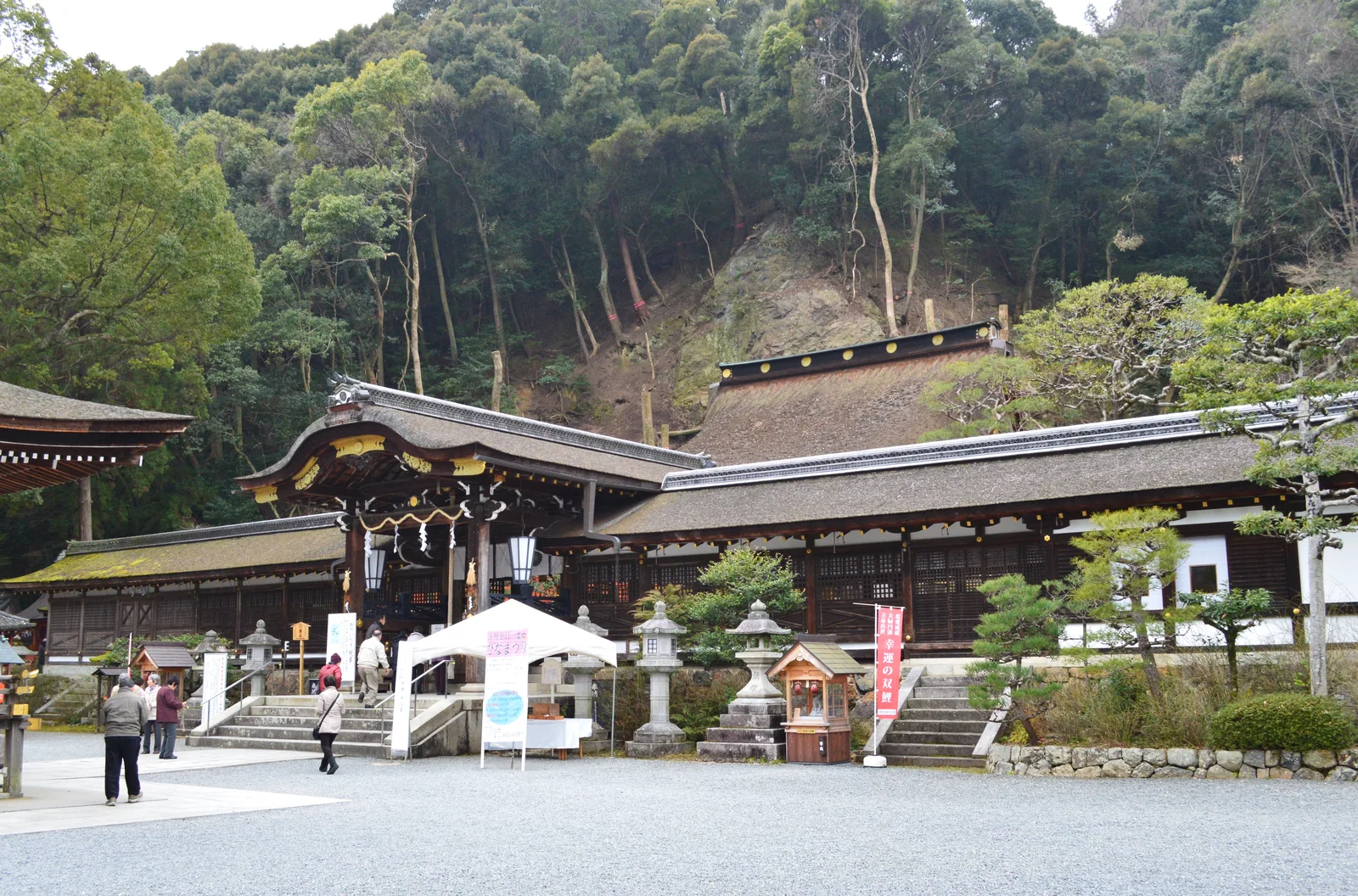
In the worship courtyard, the haiden stands in front and the honden (main sanctuary) behind it, set right against the foot of the mountain slope. Lift your gaze slightly above the worship line to see how the honden roof rises over the ridges of the haiden and surrounding pavilions. Designated an Important Cultural Property, the honden was built in Oei 4 (1397) according to shrine records, with Kyoto City records noting a major renovation in 1542. "Matsunoo-zukuri" refers to this honden's distinctive architectural style. In good light, stepping back a few paces in the courtyard frames both roofs and the wooded slope together.
Agree at the entrance on which stretch your group will walk together. Paying respects and viewing the rows of votive sake barrels sit near the entrance and courtyard, making them easy to cover as a group. Those buying tickets for the Shinzokan can loop back from the mountainside to rejoin everyone on the main approach. If you are heading on to Saiho-ji or Tenryu-ji in the afternoon, work backwards from your departure time and choose which spots to linger in across the three gardens, the Shinzokan and the spring.
| Area | Admission | Standard hours |
|---|---|---|
| General precinct worship | Free | 5:00–18:00 (listed in Kyoto City tourism data) |
| Joko, Kyokusui and Horai gardens plus Shinzokan | Combined ticket: adult ¥500, student ¥400, child ¥300 | 9:00–16:00 (until 16:30 on Sundays and national holidays) |
| Sake Museum | Free | 9:00–16:00 |
How to explore Matsunoo-taisha in western Kyoto: viewpoints across Mirei Shigemori's three Shofu-en gardens, the sake barrels, Kame-no-i spring and Shinzokan, plus combined tickets, Hankyu rail links, Arashiyama connections and Saiho-ji's winter closure dates.
Reading the torii, romon gate and honden from outside
Along the main approach, bunches of sakaki branches hang from the shimenawa rope across the vermilion torii gate. The shrine calls this custom "wakikanjo": twelve bundles in a normal year and thirteen in a leap year, linked to an older practice of divining the harvest month by month. Stand back a little first to make out the row of bundles beneath the rope. For photographs, you can capture the vermilion pillars with the hanging foliage, or cross to the far side and look back at their silhouette against the road behind. Fresh and green when hung at the New Year, the leaves naturally darken by late autumn.
Flanking the romon gate sit the Zuijin guardian statues, with wooden ladles tucked into the wire mesh around them. The shrine describes these as wishing ladles (kigan shakushi). Alongside the brewery names on the sake barrels, the ladles are another easy detail to spot. Because they sit just before you enter the worship courtyard, they are ideal to examine while waiting for companions. Inside the courtyard, look up first to locate the roof ridge, then trace the lines of the front and rear eaves. The shrine's architecture guide highlights the karahafu gable at the ends of the honden's box ridge (hakomune), arching upwards at the centre and sweeping down at both sides - worth picking out when looking up from in front of the hall.
To see the honden at closer quarters, book the shrine's separate special worship (tokubetsu sanpai). Admission is ¥1,000 per person (free for preschool children), including a priest's explanation and purification ritual lasting roughly 20 minutes. Standard reception times are 10:00, 11:30, 13:30 and 14:30, suspended from 1 to 7 January; festival days may alter the timetable. If you aim for the 10:00 slot, visit Horai-no-niwa near the entrance once the gardens open, return to the haiden area, and then continue after the ritual to the Shinzokan and the two mountainside gardens. Special worship is ticketed separately from the garden pass. Matsunoo-taisha Shrine Architecture and Special Worship
If you are staying within the public courtyard, read the rooflines first before walking up to the haiden beams and pillars. Matsunoo-taisha's architectural guide distinguishes the medieval carvings of the honden from Edo-period structures such as the haiden and romon gate. Once you have photographed the honden, glance back at the romon gate and move to the opposite edge of the courtyard to see how the front and rear roof ridges overlap.
Blue-green stone across all three gardens
Completed in 1975, the three gardens of Shofu-en draw on different chapters of Japanese garden design and shrine history, yet belong to a single modern composition. According to shrine records, more than 200 blue-green stones - chlorite schist from the Yoshino River in Shikoku - were used across the three spaces. Placed above dwarf bamboo, beside a winding stream or within a pond island, the same rock produces completely different effects of mass and sightline. When short on time, following how that stone behaves is quicker than matching every plaque date by date.
The chlorite schist looks paler in dry weather, whereas damp surfaces bring out its colour variations and veining. Because the gardens combine tall upright stones, flat slabs and small bank rocks, take one wider shot to capture each garden's layout and save close-ups for texture. One frame per garden suffices for comparison: vertical height in Joko-no-niwa, the course of the channel in Kyokusui-no-niwa, and the water surface with the opposite bank in Horai-no-niwa.
Starting with the two monoliths in Joko-no-niwa
In Joko-no-niwa, look first for the pair of large stones set centrally at the back. The shrine interprets these two boulders as representing Oyamakui-no-kami and Ichikishimahime-no-mikoto, with the surrounding cluster depicting attendant deities and the groundcover of dwarf bamboo suggesting alpine vegetation. At first glance, the eye latches onto the most prominent upright boulder; once you register the main pair, trace the stepping heights of the surrounding stones outwards to see how the composition gathers low elements back towards the two enshrined deities. Children often enjoy turning this into a stone-spotting game: each person picks out the two main rocks from the path to see whether everyone points to the same pair first.
The design takes its cue from the iwakura (sacred rock formations) on Mount Matsuo. Before any shrine buildings existed, people worshipped at giant boulders near the summit in Osugidani. In 701, Hata no Imiki Tori was ordered to build a shrine at the foot of the mountain, welcoming the mountain deities down to the present site. Today, the mountain boulders and the garden represent separate spheres: after landslides and fallen trees caused by a 2018 typhoon damaged the trail, the shrine abolished group ascents to the iwakura. Use Joko-no-niwa to read that mountain faith and save your walking for the level paths below. Matsunoo-taisha Iwakura and Ascent Notice
If you have already visited several gardens elsewhere in Kyoto, Joko-no-niwa makes the best opener here because its two upright monoliths introduce the shrine's founding story. Standing along the permitted viewing border, first read the relationship between the stone clusters head-on, then shift slightly along the path for a fresh angle. Viewing side by side makes it easy to notice which stone your companion is tracking; when taking photos, step back to a wider stretch so passing visitors have room to walk through.
Following the stream in Kyokusui and the pond bank in Horai
Kyokusui-no-niwa asks you to drop your gaze from tall rocks to ground level. "Kyokusui" refers to a winding watercourse inspired by Heian-era courtly poetry banquets. As the Kyoto Prefecture Tourism Federation notes, water from the Mitarashi-gawa curves past the foot of the slope while stones sit slightly higher up. Walk a few paces along the viewing boundary and watch how the channel disappears behind blue-green stones before emerging again between them. To read its direction clearly, choose a spot where both the stone banks and the bends ahead and behind are visible, and avoid lingering in the narrowest bottleneck.
Sitting close together on the precinct map, Joko-no-niwa and Kyokusui-no-niwa pair naturally in sequence. Joko-no-niwa's upright boulders arrest your gaze first, whereas the rock groupings in Kyokusui-no-niwa lead the eye towards the curving stream and distant hillside. At each bend in the channel, trace where the water flows next, then glance back to see which boulder hides the upper reach. Both gardens rely on the same chlorite schist, yet rearranging the stones completely alters how you move and look.
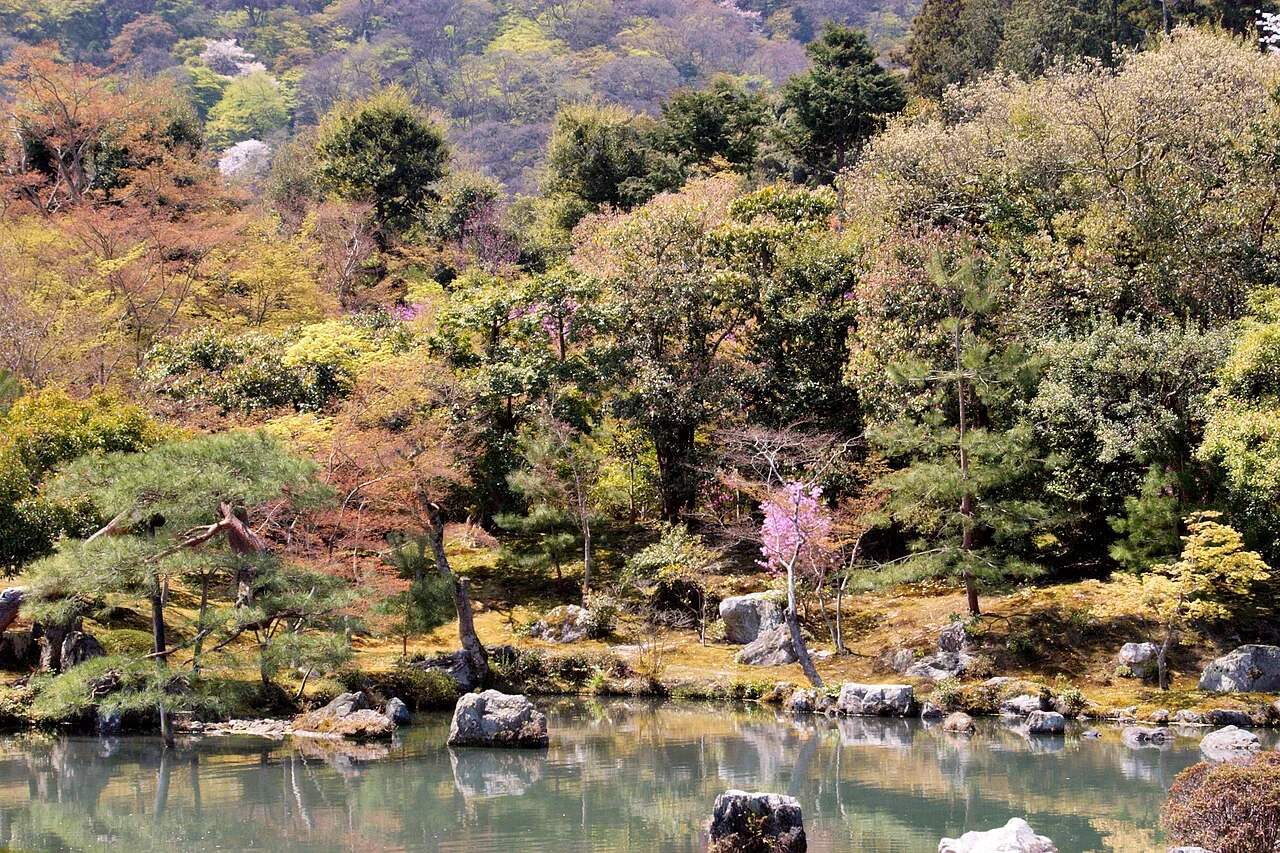
Horai-no-niwa spreads the water into a pond whose silhouette the shrine compares to a crane with outspread wings. Named after Horai, the mythical land of immortality, the garden adapts Kamakura-period strolling pond conventions so islands and rocks reveal themselves differently from each vantage point. Your first impression takes in the water and far shore; shifting along the bank is more rewarding than trying to grasp the full crane outline up close. If a companion wants to pick just one garden, choose Horai-no-niwa for water and reflections, or head closer to the mountain to see how Joko-no-niwa and Kyokusui-no-niwa express the shrine's origins.
When the weather turns, wind and rain transform the pond reflections and give photographs a different mood from clear days. If rain forces you to hold an umbrella with one hand, shorten your stay by the pond, stow your camera through the narrow sections and spend the remaining time inside the Shinzokan. The same adjustment works well in early spring or winter: catch the outdoor angles you care about most first, then leave unhurried indoor time for reading the display labels.
Single-block deity statues and a Muromachi precinct map in the Shinzokan
The Shinzokan displays 21 deity statues. Three life-sized seated figures from the early Heian period, carved primarily from single blocks of wood (ichiboku-zukuri), are designated Important Cultural Properties. Museum notes identify the elderly male deity as Oyamakui-no-kami, the female deity as Ichikishimahime-no-mikoto, and the younger adult male deity traditionally as their divine offspring. Standing before the trio, compare their silhouettes - focusing on the shoulders, sleeves and crossed knees - to see how much depth a single trunk yields. Since you are viewing through glass, skipping camera adjustments and reading a single dating label pays off quickly.
The remaining 18 statues originally stood in auxiliary and branch shrines within the precinct and are dated mostly from the late Heian to Kamakura periods. They include figures retaining traces of pigment, a statue bearing an inscription dated Koji 2 (1143) on its base, and deities carved in the guise of Buddhist monks. Anyone interested in shinbutsu-shugo (the syncretism of kami and Buddhism) can focus on those contrasts in form. When visiting with children, counting the three life-sized statues and then hunting for one dressed differently leaves a stronger impression than trying to study all 21 in turn.
To the left of the entrance hangs an early Muromachi-period map of the shrine grounds alongside a genealogy of the priestly Higashi family. Seeing the haiden, romon gate and mountain slope outside first makes it much easier to orient yourself on the historic map. On the right hang four-season photographs of Matsunoo-taisha by Katsuhiko Mizuno. On quiet rainy days, give this room an extra ten minutes: find the shrine buildings on the old map first, then pick out a corner in the photographs that you walked past earlier in the day. Matsunoo-taisha Shinzokan
Connecting the sake barrels, sugidama and Kame-no-i spring
To make sense of Matsunoo-taisha's role as a patron of brewers, start by reading a few clear labels on the rows of votive sake barrels. As the Kyoto Prefecture Tourism Federation explains, these barrels are dedicated ("hono") by breweries from across Japan - an offering of sake, or its symbol, to the kami. Noting the brand names and regions on the labels clarifies how this wall differs from shop displays in central Kyoto. From here, the museum carries the story from barrel labels into brewing stages before the spring shows where the water begins.
A spherical cedar-branch sugidama hangs at the entrance to the Sake Museum. Inside, tools, panels and video explain the bond between Matsunoo-taisha and sake alongside a step-by-step display of the brewing process. With children, start by spotting the rice-steaming equipment and move on to the vats and vessels used for fermentation and bottling. Visitors drawn to drinking vessels should save those for last, when knowing the production steps makes each shape easier to read. Because the museum is indoors, it also offers an easier shelter during sudden showers or fatigue than standing under an umbrella trying to read barrel labels outside. Matsunoo-taisha Sake Museum
Follow the edge of the shrine pavilions towards the base of the mountain to reach Kame-no-i, a spring flowing in front of Reiki Waterfall. Shrine records note that brewers draw this spring water as motomizu (starter water) to blend into their brewing water, and Kyoto City records preserve the legend that doing so keeps sake from spoiling. Looking straight from the spring into the ravine behind makes the clustering of honden, mountain and water source immediately intuitive. If others are filling bottles, wait aside briefly rather than stepping between their containers and the spout for a photograph.
"Reiki" (Sacred Turtle) also gives the waterfall its name. Shrine lore tells of an auspicious turtle appearing in the valley, prompting the imperial court to adopt the era name Reiki. If you also spot the Nadekame (stroking turtle) statue in the grounds, the two connect directly. The precinct map further marks the turtle spring as water associated with longevity and renewal, showing how a single spring carries multiple meanings in local belief. This short detour works best right after reading about raw ingredients in the Sake Museum, especially if you want to link the sake barrels directly to the natural landscape.
If you only have half an hour and want barrel photos or a list of brewery names, stay along the main approach and loop back into the worship courtyard. If you want to know what happens before sake ever enters the cask, head into the museum. Later, if you visit the Fushimi brewing district, comparing the casks, tools and labels seen at Matsunoo against Fushimi's brewery displays reveals far more than photographing rows of barrels in isolation.
Timing a visit for festivals or yamabuki blossom
Once the autumn harvest finishes, the brewing calendar enters a new cycle. On the first Hare day of November, Matsunoo-taisha holds the Jo-u-sai festival, where brewers pray for safe fermentation and take home large wooden talismans to enshrine in their breweries; the following April, on the middle Rooster day, Chuyu-sai gives thanks for the completed brew. Shrine listings also include miso, soy sauce and vinegar makers and merchants among the participants. Looking at these two ceremonies shifts the image of the sake deity from rows of Kyoto barrels to how a brewery plans its year. The 2026 Jo-u-sai took place on 1 November at 11:00. Matsunoo-taisha Brewing Festivals
In spring, the floral highlight at Matsunoo-taisha is yamabuki (Japanese kerria). The Kyoto Prefecture Tourism Federation lists the banks of the Ichinoi-gawa stream as the viewing spot, typically flowering in late April. If blossoms are your priority, check the stream running between the romon gate and the honden first to find spots combining yellow blooms and water before deciding whether to buy a garden ticket. For a post-cherry-blossom morning in western Kyoto, yamabuki pairs cleanly with Mirei Shigemori's blue-green stones. Should your visit coincide with the Shinko-sai festival, the procession crosses the Katsura River by boat (Funatogyo), which requires extra time down by the riverbanks; for pure garden viewing, a standard worship day keeps pacing far simpler.
Matsunoo-taisha also hosts Kenchakai tea-offering gatherings. The shrine has published its 2027 tsukigama schedule, with the first two sessions on 17 January and 7 February from 9:00 to 15:00. Single-day tea tickets cost ¥2,000, annual passes ¥8,000, with no gatherings in July or August. If you are visiting western Kyoto during Saiho-ji's winter maintenance closure, the 7 February gathering makes an ideal morning anchor at Matsunoo-taisha before catching the Hankyu train on to Arashiyama. Tea tickets are separate from garden admission. Matsunoo-taisha 2027 Tea-Offering Schedule
Getting to Matsunoo from Kyoto Station, Shijo-Karasuma and Arashiyama
From Kyoto Station, take the Karasuma underground line to Shijo, then follow signs to Hankyu Karasuma Station. Ride the Hankyu Kyoto Line to Katsura and change onto the Arashiyama Line, passing Kami-Katsura to reach Matsunoo-taisha Station (HK97). Visitors staying around Shijo-Karasuma or Kawaramachi can board directly at Hankyu Karasuma or Kyoto-Kawaramachi. The shrine estimates roughly 40 minutes including transfers from Kyoto Station; if you are aiming for the gardens before last entry, factor in the underground walkway, platform change at Katsura and wait for the branch-line train.
The station has east and west ticket gates. Arriving from Katsura on the Arashiyama-bound platform, leave via the west gate for a three-minute walk to the shrine. The Katsura-bound platform sits on the opposite side. Hankyu's station layout shows only stairs connecting the two platforms inside the paid area, so pushchairs and wheelchairs should enter directly through the outer gate on the required platform side. The east gate is unstaffed, with an intercom available if assistance is needed. Returning from Arashiyama, you can avoid the internal stairs by exiting straight through the east gate on the Katsura-bound platform and walking to the shrine via the street outside. Hankyu Matsunoo-taisha Station Map
For a direct bus from Kyoto Station, take Kyoto City Bus Route 28 bound for Arashiyama and Daikaku-ji and get off at Matsunoo-taisha-mae. Those staying near Shijo-Omiya can board Route 28 there, while Route 29 runs from Shijo-Karasuma towards Rakusai Bus Terminal. On the return leg, check the direction sign at Matsunoo-taisha-mae: take Route 28 back to Kyoto Station, or Route 29 back to Shijo-Karasuma. Standard Route 28 operates within the flat-fare zone at ¥230 for adults and ¥120 for children per ride; in the outbound direction, Route 28 displays Arashiyama and Daikaku-ji as its destination. Kyoto City Bus Matsunoo-taisha-mae Timetable
Kyoto Bus also stops at Matsunoo-taisha-mae. From Kyoto Station, take Route 73 towards Kokedera and Suzumushi-dera, or the weekday-only Route 83; from Sanjo-Keihan-mae and Shijo-Kawaramachi, look for Route 63. Compared with City Bus services, Kyoto Bus has the advantage of continuing on the same route to Kokedera-Suzumushidera near Saiho-ji. Watching only for "Arashiyama" on bus signs makes it easy to miss whether a service continues to Matsunoo and Kokedera, so checking both route number and final destination saves guesswork. Kyoto Bus Guide to Matsunoo-taisha
In autumn 2026, certain Kyoto Bus services travelling between Kiyotaki and Arashiyama ran on detour routes. Kyoto City Bus also announced weekday diversions on the north bank of Arashiyama from 2 to 27 November between 10:00 and 16:00, affecting routes including Route 28 towards Kyoto Station. When the Arashiyama Tenryu-ji-mae stop is suspended, board the Kyoto Station-bound Route 28 at the westbound stop of Arashiyama (Togetsukyo North End) instead. To reach Matsunoo from the north bank, you can also walk across Togetsukyo Bridge to Hankyu Arashiyama Station and ride one stop to Matsunoo-taisha. Kyoto City Transport Bureau Autumn 2026 Weekday Diversions
Pairing Saiho-ji in half a day: lock in the temple slot first
Applications for Saiho-ji's Nichinichi Sanpai (daily worship) close the day before at the latest. Inside, visitors copy sutras and pay respects in the main hall before touring the moss garden, taking roughly 60 minutes in total. Parties of three or four must split across separate online accounts or postcards, and groups of five or more cannot apply. Standard entry is limited to ages 13 and over, with children aged 12 and under restricted to designated Children's Days. If your family trip misses a Children's Day, swap Saiho-ji for Tenryu-ji's garden and keep Matsunoo-taisha on the same itinerary. Saiho-ji Nichinichi Sanpai
If you secure a 10:00 slot at Saiho-ji, leave time from 11:00 onwards for the transfer and arrive at Matsunoo-taisha before midday to worship first and visit the three gardens. That keeps your appointment firmly anchored to the sutra-copying hall while leaving the rest of the route flexible. By Kyoto Bus, ride from Kokedera-Suzumushidera towards Arashiyama or central Kyoto and alight at Matsunoo-taisha-mae. The Kyoto Prefecture Tourism Federation notes a straight-line distance of roughly 0.9 km between the two sites; on actual streets, allow around 20 minutes on foot plus buffer time for your pace. Travelling in reverse from Matsunoo to Kokedera uses the same stops - check that the bus is signed for Kokedera-Suzumushidera.
With a 13:30 Saiho-ji booking, putting Matsunoo-taisha in the morning works better. Arrive around 9:30 to cover the three gardens and the Shinzokan, leave before noon for lunch, and check in at Saiho-ji afterwards. That lets you complete both gardens unhurriedly with energy left afterwards. If you still feel like walking, catch a bus back from Saiho-ji to Matsunoo-taisha Station and take the Hankyu line up to Arashiyama for an evening riverbank stroll and dinner.
An all-rail combination works too. Saiho-ji lists Kami-Katsura as its nearest Hankyu station, roughly a 15-minute walk away. Starting at Saiho-ji in the morning means changing at Katsura onto the Arashiyama Line, getting off at Kami-Katsura, and afterwards either walking back to Kami-Katsura or continuing on foot along the road to Matsunoo-taisha. If you prefer less walking, the Kyoto Bus Kokedera-Suzumushidera stop sits roughly three minutes from the temple gate, whereas the Kyoto City Bus Suzumushi-dera / Kokedera-michi stop is about ten minutes away; always check the operator name alongside "Kokedera" when looking up timetables. Saiho-ji Access and Visiting FAQ
From 12 January to 26 February 2027, Saiho-ji pauses Nichinichi Sanpai for grounds maintenance, offering special visits such as Zen and Art gatherings in February instead. To preserve the classic sutra-copying and moss-garden pairing, schedule both sites outside that window. If your Kyoto dates fall within the closure, tour Shofu-en at Matsunoo-taisha in the morning and cross to Tenryu-ji in Arashiyama after lunch: you still get two contrasting gardens without needing the extra bus loop to Kokedera.
Adding Arashiyama: allow proper time on the north bank
Hankyu Arashiyama Station is one stop from Matsunoo-taisha and deposits you on the south side of Togetsukyo Bridge. If you only want lunch and close-up views of the bridge and Katsura River, walking out towards Arashiyama Park and the bridgehead is enough. Only cross Togetsukyo Bridge to the north bank if you are continuing to Tenryu-ji, the bamboo grove or the Randen tram. Thinking of that "one stop to Arashiyama" as two distinct stages - arriving on the south bank and crossing the bridge - stops anyone mistaking the two sides for the same station exit, especially with children, older travellers or a larger group.
Tenryu-ji's garden normally opens from 8:30 to 17:00 with last admission at 16:50; garden tickets cost ¥500 for high school students and above and ¥300 for elementary and junior high pupils. Compared with Shofu-en, Sogenchi Pond offers a broader expanse of water framing the mountains behind. If you leave Matsunoo after 14:30, pick two highlights between Togetsukyo Bridge and Tenryu-ji's garden, adding the bamboo grove via the north gate only if legs hold out. Viewing the Cloud Dragon ceiling painting in the Dharma Hall requires a separate ticket and open dates, with 2 January 2027 listed as closed; garden-focused visitors simply follow the garden admission desk hours. Tenryu-ji Visiting and Access
Starting early at the bamboo grove also works smoothly. Take the Randen tram or JR train straight to the north bank, walk the grove, return down Nagatsuji-dori to Togetsukyo Bridge, cross to the Hankyu station for Matsunoo-taisha, and save the afternoon for the closer Sake Museum and Shofu-en gardens. If Tenryu-ji is on your list, include it in the morning sweep rather than recrossing the bridge later. Since midday lunch timing gets tightest on this route, eat on the north bank before crossing rather than rushing both the bridge and temple entry at once.
For a garden-focused alternative that skips Arashiyama altogether, ride back from Matsunoo-taisha to Katsura and devote half a day to Katsura Imperial Villa. Because the Imperial Household Agency manages timed slots and strict quotas, secure your villa reservation first and place Matsunoo-taisha either side of it. Walking Katsura's pondside paths past its shoin pavilions and teahouses over stepping stones highlights the contrast between its architecture-linked stroll garden and Mirei Shigemori's upright boulders and winding stream at Matsunoo. If no villa slot is available, staying on the Hankyu Arashiyama Line to Arashiyama keeps transit straightforward. Imperial Household Agency Katsura Imperial Villa Visiting Guide
Your return route into Kyoto depends on which river bank finishes your day. Ending on the south side of Arashiyama means taking Hankyu back to Katsura to connect onto the Kyoto Line towards Shijo-Kawaramachi or Osaka. Finishing around Tenryu-ji and the bamboo grove puts JR Saga-Arashiyama Station in reach for Kyoto Station, or Randen for Shijo-Omiya. Because the JR and Randen stations serve completely different lines, confirm the exact station name if your group splits up - never abbreviate Saga-Arashiyama and Arashiyama into the same label. Kyoto City Saga-Arashiyama Access Guide
If you are already staying overnight in Arashiyama, wander down to the riverbank before check-out while leaving bags at your accommodation, then hop over from Hankyu Arashiyama to Matsunoo-taisha for the gardens. Travellers heading straight from Arashiyama to Kyoto Station for the Shinkansen can instead visit Matsunoo on the way in the previous afternoon, leaving a direct JR ride from the north bank after check-out rather than hauling suitcases across the bridge to catch Hankyu and the underground.
Plans for rain, older travellers or just one hour
In light rain, buy the combined ticket, make a short outdoor pass through Joko-no-niwa and Kyokusui-no-niwa, and duck into the Shinzokan. If the downpour worsens, head for the Sake Museum near the entrance so your second half shifts from outdoor waterworks to indoor brewing tools. Fold umbrellas before stepping out again to decide whether the path back to the spring and waterfall is worthwhile; if water is pooling and stones turn slick, skip the mountainside corner and take the shorter walk back to the main approach.
The Kyoto Prefecture Tourism Federation's accessibility listing for Matsunoo-taisha marks the Sake Museum as wheelchair-accessible. When companions need to avoid steps or prolonged standing, build the visit around that museum first, which also sits closest to the entrance. If the group splits, agree to regroup in the open space inside the torii gate so ticket holders can visit Kyokusui-no-niwa and Joko-no-niwa before returning straight to the main approach. Because Saiho-ji's garden paths cannot accommodate wheelchairs, keeping Matsunoo's indoor museum and pairing it with the south riverbank in Arashiyama makes a gentler same-day plan.
With only one hour to spare, let your main interest decide. A brewing-focused hour runs from paying respects and viewing the sake barrels into the Sake Museum, adding the spring only if minutes remain. A garden-focused hour starts with the combined ticket, concentrates on mountainside Joko-no-niwa and Kyokusui-no-niwa, and reads Horai-no-niwa from a pondside viewpoint on the way back. Whenever everyone wants photos, statue labels or time at the amulet counter, budgeting 90 minutes feels far calmer than pressing right up against your next departure. Leaving large suitcases in lockers at your departure station or hotel makes every gate, stone step and narrow path effortless.
On fine days, crossing Togetsukyo Bridge between Matsunoo-taisha and Arashiyama makes a pleasant walk in its own right. In rain, biting wind or flagging energy, stop at the south riverbank and ride the Hankyu train back instead. If the bamboo grove was also on your wish list, save it for another morning starting straight from JR Saga-Arashiyama Station. Seeing the ticketed gardens and deity statues at Matsunoo-taisha properly beats rushing across to the north bank just as gates close.
A few useful answers
Is admission to Matsunoo-taisha free?
General entry to the shrine grounds is free, as is admission to the Sake Museum. A single combined ticket covers the three Shofu-en gardens and the Shinzokan treasure house at ¥500 for adults, ¥400 for students and ¥300 for children.
What are the three gardens of Shofu-en called?
Joko-no-niwa (Garden of Antiquity) draws on the sacred boulders atop Mount Matsuo, Kyokusui-no-niwa (Garden of the Winding Stream) evokes Heian-era aristocratic banquets along a curving stream, and Horai-no-niwa (Garden of Horai) is arranged around a strolling pond. All three are modern gardens created by Mirei Shigemori.
How do you get from Matsunoo-taisha to Arashiyama?
Board an Arashiyama-bound train on the Hankyu Railway from Matsunoo-taisha Station and ride one stop to Hankyu Arashiyama Station. Tenryu-ji and the Randen Arashiyama Station lie on the north side of Togetsukyo Bridge, so walk to the bridgehead after leaving the station and cross on foot.
Can you combine Matsunoo-taisha and Saiho-ji on the same day in winter 2027?
Saiho-ji suspends its Nichinichi Sanpai daily worship from 12 January to 26 February 2027, holding special visits in February instead. To follow the standard sutra-copying and moss-garden route, travel outside those dates and submit your Saiho-ji application no later than the day before.
Official information and references
Sources used in this guide.
- Matsunoo-taisha | Precinct Guide Map
- Matsunoo-taisha | Shrine Architecture, Wakikanjo and Honden Special Worship
- Matsunoo-taisha | Garden and Shinzokan Tickets, Hours, Spring and Waterfall
- Matsunoo-taisha | Mount Matsuo Iwakura and Abolition of Ascents
- Matsunoo-taisha | Shinzokan Exhibits and Opening Hours
- Matsunoo-taisha | Sake Museum
- Matsunoo-taisha | Shrine History and the Hata Clan
- Matsunoo-taisha | Access, Pavilions and Group Worship
- Matsunoo-taisha | Jo-u-sai and Chuyu-sai Brewing Festivals
- Matsunoo-taisha | 2027 Kenchakai Tea-Offering Notice and Schedule
- Kyoto City Official Travel Guide | Matsunoo-taisha, Precinct Hours and Honden
- Kyoto City Official Travel Guide | 2026 Matsunoo-taisha Jo-u-sai Festival
- Kyoto Prefecture Tourism Federation | Matsunoo-taisha, Yamabuki and Accessibility Information
- Kyoto Prefecture Tourism Federation | Sake Museum Admission Information
- Hankyu Railway | Matsunoo-taisha Station Platforms, Gates and Timetable
- Hankyu Railway | Matsunoo-taisha Station Map
- Kyoto City Transport Bureau | Matsunoo-taisha-mae Stop Routes 28 and 29
- Kyoto City Transport Bureau | City Bus Route Stops and Flat-Fare System
- Kyoto City Transport Bureau | Standard City Bus Fares
- Kyoto City Transport Bureau | Autumn 2026 Weekday Arashiyama Bus Diversions
- Kyoto Bus | Matsunoo-taisha Routes and Boarding Information
- Kyoto Bus | Autumn 2026 Arashiyama Route Diversions
- Saiho-ji | Nichinichi Sanpai, Application Rules and 2027 Winter Closure
- Saiho-ji | Age Limits, Accessibility, Bus and Rail Stops
- Tenryu-ji | Garden, Halls and Cloud Dragon Viewing Information
- Imperial Household Agency | Katsura Imperial Villa Visiting Guide
- Kyoto City Official Travel Guide | Saga and Arashiyama Access Guide