Walk from Taigetsukyo Bridge to Kojakuji Temple, Sanshu Asuke Yashiki and old Asuke. Choose a route for your walking ability, understand autumn workshop suspensions and Hinokichaya dining, and check the date-specific last buses in November 2026.
- Region & Focus
- Toyota and Korankei
- Reading Scope
- 34 min read · 15 chapters · 4 Q&As
- Official Verification
- 19 official sources checkedUpdated November 8, 2026
- Key Topics
- SeasonsItinerariesRail travel
Chapter Route Map (tap any stop)
- Start with the river and old town; give the summit its own daylight slot
- Find your bearings with two rivers and two red bridges
- A short riverside walk: Taigetsukyo to the plaza, with an easy return the same way
- Kojakuji: make the gate and temple grounds your turning point
- Choose a daylight route for Mount Iimori
- Enter old Asuke near Tomoe Bridge, then make a short circuit of bridges and lanes
- Read the town from its shop fronts and riverside backs
- Choose a stop at the Suzuki main house or Chumakan
- Sanshu Asuke Yashiki connects materials, craftspeople and everyday uses
- Choose workshops by season, age and booking method
- Eat a meal at Hinokichaya and take a riverside break at Katakago
- Two daytime sequences, with indoor visits before sunset
- For the illuminations, eat and descend before returning to the river
- Choose 2026 buses by date; Josui services finish early over the three-day holiday
- Plan wheelchair access, strollers and payments before leaving
- Quick Q&A
For a day at Korankei, first decide where to spend your time: beside the river, on the mountain, or in Asuke's streets and craft workshops. Arrive in the morning, walk from Taigetsukyo Bridge to the plaza, visit Sanshu Asuke Yashiki around lunch, then finish with a short circuit of the old town. Shorten the town walk if you want to climb Mount Iimori. Some workshops stop in November, and the last bus after the illuminations varies by date. Choose your daytime priorities so the day leaves room for more than rushing and waiting for buses.
Start with the river and old town; give the summit its own daylight slot
For a day trip from Nagoya to Korankei, arrive in Asuke in the morning, see the riverside, then choose a longer stop at either Sanshu Asuke Yashiki or the historic streets. To explore both in detail, leave out the summit of Mount Iimori. If the climb is your priority, shorten the town walk. Taigetsukyo Bridge, Kojakuji Temple and Asuke Yashiki share a sightseeing map, but their walking demands and opening hours differ. Riverside photography and a climb to the summit are separate outings. Your group can split at the foot of the mountain.
There are three useful daytime focuses during the autumn foliage season: maples and bridges along the Tomoe River, materials becoming everyday objects inside the Yashiki, and shops and storehouses on narrow plots along the Asuke River. With half a day, the first plus a meal makes a worthwhile visit. Add the buildings and town streets when you have a full day. Staying for the illuminations extends the daytime route, so adjust meal times, the descent and transport home.
The 71st Korankei Maple Festival runs from November 1 to 30, 2026, with illuminations until 21:00. There are no illuminations on October 31. Walking in the park is free; Sanshu Asuke Yashiki admission and parking cost extra. You can complete the free riverside route before deciding whether to enter the Yashiki. Workshops are generally suspended in November, so focus on watching craftspeople and visiting the buildings. Choose a date outside the festival for hands-on work.
Walk from Taigetsukyo Bridge to Kojakuji Temple, Sanshu Asuke Yashiki and old Asuke. Choose a route for your walking ability, understand autumn workshop suspensions and Hinokichaya dining, and check the date-specific last buses in November 2026.
Find your bearings with two rivers and two red bridges
The 2026 autumn foliage map places Korankei between Mount Iimori and the Tomoe River. To the west, Taigetsukyo Bridge links the main arrival area with the riverside at the mountain's foot. To the south are Korankei Plaza, Sanshu Asuke Yashiki and places to eat. Continue east along the river to the Korankyo suspension bridge. Tomoe Bridge is to the north, with views of the whole mountain nearby; it is in a different direction from Asuke Ohashi Bridge and the national highway crossing. Save the bridge names to make meeting up and finding your return bus stop easier.
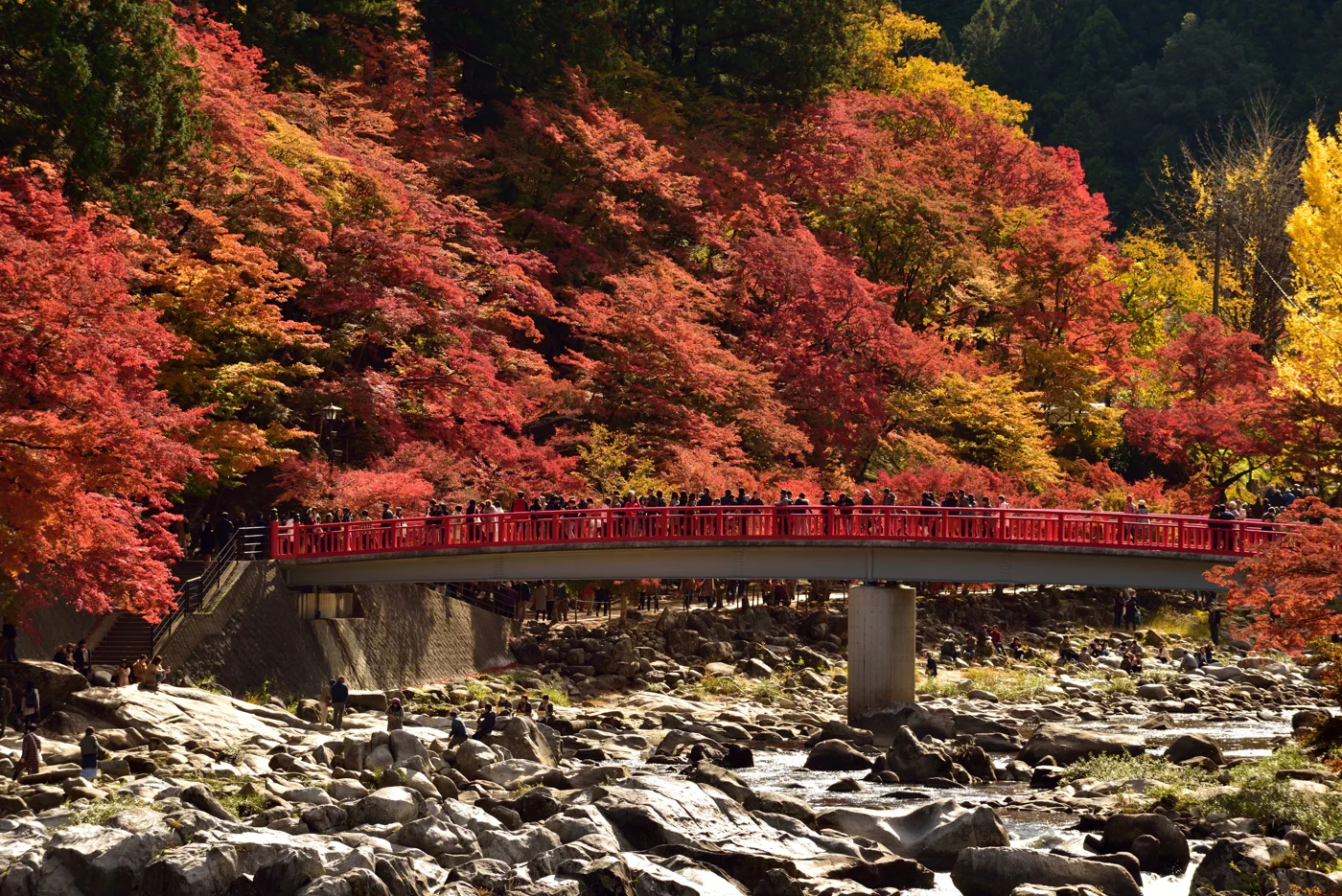
Taigetsukyo and Korankyo are both red, so a meeting message that says only 'the red bridge' is unclear. The first is a useful starting point for the main riverside walk; the second connects the opposite bank upstream with the direction of Asuke Mura. The official map shows Kawami Chaya and Asuke Mura beside Korankyo, and another bridge, Kunpukyo, beside Asuke Yashiki. Each has a different use on the route. If you are tired at the plaza, stay near the Yashiki. A photograph of another red bridge is no reason to hurry farther upstream.
Asuke's historic streets lie across the national highway along the smaller Asuke River. To move between the Tomoe riverside and the shops along the Asuke River, use the connecting roads and bridges. Drawing a direct line between two nearby map points across the mountain's foot can send you the wrong way. On arrival, locate Tomoe Bridge, Taigetsukyo Bridge and Korankei Plaza. From these, you can branch into the short riverside walk, the Yashiki visit or the town route.
A short riverside walk: Taigetsukyo to the plaza, with an easy return the same way
To save your energy for photography, cross Taigetsukyo Bridge to the Mount Iimori side and follow the Tomoe River toward Korankei Plaza and Asuke Yashiki. The official map highlights the 'five-color maple' beside the bridge, named for the range of leaf colors on a single tree. Look at the nearby leaves, then turn toward the water and opposite bank. You do not need to climb straight away. When the bridge is crowded, cross first and find somewhere to stop beside the river, so photography does not obstruct people walking through.
The official map identifies the plaza as an area that colors relatively early because of cool air from the river. The area near Korankyo Bridge to the east also tends to color early, thanks to morning sunlight. Use these differences to choose your direction on the day. The whole mountain need not be equally red at once. If leaves near Taigetsukyo are still mostly green, try the plaza and upstream. If you have already spent a long time in one spot, you can also retrace your steps and watch the light change along the same stretch of river.
End this short route in front of Asuke Yashiki, have a drink or meal, then return to Taigetsukyo the same way. Extend it to Korankyo only if you have time and energy, for views of the water, suspension bridge and another side of the mountain's foot, before turning back. Retracing your steps repeats part of the walk but keeps the junctions familiar. This is easier to coordinate for slow walkers, stroller users or groups whose members may need a rest. For a different view, make Kojakuji Temple above the plaza your next branch.
Kojakuji: make the gate and temple grounds your turning point
Kojakuji Temple stands on the southern foot of Mount Iimori. The approach from the river has slopes and steps. Its atmosphere and walking demands differ from the riverside, making it a climb with a clear destination within a river walk. To see the gate, temple and maples, turn back at the grounds and descend to Asuke Yashiki for a meal. This works for people happy with a short uphill walk who do not plan to reach the summit.
The maple planting at Korankei is directly linked to Kojakuji. The tourism association explains that in 1634, Sanei, the temple's 11th head priest, planted maples and cedars along the approach from the Tomoe River. Local residents later continued planting on Mount Iimori. Reaching the temple helps explain the relationship between the riverside trees and the wooded mountain. You can follow this history along the temple approach.
The official nighttime rules for 2026 allow access to Kojakuji's grounds, but prohibit entry to the route from the grounds to the summit after dark. If you visit the temple by day, spend the evening beside the river. If you arrive at dusk, distinguish the summit entrance signs from the temple approach. If some people climb while others stay by the river, meet at the Yashiki entrance or a named shop in the plaza. This avoids a long wait on a slope or at the temple gate.
Choose a daylight route for Mount Iimori
Mount Iimori is 254 meters high. The 2026 park map shows three summit routes: the 'Strong Legs Trail' near the north side of Taigetsukyo Bridge, the 'History Trail' via Kojakuji Temple, and the 'Prayer Trail' from the Ichinotani side to the east. The summit has a sacred rock site, and the map shows how each route leaves the river and enters the mountainside. Though the elevation is modest, there is a real climb. Grip, your ability to descend and the remaining daylight matter more than the straight-line distance between two map points.
On a first visit, if you also want to visit the temple, take the History Trail via Kojakuji and descend the same way. You repeat the route, but it is easier to follow and lets you decide at the temple whether to continue. Consider a circuit up one side and down another only if you know mountain paths and have enough stamina. Match your descent to the next stop: return south for Asuke Yashiki, or to the northern roads for the town streets.
An older tourism association hiking report notes the gradient of the summit path, and the 2026 map calls the western route the Strong Legs Trail. Allow about one to one and a half hours for the ascent, summit stop and descent, adjusting for your pace. Riverside crowds and photography take extra time. If you start climbing in the afternoon, drop a long town circuit so you still have time to eat and leave afterward. All three summit routes are closed from sunset until early morning. Finish the summit section before then.
Enter old Asuke near Tomoe Bridge, then make a short circuit of bridges and lanes
To combine autumn leaves and traditional townhouses, enter the old town near Tomoe Bridge and make a short circuit around the night lantern, road marker, Naka Bridge and Manrin Lane. The official Asuke town walking guide labels its recommended circuit as 30 minutes and its shorter Ina Road circuit as 20 minutes. It also offers a 60-minute long circuit and a 90-minute Asuke River and road circuit. Use these to choose an area. Shops, building visits and photo stops need extra time.
A short circuit shows both the street fronts and the Asuke River without taking you to the far eastern end of town. Walk past the shops, turn through a lane and across a bridge to the river, then look at the stone retaining walls and storehouses behind the buildings on your way back toward the night lantern. Manrin Lane is in the middle of the district. Nearby Katoya, Ebiya Lane and Naka Bridge help you identify turns. Use the shops as landmarks and decide whether to go inside according to your interests.
After two hours beside the river, one short circuit and one building open to visitors are a good fit. Extend the route to Asuke Chumakan and the Former Suzuki Family Residence only if architecture interests you and it is still early. The walk back from the eastern end to the west is substantial. Luggage, a stroller and shopping bags add to the load. Leave large bags at your Nagoya accommodation before coming to Asuke to make the lanes and townhouse visits easier.
Read the town from its shop fronts and riverside backs
Asuke was a trading settlement on the Ina Road linking Owari, Mikawa and Shinshu. Salt was repacked here, giving rise to the names Asuke salt and Asuke-naoshi. Townhouses rebuilt after the great fire of 1775 often have plaster walls, tiled roofs and fire protection features. Some have roof ridges perpendicular to the street, known as tsumairi, while others have ridges parallel to it, known as hirairi. Compare the roof direction, second-floor height and frontage of two or three neighboring houses to see the variation.
The official architectural guide explains that merchants often filled the street frontage with the main house, then placed reception rooms and earthen-walled storehouses behind it. The valley constrains the height and shape of plots along the Asuke River. Some houses stand on several tiers of stone retaining walls. From a bridge, their riverside backs reveal structures quite different from the shop fronts. Back on the street, look at how ground-floor shops, spaces beneath the eaves and white walls connect. A short circuit through a lane and over a bridge shows both sides of the same row.
Manrin Lane runs inward beside storehouses and stone walls. The tourism association describes its continuous earthen-walled storehouses and depth of about 50 meters. Its scale differs from the street outside, so walk slowly through it. People still live and work in this district. Doorways, house interiors and narrow lanes have their own uses. Photograph buildings from public roads and leave room for residents to pass. The official guide states that private homes marked on the map are not open to visitors; treat those buildings as homes.
Choose a stop at the Suzuki main house or Chumakan
The Former Suzuki Family Residence, also called Kamiya Suzuki-ke, is at 20 Honmachi, Asuke-cho. Its main house is free to enter. Regular hours are 10:00–16:00 on Fridays, Saturdays, Sundays and national holidays, with daily opening in November and during the Chuma Hina Festival. For an indoor visit during foliage season, arrive before 16:00 and leave the river for later. Photographing Korankei until dusk first would mean missing this different view of the town.
The official architectural guide explains that the Suzuki family traded in paper, then expanded into brewing, finance and forestry. Compare the main house with the narrow townhouses seen earlier. This was a representative large merchant household in Asuke, with buildings and land on a different scale. Public access centers on the main house; follow the areas open on site. If street exteriors interest you most, return to the Asuke River afterward rather than adding a string of temples.
The official town map identifies Asuke Chumakan as the former Asuke branch of Inahashi Bank, built in 1912. It now presents material on commerce, finance, transport and the townscape. Choose it if you want to understand how salt and goods helped this mountain settlement prosper. If building interiors interest you more, start with the Suzuki main house. Visiting both will take much longer than the recommended 30-minute circuit. Have lunch in Asuke rather than compressing every visit to get back to Nagoya for a meal.
The 2026 maple festival also has a DENKEN heritage stamp rally. Collect stamps at the Former Suzuki Family Residence, Former Taguchi Family Residence and Asuke Chumakan from October 31 to November 30 to receive an original sticker. All three are free. Announced festival hours are 10:00–16:00 for the Suzuki main house, 10:00–17:00 for Taguchi and 9:00–17:00 for Chumakan. With children, start at Suzuki, which closes first, then return to Taguchi and Chumakan. You need not fit all three and the summit into one afternoon. Taguchi also displays original artwork for Asuke Spring Festival posters and an autumn festival folding screen. Allow longer if local festival imagery interests you.
Sanshu Asuke Yashiki connects materials, craftspeople and everyday uses
Sanshu Asuke Yashiki, beside Korankei Plaza, recreates mountain farming life from the Meiji era to around 1955. Explore the main farmhouse, storehouse, artisans' building and individual workshops. The farmhouse has a sunken hearth, straw work and weaving. The storehouse presents Showa-era life and lists umbrella and bamboo work. The artisans' building houses dyeing and cooperage, while the papermaking hut beside the waterwheel gives paper its own space. The focus is on tools still used to make everyday objects.
A Japanese umbrella makes an easy thread to follow. Its ribs are bamboo, and its canopy uses Mikawa Morishita paper made at the Yashiki. The paper is treated with oil after being attached. Start with the bamboo and frame, visit the papermaking hut, then return to a finished umbrella to connect the work areas. If a child will stop only briefly, follow one question: what materials go into an umbrella? You need not spend equal time in every hut.
Another thread is wood and charcoal. Woodturners use a lathe for trays, bowls and other objects; coopers shape and assemble wood into containers. Charcoal from the kiln is also used to roast coffee at an associated cafe. If woodworking interests you, spend time on the tools and steps before having a coffee. Craftspeople also leave to gather materials. If a hut is temporarily unstaffed, visit another area first. If a particular process is the main purpose of your trip, ask about that day's arrangements by calling the Yashiki on 0565-62-1188.
The Yashiki opens 9:00–17:00, with last admission at 16:30. Admission is ¥300 for adults, ¥100 for elementary through high school students, and free for preschool children. It normally closes Thursdays, or Friday when Thursday is a national holiday, and opens every day in November. Allowing 45–75 minutes is practical; stay longer if you enjoy watching the work. Hinokichaya and Katakago are both outside the paid area, so you do not need an admission ticket to eat or rest there.
Choose workshops by season, age and booking method
The general workshop page lists indigo dyeing, bamboo windmills, top painting, weaving and straw sandals. Duration varies considerably. A large indigo-dyed handkerchief costs ¥1,300 and takes about 30 minutes; a bamboo windmill is ¥700 for about 30 minutes; top painting is ¥600 for about 30 minutes. These are useful comparisons for family activities outside the festival. Bring an apron and rubber gloves for indigo dyeing. Windmills are aimed mainly at elementary school children. Each class has limited capacity, so choose an activity before fitting in the river walk.
Weaving three bamboo-strip coasters costs ¥1,650 and takes about 30 minutes on the second floor of Fumon. It is aimed mainly at elementary school children and older. Longer table-runner classes take an hour or more. Straw-sandal making is a long class from 10:00 to 16:00, requires booking three days ahead and suits adults. Both categories show suspensions during the maple festival. For a November foliage trip, plan to watch craftspeople and visit the buildings rather than reserving an afternoon for a class that is not running.
Gohei-mochi making requires at least five people and booking three days ahead. It is suspended during the maple festival, Golden Week and Obon. Buying a rice-cake skewer to eat has different conditions from joining a class. The website also has an elementary school field-trip program. In 2026, school-group workshops stop from October 29 to December 6, and the group gohei-mochi class stops from October 22 to December 10. These dates apply to the elementary school outing program. General visitors use the fees and age conditions on the general workshop page.
The general FAQ says reservations take priority for indigo dyeing, weaving and windmills, while straw sandals and gohei-mochi require reservations. The end of the general workshop page also states that practical classes are generally suspended during the foliage period from late October to early December. Plan November around watching craftspeople. Outside the festival, book by calling 0565-62-1188 or speaking to the staff in charge on site; blacksmithing bookings go to the individual operator. Indigo dyeing, bamboo craft, straw work, bamboo baskets and blacksmithing require a separate admission fee. Include both class and admission fees in your budget. The bamboo-strip coaster class is generally for elementary school children and older, but preschool children can take part with a parent's help if their feet reach the treadle. Families with young children can use this specific condition to decide whether to enroll.
Sanshu Asuke Public Corporation introduces the Yashiki's crafts through its elementary school workshop program. Preview how the activities work, then choose a general workshop by its age requirements and schedule.
Eat a meal at Hinokichaya and take a riverside break at Katakago
Hinokichaya stands in front of Asuke Yashiki. Its official menu lists gohei-mochi, salt-grilled sweetfish, mountain-vegetable soba and udon. For a full meal, the Hinoki set combines gohei-mochi, sweetfish, mountain-vegetable noodles and seasonal side dishes. For something lighter, choose noodles or a rice-cake skewer. The menu lists bamboo-shoot noodles for spring and nameko mushroom noodles for autumn; use the day's posted selection when ordering. The maple festival has a different menu and prices. Use the year-round menu to understand the dishes, and posted festival prices for your trip budget.
Regular hours at Hinokichaya are 10:00–16:00 on weekdays, with last orders at 15:30, and 9:00–17:00 on weekends and holidays, with last orders at 16:30. It does not accept individual reservations, or group reservations in foliage season. Have lunch before going into the old town or around your Yashiki visit rather than leaving it for dinner after the lights. Gohei-mochi and sweetfish are available to take out. Eating and drinking are prohibited inside the museum area; use available seats by the river or plaza to keep your route on the same side.
Katakago is a charcoal-roasted coffee shop. Its official introduction says it roasts beans on site with charcoal made at the Yashiki. It also lists coffee milk, tea, apple juice, yuzu drinks and cake. This is a useful coffee stop for reuniting people who walked the mountain and town separately. Regular weekday hours are 9:30–16:30, with last orders at 16:00; weekends and holidays are 9:00–17:00, with last orders at 16:30. A river-view terrace is one seating option. Look at the seats available when you arrive, then choose to sit or take out.
Two daytime sequences, with indoor visits before sunset
For a daytime visit, spend the morning at Taigetsukyo Bridge, the river and Kojakuji, eat in front of the Yashiki at noon, then walk through old Asuke and visit the Suzuki main house in the afternoon before returning to the station or parking lot. This puts the more demanding slopes first and meals within restaurant hours. If you arrive late in the morning, keep the river and one indoor attraction. Choose either the Yashiki or the Suzuki house and save the other for another visit, leaving time for lunch and a proper look around.
If you prefer townhouses, reverse the order. Walk through old Asuke, take your time at the main house and riverside backs, then eat lunch at Hinokichaya. Visit the Yashiki and Korankei in the afternoon. The Suzuki house normally opens Friday through Sunday and national holidays, and daily in November and during the Chuma Hina Festival. On other closed days, look at the street exteriors or spend longer at the Yashiki. Set the order by the actual opening hours.
For a summit visit, climb Mount Iimori in the morning, eat at its foot, then choose either Asuke Yashiki or a short town circuit. By the afternoon, your feet and legs have already done some work. A 90-minute old-town circuit may offer less than another twenty minutes in a workshop. Those who do not climb can visit the Yashiki first and meet the others at the lunch stop, then decide together where to go in the afternoon. This makes it easier to suit different interests.
For the illuminations, eat and descend before returning to the river
If you plan to stay for the lights, prioritize the Suzuki main house before 16:00, Yashiki admission before 16:30 and tea houses that stop taking orders in the afternoon. Finish the summit descent before sunset too. At dusk, return to Taigetsukyo Bridge and the plaza for the mountain illuminations, using paths you already know from daylight. If you have seen the eastern suspension bridge by day, decide whether to return according to your route home rather than making a long photo detour.
In 2026, Kojakuji's bamboo lanterns run 18:00–20:30 on Saturdays and Sundays from November 1 to 29. They do not run on the national holidays of November 3 and 23, and are canceled in rain. Add the temple as a nighttime stop if you want to see them, separately from the illuminated mountain viewed from the river. On Saturdays and Sundays from November 7 to 29, wishing candles are also held at the same hours on the Tomoe River's right bank below Nishimachi No. 2 Parking Lot; access to the riverbed may be restricted. These are date-specific events, separate from the daily Mount Iimori illuminations throughout the month. If you take the 18:08 bus to Josui, focus on the first riverside lights; there is not enough time for a full bamboo-lantern visit.
The festival's official notice gives the 2026 knife-cut noodle stall's hours as 11:00 with last orders at 16:00 on October 31, and from 11:00 with last orders at 20:45 from November 1 to 30. This offers dinner separately from the daytime hours of Hinokichaya and Katakago. For hot food after the lights, keep the meal stop and bus stop along the same exit route. Eating first and then doubling back to find your group uses up the buffer before the last bus.
The illuminations end at 21:00. Bus users must leave the river earlier according to that day's last departure, allowing time to walk to the stop and wait. Josui still has a 21:08 return on ordinary weekdays, but weekends and the three-day holiday require an earlier departure. To stay later, arrange a car or accommodation within walking distance. Do not use the three summit routes, which are closed at night, as shortcuts. Return along the riverside paths and public roads checked during daylight.
Choose 2026 buses by date; Josui services finish early over the three-day holiday
From Nagoya, change to a bus at Josui, Toyotashi or Higashi-Okazaki. There is no direct Yakusa–Korankei service in 2026. As well as choosing among these three approaches, account for date-specific changes on the final section this November. The tourism association's transport page provides the Josui Oiden timetable and separate Meitetsu timetables through November 13 and from November 14. Look at the travel date, arrival stop and return direction together to decide where your short river walk starts and when it must end.
On November 14, 15, 28 and 29, some daytime buses from Josui terminate at Asuke Ohashi bus stop, shown in red boxes on the official timetable. Korankei is about another ten minutes on foot. These buses do not serve Asuke Hospital or stops beyond Korankei. Changes are greater during the November 21–23 three-day holiday: blue-marked services run only between Josui and Nishinakagane, so they cannot take you to Korankei or pick you up there. The last bus from Korankei to Josui is 18:08. On these three days, a Josui round trip allows only the early evening lights, or a daytime visit.
The same Josui timetable shows a 21:08 return from Korankei on ordinary weekdays and a last departure of 20:12 on ordinary weekends and holidays. The three-day holiday has the 18:08 exception. For the 21:08 bus, leave your photo spot before lights-out and reach the stop early. Road journeys on November holidays can exceed two hours in traffic. Do not connect to a fixed long-distance train or flight after returning to Nagoya. Waiting also uses energy; reaching the stop late and joining a long queue adds to fatigue.
The Meitetsu timetable for November 14–30 lists the last Korankei–Toyotashi bus at 20:40 on weekdays and 17:40 on weekends and holidays. The last Higashi-Okazaki service is 18:48 on weekdays and 15:50 on weekends and holidays. These evening return options differ substantially. Even if you stay in Nagoya, a weekend arrival via Higashi-Okazaki suits an earlier departure. For November 1–13, use the earlier timetable rather than applying second-half times. Set your riverside departure before the bus, then allocate the remaining daylight to the Yashiki and old town.
Plan wheelchair access, strollers and payments before leaving
The Yashiki FAQ offers wheelchairs at admission reception, and Miyamachi Parking Lot also has them. A companion must help with entry. Accessible toilets are on the right side of the Korankei Plaza toilet building, at Miyamachi Parking Lot and at Nishimachi No. 2 Parking Lot. If your group needs these facilities, focus on Miyamachi, Taigetsukyo, the plaza and the Yashiki. Leave the Kojakuji steps and summit to others. Meet at a named shop after splitting up to reduce repeated climbs and descents.
Vehicles cannot enter the park grounds. You must still reach the entrance from Miyamachi or Kawami Parking Lot, so include the walk after parking in a driving itinerary. With a stroller, starting along the river and retaining an out-and-back option is easier to manage than crossing mountain paths. Save the official map's toilets and rest points offline so you can find the nearest one when needed.
Asuke Yashiki admission takes cash or PayPay. Museum merchandise, shops and dining have separate options including credit cards and some electronic payments. Overseas visitors should carry enough yen cash to buy tickets directly. Coats and shopping bags add to the load later in the day. Buy souvenirs toward the end of the visit.
A few useful answers
Do I need to climb Mount Iimori for a riverside visit to Korankei?
No. Walk from Taigetsukyo along the river to Korankei Plaza and the front of Asuke Yashiki, then return the same way for a short route with a clear turning point. Kojakuji and the summit are separate uphill options.
Can I join weaving or gohei-mochi workshops at Asuke Yashiki in November?
The general workshop page states that practical classes are generally suspended during the foliage period from late October to early December. Weaving, straw sandals and gohei-mochi each also show maple-festival suspensions. Plan November around watching craftspeople and visiting buildings. Add a specific class only when the operator separately confirms it.
Can I stay until the 21:00 lights-out on a Josui round trip over the 2026 three-day holiday?
From November 21 to 23, the last Korankei–Josui bus is 18:08. Plan a daytime trip or just the first lights at dusk. Staying until 21:00 requires another arranged return option or nearby accommodation.
Are any buildings in old Asuke free to visit?
The Suzuki main house is free, open 10:00–16:00. Regular opening days are Friday through Sunday and national holidays; it opens daily in November.
Official information and references
Sources used in this guide.
- 71st Korankei Maple Festival, Sunday, November 1–Monday, November 30, 2026 (Reiwa 8) | Toyota Asuke Tourism Association
- Asuke Tourism Association: 2026 autumn foliage map
- Asuke Tourism Association: Asuke town walking map
- Toyota City: Asuke town walking guide, history and architecture
- Toyota City: Asuke town walking guide, townhouses and riverside
- Walk through the nationally protected historic streets | Toyota Asuke Tourism Association
- Former Suzuki Family Residence (Kamiya Suzuki-ke), an Important Cultural Property | Official Tourism Toyota website
- Sanshu Asuke Yashiki
- About Sanshu Asuke Yashiki | Sanshu Asuke and Korankei information
- Traditional livelihoods and handwork at Asuke Yashiki | Sanshu Asuke and Korankei information
- Hands-on workshops | Sanshu Asuke and Korankei information
- Dining | Sanshu Asuke and Korankei information
- Frequently asked questions | Sanshu Asuke and Korankei information
- School social studies visits, integrated learning and outings at Asuke Yashiki | Sanshu Asuke and Korankei information
- Transport and access | Toyota Asuke Tourism Association
- Asuke Tourism Association: November 2026 Oiden bus timetable
- Asuke Tourism Association: 2026 Meitetsu bus timetable through November 13
- Asuke Tourism Association: 2026 Meitetsu bus timetable, November 14–30
- Tourism Toyota: Korankei and Asuke sightseeing feature