Choose a daytime route through Taigetsukyo Bridge, Kojakuji Temple, Sanshu Asuke Yashiki and old Asuke. Plan around autumn workshop suspensions, lunch at Hinoki Chaya and the date-specific last buses in November 2026.
- Region & Focus
- Toyota and Korankei
- Reading Scope
- 34 min read · 15 chapters · 4 Q&As
- Official Verification
- 19 official sources checkedUpdated 8 November 2026
- Key Topics
- SeasonsItinerariesRail travel
Chapter Route Map (tap any stop)
- Choose the river and town first; allow separate daylight time for the summit
- Find your bearings with two rivers and two red bridges
- A short riverside route from Taigetsukyo to the plaza, with an easy turn-back point
- Kojakuji Temple: make the gate and grounds your destination
- Choose a daytime path if you want to climb Mount Iimori
- Enter old Asuke near Tomoe Bridge and start with a short loop of bridges and lanes
- Read the town from both its shop fronts and its riverside backs
- Choose a stop at the Suzuki main house or Chumakan
- Sanshu Asuke Yashiki connects materials, craftspeople and everyday uses
- Choose workshops by season, age and booking method
- Eat a meal at Hinoki Chaya and pause by the river at Katakago
- Two daytime sequences: visit buildings before daylight runs out
- For evening leaves, eat and descend before returning to the river for the lights
- Choose 2026 buses by date: Josui services finish early over the three-day holiday
- Plan wheelchair access, pushchairs and payment before leaving
- Quick Q&A
The first decision for a day in Korankei is where to spend your time: by the river, on the mountain, or among Asuke’s old streets and craft workshops. Arrive in the morning, walk from Taigetsukyo Bridge to the plaza, visit Sanshu Asuke Yashiki around lunchtime, then finish with a short circuit of the old town. If you want to climb Mount Iimori, shorten the town walk. Some workshops stop in November, and the last bus after the illuminations varies by date. Choose your daytime priority so the day does not become a sequence of rushed walks and bus queues.
Choose the river and town first; allow separate daylight time for the summit
For a day trip from Nagoya to Korankei, aim to reach Asuke in the morning. See the river first, then choose either Sanshu Asuke Yashiki or the historic streets for a longer visit. To explore both properly, leave out the summit of Mount Iimori; if the climb is your main interest, shorten the old-town walk. Taigetsukyo Bridge, Kojakuji Temple and Asuke Yashiki appear on the same sightseeing map, but require different levels of effort and have different opening hours. Riverside photography and a summit hike are separate outings. Your group can split up at the foot of the mountain.
Three useful daytime priorities during the autumn season are the maples and bridges beside the Tomoe River, the transformation of materials into household objects at the Yashiki, and the way shops and storehouses use narrow plots beside the Asuke River. For half a day, the first of these plus a meal is enough. Add the museum and streets when you have a full day. Staying for the illuminations extends the daytime outing, so meal times, the descent and transport all need a new schedule.
The 71st Korankei Maple Festival runs from 1 to 30 November 2026, with illuminations until 21:00. There are no illuminations on 31 October. Walking through the park is free; admission to Sanshu Asuke Yashiki and parking cost extra. You can therefore finish the free riverside walk before deciding whether to enter. Workshops generally stop in November, so plan to watch craftspeople and explore the buildings. Choose a date outside the festival if you want to make something yourself.
Choose a daytime route through Taigetsukyo Bridge, Kojakuji Temple, Sanshu Asuke Yashiki and old Asuke. Plan around autumn workshop suspensions, lunch at Hinoki Chaya and the date-specific last buses in November 2026.
Find your bearings with two rivers and two red bridges
The 2026 autumn sightseeing map places Korankei between Mount Iimori and the Tomoe River. On the west, Taigetsukyo Bridge connects the main arrival area with the riverside at the foot of the mountain. To the south are Korankei Plaza, Sanshu Asuke Yashiki and places to eat. Continue east along the river to the suspension bridge, Korankyo Bridge. Tomoe Bridge is to the north, with nearby views of the whole mountain; it leads in a different direction from the route via Asuke Ohashi Bridge and the national road. Save the bridge names precisely to make meeting up and finding your return bus easier.
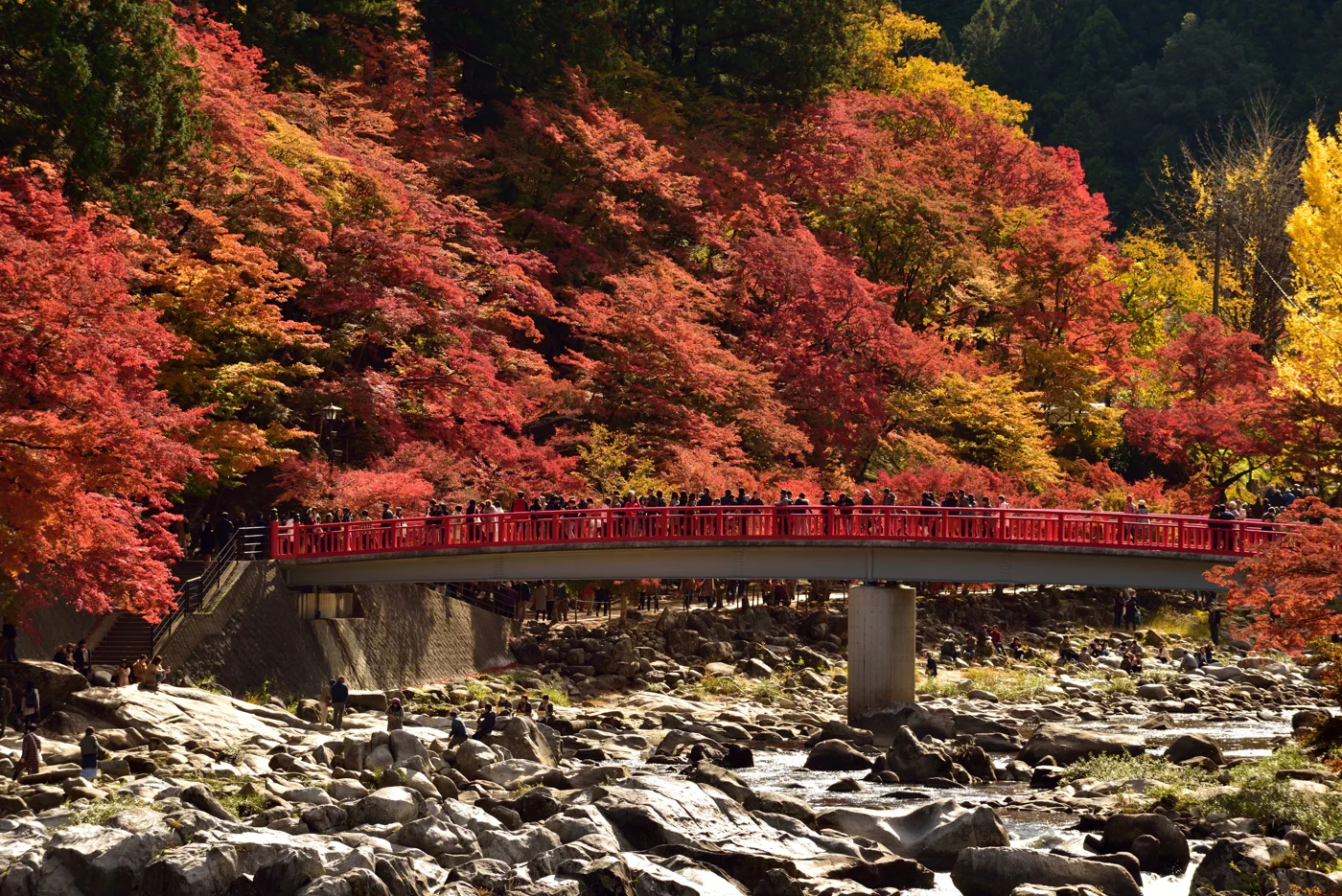
Taigetsukyo and Korankyo are both red, so “the end of the red bridge” is not a useful meeting instruction. The former is a good starting point for the main riverside walk; the latter connects the opposite bank upstream with the direction of Asuke Mura. The official map marks Kawami Chaya and Asuke Mura beside Korankyo, and another bridge, Kunpukyo, beside Asuke Yashiki. Each bridge serves a different part of the route. If you are tired at the plaza, stay near the Yashiki rather than hurrying upstream simply because you have seen a photograph of another red bridge.
Asuke’s historic district is across the national road, along the smaller Asuke River. To move between the Tomoe riverside and the shops beside the Asuke River, use the connecting roads and bridges. Drawing a direct route across the mountain’s foot between two nearby map points can send you the wrong way. Locate Tomoe Bridge, Taigetsukyo Bridge and Korankei Plaza when you arrive. From these, you can follow separate riverside, Yashiki and town routes.
A short riverside route from Taigetsukyo to the plaza, with an easy turn-back point
To save your energy for photographs, cross Taigetsukyo Bridge to the Mount Iimori side and follow the Tomoe River towards Korankei Plaza and Asuke Yashiki. The official map singles out the “five-colour maple” beside the bridge, named for the layers of colour on one tree. Look at nearby leaves, then turn towards the water and opposite bank; there is no need to climb immediately. When the bridge is crowded, cross it before finding a place to stop by the river, so people taking photographs do not block those walking through.
The official map identifies the plaza as an area that colours relatively early because of cool air from the river. Around Korankyo Bridge to the east, morning sunshine also encourages earlier colour. Use these differences to choose your direction that day, rather than expecting the whole mountain to reach the same shade at once. If the leaves near Taigetsukyo are still mainly green, try the plaza and upstream area. After spending time in one place, you can also retrace your steps and watch the light change along the same stretch.
The space in front of Asuke Yashiki makes a useful end point. Have a drink or meal, then return to Taigetsukyo by the same route. Extend to Korankyo only if time and energy allow, to see the water, suspension bridge and another side of the mountain’s foot before returning. Retracing your steps repeats some ground but keeps junctions familiar. This helps groups walking slowly, using a pushchair or needing rest stops. For a different view, take the branch to Kojakuji Temple above the plaza.
Kojakuji Temple: make the gate and grounds your destination
Kojakuji Temple sits at the southern foot of Mount Iimori. The route from the river includes slopes and steps. Its atmosphere and walking effort differ from the riverside, making it a useful uphill detour with a clear end point. To see the gate, temple and autumn leaves, turn back within the grounds and descend for a meal at Asuke Yashiki. This suits visitors happy with a short climb who do not intend to reach the summit.
The planting of maples in Korankei is directly linked to Kojakuji. The tourism association explains that in 1634, Sanei, the temple’s 11th priest, planted maples and cedars along the approach from the Tomoe River. Local residents later continued planting on Mount Iimori. Walking to the temple makes the relationship between the riverside trees and mountain woodland easier to understand. You can follow this history along the approach.
The official 2026 night-time rules allow access to Kojakuji’s grounds, but prohibit entry onto the path from the grounds to the summit after dark. If you visit the temple by day, focus on the river in the evening. If you arrive at dusk, distinguish the summit entrance signs from the temple approach. Groups splitting between the mountain and river can meet at the Yashiki entrance or a named business in the plaza, rather than waiting on a slope or at the temple gate.
Choose a daytime path if you want to climb Mount Iimori
Mount Iimori is 254 metres above sea level. The 2026 park map shows three summit routes: the “Strong Legs Path” near the north side of Taigetsukyo Bridge, the “History Path” via Kojakuji Temple, and the “Prayer Path” towards Ichinotani on the east. There is also a sacred rock at the summit, and the map shows how the routes turn inland from the river. The elevation is modest, but there is still a climb. Grip underfoot, your ability to descend and the daylight remaining matter more than the straight-line distance between map points.
For a first visit that includes the temple, choose the History Path via Kojakuji and descend the same way. You repeat the upper and lower sections, but navigation is simpler and you can decide at the temple whether to continue. Consider ascending one side and descending another only if you are confident on mountain paths and fit enough. Match the descent to your next stop: return south for Asuke Yashiki, or to the northern roads for the town.
An earlier tourism-association hiking report describes a definite gradient on the summit path, and the 2026 map calls the western route the Strong Legs Path. Allow one to one and a half hours for the ascent, summit stop and descent, adjusting to your pace. Add time for riverside crowds and photographs separately. If you start in the afternoon, remove the long town circuit so there is still time to eat and leave after descending. All three summit routes are closed from sunset until early morning. Finish the summit section before then.
Enter old Asuke near Tomoe Bridge and start with a short loop of bridges and lanes
To combine autumn leaves with traditional townhouses, approach the district from Tomoe Bridge and make a small circuit around the permanent lantern, road marker, Naka Bridge and Manrin Lane. The official Asuke Townscape Walking Guide labels its recommended circuit as 30 minutes and the shorter Ina Road circuit as 20 minutes. It also gives a 60-minute long circuit and a 90-minute Asuke River and road circuit. These help you choose the area to cover; add time for shops, building visits and photographs.
The short circuit lets you see both street fronts and the Asuke River without going to the far eastern end. Walk out along the shops, turn through lanes and across bridges to the river, then see rear stone walls and storehouses on your way back towards the lantern. Manrin Lane is in the middle of the district. Nearby Katoya, Ebiya Lane and Naka Bridge help you identify turns. Shops can simply serve as landmarks; go inside if their goods interest you.
After two hours by the river, a small town circuit plus one building open to visitors is a sensible choice. Extend to Asuke Chumakan and the Former Suzuki Residence only if you particularly like architecture and still have enough daylight. There is a walk back from the eastern end to the west, and luggage, pushchairs and shopping bags add to the effort. Leave large bags at your Nagoya accommodation before coming to Asuke to make lanes and townhouse visits easier.
Read the town from both its shop fronts and its riverside backs
Asuke was a trading settlement on the Ina Road linking Owari, Mikawa and Shinshu. Salt was repacked here, giving rise to the names Asuke salt and Asuke-naoshi. Townhouses rebuilt after the great fire of 1775 commonly have plaster walls, tiled roofs and fire-protection features. Some face the road with their roof ridge at right angles to it, known as tsumairi; others have the ridge parallel, known as hirairi. Compare roof directions, upper-storey heights and frontage widths on two or three neighbouring houses to see the variety.
The official architecture guide explains that merchants often filled the street frontage with the main house, then placed reception rooms and earthen storehouses behind it. Valley terrain constrains the levels of plots beside the Asuke River, and some houses stand on several tiers of stone walls. Looking at their backs from a bridge reveals structures very different from the shop fronts. Back on the street, notice how ground-floor shops, spaces beneath the eaves and white walls connect. A short loop through lanes and over bridges lets you see the same row from both sides.
Manrin Lane runs in beside storehouses and stone walls. The tourism association describes its succession of earthen storehouses and depth of about 50 metres. Its scale differs from the main street, so take it slowly. People still live and trade here, and doorways, private interiors and narrow lanes have their own uses. Photograph buildings from public roads and leave space for residents to pass. The official guide explicitly states that private houses on the map are not open for entry; traditional buildings are not all exhibition spaces.
Choose a stop at the Suzuki main house or Chumakan
The Former Suzuki Residence, also called Kamiya Suzuki-ke, is at 20 Honmachi, Asuke-cho. Its main house is free to enter, normally from 10:00 to 16:00 on Fridays, Saturdays, Sundays and public holidays. It opens daily in November and during the Chuma Doll Festival. Visit before 16:00 if you want to see the interior in autumn, leaving the river until later. Photographing Korankei until dusk and then coming here would miss this different view of the town.
The official architecture guide explains that the Suzuki family traded in paper before expanding into brewing, finance and forestry. Compare the main house with the narrow townhouses seen earlier: this was one of Asuke’s representative large merchant households, with a different scale of buildings and land use. Public access centres on the main house; follow the areas open on site. If street exteriors interest you most, return to the Asuke River afterwards rather than adding a series of temples.
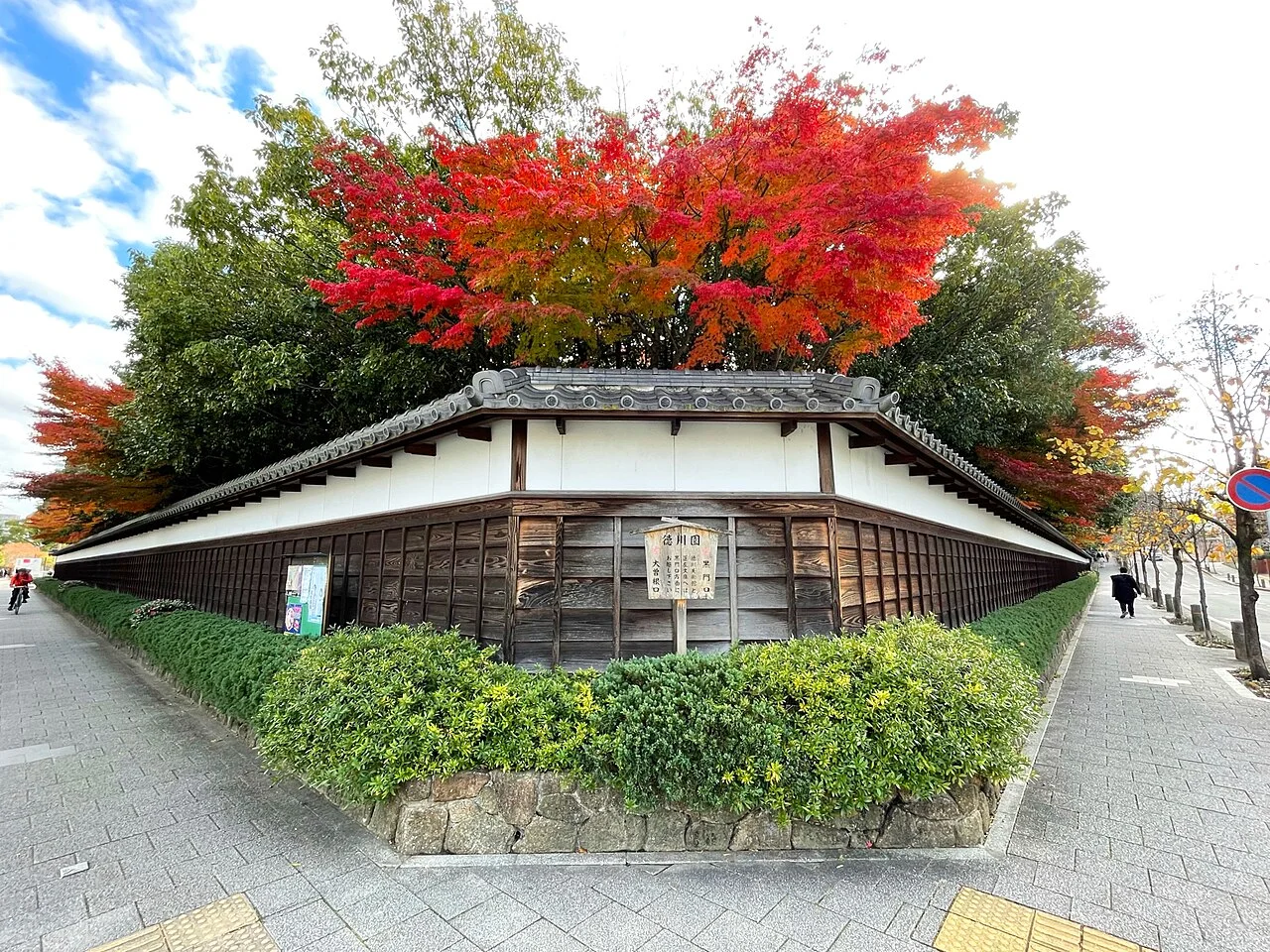
The official town map identifies Asuke Chumakan as the former Asuke branch of Inahashi Bank, built in 1912. It now presents material on commerce, finance, transport and the townscape. Choose it to understand how salt and goods brought prosperity to this mountain settlement; choose the Suzuki main house first if architectural spaces are your interest. Visiting both takes much longer than the recommended 30-minute circuit. Stay in Asuke for lunch rather than compressing every visit to get back to Nagoya to eat.
The 2026 festival also has a DENKEN heritage stamp trail from 31 October to 30 November. Collect stamps at the Former Suzuki Residence, Former Taguchi Residence and Asuke Chumakan to receive an original sticker. All three are free. Published festival hours are 10:00–16:00 for the Suzuki main house, 10:00–17:00 for Taguchi and 9:00–17:00 for Chumakan. With children, start at Suzuki, which closes first, then return via Taguchi and Chumakan. There is no need to fit all three and the summit into one afternoon. Taguchi also displays original Asuke Spring Festival poster artwork and an Autumn Festival folding screen; allow longer if local festival imagery interests you.
Sanshu Asuke Yashiki connects materials, craftspeople and everyday uses
Sanshu Asuke Yashiki, beside Korankei Plaza, recreates mountain farming life from the Meiji period to around 1955. Explore the main house, earthen storehouse, crafts building and individual workshops. The main house has a sunken hearth, straw work and weaving; the storehouse presents Showa-period life and lists umbrella and bamboo work. The crafts building houses dyeing and cooperage, while the papermaking hut beside the waterwheel gives paper production its own space. The focus goes beyond old houses: tools are still used to make household objects.
The Japanese umbrella provides an easy thread to follow. Its ribs are bamboo; the covering uses Mikawa Morishita paper made at the Yashiki, which is treated with oil after attachment. Look first at the bamboo and frame, then visit the papermaking hut and return to the finished umbrellas. This connects several work areas. For children with a short attention span, ask “What materials go into one umbrella?” rather than stopping equally long in every hut.
Another thread is wood and charcoal. The woodturner uses a lathe to make trays and bowls, and the cooper shapes timber into containers. Charcoal from the kiln also roasts coffee at a café associated with the Yashiki. If you like woodwork, spend time on the tools and processes, then have coffee. Craftspeople sometimes leave to gather materials. If a hut is unstaffed, explore another area first; if a particular process is the main reason for your visit, call 0565-62-1188 to ask about that day’s arrangements.
The Yashiki opens from 9:00 to 17:00, with last entry at 16:30. Admission is ¥300 for adults, ¥100 for primary through upper-secondary school pupils, and free for children below school age. It normally closes on Thursdays, or Friday when Thursday is a public holiday, but opens every day in November. Allow 45–75 minutes as a practical itinerary slot, longer if you want to watch processes closely. Hinoki Chaya and Katakago are outside the paid area, so you do not need an admission ticket to eat or take a break there.
Choose workshops by season, age and booking method
The general workshop page lists indigo dyeing, woven bamboo windmills, top painting, weaving and straw sandals, with widely differing durations. A large indigo-dyed handkerchief costs ¥1,300 and takes about 30 minutes; a bamboo windmill costs ¥700 and takes about 30 minutes; top painting costs ¥600 and takes about 30 minutes. These are useful comparisons for family visits outside the festival. Bring an apron and rubber gloves for dyeing. Windmills are mainly intended for primary-school children. Each class has its own capacity, so choose one before arranging your riverside time.
A set of three woven bamboo-strip coasters costs ¥1,650 and takes about 30 minutes, upstairs at Fumon, mainly for primary-school children and older participants. The longer table-runner class takes an hour or more. Straw-sandal making runs from 10:00 to 16:00, requires booking three days ahead and suits adults. Both categories are marked as suspended during the maple festival. For a November foliage trip, plan a visit to craftspeople and buildings instead of reserving an afternoon for a class that is not running.
Gohei-mochi making requires at least five people and booking three days ahead. It stops during the maple festival, Golden Week and Obon. Buying a gohei-mochi rice cake to eat has different conditions from joining a making class. The website also has primary-school educational visits: in 2026, school-group workshops stop from 29 October to 6 December, and group gohei-mochi classes from 22 October to 10 December. Those dates apply to the primary-school field-trip programme. General visitors use the fees and age conditions on the general workshop page.
The general FAQ gives booking priority for dyeing, weaving and windmills, while straw sandals and gohei-mochi require reservations. The end of the general workshop page also states that practical sessions generally stop during the autumn-leaf season from late October to early December. Make craft demonstrations your November focus. Outside the festival, book on 0565-62-1188 or with staff on site; blacksmithing is booked separately with its operator. Indigo dyeing, bamboo work, straw work, bamboo baskets and blacksmithing require an admission fee in addition to the workshop charge. Include both when comparing costs. Bamboo-strip coasters are generally for primary-school children and above, but younger children may participate with parental help if their feet reach the pedals. Families with small children can use that specific condition to decide.
Sanshu Asuke Corporation introduces the Yashiki’s craft activities through its primary-school workshop programme. Watch how the activities work, then choose a general workshop by its age requirements and available sessions.
Eat a meal at Hinoki Chaya and pause by the river at Katakago
Hinoki Chaya stands in front of Asuke Yashiki. Its official menu includes gohei-mochi, salt-grilled sweetfish, mountain-vegetable soba and udon. For a full meal, the Hinoki set combines gohei-mochi, sweetfish, mountain-vegetable noodles and seasonal side dishes. For a smaller stop, choose noodles or a rice cake individually. Bamboo-shoot noodles are listed for spring and nameko mushroom noodles for autumn; use the items displayed that day when ordering. The maple festival has a different menu and prices. The year-round menu introduces the dishes, while festival menu boards determine your budget.
Normal weekday hours are 10:00–16:00, with last orders at 15:30. Weekend and public-holiday hours are 9:00–17:00, with last orders at 16:30. Individual reservations are not accepted, and group bookings are also unavailable during the autumn-leaf season. Eat before entering the town, or around your Yashiki visit, rather than treating it as dinner after the illuminations. Gohei-mochi and sweetfish can be taken away. Eating and drinking are prohibited inside the museum; use available riverside or plaza seating to keep your route on the same side.
Katakago is a charcoal-roasted coffee shop. Its official description says beans are roasted on site using charcoal made at the Yashiki. It also lists coffee with milk, tea, apple juice, a yuzu drink and cake. This can be a coffee meeting point for those returning from the mountain and town. Normal weekday hours are 9:30–16:30, with last orders at 16:00; weekends and public holidays are 9:00–17:00, with last orders at 16:30. A river-view terrace is one seating option. See what is available on arrival before deciding whether to sit down or take away.
Two daytime sequences: visit buildings before daylight runs out
For a daytime trip, spend the morning at Taigetsukyo Bridge, the river and Kojakuji Temple. Eat in front of the Yashiki at lunchtime, then explore Asuke’s streets and the Suzuki main house before returning to the station or car park. This handles the more demanding slopes first and fits meals into business hours. If you arrive late in the morning, retain the river and one indoor visit: choose the Yashiki or Suzuki house, leaving the other for another trip rather than rushing lunch and every visit.
If townhouses are your priority, reverse the order. Explore Asuke’s streets, the main house and the backs of riverside buildings first, eat at Hinoki Chaya, then visit the Yashiki and Korankei in the afternoon. The Former Suzuki Residence normally opens Friday to Sunday and on public holidays, and daily in November and during the Chuma Doll Festival. On other closed days, look at street exteriors or spend longer in the Yashiki. Let actual opening hours determine the order.
For a summit day, climb Mount Iimori in the morning, eat at the foot, then choose either Asuke Yashiki or a short town circuit. By afternoon your feet and legs will already have done considerable work; another 90-minute old-town circuit may offer less than an extra twenty minutes in a workshop. Non-climbers can visit the Yashiki first and meet the others for lunch, then decide together where to go next. This serves individual interests better than making everyone tackle the same mountain path.
For evening leaves, eat and descend before returning to the river for the lights
If staying for the illuminations, prioritise the Suzuki main house before 16:00, entry to the Yashiki before 16:30 and teahouses whose last orders fall in the afternoon. Descend from the summit before sunset too. Return to Taigetsukyo Bridge and the plaza at dusk for the mountain lights, using the daytime walk as familiar ground after dark. If you have already seen the eastern suspension bridge, decide whether to return based on your departure direction; there is no need for a long photographic detour.
In 2026, Kojakuji Temple’s bamboo lanterns run from 18:00 to 20:30 on Saturdays and Sundays from 1 to 29 November. They do not run on the public holidays of 3 and 23 November, and are cancelled in rain. Add the temple as an evening stop if you want to see them, separately from the riverside mountain views. On Saturdays and Sundays from 7 to 29 November, wishing candles also take place during the same hours on the right bank of the Tomoe River below Nishimachi No. 2 Car Park; access to the riverbank may be restricted. These date-specific events are separate from the nightly Mount Iimori illuminations throughout the month. Taking the 18:08 return bus to Josui leaves time mainly for the first riverside lights, rather than a full bamboo-lantern visit.
The festival announcement gives 2026 hours for the knife-cut noodle stall: 11:00 with last orders at 16:00 on 31 October, then 11:00 with last orders at 20:45 from 1 to 30 November. This is a dinner option separate from the daytime hours of Hinoki Chaya and Katakago. If eating hot food after the lights, put the food stop and bus stop on the same exit route. Sitting down to eat and then going back to find companions uses up the margin before the last bus.
The illuminations end at 21:00. Bus passengers must leave the river early enough for that day’s last service, including the walk to the stop and queueing time. There is normally a 21:08 return to Josui on weekdays, but weekends and the three-day holiday require earlier departures. To stay later, arrange a car or accommodation within walking distance. Do not use the three summit paths closed at night as shortcuts. Return along the riverside and proper roads you identified during daylight.
Choose 2026 buses by date: Josui services finish early over the three-day holiday
From Nagoya, change to a bus at Josui, Toyotashi or Higashi-Okazaki. There is no direct Yakusa–Korankei service in 2026. Beyond these three approach directions, the final sections of November routes vary by date. The tourism association’s access page supplies the Josui Oiden timetable and separate Meitetsu timetables for dates through 13 November and from 14 November. Read your travel date, arrival stop and return boarding direction together to determine where the riverside walk starts and when it must finish.
On 14, 15, 28 and 29 November, some daytime services from Josui terminate at Asuke Ohashi bus stop, marked with red boxes in the official timetable. Korankei is then about ten minutes away on foot; those buses do not serve Asuke Hospital or stops from Korankei onwards. Changes are greater over the three-day holiday of 21–23 November: blue services run only between Josui and Nishinakagane, so you cannot use them to reach or board at Korankei. The last Korankei–Josui return is at 18:08. For a Josui round trip on these dates, choose daytime scenery or only a short spell of early-evening lights.
The same Josui timetable lists a 21:08 return from Korankei on normal weekdays and a final 20:12 service on normal weekends and public holidays, with the 18:08 three-day-holiday exception. For 21:08, leave your photography spot before the lights go out and reach the stop early. November holiday traffic can push road journeys beyond two hours. Do not connect to a fixed-time long-distance train or flight after returning to Nagoya. Waiting is part of the day’s physical effort too; joining a long queue late increases fatigue.
In Meitetsu’s 14–30 November timetable, the last Korankei–Toyotashi service is 20:40 on weekdays and 17:40 on weekends and public holidays. For Higashi-Okazaki, the last is 18:48 on weekdays and 15:50 on weekends and public holidays. These evening options differ substantially. Even when staying in Nagoya, a weekend arrival via Higashi-Okazaki suits an early departure. Use the separate earlier timetable for 1–13 November rather than copying second-half times. Set your latest riverside departure before the bus time, then allocate the remaining daylight to the Yashiki and town.
Plan wheelchair access, pushchairs and payment before leaving
The Yashiki FAQ offers wheelchair loans at the admission desk; Miyamachi Car Park also has wheelchairs. A companion must help with entry. Accessible toilets are on the right side of the Korankei Plaza toilet building, at Miyamachi Car Park and at Nishimachi No. 2 Car Park. If someone needs these facilities, centre the route on Miyamachi, Taigetsukyo Bridge, the plaza and Yashiki, leaving the Kojakuji steps and summit to others. Meet at a named business after splitting up to reduce repeated climbs and descents.
Vehicles cannot enter the grounds. You still have to reach the entrance from Miyamachi or Kawami Car Park, so include the walk after parking even when driving. With a pushchair, a riverside walk with the option to turn back is easier to manage than crossing mountain paths. Save the official map’s toilets and rest points offline so you can find the closest when someone needs a break.
Asuke Yashiki admission accepts cash or PayPay. Goods, shops and food outlets also offer credit cards and some electronic payments. Overseas visitors should carry enough yen cash to pay for tickets directly. Coats and shopping bags add weight later in the day; buy souvenirs shortly before leaving.
A few useful answers
Do I need to climb Mount Iimori for a riverside visit to Korankei?
No. Walk from Taigetsukyo Bridge along the river to Korankei Plaza and the front of Asuke Yashiki, then retrace your steps for a short route with a clear turn-back point. Kojakuji Temple and the summit are separate uphill additions.
Can I join weaving or gohei-mochi workshops at Asuke Yashiki in November?
The general workshop page states that sessions generally stop during the autumn-leaf period from late October to early December. Weaving, straw sandals and gohei-mochi also have festival suspension notices. Plan November around craftspeople and buildings, adding only a specific class separately confirmed by its operator.
Can I stay until the 21:00 lights finish on a Josui round trip over the 2026 three-day holiday?
From 21 to 23 November, the last Korankei–Josui bus is at 18:08. Plan daytime scenery or only the first evening lights. Staying until 21:00 requires another arranged way home or nearby accommodation.
Are any buildings in old Asuke free to visit?
The Suzuki main house is free and opens from 10:00 to 16:00, normally Friday to Sunday and on public holidays, and every day in November.
Official information and references
Sources used in this guide.
- Asuke Tourism Association: 71st Korankei Maple Festival, 1–30 November 2026
- Asuke Tourism Association: 2026 autumn sightseeing map
- Asuke Tourism Association: Asuke townscape walking map
- Toyota City: Asuke walking guide, history and architecture
- Toyota City: Asuke walking guide, townhouses and riverside
- Asuke Tourism Association: walking the protected historic townscape
- Tourism Toyota: Former Suzuki Residence (Kamiya Suzuki-ke), Important Cultural Property
- Sanshu Asuke Yashiki
- Sanshu Asuke Yashiki: about the museum
- Asuke Yashiki: traditional crafts and livelihoods
- Asuke Yashiki: hands-on workshops
- Asuke Yashiki: food and drink
- Asuke Yashiki: frequently asked questions
- Asuke Yashiki: school visits, integrated learning and excursions
- Asuke Tourism Association: transport and access
- Asuke Tourism Association: November 2026 Oiden bus timetable
- Asuke Tourism Association: 2026 Meitetsu timetable through 13 November
- Asuke Tourism Association: 2026 Meitetsu timetable, 14–30 November
- Tourism Toyota: Korankei and Asuke feature