Plan your 2026 autumn night visit to Kyoto's Kodai-ji Temple: illumination dates, projection mapping hours, tickets, the Entoku-in combo pass, and a seamless Higashiyama walking route from Kiyomizu-dera to Nene-no-Michi.
- Region & Focus
- KyotoShrines and temples
- Reading Scope
- 21 min read · 12 chapters · 7 Q&As
- Official Verification
- 20 official sources checkedUpdated November 22, 2026
- Key Topics
- ItinerariesSeasonsKyoto, Osaka & Kansai
Chapter Route Map (tap any stop)
- When to Arrive for the 2026 Kodai-ji Night Visit
- Choosing Between Kodai-ji Single Tickets and the Entoku-in Combo Pass
- Getting Your Bearings: Kodai-ji's Two Ponds and Grounds Map
- Nene, Kangetsudai, and the Otamaya Mausoleum
- Entoku-in: Rock Gardens by Afternoon, Lit Foliage by Night
- Sho Museum on the Street: Longer Run Than the Lights
- Timing Peak Foliage with the Projection Mapping Schedule
- Walking to the Gate from Kyoto Station, Gion-Shijo, or Kawaramachi
- Daytime Kiyomizu-dera, Evening Kodai-ji: One Continuous Higashiyama Route
- Pacing Tips When Traveling with Kids or Older Relatives
- Arriving Early? Ryozen Kannon Sits Just Above Daidokoro-zaka
- Where to Go Along Nene-no-Michi After You Exit
- Quick Q&A
To see Kodai-ji Temple's Kyakuden (Guest Hall), pond gardens, and night projection mapping in a single visit during autumn 2026, arrive before 4:30 PM to tour the hall and stay inside until the lights turn on at 5:00 PM. The autumn night illumination runs from October 23 to December 13, with last admission at 9:30 PM, closing at 10:00 PM, and adult tickets priced at ¥800. Just across Nene-no-Michi, Entoku-in Temple also opens after dark. An adult combination ticket for both temples costs ¥1,200—except on December 11 and 12, when Entoku-in is closed and you only need a single ticket for Kodai-ji.
When to Arrive for the 2026 Kodai-ji Night Visit
During the 2026 extended autumn season, Kodai-ji opens as usual at 9:00 AM and switches on the illuminations at 5:00 PM. Visitors who enter during the day can simply stay on the grounds; arriving in the late afternoon lets you catch dusk over the gardens and tour the temple interiors before dark. Because the Kyakuden (Guest Hall) closes at 4:30 PM, head there first upon entry, then follow the marked route past the Hojo front garden, the ponds, and Kaisando Hall. Illuminations begin at 5:00 PM and the ticket gate closes at 9:30 PM, leaving late arrivals until 10:00 PM to exit. Give yourself at least 30 minutes before closing if you want to linger over the pond reflections and watch a full projection cycle.
Kodai-ji does not clear the grounds between daytime and evening sessions during the autumn run. Once inside, do not step out of the exit gate to grab a drink, fetch camera gear, or visit another temple—re-entry on the same ticket is not permitted. Eat before entering if you want dinner prior to the lights coming on, or enter around 4:00 PM and eat afterward so your daytime walk flows straight into the illuminated route. One Kodai-ji ticket covers both the lighting and the projection mapping.
On regular days outside the autumn event, Kodai-ji is open from 9:00 AM to 5:30 PM with last admission at 5:00 PM. After the illumination season ends, you can still stroll along Nene-no-Michi before dinner, but temple visits must happen during daylight hours. If your trip extends into mid-December, plan your night foliage visit for December 13 or earlier and save Higashiyama for an afternoon walk later in the week. Kodai-ji also holds seasonal openings in spring and other times of year; check the temple's current Events ("Saiji") calendar for exact dates matching your travel year.
Time your arrival around what matters most to you. Architecture buffs interested in the Momoyama period should work backward from the 4:30 PM Kyakuden cutoff to time their arrival at Higashiyama Yasui. If members of your group are elsewhere during the day and you head over after dinner, budget at least an hour to move through the projection mapping, pond views, and bamboo grove—plus extra buffer time for ticket lines and composing photos.
Plan your 2026 autumn night visit to Kyoto's Kodai-ji Temple: illumination dates, projection mapping hours, tickets, the Entoku-in combo pass, and a seamless Higashiyama walking route from Kiyomizu-dera to Nene-no-Michi.
Choosing Between Kodai-ji Single Tickets and the Entoku-in Combo Pass
Effective April 1, 2026, Kodai-ji admission is ¥800 for adults, ¥400 for junior high and high school students, and ¥700 per person for adult groups of 30 or more. The bamboo grove sits inside the paid temple grounds and is included along the main walking circuit. Elementary school students and younger enter free when accompanied by an adult, provided there is at least one adult chaperone for every five children. Visitors holding a Japanese disability certificate (shogaisha techo) receive free entry for themselves and one accompanying caregiver upon presenting the certificate at the entrance.
Entoku-in charges ¥500 for adults and ¥200 for junior high and high school students. Buying both temples separately costs ¥1,300 per adult, while the adult combination ticket is ¥1,200—a ¥100 savings. Per Kodai-ji's revised fee notice, there is no combination ticket for junior or senior high students, who pay ¥600 combined across separate tickets. Entoku-in follows the same rule of free entry for elementary schoolers and younger with at least one adult per five children. Calculate per person when buying: two adults and one junior high student visiting both temples will need two adult combo passes plus individual student tickets at each gate.
You can wait until you reach the first temple gate to decide on the combo pass. If you have a full late afternoon and early evening before dinner, touring both gardens makes the combo worthwhile; if you only have time for Kodai-ji's pond garden and projection mapping, stick to the single ticket. Note that the Kyoto City Tourism Association lists Entoku-in as closed on December 11 and 12 due to temple affairs—on those two days, tour Kodai-ji's Kyakuden in the afternoon and stay for the night lights. Entoku-in accepts cash only for admission, matcha experiences, and temple charms, so bring enough yen rather than hunting for an ATM across the street.
On regular days, Entoku-in opens at 10:00 AM, stops admission at 5:00 PM, and closes at 5:30 PM, with the temple estimating a 30-minute visit. During the autumn night event, evening hours run from 5:00 PM with last admission at 9:30 PM and closing at 10:00 PM, with no daytime-to-nighttime clearing. When visiting both temples back-to-back, block out that 30-minute minimum for Entoku-in plus extra time for crossing Nene-no-Michi, climbing steps, and finding the gates. Tickets are checked separately at each temple, so keep the combo pass handy. If an unexpected detour cuts your time short, finish the temple you have already entered rather than rushing through both.
Getting Your Bearings: Kodai-ji's Two Ponds and Grounds Map
Open the Kodai-ji grounds map before stepping through the gate; the two most helpful landmarks are Engetsu Pond and Garyu Pond. Kaisando Hall stands between the two ponds, right beside the Hojo front garden, and the bamboo grove lies along an internal path inside the walls. The map marks the entrance and exit separately—even though they look close together on paper, they are separated by compound walls and a one-way route. Walking up from Nene-no-Michi, look for the Admission Desk ("Haikan Uketsuke") or Entrance sign; if you spot the exit sign first from the street, keep following the perimeter wall toward the main entrance.
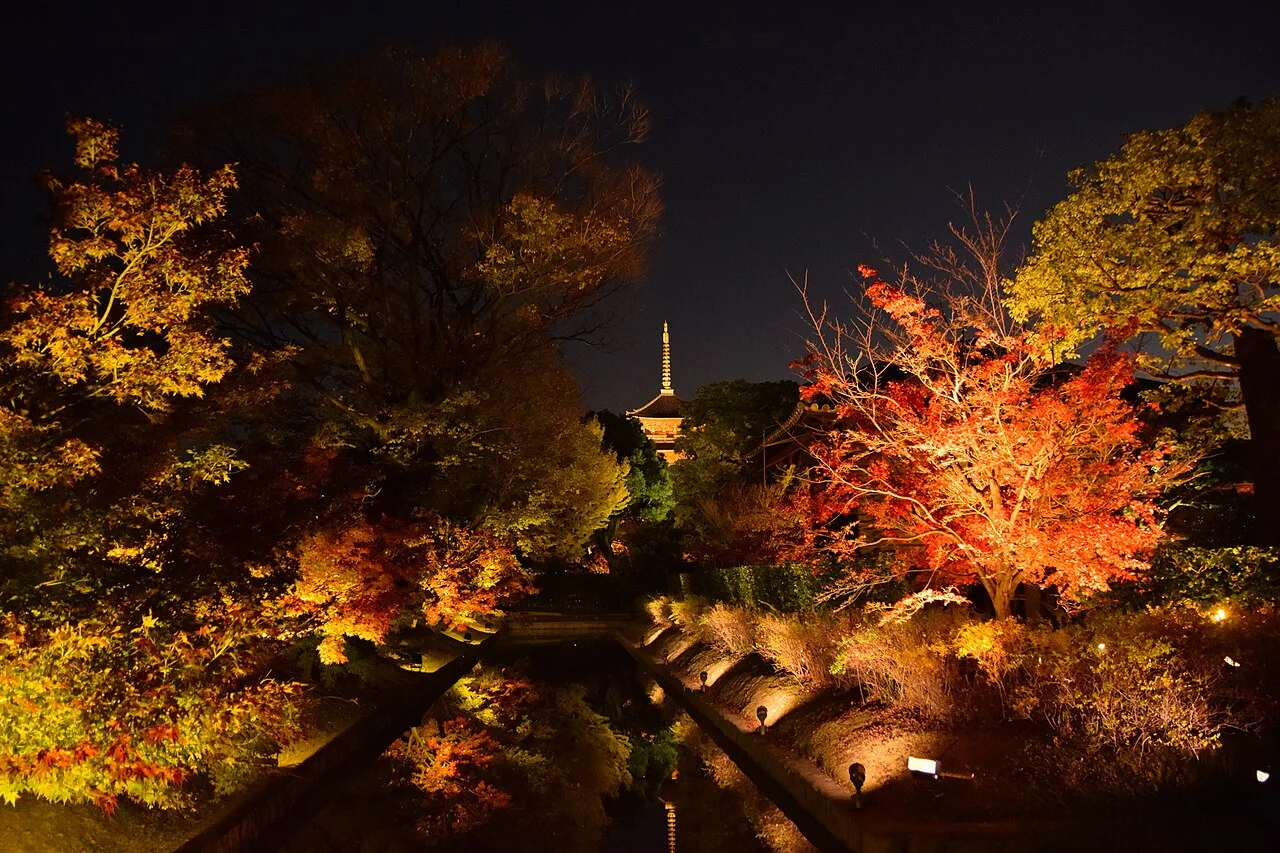
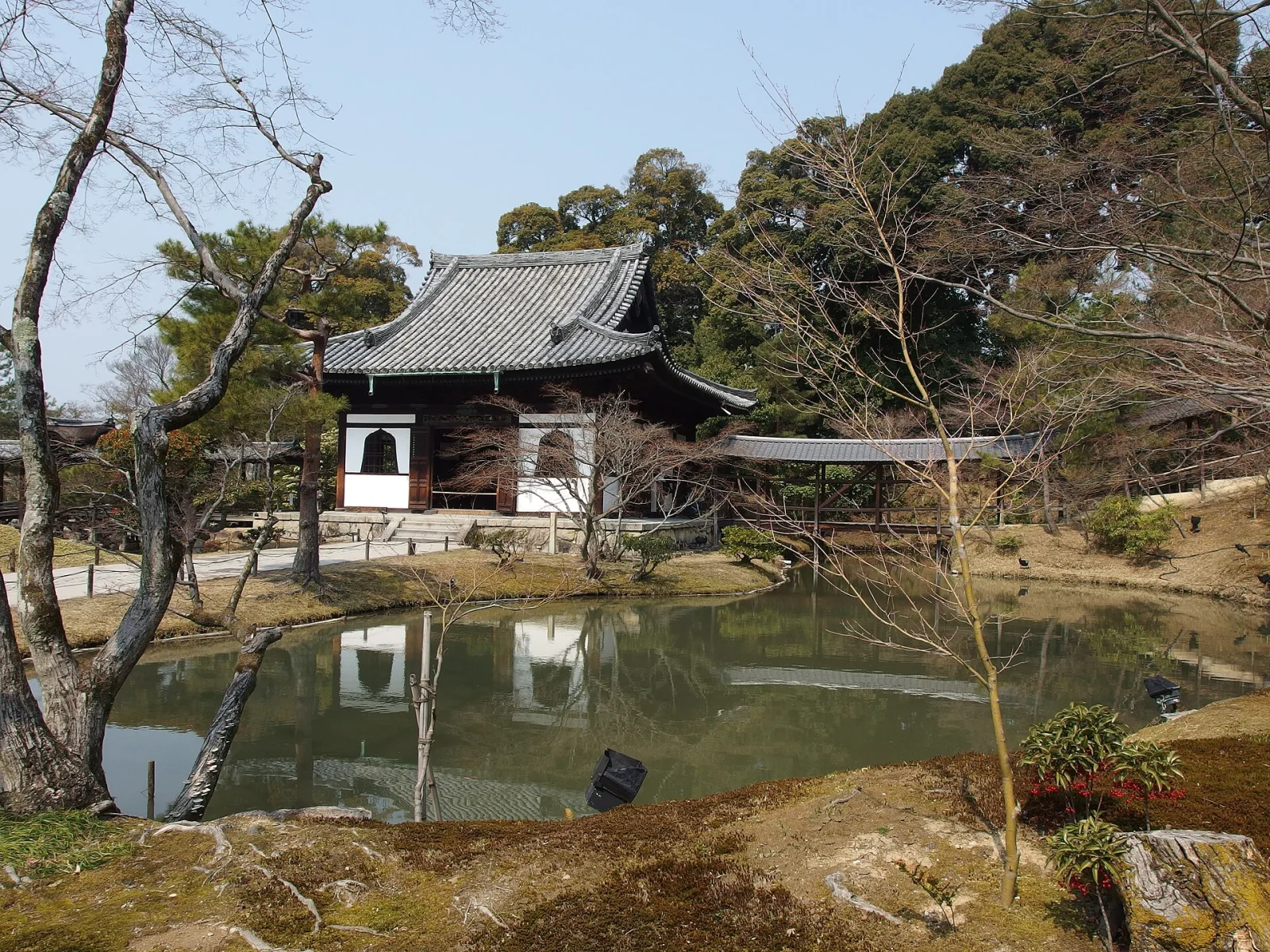
Around Kaisando Hall, notice how the wooden structures bridge the water. Looking toward Engetsu Pond from the bank, the Moon-Viewing Pavilion (Kangetsudai) jutting over the water and the trees behind it frame both sides in a single view; turning toward Garyu Pond brings the opposite rooflines and foliage into the reflection. In daylight, it is easy to trace the rock arrangements, pond edges, and two covered walkways linking the halls. At night, bright lighting pulls your eye first along the open pathways. Give your eyes a moment to adjust to the dark, then look at the lit windows and water reflections to distinguish architectural lighting from shoreline uplights.
The raked-gravel dry garden in front of the Hojo is called Hashin-tei. By day, its appeal lies in the white sand patterns, stones, and the open space framed against the wall. For the 2026 autumn nights, the Kyoto City Tourism Association notes that projection mapping plays across this Hojo front garden. Before the show starts, scan the garden's normal boundaries so you can see how the visuals interact with the gravel and walls once the projectors fire up. Because the projections, pond reflections, and lit bamboo grove sit along different stretches of the route, budget enough time for the full loop even if you came mainly for the light show. When crowds build, follow the marked standing zones and keep a lane open for others passing by.
The Garyuro (Sleeping Dragon Corridor) connects Kaisando Hall to the Otamaya (Mausoleum) higher up the slope. From the pond edge, follow the roofline to see how the covered walkway climbs the hillside behind the hall. Higher up sits the Otamaya area tied to Nene, along with the Kasatei and Shiguretei teahouses. The most rewarding stretch to slow down is often where the Hojo front garden transitions toward the ponds. Dim your phone screen brightness as you leave the projection area so you can pick up the subtle color shifts in the water reflections. When you reach the bamboo grove, put the phone away for a moment and look up—only then do the tall stalks and hillside drop-off read as a whole.
Nene, Kangetsudai, and the Otamaya Mausoleum
In 1606, Kita no Mandokoro Nene—widow of Toyotomi Hideyoshi—founded Kodai-ji to pray for her late husband's soul. According to temple records, Tokugawa Ieyasu helped fund construction, and in 1624 the monk Sanko of Kennin-ji became the founding abbot. Several surviving buildings anchor that history on the grounds: the former private worship hall is now Kaisando Hall, and Kangetsudai along with the Kasatei and Shiguretei teahouses are designated Important Cultural Properties of Japan. Rather than memorizing building names in chronological order, pull up the temple map after leaving the Hojo garden and locate Kaisando Hall between the two ponds to orient yourself immediately.
The Otamaya enshrines both Hideyoshi and Nene, and temple records state that Nene is buried beneath her wooden statue there. Its altar dais and shrine doors feature lacquerwork decorated with gold powder and motifs—the actual pieces behind the renowned "Kodai-ji Maki-e" style. Passing by at night, pause outside to take in the dark timber silhouettes against the hillside slope. If lacquerware and temple treasures are your priority, visit the indoor Sho Museum before dark. Travelers in mixed groups who want to inspect the architecture while companions prefer a casual stroll can split up and reconvene at the base of Daidokoro-zaka Slope on Nene-no-Michi.
Kasatei's high, umbrella-like roof and Shiguretei's two-story teahouse structure are best appreciated in daylight. Even if the active walking path differs slightly from the brochure map on the day of your visit, staying on the open trail gives clear sightlines to how both teahouses sit against the hillside. Short on time, focus on Kaisando Hall, Kangetsudai, and the Otamaya for the temple's founding story, then let the Hojo and bamboo grove connect it to the landscape. Visitors who find hills tiring can stick to the lower pond area to view the halls and corridors before following the open signs to the exit.
Collectors of goshuin (temple stamps) have three places to check at Kodai-ji. The grounds map separately marks the Kodai-ji Admission Desk, the Kodai-ji Tenmangu Shrine counter, and Risho-do Hall, each offering distinct stamps. If you want the main Kodai-ji temple stamp, ask at the Admission Desk right beside the entrance when you arrive, as the exit leads directly back down the hill. To locate Tenmangu Shrine and Risho-do Hall, look west of the parking lot. Built in 2016 as a worship hall, Risho-do houses a Nirvana mural modeled on a Nanboku-cho-period painting in the temple's collection, serving a different devotional role from the Otamaya enshrining Hideyoshi and Nene.
Entoku-in: Rock Gardens by Afternoon, Lit Foliage by Night
Just across Nene-no-Michi at 530 Shimokawaracho, Higashiyama Ward, stands Entoku-in, a subtemple of Kodai-ji where Nene spent the final 19 years of her life. Stepping past the Nagayamon Gate, the visit splits into the South Garden and the North Garden. For anyone who enjoys Japanese gardens, an afternoon visit gives you room to compare the two styles rather than rushing through before closing. Start with the raked white gravel lines of the South Garden, then walk toward the North Garden, where the scene shifts to massive rock clusters, stone bridges, low mounds, and moss-covered ground.
According to Entoku-in, the North Garden was relocated from the front courtyard of Kita no Mandokoro's residential quarters at Fushimi Castle, originally designed by master gardener Kentei and later refined by Kobori Enshu. The temple classifies it as a dry landscape garden in the style of a strolling pond garden. Spot the thick stone bridge spanning what reads like a stream, then trace the rock formation to a dry waterfall—waterless ground where carefully placed boulders preserve the interplay of creek and bridge. In daylight, your eyes follow the long sweep of stone from the open viewing veranda; after illumination, lit rock faces stand out against leaf shadows, sharpening the spacing between each boulder group.
Art lovers should watch for the sliding-door paintings (fusuma-e) attributed to Hasegawa Tohaku. Entoku-in holds fusuma panels painted on paulownia-crest karakami paper, and the Kyoto City Tourism Association notes that the panels on public display are reproductions. Pairing the artwork with the gardens works well in one continuous pass: study the ink-painted trees on the interior doors first, then step out to the South Garden to see living branches beside raked gravel. If you are following Hideyoshi's story, also look for the Sanmen Daikokuten (Three-Faced Daikokuten) shrine marked by the temple, combining Daikokuten, Benzaiten, and Bishamonten—an image tied to legends of Hideyoshi's early prayers for success.
Plan a daytime visit if you want to sit beside the North Garden with a bowl of matcha. Entoku-in serves Raku-ware matcha tea from 10:30 AM until last order at 4:00 PM for ¥800 or ¥1,000 depending on the sweet pairing, separate from temple admission. On Saturdays, Sundays, and Japanese national holidays, a ceremonial tea presentation (kencha-temae) is held in the small tea room for ¥2,500 per person (about 20 minutes; groups of 10 or more must reserve by phone). Factor in extra sitting time beyond the temple's 30-minute visit estimate if you want tea, and move your tea break earlier in the afternoon if you still plan to catch Kodai-ji's Kyakuden before 4:30 PM.
During the 2026 autumn night season, Entoku-in also holds a special display of the Toyotomi family's Teikanzu folding screens, running from 10:00 AM until 9:30 PM last admission (closing at 10:00 PM). Think about how you want to balance light across both temples: if your priority is studying the indoor screens and North Garden stonework clearly, visit Entoku-in in daylight and save Kodai-ji for the illuminations. If you start late in the evening, put whichever temple matters more first—Kodai-ji first for projection mapping and pond reflections, or Entoku-in first for its lit North Garden and folding screens. Both gates stop admitting visitors at 9:30 PM, so do not count on either temple as a backup after that cutoff.
Sho Museum on the Street: Longer Run Than the Lights
Located on the second floor of Kyo-Rakuichi Nene along Nene-no-Michi, the Sho Museum has a separate street-level entrance from Kodai-ji. Its special exhibition of Daizuigu Bosatsu runs from September 5, 2026, through January 27, 2027, and entry is included with your Kodai-ji admission ticket. Normally housed inside the central altar of the Otamaya, this Buddhist statue is accompanied by Nene's One Thousand Jizo statues, along with Hideyoshi's hardwood walking stick and vermilion-lacquered shoes listed in the museum catalog. Seeing the scale and craft of these objects up close adds context to the temple halls you cannot fully make out under night lighting. The museum is closed on December 30, 2026, and from January 28 to 31, 2027, for exhibition changeover.
Regular museum hours are 9:00 AM to 5:10 PM (last admission at 5:00 PM), extending during the night illumination period to 9:10 PM (last admission at 9:00 PM). If you plan to stay inside Kodai-ji for the lights, ask at the ticket counter how to coordinate visiting the museum across the street with your temple entry. Because leaving Kodai-ji forfeits re-entry on the same ticket, visiting the museum before entering the temple is the easiest way to see both. If you are already inside Kodai-ji, finish the illuminated loop first, exit, and make sure you reach the museum before its 9:00 PM last admission.
Timing Peak Foliage with the Projection Mapping Schedule
According to the Kyoto City Tourism Association, Kodai-ji's autumn leaves typically peak from mid-to-late November. Because the 2026 illumination runs from late October through mid-December, the lights stay on well beyond the core foliage window. Pull up Kyoto City's Autumn Foliage Report ("Momiji Dayori") page for Kodai-ji alongside the temple's event calendar: one tracks leaf color while the other confirms night admission dates. If one person in your group wants peak foliage photos and another wants to see the projection mapping, lock in dates within the overlap window first, then pick your exact evening based on the latest foliage updates. With two flexible evenings in Kyoto, keep one open until Kodai-ji posts fresh leaf conditions.
After an evening rain, stone paving turns slick—good shoe traction and watching the steps matter far more than packing an extra lens. Garyu Pond throws sharp reflections when the water is still; if a breeze ripples the surface, pivot to shooting the lit corridor roofs and glowing shoreline trees. In the bamboo grove, tilt your frame upward along the stalks and step into a wide pull-off along the path before stopping to compose. Put your camera or phone away before walking down any stairs rather than reviewing shots on the move. Smartphone night modes often require holding steady for a few seconds, so plant both feet firmly before choosing a single clean frame.
For a garden-focused Higashiyama half-day, arrive early on a clear morning to see the pond edges, tree branches, and Kaisando Hall eaves in natural light. If you have already hit several night illuminations elsewhere in Kyoto over the weekend, save Kodai-ji for daytime so you can take in the raked sand patterns, hillside teahouse paths, and twin ponds clearly. Even late in autumn when only scattered leaves remain, the evergreens, bamboo, and timber walkways carry the scene. If you only have one night to dedicate to autumn illuminations in Kyoto, check our Kyoto autumn night illumination comparison to pick the right neighborhood and cut down on cross-town backtracking.
Walking to the Gate from Kyoto Station, Gion-Shijo, or Kawaramachi
From Kyoto Station, Kodai-ji recommends Kyoto City Bus 206 bound for Higashiyama; get off at Higashiyama Yasui and walk uphill to the east for about 7 minutes. If you are aiming to beat the Kyakuden cutoff, add bus wait times, traffic, and ticket lines on top of that uphill walk. On the Keihan line, the Kyoto City Tourism Association estimates a 15-minute walk from Gion-Shijo Station; from Hankyu Kyoto-Kawaramachi Station, figure roughly 20 minutes. Exit toward the Kamo River and Gion, walk east along Shijo-dori to Yasaka Shrine, and turn onto Nene-no-Michi—glancing back at street signs makes it easy to tell whether you are still on Higashioji-dori or already on the pedestrian lanes climbing toward the hills.
The 7-minute walk only applies to the final stretch from the Higashiyama Yasui bus stop up to the temple gate. If you are already near Shijo-dori by train, walking straight there skips a bus transfer altogether. Drop large suitcases at your hotel, station lockers, or luggage storage before heading up, as the final approach from Nene-no-Michi to Kodai-ji involves slopes and stone steps. Kyoto City's Gion & Kiyomizu Tourism Comfort Map tracks hourly crowd forecasts from Kiyomizu-zaka through Nene-no-Michi—use it to schedule uphill walks, placing snack breaks or shopping during peak windows and saving viewpoints and photos for quieter hours.
When traveling with toddlers or companions with sensitive knees, build in a natural turn-back point. Stroll flat along Nene-no-Michi to Daidokoro-zaka Slope, size up the stone steps leading up to the temple, and decide whether everyone is up for the climb that night. Kodai-ji's grounds map clearly marks the hillside path from the Hojo toward the teahouses and bamboo grove. Visitors needing to avoid stairs or using a wheelchair should ask staff at the gate to mark accessible routes and exits on the map before buying tickets. If older family members want a garden view after a long day without tackling steep climbs, Entoku-in's street-level entrance and shorter loop make an easier standalone stop, though you should still check at the door for interior step heights and accessible areas.
Drivers can enter the parking lot on the south side of Kodai-ji; it is open 24 hours with a 2.3-meter height clearance for passenger vehicles. Standard rates are ¥600 for the first hour and ¥300 for every 30 minutes thereafter. Parking in the temple's Kodai-ji Parking Lot grants 1 hour of validated parking for a single visit to Kodai-ji or Entoku-in, or 2 hours with the combo ticket—mention your car and show your parking ticket when buying admission. Complimentary passes and free disability-certificate entries do not qualify for parking validation. If you plan to have dinner in Higashiyama afterward, weigh the extra parking fees against the walk back to the lot.
Heading back after the visit, walk down to Shijo-dori to catch the Keihan line at Gion-Shijo, or return to Higashiyama Yasui to board a southbound bus toward Kyoto Station—double-check which side of the street serves your direction. For taxis or rideshares, walk downhill to Higashioji-dori for an easy, recognizable pickup spot on a main road. If your group splits up inside, do not rely on a vague "meet at Kodai-ji," since people entering and people exiting end up on opposite sides of the wall; pick a street-side landmark instead, such as the corner where Daidokoro-zaka meets Nene-no-Michi.
Daytime Kiyomizu-dera, Evening Kodai-ji: One Continuous Higashiyama Route
For a first visit to Higashiyama with only one evening, walk north from Kiyomizu-dera. Head up Kiyomizu-zaka during the day to tour Kiyomizu-dera's Main Hall and wooden stage, stroll back down Sannenzaka and Ninenzaka, catch a street view of Hokan-ji's five-story pagoda along Yasaka-dori, and continue onto Nene-no-Michi. Knock out souvenir shopping and cafe breaks along this stretch, save Kodai-ji for dusk and after dark, and exit north past Maruyama Park and Yasaka Shrine back to Shijo-dori. Putting the temples, historic lanes, and train stations in one straight line keeps you from climbing Kiyomizu-zaka twice.
If Nene's later life interests you most, enter Higashiyama earlier from the Gion or Yasaka Shrine side. Walk through Maruyama Park onto Nene-no-Michi, tour Entoku-in's North and South Gardens first, and cross the street in the afternoon for Kodai-ji. That pacing also suits solo travelers who want time to read the temple plaques unhurried, with room to sit for a break between the two temples. Just remember to factor in the climb up the steps across the street if you want to reach Kodai-ji's Kyakuden before 4:30 PM. Friends who only want the night projection mapping can split off earlier and meet at the foot of Daidokoro-zaka, or dine together after everyone finishes the illuminated loop.
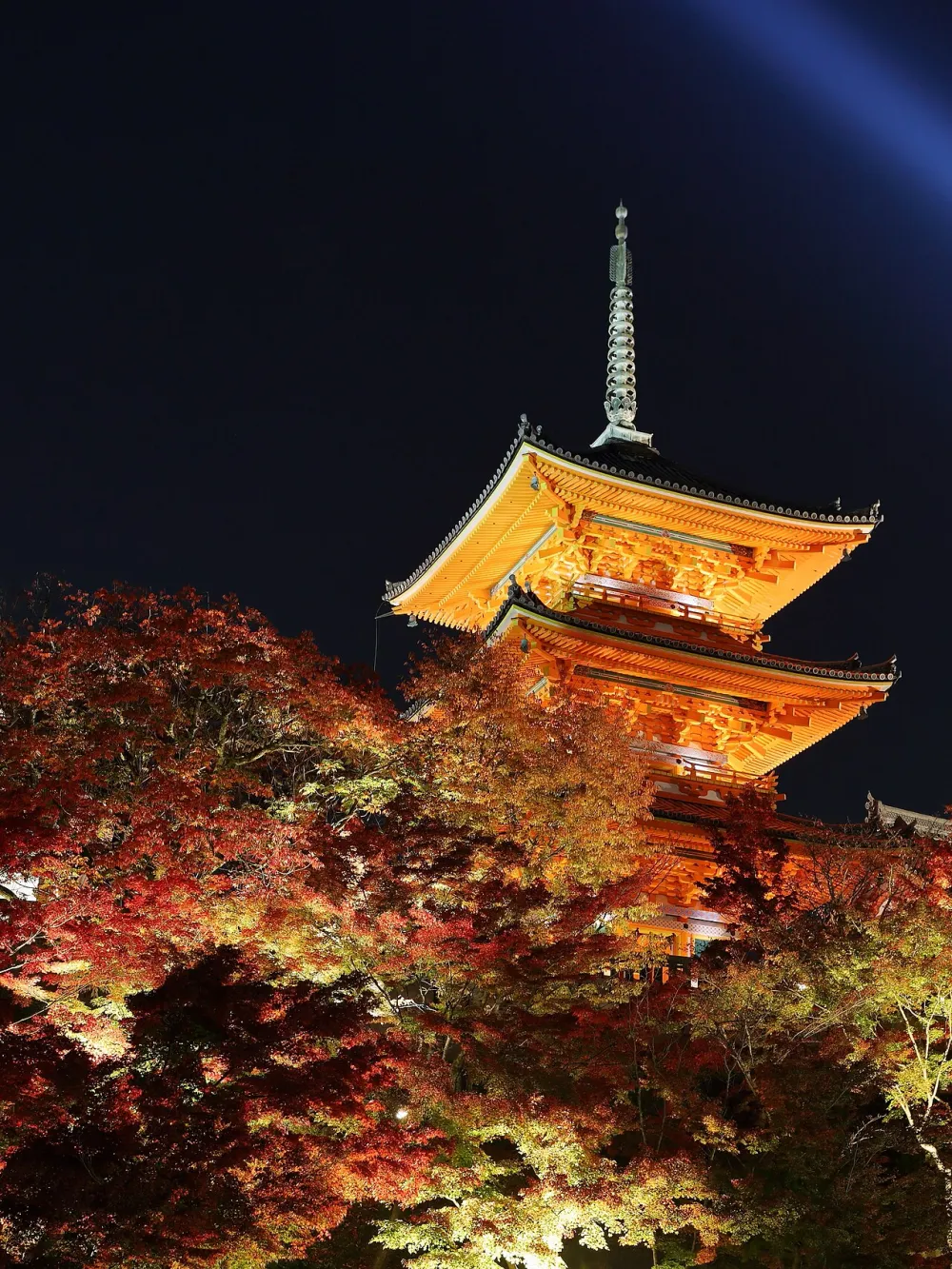
Both temples' autumn night openings overlap from November 21 to 30, 2026. Kiyomizu-dera's autumn night special visit begins at 5:30 PM, with last admission at 9:00 PM and closing at 9:30 PM—30 minutes earlier than Kodai-ji's last admission. To fit both into one evening, do Kiyomizu-dera first and walk north downhill to Kodai-ji: climb Kiyomizu-zaka at dusk, view the stage, descend past Yasaka Pagoda, and finish at Kodai-ji. Doing Kodai-ji first forces you to trek back uphill toward Kiyomizu-dera right before its earlier cutoff. If you want unhurried photo stops or have young kids in tow, splitting them across two nights is far more relaxed.
Forced to choose just one temple for a single night? Pick Kiyomizu-dera after dark if you want to see the wooden stage floating above illuminated maples, and visit Kodai-ji earlier in the afternoon for its two ponds. Pick Kiyomizu-dera by day—trimming your time in the souvenir shops—if you want Kodai-ji's colorful Hojo projections and pond reflections at night. On a tight Kyoto itinerary, the walk between them is half the experience; step into wider spots along the lanes to let faster walkers pass when slopes bottleneck. For the daytime walking sequence, see our Kiyomizu-dera and Higashiyama walking route.
Pacing Tips When Traveling with Kids or Older Relatives
With kids, enter Kodai-ji before dusk so you can gauge how they react to the projection mapping's sound and light from an easy-to-exit spot before moving on to the ponds and bamboo grove. With younger children, keep a free hand to steady them along the slopes and stairs rather than letting them shoot photos while walking. Note that in November after 5:00 PM, Kodai-ji restricts entry for elementary school field trip and excursion groups; individual families are admitted normally under the standard adult-chaperone ticket rules.
If family group photos with older relatives are a priority, bright afternoon light makes every stone step visible and lets everyone tour the courtyards at an unhurried pace. Focus on the Hojo and pond gardens, and head out along the marked evening exit route whenever fatigue sets in. The bamboo grove path includes elevation changes, so resist adding it on at the last minute once you have already walked several blocks—even if it looks close to the gate on the map. When choosing just one temple before buying tickets, pick Kodai-ji for architecture and pond views, or give Entoku-in 30 minutes if someone prefers sitting quietly beside a rock garden. When interests diverge, agree to meet back on Nene-no-Michi rather than rushing anyone through.
Hills, darkness, and crisp autumn temperature drops all slow down walking speed. Pack an easily removable outer layer for standing still during the lighting switch-on and along the pond banks. In heavy rain, trim a double-temple and Yasaka Pagoda photo plan down to one temple and main-road walking to avoid juggling umbrellas on wet steps. Alternatively, shift the temple visit to the next morning while keeping your dinner reservation in Gion or Kawaramachi—walking over from Kiyomizu-dera in daylight also makes it much easier to read the side alleys leading up to Daidokoro-zaka. If you are staying in another part of Kyoto, note your return bus stop or train station before leaving Shijo-dori so you are not checking maps at a busy intersection late at night.
Arriving Early? Ryozen Kannon Sits Just Above Daidokoro-zaka
Climbing Daidokoro-zaka toward Kodai-ji's parking lot brings you right beside the towering white statue south of the temple. Ryozen Kannon is a memorial built for the war dead of World War II, featuring a 24-meter seated statue on grounds operated separately from Kodai-ji's paid gate. Per the Kyoto City Tourism Association, it opens from 8:40 AM to 4:20 PM with last admission at 4:00 PM, and charges ¥300 for university students and adults. If you have time to spare in the afternoon, step into the plaza first for a look at the Higashiyama ridge before heading back to Kodai-ji's ticket booth—or go straight to Kodai-ji if the 4:30 PM Kyakuden cutoff is close. Seeing the mountains rise immediately east of the statue also gives you a quick visual compass whenever walls block your view along Yasaka-dori or Nene-no-Michi.
For wheelchair users, Kyoto City's official accessibility guide notes sloped ramps on both the left and right sides leading up to the plaza in front of the statue, though there is no wheelchair-accessible restroom on site and entering the interior of the statue requires stairs. Treat the front plaza as a brief, standalone afternoon stop depending on energy levels. If your group splits up, those finishing Kodai-ji's gardens exit right next to the parking lot—meeting on the same upper plaza next to Ryozen Kannon saves everyone an extra climb up from Nene-no-Michi.
Where to Go Along Nene-no-Michi After You Exit
Stepping back onto Nene-no-Michi after leaving Kodai-ji, head north to reach Maruyama Park and Yasaka Shrine, west to return to Higashioji-dori, or south for views toward Yasaka Pagoda. Because this stretch mixes temple walls, side gates, and private residences, watch corner signs as you walk and pull over into wider public spots before stopping for photos. If you still want an evening group shot, wait until you approach Shijo-dori where there is room to stand clear of traffic and split off easily toward the Keihan or Hankyu stations. When booking dinner around Gion or the Kamo River, factor in both the walk from Kodai-ji's exit and buffer time for your group to regroup.
If you arrive after the 9:30 PM admission cutoff, link Nene-no-Michi to Yasaka-dori instead to see the pagoda rising between the tiled eaves, then walk downhill to Higashioji-dori. Staying strictly on the public lanes lets you enjoy the night atmosphere without climbing Daidokoro-zaka for nothing. If you have another open evening during the illumination dates, move Kodai-ji to that night and head straight back to your hotel from Gion or Kawaramachi.
A few useful answers
How late are the 2026 Kodai-ji Temple autumn illuminations open?
The autumn night special illumination runs from October 23 to December 13, 2026. Lights come on at 5:00 PM, last admission is at 9:30 PM, and the temple closes at 10:00 PM.
Can I enter Kodai-ji during the day and stay for the night projection mapping?
Yes. During the autumn night illumination period, Kodai-ji does not clear out visitors between daytime and evening hours. Note that the Kyakuden (Guest Hall) closes at 4:30 PM, and once you exit the temple grounds, you cannot re-enter with the same ticket.
How much does the Kodai-ji and Entoku-in combination ticket save?
The adult combination ticket is ¥1,200, saving ¥100 compared to buying separate tickets. Junior high and high school students must buy individual tickets (¥400 for Kodai-ji and ¥200 for Entoku-in).
Can I visit both Kodai-ji and Entoku-in on the evening of December 11 or 12?
No. Entoku-in is closed all day on December 11 and 12. Since Kodai-ji's autumn illumination is still running on those dates, buy a single ticket for Kodai-ji instead.
Do I need a separate ticket to see the bamboo grove at Kodai-ji?
No. The bamboo grove is inside Kodai-ji's paid grounds, so your regular temple admission ticket covers the walking path through the grove.
Can I visit both Kodai-ji and Kiyomizu-dera on the same evening?
Yes, between November 21 and 30, 2026. Visit Kiyomizu-dera first, then walk north downhill to Kodai-ji. Kiyomizu-dera's last admission is at 9:00 PM, while Kodai-ji admits visitors until 9:30 PM.
Which station or bus stop is closest to Kodai-ji Temple?
The closest bus stop is Higashiyama Yasui on Kyoto City Bus 206, about a 7-minute walk east. By train, it is roughly a 15-minute walk east along Shijo-dori from Keihan Gion-Shijo Station or 20 minutes from Hankyu Kyoto-Kawaramachi Station.
Official information and references
Sources used in this guide.
- Kodai-ji Temple Autumn Night Special Admission Notice (Hours, Kyakuden, and Re-entry Rules)
- Kodai-ji Temple Visitor Information, Admission Fees, and Grounds Map
- Kodai-ji Temple April 2026 Admission Fee Revision Notice
- Kyoto City Tourism Association: Kodai-ji Night Special Admission and Projection Mapping
- Kyoto City Tourism Association: Kodai-ji Autumn Foliage Status and Walking Access
- Kodai-ji Temple History, Gardens, and Important Cultural Properties
- Kodai-ji Temple Access, Bus Stops, and Location Details
- Kodai-ji Parking Lot Operating Hours and Validation Policy
- Entoku-in Temple Visitor Guide (Tickets, Payment Methods, and Estimated Visit Time)
- Entoku-in Temple Closure Notice
- Entoku-in Temple North Garden History and Landscape
- Entoku-in Temple Matcha and Tea Room Experience
- Kyoto City Tourism Association: Entoku-in Night Special Admission and Folding Screen Exhibition
- Kyoto City Tourism Association: Entoku-in Temple Overview and Fusuma Paintings
- Sho Museum Current Special Exhibition, Hours, and Closure Dates
- Kyoto City Tourism Association: Sho Museum Special Exhibition Tickets and Last Entry Times
- Kiyomizu-dera Temple 2026 Autumn Night Special Admission Notice
- Kiyomizu-dera Temple Night Admission Closing and Reception Hours
- Kyoto City Gion & Kiyomizu Tourism Comfort Map
- Kyoto City Tourism Association: Ryozen Kannon Hours and Accessibility Information