2026 autumn night illumination dates, projection mapping times, ticket prices, and Entoku-in combo tickets for Kodai-ji Temple in Kyoto. Plan your walk from the Kyakuden, Garyu-chi Pond, and bamboo grove to Kiyomizu-dera and Nene-no-Michi.
- Region & Focus
- KyotoShrines and temples
- Reading Scope
- 21 min read · 12 chapters · 7 Q&As
- Official Verification
- 20 official sources checkedUpdated 22 November 2026
- Key Topics
- ItinerariesSeasonsKyoto, Osaka & Kansai
Chapter Route Map (tap any stop)
- When to Enter for the 2026 Kodai-ji Night Illumination
- Choosing Between Kodai-ji Single Tickets and the Entoku-in Combo
- Getting Your Bearings: Kodai-ji's Two Ponds
- Nene, the Moon-Viewing Pavilion, and the Otama-ya Mausoleum
- Entoku-in: Rock Gardens by Afternoon, Lit Stone and Maples by Night
- Sho Museum on the Lane: Exhibition Dates Run Longer Than the Lights
- Timing Autumn Foliage Alongside the Projection Mapping
- Walking to the Entrance from Kyoto Station, Gion-Shijo, or Kawaramachi
- One Higashiyama Route: Kiyomizu-dera by Day, Kodai-ji by Night
- Where to Slow Down with Children or Older Travellers
- Arrive Early in the Afternoon to Include Ryozen Kannon Above Daidokoro-zaka
- Where to Go After Exiting onto Nene-no-Michi
- Quick Q&A
To see Kodai-ji Temple's Kyakuden, pond gardens, and evening projection mapping in a single visit, arrive before 16:30 in autumn 2026 to tour the Kyakuden first, then stay inside the grounds for the 17:00 illuminations. Kodai-ji's autumn special night opening runs from 23 October to 13 December, with last entry at 21:30, closing at 22:00, and adult admission at ¥800. Across Nene-no-Michi, Entoku-in Temple also opens after dark. An adult combo ticket covering both temples costs ¥1,200—though Entoku-in is closed on 11 and 12 December, so buy a single Kodai-ji ticket on those two days.
When to Enter for the 2026 Kodai-ji Night Illumination
During the 2026 autumn extended opening, Kodai-ji opens as usual at 09:00 and switches on the illuminations at 17:00. Daytime visitors may stay on inside, so if you want dusk photographs as well as a proper look at the architecture, arrive in the afternoon before dark. The Kyakuden closes at 16:30, so make it your first stop on entering, then follow the marked route past the Hojo front garden, the ponds, and Kaisan-do Hall. Lights come on at 17:00 and the ticket gate stops admitting visitors at 21:30, with everyone required to reach the exit before 22:00. Leave yourself at least that final half-hour to take in the reflections and watch a full projection-mapping cycle.
Kodai-ji does not clear the grounds between daytime and evening sessions during the autumn event. Once inside, do not step out of the exit to buy a drink, fetch camera gear, or visit another temple, as re-entry on the same ticket is not permitted. Eat before entering if you want dinner prior to the lights coming on; if you enter shortly after 16:00, leave dinner until afterwards and transition seamlessly from your daytime route into the evening circuit. A single Kodai-ji ticket covers both the illuminations and the projection mapping.
On standard days, Kodai-ji is open 09:00–17:30 with last entry at 17:00. Outside the autumn illumination period, you can still stroll along Nene-no-Michi before dinner, but temple visits must happen in daylight. If your trip extends into mid-December, the simplest split is to save 13 December or an earlier evening for night foliage, then revisit Higashiyama in the afternoon a couple of days later. Spring and other seasons have their own temple schedules—check Kodai-ji's seasonal events calendar for the relevant year.
Base your arrival time on what you have come to see. Anyone keen on Momoyama-period architecture should work backwards from the Kyakuden's closing time when timing arrival at Higashiyama Yasui. If members of your group are elsewhere during the day and join after dinner, allow at least an hour to follow the route past the projection mapping, ponds, and bamboo grove—plus extra time for queuing at the entrance and pausing to compose photographs.
2026 autumn night illumination dates, projection mapping times, ticket prices, and Entoku-in combo tickets for Kodai-ji Temple in Kyoto. Plan your walk from the Kyakuden, Garyu-chi Pond, and bamboo grove to Kiyomizu-dera and Nene-no-Michi.
Choosing Between Kodai-ji Single Tickets and the Entoku-in Combo
From 1 April 2026, Kodai-ji admission is ¥800 for adults, ¥400 for junior and senior high school students, and ¥700 per person for adult groups of 30 or more. The bamboo grove lies inside Kodai-ji's grounds and is included along the standard temple route with your admission ticket. Primary school pupils and younger children enter free when accompanied by an adult, at a ratio of at least one adult guardian for every five children. Holders of a Japanese disability certificate (shogaisha techo), along with one accompanying carer or companion, enter free upon presenting the certificate at the entrance.
Entoku-in charges ¥500 for adults and ¥200 for junior and senior high school students. Buying separately comes to ¥1,300 per adult, whereas the adult combo ticket is ¥1,200—a saving of ¥100. As noted in Kodai-ji's revised fee announcement, there is no student combo ticket, so junior and senior high school students buy individual tickets at each temple for a combined total of ¥600. Entoku-in follows the same rule admitting primary school children and younger free with at least one adult per five children. Work out tickets per person at the counter: two adults and one junior high school pupil visiting both temples need two adult combo tickets plus one student ticket at each entrance.
You can wait until reaching the first temple's gate on the day to decide on the combo ticket. If you have a full late afternoon and a generous window before dinner, visiting both gardens represents better value; if you only have time for Kodai-ji's pond gardens and projection mapping, stick to a single ticket. Note especially that on 11 and 12 December, the Kyoto City Tourism Association lists Entoku-in as closed for temple duties—on those dates, visit Kodai-ji's Kyakuden in the afternoon and stay on for the lights. Entoku-in accepts cash only for admission, matcha experiences, and temple talismans, so carrying sufficient yen beforehand saves hunting for a cash machine across the street.
On normal days, Entoku-in opens at 10:00, stops admitting at 17:00, and closes at 17:30, with the temple estimating roughly 30 minutes for a visit. For the autumn night opening, evening hours start at 17:00 with last entry at 21:30 and closing at 22:00, again with no daytime-to-evening clear-out. When pairing both temples, block out that half-hour for Entoku-in first, then add buffer time for crossing Nene-no-Michi, climbing steps, and finding the gates. Tickets are checked separately at each temple, so keep your combo ticket somewhere accessible. If an unplanned stop leaves you short of time, finish the temple you are already inside rather than rushing through both.
Getting Your Bearings: Kodai-ji's Two Ponds
Before stepping through the gate, open Kodai-ji's precinct map and locate two key landmarks: Engetsu-chi Pond and Garyu-chi Pond. Kaisan-do Hall stands between the two ponds, right beside the Hojo front garden. Kodai-ji's bamboo grove is inside the paid grounds and reached via the temple's internal paths. The map also marks the entrance and exit separately—two points that look close on paper but are separated by boundary walls and a one-way circuit. Coming up from Nene-no-Michi, look for the admission desk sign (Haikan Uketsuke or Entrance); if you spot the exit sign from outside, follow the wall back towards the entrance.
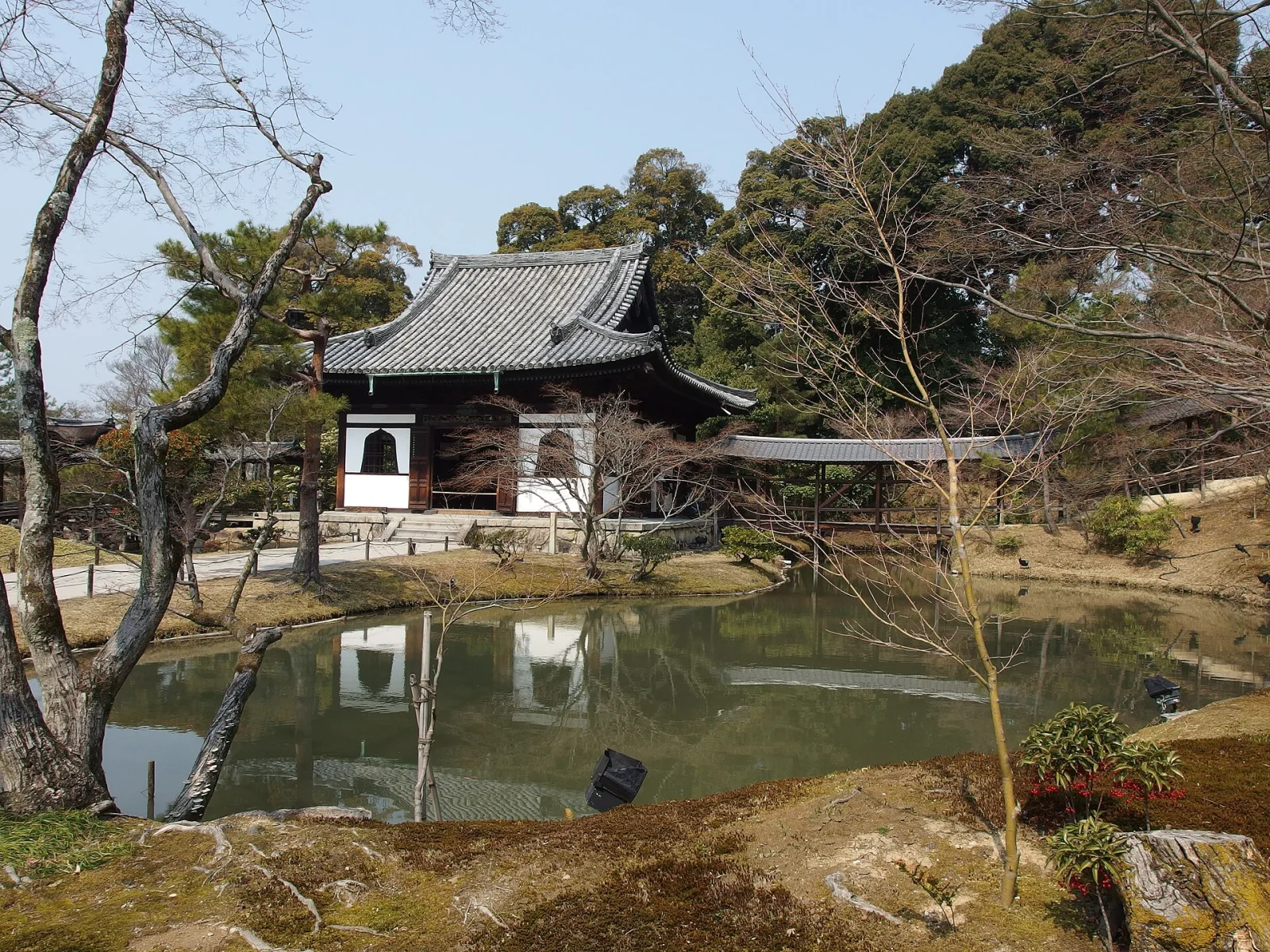
The area around Kaisan-do Hall shows how the wooden architecture bridges the water. Looking across Engetsu-chi Pond from the bank, the Moon-Viewing Pavilion jutting over the water and the trees behind it compose into a single frame; turning towards Garyu-chi Pond brings the opposite rooflines and foliage reflections into view. In daylight, you can trace how the rock arrangements, pond edges, and twin covered corridors tie the buildings together. At night along the open walkways, your eye is drawn first to the lit surfaces; give your eyes a moment to adjust to the dark and watch the illuminated windows and water reflections to tell which light comes from the halls and which from the shoreline.
The dry landscape garden in front of the Hojo is called Hashin-tei. By day, look closely at the raked patterns in the white gravel, the garden stones, and the open space framed against the perimeter walls. For autumn 2026 evenings, the Kyoto City Tourism Association lists projection mapping in the Hojo front garden. Once there, look up to see where the garden's boundaries sit in normal light before watching how the projected imagery maps across them. Because the projection mapping, pond reflections, and lit bamboo grove are spaced along different stretches of the route, leave enough time for the full circuit even if the projections are your main draw. When it is busy, follow the crowd flow and leave passing room when stopping at the Hojo garden or pond banks.
The Garyu-ro corridor links Kaisan-do Hall to the Otama-ya Mausoleum further up the slope. Viewed from the pondside, it is easy to trace the roofline climbing behind the hall towards the hillside. Higher still sit the mausoleum precinct and the teahouses Kasa-tei and Shigure-tei. Some of the calmest moments inside the grounds come right where the Hojo garden meets the ponds: dim your phone screen as you leave the front garden so you can spot subtle colour gradations in the water reflections, and pocket your phone through the bamboo grove to look up at the full height of the stalks against the slope.
Nene, the Moon-Viewing Pavilion, and the Otama-ya Mausoleum
In 1606, Kita-no-Mandokoro Nene—widow of Toyotomi Hideyoshi—founded Kodai-ji to pray for her late husband's soul. According to the temple's history, construction was backed by Tokugawa Ieyasu, and in 1624 Monk Sanko of Kennin-ji Temple was invited to serve as founding abbot. That history remains legible in several surviving structures: the former private Buddha hall is now Kaisan-do Hall, while the Moon-Viewing Pavilion and the teahouses Kasa-tei and Shigure-tei are designated Important Cultural Properties of Japan. Rather than memorising building names by date, find Kaisan-do Hall between the two ponds on the precinct map after leaving the Hojo garden—the layout of the whole complex immediately makes sense.
The Otama-ya Mausoleum enshrines both Hideyoshi and Nene, and temple records note that Nene is buried beneath her wooden statue inside. Its altar dais and shrine cabinets are decorated with gold-sprinkled lacquerware—the original craftsmanship behind the term Kodai-ji maki-e. Walking past this section at night, pause for a moment to take in the silhouette of the timber joinery against the slope. If lacquerware and temple treasures are your primary interest in Higashiyama, schedule the indoor galleries of the Sho Museum before dark. Companions with different priorities can split up here—some touring the historic halls, others strolling the lane—and meet back at the foot of Daidokoro-zaka on Nene-no-Michi.
Kasa-tei's steep roof framing and Shigure-tei's two-storey structure reward an unhurried look in daylight. Should the day's visitor route differ slightly from the printed leaflet, following the open paths will still show how both teahouses sit against the hillside. When short on time, focus on Kaisan-do Hall, the Moon-Viewing Pavilion, and the Otama-ya Mausoleum for the founding story, then let the Hojo garden and bamboo grove carry you into the landscape design. Visitors who find steep climbs tiring can enjoy the halls and corridors from the flatter pondside paths at the start and follow the open signage towards the exit.
Collectors of goshuin temple stamps will find three separate locations at Kodai-ji: the main admission desk, the Kodai-ji Tenmangu Shrine counter, and Risho-do Hall, each offering distinct stamps. If you are after Kodai-ji's main temple stamp, enquire at the admission desk beside the entrance as you arrive, since the exit leads straight down the hill. To tell Tenmangu Shrine and Risho-do Hall apart, use the buildings on the west side of the car park as your landmark. Completed in 2016, Risho-do is a worship hall housing a Nirvana mural based on a Nanboku-cho period painting in Kodai-ji's collection, serving a different devotional role from the Otama-ya Mausoleum dedicated to Hideyoshi and Nene.
Entoku-in: Rock Gardens by Afternoon, Lit Stone and Maples by Night
Just across Nene-no-Michi, Entoku-in's entrance is at 530 Shimogawara-cho, Higashiyama-ku, Kyoto. Founded as a sub-temple of Kodai-ji, it was where Nene spent the last 19 years of her life. Passing through the Nagaya-mon gate, the route divides cleanly into the South Garden and the North Garden. If anyone in your group appreciates Japanese garden design, set aside an afternoon to compare the two rather than hurrying through before closing: start with the raked white gravel lines of the South Garden, then continue to the North Garden where massive boulders, stone bridges, low mounds, and moss-covered ground take over.
Entoku-in states that the North Garden was relocated here from the front garden of Nene's dressing pavilion at Fushimi Castle—originally laid out by master gardener Kentei and later refined by Kobori Enshu—and classifies it as a dry landscape garden in the pond-stroll style. It is straightforward to read on site: look first for the thick stone bridge spanning an imaginary stream, then trace the surrounding rock groupings up towards a dry waterfall. Even without running water, a few well-placed stones preserve the relationship between stream and bridge. Viewed in daylight from the open verandas, your eye follows the contours of the large boulders; once the night lights come on, illuminated rock faces stand out against leaf shadows, sharpening the spacing between each cluster.
For fans of Hasegawa Tohaku, keep an eye out for the fusuma sliding-door paintings highlighted by the temple. Entoku-in holds ink paintings executed on paulownia-crested karakami paper, though the Kyoto City Tourism Association notes that the panels on public display are faithful reproductions. Pair this stop directly with the garden view: examine the painted trees and ink washes inside before stepping out to see the real branches and raked gravel of the South Garden. Those interested in Toyotomi Hideyoshi's history can also look for Sanmen Daikokuten, a deity combining the faces of Daikokuten, Benzaiten, and Bishamonten, linked in temple lore to Hideyoshi's early prayers for success.
If you plan to sit beside the North Garden with a bowl of matcha, make sure to visit during the day. Entoku-in serves matcha in Raku ware bowls from 10:30 with last orders at 16:00, priced at ¥800 or ¥1,000 depending on the pairing, excluding temple admission. For access to the small tea room, look for the ceremonial tea service held on Saturdays, Sundays, and Japanese public holidays at ¥2,500 per person for roughly 20 minutes (groups of 10 or more require advance telephone booking). Factor sitting and drinking time on top of the temple's 30-minute visit estimate, and take your tea earlier in the afternoon if you still aim to catch Kodai-ji's Kyakuden before 16:30.
During the 2026 autumn night opening, Entoku-in is also holding a special exhibition of the Toyotomi family's Teikan-zu Byobu folding screens, open from 10:00 with last entry at 21:30 and closing at 22:00. How you order the two temples depends on what matters most to you: put Entoku-in in the afternoon to study the indoor screens and North Garden stonework in natural light before crossing for Kodai-ji's evening illuminations; if you start late, visit Kodai-ji first if projection mapping and pond reflections are your priority, or Entoku-in first if you care more about the lit North Garden and folding screens. Both gates close to new entrants at 21:30, so neither can serve as a late backup after that cut-off.
Sho Museum on the Lane: Exhibition Dates Run Longer Than the Lights
The Sho Museum occupies the second floor of Kyo-Rakuichi Nene beside Nene-no-Michi and has a separate street entrance from Kodai-ji. Its special exhibition of Daizuigu Bosatsu runs from 5 September 2026 to 27 January 2027, and a Kodai-ji admission ticket grants entry. Normally enshrined in the central cabinet of the Otama-ya Mausoleum, this statue is shown alongside items reflecting Hideyoshi and Nene's personal devotion, including Nene's Thousand Jizo Statues and Hideyoshi's hardwood staff and vermilion shoes. Comparing the scale and purpose of these artefacts with the temple halls reveals details invisible in evening lighting. The museum is closed on 30 December 2026, and from 28 to 31 January 2027 for an exhibition changeover.
Normally, the Sho Museum opens at 09:00 with last entry at 17:00 (closing at 17:10), extending last entry to 21:00 (closing at 21:10) during special night openings. If you plan to stay inside Kodai-ji for the illuminations, ask at the ticket counter how best to sequence the street-level museum with the temple entrance. Because exiting Kodai-ji voids re-entry on the same ticket, visiting the museum before entering Kodai-ji is easier to manage; if you are already inside Kodai-ji, leave enough margin to finish the illuminations and reach the museum before the 21:00 last-entry cut-off.
Timing Autumn Foliage Alongside the Projection Mapping
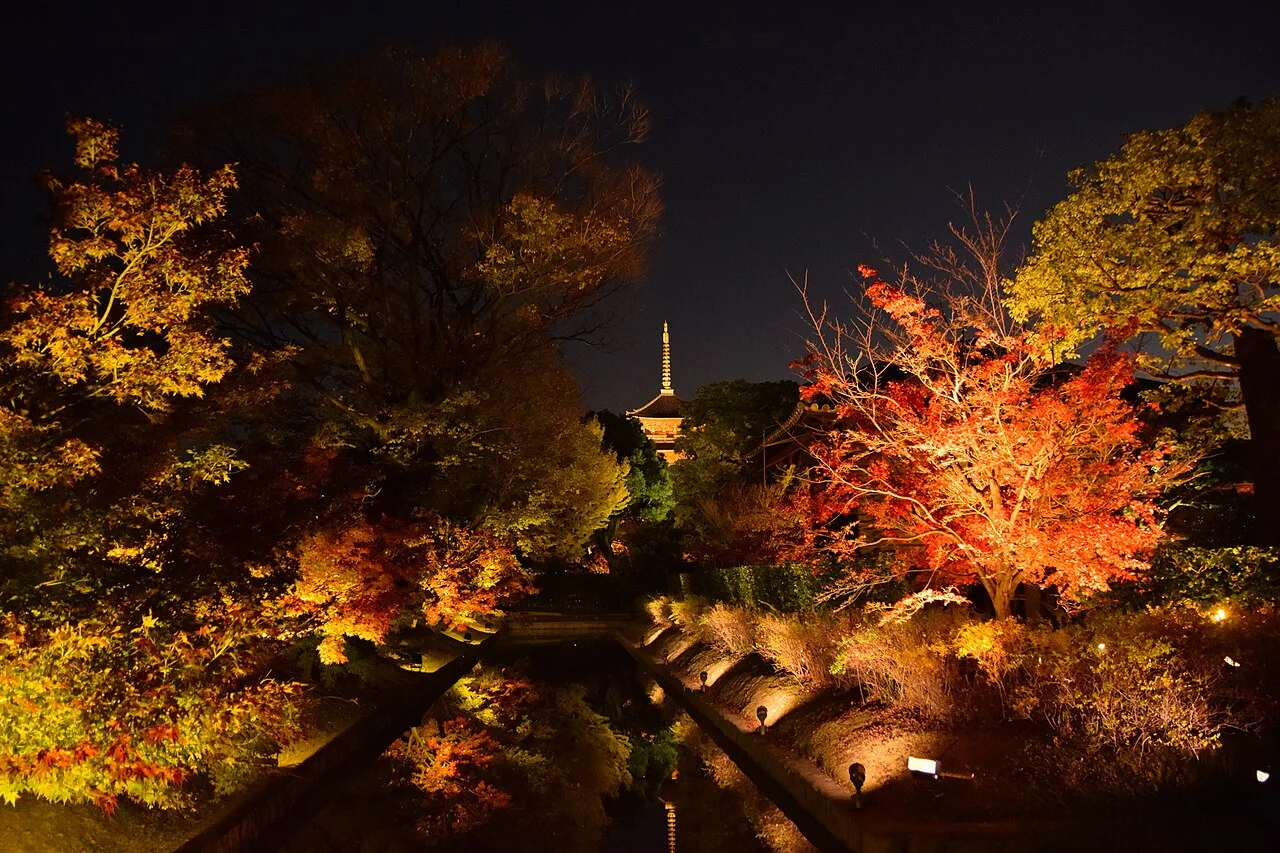
The Kyoto City Tourism Association places Kodai-ji's typical peak autumn foliage from mid- to late November. In 2026, the night illuminations begin in late October and run until mid-December, spanning a wider window than peak colour alone. Check Kyoto's official Momiji Dayori foliage updates alongside Kodai-ji's own event calendar—the former tracks leaf colour, while the latter confirms evening opening dates. If your party wants both autumn leaves and projection mapping, start with the illuminated dates that fit everyone's schedule, then pick your exact evening from the foliage reports; if you have two spare nights, keep one flexible until Kodai-ji updates its colour status.
After an early-evening shower, wet stone paving catches the glare, making reliable shoe grip and a clear view of the steps far more useful than carrying an extra lens. Garyu-chi Pond yields its sharpest reflections when the water is still; if a breeze ripples the surface, shift your framing to the lit corridor eaves and pondside lanterns. In the bamboo grove, let your gaze follow the stalks upwards and step to a wide spot along the path before stopping to compose. Put your camera or phone away before descending any stairs, and if using night mode on a phone, plant both feet firmly for the multi-second exposure rather than attempting complex angles mid-step.
For a relaxed half-day focused on Higashiyama gardens, arrive early on a clear morning to see the pond banks, branches, and Kaisan-do Hall's eaves in natural light. If you have already attended other night illuminations over a weekend, save Kodai-ji for daytime to admire the raked white gravel, the uphill paths to the teahouses, and the halls set between the ponds—even late in the season when only patches of red remain, the evergreens, bamboo grove, and timber corridors hold their own. If you only have one night in Kyoto for illuminated foliage, use our Kyoto autumn night illumination comparison to pick the right district and avoid unnecessary trips across town.
Walking to the Entrance from Kyoto Station, Gion-Shijo, or Kawaramachi
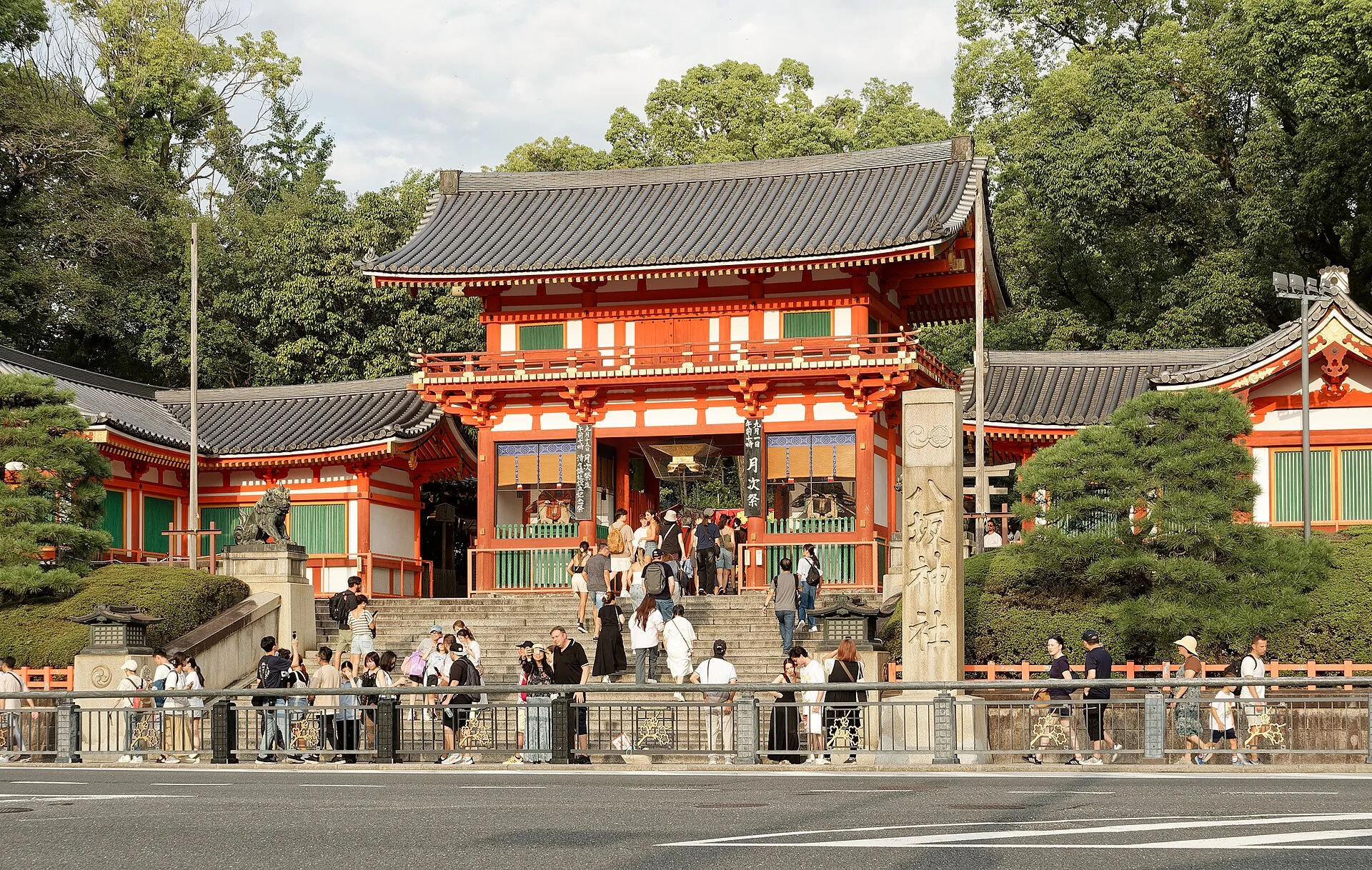
From Kyoto Station, take Kyoto City Bus 206 bound for Higashiyama—listed on Kodai-ji's official access page—and get off at Higashiyama Yasui, then walk uphill eastwards for about 7 minutes. Anyone aiming for the Kyakuden before 16:30 should factor in bus waiting times, traffic, the uphill walk, and buying tickets at the gate. On the Keihan Line, the walk from Gion-Shijo Station takes around 15 minutes according to the Kyoto City Tourism Association; on the Hankyu Line, allow roughly 20 minutes from Kyoto-Kawaramachi Station. Leave the station towards the Kamo River and Gion, walk east along Shijo-dori past Yasaka Shrine, and turn south into Nene-no-Michi—checking street signs helps confirm whether you are still on Higashioji-dori or already on the pedestrian hillside lanes.
If you are coming from Gion-Shijo or Kyoto-Kawaramachi, remember that the 7-minute estimate only covers the final climb from the Higashiyama Yasui bus stop—starting on foot from a Shijo-dori railway station avoids waiting for a bus altogether. Leave bulky luggage at your hotel, station lockers, or a storage counter before heading uphill, as the final approach from Nene-no-Michi to Kodai-ji's entrance still involves slopes and stone steps. Kyoto City's Gion and Kiyomizu sightseeing comfort map covers the stretch from Kiyomizu-zaka to Nene-no-Michi with hourly crowd forecasts, making it handy for planning shopping breaks during busier windows and saving climbs and photography for quieter spells.
When walking uphill with young children or anyone with sore knees, build in a natural decision point before committing to the full climb. Walk along Nene-no-Michi to Daidokoro-zaka to size up the stone steps first, then decide whether to go up into the temple grounds. Kodai-ji's precinct map clearly marks the hillside paths linking the Hojo area to the teahouses and bamboo grove; visitors needing step-free routes or wheelchair access should pick up a map at the gate and ask staff to mark that evening's accessible paths and exits. For older relatives eager to see a garden after a full day of sightseeing, Entoku-in's street-level entrance and shorter circuit make an easier standalone stop, though its interiors still have level changes worth checking at the gate.
Drivers will find the entrance to Kodai-ji Car Park on the south side of the temple; it is open 24 hours with a 2.3-metre height limit for passenger cars. Standard parking rates are ¥600 for the first hour and ¥300 for each additional 30 minutes. Parking at the temple-run lot grants 1 hour of free parking with admission to either Kodai-ji or Entoku-in, or 2 hours with the combo ticket—mention your car and show your parking ticket when purchasing temple admission, noting that complimentary passes and free disability-certificate entries are excluded from this discount. If you plan to eat nearby afterwards, weigh up the extra parking charges against walking back from a restaurant in Higashiyama.
For the journey back after closing, head north to Shijo-dori for Keihan Gion-Shijo Station, or walk down to Higashiyama Yasui for buses towards Kyoto Station—double-check which side of the road serves your direction before queuing. If ordering a taxi or ride-hail, walk downhill to a clear pick-up point along Higashioji-dori rather than waiting inside narrow lanes. Because Kodai-ji's entrance and exit are separated, simply saying 'meet at Kodai-ji' can leave companions stranded at opposite ends; agree instead on an easy street-level landmark such as the junction where Daidokoro-zaka meets Nene-no-Michi.
One Higashiyama Route: Kiyomizu-dera by Day, Kodai-ji by Night
First-time visitors to Higashiyama with a single afternoon and evening can walk north from Kiyomizu-dera. Head up Kiyomizu-zaka in daylight to see Kiyomizu-dera's main hall and wooden stage, then wander down through Sannenzaka and Ninenzaka, pause on Yasaka-dori for street-level views of Hokan-ji Temple's five-storey Yasaka Pagoda, and continue onto Nene-no-Michi. Fit souvenir browsing and coffee breaks into this middle stretch, save Kodai-ji for evening, and finish by walking north past Maruyama Park and Yasaka Shrine out to Shijo-dori. Putting temples, lanes, and railway stations in one continuous line avoids having to trudge back up Kiyomizu-zaka after dark.
If Nene's later life interests you more, enter Higashiyama earlier from the Gion or Yasaka Shrine side instead. Stroll through Maruyama Park onto Nene-no-Michi, tour Entoku-in's North and South gardens first, and cross the lane to climb up to Kodai-ji in the afternoon. This unhurried order also works well for solo travellers taking time over explanatory plaques, with space for a quiet rest between temples—just allow for the steps up to Kodai-ji if you still want to reach the Kyakuden before 16:30. Companions interested solely in Kodai-ji's projection mapping can split up earlier and reunite at the bottom of Daidokoro-zaka, saving a group meal until everyone emerges from the illuminated route.
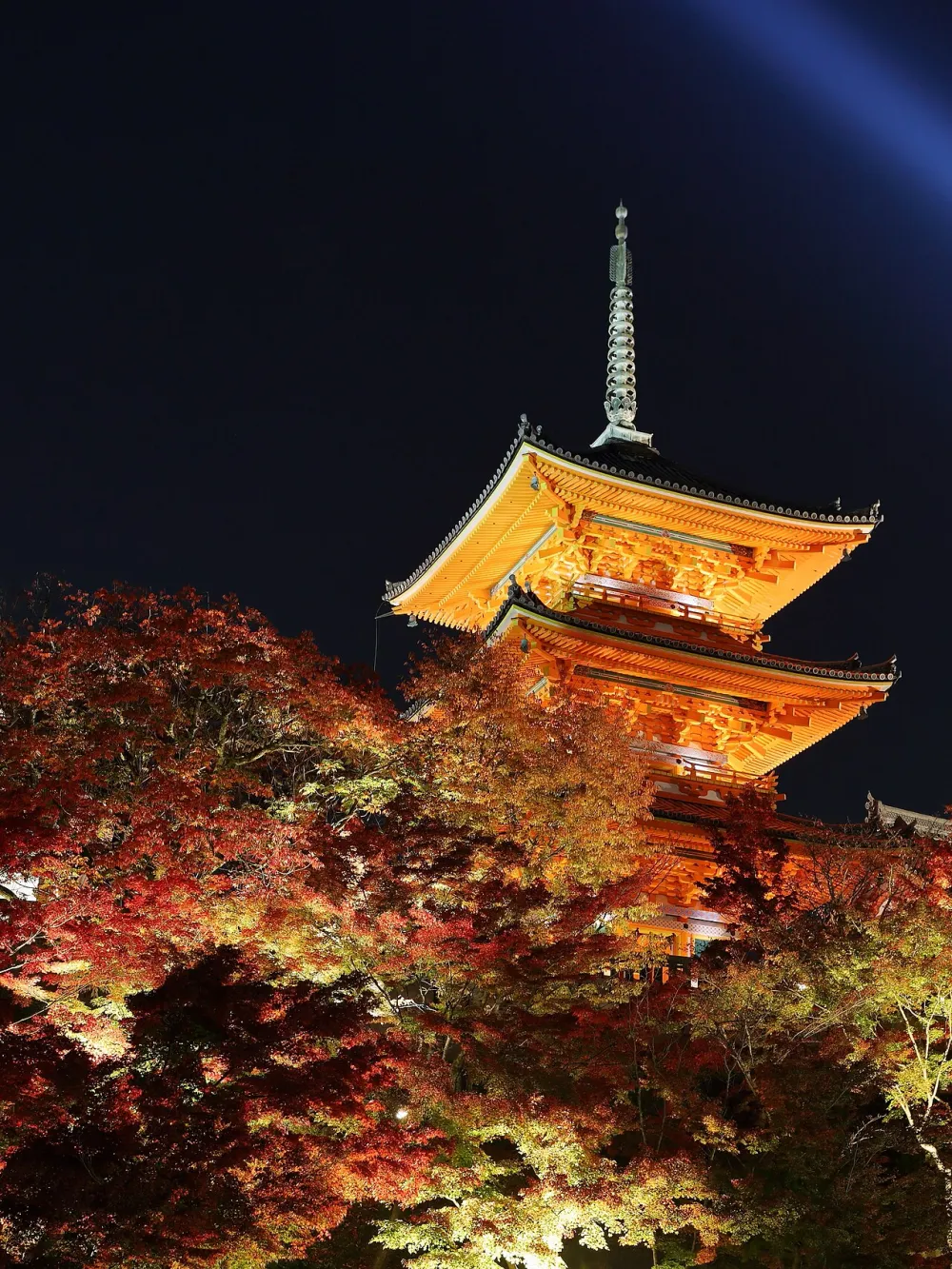
Both temples' autumn night openings overlap from 21 to 30 November 2026. Kiyomizu-dera's special night viewing begins at 17:30 with last entry at 21:00 and closing at 21:30—half an hour earlier than Kodai-ji's last admission. To fit both into one evening, start at Kiyomizu-dera and walk northwards downhill to Kodai-ji: climb Kiyomizu-zaka at dusk for the stage, drop down towards Yasaka Pagoda, and end at Kodai-ji. Doing Kodai-ji first leaves you climbing the longer hill towards Kiyomizu-dera against a tighter deadline; if you want unhurried photography or are travelling with children, split the two temples across separate evenings.
Forced to choose just one temple for a single night? Pick Kiyomizu-dera after dark if you want the wooden stage rising above illuminated maples, and visit Kodai-ji's twin ponds earlier in the afternoon. Conversely, put Kiyomizu-dera in daylight—trimming shopping stops along the approach—and save the evening for Kodai-ji's colourful Hojo projections and pond reflections. On a brief Kyoto stay, the walk between them is an attraction in itself; step into wider bays on crowded lanes to let others pass, and see our Kiyomizu-dera and Higashiyama walking route for the daytime sequence.
Where to Slow Down with Children or Older Travellers
With children, enter before dusk for the projection mapping so they can adjust gradually, pick an open spot near the edge if loud audio or flashing visuals feel overwhelming, and then move on to the ponds and bamboo grove. For younger children, the climb up from the lane requires watching every step—keep one hand free to hold theirs rather than letting them wander while taking photos. Note also that Kodai-ji restricts primary school excursions and school-trip groups after 17:00 in November, though ordinary families remain welcome under the standard adult-accompaniment ticket rule.
If family portraits and sightseeing with older relatives are the focus, bright afternoon light makes every stone step visible and allows a gentle pace across the courtyards. Concentrate on the Hojo garden and pondside walks, heading out along the open exit route once feet tire—avoid tacking the sloping bamboo grove back on at the end simply because it looks close on the map. When choosing only one temple at the ticket desk, pick Kodai-ji for architecture and pond reflections, or give Entoku-in 30 minutes if your companions would rather sit quietly admiring a stone garden; when interests diverge, agree to regroup on Nene-no-Michi rather than hurrying anyone along.
Slopes, darkness, and crisp autumn temperature drops all affect walking speed. Bring an easily layered jacket for standing around before lights-on and beside the water. In heavy rain, trim an ambitious plan of two temples plus Yasaka Pagoda street shots down to a single temple and main-road walking so you are not constantly opening and folding umbrellas on wet stairs. If you decide to postpone the temple visit to the next morning, keep your dinner booking in Gion or Kawaramachi—walking over from the Kiyomizu-dera side in daylight also makes the layout of the side lanes up to Daidokoro-zaka much easier to read. Note your return station or bus stop before setting out so you are not checking maps at busy Shijo-dori junctions late at night.
Arrive Early in the Afternoon to Include Ryozen Kannon Above Daidokoro-zaka
Climbing Daidokoro-zaka towards Kodai-ji Car Park brings into view the tall white statue of Ryozen Kannon just south of Kodai-ji. Built as a memorial to the Second World War dead, the seated figure stands roughly 24 metres tall and is visited on a separate ticket from Kodai-ji uphill. According to the Kyoto City Tourism Association, it opens 08:40–16:20 with last entry at 16:00 and admission at ¥300 for university students and adults. If you arrive with time to spare in the afternoon, stop at the statue plaza first for views towards the Higashiyama ridge before walking back to Kodai-ji's ticket counter—though head straight to Kodai-ji if the Kyakuden's 16:30 closing time is near. Because the statue sits against the eastern hillside, glancing up towards it also helps you reorient yourself whenever high walls along Nene-no-Michi or Yasaka-dori obscure which direction leads uphill.
For wheelchair users, Kyoto City's official accessibility guide notes ramps on both the left and right sides leading up to the Ryozen Kannon plaza, though there is no wheelchair-accessible toilet on site and entering the interior of the statue involves stairs. Treating the plaza as a standalone afternoon stop works well when pacing energy. If members of your group split up, those leaving Kodai-ji via its exit emerge near the car park, making it easy to meet companions exiting Ryozen Kannon on the same upper level without walking all the way back down to Nene-no-Michi.
Where to Go After Exiting onto Nene-no-Michi
Returning to Nene-no-Michi after leaving Kodai-ji, turning north takes you towards Maruyama Park and Yasaka Shrine, heading west brings you back out to Higashioji-dori, and turning south leads towards the approach for Yasaka Pagoda photos. The lane is lined with temple walls, private entrances, and residences, so follow street-corner signs as you walk and pull over to wide spots on public roads before stopping for photographs. For a final group shot in the evening, wait until you reach the wider pavements near Shijo-dori—where separating towards the Keihan or Hankyu lines is straightforward too—and remember to factor both the walk from Kodai-ji's exit and regrouping time into any dinner reservation in Gion or along the Kamo River.
If you arrive too late and miss the 21:30 last-entry gate, turn from Nene-no-Michi onto Yasaka-dori to view Yasaka Pagoda rising between the traditional eaves, then continue downhill to Higashioji-dori. Staying on flat and gently sloping streets means no wasted climb up Daidokoro-zaka. Should you have another evening left within the illumination dates, move Kodai-ji to that night and head back to your accommodation via Gion or Kawaramachi.
A few useful answers
What are Kodai-ji Temple's 2026 night illumination hours?
The autumn special night opening runs from 23 October to 13 December 2026. Illuminations begin at 17:00, last entry is at 21:30, and the temple closes at 22:00.
Can I enter Kodai-ji during the day and stay for the night projection mapping?
Yes. Kodai-ji does not clear the grounds between daytime and evening hours during the autumn special opening. Note that the Kyakuden closes at 16:30, and you cannot re-enter with the same ticket once you exit.
How much does the Kodai-ji and Entoku-in combo ticket save?
The adult combo ticket is ¥1,200, saving ¥100 compared with buying separate tickets. Junior and senior high school students buy individual student tickets instead: ¥400 at Kodai-ji and ¥200 at Entoku-in.
Can I visit both Kodai-ji and Entoku-in on the evening of 11 or 12 December?
No—Entoku-in is closed all day on both 11 and 12 December. Because Kodai-ji's autumn night opening is still running on those dates, buy a single Kodai-ji ticket instead.
Do I need a separate ticket to see Kodai-ji's bamboo grove?
No. The bamboo grove is part of Kodai-ji's temple gardens and is included along the open visitor route with a regular Kodai-ji admission ticket.
Can I see both Kodai-ji and Kiyomizu-dera on the same evening?
Yes, their 2026 autumn night openings overlap from 21 to 30 November. Visit Kiyomizu-dera first—its last entry is at 21:00—then walk downhill northwards to Kodai-ji, which admits visitors until 21:30.
Which station is closest to Kodai-ji Temple?
The nearest bus stop is Higashiyama Yasui, roughly a 7-minute uphill walk east. By train, walk east along Shijo-dori from Keihan Gion-Shijo Station or Hankyu Kyoto-Kawaramachi Station.
Official information and references
Sources used in this guide.
- Kodai-ji Temple Autumn Special Night Opening Notice (Hours, Kyakuden, and Re-entry Rules)
- Kodai-ji Temple Visitor Information, Admission Fees, and Precinct Map
- Kodai-ji Temple April 2026 Admission Fee Revision
- Kyoto City Tourism Association: Kodai-ji Special Night Opening and Projection Mapping
- Kyoto City Tourism Association: Kodai-ji Autumn Foliage Status and Walking Access
- Kodai-ji Temple History, Gardens, and Important Cultural Properties
- Kodai-ji Temple Access, Bus Stops, and Address
- Kodai-ji Car Park Operating Hours and Parking Discounts
- Entoku-in Temple Visitor Guide (Tickets, Payment, and Visit Duration)
- Entoku-in Temple Closure Notice
- Entoku-in Temple North Garden History and Landscape
- Entoku-in Temple Matcha and Tea Room Experiences
- Kyoto City Tourism Association: Entoku-in Special Night Opening and Folding Screen Exhibition
- Kyoto City Tourism Association: Entoku-in Guide and Fusuma Sliding-Door Paintings
- Sho Museum Special Exhibition, Opening Hours, and Closed Dates
- Kyoto City Tourism Association: Sho Museum Exhibition Tickets and Last Entry
- Kiyomizu-dera Temple 2026 Autumn Special Night Viewing Notice
- Kiyomizu-dera Temple Night Viewing Closing and Admission Hours
- Kyoto City Gion and Kiyomizu Sightseeing Comfort Map
- Kyoto City Tourism Association: Ryozen Kannon Opening Hours and Accessibility