Planning a cherry blossom trip to Fukuoka from late March to early April? Here is a practical guide to Maizuru Park, Nishi Park, and Ohori Park, covering subway exits, night illumination tickets, half-day walking routes, and rainy-day backups.
- Region & Focus
- Fukuoka
- Reading Scope
- 22 min read · 12 chapters · 6 Q&As
- Official Verification
- 32 official sources checkedUpdated November 22, 2026
- Key Topics
- SeasonsItinerariesRail travel
Chapter Route Map (tap any stop)
- When to Go: Follow the Bloom Forecast First, Festival Dates Second
- Which Subway Exit to Use for Each Park
- Daytime at Maizuru Park: From the Moat Up Into the Castle Ruins
- How Night Cherry Blossom Tickets Work at the Fukuoka Castle Sakura Festival
- Nishi Park: Up the Shrine Approach to Sakura Valley and Bay Views
- Ohori Park: Leave Time for the Pond Shoreline
- Half-Day, Full-Day, and Arrival-Day Routes
- Lunch Inside the Castle Ruins vs. Restaurants South of the Pond
- Rainy-Day Indoor Backups by Day of the Week
- Pacing for Weather, Slopes, and Standing in Line
- Where to Stay: Hakata, Tenjin, or Ohori?
- Fitting Cherry Blossoms Into a Three-Day Kyushu Itinerary
- Quick Q&A
If you only have half a day for cherry blossoms in Fukuoka, pick Maizuru Park: walk from the moat along the stone castle walls into the Fukuoka Castle Ruins, then loop into neighboring Ohori Park if you want to keep going. With a full day, take Ohorikoen Station Exit 1 in the morning to climb Nishi Park, return to Maizuru in the afternoon, and stay past dinner for the illuminated night blossoms. Aim for late March through early April, and anchor your transit, hotel, and rain backups along the subway line.
When to Go: Follow the Bloom Forecast First, Festival Dates Second
If your travel dates are flexible, target late March through early April and leave two interchangeable daytime slots for city cherry blossom viewing. According to the Fukuoka Regional Meteorological Observatory, the average first-bloom date for Somei-Yoshino trees is March 22, with average full bloom on March 31. In 2026, first bloom landed on March 24 and full bloom arrived ten days later on April 3. That year's Fukuoka Castle Sakura Festival opened on March 25, and the city extended the original April 5 closing date to April 8 because of the delayed peak. When booking flights a year ahead, aim for that reliable window, then check official organizer updates closer to spring for exact festival dates.
An official first-bloom announcement only means a few blossoms have opened on the designated reference tree. If you land right on that day, spend your first afternoon near your hotel and save the castle grounds for later in your trip. Fukuoka Castle and Nishi Park also hold multiple cherry varieties, so you will see fully open canopies right next to tight buds inside the same park. For dedicated flower hunting, cross-reference Maizuru Park's bloom updates, Nishi Park management's zone-by-zone reports, and JMA dates. In spring 2026, Nishi Park management posted staggered updates by area—far more practical for locating peak trees in Sakura Valley or around the shrine than relying on a single citywide date.
Heavy rain and strong winds after full bloom can strip upper branches quickly, though they often leave thick drifts of petals floating in the moat or along the water's edge. Keep your schedule adaptable. If boat tickets, day trips, or restaurant reservations lock down one day, slot cherry blossom viewing into an unbooked half-day without prepaid commitments. Staying two nights? Walk the moat as a short preview after check-in, then decide the next afternoon whether to climb the castle's stone walls or head up to Nishi Park based on live bloom reports. If you only have one night in Fukuoka before catching a morning Shinkansen, prioritize Maizuru Park—subway stations flank both sides, making a half-day visit easy to wrap up.
Planning a cherry blossom trip to Fukuoka from late March to early April? Here is a practical guide to Maizuru Park, Nishi Park, and Ohori Park, covering subway exits, night illumination tickets, half-day walking routes, and rainy-day backups.
Which Subway Exit to Use for Each Park
From Hakata or Tenjin stations, take the Fukuoka City Subway Kuko (Airport) Line to Ohorikoen Station. Heading west from Tenjin, trains stop at Akasaka first, then Ohorikoen; from Hakata, it is a straight shot with no transfers. Adult single-ride fares scale by distance: ¥210 up to 3 km, ¥260 from 3 to 7 km, and ¥300 from 7 to 11 km. If you are staying in Tenjin and only making a round trip to Ohorikoen, two single tickets cost ¥420. If you plan to add trips to Ropponmatsu or elsewhere downtown, add up your segments against the ¥640 Subway 1-Day Pass—three short ¥210 rides total ¥630.
At Ohorikoen Station, Exit 1 leads to Nishi Park: walk north along the street to reach the Terumo Shrine approach, which park management estimates at about a 15-minute walk from the station, plus extra time for the uphill climb to the blossoms. Exit 3 brings you to the north end of Ohori Park's pond for shoreline walks and benches. Exit 5 points toward the Fukuoka Castle Ruins, Maizuru Park, and Heiwadai Athletic Stadium. Because all three exits share the same station name, split groups should agree on an exact exit number or landmark beforehand so one person does not end up by the moat while another searches the pond.
If you prefer starting on the castle's east side near the Fukuoka Castle Mukashi Tanbokan and Korokan Ruins, Akasaka Station Exit 2 is smoother, roughly a 10-minute walk according to the historic site's official guide. You can then walk west through the park and leave via Ohorikoen Station without backtracking. Travelers using wheelchairs, rolling luggage, or strollers should follow elevator signs inside the station rather than relying solely on exit numbers. Once at street level by Ohori Park, the lakeside path is flat and smooth, whereas heading up from the pond into the castle's Honmaru enclosure still involves slopes and stone steps.
International flights arrive at Fukuoka Airport's International Terminal, while the subway station connects to the Domestic Terminal. Take the free inter-terminal shuttle bus from the first floor of the International Terminal to transfer to the Kuko Line. During the day, shuttles depart roughly every 5 to 7 minutes, and all buses are equipped with wheelchair ramps. Factor in immigration, baggage claim, the shuttle transfer, and luggage storage before estimating when you will reach the park. If a morning flight puts you downtown before noon, start along Maizuru's moat; if you land in the evening, eat dinner first and decide afterward whether to head out, especially if you have an early intercity train the next morning.
If your group splits up, each adult needs their own IC transit card or must tap the same credit card in and out of the fare gates for each trip. If you plan to use contactless credit card tap-to-pay for multiple rides in one day, use the exact same physical card or mobile device from your first ride onward—taps on a physical card and a smartphone are not combined toward the ¥640 daily fare cap. Traveling with elementary school students? On weekends, holidays, and designated Fukuoka Municipal elementary school spring break days, the subway sells a ¥100 Elementary Student 1-Day Pass. If adults only need a Tenjin–Ohorikoen round trip while kids make extra stops, buy their passes separately.
| Station & Exit | Nearby Destinations | Best Itinerary Fit |
|---|---|---|
| Ohorikoen Station Exit 1 | Nishi Park, Terumo Shrine Approach | Morning hillside walk at Nishi Park |
| Ohorikoen Station Exit 3 | Ohori Park Pond Shoreline | Family strolls or walking north to south toward the Art Museum |
| Ohorikoen Station Exit 5 | Maizuru Park West Side, Fukuoka Castle Ruins | Viewing Shimonohashi-gomon Gate and the moat |
| Akasaka Station Exit 2 | Maizuru Park East Side, Korokan Ruins area | Walking east to west from the castle into Ohori Park |
| Ropponmatsu Station Exit 3 | Fukuoka City Science Museum, Ohori Park South Side | Pairing the Science Museum with a south-pond stroll on rainy days |
Daytime at Maizuru Park: From the Moat Up Into the Castle Ruins
Maizuru Park occupies the grounds of Fukuoka Castle, where the city highlights roughly 1,000 cherry trees across 19 varieties. Heading east from Ohorikoen Station Exit 5, orient yourself by Shimonohashi-gomon Gate and the Shiomi Yagura turret, then follow the water until both stone walls and blossoms fill your view. Keep this opening stretch flexible: branches drape low over the moat, giving plenty to see without climbing. If anyone in your group walks slowly or pushes a stroller, lingering along the outer perimeter is far easier than heading straight up to the Honmaru summit.
When you have time, head inside to see how the castle walls layer the blossoms at different elevations. From below, you frame the angled masonry first; once up near the Honmaru, the canopy closes overhead. Sakuraen is the main blossom viewing area near the Honmaru and also serves as the marked night-festival entrance on official maps. When pinning locations on your map inside the park, search Sakuraen and Tenshudai separately. Stay along the Honmaru paths if you want uphill shots of branches framed against stone walls; head specifically to Tenshudai only if you want the elevated viewpoint looking across the castle grounds.
Due to archaeological excavations, Tenshudai is scheduled to be closed from May 26, 2026 through the end of December, according to park management notices. Construction around the Kanamono Yagura stone wall and temporary stone storage on part of the plaza in front of the athletic stadium are also slated to continue through March 2027. Even with those closures, the moat along Meiji-dori, Shimonohashi-gomon Gate, and the Sannomaru area easily fill a short castle-ruins walk. Stick to open park paths and follow perimeter detours around any fencing rather than climbing extra slopes for a specific photo angle.
Both the castle ruins and Korokan sit inside Maizuru Park, making it easy for first-time visitors to conflate the two eras based on pavilion signs. Korokan was an ancient guesthouse for foreign envoys, while Fukuoka Castle was built by Kuroda Nagamasa in the early Edo period. If you are staying outdoors, group the stone walls and castle gates into one stretch, then stop by the Sannomaru Square visitor center on your way out to check the maps. Entering from Akasaka? Visit Mukashi Tanbokan first to see reconstruction diagrams before walking the walls—it makes locating the gates and understanding the castle's footprint much easier.
How Night Cherry Blossom Tickets Work at the Fukuoka Castle Sakura Festival
The festival website has confirmed the event will continue in 2027; until new details drop, use the 2026 zones and prices as a planning reference. That season, illuminated trees along parts of the moat could be enjoyed for free from public pathways, while dedicated light displays at Sakuraen, Otakayashiki Ruins, and Tamon Yagura required separate ticket checks. Paid zones ran from 18:00 to 22:00 with last entry at 21:45, priced at ¥600 per single zone or ¥1,500 for a three-zone adult pass, with free admission for high school students and younger. Seeing just one or two zones costs ¥600 or ¥1,200 respectively—buy the ¥1,500 pass only if you are sure you will walk all three, which saves ¥300 per adult. Moving between venues requires walking, with some sections overlapping daytime park routes.
If you only have one evening or already booked dinner, pick the single view that appeals to you most. Sakuraen pairs dense canopies directly with the castle ruins, Tamon Yagura showcases a long stretch of white plaster walls beside cherry trees, and Otakayashiki Ruins offers a different, quieter garden scale. Walk along the Meiji-dori moat first, then head to your chosen paid gate after dark. If waiting in line clashes with kids' dinnertime, families can split options easily—eat first and return later, or stick to the free illuminated walkways. Groups arriving from different subway exits should meet at a clear intersection outside the paid gates instead of trying to push upstream through an entry queue.
Under the 2026 subway tie-in campaign, riders holding an eligible Subway 1-Day Pass received a ¥100 discount on the three-zone night pass at the on-site ticket booth. Note that while contactless credit card taps cap at ¥640 per day, the discount required presenting an eligible physical pass listed in the campaign—tapping a credit card up to the cap did not qualify. Compare totals based on your actual rides: if you are only making a Hakata–Ohorikoen round trip plus one night zone, there is no bundle savings anyway. Only factor this discount into your route if you already hold a qualifying day pass and intend to visit all three zones.
If you already toured the park during the day, enter from the opposite side in the evening. Eating dinner outside the park before the lights turn on and then crossing the moat for a single uphill visit is far more relaxing than juggling takeout boxes while rushing across three venues. In 2026, reserving spots with tarps and hosting banquets inside paid zones was banned from 18:00 onward, so keep picnics to daytime hours. If weekend ticket lines look long, walk a loop along the free outdoor paths instead. When photographing stone walls and blossoms together, step to the edge of the path for a quick shot and avoid blocking gates or narrow stone stairways.
Nishi Park: Up the Shrine Approach to Sakura Valley and Bay Views
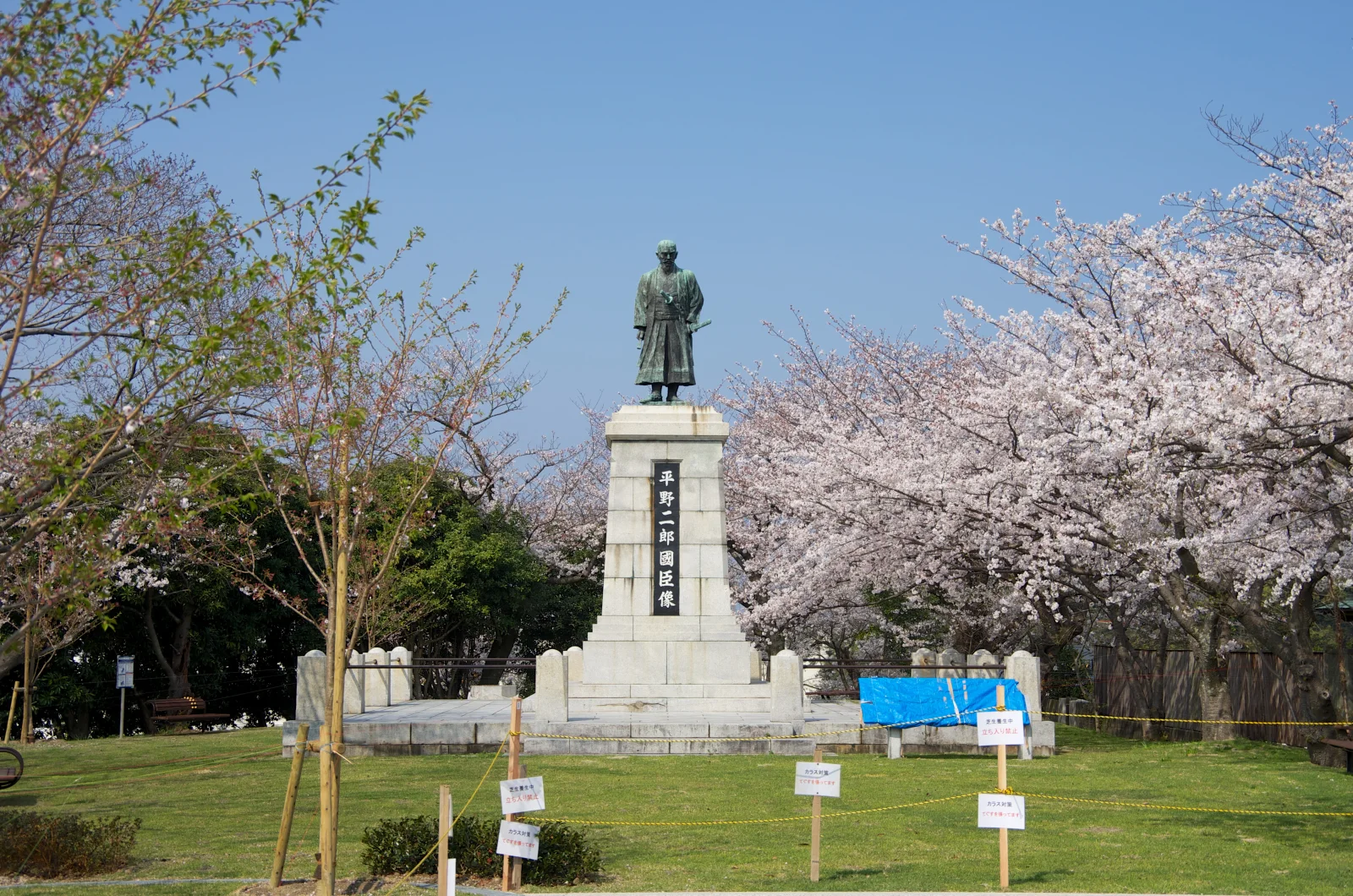
Nishi Park sits on Mount Aratsu just north of Ohori Park; take Ohorikoen Station Exit 1 to the base of the hill, then walk up the Terumo Shrine approach. Valleys, slopes, and shrine staircases naturally spread crowds across different elevations. Park management counts around 1,300 cherry trees—including Somei-Yoshino and wild Yamazakura—making it the only spot in Fukuoka Prefecture listed among Japan's Top 100 Cherry Blossom Spots. For dense, overhead blooms, look for Sakura Valley (Sakuradani) on the park map. For cleaner frames with fewer city buildings in the background, walk over near the Hirano Kuniomi statue, where trees open beside an expanse of lawn with clear foreground and background depth.
Terumo Shrine honors Kuroda Josui and Nagamasa, tying its history directly to Fukuoka Castle. Walking up the cherry-lined approach and pausing by the torii gate already feels like a complete short stroll. From there, choose one branch route that fits your energy—climb the shrine steps, dip down into Sakura Valley, or walk out to the lookout. Older travelers who prefer handrails or a slower pace downhill should budget more time for the descent than the climb up. Points that look close on a flat map still require climbing across ridges inside the park.
From the central lookout area, Nishi Park overlooks Hakata Bay and, on clear days, Shikanoshima Island. Fukuoka Prefecture announced that construction on a public-private park facility began in March 2026, with opening slated for May 2027. For a spring visit, anchor your main stops around Terumo Shrine and Sakura Valley, treating the bay viewpoint as an optional extension. Families with kids can also check out the already open Mori no Asobi Hiroba (Forest Play Plaza), whose terrain and playground equipment offer more room to run than the shrine path. It sits toward the west side, so add that extra distance to your walking budget if combining it with the bay lookout from the station.
For the 2026 Nishi Park Sakura Festival, illuminations were announced from March 27 to April 10 between 18:00 and 22:00, though on-site vehicle restrictions were lifted early on April 9. Because festival schedules, parking rules, and traffic controls vary year by year, treat Ohorikoen Station as your primary entry point for spring 2027. Leaving your car at your hotel or a downtown lot saves you from waiting for limited hillside parking. Walking slopes in rain or after dark quickly gets tiring, so save Nishi Park for daytime blooms and head back down to the flatter moat paths at night.
Ohori Park: Leave Time for the Pond Shoreline
Ohori Park's large central pond was once part of Fukuoka Castle's outer moat, with a loop trail measuring roughly 2 km. It works well either as an easygoing first stop or a low-key breather after touring Maizuru. Start along the north shore and follow one bank south toward the Japanese Garden, Fukuoka Art Museum, or Ropponmatsu. To shorten the loop, cut across the Nakanoshima Island bridges and head back north, or simply grab a bench along the north bank. Calm, low-wind hours are best for water reflections, though blossoms in the frame depend on where trees meet the shoreline—if dense flower canopies are your priority, hit Maizuru or Nishi Park first.
Because joggers, walkers, and strollers share the lakeside path, check the painted lane markings along the ground before settling into a pace. Step out of the main flow whenever stopping for photos or checking a map. Families with young kids can aim for Kujira (Whale) Park on the east bank near the museum side, or Donguri (Acorn) Park on the west side, rather than treating the full 2-km circuit as mandatory. If only one or two people in your group want to visit the museum, set a meetup spot outside the Fukuoka Art Museum or at the Japanese Garden's Kabukimon Gate so nobody has to track each other down around the pond.
If kids want to go boating, aim for the boathouse at the north end during the warmest, calmest window of the day. Thirty-minute rentals cost ¥800 for a rowboat and ¥1,200 for a small swan boat. Standard small-boat capacity is two adults plus one elementary school child, or two adults plus two children aged 5 and under; two adults with two school-age kids will need to check large-boat capacity. The boathouse opens at 11:00 on weekdays and 10:00 on weekends and national holidays. In March, last rental acceptance generally closes about an hour before sunset; in April, hours usually run until 18:00 with last acceptance at 17:30. High winds or rain can shorten hours, so if you also plan to enter the Art Museum that afternoon, work backward from museum last-entry times before deciding whether to save boating for another trip.
To add the Ohori Park Japanese Garden, enter through the Kabukimon Gate near the Art Museum or the West Gate by Ohori Terrace. In March and April, the garden opens from 9:00 to 17:00 with last admission at 16:45. Admission is ¥250 for adults, ¥120 for children under 15, free for children under 6, and free for visitors aged 65 and over with valid age ID. It closes on Mondays, or the following day if Monday is a national holiday. Companions who just want to rest can wait at a bench outside and agree on a pickup time; because the garden is mostly open-air paths, heavy rain makes going straight into the Art Museum the better call.
Half-Day, Full-Day, and Arrival-Day Routes
For a half-day route, start at Ohorikoen Station Exit 5. Walk along the moat past Shimonohashi-gomon Gate, pick one section of the castle walls to explore inside, and then head west to the north end of Ohori Park's pond. Wrap up there before noon and grab lunch nearby before heading back underground. If you already booked lunch near Ropponmatsu, cross from the castle grounds to the south shore using the Art Museum as a landmark, then walk straight to Ropponmatsu Station on the Nanakuma Line—you can ride directly back to Hakata without looping up to the Kuko Line.
For a full day, walk up Nishi Park's shrine approach in the morning, return to Ohori Park for lunch and a shoreline stroll, and explore Maizuru Park's stone walls and cherry trees in the afternoon. If you want night illuminations too, sit down for an early dinner around Akasaka or Otemon before walking back in through your ticketed entrance. Putting the uphill climb first and the castle second works best when Nishi Park is near peak bloom. If bloom conditions differ sharply between the two parks, visit whichever is peaking first, fill the post-lunch gap with the pond or a museum, and push the third park to the next morning.
Traveling with older relatives or toddlers? Take Exit 3 in the morning to find benches at the north end of Ohori Park, focusing on the lakeside and the outer perimeter of Maizuru Park. Anyone wanting the castle climb can split off for an uphill detour while everyone else meets near Shimonohashi-gomon. If toddlers need a nap or older travelers get chilly after walking, head back to the hotel for the afternoon and return solely for one illuminated zone after dark. If your family only wants one outing per day, a sunny morning walk paired with lunch beats waiting around all afternoon for the lights.
Arriving from the airport with an onward JR train later the same day? Drop heavy suitcases at Hakata Station or your hotel first, then take the Kuko Line to Akasaka or Ohorikoen. Walk one stretch along the moat and ride the exact same line back. On tight transit days, staying close to the moat and castle gates keeps your return clock predictable. If you are staying two nights or longer in Fukuoka, move night blossoms to a separate evening so your daytime hours go toward whichever park looks best outdoors.
Lunch Inside the Castle Ruins vs. Restaurants South of the Pond
If you want to eat inside Maizuru Park, pick up onigiri, sandwiches, or bakery items right outside the subway station and look for open pedestrian spaces or designated seating areas. Handheld food makes it far easier to switch lawns or follow another row of trees than spreading out a picnic tarp to claim a spot. When festival food trucks are operating, lunch lines cross paths with afternoon arrivals—view the flowers first and eat slightly later near the entrance. If rain has soaked the grass, skip the park picnic for cafes along Meiji-dori or in Akasaka; a hat and a small waterproof mat are far more practical than hauling full picnic gear.
Ohori Park works best for picking a lakeside bench mid-stroll, while Nishi Park's steep paths are easier after eating first. Open flames, barbecues, and camp stoves are strictly prohibited in both Nishi Park and Ohori Park. Pack out all containers, napkins, and plastic bags, and tuck trash inside a zippered pouch or knotted bag if the wind picks up. On pond-focused days, walking south to Ropponmatsu for a meal connects right onto the Nanakuma Line back to Hakata, while eating around Otemon or Tojinmachi keeps you close to the Kuko Line. Pick a restaurant on whichever side you happen to get hungry rather than walking another half-lap around the pond just for a saved pin.
For a relaxed dinner around night illuminations, schedule a sit-down meal before entering the paid zones, or take the subway back to Tenjin afterward. If you eat before going in, leave enough buffer for ticket lines, castle walking, and your return train. When someone holds a single-zone ticket, they can linger for extra photos while the rest of the group rides ahead to Tenjin to meet up. To keep your evening going, check our guide to Fukuoka food neighborhoods and yatai stalls and choose between Tenjin and Nakasu based on your route back to the hotel, avoiding a late-night walk back near the castle grounds.
Rainy-Day Indoor Backups by Day of the Week
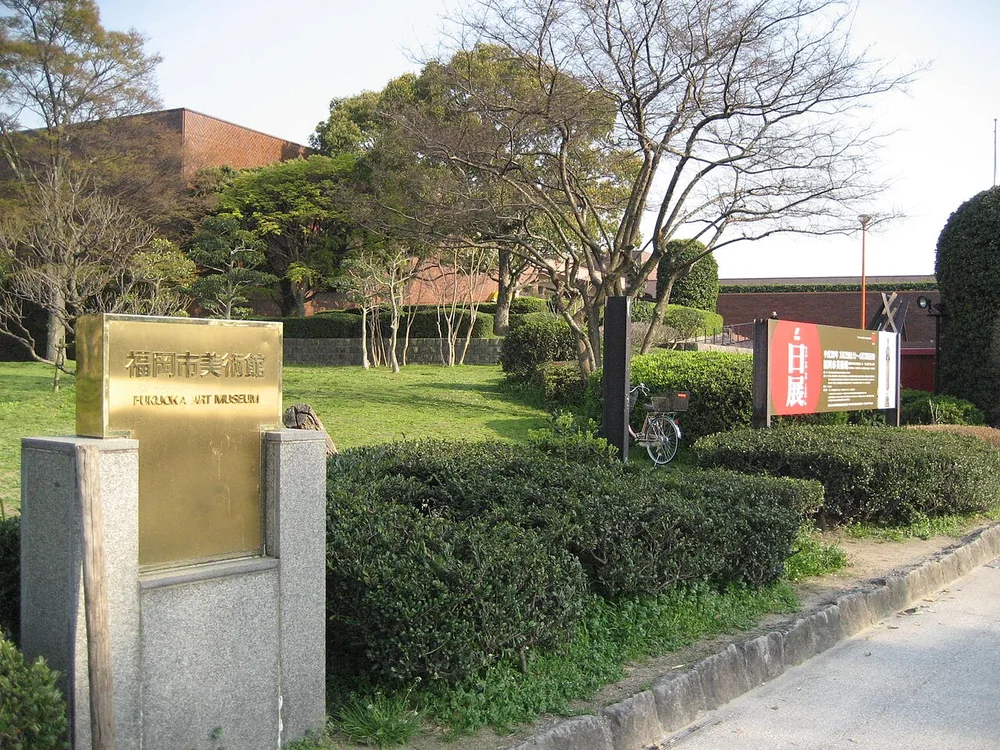
The Fukuoka Art Museum sits on the southeast corner of Ohori Park. Spring hours are typically 9:30 to 17:30 with last entry at 17:00. Collection and regular gallery admission is ¥200 for adults, ¥150 for high school and university students, and free for junior high students and younger, while special exhibitions are priced separately. The museum closes on Mondays, shifting to the next weekday when Monday is a national or substitute holiday. Walking over from Maizuru's stone walls lets you make a game-time call at the doors: light drizzle means a quick south-shore walk; steady rain means stepping inside and saving the pond for tomorrow. To pick galleries ahead of time, read our Fukuoka Art Museum half-day collection route.
The Korokan Ruins Museum closed for renovations on October 1, 2026 and is scheduled to remain closed through late March 2027. If you arrive early in the spring season, swap in the Fukuoka Castle Mukashi Tanbokan inside the park or Sannomaru Square near Ohorikoen Station Exit 5. Sannomaru Square is free to enter from 9:00 to 17:00 (last entry 16:30) and displays visual guides to both Fukuoka Castle and Korokan. Both spots pair smoothly with a brief walk along the moat; if you are ducking out of rain for the entire afternoon with kids, continue straight to the Science Museum in Ropponmatsu.
The Fukuoka City Science Museum sits right outside Exit 3 of Ropponmatsu Station on the Nanakuma Line. The 5th-floor Basic Exhibition Room opens from 9:30 to 18:00 with last admission at 17:30. Tickets cost ¥510 for adults, ¥310 for high school students, and ¥200 for elementary and junior high students; preschool children enter free with a guardian. Planetarium shows require separate timed tickets, so check the schedule before heading in. The museum usually closes on Tuesdays (or the following day if a holiday falls on Tuesday), though it stays open daily during school spring break. On Mondays when the Art Museum is closed, families can easily pivot from the south pond straight to the Science Museum—and if kids run out of steam, hop on the subway right at Ropponmatsu back to the hotel.
Pacing for Weather, Slopes, and Standing in Line
For quiet morning photos, start along Maizuru Park's moat, where wide walkways make it easy to frame drooping blossoms over the water. At peak bloom, crowds naturally pause at the same trees—keep walking along the stone walls for a fresh angle instead of waiting for one spot to clear. Right after rain stops, wet masonry, petals, and reflections hold rich detail up close without needing a high perch like Tenshudai. Use your phone's night mode for illuminated sections, then tuck it away and step clear of corners, stone stair landings, and entry gates.
Standing still waiting for evening lights is often the coldest part of a spring day, feeling noticeably chillier than walking in daylight. Spring breezes across Nishi Park's bay-facing ridge and Ohori Park's open pond drop temperatures quickly, so pack a compressible windbreaker. In damp, cold weather, postpone the Nishi Park climb and stick to a shorter flat circuit between the moat and the Art Museum. Large umbrellas take up tight space on stone steps and narrow paths; short rain ponchos free up both hands and make supervising children much easier. After rain, take any paved pedestrian detour around wet stone steps straight back to an exit.
If someone in your group tires from standing long stretches, walk a short segment by Ohori Pond during the day, head back to the hotel to rest, and return by subway just for a single night-illumination zone. Strollers heading to Nishi Park need to follow the paved slope road to access the shrine approach, turning back before any staircases near the torii gate to keep the rest of the route level. Another easy compromise is choosing a cafe with seating outside the castle walls and meeting up only when it is time to view the moat blossoms. If travelers want different walking distances, break into two shorter routes that both end cleanly at a subway station rather than forcing everyone through one big loop.
Where to Stay: Hakata, Tenjin, or Ohori?
If you have an early JR train, Shinkansen, or morning flight the next day, staying near Hakata Station simplifies luggage storage and departure timing. Ride the Kuko Line out for cherry blossoms, return on the same line at night, or take the Nanakuma Line straight back from Ropponmatsu. When booking, factor in the walk from the underground subway platforms to your hotel lobby—a short walk with rolling suitcases matters more than straight-line distance to the castle on a map. If you need to catch a morning train right after breakfast, limit your arrival day to either daytime viewing or night illuminations, not both.
If shopping and night blossoms share equal priority, Tenjin near the Kuko Line's Tenjin Station is hard to beat. After dinner, Akasaka is only one stop away—or an easy walk down city streets if your legs still feel good. Staying around Tenjin-Minami, Watanabedori, or Yakuin puts you on the Nanakuma Line for daytime trips to Ropponmatsu and Ohori's south side. Keep in mind that Tenjin and Tenjin-Minami are separate stations; treat the walk from your hotel to the exact platform you need as one continuous trip, as walking above ground straight to the Kuko Line is often faster than transferring underground between lines.
If cherry blossoms are your trip's centerpiece and you want different light across two days, look along Ohorikoen Station, Otemon, and Tojinmachi. With an open morning, you can walk straight out to the pond or moat to check the blooms, walk home from Maizuru's night lights, and still hop onto the Kuko Line downtown the next day. On the flip side, if you have dinners booked in Hakata both nights and are checking out with heavy suitcases, put the transit hub first. When your group has mixed priorities, compare options in our Hakata vs. Tenjin hotel guide and match your base to the hours you plan to be out.
Even among hotels labeled "near the station," check which exit lines up with your itinerary. JR Kyushu Hotel Blossom Hakata Central is roughly a 2-minute walk from Hakata Station's Hakata Exit, while its sister property Blossom Fukuoka is about a 2-minute walk from the Chikushi Exit. Both connect easily to the subway toward Tenjin, just from opposite sides of the complex. If the castle ruins are your main focus, Heiwadai Hotel Otemon sits between Akasaka and Ohorikoen stations, about a 6-minute walk from Ohorikoen Exit 5, while Heiwadai Hotel Arato is around 3 minutes from Ohorikoen Station—a stronger base for walking north into Nishi Park in the morning. Pin your two evening returns on a map to see which cuts out wasted backtracking.
Fitting Cherry Blossoms Into a Three-Day Kyushu Itinerary
Staying all three nights in Fukuoka? Keep your city cherry blossom day swappable with a day trip to Dazaifu. If you arrive before noon on day one, walk Ohori Pond and Maizuru's moat right away. Save the clearest weather on day two for whichever park—Maizuru or Nishi—is blooming best, and leave Maizuru's night illuminations for your final evening. If you want to combine Dazaifu with evening castle lights, tour only the Dazaifu Tenmangu area during the day, rest at your hotel, and head back out fresh; if rain moves in, pivot to the Ohori Art Museum or downtown arcades.
Thinking of adding Kumamoto or Kitakyushu for extra cherry blossoms? Check regional JMA bloom reports separately before committing. Each city announces full bloom off its own local reference tree, meaning places only an hour apart can sit in different stages the same week. Before locking in an intercity JR day trip, make sure the destination has sights you still want to see if the blossoms happen to be past peak or still tight. If maximizing flower time is your goal, splitting two days across Fukuoka's own parks—Nishi Park's approach and Sakura Valley feel completely distinct from Maizuru's stone walls—saves you from packing and unpacking bags.
If blossoms are already dropping by the final stretch of your trip, trim your outdoor time to a quick walk along the moat before heading into your favorite shopping streets. When catching a midday JR train out of town, ride the Kuko Line back to Hakata from Akasaka or Ohorikoen, or take the Nanakuma Line direct from Ropponmatsu. If only one person wants extra morning photos, everyone else can stay at the hotel for breakfast and packing, meeting at the station instead of hauling bulky luggage up castle stairs or hunting for coin lockers inside the park.
A few useful answers
When is the best time to see cherry blossoms in Fukuoka?
Aim for late March through early April. Based on Japan Meteorological Agency (JMA) Fukuoka data for Somei-Yoshino cherry trees, the average first-bloom date is March 22 and average full bloom is March 31. In 2026, first bloom was observed on March 24 and full bloom on April 3.
Are the 2027 Fukuoka Castle Sakura Festival dates announced yet?
The organizer's official website has confirmed the festival will return in 2027, though exact dates have not been announced yet. In 2026, the festival started on March 25 and was extended to April 8 to match the bloom schedule.
Do you need a ticket for night cherry blossoms at Maizuru Park?
Using 2026 as a baseline, public pathways along the moat are free to walk and view lit trees. Separate admission applies to specially illuminated zones—Sakuraen, Otakayashiki Ruins, and Tamon Yagura—at ¥600 per zone or ¥1,500 for a three-zone pass for adults; high school students and younger enter free.
Are all three cherry blossom parks near Ohorikoen Station?
Yes. From Ohorikoen Station, Exit 1 leads to Nishi Park, Exit 3 opens near the Ohori Park pond, and Exit 5 heads toward the west side of Maizuru Park. To enter from the east side of Fukuoka Castle Ruins, use Akasaka Station Exit 2.
What can you do if it rains during your cherry blossom trip?
The Fukuoka Art Museum sits on the south side of Ohori Park, and the Fukuoka City Science Museum is right outside Ropponmatsu Station. The art museum typically closes on Mondays, while the science museum typically closes on Tuesdays with special daily openings during spring break.
Which route is best for strollers or older travelers?
Start on the north shore of Ohori Park's pond, then continue to the moat and Shimonohashi-gomon Gate at Maizuru Park. Both Nishi Park's shrine approach and the Honmaru area inside the castle ruins involve slopes and stone steps, so save those climbs for anyone with energy to spare.
Official information and references
Sources used in this guide.
- Fukuoka Regional Meteorological Observatory | Somei-Yoshino Normals and 2026 Bloom Observations
- Fukuoka Castle Sakura Festival Official Site | 2027 Continuation & Night Venues
- City of Fukuoka | 2026 Fukuoka Castle Sakura Festival Extension Notice
- Fukuoka Castle Sakura Festival Official Site | Access & 2026 Subway Ticket Discount
- Maizuru Park Management | Tenshudai, Kanamono Yagura & Korokan Closure Notices
- Fukuoka Castle & Korokan | Sannomaru Square Visitor Center & Access
- Fukuoka Castle & Korokan | Fukuoka Castle Mukashi Tanbokan
- Fukuoka City Subway | Ohorikoen Station Exits & Facilities
- Fukuoka City Subway | Regular Fares
- Fukuoka City Subway | 1-Day Pass & Other Tickets
- Fukuoka Airport | Free Inter-Terminal Shuttle Bus (International/Domestic)
- Nishi Park | Park Map, Sakura Valley & Lookout Plaza
- Nishi Park | Bloom Logs & Daytime Viewing Notices
- Nishi Park | Walking Routes & Parking Information
- Nishi Park | 2026 Sakura Festival Illuminations & Vehicle Restrictions
- Nishi Park | 2026 Early Lifting of Vehicle Restrictions
- Fukuoka Prefecture | Nishi Park New Facility Construction & Scheduled Opening
- Nishi Park Management | Mori no Asobi Hiroba Playground Opening Notice
- Nishi Park | Open-Flame Ban & Park Rules
- Ohori Park | Park Map
- Ohori Park | Open-Flame Ban & Park Rules
- Ohori Park Japanese Garden | Hours & Admission Fees
- Fukuoka Art Museum | Opening Hours & Admission Fees
- Fukuoka City Science Museum | Exhibition Hours, Closures & Fees
- Fukuoka City Science Museum | Traditional Chinese Facility & Access Guide
- Fukuoka Municipal Newsletter | 2026 Maizuru Park Cherry Varieties & Night Pathway Rules
- Fukuoka City Subway | Contactless Payment Daily Cap & Card Rules
- Ohori Park | Outer Moat, Loop Trail & Lakeside Facilities
- Ohori Park Boathouse | Rental Hours, Boat Types & Fares
- JR Kyushu Hotels | Hakata Exit vs. Chikushi Exit Comparison
- Heiwadai Hotel | Otemon & Arato Locations and Subway Access
- Nishi Park | Mount Aratsu Park History & Japan's Top 100 Cherry Blossom Spots