How to take the free shuttle to the subway from Fukuoka Airport's International Terminal, plus direct bus stops, fares, and payment rules for Hakata Chikushi Exit and Tenjin, Visit Japan Web, late arrivals, terminal transfers, and return trips.
- Region & Focus
- Fukuoka
- Reading Scope
- 21 min read · 9 chapters · 7 Q&As
- Official Verification
- 27 official sources checkedUpdated November 22, 2026
- Key Topics
- Airport transfersRail travelFirst trip
Chapter Route Map (tap any stop)
- Start on International Terminal 1F and Check Your Hotel's Exit
- How to Catch the Free Shuttle to the Kuko Subway Line
- Nishitetsu Direct Buses to Hakata and Tenjin: Different Payment Rules
- Visit Japan Web, Joint Kiosks, and Customs
- Heading Straight to Kumamoto or Yufuin vs. Staying in Hakata
- Late-Night Arrivals: Catching the Last Shuttle and Hotel Check-In
- Traveling with Kids, a Wheelchair, or Heavy Luggage
- Connecting Between Flights at FUK Means Switching Terminals
- Keep Arrival Day and Return Plans Flexible
- Quick Q&A
Once you clear customs at Fukuoka Airport, you step out onto the 1st floor of the International Terminal. From that same level, you can board a direct bus to Hakata or Tenjin, or take the free inter-terminal shuttle to the Domestic Terminal and go downstairs for the subway. The subway ride from Fukuokakuko Station takes about 5 minutes to Hakata and 11 minutes to Tenjin once you board. Travel light to a hotel near a subway exit? Take the train. Staying near Hakata's Chikushi Exit or Nishitetsu Tenjin Expressway Bus Terminal? Check which direct bus leaves soonest after you exit customs.
Start on International Terminal 1F and Check Your Hotel's Exit
Save your hotel's exact address and nearest station entrance on your phone before you land. Typing just "Hakata Station" into a map app leaves out a crucial step. Nishitetsu's direct airport buses stop on the east side at the Chikushi Exit; if your hotel sits outside the west Hakata Exit, you will still have to cross through the station with your bags. On the subway, you can follow exit signs underground toward the side you actually need. If your hotel is right by the Chikushi Exit and a bus is about to leave, taking it saves loading bags onto the shuttle, heading down to the subway, and climbing back to street level. If you are headed to the Hakata Exit or transferring to JR trains, set your map destination to the hotel door or transfer gates before comparing routes.
Tenjin has two similarly named stations that trip up first-timers. The Kuko Line from the airport serves "Tenjin" Station, while "Tenjin-minami" sits on the Nanakuma Line. A hotel listed as being in Tenjin may actually be closer to Tenjin-minami, Watanabe-dori, or across a long stretch of underground shopping arcade. Nishitetsu's direct express bus ends at Nishitetsu Tenjin Expressway Bus Terminal, right next to Nishitetsu Fukuoka (Tenjin) Station. If you are staying next to the bus terminal with heavy suitcases, the direct bus is effortless. If your hotel is north of Kuko Line Tenjin Station, following the subway exits is usually smoother. If it is raining, factor in that final stretch above ground.
If your hotel is near Kushida Shrine, Yakuin, or Tenjin-minami, take the Kuko Line from Fukuokakuko to Hakata and follow the Nanakuma Line signs inside the subway fare gates. Exiting at Tenjin and walking to Tenjin-minami to tap back in splits the trip into two separate fares. Stay inside the subway gates at Hakata and use the connecting passageway instead of following the crowd out toward JR trains. Kushida Shrine is the very first stop from Hakata on the Nanakuma Line. Staying along the river in Nakasu? Compare the entrances for both Nakasu-Kawabata and Kushida Shrine stations on a map, and pin exits with elevators if you have large bags -- you will use them every day.
Outside on the 1st floor of the International Terminal, look separately for the inter-terminal shuttle bus and Nishitetsu's two city buses to Hakata Station (Chikushi Exit) and Tenjin. The free shuttle only moves you to the other terminal; you still have to board the subway there to reach downtown. Nishitetsu's two direct routes each have their own bus stops, fares, and accepted payment methods. If you are traveling in a group, send one person ahead to check the destination display on the bus and the end of the line while everyone else waits off to the side with the luggage instead of hauling bags back and forth between adjacent stops.
| Transit Option | International Terminal Stop | Best Drop-Off | Adult One-Way Fare |
|---|---|---|---|
| Free shuttle + subway | Bus Stop 5 | Hakata, Gion, Nakasu-Kawabata, Tenjin, and other subway stations | ¥260 to Hakata or Tenjin |
| Nishitetsu Airport Bus | Bus Stops 6 & 7 | Hakata Station Chikushi Exit | ¥400 (¥380 via IC card or contactless credit card) |
| Nishitetsu Airport Express | Bus Stop 8 | Nishitetsu Tenjin Expressway Bus Terminal | ¥500 (¥480 via IC card) |
| Taxi | 1F Taxi Stand | Hotel entrance or any street address | Metered fare plus applicable fees |
How to take the free shuttle to the subway from Fukuoka Airport's International Terminal, plus direct bus stops, fares, and payment rules for Hakata Chikushi Exit and Tenjin, Visit Japan Web, late arrivals, terminal transfers, and return trips.
How to Catch the Free Shuttle to the Kuko Subway Line
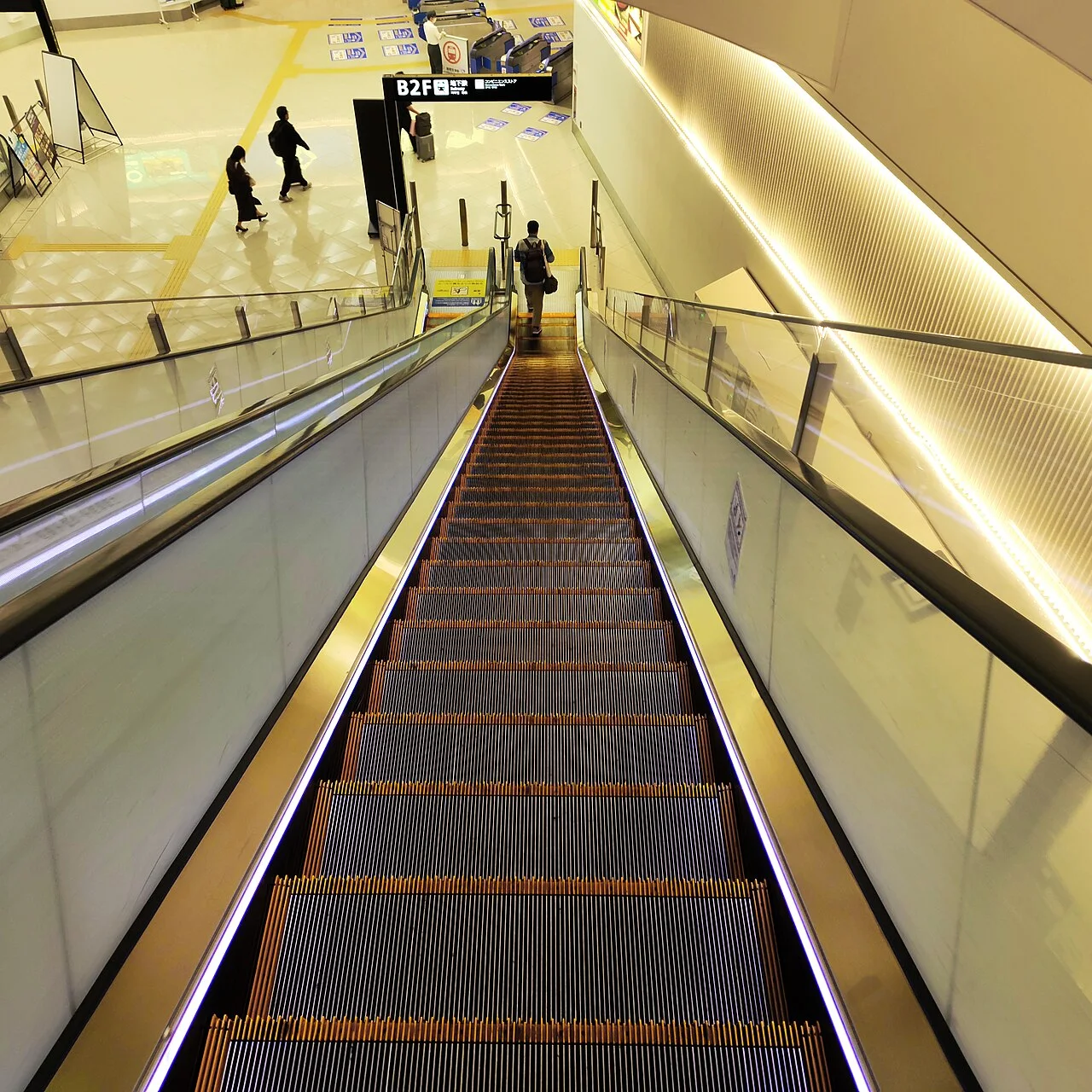
After clearing customs at the International Terminal, step outside to Bus Stop 5 and wait for the free shuttle bus marked for the Domestic Terminal. According to the airport's transfer guide, the ride takes about 10 minutes each way, not counting wait time and walking down to the station. You can board and exit through both the front and rear doors with no ticket or tap required. The shuttle drops you on the south side of the Domestic Terminal near subway entrances 1A and 1B, where escalators and stairs lead down. If you need an elevator, head inside the Domestic Terminal to the south elevator and ride down to the B2 subway concourse.
Domestic Terminal arrivals are already on the subway side of the airport. Walk out of the South Arrival Gate and look ahead for the south elevator or the escalators going straight to B2; from the North Arrival Gate, turn right first. Do not follow the shuttle bus arrows outdoors unless you actually need to cross over to the International Terminal. If you just rode the shuttle over from the International Terminal to catch a domestic flight, stay on the 1st floor to find your airline counter and check in before heading up to security on the 2nd floor.
Once inside Fukuokakuko Station on the Kuko Line, Hakata is two stops away, followed by Gion, Nakasu-Kawabata, and Tenjin. Pull up Hakata Station's layout map before you board. Follow signs for the Shinkansen if catching a bullet train, "JR Lines" for conventional limited express trains, or head straight for your exit if going to a hotel. During rush hour, letting a packed train go and waiting for the next one is far easier than wedging large suitcases by the doors -- especially if someone in your party needs to find the platform elevator at your stop.
A standard adult subway fare from Fukuokakuko to either Hakata or Tenjin is ¥260. Nationwide IC cards such as Suica, ICOCA, and nimoca work at the gates, and you can also tap an eligible contactless credit card at the dedicated readers on the ticket gates. Even if your mobile wallet and physical card are linked to the same account, stick to the exact same device or card when tapping both in and out. If you are traveling with children who qualify for child fares, use a child IC card or buy age-specific tickets at a vending machine so you can easily verify the discounted fare.
One ticket or one contactless card covers only one rider. If two adults are traveling together, one can tap an IC card while the other buys a single-ride paper ticket, then split through the gates and meet under the exit sign. If you are only taking the subway from the airport to your hotel that day, pay the single-ride fare. Planning several more subway rides later? Add up your planned trips to see if the ¥640 Fukuoka City Subway 1-Day Pass makes sense. Paper 1-Day Passes from the ticket machines are valid on the day of purchase and do not cover JR or Nishitetsu trains.
Fukuoka City Subway also caps daily fares at ¥640 when you ride exclusively with the same eligible contactless credit card or the same mobile device. If you are unsure how many subway trips you will take that day, tapping the same card or phone all day avoids standing in line to buy a paper pass. Just remember not to mix methods: riding into town on a Suica and switching to a contactless credit card later will not count that first fare toward the credit card cap. If you want a paper pass's partner attraction discounts, check which pass format the venue requires.
Keep your outbound and return directions straight. Going downtown from Fukuokakuko, both Hakata and Tenjin are on the same line. Heading back to the airport -- especially from Tenjin or stations farther west on the Kuko Line -- check the platform display for the train's final destination and board one bound for Fukuokakuko, since trains bound for Kaizuka also share the same eastbound track. If you reach Hakata and realize your hotel is on the Nanakuma Line, just transfer inside the gates.
Nishitetsu Direct Buses to Hakata and Tenjin: Different Payment Rules
The Nishitetsu Airport Bus to Hakata Station's Chikushi Exit departs from Bus Stops 6 and 7 outside the International Terminal, with an official fastest travel time of 15 minutes. The regular adult fare is ¥400, or ¥380 with a transit IC card or eligible contactless credit card. This route is currently running a cashless boarding trial, so tap an IC card, use contactless credit, or buy a ticket before boarding. Leaving the airport, you pay as you board through the front door; on the return trip from Hakata Station's Chikushi Exit, tap your IC card or contactless credit card both when boarding and when getting off. Note that payment timing differs by direction.
The nonstop Nishitetsu Airport Express to Tenjin departs from Bus Stop 8 and terminates at Nishitetsu Tenjin Expressway Bus Terminal. Its timetable updated October 25, 2026 splits weekday and weekend/holiday schedules, with travel times of roughly 30 to 40 minutes depending on the departure. The adult cash or paper-ticket fare is ¥500, or ¥480 with a transit IC card -- contactless credit cards cannot be tapped directly on board this route. If you only have a contactless credit card, buy a bus ticket at the terminal or take the free shuttle to the Domestic Terminal and tap your card at the subway. On the Airport Express, Nishitetsu asks passengers to load and unload their own suitcases in the underfloor luggage bay; ask station staff if you need help.
Old screenshots often send travelers to the wrong return bus stop. The direct Nishitetsu bus from Hakata back to the International Terminal leaves from outside JR Hakata Station's Chikushi Exit -- do not go to the Hakata Bus Terminal on the opposite side of the station. From Tenjin, head to Boarding Gate 6 inside Nishitetsu Tenjin Expressway Bus Terminal for buses to Fukuoka Airport International Terminal. Save the Japanese stop names and gate numbers on your phone and check Nishitetsu's timetable for your exact direction so you do not accidentally read the airport-departure column for a downtown departure.
The direct "Tabito" bus to Dazaifu also boards at Bus Stop 8 in the same zone as the Tenjin express bus, so check the destination sign on the front of the bus for "Dazaifu" or "Tenjin" before getting in line. From the International Terminal, the Tabito bus takes you straight to Dazaifu for ¥700 adult cash/ticket, or ¥680 with an IC card or contactless credit card. The route map shows Hakata Bus Terminal because inbound trips originate in Hakata before stopping at the airport; to go from the airport to Hakata, take the Chikushi Exit Airport Bus instead. Only slot Dazaifu Tenmangu Shrine onto arrival day once you see how closely your customs exit lines up with the next departure.
You do not have to lock in subway vs. direct bus until you walk out of customs. For two adults going to the Chikushi Exit, the shuttle-plus-subway route totals ¥520, while the Nishitetsu Airport Bus with IC cards totals ¥760 -- that ¥240 difference buys you a one-seat ride with no transfer. On the other hand, if the next direct bus is a long wait and you only have carry-on bags, heading for the subway makes total sense. Pick a default plan before departure, then compare the live departure board and bus queue on 1F before committing.
Visit Japan Web, Joint Kiosks, and Customs
Before your trip, create a Visit Japan Web account through Japan's Digital Agency using your email address. Have your passport, arrival date, flight number, and first-night hotel address and phone number from your booking confirmation ready. If you are staying at multiple hotels, enter your first night's accommodation for immigration purposes. If your flight changes or you switch hotels, update the trip in Visit Japan Web and pull up a fresh QR code. Registering an account and scanning your passport is separate from completing immigration and customs declarations for a specific trip -- open your actual arrival entry and tap "Display QR Code" ahead of time to confirm it loads.
Follow the immigration signs for foreign visitors after deplaning, keeping both your passport and QR code handy. Fukuoka Airport's International Terminal also operates Joint Kiosks, listed with official operating hours of 7:00-21:00. These kiosks scan your e-passport and Visit Japan Web QR code to submit both immigration and customs data at once. After finishing at a kiosk, eligible international travelers proceed to the dedicated Joint Kiosk immigration counter for processing, collect checked bags at baggage claim, and follow signs to customs. If customs clears you without inspection, you can exit through the facial-recognition e-gate.
If your flight lands late after the Joint Kiosks close, or staff direct you to the standard lane, show your QR code at the regular immigration counter first and pick up your bags afterward. At customs, scan your eligible e-passport and QR code at an electronic declaration terminal and follow signs to the e-gate -- keeping any declarable items and receipts accessible if inspection is required. If your phone battery dies or the screen will not load, ask staff for paper immigration and customs declaration forms and use the staffed counters.
If you register family members under a single Visit Japan Web account, fill out the arrival details for each traveler individually and toggle between profiles to display each person's QR code. Customs electronic declaration also follows a strict one-code, one-person rule. Japan Customs notes an exception allowing young children under 100 cm tall to pass through the gate alongside a family member as directed by airport staff; keep everyone's passports together and let an attendant know when you reach the terminals. If your whole family's codes are on one phone, stack the passports in matching order before stepping up to immigration. Meeting friends or relatives arriving separately? Plan to meet outside the restricted area in the 1F Arrivals Hall.
When several flights land back-to-back, bottlenecks usually happen at immigration queues or baggage claim. Filling out Visit Japan Web early saves you from hunting up hotel details at the desk, though you should still base onward bus or train bookings on when you actually clear customs. If you book a timed highway bus or JR train, keep the operator's contact info, ticket change deadline, and reservation code saved on your phone. Never rush off without all your checked bags; if a bag does not show up, bring your baggage claim tag to the airline counter first, and adjust train or bus tickets according to their fare rules.
Heading Straight to Kumamoto or Yufuin vs. Staying in Hakata
If you are spending your first night in central Kumamoto, look at Bus Stop 11 outside the International Terminal for the "Hinokuni" highway bus, which Nishitetsu lists at ¥2,500 adult one-way to Kumamoto Sakuramachi Bus Terminal (boarding is at Stop 9 from the Domestic Terminal). If your hotel is near Sakuramachi or Karashimacho tram stop, you can walk straight there from the bus terminal. Staying next to JR Kumamoto Station? Taking the subway to Hakata and transferring to the Kyushu Shinkansen usually puts you much closer to your hotel. Plot both terminals and your hotel on the same map before deciding which route saves more walking.
Do not just search "Kumamoto" on a map -- specify either Sakuramachi Bus Terminal or JR Kumamoto Station. If taking the Shinkansen from Hakata, verify your exact train and direction on your ticket. JR Kyushu requires advance reservations for oversized baggage seats when a suitcase's total dimensions (length + width + height) exceed 160 cm up to 250 cm. Handle that when booking so you do not reach the platform with a giant trunk only to be sent back to the ticket office. With tight transfer windows, check ticket change rules beforehand instead of assuming two subway stops to Hakata guarantees a seamless connection.
Nishitetsu highway buses to Yufuin and Beppu depart from Bus Stop 10 at the International Terminal. Double-check that your booking lists "Fukuoka Airport International Terminal" as the pickup point and confirm your exact drop-off stop name. Keep in mind that direct highway buses to Yufuin run on a completely separate schedule from JR sightseeing trains out of Hakata. If your flight lands late and your ryokan has a dinner check-in cutoff, work backward from that cutoff time. If a highway bus gets you there in time, head straight to the stop after customs; otherwise, sleep in Hakata and leave the next morning when reserved seats and dinner timing are stress-free. See choosing between Yufuin and Beppu to decide which base fits your first night best.
Highway buses from the International Terminal also serve Kurokawa Onsen and Nagasaki. When checking schedules, select your terminal first, enter your destination, and expand your specific departure to see all intermediate stops. Looking only at an overview map on the airport website makes it easy to miss who operates the route, whether seat reservations are mandatory, and how ticket changes work -- for example, only certain departures on Kumamoto's Hinokuni bus require reservations, so do not assume the same rules apply to Yufuin or Kurokawa. Lock in a workable backup route and note your accommodation's latest check-in time when booking.
Want to pick up a JR Kyushu Rail Pass (Northern Kyushu or All Kyushu) right away? There is an exchange counter on 1F of the International Terminal open daily 9:00-17:00, where you can redeem agency exchange orders or official JR Kyushu online bookings along with any pre-booked reserved-seat tickets. Bring your passport, exchange order, and -- if purchased directly on JR Kyushu's website -- the original payment credit card. New pass purchases, ticket changes, and refunds must be handled at a full JR ticket office. If you clear customs after 17:00, drop your bags at your Hakata hotel and visit the JR Hakata Station pass pickup counter instead, listed as open daily 7:00-22:00. Handling pass pickup the evening before keeps you from hauling suitcases to the counter the next morning.
Late-Night Arrivals: Catching the Last Shuttle and Hotel Check-In
For late flights arriving at the International Terminal, check the "From International Terminal" schedule on the airport's shuttle page alongside Fukuokakuko Station's subway timetable. As of a November 22, 2026 schedule check, the airport lists the last shuttle leaving the International Terminal at 23:21, with departures spacing out to roughly every 15 minutes after 22:00. Keep in mind that 23:21 is the time the bus pulls away from the International Terminal stop -- if your plane touches down at 23:00, you still have deplaning, immigration, baggage claim, and customs to clear before reaching 1F. Use any flight delay alerts and your actual customs exit time to decide between rushing to the bus stop or heading straight to the taxi rank.
Even if you catch the last inter-terminal shuttle, you still have to make the final subway departure from Fukuokakuko Station and any last downtown transfer. Fukuoka City Subway publishes separate weekday and weekend/holiday timetables for Fukuokakuko Station, and late trains may terminate at different stations along the line. If you are staying in Yakuin or Watanabe-dori on a late arrival, check whether the Nanakuma Line is still running at Hakata. If only the Kuko Line is still operating, ride to a central station where you can easily hail a taxi for the final stretch. If you spot a late-night airport bus on a schedule, verify which terminal it departs from and whether it actually stops near your hotel -- crossing terminals for a bus that skips your area costs extra time.
When traveling late, carrying heavy bags, or needing door-to-door service, taxis wait outside 1F at both terminals. Because hotel chains often operate two properties near Hakata Station, show your driver the hotel's full Japanese name, street address, and map pin. If you need space for a wheelchair or multiple large trunks, let the stand attendant know your passenger count, wheelchair type, and bag count so they can direct you to an appropriate vehicle. Fukuoka Airport advises contacting operators in advance for accessible welfare taxis -- share your flight arrival window, party size, and wheelchair dimensions when booking.
Save a single screenshot on your phone showing your hotel's latest check-in time and any after-hours entrance instructions. If a flight delay pushes your arrival past your stated check-in time, call or message the hotel from the airport with your updated ETA and ask about self-check-in or night-entry codes. If your group splits into two taxis, make sure both cars have the exact address and agree to meet in the hotel lobby. For a late-night meal on arrival, pick a spot still taking orders or grab something simple on the way rather than burning your remaining check-in window hunting for dinner.
Traveling with Kids, a Wheelchair, or Heavy Luggage
Pushing a stroller makes the difference between a 5-minute subway ride and a 5-minute platform walk feel huge. Heading back from downtown by subway with a stroller or wheelchair, Fukuoka Airport's accessible route tells riders to exit the Domestic Terminal Building ticket gates, take the south elevator up to 1F, exit via Door A, and turn right to Shuttle Stop 1. Coming in the opposite direction into the city, enter the south side of the Domestic Terminal and take the south elevator down to B2. Every inter-terminal shuttle bus is equipped with a wheelchair ramp. With kids in tow, have one adult manage the stroller and another handle the bags, and stow loose totes before the shuttle doors open so your hands are free.
Check which exit has an elevator at your destination subway station before boarding. At Tenjin Station, the most convenient escalator exit toward street-level hotels may have no elevator at all, and Hakata Station separates exits toward JR tracks from exits to the street. If anyone in your group has trouble walking far, measure the longest walking leg between the terminal, destination station, and hotel first -- that tells you quickly whether the extra cost of a direct bus or a taxi is worth it. If a mobility aid is non-folding or needs tie-downs, send its dimensions to the bus or taxi operator ahead of time; inside the subway, ask station staff to point out transfer elevators.
Fukuoka Airport's International Terminal 1F offers temporary baggage storage, coin lockers, and luggage delivery, so decide in advance where you want to retrieve your bags. If you are heading straight to your hotel to check in, bringing your bags with you is usually simpler than picking them up back at the airport at night. Want to head directly to Dazaifu or shop around Tenjin right off the plane? Check the CARGO PASS downtown hotel delivery counter on 1F. The airport lists counter hours as 8:00-19:30, with same-day delivery to participating hotels requiring drop-off by 14:00 for pickup at your hotel by 18:00 -- meaning the same-day cutoff arrives well before the counter closes.
Before handing suitcases over to a delivery counter, pull out passports, medications, diapers, charging cables, and a change of clothes -- and never pack tomorrow's train tickets or hotel confirmations inside a delivered bag. If using coin lockers, snap a photo of the locker number and nearby floor signs; remember that storing bags at the International Terminal means taking the shuttle back there later if you came in via the subway. For a few hours between flights out of different terminals, storing luggage at your departure terminal is far smoother than leaving it where you landed.
Renting a car makes sense if you are driving straight out to the countryside upon landing and can pick up the vehicle during the agency's operating hours. Rental car counters are located on 1F of the International Terminal (there are no equivalent counters inside the Domestic Terminal). If your confirmation says "Fukuoka Airport branch," check whether you report to the 1F counter, meet staff at a designated exit, or catch a shuttle van to an off-site lot. Leave plenty of buffer time after baggage claim for shuttle waits, vehicle inspection, and installing child seats. If you are only staying in downtown Fukuoka your first night, wait until the day you leave town to pick up the car and skip paying for overnight hotel parking.
Connecting Between Flights at FUK Means Switching Terminals
When flying into Fukuoka internationally and connecting to a Japanese domestic flight, you must enter Japan at Fukuoka, claim your checked luggage, clear customs, and ride the shuttle bus from International Terminal 1F. Once dropped off on the south side of the Domestic Terminal, take any re-checked bags to your airline's 1F counter with your travel documents ready; security and departures are one floor up on 2F. Exact transfer rules depend on your ticketing airline, so if your baggage tag or transfer instructions seem unclear, ask at check-in on your first flight which carousel to use in Fukuoka and when baggage drop closes for your domestic leg.
Connecting from a Japanese domestic flight to an international flight works in reverse. Board the shuttle at Stop 1 on the south side of the Domestic Terminal 1F, ride to International Terminal 1F, and head up to 3F for airline check-in and security. Treat the Domestic Terminal subway entrance simply as a landmark for the shuttle stop -- there is no reason to go down to the train platforms. At the International Terminal, check in and drop your bags before worrying about your gate. Even if your incoming domestic flight lands early, hold off on sitting down for a meal until your bags are checked and you have seen the security line.
If you booked two flights on separate tickets, build your schedule backward from the second flight's check-in and baggage-drop cutoff -- factoring in baggage claim, walking to Stop 5, waiting for the shuttle, and heading upstairs on arrival. Say your first flight lands at 13:00 and your next leaves at 14:15: verify exactly when check-in closes for the 14:15 flight before booking. The 10-minute bus ride between terminals is only part of the transfer and leaves out both terminal walks. If both legs are on a single protected itinerary, save the airline's rebooking contact so you can reach out immediately if your first flight is delayed.
On separate tickets with different airlines where a missed connection means buying a walk-up fare, weigh the cost of a later flight or an overnight stay against the risk of rebooking from scratch. On an overnight layover, let the next morning's departure terminal dictate where you sleep: hotels along the subway give effortless access to the Domestic Terminal, while an International Terminal departure adds the shuttle ride. For early-morning international flights, work backward from when your airline's 3F counter opens and closes rather than planning like a late-night arrival.
Keep Arrival Day and Return Plans Flexible
Landing before noon with a first-night stay in Hakata? Plan to drop your bags and grab lunch, and leave the rest open until you actually step out of the airport. From a hotel near the Hakata Exit, strolling toward Gion or Kushida Shrine once your bags are stowed beats dragging suitcases through shopping malls. If you want to hop straight onto a JR train on arrival day, buy flexible tickets or leave buffer between departures so you can message whoever is waiting at your destination once everyone and every bag has cleared customs. To trim down an easy first evening downtown, pull a short loop from our three-day Fukuoka itinerary.
Arriving in Tenjin around dusk? Pick a dinner spot near the bus terminal or your hotel, and save separate errands for after check-in if anyone in your group needs an early night. When choosing between Hakata and Tenjin for your final night, let your flight time decide: early departures favor a short walk from your hotel door to your first morning train or bus, while evening departures give you daytime hours to shop. Returning from Yufuin or Kumamoto on your final day to catch a flight? Budget extra minutes to retrieve bags from station lockers or a hotel before one last meal. Our Hakata vs. Tenjin hotel guide breaks down which neighborhood fits each schedule.
For international departures, check in on 3F of the International Terminal -- and complete any downtown tax-free customs verification first if needed. Start with your airline's check-in and bag-drop cutoff, then work backward from the moment you reach 3F. Taking the subway means leaving time to exit Fukuokakuko Station, walk to Bus Stop 1 on Domestic Terminal 1F, ride the shuttle to the International Terminal, and go up to 3F. Taking a direct bus means padding for weekday rush-hour or weekend event traffic. Booking a private van for a family or group? Set pickup early enough for everyone to clear baggage drop comfortably.
If an early international flight requires arriving at the terminal before public transit starts running, pre-book a taxi or car straight to the International Terminal departures curb. When trains and buses are running, remember that the first subway arrival at Domestic Terminal and the first shuttle to International Terminal run on two separate schedules -- do not check only the first subway train. For example, the airport timetable checked on November 22, 2026 shows the first shuttle leaving Domestic Terminal at 6:00, so check whether an earlier subway train still leaves you waiting for the shuttle, plus the walk up to 3F. Pack the night before, confirm where to drop checkout keys, and check which side of the hotel your pre-booked car can pull up to if the building has two entrances.
Starting November 1, 2026, participating tax-free shops in Japan charge the tax-included price upfront. When you make a tax-free purchase, you must depart Japan within 90 days of purchase and have customs verify your items before the store processes your refund. Flying out of Fukuoka's International Terminal, bring your passport and all tax-free goods up to 3F and complete customs confirmation before checking in or dropping luggage. Fukuoka Airport's verification kiosks sit on the south side in front of counters J-M, with the kiosks and adjacent inspection counter open 6:00-21:00. If the kiosk flashes "RED," step over to the nearby customs officer for inspection. If using Visit Japan Web for tax-free processing, you can connect to the dedicated customs Wi-Fi on that same floor.
Any purchases that must go into checked luggage -- such as liquids or gels exceeding the 100 ml per-container carry-on limit at international security -- should be bought downtown, packed at your hotel, or picked up at terminal shops before bag drop. Once you clear security, check your gate number and boarding time before browsing duty-free souvenirs. Even when booking flights and hotels months ahead, note your departure terminal, check-in floor, and preferred airport transit option right away, and save any shops for later on your map.
A few useful answers
Is there a subway station in Fukuoka Airport's International Terminal?
No -- Fukuokakuko Subway Station is on B2 of the Domestic Terminal. Take the free shuttle bus from Bus Stop 5 on International Terminal 1F to the Domestic Terminal, then transfer to the Kuko Line. Trains take about 5 minutes to Hakata and 11 minutes to Tenjin.
Can you tap a credit card on both direct airport buses?
You can tap an eligible contactless credit card on Nishitetsu's Airport Bus to Hakata Station's Chikushi Exit for ¥380 adult. On the Airport Express to Tenjin, the discounted ¥480 fare applies only to transit IC cards; paying by cash or paper ticket is ¥500.
Can family members share one Visit Japan Web QR code?
You can register family members under one account, but each traveler needs their own QR code and separate declaration when using the customs e-gates. Japan Customs allows young children under 100 cm tall to pass through with a family member if you inform airport staff at the machines.
Do you still line up for immigration after using a Fukuoka Airport Joint Kiosk?
Yes. The Joint Kiosk collects your immigration and customs details first, after which eligible international travelers proceed to a dedicated immigration counter for inspection. From there, collect your checked bags and pass through customs.
Where do you catch the shuttle bus back to the International Terminal?
Board at Bus Stop 1 on the south side of Domestic Terminal 1F. If arriving by subway with a stroller or wheelchair, exit the Domestic Terminal Building ticket gates, take the south elevator up to 1F, exit via Door A, and turn right.
Can you head straight from Fukuoka Airport to Yufuin at night?
Check the International Terminal's Yufuin highway bus schedule, your arrival time, and your ryokan's latest check-in or dinner cutoff first. If the timing does not work out that night, stay in Hakata and take a JR train or highway bus from downtown the next morning.
Can you take a bus directly from the airport to Dazaifu on arrival day?
Yes. Wait at Bus Stop 8 on International Terminal 1F for the "Tabito" bus to Dazaifu -- the regular adult fare is ¥700, or ¥680 with an IC card or contactless credit card. Since buses to Tenjin also leave from Stop 8, check the front destination sign before boarding.
Official information and references
Sources used in this guide.
- Fukuoka Airport | Subway, Shuttle Stops, and Accessible Routes
- Fukuoka Airport | Domestic-International Free Shuttle Timetable
- Fukuoka Airport | Inter-Terminal Transit and Check-In Floors
- Fukuoka Airport | Airport Bus Stop Guide
- Fukuoka City Subway | Zone Fares and Inter-Station Distances
- Fukuoka City Subway | 1-Day Pass
- Fukuoka City Subway | Hakata Nanakuma Line Transfer and Tenjin Separate Fares
- Fukuoka City Subway | Travel Times and Network Overview
- Fukuoka City Subway | Station Timetables
- Fukuoka City Subway | Contactless Card Boarding Guide
- Nishitetsu | Direct Airport Bus: International Terminal to Hakata Station Chikushi Exit
- Nishitetsu | Tenjin Airport Express Schedule and Fares
- Nishitetsu | Dazaifu Liner "Tabito" Route and Fares
- Nishitetsu | Kumamoto Highway Bus "Hinokuni" Fares and Reservations
- Digital Agency of Japan | Visit Japan Web User Guide
- Japan Customs & Immigration Services Agency | Fukuoka Joint Kiosk Flow
- Japan Customs | Joint Kiosk Operating Hours by Airport
- Japan Customs | Electronic Declaration Gate FAQ
- Japan Customs | Customs Procedures for Arriving Passengers
- Fukuoka Airport | Mobility Assistance, Elevators, and Accessible Transit
- Fukuoka Airport | International Terminal CARGO PASS Baggage Delivery
- Fukuoka Airport | Rental Car Counters and Reservation Guide
- Fukuoka Airport | International Check-In, Security, and Carry-On Baggage
- Fukuoka Airport | Downtown Tax-Free Exit Verification (From November 2026)
- JR Kyushu | Shinkansen Oversized Baggage Seat Rules
- Fukuoka Airport | International Terminal JR Kyushu Rail Pass Exchange Counter
- JR Kyushu | Rail Pass Pickup Locations and Hours