Choose Yufuin if you want to spend the evening at a ryokan. In Beppu, your base determines how you combine city dining, geothermal sights and seaside hotels. Settle the room, meals and current intercity transport first, then plan the food and sights you can comfortably fit around that overnight stay.
Yufuin or Beppu: choose your evening before your hotel
If your priorities are Yunotsubo’s shops, a walk around Lake Kinrin and dinner back at the inn, give Yufuin an overnight stay. For varied geothermal sights, steam-cooked food and restaurants still to choose from in the evening, compare Beppu Station or Kitahama first. You can combine the two cities, but daytime sightseeing competes with an afternoon at the inn. With two days and one night, one main accommodation focus is more likely to provide a complete experience than skimming both cities.
Yufuin belongs to Yufu City; Beppu is a separate city. Both 湯布院 and 由布院 appear on signs, place names and products: for transport, identify JR Yufuin Station or the bus center in front of it. Kannawa, Kankaiji and Shoningahama in Beppu are not one walkable neighborhood either. A seaside hotel returned by a Yufuin–Beppu accommodation search may be nowhere near Yufuin’s shopping street. Put its address on your actual route before comparing rooms.
This guide uses official material read on October 22, 2026. The major current changes are the suspension of the Yufurin sightseeing rapid bus and closures at some Myoban facilities; alternatives appear below. For the wider Kyushu route, see planning a Fukuoka city stay and departure base. Here, accommodation, neighborhood meals and onsen activities in Yufuin and Beppu form one connected decision.
From Fukuoka: the sightseeing train is one option
JR Kyushu’s official Yufuin no Mori page states that all seats are reserved; obtain a seat reservation before boarding. Reserved seats go on sale at 10:00 Japan time one month before the travel date. Searches also show the Yufu limited express, so check the train name, date, endpoints and departure time. A seat from Hakata to Yufuin does not by itself mean you have booked the same sightseeing train.
The operator also publishes an operating calendar: Yufu substitutes for Yufuin no Mori on some dates, without the same onboard attendants or sales service. If an inn is available only on one night, compare all transport for that date before deciding whether the sightseeing train justifies changing your stay. For Hakata–Beppu, check limited expresses on the Nippo Main Line separately. The route via Kurume to Yufuin and the route via Kokura and Oita to Beppu are different journeys.
A rail pass still requires checking reserved seats and covered routes. Two nights with a return journey to one onsen town do not automatically justify a pass because the trip is called Kyushu. List your actual sections, eligible trains and reservation methods, then use the comparison of single tickets and rail passes. Your arrival must suit the inn’s reception and dinner requirements, not merely the last train reaching the station.
Autumn 2026 intercity transport: Yufurin is suspended
Kamenoi Bus’s suspension notice lists all Yufurin sightseeing rapid services suspended from October 17, 2026, with no restart date announced. It recommends route 36, the Yufuin line from Beppu Station West Exit. From Kannawa, go to the west exit first and transfer. Old advice to take Yufurin directly from Kannawa to Yufuin cannot currently be followed; a general normal-service message on the bus homepage does not override this route-specific notice.
The official boarding-point and route guide places route 36 at West Exit stop 1, traveling toward Yufuin via Beppu Ropeway and Kijima. Check east versus west exit, weekday versus holiday timetable, and direction. Mountain-road travel, waiting, luggage collection and the walk to your inn need time; map driving minutes alone cannot establish a tight connection before dinner.
A separate temporary direct service runs October 1, 2026–March 31, 2027: it leaves stop 5 in front of Beppu Station at 09:30 for Yufuin Station’s bus center. Adults pay ¥1,100, children ¥550. The notice accepts cash, IC cards, specified one-/two-day wide-area free passes and SUNQ PASS, but not contactless credit-card payment; a full bus may leave you unable to board. This announcement is for one direction, not evidence of a matching afternoon direct return.
For JR between the cities, distinguish going via Oita from having to change there. JR Kyushu’s Yufuin no Mori timetable lists services 3 and 4 through Yufuin, Oita and Beppu: on those through services you can remain on the train. Only when your date-specific result shows an Oita transfer should you check the two trains and seat requirements separately. Rail goes via Oita rather than taking the bus’s mountain shortcut, and not every Yufuin no Mori runs to Beppu. Some dates use Yufu rolling stock. Check operating days and actual reservation results before comparing arrival times.
Make the journey scenic: book the open-top bus separately
If travel itself is part of the experience, compare Kamenoi’s Yunokaze open-top bus. The Beppu–Yufuin route checked here runs October 7–December 13, 2026, taking about 65 minutes one way. Departures from Beppu Station East Exit stop 4 are 09:00, 12:15 and 15:45; returns from Yufuin Station’s bus center are 10:40, 14:20 and 17:05. These limited-period departures cannot be used to plan travel from December 14 onward.
Regular one-way fares are ¥2,200 for adults and ¥1,100 for elementary-school children and younger. Official online credit-card reservations cost ¥2,000 and ¥1,000 respectively. Advance booking opens at 08:00 on the same date one month before travel; gather ten minutes before departure. This is a different product, price and boarding point from the unreserved 09:30 temporary direct service. Do not transfer one service’s fare to the other.
The open-top option suits travelers who want time for the scenery. Check conditions for large luggage, wind sensitivity or rain before traveling. Do not squeeze the inn’s dinner around it: leaving Yufuin at 17:05 still leaves the onward trip to a hillside Beppu hotel. For an afternoon bath, cross earlier and keep the evening for the accommodation you have paid for.
Walking Yufuin: station, Yunotsubo and Lake Kinrin in three stages
A first walk can start at Yufuin Station, follow Yufumi-dori to Yunotsubo Kaido and continue to Lake Kinrin. Return on foot or arrange transport according to energy. Yufu City’s Lake Kinrin guide explains the relationship between the lake and hot springs and the mist that may appear on winter mornings. Mist still depends on the day’s weather. Getting up early offers a chance to see it; a lakeside booking does not guarantee a performance.
Choose a few Yunotsubo shops to browse slowly rather than trying to eat every takeaway as a full meal. For half a day, put lunch at either the station end or the lake end, leaving the middle for walking, sweets and crafts. This avoids repeatedly crossing the crowds for the same shop. With only two hours, eat near the station and walk part of the street rather than forcing in the lake, a dessert queue and a ryokan day bath.
Leave large luggage with a hotel or station-area service whose storage you have confirmed. Hotel storage may have hours and may exclude chilled food: Yadoya explicitly refuses perishables, refrigerated and frozen items. Decide when and where to eat a cake before buying it. Residents and vehicles still use the shopping street and lanes. Keep to the side for photos, queues and sorting purchases, and eat bought food only where the shop allows.
Yufuin accommodation areas: station, shopping streets or outskirts
The station area suits early departures, large luggage and one-night stays. Arrival and departure are simpler, but a room may lack the wooded garden you imagined. Around Yunotsubo and Lake Kinrin, morning and evening walks can be the main attraction; still inspect the actual entrance and road. A short straight-line distance may be harder with luggage, a stroller or rain. The label Yufuin area cannot replace planning the last leg from the station.
Independent mountain-side or outlying inns suit staying on the property with dinner and breakfast. Ask about transfers, advance reservations, the exact station-exit meeting point and late arrivals first. If you want to compare town restaurants in the evening, an outlying inn without evening transfers may add two taxi journeys. Include both fares and waiting in the total cost.
A dinner-and-breakfast stay is convenient for a first ryokan visit, but fixes another time in the day. Travelers leaving Fukuoka in the afternoon and arriving at night should first check for plans accepting that arrival. Conversely, if you have paid for an expensive garden room and dinner, returning around 16:00 for bathing and rest often makes better use of the room than finding a third dessert shop.
Yawaragi-no-Sato Yadoya: near the walks, without an in-room onsen
Yufuin Yawaragi-no-Sato Yadoya’s room list gives its Japanese room as 23 square meters for four, with four futons and an in-room shower. Guests lay out their own futons. Families or friends comfortable sleeping on tatami can keep daytime free for the town. If an older traveler struggles to rise from floor level, check bedded rooms and space beside the beds. Capacity for four does not establish suitability for all four people.
The inn’s FAQ says every guest room has a shower only, with separate men’s and women’s baths and reservable private baths for staying guests. Inquire in booking notes, by phone or email; requests are handled in order and your preferred time is not guaranteed. This is not an open-air bath in your room exclusively available all night. When searching private bath, ask whether it is attached to the room, reserved for a session or used when a slot becomes free.
Official walking estimates are about five minutes to Yunotsubo, eight to Lake Kinrin and 15–20 to Yufuin Station; the inn explicitly has no transfer service. Check-in starts at 15:00 and checkout is by 11:00. A taxi for large luggage or rain is a separate cost. The convenience is proximity to the walking area, not a walk-free arrival from the train, and a Japanese-Western room label does not answer every accessibility need.
Meals at Yadoya: reserve dinner; a child meal is not a whole stay
Yadoya’s FAQ lists a set dinner centered on Kyushu Japanese Black beef sukiyaki, strictly by reservation at least three days before the stay. Confirm at booking whether your plan includes dinner rather than requesting it only after arrival. Ask before booking about adjustments for anyone who does not eat beef or cannot eat an ingredient. A menu photograph does not establish equal alternatives for everyone.
The same page lists ¥4,400 total for a young child’s breakfast and dinner, selected in the young-child booking field. That figure describes meals, not a universal child room rate including bedding and both meals. An actual quote still needs age, bedding requirements and the number of paying adults. If the booking lists only two adults, do not assume the child has already been included in occupancy and amenities.
Breakfast runs 07:30–10:00, with last admission at 09:30. Tell the inn your departure time for early transport; the latest breakfast time does not mean everyone can sleep late. The property suits ending a Yufuin day with dinner at the inn. For two nights of restaurant visits instead, compare plans without dinner so you do not pay for included meals and outside dining twice.
Beppu areas: station, Kannawa, Kankaiji and the coast serve different stays
Beppu Station and Kitahama suit travelers without a car, those wanting dinner options, and those with onward JR or highway-bus connections. Use the hotel as a luggage base, take a daytime bus to Kannawa, then return for dinner or Takegawara Onsen. Check east/west exits, reception storage and the walking route. Staying near the station simplifies arrival and departure; it does not make the mountain-side hells walkable from the hotel.
Kannawa suits lingering among steam, visiting hells, eating geothermal steam-cooked food and spending the evening in an onsen neighborhood. It is a road journey from JR Beppu Station, and suspended Yufurin cannot currently take you directly to Yufuin. That transfer affects breakfast and checkout on an intercity day. The benefit is staying in the same district morning and evening, rather than carrying bags back to the station daily.
Kankaiji’s hillside resorts suit spending a whole afternoon with pools, baths and restaurants. Along Shoningahama’s coast, compare sea-facing rooms and room baths. Recalculate access to central Beppu and Kannawa for either. Decide whether you need to walk out for dinner or stay in after it before comparing prices; a single undifferentiated list of Beppu onsen hotels obscures that choice.
Suginoi Sorakan: check beds and facilities, not just the room name
Suginoi Hotel Sorakan’s sea-side Deluxe room measures 46.85–49.06 square meters for two to five guests. Maximum occupancy uses two main beds, two smaller supplementary beds and one sofa bed, not five identical permanent beds. Five adults or tall teenagers should check bed widths, lengths and layout before choosing one large room over two rooms.
Four people who accept two sleeping on tatami can compare the mountain-side Premium Standard: 36.38–37.85 square meters for two to four, with two beds and two futons. Its bathroom has a shower rather than a tub. Sea views, floor area, bedding and bathroom layout are separate conditions. Being in Sorakan does not transfer the sea-side Deluxe bathroom or five-person limit to another room type.
Sorakan guests can use Sorayu; guests in other buildings and room types should check access against their current plan. TERRACE & DINING SORA serves dinner and breakfast buffets, but the cheapest official calendar may mix room-only, breakfast and two-meal plans. Compare family totals for the same date, people, restaurant and meal count. The lowest displayed price does not mean every room includes dinner and breakfast.
Suginoi children, shuttles and cancellations: read all three sets of rules
Suginoi’s accommodation terms dated March 31, 2026 give standard child charges: elementary-school children aged 7–12 pay 70% of the adult rate; preschool children aged 3–6 pay 50%; ages two and under are charged ¥3,000 before tax when bedding is provided. These are basic contractual conditions and specific plans can differ. Enter birthdays, school stages and bedding correctly. Day-use pool admission being free for children under three does not make overnight charges the same.
The free shuttle’s station meeting point is Hotel Fujiyoshi’s parking area on the mountain side of Beppu Station West Exit. At checking, the final station departure was 18:40 on weekdays and 20:40 on weekends and holidays; midday frequencies also differ. For dinner in Kitahama before returning, check your date and last bus or budget another fare. You can wait in the station information office, but it explicitly offers no luggage storage; it is not a free locker.
The standard cancellation schedule for groups of up to 14 lists 30% from three days before the stay, 50% the day before, and 100% on the day or for a no-show. Accommodation terms also allow different conditions for individual plans and travel agents. Save your actual booking’s deadlines first. An intercity bus suspension does not automatically waive hotel cancellation charges. Completed payment, a confirmed room and arranged transport each need their own confirmation.
For bathing in your room: compare Seikai’s named room types
For private bathing ahead of shopping, compare AMANE RESORT SEIKAI at Shoningahama. The Sora building’s TYPE Q Deluxe Wa Modern lists 77 square meters for two to four, two beds each 140 cm wide and 200 cm long, a Japanese room, terrace and semi-open-air bath. That is bathing space inside your guest room, used differently from Yadoya’s separately reserved private-bath sessions.
On the same page, TYPE R Superior Twin measures 65 square meters for one to three, with a daybed for the third guest. TYPE U accessible rooms are 75 square meters for one to two. Large floor area does not automatically increase occupancy, and not every sea-view room suits a family of four. Search for four guests and check third- and fourth-person bedding directly instead of booking for two and assuming you can pay to add people on arrival.
For a room bath, also check whether it uses hot-spring water, any steps into the bathing area, screening around terrace and bath, and children’s safe use. Restaurant, child meals, transfers and cancellations depend on the selected plan; Suginoi or Yufuin inn rules do not transfer here. A coastal stay like Seikai rewards time in the room around sunset. If you leave early and return only to sleep, an in-room bath and large terrace may not be the best use of the extra budget.
Bathing tax: Yufu and Beppu use different calculations
Yufu City’s current bathing tax uses pretax accommodation charges: ¥100 per person per night at ¥4,000 or below, and ¥250 at ¥4,001 or above; under-twelves are exempt. Overnight guests are treated as having bathed, so you cannot remove the charge yourself because you did not use a bath. Day use has separate conditions: do not apply an overnight ¥250 charge to every public bath.
Beppu City’s short-stay table instead combines pretax accommodation and food consumed within the property. The ¥6,001–¥50,000 band is ¥250 per person per day; ¥50,001 or above is ¥500. Lower bands have ¥50, ¥100 or ¥150 charges, and stays of seven nights or more use separate calculations. Follow official exemptions, including under-twelves. A ¥500 charge at a high-priced inn is not a citywide flat rate.
Compare three columns: meals and facilities already in the room price, taxes and rentals paid locally, and extra transport needed for the property. Two adults spending one night in a qualifying ¥250 band owe ¥500 in bathing tax together, but check whether it has already been collected and whether children are exempt. Keep an itemized total rather than only a per-person starting price to avoid discovering a gap at checkout.
Day bathing: Takegawara’s ordinary bath, sand bath and private sessions differ
A first public-bath experience need not start with an expensive resort day plan. Takegawara Onsen’s official information lists ordinary bathing at ¥300 for adults, meaning junior-high age and above, ¥100 for elementary students, and free for preschool children, open 06:30–22:30. Sand bathing is a separate ¥1,500 for ages six and above, starting at 08:00 with normal last admission at 21:30; crowds can bring an earlier cutoff. Both close on the third Wednesday monthly, shifting to the next day if it is a holiday.
Sand bathing means lying in a yukata while staff cover you with warm sand; an ordinary-bath ticket does not include it. The official maximum is eight people at once, so there may be a wait. With little time before a train, check whether you can finish first. Bring or buy towels and washing supplies for ordinary bathing. They are sold on site, but low-cost baths do not all provide the complete resort set.
If shared bathing with strangers is uncomfortable, or a child or older relative needs help, compare reservable private sessions or room baths first. Ask the actual facility about tattoos, diapers, bathing garments and children entering opposite-sex baths: Suginoi’s Sorayu page, for example, limits accompanying children in opposite-sex baths to age six and under. Bathing is not medical treatment, and you do not need to endure uncomfortable heat to complete the experience. See preparing for a first ryokan stay for more bathing and inn etiquette.
Hells tickets: buy for the places you actually want to see
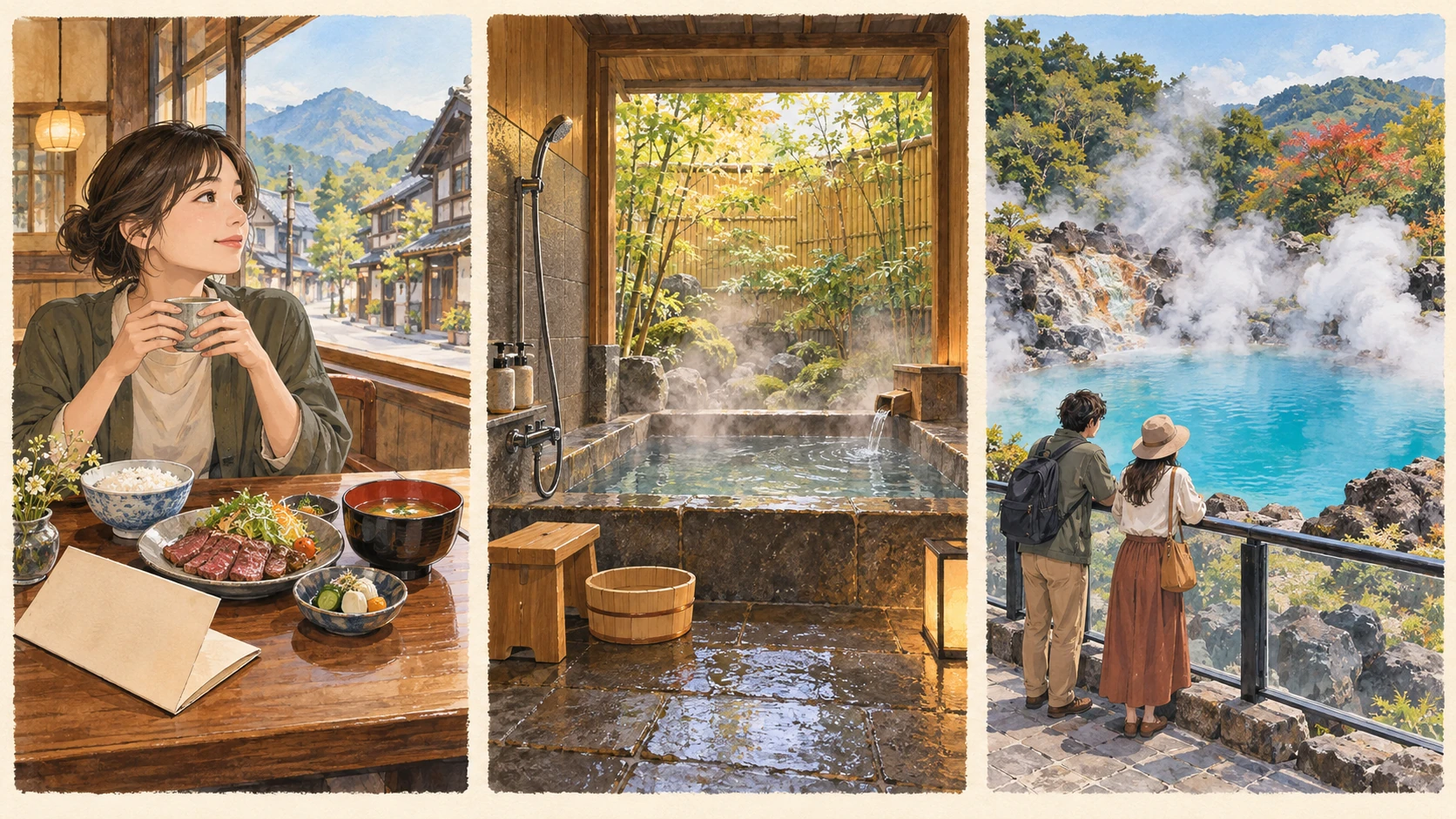
The Beppu Jigoku Association’s common admission pass includes Umi, Oniishibozu, Kamado, Oniyama, Shiraike, Chinoike and Tatsumaki: seven sites. Adults of high-school age and above pay ¥2,400; elementary and junior-high students pay ¥1,200. Buy it at any hell. It is valid on the purchase day and following day, once at each site, with general hours of 08:00–17:00. It admits you to geothermal sights, not ryokan bathing or every attraction with jigoku in its name.
For only the blue pool and garden, Umi Jigoku’s individual ticket is ¥500 for adults or ¥250 for elementary and junior-high students, much less than the full pass. Two adults pay ¥1,000 for Umi alone versus ¥4,800 for two seven-site passes. Do not add six unwanted stops just because a pass is described as better value. Value depends on where you will actually go, not the advertised total number.
Check each hell’s current individual price rather than extending Umi’s ¥500 to all of them. Discount vouchers, electronic exchange tickets and tickets bought on site can have different exchange locations and deadlines. In particular, an online purchase-validity period does not mean you can spread seven-site admission across any month. Families with junior-high students should note that they still pay the child common-pass fare, while some transport packages place them in a separate category.
Two groups of hells: five around Kannawa, then Chinoike and Tatsumaki
The official location guide divides the seven into two groups. Five around Umi Jigoku link on foot; Chinoike and Tatsumaki are about 3 km from that group, with transport recommended. For a first half-day, choose the Kannawa sites that interest you, lunch and part of the onsen neighborhood. For all seven, leave room for cross-area bus waits, rests and the geyser. Three kilometers is not a walk between exhibits inside one park.
Without a car, use Kamenoi’s current route information to check routes such as 2, 5, 7 and 41 from Beppu Station West Exit toward Umi Jigoku and Kannawa, and your actual stop. For Kannawa toward Chinoike, check 16, 16A, 29 and other relevant departures separately. Some official attraction pages may retain old route numbers or fares, so prioritize current bus-operator information for travel. Save both outward and return details before leaving the second group without a plan back to town.
Drivers can use each hell’s free parking and move the car between groups; parking does not remove walking inside. With a stroller, walking stick or wheelchair, choose the main sights and rest points first. Official information lists accessible toilets and a small number of loan wheelchairs, which cannot be reserved. Heat, rain or crowds are good reasons to drop one or two stops rather than force completion because you bought a pass.
Umi and Tatsumaki: leave time to watch and wait
Umi Jigoku features a blue hot-spring pool and gardens, viewed from designated paths rather than entered for swimming. Stay on the paths for photographs, do not cross railings, touch hot water or approach steam vents, and do not block narrow routes for a shot. One geothermal sight observed slowly with its explanations, followed by a steam-cooked meal in Kannawa, can make a complete half-day.
Tatsumaki Jigoku is a geyser. Its official guide says a red light above the entrance means an eruption is approaching or underway. After reaching the Chinoike–Tatsumaki area, ask staff about the next viewing opportunity before deciding the order. A fixed interval quoted in a travel article is not an eternally punctual timetable for a natural phenomenon. Waiting is one reason the full tour can take longer than expected.
Common opening hours are daytime; evening events have separately announced dates and ticket types. For example, Umi Jigoku’s official site lists the 2026 Night Umi Jigoku event as September 18–27. Its promotional image does not prove nightly opening in October. A Kannawa stay can include evening walks on public streets among the steam, but paid gardens should not be assumed accessible after dinner.
A scheduled tour of all seven: admission included, walking still required
Kamenoi’s scheduled hells sightseeing bus lists about three hours, with prices effective May 1, 2025 including seven-hell admission: ¥4,500 for adults, ¥3,500 for junior-high students and ¥2,300 for elementary-school children and younger. It reduces the work of checking cross-area local buses and suits people who want the full set and can follow a group’s pace. Do not buy another common pass for the same seven sites if you choose this tour.
It is not a no-walking trip viewed entirely through the windows. The operator describes about 60 minutes of guided walking around Kannawa’s five sites. Travelers with limited mobility need an accompanying caregiver and should confirm conditions with the ticket counter before departure. For young children, check seat requirements and ticket categories; elementary-school children and younger on the fare list does not let you decide the charge for a child without a separate seat yourself.
The website has morning and afternoon tours, but the timetable is still marked March 19, 2024. Before buying, confirm your date’s meeting time at Kitahama or Beppu Station East Exit stop 4. Traffic and waiting for Tatsumaki’s eruption can delay the return, so do not make the first limited express after the published finish your only way out. Independent site selection suits a long Kannawa lunch or extended bath better than the complete package.
Jigokumushi Kobo Kannawa: add chamber hire to the ingredients
Jigokumushi Kobo Kannawa lets visitors cook ingredients with hot-spring steam. At checking, its site listed 10:00–19:00, last food orders at 18:00, no reservations and numbered-ticket order on site. It closes on the third Wednesday monthly, moving to the next day for a holiday; steam conditions can also change operations. Lunch needs time for a number, ingredient selection, steaming, eating and clearing up. Fifteen minutes of steaming is not a fifteen-minute total visit.
Beppu City’s fee table lists ¥400 for a standard chamber or ¥600 for a large chamber for up to 15 minutes. Each further ten minutes or part thereof adds ¥200 or ¥300 respectively. These are chamber-use charges; ingredients are extra. A standard chamber used for 25 minutes costs ¥600, not an all-you-can-eat meal at ¥400 per person. Bringing your own food also requires checking the operator’s rules and charges.
Families should note that hands-on steam cooking is officially limited to junior-high age and above. Elementary-school children can watch the steam, wait and eat as part of the visit, but do not promise operation of hot equipment; staff decide on site. The neighboring foot-steaming service is currently unavailable because of steam conditions; foot soaking is separately listed at 10:00–18:00. Lunch, foot soaking and foot steaming are different services, not all guaranteed by one facilities photograph.
Yufuin lunch: choose the Yufumabushi Shin branch for your walk
Yufumabushi Shin’s official menu lists Bungo beef and eel mabushi at ¥3,200 each and local-chicken mabushi at ¥2,850, including tax, with starters, pickles, condiments and red-miso soup. Treat it as a seated main meal, following the restaurant’s guidance to enjoy the rice, accompaniments and broth in stages. It is not a snack for eating as you walk along the shopping street.
The Lake Kinrin main restaurant lists 10:30–18:30, last orders at 17:30; the station-front branch lists 10:30–20:30, last orders at 19:30. The main restaurant pairs lunch with a lakeside walk, while the station branch reduces backtracking around transport. The site still warns of irregular closures and asks visitors to call first. Its contact page says online reservations are suspended and inquiries should be by phone. A booking field or old tutorial does not establish current online availability.
If the inn serves beef sukiyaki that evening, consider a different lunch main to avoid two heavy meals. Ask about seasonings, stock and sides for allergies or dietary restrictions. You can also make this a meal if seats are available and keep another restaurant in the same area as backup. Do not sacrifice a booked train or ryokan dinner for a lunch queue. Plan full meals and desserts separately rather than filling the day by counting restaurant names.
Carrying sweets: P Roll needs chilling; pudding does not reopen Myoban
B-speak’s official site lists plain and chocolate P Rolls, each 15 cm and ¥1,620 including tax, sold only in store. Keep them at 10°C or below and eat the same day. The main shop generally opens 10:00–17:00, has no parking and may sell out early. Decide where to share it or take it back that day, with cooling confirmed. Other shippable cheesecakes on the site do not make fresh-cream P Roll suitable for an unrefrigerated day of sightseeing.
Okamotoya Shop in Beppu’s Myoban district offers geothermal steam pudding and light meals, listing 08:30–18:30, food last orders at 17:30 and indoor use until 18:00. Myoban is another mountain-side area, so connect it to your route and buses. Leaving Kannawa specially for one dessert, then returning to the station, can mean more time traveling than eating.
The same official site currently lists the Myoban Jigoku walking path suspended for emergency works. Yama-no-Yu’s view bath and family baths have been closed since April 1, 2026 because of reduced hot-spring flow, with no restart date announced. Buying pudding does not mean you can also walk the path or use a family bath. Neither is covered by the seven-hell common pass. Plan Myoban around the service you actually want and have confirmed open.
Toriten and cold noodles in Beppu: save the exact branch
Toyoken’s official website lists its main restaurant in Ishigaki-Higashi, normally 11:00–15:30 and 17:00–22:00, with last orders at 15:00 and 21:00. It closes on the second Tuesday monthly. On weekends and holidays, 15:00–17:00 service is limited to designated toriten and yuzu-toriten à la carte dishes and sets. This Japanese chicken tempura can be a main meal rather than another must-eat squeezed in after a steam-cooked lunch.
The main restaurant does not reserve à la carte meals, seats alone or same-day visits. Ordinary reservations are for designated courses for at least four adults, starting 17:00–20:00. Two people wanting a toriten set cannot use the group-course conditions to demand a held table. The operator also warns that heavy demand can close the waiting list early; last-order time does not guarantee entry at that minute.
From a Kitahama base, compare the branch in Tokiwa Beppu’s basement rather than detouring to Ishigaki-Higashi. It has its own menu and hours; the main restaurant’s courses and evening schedule do not transfer unchanged. Save the full branch name with the map. Daytime steam cooking in Kannawa and a different dinner in Kitahama usually work better than repeated mountain-to-coast trips to collect restaurant names.
For noodles at another meal, consider Beppu cold-noodle specialist Rokusei. Its beef-and-kelp broth comes with chewy noodles, sliced beef and cabbage kimchi. The noodles contain buckwheat flour; people allergic to it must not treat them as ordinary wheat noodles. Besides the Matsubara main restaurant, Rokusei also has a Tokiwa Beppu West Building B1F branch, convenient for Kitahama plans. It can close early when broth sells out, and the company and department-store pages disagree on this branch’s closing time. Ask that branch before planning dinner. Cold noodles at lunch and steam cooking for another meal offer more variety than several fried meals in one day.
Two days, one night: a complete Yufuin ryokan or Beppu city stay
For Yufuin, arrive on the first morning and store luggage. Lunch near either the station or lake, walk Yunotsubo and Lake Kinrin in the afternoon, then return at the inn’s required time for bathing and dinner. Next morning, choose a lakeside walk or unhurried breakfast, check out, add only one desired stop and take confirmed transport away. The point is to enjoy a full ryokan night; all seven Beppu hells need not be appended on the second afternoon to validate an onsen trip.
For Beppu, store bags on day one and head to Kannawa for two or three hells and a steam-cooked lunch. Return to the hotel for an afternoon rest, then dine near the station or in Kitahama. On day two, choose Takegawara’s ordinary or sand bath according to energy, or visit the other hells group still unused on your pass. Two-day validity gives flexibility, not an obligation to spend both days sightseeing. Individual-ticket visitors can leave the extra time for neighborhoods.
To include both cities in two days, accept a short visit to one: stay in Yufuin on night one and see only Umi Jigoku after crossing next morning, or stay in Beppu and walk Yufuin the next day. The better order depends on your final transport out of Kyushu. Put checkout, luggage collection, the crossing and onward departures on one timeline before booking; it reveals stops that have too little time.
For a day trip leaving and returning to Fukuoka, choose Yufuin or Beppu first. Both cities plus the long return journey can reduce ryokan bathing or seven hells to a rush. From an existing Beppu base, Yufuin can instead be a day return, but confirm the return service before setting lunch and lakeside walking time, and do not add a full seven-hell tour that day. These two kinds of day trip have very different usable hours.
Three days, two nights: one night in each, one luggage move
Three days and two nights give both accommodation experiences more room. Spend day one in Yufuin with dinner at the inn. After breakfast and checkout on day two, take confirmed transport to Beppu, store bags and choose either Kannawa’s hells or hotel facilities for the afternoon. Do the other theme on day three before onward rail or airport travel. Reverse the order if rooms, final-day transport and meals suit it better; map proximity alone does not decide which stay comes first.
With a facilities-rich Beppu hotel such as Suginoi, returning on the second afternoon makes more use of it; leave the hells for the third morning. In Kannawa, stay in that neighborhood from midday on day two and head toward central Beppu slowly next day. For a seaside room with a private bath, protect time with no need to leave. All three work; they exchange the room budget for facilities, neighborhood location or privacy respectively.
To avoid daily packing, stay both nights in Beppu and visit Yufuin on one day. Return travel is the cost; no new check-in is the benefit. With no direct Yufurin from Kannawa currently, the station area makes the intercity day easier to connect. If luggage moves are hard on children or older relatives, fewer room changes may matter more than experiencing another inn. Decide before booking.
Children, rain and winter: keep one stop you can drop
Build a family day around what children can do rather than the adults’ restaurant list. Elementary-school children cannot operate the steam-cooking chambers; under-sixes cannot use Takegawara’s sand bath; Suginoi’s large water attractions have height, weight and accompaniment rules. A room fitting the family does not make every activity suitable. Include parents taking turns caring, naps and changing clothes before deciding between a hotel afternoon and all seven hells.
Rain can mean shorter shopping-street and outdoor-hell visits, a seated lunch, rest at the inn and confirmed indoor facilities. An indoor pool is not necessarily year-round: the checked announcement for Suginoi Aqua Beat schedules 2026 operation only through November 1. Check winter separately; October photographs do not establish December access.
Winter mornings in Yufuin, Beppu’s coast and its hills feel different. Bring layers for moving outdoors, indoors and after bathing. If mountain-road weather changes, read road and operator notices first rather than adding a drive through fog or uncertain snow. Keep a shopping stop or secondary sight removable each day. Protect meals at the accommodation and long-distance onward transport when delayed; an unfinished shop list does not mean a failed trip.
Family budget example: calculate fixed items before adding room quotes
For two adults and one ten-year-old elementary-school child, three seven-hell passes cost ¥2,400 × 2 + ¥1,200 = ¥6,000. On another day, the announced-period 09:30 direct bus from Beppu to Yufuin is ¥1,100 × 2 + ¥550 = ¥2,750 one way. Two Bungo beef mabushi and one local-chicken mabushi total ¥3,200 × 2 + ¥2,850 = ¥9,250. These three choices add to ¥18,000.
That ¥18,000 is an itemized example for specific choices, not a three-day, two-night trip total. It excludes accommodation, return travel to Beppu or onward travel from Yufuin, local Beppu buses, other meals, bathing tax and sweets. It also does not mean a ten-year-old needs a full set meal. For Umi Jigoku alone, three individual tickets total ¥1,250, saving ¥4,750 against the common passes. Keep that difference for bathing, food or convenient transport you actually want.
Quote accommodation for your actual dates, all three ages, meals and beds. Do not multiply a per-person starting rate based on double occupancy by three. For budget versus resort versions, keep food and activities equal, vary the room and number of intercity hotel moves, then add the resulting fares. See breaking down a Japan travel budget for food, luggage and transport categories.
Before booking: connect the room, dinner and final transport leg
Mark the accommodation, first stop and final stop on a map, then decide whether dinner is in or out. Confirm occupancy, fixed and extra beds, each child’s age and meals before comparing cancellation terms and total price. Room onsen, reservable private baths and shared large baths work differently. Put the experience you most want explicitly in the search; this narrows the field more effectively than repeatedly comparing photographs.
After confirming, save the room name, included meals, check-in time, cancellation deadline and transfer method. Before departure, reread Kamenoi’s route-specific notices, hell and day-bath closure days, and current restaurant information. The biggest disruption is not one missed shop but treating a suspended bus, unopened bath or unreserved inn dinner as already settled.
Yufuin connects a town walk with an inn day; Beppu offers city life, geothermal sights and seaside stays. Leave room for things your companions want to do together, then return to three practical questions: which bed does each person sleep in, where is dinner, and can you make the last connection? With those settled, spare time can comfortably become a walk, a bath or tea.
A few useful answers
Should a first visit be based in Yufuin or Beppu?
Choose Yufuin for Yunotsubo, Lake Kinrin and dinner at an inn. Compare Beppu Station or Kitahama for the hells, geothermal steam cooking and a wider choice of evening restaurants. Give a two-day, one-night trip one main accommodation focus; three days and two nights make one night in each easier.
Can I still take Yufurin directly from Kannawa to Yufuin?
As of October 22, 2026, every Yufurin service has been suspended since October 17, with no restart date announced. The operator advises Kannawa passengers to go to Beppu Station West Exit first, then take route 36 to Yufuin.
Does Yufuin no Mori have non-reserved seats?
No. JR Kyushu lists all seats as reserved. Obtain a seat reservation before boarding. Sales normally open at 10:00 Japan time one month before travel; check the operating calendar and whether the Yufu limited express substitutes on your date.
Does a reservable private bath mean the room has onsen?
Not necessarily. Yadoya rooms have showers only; staying guests can separately inquire about reservable baths. Seikai’s Sora building TYPE Q has a semi-open-air room bath. Confirm the named room and how the bath is used rather than relying on the phrase private bath.
What does the seven-hell pass cost, and how long is it valid?
Current individual prices are ¥2,400 for adults of high-school age and above and ¥1,200 for elementary and junior-high students. It is valid on the purchase day and the following day, once at each hell. Umi Jigoku alone costs ¥500 for adults or ¥250 for elementary and junior-high students.
Can I walk between all seven hells?
The five around Kannawa can be linked on foot, but Chinoike and Tatsumaki are about 3 km from that group; the official guide recommends transport. Include waiting for cross-area buses and the geyser, not just walking within the grounds.
Can children operate the geothermal steam-cooking equipment?
The hands-on cooking experience at Jigokumushi Kobo Kannawa is limited to junior-high age and above. Elementary-school children can observe and eat as staff arrange, but do not promise that they can operate a hot steam chamber. Ingredients and chamber use are charged separately.
Does Takegawara Onsen’s ¥300 admission include sand bathing?
No. Adult ordinary bathing is ¥300; sand bathing is a separate ¥1,500 and is limited to ages six and above. There may be a queue or an early admission cutoff.
Can I visit Yama-no-Yu after buying pudding at Okamotoya?
Do not currently plan on it. At checking, the official site listed Yama-no-Yu closed from April 1, 2026 and the Myoban Jigoku walking path suspended for works, with no reopening dates announced. Check the shop and other facilities separately.
Can both Yufuin and Beppu fit into two days and one night?
You can stay in one and make a short visit to the other, but do not also expect a full ryokan afternoon, both cities’ food and all seven hells. Check the time left after checkout, luggage collection, intercity departures and onward travel.
Check with the source
Schedules, availability and rules can change. These official sources are the place to confirm details before you book.
- JR Kyushu | Yufuin no Mori operating dates and reservations
- Kamenoi Bus | Yufurin suspension from October 17, 2026
- Kamenoi Bus | Sightseeing routes and boarding points
- Kamenoi Bus | Temporary direct Beppu–Yufuin service
- Kamenoi Bus | Yunokaze open-top bus dates and reservations
- Yufu City | Lake Kinrin
- Yawaragi-no-Sato Yadoya | Rooms
- Yawaragi-no-Sato Yadoya | Meals, baths, luggage and access FAQ
- Suginoi Hotel | Sorakan rooms
- Suginoi Hotel | SORA restaurant and plan conditions
- Suginoi Hotel | Accommodation terms dated March 31, 2026
- Suginoi Hotel | Beppu Station shuttle and meeting point
- Suginoi Hotel | Cancellation charges and transaction terms
- AMANE RESORT SEIKAI | Sora building rooms
- Yufu City | Bathing tax
- Beppu City | Bathing-tax bands and exemptions
- Beppu City | Takegawara ordinary and sand bathing
- Suginoi Hotel | Sorayu and children entering opposite-sex baths
- Beppu Jigoku Association | Seven-hell admission pass
- Umi Jigoku | Individual admission
- Beppu Jigoku Association | Two groups, access and parking
- Beppu Jigoku Association | Tatsumaki Jigoku
- Umi Jigoku | Sights and evening-event dates
- Kamenoi Bus | Scheduled hells sightseeing tour
- Jigokumushi Kobo Kannawa | Hours, participation age and current services
- Beppu City | Steam-chamber fees and facilities
- Yufumabushi Shin | Menu and branch hours
- Yufumabushi Shin | Reservation methods
- B-speak | P Roll prices, refrigeration and same-day consumption
- Okamotoya Shop | Hours and Yama-no-Yu/Myoban closures
- Toyoken | Main restaurant, branches, hours and reservations
- Suginoi Hotel | Aqua Beat seasonal operation and restrictions
- Rokusei | Beppu cold noodles, ingredients and branches
- Tokiwa Beppu | Rokusei West Building B1F branch