Autumn foliage at Yoro Park in Gifu typically peaks from mid-November to early December. Plan the 50-minute walk from Yoro Station to Yoro Falls, check 2026 leaf reports, free shuttles, and car parks, and match Koshizaka Slope, children's play areas, or the Site of Reversible Destiny to your energy levels.
- Region & Focus
- ChubuAutumn leaves
- Reading Scope
- 21 min read · 9 chapters · 7 Q&As
- Official Verification
- 26 official sources checkedUpdated 22 November 2026
- Key Topics
- ItinerariesSeasonsRail travel
Chapter Route Map (tap any stop)
- Late November is ideal: check Fudobashi Bridge foliage first
- Climb Koshizaka Slope from Shofubashi Bridge and save the valley for the descent
- Two transfer stations from Nagoya: check Yoro Railway train times
- Free bus to Shofubashi Bridge, mini shuttle uphill to Myokenbashi Bridge
- Driving: pick your car park first; the upper private car park shortens the walk
- Families: pick playgrounds first for children, and rest spots before the descent for older relatives
- Site of Reversible Destiny in autumn: save the steep slopes for those with spare energy
- The filial son legend, dango dumplings, and an easy lunch break
- A half-day from Nagoya, or Yoro by day and Nabana no Sato at night
- Quick Q&A
Walking from Yoro Station to the entrance of Yoro Park takes around 10 minutes, while continuing all the way to Yoro Falls takes roughly 50 minutes. If you are travelling from Nagoya with young children or older relatives, use those two times to decide how far you want to go. For riverside autumn colour alone, you can start at Shofubashi Bridge and turn back around Fudobashi Bridge, or climb the Yoro Koshizaka Slope to the waterfall itself. According to Gifu Prefecture's official tourism site, the usual viewing window runs from mid-November to early December, and the park's 22 November 2026 update recorded foliage across the grounds at roughly 50 per cent colour.
Late November is ideal: check Fudobashi Bridge foliage first
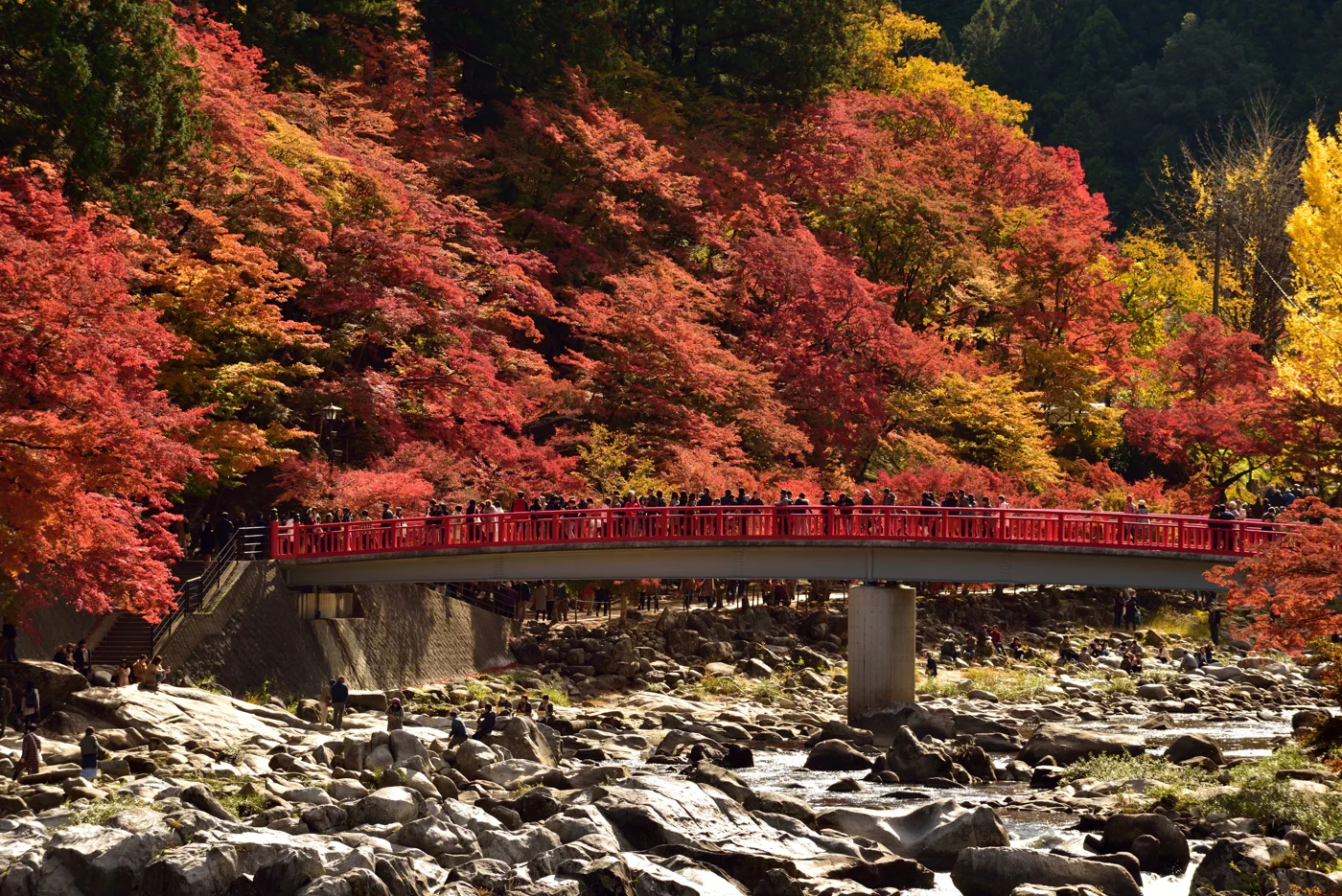
If you only have one weekend to spare from Nagoya, late November is the most reliable starting point for Yoro, with leeway on either side. Gifu Prefecture's official tourism guide lists the viewing season through early December, while Yoro Town's municipal overview cites late November as the typical peak. One helps you pick the right week; the other narrows down when colour is usually most concentrated. To choose your exact day, check the Yoro Park 2026 autumn foliage photos. The park has posted updates since 13 November: on the 13th, only patches near Fudobashi Bridge had started to turn; by the 16th, mountaintop trees showed vivid colour; on the 18th, foliage reached about 30 per cent; and on both 20 and 22 November, the park as a whole stood at roughly 50 per cent.
Those park updates offer a helpful benchmark. Because several reports are shot near Fudobashi Bridge, it is easy to track changes along the same stretch of trees and gauge which route to take once you arrive. The 50 per cent figure applies across the entire park, though the waterfall, the valley beneath the bridges, and the open lawns turn at different speeds. If you only want a gentle waterside stroll, a short walk is worthwhile as soon as the trees by the bridges show colour. If you are hoping to frame the waterfall alongside turning branches, prioritise the falls trail first and save part of your photography time for the bridges rather than waiting in one spot for a single shot.
The 2026 Yoro Park Autumn Leaves Festival (Yoro Koen Momiji Matsuri) runs from 1 October to 30 November, organised around the grounds by the Yoro Town Tourism Association. Individual events such as plein-air sketching and an AR character hunt fall on specific dates, so check the park announcements and event poster before picking a day. Both the evening lawn events on 24 and 25 October and the early-November craft markets have already wrapped up. If you visit in the final days of November, focus on the daytime valley scenery; you can follow the same plan into early December based on fresh leaf reports.
If your trip falls around a late-November holiday, check transport dates alongside the festival calendar. Sunday 29 November 2026 is the final day of the season's free bus, one day before the autumn festival closes on the Monday. If you choose Monday 30 November, plan to walk from Yoro Station or book a taxi in advance. To use either the free bus or the smaller shuttle to save your legs, both the 23 November public holiday and the 28-29 November weekend fall within the published operating schedule for both services.
Autumn foliage at Yoro Park in Gifu typically peaks from mid-November to early December. Plan the 50-minute walk from Yoro Station to Yoro Falls, check 2026 leaf reports, free shuttles, and car parks, and match Koshizaka Slope, children's play areas, or the Site of Reversible Destiny to your energy levels.
Climb Koshizaka Slope from Shofubashi Bridge and save the valley for the descent
Treat the Yoro Falls Entrance Car Park (Yoro-no-Taki Iriguchi Chushajo) as the trailhead for the waterfall walk. Managed by the park and free to use, it sits beside Shofubashi Bridge and doubles as a stop for the free shuttle bus. From here to Yoro Falls is around 1.2 km, which the park's attraction page estimates at 30 minutes each way and its access page puts at 30 to 40 minutes. At an unhurried pace, allow well over an hour just for the climb and descent, plus extra time for photos, browsing stalls, or taking side paths. Putting the waterfall before lunch makes it easier to decide how much energy you have left for the afternoon over your meal.
The path follows the Takidani Valley downstream of the falls, with Yoro Koshizaka Slope running up the left bank toward the cascade. Small shops and a tourist information post line the route, and several bridges give views over the water. The park map marks seven bridges along the valley, offering multiple spots to look back downstream as you climb. Use Shofubashi Bridge as your starting landmark. Fudobashi Bridge sits along the return route back toward the foothills, so leave it for the walk down. If a tour group crowds the middle of a bridge, move to a wider kerbside spot to take your photo so people climbing or descending can pass safely along the narrower stretches.
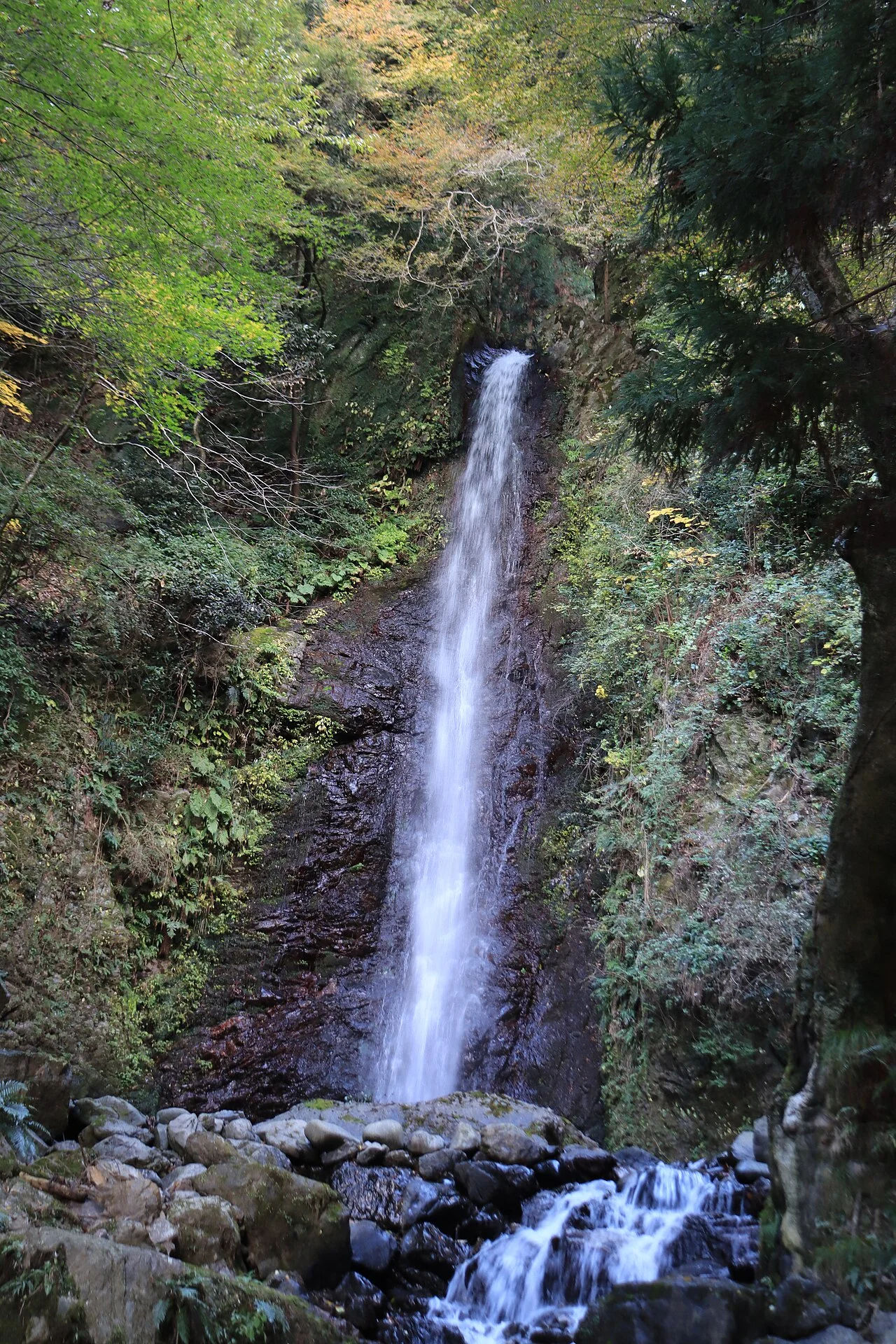
When you reach the plaza in front of the falls, the cascade drops roughly 30 metres high and 4 metres wide down the rock face before continuing along Takidani Valley at your feet. It is worth pausing here, where colourful foliage, dark cliff walls, and white rushing water sit in a single frame. On a phone, find a safe spot to compose a wide shot including the leaves on both banks, then switch to telephoto for details of water striking the rocky ledges. Earlier in the season when colour is still patchy, frame nearby branches or a bridge railing in the foreground to capture the turn of autumn.
If you are carrying a dedicated camera uphill, edit your kit down to suit the walk. Keep bridges and narrow sections of Koshizaka Slope clear for foot traffic, and only set up for slow-shutter shots once you find stable, out-of-the-way footing at the falls plaza. With just a phone, try a landscape shot of the bridges and stream on the way up, then switch to portrait orientation at the waterfall. When viewpoints get busy, walk on to the next bridge for stream photos and circle back later. Drones are prohibited throughout the park, and visitors are asked not to block walkways while shooting.
If you have energy left on the descent, combine Yoro Shrine, Kikusui Spring, and Furougaike Pond into a gentle detour. Kikusui Spring lies within the shrine precincts, and the pond area also shows good autumn colour. For a quieter extra stretch, head east from Myokendo Hall along Yoro Seseragi Kaido, which the park highlights as a less crowded foliage path. Look for signposts pointing to Myokendo Hall or the full street name (Yoro Seseragi Kaido). The shuttle's Myokenbashi Bridge stop is also nearby, so be clear whether you mean the bridge or the hall when arranging a meeting point.
If someone in your group tires early, they can turn back before the next climb and wait near Shofubashi Bridge. Separating the waterfall hike from a casual valley stroll gives shorter walks a clear turnaround point. Even climbing a short distance from the entrance car park lets slower walkers enjoy bridge views over the stream before resting on level ground. If your party splits up, agree on a specific bridge or Oyakoko no Furusato Kaikan (Filial Piety Heritage Hall) beforehand; dropping a generic pin on 'Yoro Park' on a map app is far too vague for meeting up.
There is no street lighting along the valley trail, and the park itself describes Koshizaka Slope as narrow and steep. Aim to finish your descent in daylight if you want a relaxed pace for photography. After rain, check the path surface on wider sections first, slow down where wet leaves hide slick patches, and decide whether to push on or turn back. If your soles lack grip, your ankles feel unsteady, or you are juggling a pushchair and an umbrella, save the full waterfall climb for a drier day. Climbing further from the Mount Yoro trailhead is a separate hike altogether; turning back at the falls completes the autumn foliage walk.
Two transfer stations from Nagoya: check Yoro Railway train times
If you are staying near Nagoya Station and heading straight back to the city afterwards, look up the JR Tokaido Main Line to Ogaki first. At Ogaki, transfer to the Yoro Railway bound for Kuwana and alight at Yoro (Yoro Park) Station. Travellers coming from Gifu City or Sekigahara can join via Ogaki in the same way. Yoro Town lists the Ogaki-to-Yoro ride at about 25 minutes, measured from the Yoro Railway departure, so build in extra time for getting off the JR train, walking between platforms, and waiting.
The alternative route takes the JR Kansai Main Line or the Kintetsu Nagoya Line from Nagoya to Kuwana, then transfers to the Yoro Railway bound for Ogaki. Yoro Town puts the Kuwana-to-Yoro journey at roughly 40 minutes. This works smoothly if you are continuing to Nagashima in Mie Prefecture later in the day or already staying in Kuwana. Kuwana Station serves JR, Kintetsu, and the Yoro Railway, so follow signs for the Yoro Railway (Yoro Tetsudo) once you arrive. In Nagoya, check which station entrance your map app directs you to, as Kintetsu Nagoya and JR Nagoya have separate gates.
Pick your return train on the Yoro Station timetable page, then note the following train in the same direction as a backup. Checking only outbound trains often leaves visitors rushing the valley descent, toilet stops, and the walk back to the station all at once. If you want to pause for dango dumplings along Koshizaka Slope, work backwards from your target departure by subtracting the walk from the falls to the station. Leave extra buffer for reuniting with your group and taking photos, and avoid cutting a shuttle arrival to within a few minutes of your train.
Passengers using IC transit cards on JR or Kintetsu must buy a separate paper ticket at the Yoro Railway ticket counter or vending machine when transferring. The railway publishes guidance for both cash and cashless ticket machines; if you pay with e-money, remember to collect your printed ticket from the slot. For larger groups, it is usually quickest for one person to buy all the adult and child tickets at the machine while everyone else checks which platform serves Kuwana or Ogaki. If you plan to exit via the opposite end of the line on the way back, buy your return ticket according to where you are actually heading.
From Yoro Station, it is roughly a 10-minute walk to the park entrance area. The Yoro Railway's own walking map puts the loop linking Children's Land, Site of Reversible Destiny, Filial Piety Heritage Hall, and the climb up to the falls at about 4.5 km—a useful benchmark against your group's usual walking distance. For a direct out-and-back walk between the station and the falls, the railway map cites roughly 2.1 km each way between the falls and Yoro Station, before factoring in stops and steep gradients. If you plan to walk the whole day, decide after lunch whether to add extra paid attractions so your return train stays manageable. When searching on map apps, include 'Yoro-cho, Gifu Prefecture' with the station name, as 'Yoro' also brings up Yoro Keikoku in Chiba Prefecture.
Free bus to Shofubashi Bridge, mini shuttle uphill to Myokenbashi Bridge
The autumn 2026 free bus operates on Saturdays, Sundays, and public holidays from 12 September to 29 November, stopping at Yoro Station, Yoro Park Kodomo no Kuni-mae (Children's Land), and Shofubashi Bridge. Alight at Kodomo no Kuni-mae for the playgrounds, or stay on to Shofubashi Bridge to hike uphill along the valley to the falls. This cuts out the initial walk from the station to each entrance and works especially well when half a group wants playgrounds while the rest want the waterfall.
The Yorokan-go is a separate free mini shuttle scheduled on Saturdays, Sundays, and public holidays until 6 December 2026, running between 10:00 and 16:00. Uphill journeys run from Yoro Station to Myokenbashi Bridge, while downhill trips depart Shofubashi Bridge back to Yoro Station, with no intermediate stops allowed. If you want to ride up and stroll back down, remember Myokenbashi Bridge outbound and Shofubashi Bridge on the return. The weekend of 5-6 December is the last chance this autumn to use the mini shuttle, after the larger free bus has ended for the season.
Both free shuttle services resume for spring on Saturdays, Sundays, and public holidays from 13 to 28 March 2027. During the winter gap between those operating windows, plan around walking or taxis. Yoro Station has no regular local bus routes and no permanent taxi rank outside. When you need a cab, the park lists Gifu Kintetsu Taxi on 0584-32-1135. Tell the driver clearly whether you want the lower car park beside Shofubashi Bridge or the upper car park near the falls; the taxi operator also notes that the upper road closes when snow or ice accumulates.
Check exact departure times on the park shuttle notice timetable. As noted in the announcement, the mini shuttle may run reduced services or suspend operations in bad weather or heavy crowds. Before waiting at the station, decide which park entrance you can comfortably reach on foot as a fallback. If anyone in your group relies on the shuttle to manage the distance, switch to the lower park grounds around 10 minutes from the station or pre-arrange a taxi using the number above. Families riding uphill and walking back can line up their downhill bridge stops with a lunch spot along the way.
| Service | Late-autumn 2026 schedule | Key stops |
|---|---|---|
| Free Shuttle Bus | Saturdays, Sundays & public holidays, 12 Sep–29 Nov | Yoro Station, Kodomo no Kuni-mae, Shofubashi Bridge |
| Yorokan-go | Saturdays, Sundays & public holidays until 6 Dec, 10:00–16:00 | Uphill to Myokenbashi Bridge; downhill from Shofubashi Bridge to Yoro Station |
Driving: pick your car park first; the upper private car park shortens the walk
The park's official site estimates the drive from Nagoya via expressway at about an hour, sitting roughly 10 minutes from the Yoro Interchange on the Tokai-Kanjo Expressway. It is about 20 minutes from the Ogaki Interchange and 25 minutes from the Sekigahara Interchange on the Meishin Expressway. Those are pure driving times, so allow extra for picking up a hire car in Nagoya, loading bags, and finding a space. Entering only the park street address (Takabayashi 1298-2) tends to route you to the lower management offices first, so navigate directly to the specific car park name instead.
Most visitors aiming for autumn foliage and the waterfall start from the Yoro Falls Entrance Car Park (Yoro-no-Taki Iriguchi Chushajo), turning west from the Yoro Park East (Yoro Koen Higashi) junction on Prefectural Route 56. Managed by the park, spaces are free on a first-come, first-served basis, making it the smoothest base if you want to linger around Shofubashi Bridge and Koshizaka Slope. If the Site of Reversible Destiny is your first stop, Car Park 2 sits conveniently beside Rakuichi Rakuza. The park recommends Car Park 1 for combining the falls and Reversible Destiny, and Car Park 3 for the putting golf course and tennis courts; for Children's Land alone, park directly at the Kodomo no Kuni Car Park.
To cut out part of the uphill walk to the falls, drive up to the paid, privately run Yoro Falls Car Park (Yoro-no-Taki Chushajo) near the top. Even from there, a short walk remains: the park's access page estimates 5 minutes, while its FAQ gives 10 minutes, so budget 5 to 10 minutes. The approach road is a narrow mountain lane where vehicle width, passing oncoming cars, and wet post-rain conditions all matter. Parking fees and opening hours are set by the private operator (tel: 0584-32-0713). If you are in a wider hire car or have passengers prone to travel sickness, choose the lower car park from the outset and keep to a riverside walk or split the route.
According to the park's opening hours and fees page, park-managed car parks open at 09:00, with last entry at 16:15 and final exit by 17:15. Note that the access page and the March park brochure still print a 17:00 closing time, so aim to be back at your car before 17:00—especially given the downhill walk from the waterfall. If you want an early start and a park-managed space, plan around 09:00; if you want to arrive earlier than that, take an early train and walk from Yoro Station.
The park closes on Tuesdays, or the following day if Tuesday is a public holiday. On regular closed days, only the Yoro Falls Entrance Car Park remains open as normal, while Children's Land, the Site of Reversible Destiny, and sports facilities close. Over New Year, from 29 December 2026 to 3 January 2027, even the Yoro Falls Entrance Car Park shuts completely, and Gifu Tourism's autumn foliage page excludes the year-end period from free waterfall access dates. Schedule your visit outside those dates if travelling over New Year, and keep regular Tuesday visits to a short daylight walk.
Families: pick playgrounds first for children, and rest spots before the descent for older relatives
Gifu Children's Land (Gifu-ken Kodomo no Kuni) is the easiest stop to keep family itineraries running smoothly. Entry is free and hours run from 09:00 to 16:30. Toddlers aged 1 to 3 can play at their own pace in the covered Sukusuku Hiroba, while energetic older children up to age 12 can tackle the log obstacles and ropes at Boken Hiroba or the slides and swings at Wanpaku Hiroba. Because the paddling pool and splash area are summer-only facilities, autumn visits centre on the dry play equipment and open lawns.
This zone also includes the gently sloped Nobinobi Hiroba lawn, looking out across the Nobi Plain. It is a natural spot for a picnic or breather after the playground before deciding whether children have the stamina for the valley path. Inside the green-roofed Kodomo no Ie (Children's House), you will find nursing rooms and rest seating. The park's family services page notes nappy-changing tables in the accessible toilets, though Kodomo no Ie does not supply hot water for formula, warm baby food, or lend out a microwave. Pack any water and food your baby or toddler will need before leaving so you do not have to backtrack later.
On 20 March 2026, a new indoor play space opened in the Kodomo no Ie multipurpose hall, operating 09:00 to 16:30 for pre-schoolers through primary-school children. The floor is padded, shoes must come off at the entrance, food and drink are not allowed inside the play area, and it may close temporarily when events book the hall. If outdoor equipment is still damp from rain, start indoors and wait to see if the weather clears for the lawns or bridges. Families hoping to join storytelling sessions or workshops should check session times and note which activities require advance booking.
Access for pushchairs and wheelchairs varies across the park, and the family and accessibility guide marks accessible toilets and information desks. Anyone using a wheelchair or uneasy on steep descents should begin near the Children's Land facilities and level lawn paths, turning back where the terrain stays comfortable. To test the valley walk, inspect the gradient from Shofubashi Bridge first; companions can rest by the bridge and nearby shops while others continue uphill. For three-generation outings, splitting up for an hour is far easier than waiting on steep slopes.
With half a day for a family visit, give children ample playground time in the morning and only add a short valley walk from Shofubashi Bridge if everyone still has energy. Conversely, if seeing Yoro Falls is the main goal, tackle Koshizaka Slope on fresh morning legs and save the playgrounds for back at the foot of the hill. Note that Children's Land closes at 16:30 if you arrive late in the afternoon. On days when play equipment is the clear priority for younger children, skip the waterfall altogether and take an easy post-lunch stroll to see the leaves around the bridges.
Site of Reversible Destiny in autumn: save the steep slopes for those with spare energy
Located beside Children's Land, the Site of Reversible Destiny - Yoro (Yoro Tenmei Hantenchi) was created by artist Shusaku Arakawa and poet Madeline Gins and opened in 1995. The memorial hall just to the left of the entrance displays architectural drawings and related works. The main pavilion, Kyokugen de Niru Mono no Ie (Critical Resemblance House), works like a labyrinth entered from multiple angles, where looking up reveals the floor plan mirrored across the ceiling. Outside, an elliptical field of mounds, hollows, and winding paths hides differently shaped outlines of the Japanese archipelago depending on where you stand.
Gates open at 09:00, with last admission at 16:30 and closing at 17:00. Admission is ¥850 for adults, ¥550 for senior high school students, ¥350 for primary and junior high students, and free for pre-schoolers; primary, junior high, and senior high students must be accompanied by an adult. Non-refundable ¥100 coin lockers are available inside, and bulky bags that do not fit can be checked at the museum shop. If you are carrying camera gear or spare children's clothes, drop the extra weight at the entrance before exploring the closer installations.
The outdoor grounds feature slick slopes and sudden dips where pushchairs and wheelchairs are restricted; ask museum shop staff which areas are accessible. Families with young children should start around the entrance zone and keep close hold of children on steeper terrain. Older relatives who have already tackled the waterfall path can browse the memorial hall, rest outside, or have lunch next door at Rakuichi Rakuza while the rest of the group explores. In light rain, a quick loop of the outdoor slopes takes less time than lingering inside the exhibits, so swap the order if you want to cover the outdoor field properly.
When time is tight, prioritise whichever stop matters most to you. Travellers heading back to Nagoya for dinner do best climbing to the waterfall in the morning and seeing how much time remains for the art park after lunch. If Arakawa and Gins's work is your primary reason for coming, enter early and keep your valley walk to the stretch between Shofubashi and Fudobashi bridges. Alternatively, tour Reversible Destiny first and judge your footing before heading uphill to the falls—if wet autumn leaves are clinging to your soles after rain, trim the climb short.
Families with older primary or secondary children who still want active outdoor time can head to the park's putting golf course instead. Of its three nine-hole courses, the park opens two designated loops for an 18-hole round estimated at roughly an hour. Club and ball hire is included in the green fee: ¥500 for adults and ¥250 for junior high students and younger (accompanied by a parent or guardian), with last tee-off at 16:00 and closing at 17:00. Families combining only the playgrounds and a brief valley walk can skip it, or slot it into the afternoon as an easy group activity.
The filial son legend, dango dumplings, and an easy lunch break
Begin the folklore behind the waterfall at Oyakoko no Furusato Kaikan (Filial Piety Heritage Hall). In the Yoro Town legend, a devoted son climbed the mountain daily to gather firewood for his ageing father until he discovered a spring smelling of fine sake, filling a gourd to carry home. The hall shows an introductory film on the tale and stocks local Yoro specialities, making a natural stop either before or after the climb. The hall closes during winter, when visits focus outdoors on Yoro Shrine and the valley bridges.
The gourd from the story even appears on Yoro Town's municipal crest, matching the gourd-shaped souvenirs sold along Koshizaka Slope. Nearby sits Yoro-dera Temple, whose founder according to park materials is said to be Genjonai, the filial son of the legend. From the shrine near Kikusui Spring, paths also connect to Furougaike Pond and the historical marker for Empress Gensho's imperial visit. Local records link the 717 era-name change to Yoro with the empress's visit to the spring—a neat stop on the way down after seeing the falls if you enjoy the backstory behind place names.
Visiting Kikusui Spring from Yoro Shrine also ties the scenery to local ritual. The park's anniversary schedule lists the Wakamizu-tori water-drawing ceremony at Kikusui Spring at 10:00 on 21 March 2027, offering spring water to Yoro Shrine and Yoro-dera Temple—a date that falls within the spring free-shuttle window. For autumn visitors, the shrine and spring offer a quieter counterpoint to the cascade itself; taking time over one shrine and one bridge feels far more relaxed than trying to tick off every pin on the park map.
For casual snacks, stop wherever takes your fancy along Koshizaka Slope for grilled dango dumplings or Yoro Cider. For a proper sit-down meal, schedule Rakuichi Rakuza Yoro at the foot of the park before your afternoon attractions. The park lists food ordering from 10:00 to 16:00 (with occasional weather closures), making it an easy pre-entry lunch spot before Reversible Destiny. If you bring a packed lunch, spread out on the lawns or use designated dining spaces such as the Kodomo no Ie multipurpose hall—just keep food and drink out of the padded indoor play zone. Open flames are prohibited in the park, so bring ready-to-eat picnic food.
For the 10th anniversary of the Yoro Koshizaka Slope naming, food trucks are scheduled on 6, 7, 13, and 14 March 2027 from 10:00 at Car Park 2. Drivers planning to visit the Site of Reversible Destiny on those days should follow on-site parking guidance on arrival. Because the spring shuttle does not start until 13 March, visitors arriving by train for the first March weekend should plan to walk from Yoro Station.
A half-day from Nagoya, or Yoro by day and Nabana no Sato at night
For a half-day rail trip, the simplest plan focuses on riverside photos and part of the climb. Take the train from Nagoya changing at Ogaki, then walk or hop on the shuttle to Shofubashi Bridge. Hike to the falls, take your photos, and amble back down with time to pick up snacks on Koshizaka Slope. Add either Yoro Shrine or the playgrounds depending on your group, then match your departure to your descent pace—either your first-choice train or the next one along. If you need to catch a Shinkansen back from Nagoya in the afternoon, stick to a single route inside the park and buffer platform transfer times. With an extra day in the city, save ginkgo avenues and gardens for another morning using our Nagoya city autumn foliage guide.
Families wanting an unhurried pace can easily make Yoro a full daytime outing. Moving between the waterfall, the bridges, and the lower park already involves hills, so skipping a second city lets you linger over lunch and one afternoon attraction. Rail travellers can keep an eye on the clock near Children's Land or Reversible Destiny, while drivers can park mid-way between their morning and afternoon priorities. If your children are happiest with free-play time and you would rather sit and catch your breath, spending the afternoon at Children's Land fits the rhythm of the day far better than rushing back onto the motorway.
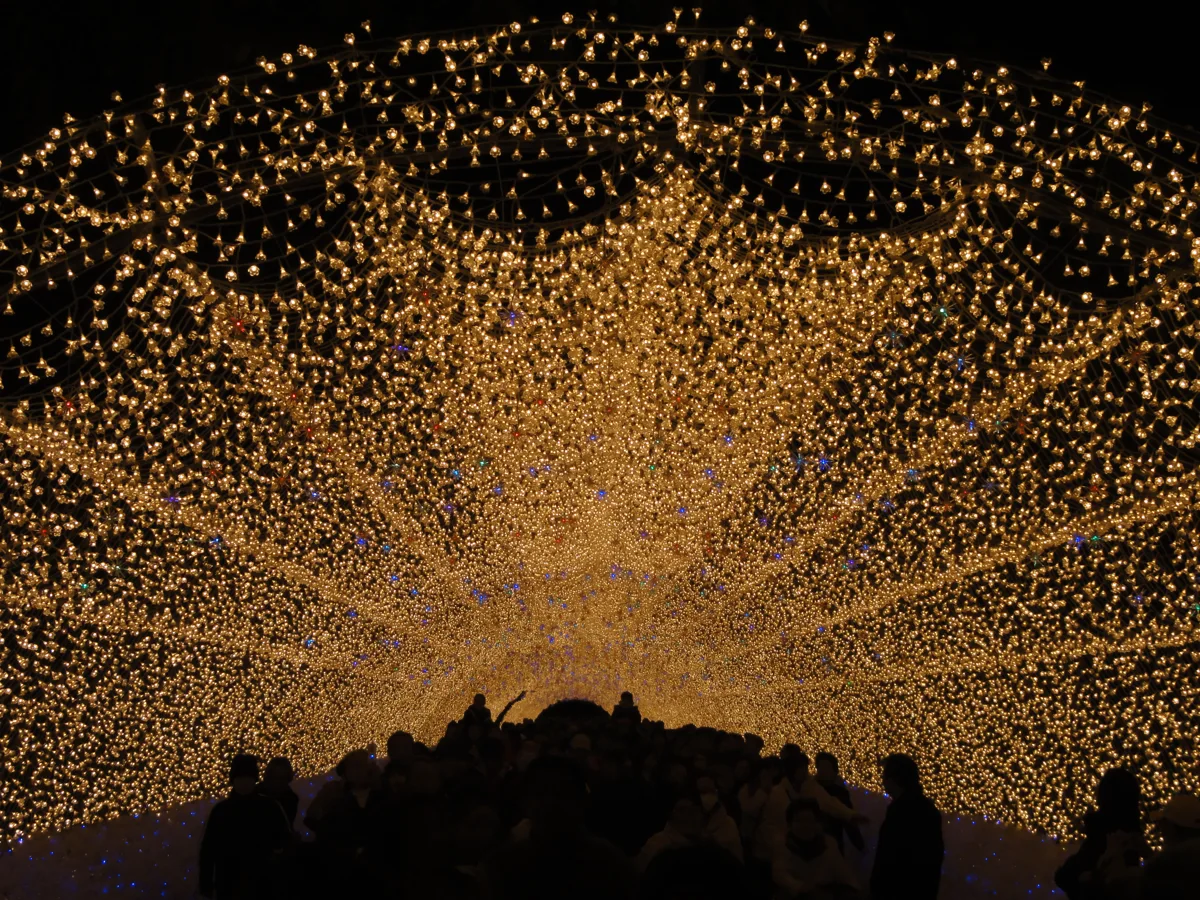
To pair Yoro with Nabana no Sato in Kuwana, Mie Prefecture, keep Yoro for the daytime and pick just one post-lunch stop between Children's Land and the Site of Reversible Destiny. Calculate your drive time to Nagashima from whichever car park and exit road you use—factoring in the narrow lane down from the upper private car park before joining the expressway. Nabana no Sato's 2026–27 winter illumination runs from 17 October 2026 to 31 May 2027 (closed 6 and 7 January 2027). Lighting and closing times vary by date, so time dinner and entry around the official operating calendar.
Combining both by train also works, provided you exit via Kuwana: ride the Yoro Railway from Yoro to Kuwana, switch to the Kintetsu Nagoya Line to Kintetsu-Nagashima, and board the direct Mie Kotsu bus to Nabana no Sato. During the illumination season, buses from Kuwana Station to Nabana no Sato are suspended, so you must board at Kintetsu-Nagashima Station. Check the last evening bus back from Nabana no Sato to Kintetsu-Nagashima and your onward train to Nagoya first—that tells you the latest afternoon train you can afford to catch from Yoro. If the evening connections look tight, split the two onto separate days.
Another easy option is staying overnight in Kuwana or Nagashima for Nabana no Sato, leaving Yoro as a straightforward daytime rail hop. That removes the pressure of catching late trains back to Nagoya after dinner and a leisurely walk through the lights. Note that on 23-25 December evenings, Nabana no Sato enforces date-specific ticket rules—check the seasonal illumination notice for booking windows and entry slots. For a late-November pairing of mountain gorge colour and illuminated gardens, plan your evening buses and trains with our Nabana no Sato illumination guide.
A few useful answers
When is the best time to see autumn leaves at Yoro Park?
The typical viewing season runs from mid-November to early December, making late November a safe bet for a day trip. On 22 November 2026, the park reported roughly 50 per cent colour overall, so compare photos from the park's foliage updates close to your departure.
Does it really take 50 minutes to walk from Yoro Station to Yoro Falls?
The park estimates around 50 minutes each way from Yoro Station to the falls, whereas reaching the park entrance takes only about 10 minutes. From the Yoro Falls Entrance Car Park to the cascade is roughly 1.2 km, taking 30 to 40 minutes each way plus extra time for stops.
Are there free shuttles running in early December 2026?
The seasonal free shuttle bus finishes on 29 November. However, the Yorokan-go mini shuttle still runs on weekends (5-6 December) from 10:00 to 16:00, heading uphill to Myokenbashi Bridge and returning downhill from Shofubashi Bridge to Yoro Station.
How do the two waterfall car parks differ?
The Yoro Falls Entrance Car Park sits by Shofubashi Bridge, is park-managed and free, and suits visitors walking up the valley. The upper Yoro Falls Car Park is privately operated and paid, leaving a 5-to-10-minute walk to the falls, though its approach road is narrow.
Where should we go in the afternoon with children if we only have two hours?
Focus on the free Gifu Children's Land, starting toddlers aged 1 to 3 at the covered Sukusuku Hiroba. It stays open until 16:30, and you can add a short riverside stroll near Shofubashi Bridge if everyone still has energy.
If we can only pick either Yoro Falls or the Site of Reversible Destiny with older relatives, which is better?
For autumn foliage, start with a gentle walk around Shofubashi and Fudobashi bridges and only continue to the falls if everyone feels up to it. For art, visit the Site of Reversible Destiny's memorial hall and entrance area, as the outdoor field has steep slopes and limited wheelchair access.
Are Yoro Park and its car parks open on Tuesdays and over New Year?
Park facilities close on Tuesdays (or the next day if Tuesday is a public holiday), though the Yoro Falls Entrance Car Park remains open on regular closed days. Over New Year, from 29 December 2026 to 3 January 2027, the entire park—including the Yoro Falls Entrance Car Park—closes completely.
Official information and references
Sources used in this guide.
- Yoro Park 2026 Autumn Foliage Reports
- Gifu Prefecture Official Tourism Guide: Yoro Park Autumn Foliage Season
- Yoro Park Autumn Leaves Festival & Koshizaka Slope 10th Anniversary Events
- Yoro Park Access & Car Parks
- Yoro Park Opening Hours & Admission Fees
- Yoro Park FAQ & Closed-Day Access
- Yoro Park Free Shuttle Bus & Mini Shuttle
- Yoro Falls & Valley Facilities
- Yoro Town Transport Guide
- Yoro Railway: Yoro Park Walking Route
- Yoro Railway: Yoro Station Timetable
- Gifu Kintetsu Taxi: Yoro Area Transfers
- Gifu Children's Land Playgrounds & Facilities
- Yoro Park Family & Accessibility Services
- Site of Reversible Destiny - Yoro: Attractions & Facilities
- Nabana no Sato 2026–27 Illumination Season
- Nabana no Sato Illumination Operating Calendar
- Nabana no Sato Illumination Public Transport
- Yoro Park 2026 New Indoor Play Area
- Yoro Park Putting Golf Course
- Yoro Park Photography & Visitor Rules
- Yoro Town: Waterfall Legend & Era-Name History
- Yoro Town Crest: The Gourd Emblem
- Yoro Town Overview: Typical Autumn Foliage Peak
- Yoro Railway Ticket Vending Machines & Payment Guide
- Yoro Park Grounds Map