Plan Hana Hiroba, Begonia Garden, the Tunnel of Light and the 2026–27 themed displays along the park's routes. Compare named restaurant bookings and rest stops for children and wheelchair users, with afternoon-arrival and shorter itineraries.
- Region & Focus
- ChubuAttractions
- Reading Scope
- 24 min read · 14 chapters · 4 Q&As
- Official Verification
- 27 official sources checkedUpdated 22 November 2026
- Key Topics
- SeasonsItinerariesFood
Chapter Route Map (tap any stop)
- Use the central pond to orientate yourself, then split daylight from lights
- Choose the seasonal garden first; give Hana Hiroba its own time
- Walk through Begonia Garden's four greenhouses; rest in the last
- For gardening interests, start with Saturday's 13:00 tour
- Central pond at switch-on: separate the water show from Twin Trees
- After the 200-metre Tunnel of Light, allow time for the main display
- Follow the themed area into Golden Safari, then towards the exit
- The afternoon version: a garden, dinner and the illumination route
- Arriving after dark or staying two hours: do the outdoor route first
- Meals with vouchers: queues, reserved courses and cafe breaks
- For a fixed meal time, choose a course by its restaurant's deadline
- With young children, connect feeding facilities with switch-on crowds
- For wheelchair users and slower walkers, choose a route you can end early
- Rain, photography and departure: finish at the same gate
- Quick Q&A
Arrive at Nabana no Sato two to three hours before the lights switch on. Choose one seasonal outdoor garden in daylight, explore Begonia Garden's four greenhouses and fit in a meal. After dark, see the central pond, 200-metre Tunnel of Light and main themed area. With young children, wheelchair users or late arrivals, shorten the same route to keep the parts you most want to see.
Use the central pond to orientate yourself, then split daylight from lights
Nabana no Sato is in Kuwana, Mie Prefecture. Its central pond is the most useful landmark for orientation. Entrance and exit use the same gate, near Mura-no-ichi market, the bakery and service facilities. Across the pond are several restaurants and Begonia Garden. Hana Hiroba is another large flower garden that needs its own walking time. Collect a map on entry and mark one restaurant, one rest stop and the main evening display so you can adjust the route partway through.
The official evening guide specifies an anticlockwise route around the central pond. In daylight, choose branches according to the flowers. After dark, follow the arrows: central pond and chapel first, then the 200-metre Tunnel of Light and main themed area, followed by the seasonal lights in Hana Hiroba.
Paid lockers are near the entrance. Since you leave through the same gate, small items stored on arrival are easy to collect. Leave large luggage at your Nagoya accommodation or station and bring the coat and care supplies needed that evening. To leave for the car park during your visit, obtain a hand stamp from exit staff first. Re-entry requires both stamp and original ticket. Deduct the time spent collecting things from the car from your garden time.
For flowers and lights, aim to arrive two to three hours before that day's switch-on. This allows an outdoor garden, the greenhouses and an early dinner. Arrive earlier if you want to photograph every flower bed slowly. The park opens at 10:00, so a midday arrival suits lunch or a guided tour, leaving the afternoon for plants. If arriving only after dark, focus on the illuminations and choose between indoor flowers and a full meal.
Sunset differs greatly between winter and spring. The same 16:00 arrival leaves different amounts of daylight for outdoor gardens. Open the official switch-on timetable for your visit date before setting your arrival time.
Plan Hana Hiroba, Begonia Garden, the Tunnel of Light and the 2026–27 themed displays along the park's routes. Compare named restaurant bookings and rest stops for children and wheelchair users, with afternoon-arrival and shorter itineraries.
Choose the seasonal garden first; give Hana Hiroba its own time
The official flower-area guide lists Hana Hiroba as the main large flower field in spring and autumn. Autumn dahlias and cosmos reward daylight comparisons of flower shape, plant height and massed colour. Night lighting shifts attention to outlines and light colours. If plenty of daylight remains, walk through the fields first, then visit the greenhouses or have dinner. One visit can then show two aspects of the same flowers.
Hana Hiroba's observation-area dining pauses before switch-on. The October 2026 facilities page lists last orders one and a half hours before the lights, with service suspended one hour before and resuming afterwards. Eat hot food here early, or save it for a small evening meal as you pass. If you have a restaurant booking, focus on the flowers here and keep the main meal at your chosen restaurant.
The flower update dated 26 October 2026 lists cosmos and dahlias at viewing stage, with roses roughly 60–70% in bloom. In late October, visit Hana Hiroba in daylight, then reach the rose garden through Begonia Garden. For travel after the autumn flowers, use the update for your departure week to choose a garden.
In early spring, make the plum garden the main daylight stop. The park describes about 330 weeping plum trees with paths among them. Studying branches, colours and flowers close up needs more daylight than a single panorama. As cherry blossoms, tulips and nemophila follow, use the latest flower update to choose the day's best area. Giving one garden priority leaves time for the greenhouses and lights.
Hana Hiroba's observation deck originally offered an elevated flower-field view. The October 2026 facility notice separately lists dining on the ground floor only, so plan meals on that basis.
Walk through Begonia Garden's four greenhouses; rest in the last
The official Begonia Garden guide describes four connected large greenhouses covering about 9,000 m², mainly displaying tuberous begonias. Large blooms near the entrance, hanging baskets, upright plants and reflections offer different views. Look closely at petals first, then up at the hanging arrangement, and finally back across the whole space. This creates more variety than searching for the same wide shot in every greenhouse.
The park locates the water-lily pond near the entrance to the third greenhouse. The small pond suits a pause to examine leaves and flowers without a separate circuit. Water-lily flowers open and close with time; the official recommendation is morning to midday. If arriving in the afternoon for the lights, observe it as you pass, then continue through the displays.
Garden Cafe is towards the end of the fourth greenhouse, with seats among the flowers. Put a drink here at the end of your greenhouse route, then leave the building. The October 2026 facilities notice gives cafe hours of about 10:00–17:00. If entering the garden after switch-on, use an open park restaurant for a break rather than treating the cafe as a late-night dining option.
Hanging baskets and upright plants give children specific things to find: a single and a double flower, or a comparison between blooms overhead and at eye level. The park explains that climate control, watering and cultivation maintain year-round flowers. In months with fewer outdoor blooms, the greenhouses can become the afternoon's main activity. Allow 45 minutes to an hour for a closer plant visit, or about half an hour upwards for a stroll, adjusting for actual stops.
The special greenhouse show announced on 15 October lists lights and music in greenhouses B and C after sunset. The Christmas version on 23–25 December also uses greenhouse D. A single visit around dusk lets you study the flowers first, see the light change the same space after dark, then continue to the pond. On those Christmas dates, special opening begins at 15:00. A Christmas special-opening ticket for the specified date is required on 23–25 December; ordinary admission and standard advance tickets are suspended on those three days.
Ordinary purchased admission includes Begonia Garden entry. Keep the ticket for inspection and follow staff instructions at the entrance.
For gardening interests, start with Saturday's 13:00 tour
The greenhouse tour announced on 4 September 2026 runs from 5 September, every Saturday at 13:00, lasting about 30 minutes. The first ten arrivals can join; meet at the Begonia Garden entrance five minutes before the start. Horticultural staff cover greenhouse highlights, cultivation and plant ecology. The tour itself is free, while park and garden entry follow the applicable ticket arrangements.
For this tour, enter the park before the 12:55 meeting time. Eat lunch in Nagoya or after arriving at the park beforehand. After the tour, study the flowers and have tea in the final greenhouse, then move to the outdoor garden in the afternoon, followed by dinner and lights.
The spring and autumn rose garden is also reached through Begonia Garden. The park describes modern, English and old roses displayed with brick walls, arches and climbing supports. Add it during the same entry if fragrance and branch form interest you as well as colour. When the seasonal rose garden is closed, stay with the greenhouses and keep the usual evening illumination route.
Central pond at switch-on: separate the water show from Twin Trees
The central pond's River of Light is about 130 m long and 8 m wide, inspired by the Kiso Three Rivers and changing with music. The park gives about ten minutes per sequence, visible from several pondside positions. If you arrive midway, watch from a spot clear of the path, then decide whether to wait for the next beginning. Leaving after photographing one colour can miss later changes in the flowing light.
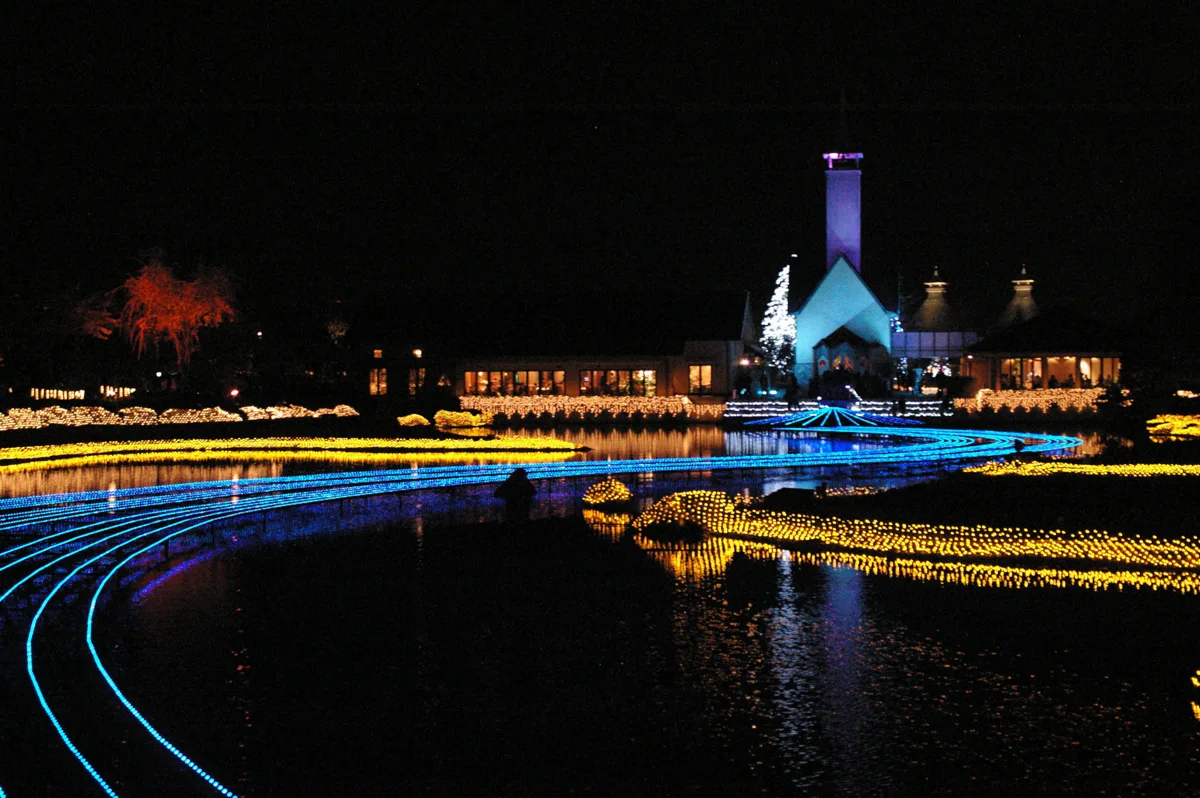
The bridge opposite the chapel is an officially listed popular viewpoint, but it is also a passage. Wider pondside areas usually suit a full sequence better. Photograph from a position that leaves room for pushchairs and wheelchairs. If some companions want pictures and others a rest, agree to meet near a named restaurant or service point rather than simply somewhere beside the pond.
The Twin Trees beside the chapel are two tall natural Himalayan cedars with lights following their branches. Stand back to see their outlines; for the water show, stay in one position. Crowds gather at switch-on. If your schedule allows, eat or stay in the greenhouses first, then see both the trees and water later.
The water show runs from switch-on until closing. If dinner coincides with switch-on, you can still watch a sequence by the pond afterwards before continuing to the tunnel.
After the 200-metre Tunnel of Light, allow time for the main display
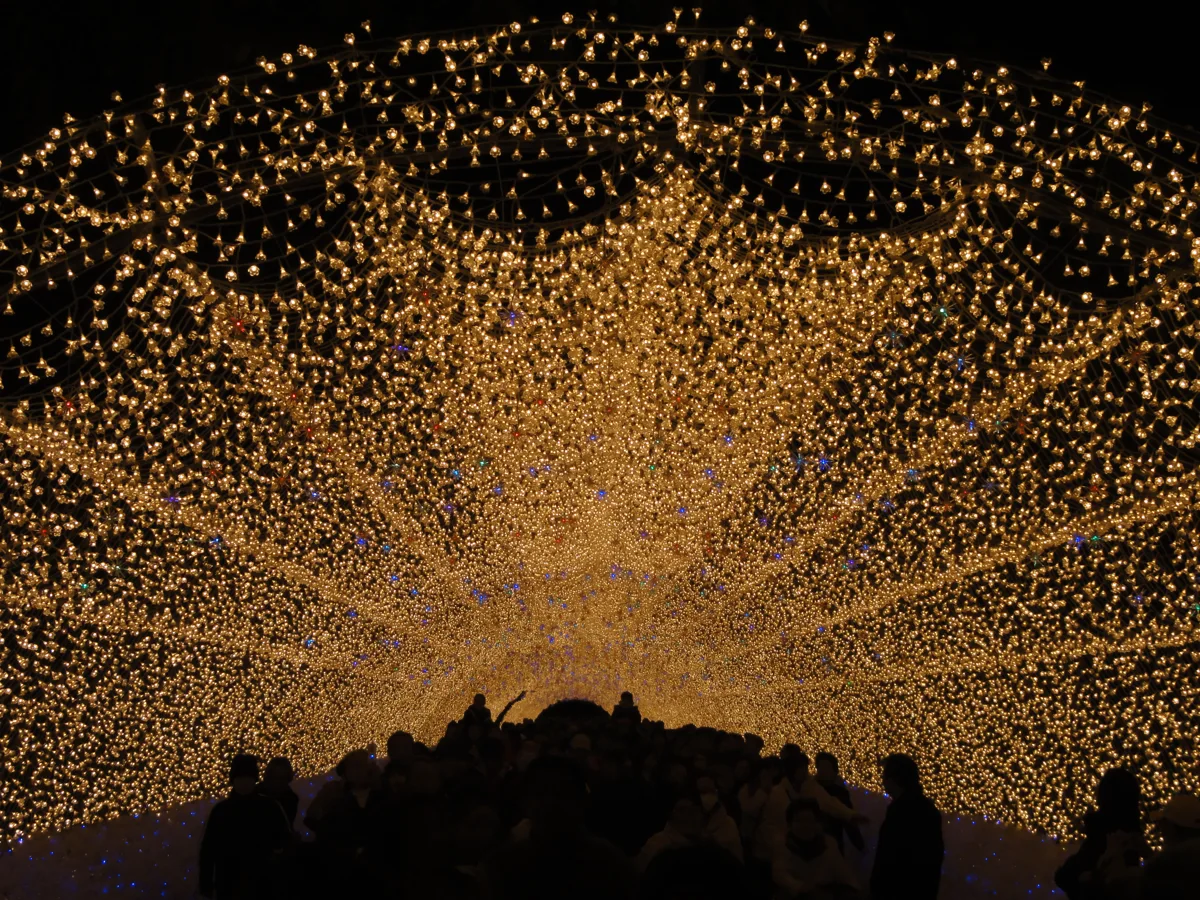
The Hana Kairo Tunnel of Light is about 200 m long, before the themed area at the Hana Hiroba entrance, with petal-shaped lamp holders and warm light. Follow the walking direction. Use gaps in the flow for portraits, then continue. The walk itself is the experience; take pictures along the way rather than blocking the entrance.
The 2026–27 themed area, Wild Paradise, moves from dinosaurs and ancient continents to wild animals, a grassland sunset, the underwater world and waterfalls. It ends with blue-purple flowers and trees and a moonlit scene. Images and the surrounding light field change together. On arrival, find a position where you can see both the main image and foreground lights, then stop to follow the transitions.
Children keen on dinosaurs may want to stay at the opening. Tell them animals and ocean scenes follow, then choose a safe position clear of the route to watch. If arriving midway, wait for the next start if energy allows. Treat the themed area as a place to spend time, leaving after the scenes you want to see.
Watch part of the display before choosing what to film. When scenes change quickly, constant camera movement can obscure the whole. Keep one angle while the sequence develops, then take a group photograph. Gloves and phone battery also affect how long you can stay in the cold. Put on warm clothing before leaving the greenhouses so the main area can be about the display itself.
Nagashima Resort's introduction to the 2026–27 season connects changes in the themed area with the surrounding lights. Allow time on site to follow the scene transitions.
Follow the themed area into Golden Safari, then towards the exit
Golden Safari for 2026–27 is in Hana Hiroba, extending from the themed area along Wild Flower Road into champagne-gold lighting. The official guide describes Golden Forest, formed by four tall Himalayan cedars, and three-dimensional LED animals. This changes the pace from a large moving display to finding animals and examining tree shapes close up.
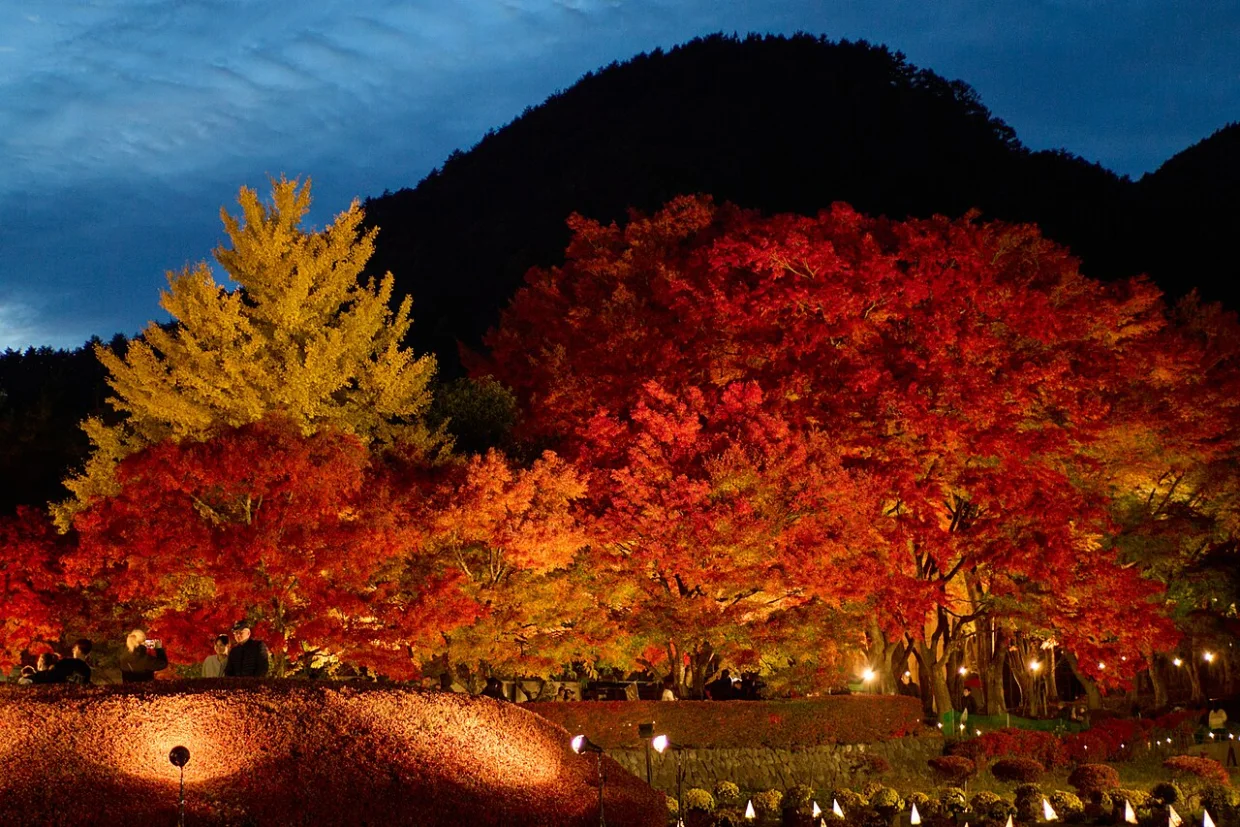
The Golden Safari page divides flower-field night lighting into cosmos and dahlias from October to December, tulips from late March to mid-April, and nemophila from late April to mid-May. Use this seasonal flower lighting to choose a spring travel month, then combine the themed show and golden trees that evening. After seeing autumn flower shapes in daylight, return after dark to see how the field joins the champagne-gold lights. In spring, tulips and nemophila take turns in the same Hana Hiroba area, changing the scene.
Golden Forest's four Himalayan cedars are separate from the chapel's Twin Trees. The former stand in Hana Hiroba's Golden Safari, the latter by the central pond in front of the chapel. To photograph both, see the chapel trees earlier, then follow the themed area's exit direction to the golden forest. They are different photo locations.
The afternoon version: a garden, dinner and the illumination route
On an ordinary operating day, arriving two to three hours before switch-on, deal first with toilets, tickets and the dinner location. If outdoor flowers are good, start at Hana Hiroba. If it is cold or flowers are limited, start at Begonia Garden and combine the indoor visit with a cafe break. Both versions keep a meal in the plan. Decide its timing on arrival for a steadier visit.
For Bashoan or Nagashima Beer Garden, which do not accept seat-only bookings, check the queue earlier in the afternoon and aim to eat before switch-on. If the wait is already long, use another restaurant with space and shorten a garden branch. Read the operating notice on arrival to avoid places serving lunch only that day or closed for a private evening event.
After dinner, watch a full water sequence at the central pond, then continue through the 200-metre tunnel, themed area and Golden Safari. This is the main outdoor route. If you want Begonia Garden at night and have not visited it, let it replace the earlier daylight garden rather than doubling back after all the lights. Leave just one gift or bakery stop before departure to keep the return transfer manageable.
For an illustrative 20:30 departure through the gate, put gardens and dinner before switch-on, then keep the pond and large illuminated areas afterwards. Earlier winter darkness separates the two phases more easily. In spring, an early dinner frees a continuous period for the later lights.
Arriving after dark or staying two hours: do the outdoor route first
For a short visit, start from the entrance service area, follow the central pond's water lights, then the tunnel, main themed area and Golden Safari before returning to the exit. Eat the main meal before entering. Use park vouchers at open food outlets or shops along the route, leaving enough time for more than the walk to the main display.
If flowers are the evening's priority, choose Begonia Garden plus the central pond instead. Explore all four greenhouses, watch one water sequence afterwards, then head out. This has less outdoor walking and is easier to end according to energy. For companions who dislike standing through large displays, indoor flowers and a pondside night view provide a complete visit.
A late arrival does not fit extra visits to the Nagashima amusement park, outlet or day-use hot springs outside. Each needs travel and visiting time. To enjoy both, split the daytime activity into another day and give Nabana no Sato an afternoon and evening. With only one evening, keep dinner before entry and the night-light route focused.
Meals with vouchers: queues, reserved courses and cafe breaks
The official Q&A says Nabana Coupons can be used for food and shopping inside the park. They cannot be exchanged for cash and no change is given. Exclusions include Island Fuji, the flower market outside, lockers, ticket machines and vending machines. Keep the vouchers accessible for payment; using them together at a meal is convenient. The park asks visitors to use its food outlets and shops and prohibits bringing in food and drinks.
Bashoan mainly serves noodles and rice bowls. Its website explicitly says seat reservations are not accepted. It suits visitors who want flexibility and choose on arrival. For a fixed family meal time, check the queue early or select a reserved course elsewhere. This needs a different plan from restaurants booked two days ahead.
Nagashima Beer Garden has a large dining hall, local beer and meat dishes, making it a full-meal option. For individual visitors, seating is arranged on site. The website's booking service is for groups of 15 or more and accepts neither seat-only nor same-day reservations. Its space can suit larger groups, but the number of seats alone does not establish a short wait.
Garden Cafe lists a rose sundae at ¥650 and botanical drinks at ¥550 each, including raspberry lemon, elderflower, Victorian lemon and rose lemon. In the last greenhouse area, it suits dessert or a drink after the flowers. For a noodle or rice meal, look at Bashoan; for meat dishes, Nagashima Beer Garden.
The restaurant and facilities operating notice is more useful than a general introduction for setting the evening's order. From 17 October 2026, ordinary weekdays close at 21:00 with food last orders at 20:30; weekends and holidays close at 22:00 with food last orders at 21:00, subject to individual dated changes. Heavy queues can lead restaurants to stop accepting diners earlier. Dinner before the main display is usually easier than finding a table in the last hour. For example, Bashoan opens only 11:00–15:00 on 26 October, so dinner needs another restaurant. Marseille opens from 16:00 on 27 October, suitable for dinner. Kawasemi has a private booking from 16:00 on 9 November; choose lunch there that day for Japanese food.
For a fixed meal time, choose a course by its restaurant's deadline
The Italian restaurant Mugi accepts illumination-season course bookings from ¥5,000 per person, completed by 14:00 two days before the visit. Listed dinner start times are 16:00–19:00. An early sitting connects the afternoon garden with the evening lights. Save date, numbers and start time, then finish garden branches around that fixed point. Same-day cancellation incurs a 100% charge.
The Marseille booking deadline is 15:00 two days ahead. From 5 October 2026, the ¥5,000 meat or fish course lists dinner starts from 16:00 to 19:00; the ¥6,200 full course lists 16:00–17:00. Compare the full course for a longer seated meal, or the wider start window if you want to dine later. Same-day cancellation is also charged at 100%.
Japanese restaurant Kawasemi is beside Begonia Garden, useful for combining greenhouses and Japanese food. Booking and cancellation deadlines differ by meal. Shokado Gozen requires at least two people and booking by 16:00 the previous day; cancellations after that point incur 100%. Reserved dishes priced at ¥8,000 or above have an earlier deadline of 16:00 three days ahead, with 100% cancellation after it. Include that cost in the decision if you want flexibility for weather changes.
The admission benefit for designated courses applies from 17 October 2026, with Kawasemi from ¥6,000 and other designated restaurants from ¥5,000. Select a qualifying dish and time. With this plan, give the restaurant and booking name at entrance Information and do not buy a separate admission ticket. The plan includes no vouchers. Compare standard admission or a Kintetsu package with transport and vouchers included in the calculation. Choose the plan before buying tickets; advance tickets already bought are not refunded.
Mugi's number is 0594-41-0756, Marseille's 0594-41-0755 and Kawasemi's 0594-41-0753. Marseille telephone enquiries and Kawasemi telephone bookings list 11:00–16:00 reception hours. Designated Mugi and Marseille plans also link to Gurunavi, while Kawasemi has online-only plans. Telephone and online products each have their own meals, times and cancellation conditions. Save restaurant, dish and start time so you can report directly on arrival.
With young children, connect feeding facilities with switch-on crowds
The nursing room is in the entrance gate building; ask entrance staff to use it. The park does not hire pushchairs, so bring your own. Feed, change nappies and organise clothes just after entry before heading to the pond and gardens, avoiding a return from deep inside the park. Near a child's bedtime, choose the short greenhouse-and-pond version and return to your accommodation afterwards.
The official advice for pushchairs and wheelchairs is to stay in Begonia Garden from before switch-on until about 30 minutes afterwards, then leave when the main paths flow more easily. For this version, eat first, make the greenhouses the switch-on activity, then follow the pond and lights. For a seated Garden Cafe break, also account for its earlier closing time.
Nappy-changing facilities include three locations before the gate, one in Hana Hiroba, one in Begonia Garden, one in front of Mura-no-ichi and women's toilets in restaurants. The nursing room is separately located in the gate building. Use the nearest changing point before entering the large illuminated area to reduce backtracking through crowds.
If adults split up for photographs, specify a meeting time and a clear place such as the Begonia Garden entrance, a restaurant doorway or entrance Information. The park does not make visitor-location announcements. If separated, ask nearby staff for help, then go to entrance Information. A recognisable service facility is a clearer meeting point than a large field of lights.
For wheelchair users and slower walkers, choose a route you can end early
About 20 wheelchairs are lent free at the entrance gate, first come, first served on the day, without reservations. Bring your own if reliable access is essential. Choose the central pond and greenhouses according to your companions' energy, extending to the main display only if wanted.
The park lists accessible toilets beside the entrance shop, at the beer garden, Hana Hiroba, behind Mura-no-ichi, Begonia Garden and Kawasemi. The greenhouses and Kawasemi form a manageable area with indoor flowers, a full meal and facilities. If skipping the flower fields and themed area, finish after the central pond by following the exit signs.
Avoid the dense crowds around switch-on for the period recommended by the park. Afterwards, follow the arrows and ask staff for available routes at narrow or crowded sections. The daytime facilities map locates toilets and restaurants; use that day's on-site directions for evening crowd flow.
Rain, photography and departure: finish at the same gate
The park says it opens and switches on the lights in rain. In light rain, spend longer in Begonia Garden and over dinner, keeping the water show, tunnel and themed area outdoors. With an umbrella, children or a wheelchair to manage, take fewer photographs while moving and stop in a wide spot for a scene you like. If wind or operating notices change the plan, shorten the outdoor section; restaurant bookings still follow their cancellation rules.
Let companions watch a sequence before taking portraits and wide views. Keep bridges, tunnels and exits clear, without using luggage or tripods to hold space. The park prohibits groups or individuals occupying areas or placing luggage to claim them. Personal souvenir photographs are allowed. Pack away tripods in dense crowds. Photography for advertising, business or sale is prohibited; reporting and interviews need separate permission.
For an elevated view, add Island Fuji outside the main light area. The park describes an ascent to about 45 m and a ride of roughly seven minutes. Replace an extra pondside photo stop with this view over the lights and surrounding nightscape, allowing queue time separately. The ride costs ¥800 for adults and lower secondary school age upwards, and ¥500 from age three through primary school. The ticket machine takes cash; park vouchers cannot be used. Last acceptance is half an hour before operation ends. The October 2026 notice lists different end times by day of the week, with suspension for wind, rain or mechanical inspection. Check operations on arrival and keep the ground route if it is suspended.
Before leaving, use remaining vouchers for gifts at Mura-no-ichi or the bakery if wanted, then collect belongings, use the toilets and meet at the gate. Include bus waiting time in the return towards Kintetsu-Nagashima. Continue with the Nabana no Sato transport section of the Nagoya two-day guide if using public transport. Drivers should note their parking area and space and head directly there after the gate.
A few useful answers
When should I get to Nabana no Sato to see the gardens and the lights?
Aim to arrive two to three hours before the lights go on. That gives you time to visit one seasonal flower garden and the greenhouses at Begonia Garden and have an early dinner. Check the switch-on time for the day you’re visiting.
Which route should I take at Nabana no Sato if I have only two hours to see the lights?
Follow the signs anticlockwise around the central pond to see the lights on the water. Take the 200-metre Tunnel of Light to the main theme area, then see Golden Safari in the flower field before heading back to the exit. Eat before going in.
Does a standard Nabana no Sato ticket cover Begonia Garden?
A standard ticket covers the four greenhouses at Begonia Garden, so keep it handy to show at the greenhouse entrance. From 23 to 25 December 2026, you’ll need a ticket for a specific date during the special Christmas opening.
How can I avoid the switch-on crowds at Nabana no Sato with a pushchair or wheelchair?
The park advises going into Begonia Garden before the lights go on and waiting until about half an hour after switch-on to come out. Bring your own pushchair. There are around 20 wheelchairs to borrow free of charge at the entrance on a first-come, first-served basis.
Official information and references
Sources used in this guide.
- Nabana no Sato | Visitor guide and park map
- Nabana no Sato | FAQs
- Nabana no Sato | Restaurant and facility operating status
- Nabana no Sato | Dining and restaurants
- Nabana no Sato | Latest flower updates
- Nabana no Sato illuminations | Main themed area
- Nabana no Sato illuminations | River of Light water display
- Nabana no Sato illuminations | 200-metre Hana Kairo Tunnel of Light
- Nabana no Sato illuminations | Golden Safari, Hana Hiroba 2026–2027
- Nabana no Sato illuminations | Twin Trees
- Nabana no Sato illuminations | Popular spots and visiting advice
- Nabana no Sato | Illumination guide map
- Nabana no Sato | Garden Cafe inside Begonia Garden
- Nabana no Sato | Japanese restaurant Kawasemi
- Nabana no Sato | Bakery restaurant Marseille
- Nabana no Sato | Italian restaurant Mugi
- Nabana no Sato | Noodle restaurant Bashoan
- Nabana no Sato | Nagashima Beer Garden
- Nabana no Sato | Begonia Garden
- Nabana no Sato | Begonia Garden guided tour
- Nabana no Sato | Flower areas
- Nabana no Sato illuminations | Symphony of light and sound: Begonia Garden special show
- Nabana no Sato | Illuminations
- Nabana no Sato illuminations | Switch-on times 2026–2027
- Nabana no Sato illuminations | Opening hours and admission during the illumination season
- Nabana no Sato | Island Fuji
- Nabana no Sato | Park admission benefit with restaurant bookings