Plan Hana Hiroba, Begonia Garden, the Tunnel of Light and the 2026–27 theme area in route order. Compare named restaurant bookings, rest stops for families and wheelchair users, and afternoon or short visits.
- Region & Focus
- ChubuAttractions
- Reading Scope
- 24 min read · 14 chapters · 4 Q&As
- Official Verification
- 27 official sources checkedUpdated November 22, 2026
- Key Topics
- SeasonsItinerariesFood
Chapter Route Map (tap any stop)
- Use the central pond to get your bearings, then divide daylight and evening visits
- Choose a seasonal garden by day and give Hana Hiroba its own time
- Walk Begonia Garden’s four greenhouses and rest in the last
- For a gardening interest, start with Saturday’s 13:00 tour
- At lighting time, view the pond, chapel trees and water display separately
- After the 200-meter Tunnel of Light, give the theme area a full viewing stop
- Continue from the theme area to Golden Safari, then toward the exit
- The standard afternoon visit: reserve time for gardens, dinner and lights
- After-dark arrival or just two hours: start with the outdoor main route
- Use vouchers for a meal: distinguish walk-in dining, course bookings and cafe breaks
- For a fixed meal time, choose a course by each restaurant’s booking deadline
- With young children, put nursing and lighting-time crowds on the same route
- For wheelchairs or slower walkers, choose a route that can finish partway
- Rain, photography and departure: finish back at the gate
- Quick Q&A
Arrive two to three hours before lighting time. Choose a seasonal outdoor garden by day, walk through Begonia Garden’s four greenhouses, fit in a meal, then see the central pond, 200-meter Tunnel of Light and theme area after dark. With young children, wheelchair users or late arrivals, shorten the same route around what you most want to see.
Use the central pond to get your bearings, then divide daylight and evening visits
Nabana no Sato is in Kuwana, Mie Prefecture. Its central pond is the most useful landmark. Entry and exit share one gate, with Mura no Ichi, a bakery and services nearby. Several restaurants and Begonia Garden lie around the pond’s other side. Hana Hiroba is a separate large flower garden that needs time to explore. Collect a map on entry and mark one restaurant, one rest stop and the main evening display. You can then adjust the route partway through.
The official night guide specifies a counterclockwise route around the pond. By day, choose branches according to flowering conditions. After dark, follow the arrows: central pond and chapel area, 200-meter Tunnel of Light, theme area, then seasonal illuminations in Hana Hiroba.
Paid lockers are near the entrance. Since you leave through the same gate, small items stored on arrival are easy to collect. Leave large luggage at your Nagoya hotel or station and bring the evening’s coat and care supplies. If you need to leave for the parking lot, ask exit staff for a hand stamp first. Re-entry requires that stamp and the original ticket. Deduct time spent fetching items from the car from your garden visit.
To see flowers and lights, arrive two to three hours before that day’s lighting time. This allows an outdoor garden, greenhouse visit and early dinner. Arrive earlier to photograph every flower bed slowly. The park opens at 10:00; come around noon for lunch inside or a guided tour and give the afternoon to plants. After-dark arrivals should focus on the lights and choose either indoor flowers or a full meal.
Sunset differs greatly between winter and spring. A 16:00 arrival leaves different amounts of daylight for outdoor gardens. Open the official lighting-time page for your visit date before choosing arrival time.
Plan Hana Hiroba, Begonia Garden, the Tunnel of Light and the 2026–27 theme area in route order. Compare named restaurant bookings, rest stops for families and wheelchair users, and afternoon or short visits.
Choose a seasonal garden by day and give Hana Hiroba its own time
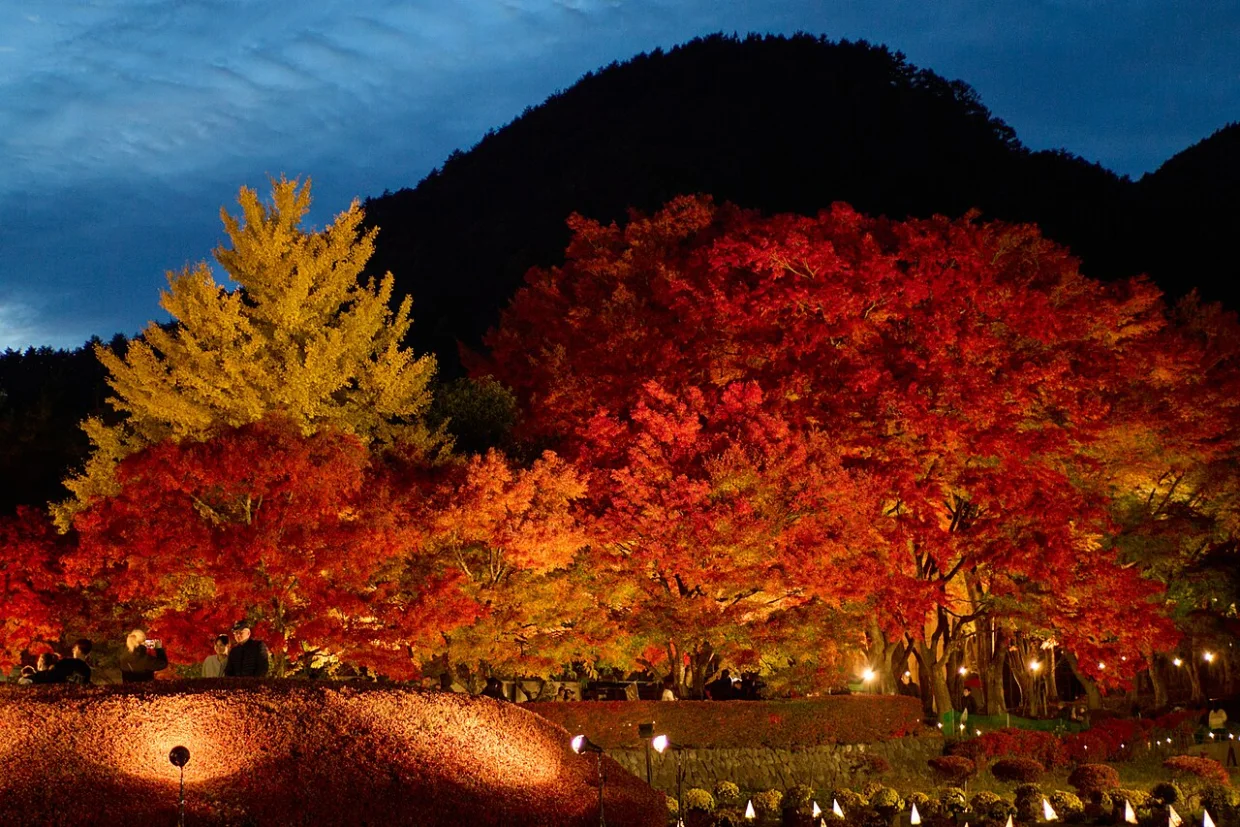
The official garden introduction lists Hana Hiroba as the main large flower field in spring and autumn. Daylight suits comparing autumn dahlias and cosmos by flower form, plant height and blocks of color. Night lighting shifts attention to outlines and light colors. With enough daylight on arrival, visit the flower field before greenhouses or dinner to see two appearances in one admission.
Hana Hiroba’s observation dining facility pauses service before lighting. The October 2026 facility page lists last orders 1.5 hours before lighting and temporary closure one hour before, reopening after lighting. Eat hot food there early or use it for a small evening meal along the route. If you have a restaurant booking, focus on flowers here and keep the main meal at your booked venue.
The October 26, 2026 bloom report listed cosmos and dahlias in viewing season and roses about 60–70% open. In late October, see Hana Hiroba by day, then reach the rose garden through Begonia Garden. For visits after the autumn flowers, use the report for your actual travel week to choose a garden.
In early spring, make the plum garden the main daytime stop. The operator describes about 330 weeping plum trees with paths among them. Branches, flower colors and close views need more daylight time than a single panorama. As cherry blossoms, tulips and nemophila follow, use the latest bloom report to choose the day’s best area. One main garden leaves room for greenhouses and illuminations.
Hana Hiroba’s viewing platform originally offered a raised view over the fields. The October 2026 facility notice separately lists dining on the first floor only; plan meals on that basis.
Walk Begonia Garden’s four greenhouses and rest in the last
The official Begonia Garden introduction describes four connected large greenhouses covering about 9,000 m², with displays centered on tuberous begonias. Large flowers at the entrance, hanging baskets overhead, upright plants along the route and water reflections offer different angles. Start with nearby petals, look up at the baskets, then look back for the whole space. This gives more variety than searching for the same wide shot in every greenhouse.
The water-lily pond is near the third greenhouse entrance. It is small enough for a pause to study leaves and flowers without a separate full circuit. Water-lily blooms open and close with time; the operator recommends morning to noon. If arriving in the afternoon for lights, observe it as you pass, then continue through the displays.
Garden Cafe sits near the end of the fourth greenhouse, with seating among flowers. Make a drink here the last part of your greenhouse visit before leaving. The October 2026 facility notice lists cafe hours of about 10:00–17:00. If entering the greenhouse only after lighting, use an open park restaurant for a rest rather than planning the cafe as late-night dining.
Hanging baskets and upright plants give children specific tasks: find a single-petaled and a double-petaled flower, or compare blooms overhead and at eye level. The operator explains that climate control, irrigation and cultivation keep flowers on display year-round. In months with fewer outdoor flowers, the greenhouses can be the main afternoon activity. Plant enthusiasts should allow 45–60 minutes; a simple walk starts at around half an hour, adjusted to actual stops.
The special greenhouse presentation announced October 15 lists light and music in buildings B and C after sunset, with a separate Christmas version in D on December 23–25. A single visit around dusk lets you study flowers first, then see light change the same space before leaving for the pond. On Christmas dates, special opening begins at 15:00. December 23–25 require date-specific Christmas special-opening tickets; regular admission and ordinary advance tickets are suspended on those three days.
Ordinary admission tickets include Begonia Garden. Keep your ticket for inspection and follow entrance staff’s instructions.
For a gardening interest, start with Saturday’s 13:00 tour
The greenhouse tour announced September 4, 2026 begins September 5 and runs Saturdays at 13:00 for about 30 minutes, for the first ten participants. Gather at the Begonia Garden entrance five minutes early. Horticultural staff explain greenhouse highlights, growing methods and plant ecology. The tour itself is free; park and greenhouse admission still follow your ticket’s conditions.
For this tour, enter before the 12:55 meeting time. Eat lunch in Nagoya or after reaching the park. After the tour, look more slowly at flowers and have tea in the last greenhouse, then move outdoors in the afternoon. Dinner and lights can follow as a full day.
Spring and autumn rose-garden visits also go through Begonia Garden. The operator describes modern, English and old roses displayed with brick walls, arches and climbing supports. If fragrance and branching interest you as well as color, add roses within the same visit. When the seasonal garden is closed, stay with the greenhouses and follow the regular evening illumination route.
At lighting time, view the pond, chapel trees and water display separately
The central pond’s River of Light is about 130 meters long and eight meters wide. It takes the Kiso Three Rivers as its theme and changes with music. The operator gives about ten minutes per sequence, viewable from several pondside points. If you arrive midway, find a place clear of the path, watch, then decide whether to wait for the next start. Leaving after photographing one color can miss later changes in the flowing light.
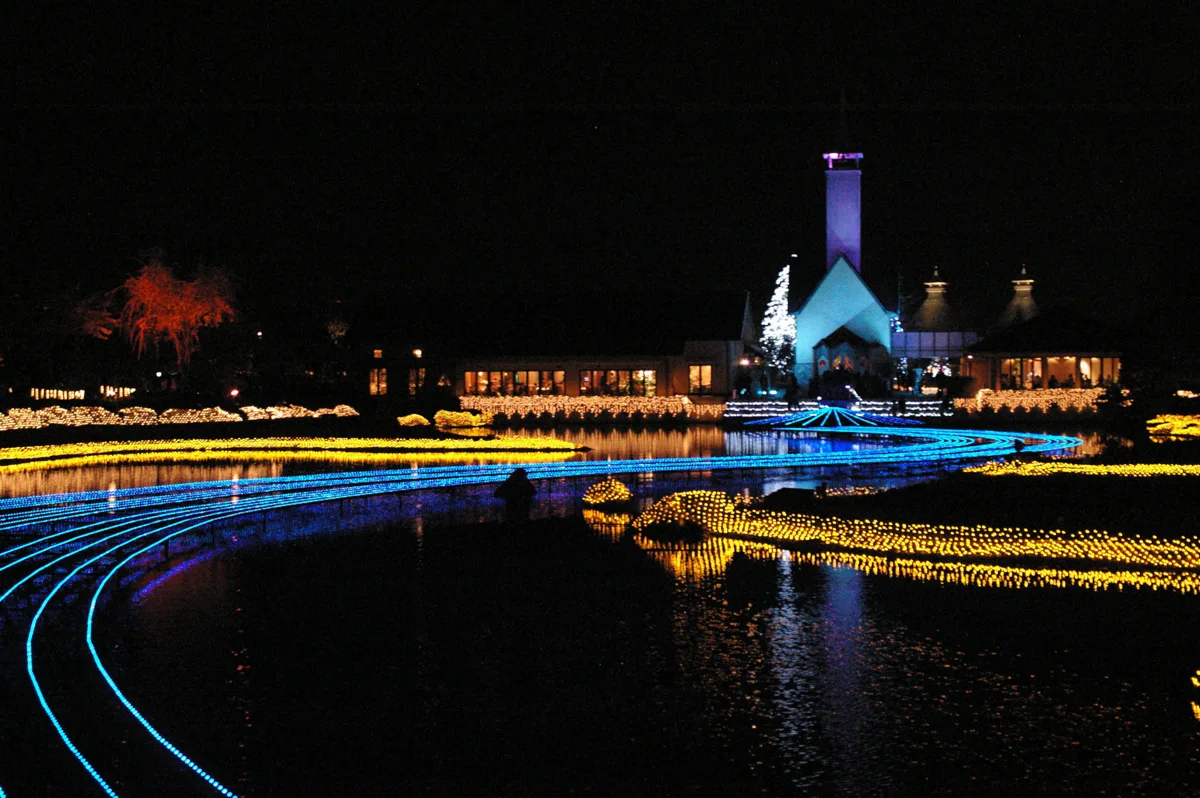
The bridge opposite the chapel is an officially listed popular view, but it also carries visitors. For a full sequence, a wider pondside area usually suits a longer stop. Keep photographs to a side clear of the flow, leaving passage for strollers and wheelchairs. If some companions photograph while others rest, agree on a named restaurant or service point. “Meet by the pond later” is too vague.
The Twin Trees beside the chapel are two tall natural Himalayan cedars, with lights following their branches. Stand back for tree outlines; stay in one position for the water performance. Crowds gather at lighting time. If you can pass later, eat or remain in the greenhouses first, then view both afterward.
The water display runs from lighting until closing. If dinner overlaps lighting time, you can still watch a sequence afterward before continuing to the tunnel.
After the 200-meter Tunnel of Light, give the theme area a full viewing stop
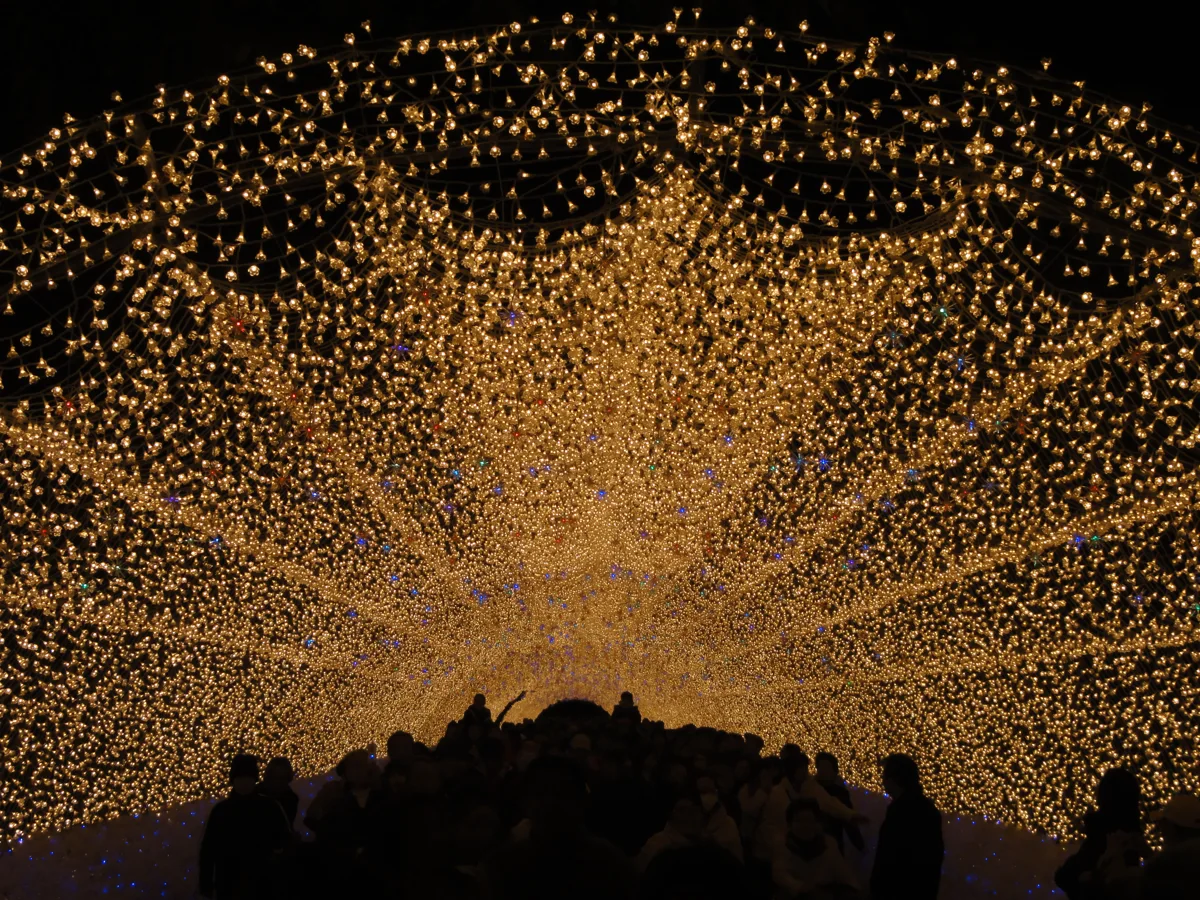
The Hana Kairo Tunnel of Light stands before the theme area at the Hana Hiroba entrance. About 200 meters long, it uses flower-petal-shaped lamp holders and warm lights. Follow the direction of travel. Use gaps in the flow for portraits, then continue. The tunnel is itself a walking experience; spreading photos along it works better than blocking the entrance.
The 2026–27 theme area, Wild Paradise, moves from dinosaurs and ancient continents to wild animals, a grassland sunset, the underwater world and waterfalls, ending with blue-purple flowering trees and a moonlit scene. Main images and surrounding lights change together. On arrival, find a place where you can see both the main image and lights in front before stopping to watch the transitions.
Children keen on dinosaurs may want to stop for a long time at the opening. Tell them animals and ocean scenes follow, then choose a safe place clear of the passage to wait. If you arrive midway, decide whether energy allows waiting for the next beginning. Give the theme area a block of time and leave after seeing the scenes you want.
Watch some of the show before deciding what to record. Constant camera movement during rapid scene changes can hide the overall effect. Hold one angle until the sequence finishes, then take a group portrait. In cold weather, gloves and phone battery life also affect how long you can stay. Put on outer layers before leaving the greenhouse so your theme-area time can go to the show.
Nagashima Resort’s 2026–27 season introduction connects changes in the theme area with the surrounding lights. Allow time on site to watch the scene transitions.
Continue from the theme area to Golden Safari, then toward the exit
Golden Safari for 2026–27 lies in Hana Hiroba, extending from the theme area along Wild Flower Road into champagne-gold lights. The official introduction describes four tall Himalayan cedars forming Golden Forest and three-dimensional LED animals. Shift from the large spectacle to finding animals up close and studying tree shapes, a different pace from the theme area’s moving images.
The Golden Safari page divides seasonal flower lighting into cosmos and dahlias in October–December, tulips from late March to mid-April, and nemophila from late April to mid-May. For spring, choose a month for the flowers you want, then add the theme show and golden forest that evening. After seeing autumn flower forms in daylight, look at how the field joins the champagne-gold lights at night. Tulips and nemophila succeed each other in the same Hana Hiroba field, changing the scene with the planting.
Golden Forest’s four cedars and the chapel’s Twin Trees are separate locations. The former are in Hana Hiroba’s Golden Safari; the latter beside the central pond in front of the chapel. For both photographs, see the chapel pair first, then continue from the theme area toward the golden forest. This avoids confusing two landmarks as one photo spot.
The standard afternoon visit: reserve time for gardens, dinner and lights
On a regular operating day, arrive two to three hours before lighting. Handle toilets, tickets and dinner location first. With good outdoor flowers, start at Hana Hiroba. In cold weather or modest flowering, start at Begonia Garden and combine indoor viewing with a cafe break. Both versions retain a meal; deciding its time on arrival makes the walk easier to manage.
For Bashoan or Nagashima Beer Garden, which do not accept individual seat reservations, check queues earlier in the afternoon and aim to eat before lighting. If a queue is already long, use another restaurant with seating available and shorten a garden branch. Check operating notices on arrival to avoid a venue open only at lunch or reserved privately that evening.
After dinner, watch one pond sequence, then follow the 200-meter tunnel, theme area and Golden Safari. This is the outdoor main route. If you want the greenhouse after dark, use it instead of the earlier daytime outdoor garden rather than backtracking after all the lights. Leave only one gift-shop or bakery stop before departure to keep return-shuttle timing manageable.
For an example departure through the gate at 20:30, put gardens and dinner before lighting, then reserve the pond and large displays for after dark. Earlier winter darkness separates these parts easily. In spring, an early meal frees a continuous stretch for lights after the later sunset.
After-dark arrival or just two hours: start with the outdoor main route
For a short visit, leave the entrance services, follow the pond’s water lights, then tunnel, theme area and Golden Safari, and return to the exit. Eat your main meal before entry and use park vouchers at open food outlets or shops on the way. This avoids discovering after a restaurant queue that you have only enough time left to reach the theme area.
If flowers are the main goal, choose Begonia Garden plus the pond instead. Explore all four greenhouses slowly, watch one water sequence after leaving, then head for the exit. This involves less outdoor walking and is easier to end according to energy. For companions who dislike standing through large shows, indoor flowers and a waterside night view can make a full visit.
A late arrival does not fit extra visits to the outside Nagashima amusement park, outlet or day-use hot spring. Each needs travel and visiting time. Over two days, separate daytime activities onto another day and give Nabana no Sato its afternoon and evening. With one evening, keep dinner before entry and the night-light route focused on one clear goal.
Use vouchers for a meal: distinguish walk-in dining, course bookings and cafe breaks
The park Q&A says Nabana coupons can be used for dining and shopping inside, with no cash exchange or change. Exclusions are Island Fuji, the outside flower market, lockers, ticket machines and vending machines. Keep vouchers handy after collecting your ticket; using them in one meal is convenient. The park asks visitors to use its food outlets and shops, with no outside food or drinks brought in.
Bashoan focuses on noodles and rice bowls and explicitly accepts no seat reservations. It suits flexible visitors who decide what to eat on arrival. Families needing a fixed meal time should check the queue early or choose a bookable course. This is a different planning method from restaurants requiring bookings two days ahead.
Nagashima Beer Garden has a large hall, local beer and meat dishes for a full meal. Individual visitors are seated on arrival. Its reservation service is for groups of 15 or more, with no seat-only or same-day bookings. Larger parties may like its space, but a high seat count does not establish that there will be no wait.
Garden Cafe’s rose sundae is JPY 650 and botanical drinks JPY 550 each, with flavors including raspberry lemon, elderflower, Victorian lemon and rose lemon. In the greenhouse’s final area, it suits dessert or a drink after flowers. For a noodle or rice meal, look at Bashoan; for meat dishes, Nagashima Beer Garden.
The restaurant and facility operating notice is more useful for that evening’s order than general introductions. From October 17, 2026, regular weekday park closing is 21:00 with dining last orders at 20:30; weekends and holidays close at 22:00 with dining last orders at 21:00. Individual venues have date-specific changes. Long queues can bring earlier closure to new diners, so eating before the main displays usually works better than seeking a restaurant in the final hour. For example, Bashoan opened only 11:00–15:00 on October 26, requiring another dinner choice. Marseille opened from 16:00 on October 27, suiting dinner. Kawasemi is privately booked from 16:00 on November 9, so choose lunch there that day.
For a fixed meal time, choose a course by each restaurant’s booking deadline
The Italian restaurant Mugi accepts illumination-season course bookings from JPY 5,000 per person, by 14:00 two days before. Listed dinner start times are 16:00–19:00. An earlier sitting can connect afternoon flowers with evening lights. Save party size, date and start time in your itinerary, then finish garden branches around that fixed point. Same-day cancellation costs 100%.
Marseille requires booking by 15:00 two days before. From October 5, 2026, its JPY 5,000 meat or fish course lists dinner starts from 16:00 to 19:00; the JPY 6,200 full course lists 16:00–17:00. They offer different meal schedules. Compare the full course for a slower meal, or the wider-time-window course for a later sitting. Same-day cancellation also costs 100%.
The Japanese restaurant Kawasemi, beside Begonia Garden, connects greenhouses and Japanese dining. Deadlines vary by dish. Shokado Gozen requires at least two people and booking by 16:00 the previous day; cancellation after that cutoff costs 100%. For reserved dishes from JPY 8,000, the cutoff moves to 16:00 three days before, with 100% cancellation after it. Include this cost when deciding how much weather flexibility you need.
The admission benefit for designated courses applies from October 17, 2026, from JPY 6,000 at Kawasemi and JPY 5,000 at other designated venues, for qualifying dishes and times. With this plan, give your restaurant and booking name at entrance Information instead of buying another admission ticket. It includes no vouchers. For ordinary admission or Kintetsu packages, include transport and vouchers in the comparison. Choose the plan before buying tickets: purchased advance tickets are nonrefundable.
Mugi’s phone is 0594-41-0756, Marseille’s 0594-41-0755 and Kawasemi’s 0594-41-0753. Marseille phone inquiries and Kawasemi phone bookings are listed for 11:00–16:00. Designated Mugi and Marseille plans also link to Gurunavi; Kawasemi has web-only plans. Phone and online products each have their own dishes, times and cancellation terms. Save restaurant, dish and start time after booking so you can report directly on entry.
With young children, put nursing and lighting-time crowds on the same route
The nursing room is inside the admission-gate building; ask entrance staff to use it. The park does not rent strollers, so bring your own. Nurse, change diapers and organize clothing on arrival before heading to pond and gardens, saving a return from deep inside the park. Near a child’s bedtime, choose the greenhouse-and-pond short route and return to your accommodation afterward.
The operator’s advice for stroller and wheelchair users is to remain in Begonia Garden from before lighting until about 30 minutes afterward, then leave when main paths flow more easily. For this version, eat first and make the greenhouse your lighting-time activity, then follow the pond and displays. A Garden Cafe stop must also fit its earlier closing time.
Diaper-changing facilities include three by the gate, one in Hana Hiroba, one in Begonia Garden, one in front of Mura no Ichi, and women’s toilets at restaurants. The nursing room remains inside the gate building, so plan it separately from these scattered changing points. Use the nearest facility on your route before entering large displays to reduce backtracking through crowds.
When adults split up for photos, specify the Begonia Garden entrance, a named restaurant door or entrance Information as the meeting point, with a time. The park does not make missing-person announcements. If separated, ask nearby staff, then go to entrance Information. An identifiable service point is more practical than waiting somewhere in a large illuminated field.
For wheelchairs or slower walkers, choose a route that can finish partway
About 20 wheelchairs are lent free at the gate on a first-come basis that day, without reservations. Bring your own if dependable availability is essential. Choose pond and greenhouse visits according to energy, extending to the theme area only if wanted.
Accessible toilets are listed by the entrance gate shop, Beer Garden, Hana Hiroba, behind Mura no Ichi, Begonia Garden and Kawasemi. The greenhouse and Kawasemi form a zone with indoor flowers, a full meal and services. If skipping the flower field and theme area, finish at the pond and follow exit guidance.
Avoid the busiest period around lighting as the operator recommends, then follow on-site arrows. At narrow or crowded points, ask staff for an available route. The daytime map locates toilets and restaurants; that night’s on-site arrangements govern crowd flow.
Rain, photography and departure: finish back at the gate
The park lists normal opening and illumination in rain. In light rain, extend Begonia Garden and dinner, keeping the water display, tunnel and theme area outdoors. When holding umbrellas, caring for children or pushing a wheelchair, take fewer photos while moving and stop in a wide place for a scene you like. If wind or operating notices change plans, shorten the outdoor section. Existing restaurant bookings remain subject to their cancellation rules.
Let companions watch a sequence before taking portraits and wide shots. Keep bridges, tunnel and exits clear, without occupying space with bags or tripods. The operator prohibits groups or individuals reserving space or leaving luggage to occupy it. Ordinary personal souvenir photos are allowed. Put tripods away in dense crowds. Advertising, business and sales photography is prohibited; reporting and interviews require separate permission.
For a raised view, add Island Fuji outside the main display route. The operator describes a rise to about 45 meters and a ride of about seven minutes. Replace a repeat pond-photo stop with it if overall lights and surrounding night views interest you, allowing extra queue time. Admission is JPY 800 for adults and junior-high students and older, JPY 500 for ages three through elementary school. Ticket machines take cash; park vouchers cannot be used. Final ticket acceptance is half an hour before operation ends. The October 2026 notice gives different end times by day of week; wind, rain or maintenance can stop service. Check on entry and retain your ground route if it is closed.
Before leaving, use remaining vouchers for gifts at Mura no Ichi or the bakery, then collect stored items, use toilets and meet at the gate. Include bus waiting in the last part of the return to Kintetsu-Nagashima. Continue with the Nabana no Sato transport section in the Nagoya two-day guide. Drivers should note parking zone and space, then go directly back after leaving the gate.
A few useful answers
When should I arrive at Nabana no Sato to see both the flowers and the lights?
Arrive two to three hours before the lights come on. Visit one seasonal flower garden and the greenhouses at Begonia Garden, then have an early dinner. Look up the lighting time for your visit date to work out when to enter.
What’s the best route at Nabana no Sato if I have just two hours for the lights?
Follow the signs counterclockwise around the central pond to see the lights on the water. Walk through the 200-meter Tunnel of Light to the main theme area, then see Golden Safari in the flower field before heading to the exit. Have dinner before you go in.
Does regular admission to Nabana no Sato include Begonia Garden?
Regular admission includes all four greenhouses at Begonia Garden. Keep your park ticket to show at the greenhouse entrance. From December 23 to 25, 2026, you’ll need a date-specific ticket for the special Christmas opening.
How can I avoid the crowds with a stroller or wheelchair at Nabana no Sato?
The park suggests going into Begonia Garden before the lights come on and coming out about 30 minutes afterward. Bring your own stroller. About 20 wheelchairs are available to borrow free of charge at the entrance on a first-come, first-served basis.
Official information and references
Sources used in this guide.
- Nabana no Sato | Visitor guide and park map
- Nabana no Sato | Frequently asked questions
- Nabana no Sato | Restaurant and facility operating status
- Nabana no Sato | Restaurants
- Nabana no Sato | Latest bloom reports
- Nabana no Sato illumination | Main theme area
- Nabana no Sato illumination | River of Light water display
- Nabana no Sato illumination | 200-meter Hana Kairo Tunnel of Light
- Nabana no Sato illumination | Golden Safari, Hana Hiroba 2026–2027
- Nabana no Sato illumination | Twin Trees
- Nabana no Sato illumination | Popular spots and advice
- Nabana no Sato illumination | Night guide map
- Nabana no Sato | Garden Cafe inside Begonia Garden
- Nabana no Sato | Kawasemi Japanese restaurant
- Nabana no Sato | Marseille bakery restaurant
- Nabana no Sato | Mugi Italian restaurant
- Nabana no Sato | Bashoan noodle restaurant
- Nabana no Sato | Nagashima Beer Garden
- Nabana no Sato | Begonia Garden
- Nabana no Sato | Begonia Garden guided tour
- Nabana no Sato | Flower areas
- Nabana no Sato illumination | Begonia Garden special light and music presentation
- Nabana no Sato | Illumination
- Nabana no Sato | Lighting times 2026–2027
- Nabana no Sato | Illumination-season hours and admission
- Nabana no Sato | Island Fuji
- Nabana no Sato | Admission benefit with restaurant reservations