Take the bus via Kamo to see the jellyfish, choose the right route and return service, then explore Chido Museum and the domain school. Includes child tickets, lunch and where to stay.
- Region & Focus
- Tsuruoka
- Reading Scope
- 30 min read · 17 chapters · 4 Q&As
- Official Verification
- 14 official sources checkedUpdated 29 October 2026
- Key Topics
- ItinerariesRail travelBooking
Chapter Route Map (tap any stop)
- Allow two days: jellyfish by the sea, buildings and daily life in town
- Check for Kamo on the bus: two routes serve Yunohama
- Use the 2026 timetable to plan a morning with enough time inside
- Calculate admission, last entry and advance tickets before buying
- Look beyond the large tank and learn to distinguish the jellyfish
- Slow down for the tiny jellyfish and the research displays
- Follow Shonai’s rivers to the sea, then connect them with tomorrow’s tools
- Eat inside, or return to town after finishing your visit
- Use the ramps with a pushchair, wheelchair or luggage
- Save Chido Museum and Chidokan as two separate places
- Two Western-influenced buildings: towers and Japanese roof details
- The former Shibuya house: a thatched roof shaped by snow and silkworms
- In the tool stores, compare coastal, river and working life
- The retirement residence and Sakai garden: from objects back to space
- At Chidokan, study the gates, lecture hall and traces of lost buildings
- Stay near Tsuruoka Station for less luggage handling, or choose Yunohama for the coast
- Separate fares usually cost less; keep the two sightseeing days interchangeable
- Quick Q&A
For Kamo Aquarium from Tsuruoka Station, first check that the bus says “加茂経由” (via Kamo). Buses to the same destination, Yunohama Onsen, also run via Zenpoji on a different route. Give the jellyfish and breeding displays a morning, then use another day for Chido Museum’s old buildings, mountain village house and the domain school. This makes a workable two-day trip without a car. If you arrive at midday, start with the castle town and leave the aquarium, which needs a bus out of town, until the next day.
Allow two days: jellyfish by the sea, buildings and daily life in town
Tsuruoka’s two main sightseeing areas are the coast and the castle town. Buses connect Kamo Aquarium with Tsuruoka Station; Chido Museum and the Shonai domain school Chidokan are in town. If you arrive at midday on day one, explore the castle town first and visit the aquarium the next morning. If you stayed in Tsuruoka the previous night, put the aquarium on your first morning. Both options reserve a full day for the coastal buses, which are harder to work around.
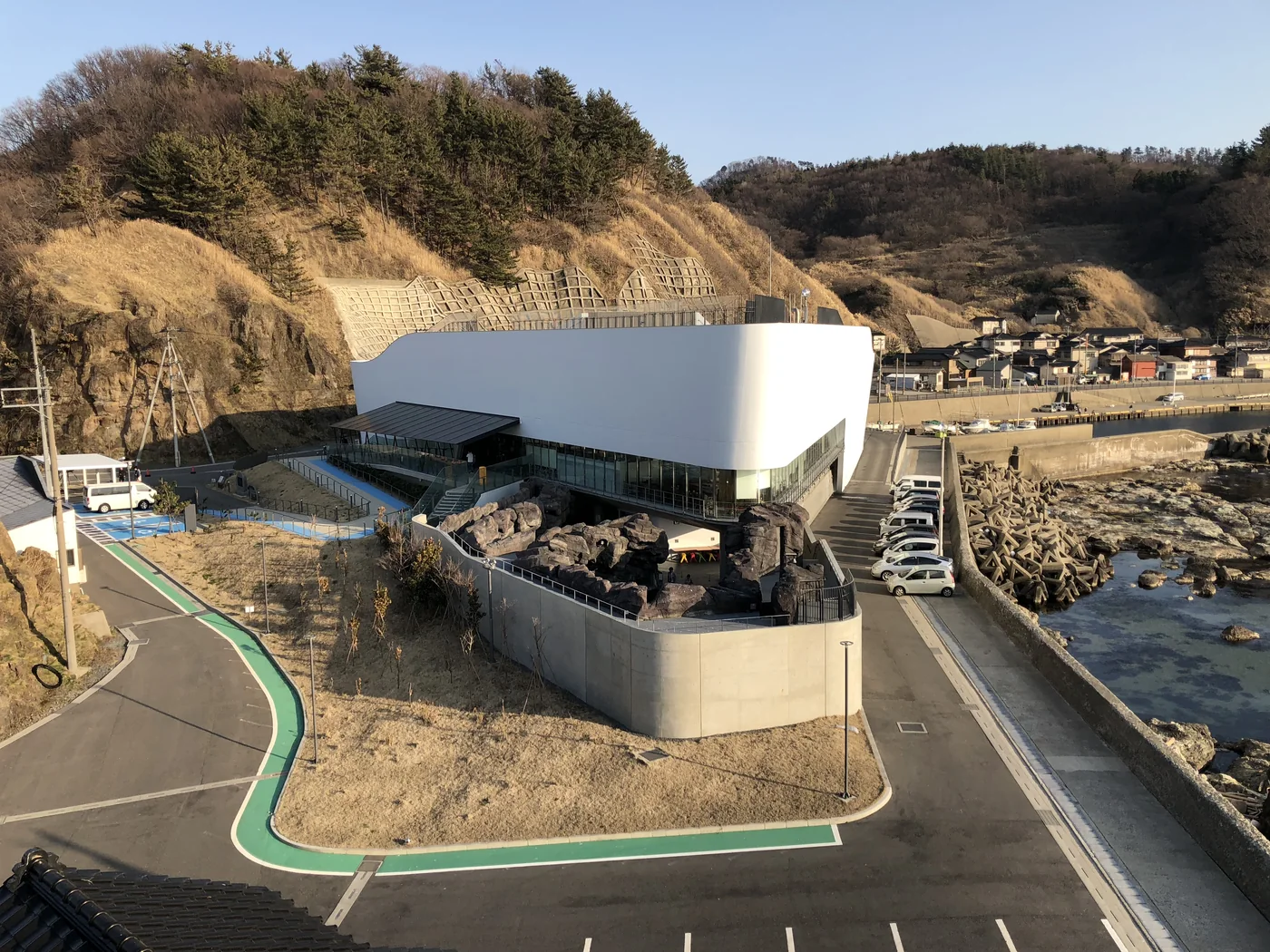
Jellyfish enthusiasts should allow half a day for the aquarium, with separate time for small specimens, breeding displays and the large tank. If architecture and folk culture interest you, visit Chido Museum in the morning and the domain school after lunch. This two-day plan suits travellers who want to examine the exhibits, with lunch included in the available daylight hours. With only one day, choose a main theme: the aquarium and a short castle-town walk, or a full visit to the museum and school.
Tsuruoka lies on the Shonai coast of Yamagata Prefecture. Fly into Shonai Airport or arrive by rail at Tsuruoka Station, then use local buses. The aquarium’s official access page gives rail journey times of about two hours from Niigata and four hours from Tokyo. These journeys reduce what you can do on day one. Adding Sendai, Ginzan Onsen or Zao to the same day often leaves only a short visit to Tsuruoka before closing time.
Take the bus via Kamo to see the jellyfish, choose the right route and return service, then explore Chido Museum and the domain school. Includes child tickets, lunch and where to stay.
Check for Kamo on the bus: two routes serve Yunohama
From Tsuruoka Station, choose a Yunohama Onsen bus marked “加茂水族館経由” (via Kamo Aquarium). The official access page specifically states that services via “善宝寺経由” (Zenpoji) do not stop at the aquarium. Both may display Yunohama Onsen, but their routes differ. Check the intermediate stop as well as the destination. Save the Japanese stop name, 加茂水族館, on your phone to show the driver.
In the Kamo Line timetable revised on 1 April 2026, buses use stand ② at Tsuruoka Station and stand ① at the starting point, S-Mall Bus Terminal. These are different boarding points on the same route, with departure times a few minutes apart. Board at the station if you stay nearby. Use the terminal if you stay near the shopping centre; there is no need to haul luggage there just to board at the first stop.
The official approximate journey time is 40 minutes. Alight at Kamo Suizokukan, right by the aquarium. The bus also passes Chido Museum on its way out of town, so both can fit into one day. However, after a museum stop you must still wait for the next scheduled service. Treating the museum as a stop that takes no extra time can push your aquarium arrival much later.
There is no direct public transport from Shonai Airport to the aquarium. Take the airport bus to Tsuruoka Station, then change to the Kamo Line. The official page also gives a taxi journey of about 20 minutes from the airport. Families with much luggage or a late flight can include a taxi as a separate transport cost. If using buses throughout, settle into a town hotel on arrival day and go to the coast the next morning.
Use the 2026 timetable to plan a morning with enough time inside
In the timetable revised on 1 April 2026, a weekday service leaves Tsuruoka Station at 08:53 and reaches the aquarium at 09:33. On Saturdays, Sundays and public holidays, a morning service leaves at 08:38 and arrives at 09:18. Both give you a morning start. On either day type, the next service leaves at 10:38 and arrives at 11:18. This suits a later start, but lunch then shares the middle of the day with the exhibits. Choose your bus first and plan around it.
Return services on weekdays and on Saturdays, Sundays and public holidays leave the aquarium at 12:26, arriving at Tsuruoka Station at 13:00, and at 14:26, arriving at 15:00. Early arrivals can return at 12:26 and have lunch in town. Choose 14:26 for lunch inside and more time with the tiny jellyfish. Arriving at 11:18 and leaving at 12:26 gives only about an hour, so choose the later return.
You can also alight at Chido Museum on the return journey. The 12:26 bus reaches it at 12:51; the 14:26 bus at 14:51. The first leaves an afternoon for the museum, while the second suits a few selected highlights. From December to February, admission closes at 16:00. Arriving at the stop at 14:51 still leaves entry and walking time, so starting a visit to the whole museum then would be rushed.
The timetable applies Saturday, Sunday and public-holiday services from 13–16 August and from 30 December to 5 January. Do not decide the service pattern from the weekday alone. These times belong to the announced April 2026 revision. For a New Year trip, read the operating-day rules alongside the operator’s timetable announcements. Allow time to collect luggage, enter the station and wait for your train; the bus arrival time is not the time you can board a train.
Calculate admission, last entry and advance tickets before buying
Kamo Aquarium’s standard individual admission is ¥1,500, or ¥500 for primary and junior high school pupils. Younger children enter free. Child admission changes with the school year: the pupil rate starts on 1 April of the year the child enters primary school; the previous day still counts as preschool age. Two adults and one primary school pupil pay ¥3,500. With a preschool child, the two adult tickets total ¥3,000. Transport and meals are extra.
Opening hours are 09:00–17:00, with last admission at 16:00. Start in the morning or before midday for a detailed visit. The final hour must also cover toilets, shopping and the walk back to the bus stop. There is no fixed weekly closing day. Temporary winter closures for maintenance are announced separately, so use the important notices on the official site to choose your winter visit date.
Official advance options include digital tickets from Tsuruoka’s “Kaoru Tsuruoka” online shop and advance tickets sold by Shonai accommodation providers and others. Advance-ticket holders still join the admission queue. They suit visitors who want to pay beforehand, but do not provide faster entry. Leave earlier and allow for waiting at the entrance.
Annual passes cost ¥3,000 for adults and ¥1,250 for primary and junior high school pupils. Buy a single ticket for a normal one-visit trip. Compare an annual pass if you will stay several days and return on different dates. The aquarium does not allow re-entry after a long absence for a meal or sightseeing elsewhere. If eating outside, do so after finishing your visit.
Look beyond the large tank and learn to distinguish the jellyfish
The jellyfish area, Kuranetarium, is the aquarium’s main attraction. The aquarium describes about 100 species. Start with size, bell shape, colour and movement. Study one individual in a small tank before looking at a group; this often leaves a clearer impression than photographing every tank. Read a keeper’s information panel and compare it with the movement in front of you.
The best-known display, the Kurage Dream Theatre, has a tank five metres in diameter. The aquarium says its approximately 10,000 moon jellyfish were bred and raised at the research institute. Step back to see the whole circular tank, then move closer to watch individual bell edges open and close. The floating group and one jellyfish’s movement offer two scales of observation in the same scene. Allow time for both.
The cylindrical Kurage Tube lets you change your viewing angle, and there is also a tank two metres in diameter. Share your time among the displays: use small tanks to learn shapes, the cylinder to see individuals’ relative positions, and the large tank to watch the group. Companions who prefer photography or reading the panels can each spend time with these different tanks.
Follow staff instructions on visitor flow when taking photographs. Staff may stop photography when it is crowded. Tripods, monopods and prolonged photography at one tank are restricted, and live streaming is prohibited inside. Take a few phone photographs, then make room for others. For views without other visitors, arrive early and use quiet moments without blocking the route.
Slow down for the tiny jellyfish and the research displays
The Micro Aquarium uses microscopes and screens to show jellyfish measuring only a few millimetres or less. The large tank is easy to take in immediately; here you first need to find the subject on the screen, then identify its movement. Some small specimens are already adults. Read the species name and growth stage rather than assuming a tiny animal is newly born.
Keepers give several talks each day about jellyfish ecology and care. Check the daily notices on entry and fit a talk within your chosen return bus time. If it overlaps with lunch, shorten shopping time to keep both the talk and meal. For a visit focused on the research displays, a 14:26 return gives more room than committing to 12:26 from the outset.
This area also introduces husbandry work and research. Water temperature, food and collection require continued observation and accumulated data. Follow the question “How do they care for this species?” rather than trying to memorise every name. Thinking back to the many animals in the large tank helps explain the work behind a stable display.
With children, change how you look between the large tank and microscopic displays. In the first, find one jellyfish and follow several bell movements; in the second, compare the screen with the specimen. If a young child is not interested in microscope images, finish one brief observation and move on. Turning the visit into a test of names makes attention harder to sustain.
Follow Shonai’s rivers to the sea, then connect them with tomorrow’s tools
The Shonai rivers, ponds and sea displays follow water from mountains through upper, middle and lower river reaches to the coast and deep sea. This sequence places Tsuruoka in its surroundings: rivers outside town, rocky shores by the sea and different animals in different waters. If you have not visited other parts of Shonai, use the tanks to build a simple picture of the region.
The marine displays move from nearer waters towards deeper areas. A large tank shows several fish species living together along the Shonai coast. Choose a fish near the bottom or rocks, then compare it with one that moves elsewhere. Their positions help explain the differences. Handwritten panels also discuss local history and culture, giving you more to follow than fish names alone.
The aquarium works with Kamo Fisheries High School so that students can present work from their aquarium studies course in a tank. Themes change by academic year. Look for the question the students chose and how the tank explains it. At Chido Museum the next day, connect coastal and river fishing tools with these environments. This gives the two visits a concrete link.
Eat inside, or return to town after finishing your visit
The aquarium’s Gyosho Dining Okimizuki opens from 11:00 to 15:00, convenient after a morning arrival. Its introduction describes dishes based on local ingredients, history and food culture, including the Shonai Kitamae set, black sea bream set and jellyfish ramen. Some dishes are seasonal. Read the day’s menu before ordering. If you have specific dietary needs, favour dishes whose ingredients are clearly identified.
For the 12:26 return, finish the exhibits, go back to Tsuruoka and eat near the station before planning the afternoon. For 14:26, eat inside and continue with the remaining displays. Each is a complete plan. Leaving for a meal elsewhere and then returning conflicts with the rule against re-entry after a long absence.
Okimizuki also offers evening dining by reservation for at least two people. Plan this separately with return transport. Normal aquarium hours end at 17:00, so daytime admission and an evening booking are separate arrangements. For a normal two-day visit, lunch here is enough. Return to town in the evening and rest before a slower museum visit the next day.
Use the ramps with a pushchair, wheelchair or luggage
The aquarium entrance is on Level 2, reached by a ramp from the car park. Its FAQ says the main route inside uses ramps down to Level 1, followed by a lift back to the Level 2 exit. Wheelchair users can plan around this route, and companions can see why entry and exit share a level. After getting off the bus, find the ramp rather than heading for stairs because of the change in level.
Wheelchairs and pushchairs are available to borrow while supplies last. Bring your own pushchair if it suits your child. If borrowing one, include collection and return in your visit time. If a child becomes tired, reduce prolonged standing at information panels, make a short stop at the large tank, then use the toilets and organise belongings near the exit.
Small, medium and large lockers are available. Ask reception about luggage too large for a locker; the office can store it. This helps if you visit after checkout and then continue to Yunohama. If staying near Tsuruoka Station again, leaving luggage with the same accommodation saves carrying it. Decide where it will go before arriving so that you can start the visit straight away.
Save Chido Museum and Chidokan as two separate places
Chido Museum is at 10-18 Kachushinmachi; the Shonai domain school Chidokan is at 11-45 Babacho. The former is a museum of buildings and collections; the latter is a historic school site. Save both full names in your map app. Start with the museum for architecture and folk tools, or with free-entry Chidokan for a shorter introduction to the school grounds.
Chido Museum opens 09:00–17:00 from March to November, with admission ending at 16:30. From December to February it closes at 16:30, with admission ending at 16:00. It closes on Wednesdays and from 28 December to 4 January; some areas also close for exhibition changes. Admission is ¥1,000 for adults, ¥400 for senior high school and university students, and ¥300 for primary and junior high school pupils. Students must show student identification when buying tickets.
The grounds contain Western-influenced public offices and a police station, a former lord’s retirement residence, a thatched house, folk-tool stores and a garden. Allow two to three hours for a first visit, then shorten it to suit your interests. Equal 15-minute slots for every building can take time away from what interests you most. Choose architecture, everyday tools or the garden as your main focus.
Two Western-influenced buildings: towers and Japanese roof details
The former Nishitagawa District Office was built in 1881 and relocated in 1972. From the front, look at the projecting balcony over the central entrance, with a tower and clock tower above. The museum gives its height as 20 metres. Follow the central vertical section, then the windows and walls on either side to see how the façade presents a public building. Inside are displays on Shonai archaeology, the Boshin War and the Meiji period.
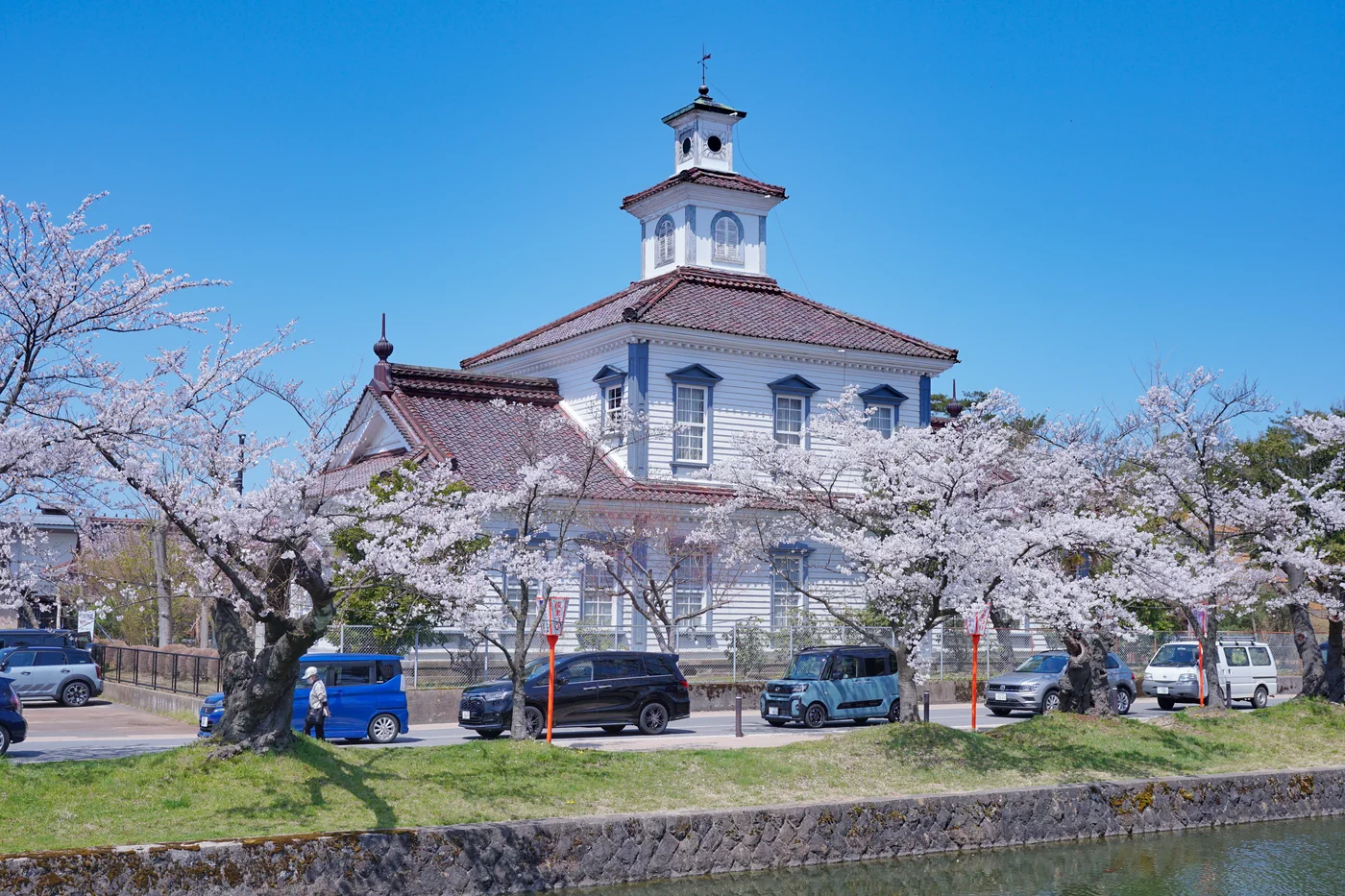
The former Tsuruoka Police Station was built in 1884 and relocated in 1957. Its designer was Tsuruoka-born master carpenter Takahashi Kanekichi. The museum identifies Renaissance-style window surrounds alongside established Japanese forms in the main ridge and gables. After the district office, shift your attention to the roof and how it combines with the Western appearance of the walls.
Start with each building’s outline, then go inside for the exhibits. Even with little interest in modern history, you can ask concrete questions: where is the entrance, how does the centre project, and how does the roof end? History enthusiasts can spend longer with the interior displays. A photograph of the first building is only a start; the house further on presents a very different scale.
Chido Museum introduces the former Tsuruoka Police Station building.
The former Shibuya house: a thatched roof shaped by snow and silkworms
The former Shibuya residence came from Tamugimata at the foot of Mount Yudono. Built in 1822, it was relocated for preservation in 1965. The museum describes a mountain village with heavy snowfall, where steep terrain and deep snow encouraged upward use of space and multi-storey houses. Look first at the overall height and space beneath the roof to see how its purpose differs from the public office.
From the Meiji period onwards, the family raised silkworms. The second and third floors and even the roof space served as work and storage areas. High windows added for ventilation and daylight changed the thatched roof into the form known as kabuto-zukuri. Compare the roof outside with the explanation of silk production to connect the outline with everyday work.
This house once stood in a mountain village and is now preserved with castle-town buildings. If your group wants to study just one house closely, it makes a useful focus: snow, terrain, work space, ventilation and roof shape all connect here. Afterwards, look back at the site plan to see how the museum brings buildings from different living environments together.
In the tool stores, compare coastal, river and working life
The Mingu no Kura was a two-storey earthen storehouse built late in the Edo period. It originally held the lord’s arms and furnishings, then became a display of Shonai folk material. The ground floor covers Sea of Japan shipping and commerce; the upper floor covers local crafts such as clay figures and black persimmon woodwork. Consider how objects were stored and carried before reading their names.
The store for Important Tangible Folk Cultural Properties includes Shonai work clothes, wooden drinking vessels, mountain village wooden utensils, fishing equipment from the Shonai coast and Tobishima, and tools from the Mogami River system. Read sea and river tools separately rather than memorising every category. After the aquarium’s different waters, this offers the human question: how did people work in these places?
Choose a practical question for a tool: which part of the body operated it, did it need one person or several, and which parts touched water, fish or clothing? Compare the label’s explanation with its shape. With children, choose one tool and find the answers together, then browse other cases according to interest rather than reading every name aloud.
The museum distinguishes collection storage from exhibition space, and rice-farming tools have separate storage arrangements. For rice-growing material, use the areas open that day and spend time with the objects on display. Comparing the two environments that interest you most gives a complete visit within a museum that places sea, mountain, river and castle-town life side by side.
The retirement residence and Sakai garden: from objects back to space
The former Shonai lord’s retirement residence was Sakai Tadaaki’s home in retirement. In 1864, part of the Edo secondary residence was dismantled and moved to Tsuruoka. The museum records that timber and tiles travelled by the western coastal shipping route to Sakata, then by river boat to Tsuruoka. Read this after the shipping exhibits: the wooden building before you once travelled as separate materials.
Displays inside cover the Tsuruoka castle town, Shonai rock fishing, and the Sakai family’s arms, furnishings, calligraphy and paintings. Start with the castle-town material to understand your location, then follow your interest in fishing gear or other objects. If Sakata is on tomorrow’s itinerary, take this link between sea and river transport with you; it helps explain the relationship between Tsuruoka’s buildings and Sakata’s port.
The Sakai garden is a shoin-style garden, with a hill, stone arrangements and shoreline across the pond. The museum describes a dry waterfall and gorge on the left, and petrified-wood stones forming a peninsula and inlet on the right. Stop where you can see across the pond, then study each side before moving for another angle. Water, stone and trees provide a slower rhythm after the display cases.
At Chidokan, study the gates, lecture hall and traces of lost buildings
The Shonai domain school Chidokan opens 09:00–16:30, with free admission. It closes on Wednesdays; if Wednesday is a public holiday, it closes on the next weekday instead. Its New Year closure is 29 December–3 January, starting a different day from Chido Museum’s closure. Mark them separately for a New Year trip. Allow about 45 minutes to an hour on your castle-town afternoon.
The site retains the Confucian temple, lecture hall, Onyuma room and several gates. Compare who used each gate: the main gate served the lord, the west gate served teachers and domain officials, and the east gate served students. These names help explain rank and access within the grounds.
The lecture hall held student gatherings such as opening ceremonies. In years when the lord was away on alternate attendance duty, it also regularly served as an office for domain officials’ meetings. This links the school and local government within one room. The Confucian temple relates to the Sekiten ceremony honouring Confucius. Distinguish study, ritual and administration to understand the buildings’ roles.
East of the lecture hall, ground markings show the layout of the main school buildings that no longer stand. After the surviving buildings, spend time with these positions and imagine the original extent of the grounds. Looking only for roofs can lead you past this area; the ground markings reveal the difference between what survives and the former school.
Stay near Tsuruoka Station for less luggage handling, or choose Yunohama for the coast
For this two-day route, favour the area around Tsuruoka Station. Leave luggage on arrival, take the Kamo Line the next day, then collect it before leaving by rail. Compare usable beds, whether children need their own beds, breakfast starting times and luggage storage after checkout. These directly affect your morning bus. For 08:53 or 08:38 departures, finish breakfast and reach stand ② beforehand.
If staying at Yunohama Onsen, visit the aquarium on the day you move to the coast. The Kamo Line continues to Yunohama, but 14:26, for example, is a departure towards Tsuruoka. For the coast, read the Yunohama Onsen-bound column. The 2026 timetable includes a 15:28 departure from the aquarium, reaching Yunohama Onsen at 15:39, as an afternoon option. Allow time to walk to your inn and check in, then plan around its stated dinner time.
For family stays with meals, enter children’s meals, bedding and adult numbers separately. With a cancellable plan, record the free-cancellation deadline, later charges at each stage and no-show terms. A coastal night gives you the evening and morning there. If leaving early by long-distance train, the station area is more convenient. With only one night, decide how you will leave Tsuruoka before choosing the area.
Separate fares usually cost less; keep the two sightseeing days interchangeable
An adult fare between Tsuruoka Station and the aquarium is ¥840 each way, or ¥1,680 return. Add ¥1,500 for the aquarium and ¥1,000 for Chido Museum: main transport and admission to both total ¥4,180 per adult. Meals, accommodation and other castle-town journeys are extra. On the museum day, a regular route bus from the station costs ¥320 each way, while the city loop bus costs ¥300 each way. Calculate according to the route you use.
The Tsuruoka one-day unlimited bus pass costs adults ¥700 for Zone A or ¥2,900 for Zone C. Zone A covers central Tsuruoka; out-of-town trips such as the aquarium require consideration of Zone C. A simple aquarium return costs ¥1,680, below the Zone C price, so two single fares are cheaper. Two regular bus journeys to the museum total ¥640, also below the ¥700 Zone A pass. Compare again only if adding more city journeys.
The pass is loaded onto cherica, Suica or PASMO, one person per card. Buy it on the bus using the stored balance. Ask the driver before your first alighting, then tap as instructed. The selected zone cannot be changed, and the pass is valid only on the purchase date. Children need a child card. It cannot be bought on a card holding a bus season ticket valid that day, or with a disability IC card. Airport and highway buses are excluded, so do not count airport transport as a pass saving.
With two full days, visit the aquarium on the first morning, return at 14:26, rest in town and have dinner. On day two, visit Chido Museum in the morning and the school after lunch, then collect luggage at the station. If arriving at midday on day one, put the museum and school first, then take an early aquarium bus the next day and leave after the 12:26 return. If Wednesday falls within the trip, put the coast on Wednesday and the castle town on an opening day.
A few useful answers
Can I take a direct bus from Shonai Airport to Kamo Aquarium?
By public transport, take the airport bus to Tsuruoka Station, then a Yunohama Onsen bus via Kamo. The official page also gives about 20 minutes by taxi from the airport.
Is the Tsuruoka day pass good value for an aquarium return?
The adult fare is ¥840 each way, or ¥1,680 return, below the ¥2,900 Zone C day pass covering the wider Tsuruoka area. Separate fares cost less for this return trip alone.
Are Chido Museum and Chidokan the same place?
They are separate. Chido Museum in Kachushinmachi holds buildings, folk tools and the former lord’s family material. Chidokan in Babacho is the historic Shonai domain school, with free admission.
Do preschool children need tickets for Kamo Aquarium?
Preschool children enter free. The ¥500 primary and junior high school rate applies from 1 April of the year a child enters primary school. There are ramps, a lift and limited pushchairs to borrow.
Official information and references
Sources used in this guide.
- Kamo Aquarium: opening hours and admission
- Kamo Aquarium: access and airport transfers
- Shonai Kotsu: Kamo Line timetable from 1 April 2026
- Chido Museum: admission and opening hours
- Shonai domain school Chidokan: opening hours and address
- Kamo Aquarium: jellyfish displays
- Kamo Aquarium: microscopic displays and research
- Kamo Aquarium: re-entry, advance tickets, accessibility and photography
- Chido Museum: permanent buildings, folk tools and garden
- Shonai Kotsu: main fares for 2026
- Shonai Kotsu: Tsuruoka day pass
- Kamo Aquarium: Shonai rivers and sea
- Chidokan: temple, lecture hall and gates
- Okimizuki: lunch and evening reservations