Take the bus via Kamo to see jellyfish, choose the right return service and compare day passes. Spend day two on Chido Museum’s architecture, the Tamugimata farmhouse and the domain school, with child fares, lunch and lodging choices.
- Region & Focus
- Tsuruoka
- Reading Scope
- 30 min read · 17 chapters · 4 Q&As
- Official Verification
- 14 official sources checkedUpdated October 29, 2026
- Key Topics
- ItinerariesRail travelBooking
Chapter Route Map (tap any stop)
- Allow two days: jellyfish by the sea, buildings and daily life in town
- Look for Kamo on the bus: two routes go toward Yunohama
- Use the 2026 timetable to leave a full morning for the visit
- Work out admission, last entry and advance tickets before buying
- Look beyond the large tank and compare the jellyfish
- Slow down for tiny jellyfish in the research area
- Follow Shonai’s rivers to the sea, then connect them with tomorrow’s tools
- Eat inside, or return to town after finishing your visit
- Use the ramps with a stroller, wheelchair or luggage
- Save Chido Museum and Chidokan as two separate places
- Compare two Western-influenced buildings, from towers to Japanese roof details
- The Former Shibuya House: a thatched roof shaped by snow and silkworms
- Read coastal work, river work and crafts through the folk tools
- Move from objects to space at the retirement residence and Sakai Garden
- At Chidokan, study the gates, lecture hall and vanished school buildings
- Stay near Tsuruoka Station for easy luggage handling, or choose a seaside night
- Separate fares suit this route; keep the two sightseeing days interchangeable
- Quick Q&A
For Kamo Aquarium from Tsuruoka Station, first look for “加茂経由” (via Kamo) on the bus. Services via Zenpoji also go to Yunohama Onsen but take a different route. Leave a morning for jellyfish and breeding displays, then another day for Chido Museum’s historic buildings, mountain farmhouse and the domain school. This makes a two-day trip without a car. If you arrive at midday, walk around the castle town first and visit the aquarium by rural bus the next day.
Allow two days: jellyfish by the sea, buildings and daily life in town
Tsuruoka’s two main sightseeing areas are on the coast and in the castle town. Buses link Kamo Aquarium with Tsuruoka Station; Chido Museum and the Shonai domain school Chidokan are in town. If you arrive at midday on day one, explore the castle town and visit the aquarium the next morning. If you stayed in Tsuruoka the night before, put the aquarium on the first morning. Both plans leave the less flexible coastal bus trip for a day with enough time.
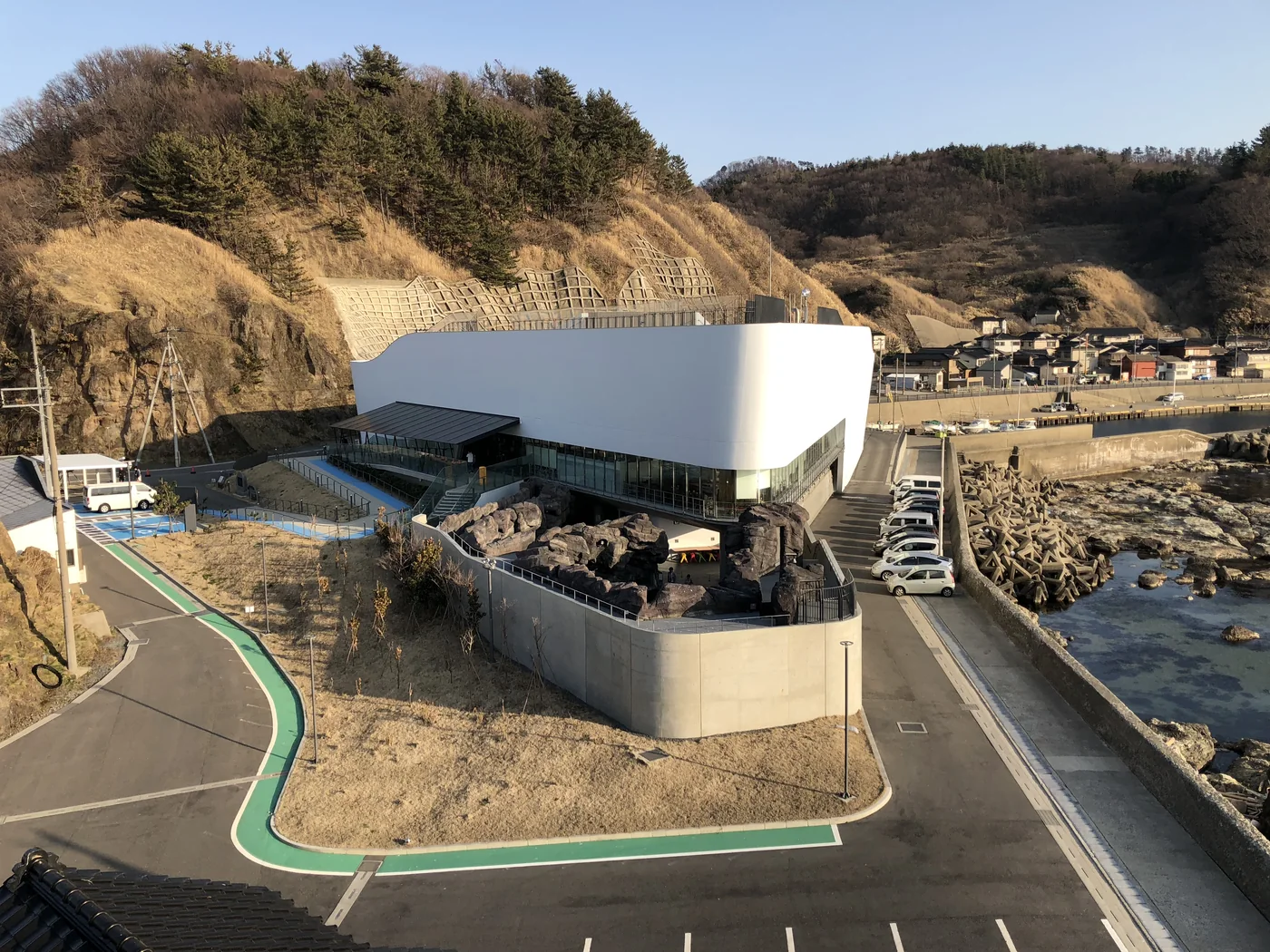
Jellyfish enthusiasts should allow half a day for the aquarium, looking separately at small specimens, breeding displays and the large tank. If architecture and folk culture interest you more, visit Chido Museum in the morning and the domain school in the afternoon. This two-day plan suits travelers who want to study the exhibits, with lunch included in the daytime schedule. With only one day, choose a focus: the aquarium and a short castle-town walk, or a full visit to the museum and school.
Tsuruoka is in the coastal Shonai region of Yamagata Prefecture. Fly into Shonai Airport or arrive by rail at Tsuruoka Station, then use local buses. The aquarium’s official access page gives rail journey times of about two hours from Niigata to Tsuruoka and about four hours from Tokyo. These long journeys take up much of day one. Adding Sendai, Ginzan Onsen or Zao to the same day often leaves only a short visit before Tsuruoka’s attractions close.
Take the bus via Kamo to see jellyfish, choose the right return service and compare day passes. Spend day two on Chido Museum’s architecture, the Tamugimata farmhouse and the domain school, with child fares, lunch and lodging choices.
Look for Kamo on the bus: two routes go toward Yunohama
From Tsuruoka Station, choose a bus to Yunohama Onsen marked “加茂水族館経由” (via Kamo Aquarium). The official access page specifically says services marked “善宝寺経由” (via Zenpoji) do not stop at the aquarium. Both may show Yunohama Onsen as their destination, but their routes differ. Check the intermediate stop rather than just the destination. Save the Japanese stop name, 加茂水族館, on your phone to show the driver.
Under the Kamo Line timetable revised on April 1, 2026, buses leave from stop ② at Tsuruoka Station and stop ① at the originating S-Mall Bus Terminal. These are different boarding points on the same route, with departures a few minutes apart. Board at the station if you are staying nearby. Use the terminal if you are staying by the shopping center; there is no need to haul luggage out of your way just to board at the first stop.
The official approximate journey time is 40 minutes. The stop is called Kamo Aquarium, and you can enter the aquarium after getting off. Buses from town also pass Chido Museum, so both visits can fit on one day. However, after a museum stop, the next bus still follows its timetable. Treating the museum as a stop that costs no extra time can push your aquarium arrival steadily later.
There is no direct public transport from Shonai Airport to the aquarium. By bus, take the airport bus to Tsuruoka Station and transfer to the Kamo Line. The official page also gives about 20 minutes for a taxi from the airport. With heavy luggage, a family group and a late flight, a taxi is another transport cost to consider. If you plan to use buses throughout, settle into town on arrival day and go to the coast the next day.
Use the 2026 timetable to leave a full morning for the visit
The timetable revised on April 1, 2026 has a weekday service leaving Tsuruoka Station at 08:53 and reaching the aquarium at 09:33. On Saturdays, Sundays and holidays, a morning service leaves at 08:38 and arrives at 09:18. Both let you start in the morning. The next departure is 10:38, arriving at 11:18, on both schedules. It suits a later start, but lunch and sightseeing then share the midday hours. Choose your bus first and plan the activities after it.
Return services on weekdays and weekends/holidays leave the aquarium at 12:26, reaching Tsuruoka Station at 13:00, and at 14:26, reaching the station at 15:00. Early arrivals can take the 12:26 bus and eat lunch in town. The 14:26 service gives more time for lunch inside and a close look at tiny jellyfish. Arriving at 11:18 and leaving at 12:26 gives only about an hour, so choose the later return instead.
You can also get off at Chido Museum on the return trip. The 12:26 aquarium departure reaches the museum at 12:51; the 14:26 departure arrives at 14:51. The first leaves an afternoon for the museum, while the second suits a few selected highlights. From December through February, museum admission ends at 16:00. After a 14:51 arrival, you still need to enter and move between buildings, so starting the whole museum visit then would be rushed.
The timetable assigns August 13–16 and December 30–January 5 to the weekend/holiday schedule. The day of the week alone is not enough. These times come from the published April 2026 revision. For a New Year trip, read the operating-day categories together with the bus company’s revision notices. Leave time before an onward train to collect luggage, enter the station and wait. A bus arrival time is not a train you can immediately board.
Work out admission, last entry and advance tickets before buying
Kamo Aquarium’s current individual admission is ¥1,500 for adults and ¥500 for elementary and junior high school students. Preschool children enter free. The child category changes with the school year: student admission applies from April 1 of the year a child enters elementary school; the day before, the preschool category still applies. Two adults and one elementary school child pay ¥3,500 in total. With a preschool child, the two adult tickets total ¥3,000. Transport and meals are extra.
The aquarium opens 09:00–17:00, with last entry at 16:00. For a detailed visit, start in the morning or by midday. The final hour must also cover restrooms, shopping and the walk back to the bus stop. There is no fixed weekly closing day. Temporary winter maintenance closures are announced separately, so use the important notices on the official website to choose your winter visit date.
Official advance options include digital tickets through Tsuruoka EC “Kaoru Tsuruoka” and advance tickets sold at Shonai accommodation facilities and other outlets. Advance ticket holders still join the admission queue. They suit people who want to pay ahead, but will not provide fast-track entry. An earlier start and time for the entrance queue are the practical ways to plan for that.
Annual passes cost ¥3,000 for adults and ¥1,250 for elementary and junior high school students. For a single visit on an ordinary trip, buy a single-entry ticket. Compare annual passes if you are spending several days in Tsuruoka and plan to return on another day. The aquarium does not allow reentry after a long absence for meals or sightseeing elsewhere. If lunch is outside, put it after the day’s aquarium visit.
Look beyond the large tank and compare the jellyfish
The jellyfish area, Kuranetarium, is the aquarium’s main attraction. The aquarium describes around 100 species. Start by comparing size, bell shape, color and movement. Looking closely at one jellyfish in a small tank before watching a group can leave a stronger impression than taking one photo at every tank. Read a keeper’s explanation and compare it with the movement in front of you to give your observation a focus.
The best-known display, the Jellyfish Dream Theater, has a tank five meters in diameter. According to the aquarium, its roughly 10,000 moon jellyfish were bred at the research institute. Step back to see the whole circular tank, then move closer to watch an individual bell’s edge contract. A drifting group and one jellyfish’s movement show the same scene at two scales. Give each some time.
You can view the cylindrical Jellyfish Tube from different angles. There is also a tank two meters in diameter. Avoid spending all your time at the largest round window. Learn the shapes at small tanks, compare individual positions in the cylinder, then watch the group in the large tank. Each display then offers something different. People who prefer photographs and those who prefer reading can divide their time among these tanks.
Follow staff instructions on visitor flow when taking photos. Staff may ask visitors to stop photographing when it is crowded. Tripods, monopods and photography that occupies one tank for a long time are restricted, and livestreaming is prohibited. Take a few phone photos, then make room for others. Do not block the route to get a picture without other visitors. Arrive early and use quieter moments for photographs.
Slow down for tiny jellyfish in the research area
The Micro Aquarium uses microscopes and screens to show jellyfish a few millimeters long or smaller. The large tank is easy to grasp at a glance; here you first need to find the subject on the screen and then follow its movement. Some small specimens are adults. Size alone does not make them newborns. Read the name and growth stage on the display rather than judging only by size.
Keepers give several talks each day about jellyfish ecology and care. Check the day’s notices on arrival and fit a talk within your chosen return-bus schedule. If it overlaps lunch, shorten shopping time to preserve both the talk and your meal. If research displays are your main reason for visiting, a 14:26 return gives more room than committing to leave at 12:26.
This area also shows care work and research. Water temperature, food and collection require continued observation and records. Read with the question “How do they care for this species?” rather than trying to remember every species at once. Think back to the many individuals in the large tank afterward; the work needed to maintain that display will be easier to understand.
Families can change how they look between the large tank and the miniature displays. At the former, let a child choose one jellyfish and follow a few contractions; at the latter, compare the screen with the specimen together. If a young child is not interested in microscope images, finish one short observation and move on. Turning the visit into a test of names is less likely to hold their attention.
Follow Shonai’s rivers to the sea, then connect them with tomorrow’s tools
The Shonai Rivers and Ponds / Shonai Sea area follows water from the mountains through upper, middle and lower river reaches to the coast and deep sea. This sequence places Tsuruoka in its surroundings: rivers beyond town, rocky shores on the coast and different animals in different waters. If you have not visited other parts of Shonai, the tanks provide a simple first map of the region.
The marine displays move from nearer waters toward deeper areas. A large tank also shows several fish species living together off Shonai. Choose a fish near the bottom or rocks, then another with a different swimming range. Their positions help explain the difference. Handwritten signs also discuss local history and culture, adding another way to read this area beyond a list of fish names.
The aquarium works with Kamo Fisheries High School, whose students use a tank to present what they learn in an introductory aquarium course. The topic changes by year. Look at the question students chose and how they explain it through a tank. At Chido Museum the next day, connect coastal and river fishing tools with these environments. That gives the two days a specific link.
Eat inside, or return to town after finishing your visit
The aquarium restaurant, Gyosho Dining Okimizuki, opens 11:00–15:00 and suits lunch after a morning arrival. Its introduction describes dishes built around local ingredients, history and food culture, including the Shonai Kitamae set, black sea bream set and jellyfish ramen. Some dishes are seasonal. Read the day’s menu before ordering. For specific dietary needs, favor dishes whose ingredients you can clearly identify.
If taking the 12:26 return, finish the visit, go back to Tsuruoka and eat near the station before organizing the afternoon. With the 14:26 bus, you can eat inside and then finish the remaining displays. Both are complete plans. Leaving for a meal elsewhere and returning to see more jellyfish conflicts with the rule against reentry after a long absence.
Okimizuki also offers reserved evening dining for parties of two or more. Plan this separately with return transport. The ordinary aquarium closes at 17:00, so daytime admission and an evening table are two arrangements. For a standard two-day trip, lunch at the restaurant is enough. Return to town in the late afternoon and rest before a slower museum visit the next day.
Use the ramps with a stroller, wheelchair or luggage
The aquarium entrance is on the second floor, reached by a ramp from the parking area. The official FAQ says the main visitor route uses ramps, leading down to the first floor; an elevator returns you to the second-floor exit. This helps wheelchair users plan the route and companions understand why entrance and exit share a floor. Bus passengers should find the ramp after alighting rather than take stairs simply because they see a level change.
Wheelchairs and strollers are available to borrow, subject to availability. Bring your own stroller if it suits your child. If borrowing one, include collection and return in your visit time. When a child tires, reduce long stops to read signs, spend a short time at the large tank, then use the restroom and organize belongings near the exit.
There are small, medium and large lockers. Ask reception about luggage too large for a locker; the office can store it. This is useful if you check out, visit the aquarium and continue to Yunohama. If staying near Tsuruoka Station again that night, leaving luggage at the same accommodation saves carrying it. Decide where luggage will go so you can start the visit after getting off the bus.
Save Chido Museum and Chidokan as two separate places
Chido Museum is at 10-18 Kachushinmachi; the Shonai domain school Chidokan is at 11-45 Babacho. The first is a museum of buildings and collections, the second a historic domain-school site. Save both full names in your map app so their similar names do not disrupt your route. Start at the museum for architecture and folk tools. For a shorter introduction to the school grounds, start at free-entry Chidokan.
Chido Museum opens 09:00–17:00 from March through November, with admission ending at 16:30. From December through February, it closes at 16:30 and admission ends at 16:00. It closes Wednesdays and December 28–January 4, with some areas also closing for exhibition changes. Admission is ¥1,000 for adults, ¥400 for high school and university students, and ¥300 for elementary and junior high school students. Students must show student ID.
The grounds contain many buildings and displays: Western-influenced government and police buildings, the former lord’s retirement residence, a thatched farmhouse, folk-tool storehouses and a garden. Allow two to three hours on a first visit, then shorten it according to your interests. Giving every building the same 15 minutes can cut short the most interesting parts. Choose architecture, daily tools or the garden as a focus rather than trying to spend equal time everywhere.
Compare two Western-influenced buildings, from towers to Japanese roof details
The Former Nishitagawa District Office was built in 1881 and relocated in 1972. From the front, a balcony projects above the central entrance, with a tower and clock tower above. The museum gives the building’s height as 20 meters. Start with this vertical center, then look at windows and walls on each side to see how the facade presents a public building. Inside are displays on Shonai archaeology, the Boshin War and the Meiji period.
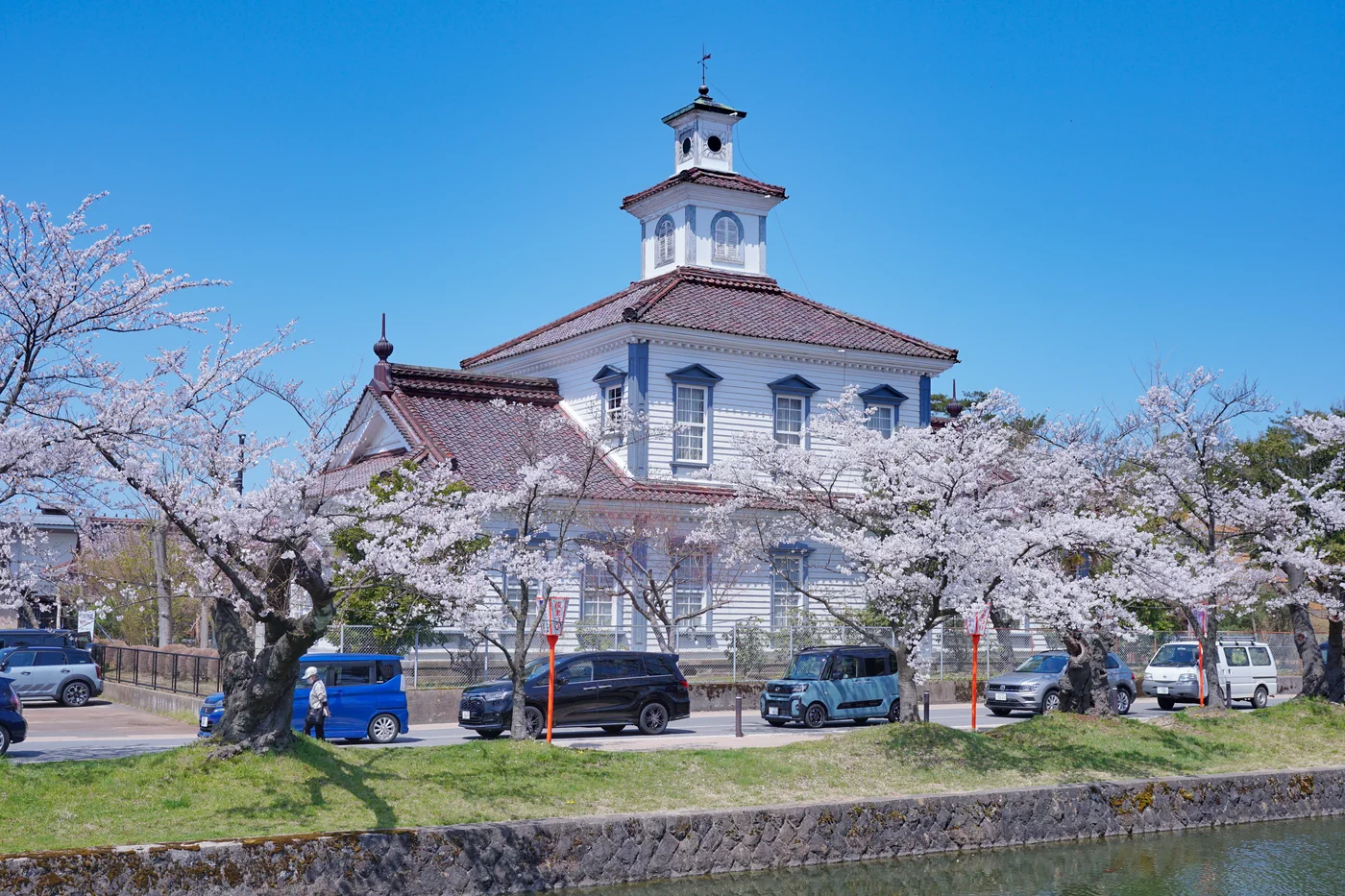
The Former Tsuruoka Police Station was built in 1884 and relocated in 1957. It was designed by master carpenter Kanekichi Takahashi from Tsuruoka. The museum notes Renaissance-inspired window surrounds alongside established Japanese forms in the main ridge and gables. After the district office, shift your attention to the roof here: how do the Western-looking walls combine with the roof above?
Start with each building’s outline, then go inside for the displays. Even without a strong interest in modern history, you can ask concrete questions: Where is the entrance? How does the center project? How does the roof end? History enthusiasts can allow longer for the indoor displays. A photo outside the first building does not cover the museum’s architecture. The farmhouse ahead changes the scale completely.
Chido Museum introduces the Former Tsuruoka Police Station building.
The Former Shibuya House: a thatched roof shaped by snow and silkworms
The Former Shibuya House came from Tamugimata at the foot of Mount Yudono. Built in 1822, it was relocated for preservation in 1965. The museum describes a mountain village with heavy snow, where steep terrain and deep snow encouraged upward use of space and multistory houses. Look first at its height and the space beneath the roof to understand how its purpose differs from the government buildings.
From the Meiji period onward, the household raised silkworms. The second and third floors and even the roof space served as work and storage areas. High windows added for ventilation and light changed the thatched roof’s shape, producing the form known as kabuto-zukuri. Look at the roof outside, then read about silk production. The outline becomes part of daily work rather than simply an attractive old-house roof.
This farmhouse once stood in a mountain village and is now preserved with castle-town buildings. If your group wants to study just one building closely, it makes a useful focus. Snow, terrain, workspace, ventilation and roof shape all connect in this single house. Afterward, look back at the site plan to see how the museum brings buildings from different living environments together.
Read coastal work, river work and crafts through the folk tools
The Mingu no Kura was a two-story earthen storehouse built in the late Edo period. It first held the lord’s arms and furnishings, then became a display of Shonai folk materials after joining the museum. The first floor covers Sea of Japan shipping and commerce; the second presents local crafts such as kawara clay dolls and black-persimmon woodwork. Its storage role connects with the everyday objects on display. Imagine how tools were stored and transported before reading their names.
The Important Tangible Folk Cultural Properties Storehouse includes Shonai work clothes, wooden sake vessels, mountain-village wooden objects, fishing gear from the Shonai coast and Tobishima, and fishing gear from the Mogami River system. Read sea and river tools separately rather than memorize every category. After seeing different waters at the aquarium on day one, this changes the question to how people worked in those places.
Choose a practical question for a tool: Which part of the body operates it? Does it need one person or several? Which parts touch water, fish or clothing? Read its use and compare its shape to avoid seeing only rows of old objects. With children, choose one tool and find an answer together. Browse the other cases by interest rather than read every name aloud.
The museum distinguishes its collections from their display locations; rice-growing tools have separate storage arrangements. For rice-farming material, use the areas open that day and spend your time on what is visible. The museum places coastal, mountain, river and castle-town life side by side. Comparing two environments that interest you can make a complete visit in itself.
Move from objects to space at the retirement residence and Sakai Garden
The former Shonai lord’s retirement residence belonged to Sakai Tadaaki. In 1864, part of the Edo middle residence was dismantled and moved to Tsuruoka. The museum records that timber and tiles traveled by the western sea route to Sakata, then by riverboat to Tsuruoka. Read this after the Sea of Japan shipping displays: the wooden building in front of you was once broken down into transportable materials.
Displays inside cover Tsuruoka’s castle town, Shonai shore fishing, and Sakai family arms, furnishings, calligraphy and paintings. Start with the castle-town material to understand where you are, then choose fishing equipment or other objects by interest. If Sakata is on the next day’s route, carry this connection between sea and river transport with you. The buildings in Tsuruoka and the role of Sakata’s port become clearer than two isolated city names.
Sakai Garden is a shoin-style garden, with a mound, stone arrangements and shoreline across the pond. The museum describes dry-waterfall and gorge imagery on the left, and a peninsula and inlet formed with notable petrified-wood stones on the right. Pause where you can see across the pond, then study each side before looking for another angle. Moving from cases to water, stones and trees also slows the pace after sustained reading.
At Chidokan, study the gates, lecture hall and vanished school buildings
The Shonai domain school Chidokan opens 09:00–16:30 with free admission. It closes Wednesdays; when Wednesday is a holiday, it closes on a subsequent weekday. The New Year closure is December 29–January 3. This starts on a different date from Chido Museum’s closure, so mark each separately for a New Year trip. On a normal two-day visit, allow about 45 minutes to an hour on the castle-town afternoon.
The site retains the Confucian sanctuary, lecture hall, lord’s room and several gates. Compare who used each gate: the main gate was used when the lord visited, the west gate by teachers and domain officials, and the east gate by students. These names help explain rank and access within the grounds, adding more than a photo of an old building.
Students gathered in the lecture hall for occasions such as opening ceremonies. In years when the lord was away on alternate attendance duty, it also regularly served as an office where domain officials met. This puts the school’s link with local government into one specific room. The sanctuary relates to the Sekiten ceremony honoring Confucius. Think separately about learning, ritual and administration to understand each building’s role.
East of the lecture hall, ground-level markings show the layout of major school buildings that no longer stand. After the surviving buildings, take time to look at these positions and imagine how the grounds once extended. Following only roofs makes it easy to walk past this space. The markings show the difference between what survives and the former school layout.
Stay near Tsuruoka Station for easy luggage handling, or choose a seaside night
For this two-day route, the Tsuruoka Station area is the first choice. Drop luggage on arrival, take the Kamo Line the next day, then collect bags before leaving by rail. When booking, compare usable beds, whether children need their own beds, breakfast start times and luggage storage after checkout. These affect your morning bus. For the 08:53 or 08:38 service, finish breakfast and reach stop ② before departure.
For a Yunohama Onsen stay, visit the aquarium on the day you move to the coast. The Kamo Line continues to Yunohama. The 14:26 departure, for example, heads back toward Tsuruoka; for the coast, read the “湯野浜温泉方面” (toward Yunohama Onsen) column. The 2026 timetable has a 15:28 aquarium departure arriving at Yunohama Onsen at 15:39, a reference for an afternoon transfer. Add time to walk to the inn and check in, and plan around the inn’s stated dinner time.
For a family meal-inclusive stay, enter children’s meals, bedding and the number of adults separately. With a cancellable plan, record the free-cancellation deadline, later cancellation rates and no-show terms. A seaside night gives you the local evening and morning. If an early long-distance train follows, the station area is more suitable. With only one night, decide how you will leave Tsuruoka before choosing the lodging area to avoid an extra early luggage transfer.
Separate fares suit this route; keep the two sightseeing days interchangeable
The adult fare between Tsuruoka Station and the aquarium is ¥840 each way, or ¥1,680 return. Add ¥1,500 for the aquarium and ¥1,000 for Chido Museum: the main transport and two admissions total ¥4,180 per adult. Meals, accommodation and other castle-town rides are extra. For a station–museum return trip on the other day, official regular-route bus fares are ¥320 each way; city loop buses are ¥300 each way. Calculate them according to the route used.
The Tsuruoka unlimited one-day pass costs adults ¥700 for Area A and ¥2,900 for Area C. Area A covers central Tsuruoka; rural trips such as the aquarium require looking at Area C. The ¥1,680 station–aquarium return costs less than Area C, so two single fares are cheaper. Two regular bus rides to the museum on day two total ¥640, also below the ¥700 Area A pass. Compare again only if adding more city rides.
The day pass is loaded onto cherica, Suica or PASMO, one card per person. Buy it on the bus using the card’s stored balance. Tell the driver before your first alighting and tap as directed. The selected area cannot be changed, and the pass is valid only on the purchase day. Children need a child card. It cannot be bought on a card holding a bus commuter pass valid that day, or with a disability IC card. Airport and express buses are excluded, so do not count airport transfers as day-pass savings.
With two full days, take the morning bus to the aquarium on day one and the 14:26 return, rest in town and have dinner. Visit Chido Museum on the second morning, walk to the domain school after lunch, then collect luggage at the station. If you arrive at midday on day one, visit the museum and school that day, take the early aquarium bus the next morning and leave after the 12:26 return. If Wednesday falls in the trip, put the coast on Wednesday and the castle town on an open day.
A few useful answers
Can I take a direct bus from Shonai Airport to Kamo Aquarium?
By public transport, take the airport bus to Tsuruoka Station, then transfer to a Yunohama Onsen service via Kamo. The official page also gives about 20 minutes for a taxi from the airport to the aquarium.
Is the Tsuruoka day pass worthwhile for an aquarium return trip?
Adult single fares are ¥840, or ¥1,680 return, below the ¥2,900 all-Tsuruoka Area C day pass. For an aquarium return trip alone, separate fares are cheaper.
Are Chido Museum and Chidokan the same place?
They are separate sites. Chido Museum in Kachushinmachi collects buildings, folk tools and material from the lord’s family. Chidokan in Babacho is the free-entry historic Shonai domain school.
Do preschool children need a Kamo Aquarium ticket?
Preschool children enter free. The ¥500 elementary/junior high school ticket applies from April 1 of the year they enter elementary school. The aquarium has ramps, elevators and a limited number of loan strollers.
Official information and references
Sources used in this guide.
- Kamo Aquarium: opening hours and admission
- Kamo Aquarium: access and airport transfers
- Shonai Kotsu: Kamo Line timetable, April 1, 2026
- Chido Museum: admission and opening hours
- Shonai domain school Chidokan: opening hours and address
- Kamo Aquarium: jellyfish displays
- Kamo Aquarium: Micro Aquarium and research
- Kamo Aquarium: reentry, advance tickets, accessibility and photography
- Chido Museum: permanent buildings, folk tools and garden
- Shonai Kotsu: main-route fares for 2026
- Shonai Kotsu: Tsuruoka one-day pass
- Kamo Aquarium: Shonai rivers and seas
- Chidokan: sanctuary, lecture hall and gate uses
- Okimizuki: lunch and evening reservations