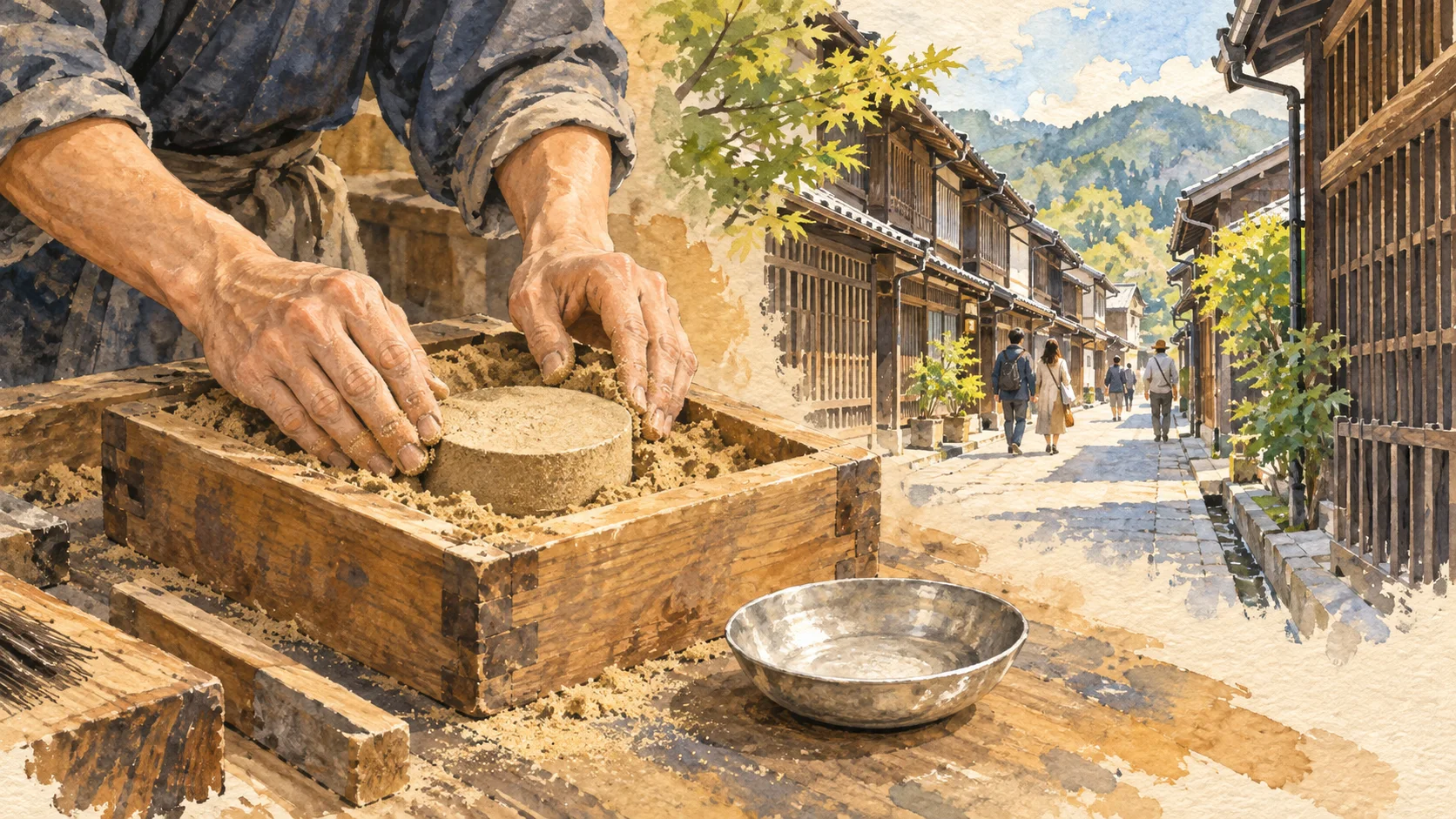
Take the Toyamako Line to Higashi-Iwase, explore the Baba shipping family’s long passage and hall, then visit a rice-storehouse restaurant, Masuizumi tasting bar and GAKU ceramics by appointment. Return along Iwase Canal. Includes 2026 tram times, the Mori closure and shop hours.
- Region & Focus
- Toyama
- Reading Scope
- 25 min read · 18 chapters · 4 Q&As
- Official Verification
- 23 official sources checkedUpdated 8 November 2026
- Key Topics
- NeighbourhoodsItinerariesRail travel
Chapter Route Map (tap any stop)
- How long to allow: give architecture and craft a full day
- At Toyama Station, take an Iwasehama-bound tram to Higashi-Iwase
- Orient yourself to Omachi-dori, the port and canals, then walk north
- Shipowners and shipping agents: why the house needs such a long passage
- Baba’s façade: rebuilding after fire, with distinct scales of house and lattice
- The 30-metre toriniwa and 33-mat oi hall
- A river once ran behind the house: bringing goods and shipping ashore
- Mori is closed: read its background and use Baba for the interior
- Lunch at Kobo Brew Pub in the old rice storehouse
- MUROYA has an earlier lunch window and closes Sundays and Mondays
- Masuizumi: brewery shopping and Saseki tasting have separate addresses
- GAKU ceramics: reading craft through cup rims and plate surfaces
- Why breweries, restaurants and makers share the old street
- Otsukaya’s triangular dorayaki in the northern part of the street
- Toyama Port Observation Tower: 107 steps to place port and townhouses together
- Finish along Iwase Canal, with the tram beside Canal Hall
- Put the walk on the clock and replace a stop when it closes
- Returning from Iwasehama: save a weekday and holiday service
- Quick Q&A
Give Iwase a full day. Take a tram from Toyama Station to Higashi-Iwase, visit the Baba Residence to see how a Kitamaebune merchant family arranged living spaces and goods movement, then have lunch in an old rice storehouse. In the afternoon, choose a sake tasting or a ceramics appointment on Omachi-dori before returning along the canal to Iwasehama. Much of the interest lies behind the façades: a long passage, a large hall, warehouses converted for dining and a pottery studio still centred on making. The Mori Residence is closed for seismic strengthening, so use Baba for the townhouse interior. Giving lunch and craft their own time explains more of the port town than a quick walk through the street.
How long to allow: give architecture and craft a full day
With only half a day, choose the Baba Residence, Omachi-dori and one place to eat or drink. For sake, ceramics and the waterfront at an easy pace, stay from morning into the afternoon. Use a departure from Toyama around 09:30 and a return after 16:00 as the framework, reserve a block for lunch and make a confirmed ceramics appointment the afternoon’s fixed point.
Iwase’s old streets are compact, but their uses follow different hours: Baba has museum admission hours, restaurants have their own service windows, and the ceramic artist needs to arrange a reception. Choose your priority first, then connect the nearby streets. For a craft-focused visit, contact GAKU ceramics first. For a relaxed walk, Baba and lunch in the old rice storehouse make a sufficient main focus.
Save the Japanese station names Higashi-Iwase (東岩瀬) and Iwasehama (岩瀬浜), along with shop names, in your map. The district is beside the port north of central Toyama and accessible by city tram from Toyama Station. Stay in Toyama the night before for a direct station departure. If your wider trip starts or ends in Tokyo or Kansai, read the Hokuriku Arch Pass and Tsuruga transfer guide for intercity tickets, keeping this day for Iwase.
Take the Toyamako Line to Higashi-Iwase, explore the Baba shipping family’s long passage and hall, then visit a rice-storehouse restaurant, Masuizumi tasting bar and GAKU ceramics by appointment. Return along Iwase Canal. Includes 2026 tram times, the Mori closure and shop hours.
At Toyama Station, take an Iwasehama-bound tram to Higashi-Iwase
Toyama Chiho Railway’s timetable revised on 14 March 2026 separates Iwasehama-bound and Toyama Station-bound services, each with weekday and holiday versions. Start at Toyama Station C15 towards Iwasehama C39. For this south-to-north walk, get off en route at Higashi-Iwase C37. Through trams on the Toyamako Line take you there directly from Toyama Station. Toyama Chiho Railway: city tram and Toyamako Line timetable, 14 March 2026
A useful morning service leaves Toyama at 09:30 and reaches Higashi-Iwase at 09:51. It appears in both weekday and holiday tables and continues to Iwasehama at 09:54. Stay on to the terminus to collect a map at Iwase Canal Hall, or get off at Higashi-Iwase for the morning explanation at Baba. The city gives a walk of about ten minutes from Higashi-Iwase to Baba, leaving some street-walking time after the 09:51 arrival.
The current flat city-tram fare, paid in cash or a nationwide transport IC card, is ¥240 per adult and ¥120 per child per journey. Two journeys between Toyama Station and Iwase total ¥480 per adult. Local Ecomyca and Passca cards have a separate ¥220 fare. There is no need to obtain one for this single return trip; bring a usable transport IC card you already have or cash. Toyama Chiho Railway: city tram fares
After reaching Higashi-Iwase at 09:51, follow your map towards Omachi and Niikawa. For a later start, find the Toyama Station row in the same Iwasehama-bound table and trace the service to Higashi-Iwase. Where that stop is blank, choose a column with an actual arrival time. Save both departure and arrival cells to avoid using a departure from a different starting stop as Toyama’s time.
Orient yourself to Omachi-dori, the port and canals, then walk north
Canal Hall’s March 2026 walking map places Higashi-Iwase near the old town’s southern end and Iwasehama to the north near the hall. Enter from Higashi-Iwase, walk north along Omachi-dori through the Baba and Mori area towards Otsukaya, Saseki and Toyama Port Observation Tower, then follow Iwase Canal to Iwasehama. Using different stations at either end connects the district into one walk. Iwase Canal Hall: March 2026 walking map
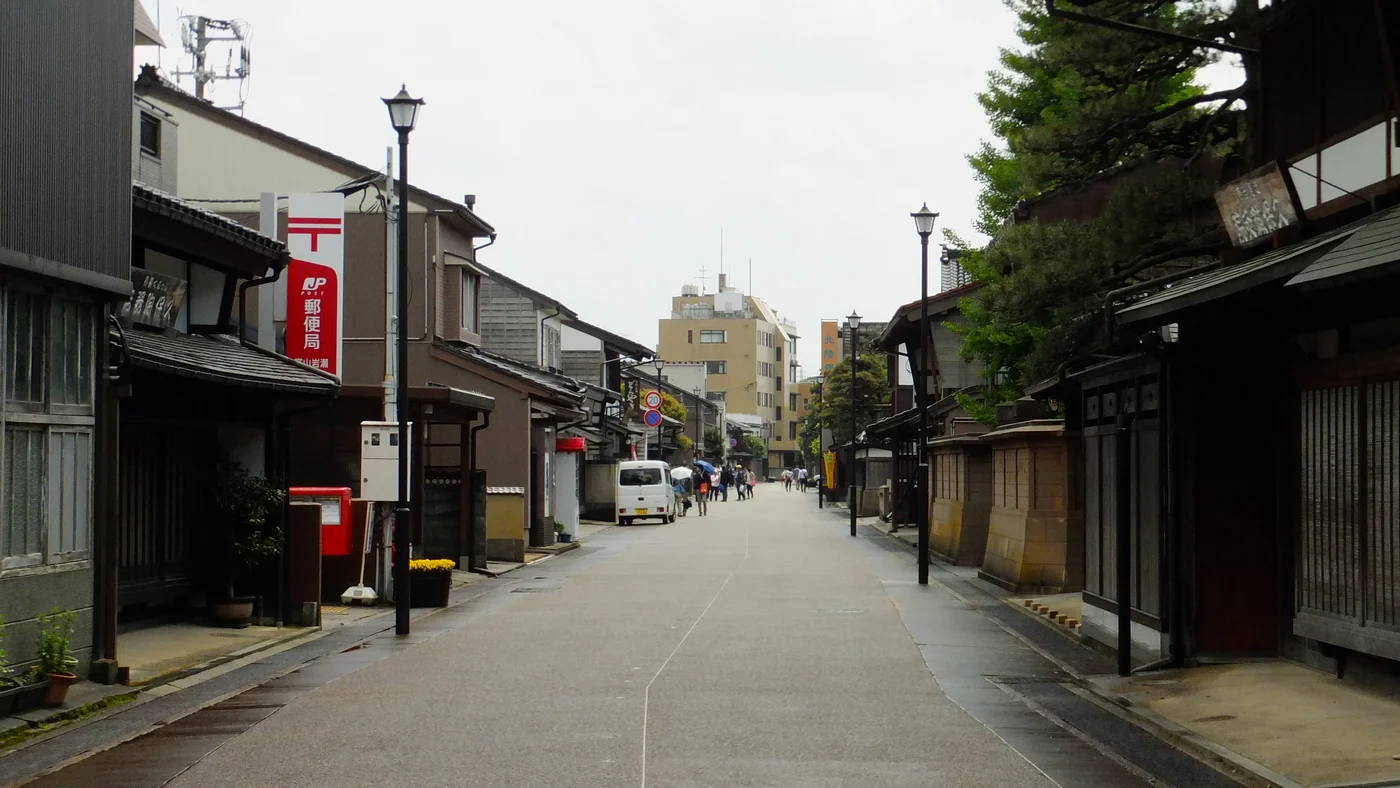
Omachi-dori forms part of the old Hokkoku road, with earthen storehouses, shipping agents’ premises and later reused shops. The street façades are the first layer. Look into the depth of houses, rear warehouses and waterfront to understand how the buildings once worked. First study one home at Baba, then a warehouse converted for dining, to connect two different uses.
Toyama Port, Iwase Canal and Fugan Canal occupy distinct positions on the map. The tower faces the port; Canal Hall is beside Iwase Canal and has a Fugan Suijo Line boat stop. A boat from Kansui Park north of Toyama Station is another arrival option. This walk uses trams both ways, while still putting the hall and waterfront at the end without another long journey.
Mark Baba, your lunch choice and any booked studio on the map, leaving the intervening street for façades and snacks. MUROYA is near Masuda Shuzo, closer to the southern part, so lunch can come earlier. Kobo in the Baba rice storehouse fits directly after the house visit. Either choice only requires a change of order within the district.
The Japan Sea Studies Promotion Organization’s Toyama Bay 60-Second Theatre introduces Iwase’s streets, Kitamaebune and reused earthen storehouses.
Shipowners and shipping agents: why the house needs such a long passage
The Baba family were both Kitamaebune shipowners and shipping agents. The city education board’s house guide explains that shipping agents arranged vessels, consolidated cargo and handled its sale at ports. Baba also owned several Kitamaebune ships and traded. Consider home, business and goods movement together to understand the deep working space beyond the entrance. Toyama City Board of Education: former Baba Residence guide (April 2021)
Kitamaebune traded along their routes, linking owners’ income with cargo, ports of call and markets. Canal Hall’s map places this history within the network of Kitamaebune ports and shipowner settlements. Surviving wealthy merchants’ homes and storehouses were the land-based business sites. Along with façade width, look at the distance from front door to rear and the warehouses’ positions within the house groups.
Baba ranked first among Iwase’s five great families and among Hokuriku’s five major Kitamaebune shipowners. City material dates the family’s activities from the late Edo period. The buildings now seen also relate to rebuilding after Iwase’s 1873 fire. Earlier shipping business, Meiji architecture and modern domestic life therefore overlap within the same house.
On entering, first look at how the passage extends from street to rear, then turn to the hall beside it. Goods movement and seated business discussions occupy different places. This simple sequence keeps materials and decoration in context: the dimensions, room divisions and former rear waterway all show how the merchant household operated.
Baba’s façade: rebuilding after fire, with distinct scales of house and lattice
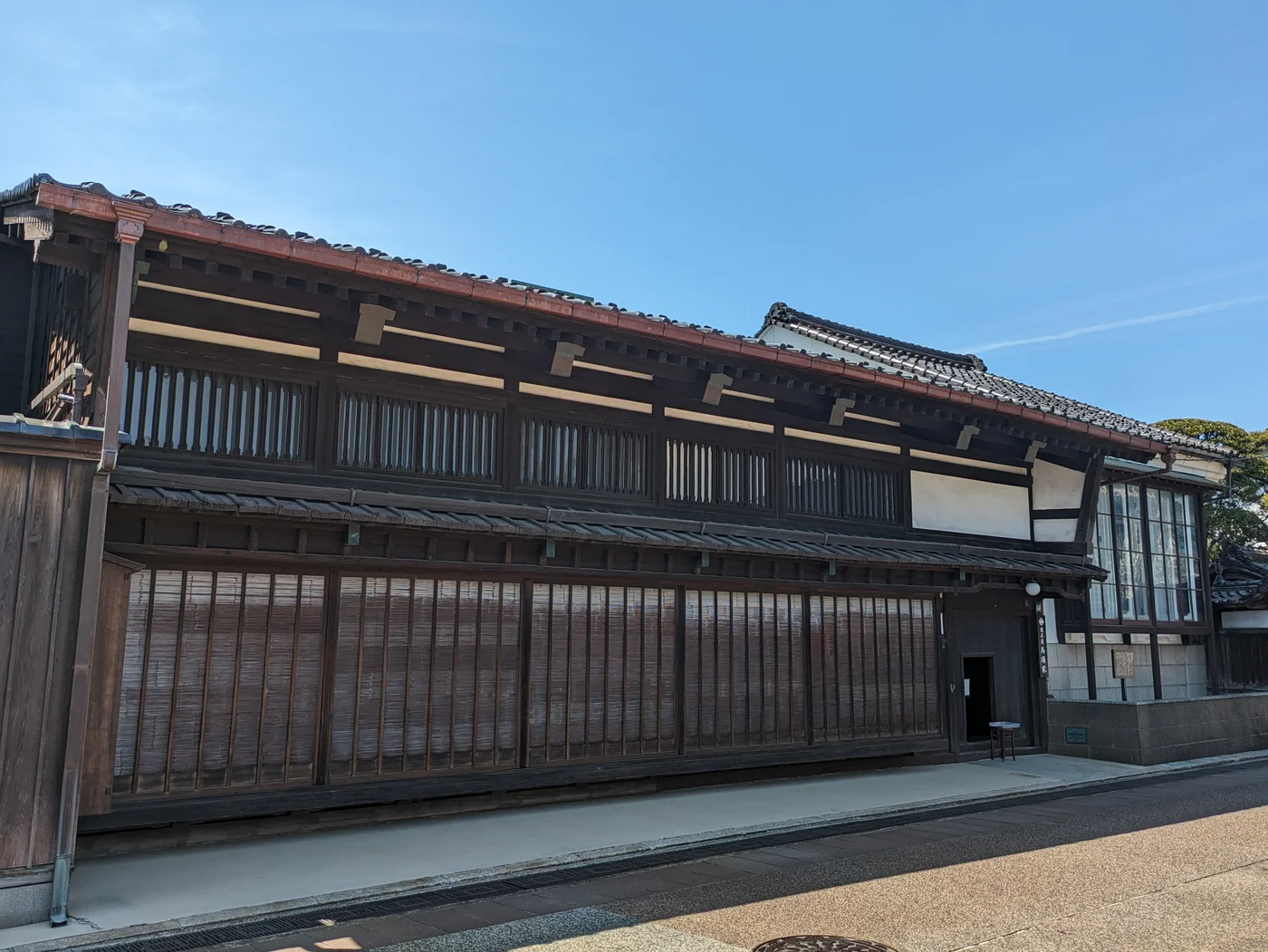
The Baba Residence is at 107-2 Higashi-Iwase-machi. It opens 09:00–17:00, with final admission at 16:30, and closes from 28 December to 4 January. Individual adult admission is ¥100; high-school pupils and younger visitors enter free. Explanations are normally available 10:30–12:00 and 14:00–15:00. Start near 10:30 if you want to hear one. Groups of 20 or more must contact the house in advance on 076-456-7815.
The city says the house was built after the 1873 fire using some older materials and registered as a national Tangible Cultural Property in August 2016. It therefore tells stories of both reuse and post-fire rebuilding. From across the street, look at the relationship between roof, upper openings and ground-floor entrance, then approach the lattice details to distinguish the house’s overall form from its façade components.
The guide calls the front lattice sumushiko, describing it as resembling a bamboo blind. The canal map’s elevation drawings distinguish Higashi-Iwase shipping-agent, traditional townhouse and fire-resistant storehouse types, marking openings, walls and roofs. Identify the lattice at Baba, then use the drawings at the next building to give street-house differences a clear reference.
The façade is only the street-facing side. The guide lists four storehouses, a west gate and west wall as part of the group; the main house served both living and business. Focus the general visit on the public main house, passage, hall and exhibits, then use layout and historical drawings to read the wider property. The depth behind the front door becomes clearer than it would from exterior viewing alone.
The 30-metre toriniwa and 33-mat oi hall
Baba’s toriniwa is the passage through the house, recorded by the city as about 30 metres long. The oi is a hall of 33 tatami mats. Passage depth and hall area are the two most immediate scales in the house. First look along the passage towards the rear, then back at how rooms line it, and the merchant-home layout begins to emerge.
The passage stays at ground level, while adjacent rooms have raised floors and tatami. The city guide’s interior images show timber framing, room boundaries and the continuous circulation strip. On site, use floor height to distinguish walking space from places for sitting or sleeping, then look up at the beams and pillars spanning them. Understanding those levels gives width and depth more meaning than a general impression of a large house.
The hall’s 33 mats are a tatami count; retaining the unit makes comparison with the site explanation easier. Look along the room edges at pillars, sliding partitions and connections, then consider the divisions needed for business, reception and daily life. Interior enthusiasts can give this space more time, looking at it before reading each explanation.
The house also illustrates the oi and mise shop space, the garden-side veranda and new reception rooms. As you reach them, move from the large hall to the veranda to examine light and the garden, then return to the business frontage. Compare spaces facing the garden, street and passage. Their different orientations can guide the whole visit.
If an explanation is available, ask where goods entered, where the passage led and which rooms served business. These questions return directly to the building. Walk the front part again afterwards and doors and turns missed at first often become clearer. Without an explanation, read the property and former-waterway layouts in the displays, then follow the same directions through the public areas.
A river once ran behind the house: bringing goods and shipping ashore
The Baba guide explains that today’s road beyond the west gate behind the house faced the Jinzu River during the height of Kitamaebune trade, making it easy to load goods on vessels or move them into stores. This is key to the long interior passage. Reading from street front through the main house to the rear leads to a former waterfront, beyond the garden alone.
The booklet compares today’s district with a Higashi-Iwase topographic map surveyed in 1910 and published in 1911. Find the house, then compare lines and water to its west to understand the relationship between the old riverbank and current road. Exhibits also explain Iwase and Baba family history. Returning to Omachi-dori after the maps adds an invisible former cargo route to the streets.
The family business changed with shipping technology. City material records a move from Kitamaebune to steamships in the mid-Meiji period and involvement in founding banks. The booklet uses Hokuriku Maru as an example, recording its purchase by Baba Steamship Company in 1903. Read vessel types alongside business changes to carry the house’s story into modern commerce.
Exhibits on Haru Baba connect shipping wealth with Toyama education. She donated towards establishing the former Toyama High School; the family also donated the Hearn Library, containing Lafcadio Hearn’s former collection. These accounts show how family assets moved from shipping into education and culture. Leave time for displays as well as architecture so the house offers more than scale and decoration.
Mori is closed: read its background and use Baba for the interior
The Mori Residence is next door at 108 Higashi-Iwase-machi. The city’s current notice says it is closed until seismic strengthening after the 2024 Noto Peninsula earthquake is complete, with reopening expected in FY2027 or later. Baba’s page also states that joint Mori–Baba tickets are suspended. Plan this day with Baba’s single-site ticket. Toyama City: Mori seismic-strengthening closure and architecture
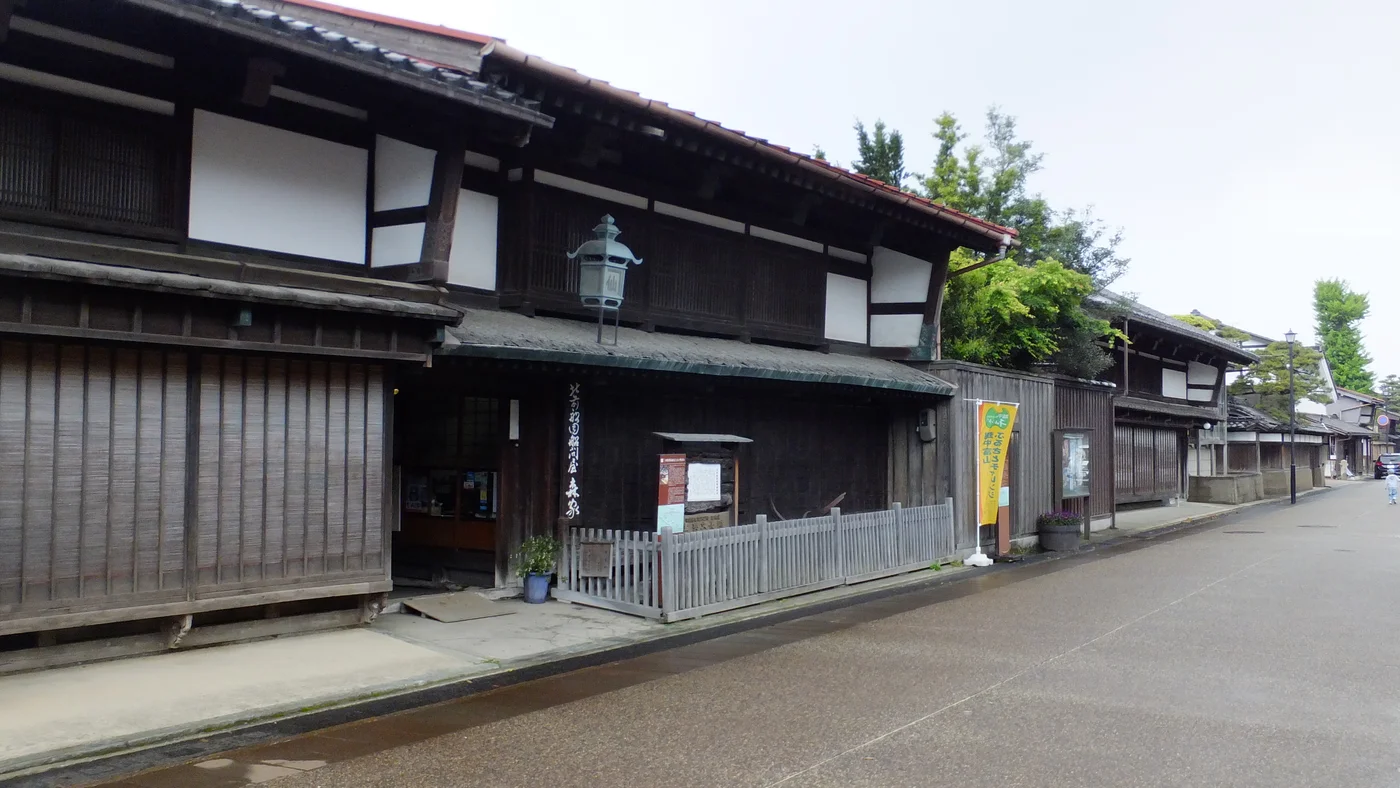
Mori was built around 1878, continuing Toyama’s townhouse structure from the Edo period, and designated a national Important Cultural Property in 1994. The city lists the main house, north earthen storehouse and south earthen storehouse separately. The timber main house is partly two-storey; both storehouses have two floors. Compare this arrangement with Baba’s mixed residential and business main house and storage buildings to see how agents assembled their properties.
Passing Mori, view its position and street frontage from the public road, leaving enclosed works areas for construction. Concentrate interior time at Baba, then compare another use at the rice-storehouse restaurant. For a later visit specifically to Mori’s interior, choose a date from the city’s reopening announcement.
Lunch at Kobo Brew Pub in the old rice storehouse
After Baba, have lunch at Kobo Brew Pub. It reuses the former Baba Residence rice storehouse at the same address, 107-2 Higashi-Iwase-machi. The customer area has wooden tables and brewing equipment separated by glass. Moving from the home’s hall to the former rice store gives you beams, ceiling height and present seating arrangements to compare. Official Toyama City tourism: Kobo Brew Pub
A Czech-born brewer makes craft beer here. The city’s official description lists about ten regular taps, including beers using Toyama fruit and sake lees. Drinkers can choose a four-beer tasting flight. For a meal, consider food such as sausages; non-alcoholic drinks are also available. A midday stop combines warehouse reuse with brewing still in operation.
Current city tourism information lists 11:00–18:00, with food last orders at 17:00 and drinks at 17:30, and New Year closure. This plan suggests lunch between 11:30 and 13:00 before craft or sake tasting, avoiding a later search for food during visits. View the glass-separated brewing area from the customer side and leave working equipment to staff.
MUROYA has an earlier lunch window and closes Sundays and Mondays
To eat first and then walk north from the southern part, choose MUROYA beside Masuda Shuzo. This café serves lunch and sweets using Toyama ingredients, including Masuizumi sake-lees desserts. The city also explains its employment training for people with disabilities, with participants and staff sharing reception, plating and other work. Official Toyama City tourism: MUROYA
Hours are 11:00–15:00, with last orders at 14:00, closed Sundays and Mondays, and payment in cash. Eat before Baba or after the morning visit rather than returning only after ceramics. For a Sunday walk, use Kobo; Tuesday–Saturday, decide whether to sit down first or visit the main house first.
The lunch choice is clear: Kobo for the rice storehouse and brewing equipment; MUROYA for an earlier southern lunch with sake-lees sweets. Both reconnect with Omachi-dori afterwards. If you have dietary restrictions concerning alcohol, ask directly about sake lees and alcoholic ingredients in desserts and choose accordingly.
Masuizumi: brewery shopping and Saseki tasting have separate addresses
Masuizumi’s producer, Masuda Shuzo, is at 269 Higashi-Iwase-machi. The prefectural tourism page lists 08:30–17:00, closed Saturdays, Sundays and national holidays, and explicitly says the brewery interior is not open for tours. For tasting, go to Saseki on Omachi-dori, about five minutes away according to the official description. Decide whether you want shopping or tasting before looking for an entrance.
Saseki at 93 Iwase-Omachi is Masuda Shuzo’s directly operated standing sake bar, with about 100 sakes to choose from. It occupies a converted shipping-agent building. Customers select from refrigerated cabinets and are charged or timed according to their chosen option. Place it after lunch to connect labels, drinking vessels and the nearby producer within one walk. Official Toyama City tourism: Masuda Shuzo’s Saseki
The city currently lists three options. For per-glass charging, first buy a ¥250 wooden masu; glasses cost ¥200–600, with drinks noted on a sheet and settled at the end. Timed options are ¥1,500 for 15 minutes, limited to about eight glasses, and ¥3,000 for 30 minutes, limited to about 15. Per-glass ordering is easier for reading labels and drinking slowly. The timed glass counts are the operator’s limits; choose a small number you want to compare.
Saseki opens 10:00–18:00, with final reception at 17:15, and closes Tuesdays except national holidays. With friends, agree a departure time, then choose your own drinks. Non-drinking companions can browse nearby and meet later instead of everyone waiting through the same tasting. If visiting the observation tower, climb before drinking; this also works better with the route.
Fit drinking into a transport plan with no further driving that day, returning by tram. For bottles to take to your accommodation, ask about storage and packaging and buy later in the day to carry them less. If unsure of your taste, try a few per-glass selections before buying. Standing tasting and bottle shopping have separate purposes and can have separate budgets.
GAKU ceramics: reading craft through cup rims and plate surfaces
Ceramic artist Gaku Shakunaga’s GAKU ceramics is at 146 Higashi-Iwase-machi. His official biography records graduation in sculpture from Tokyo University of the Arts in 2002, followed by independent practice in 2006 and pottery work in Iwase’s Mori storehouse group. His work now centres on commissioned tableware and ceramic objects for restaurants, businesses and individuals. Approach it through both sculptural form and use at the table. GAKU ceramics: Gaku Shakunaga biography and work
On his site, the artist describes cooking, hosting and drinking often, so when making drinking vessels he considers how to give users pleasure and surprise. Chefs and private customers bring commissions, exchanging ideas before completion. This account suggests asking how rim, form and serving method are decided together, alongside looking at colour.
The site’s Nomi-sugiru Sakazuki cups, deep-black pieces and Nenrin works provide concrete starting points. Compare rim thickness, weight in the hand and inner and outer profiles, then consider plate surfaces with food on them. The site includes restaurant and sake-merchant comments on thin cups, black and Nenrin pieces. Start with one form and ask how it supports drinking or serving.
For an everyday cup, ask about capacity, rim, stability on the table and washing. For a plate, consider food you often cook, cupboard size and how much room you want to give the food. With a strongly shaped piece, decide whether it is for use or display, then ask the artist about care. This is clearer than choosing only by a series name.
Contact the studio before viewing work. The official Gallery page lists 076-456-7598 and a contact form. State which work interests you and when you can visit, then arrange lunch and the return around the studio’s confirmed time. GAKU ceramics: Gallery and advance contact
Without an appointment, start with the official shop’s categories and descriptions, then give the afternoon to Baba’s displays, street façades and water. For a hands-on making activity, set aside another day for Nousaku and Kanayamachi in Takaoka, choosing by the material you want to learn about. This Iwase stop focuses on the artist and objects, with timing guided by reception arrangements.
Why breweries, restaurants and makers share the old street
Iwase’s newer shops and studios did not gather in old buildings by chance. In the prefecture’s doors TOYAMA interview, Ryuichiro Masuda discusses buying and restoring buildings in his hometown for restaurants and artists. An early project converted a former timber shop into a soba restaurant for Niuan, which needed new premises. Invitations to artists followed, and glass artist Taizo Yasuda, ceramic artist Gaku Shakunaga and others gradually established bases here. Toyama Prefecture doors TOYAMA: Ryuichiro Masuda on brewing, old buildings and artists’ bases
The process keeps changing the street’s uses. Main houses once handled living and business, and storehouses held goods. Today, some stores house brewing and dining, while old homes serve making, display or sales. Read the names at entrances for present use, then look again at openings and depth. Similar old-house outlines accommodate different work.
Food and ceramics also have working collaborations. GAKU’s site includes chefs discussing commissioned plates, including CAVE YUNOKI’s account of commissioning Shakunaga’s tableware since opening in 2009. Ask what a piece was intended to hold and how it accommodates users to connect the collaboration back to the table.
Ichibamachi TV Channel introduces Toyama food and craft through L’évo’s collaboration between cuisine and tableware. GAKU ceramics links to the programme on its official site.
Otsukaya’s triangular dorayaki in the northern part of the street
Otsukaya at 152 Iwase-Omachi was founded in 1933. The city’s official description says its thin skins use Toyama eggs and wrap chunky Hokkaido red-bean filling in a triangle inspired by Sea of Japan waves. Look at the wrapping to distinguish it from the usual filling between two round cakes. Its shape is also an immediate way to recognise the product. Official Toyama City tourism: Otsukaya triangular dorayaki
Hours are 08:30–17:30 Tuesday–Saturday and 08:30–16:00 Sunday, closed Mondays except national holidays. Heading north from Baba, place it between lunch and the waterfront. On Sundays, buy before the tower rather than returning after 16:00. The city also lists sales at Canal Hall, where you can look at the end of the walk.
The product description gives an indicative shelf life of about four days. For accommodation snacks or gifts, follow the date and storage instructions on the package you receive. To eat that day, finish it in a suitable place indicated by the shop before continuing.
Toyama Port Observation Tower: 107 steps to place port and townhouses together
Toyama Port Observation Tower takes its form from the local Kotohira Shrine’s night lantern. Its spiral staircase has 107 steps, with the viewing space about 20 metres above ground. The city lists free admission, 09:00–16:30, no regular closing day and stairs as the only access. Visit before drinking. Companions who cannot manage the stairs can stay by the port at ground level and agree a meeting point. Official Toyama City tourism: Toyama Port Observation Tower
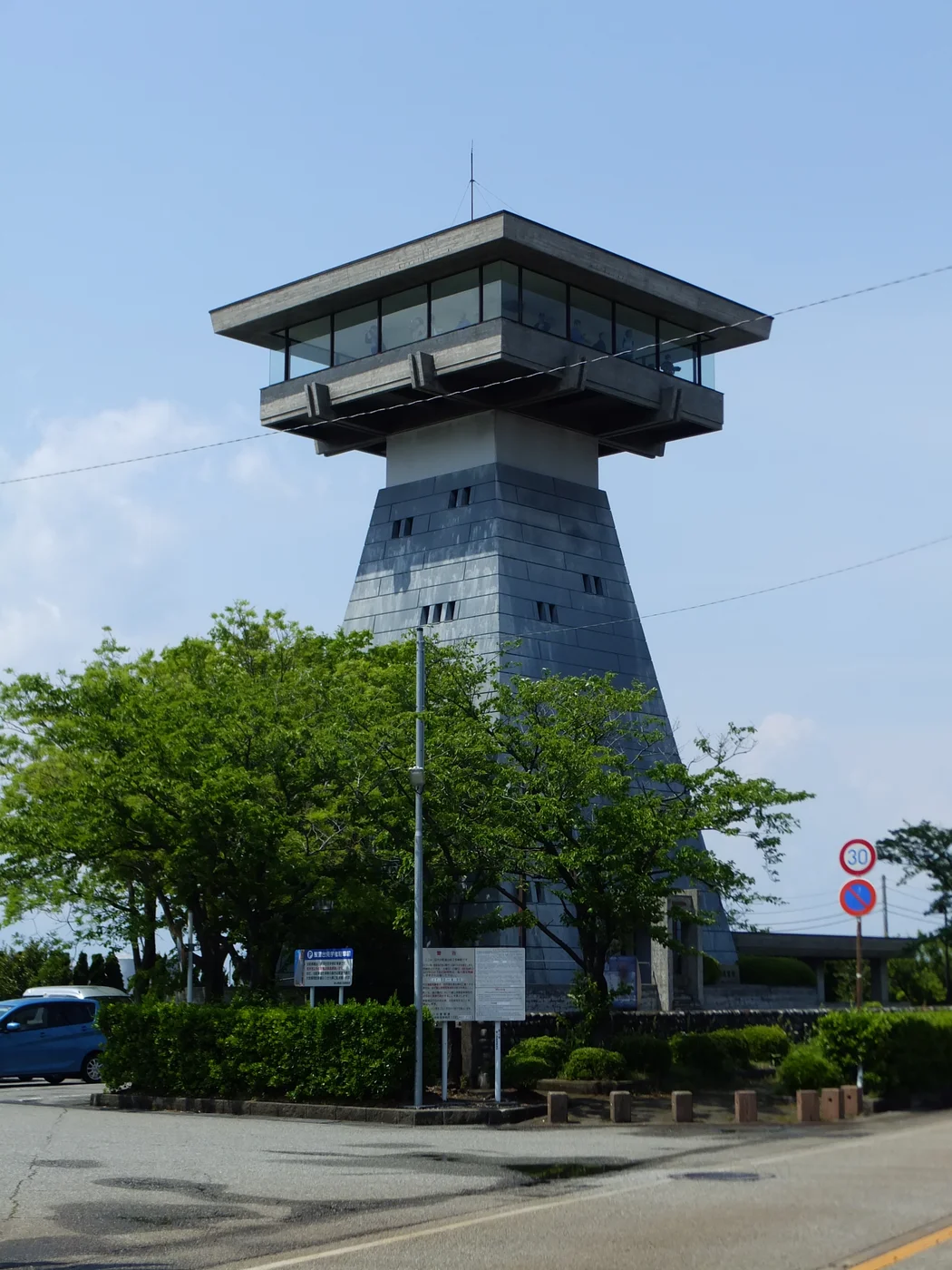
From above, see Toyama Port and Iwase, with distant views towards the Tateyama range and Noto Peninsula in clear weather. For this walk, first locate the townhouse street you have just used and see which water it approaches. The house, cargo and riverbank relationships read at Baba become a wider spatial picture here, giving the port a role beyond scenery beside the old town.
The tower closes at 16:30. If ceramics is booked in the afternoon, work backwards from that appointment to fit the climb. Adjust the order among Otsukaya, the tower and Saseki: climb first, then sit or taste standing, before continuing towards Canal Hall and the tram. If you only want a waterfront walk, omit the tower and rest in a street-side business.
Finish along Iwase Canal, with the tram beside Canal Hall
From the old town’s northern side, continue towards Canal Hall and Iwase Canal. The hall’s access page gives a walk of about one to two minutes from Iwasehama Station. It has dining, souvenirs and a Fugan Suijo Line boat stop. For a short final waterside walk, use the hall as the turning point and landmark for finding the station. The return boarding point is close once you reach it. Iwase Canal Hall: access and canal cruises
Canal Hall’s walking map is a useful district index, marking houses, workshops, dining and tram stops. Review the route before returning to put Baba’s passage, the rice-storehouse meal and port water back in place. Buy any final souvenirs at the hall and carry them to Iwasehama, avoiding another return along the old street.
To replace one tram journey with the Fugan Suijo Line, follow the hall’s transport page to the operator’s timetable, choose an operating day and bookable service, then adjust the day. The hall gives about one hour for the canal cruise from Kansui Park to Iwase. Treat it as an activity in its own right. With a fixed craft appointment or evening train, the tram return used here is easier to fit around set windows.
Put the walk on the clock and replace a stop when it closes
A full day can start with the 09:30 tram from Toyama and 09:51 arrival at Higashi-Iwase, then the southern streets and Baba’s explanation around 10:30. Choose Kobo or MUROYA for lunch, fit in the confirmed GAKU appointment, then Otsukaya, the tower and Saseki, ending at Canal Hall and Iwasehama. For a different studio appointment, swap the street walk before and after lunch.
On a Tuesday that is not a national holiday, Saseki closes; give its time to Baba’s exhibits or craft. On Sundays, MUROYA closes, so choose Kobo and buy at Otsukaya before 16:00. On Mondays, look for triangular dorayaki at Canal Hall; Otsukaya’s main shop opens only if it is a national holiday. All these changes stay within the same street route.
Arriving at noon, choose Baba and the old street after lunch, then either the tower or Saseki. With a ceramics appointment, make that and Baba the afternoon’s main stops. Non-drinkers interested in port-town architecture can concentrate on house displays, lattice façades, the rice storehouse and water, each with a different subject.
In heavier rain, group Baba, lunch and a booked ceramics visit close together and walk only the connecting streets. Leave the tower and water for suitable weather. If you want a seat after Baba, eat first and view the streets later in the return direction. Both the main house and ceramics need time; this day does not need another distant excursion.
Returning from Iwasehama: save a weekday and holiday service
In the timetable revised on 14 March 2026, the weekday 15:46 departure from Iwasehama reaches Toyama Station at 16:13; the 16:16 reaches it at 16:48. On holidays, the 15:46 reaches Toyama at 16:14 and the 16:16 at 16:48. These fit lunch, old streets and an afternoon stop. Choose your actual return when you arrive in Iwase.
If finishing earlier in the southern streets, use Higashi-Iwase instead. The 15:46 service from Iwasehama calls there at 15:48, and the 16:16 at 16:18, in both weekday and holiday tables. From Canal Hall, Iwasehama is more direct. If still near Baba, GAKU or MUROYA, Higashi-Iwase saves walking north again.
Leave a separate gap between the tram’s Toyama arrival and any Shinkansen or dinner reservation. This example reaches Toyama at 16:13 on weekdays or 16:14 on holidays, or 16:48 on the later service. Add luggage collection and long-distance transfers after getting off the tram. At Iwasehama, check the Toyama Station-bound direction and correct date version, then end the port-town walk on your selected service.
A few useful answers
Which stop should I use for Iwase from Toyama Station?
For townhouses and the Baba Residence, get off at Higashi-Iwase (C37), about ten minutes’ walk from Baba. For a walking map or a canal-first route, stay on to Iwasehama (C39), about one to two minutes from Canal Hall.
Can I visit the Mori Residence now?
Mori is closed for seismic strengthening after the 2024 Noto Peninsula earthquake, with the city expecting reopening in FY2027 or later. Baba remains open, at ¥100 per adult and free for high-school pupils and younger visitors. Joint Mori–Baba tickets are currently suspended.
Can I tour the Masuizumi brewery or enter the studio without booking?
Masuda Shuzo does not offer brewery tours; use Saseki for tasting. Contact GAKU ceramics in advance to view work on 076-456-7598, then put the confirmed time in your itinerary.
Is Iwase suitable for non-drinkers?
Yes. The Baba Residence, townhouse façades, Toyama Port Observation Tower and canal can form a visit on their own. Kobo Brew Pub has non-alcoholic drinks, and MUROYA is another lunch option Tuesday–Saturday. Ceramics enthusiasts can arrange a GAKU ceramics appointment.
Official information and references
Sources used in this guide.
- Toyama City: Baba Residence hours, admission and explanations
- Toyama City Board of Education: former Baba Residence guide (April 2021)
- Toyama City: Mori seismic-strengthening closure and architecture
- Toyama Chiho Railway: city tram fares
- Toyama Chiho Railway: city tram and Toyamako Line timetable, 14 March 2026
- Toyama Chiho Railway: weekday Toyama Station to Iwasehama
- Toyama Chiho Railway: weekday Iwasehama to Toyama Station
- Toyama Chiho Railway: holiday Toyama Station to Iwasehama
- Toyama Chiho Railway: holiday Iwasehama to Toyama Station
- Official Toyama City tourism: Masuda Shuzo’s Saseki
- Official Toyama City tourism: Kobo Brew Pub
- Official Toyama City tourism: Iwase townscape and walking information
- Official Toyama City tourism: Toyama Port Observation Tower
- Official Toyama Prefecture tourism: Masuda Shuzo
- GAKU ceramics official shop: brand and work
- GAKU ceramics: artist’s account and user introductions
- GAKU ceramics: Gallery and advance contact
- GAKU ceramics: Gaku Shakunaga biography and work
- Iwase Canal Hall: access and canal cruises
- Iwase Canal Hall: March 2026 walking map
- Toyama Prefecture doors TOYAMA: Ryuichiro Masuda on brewing, old buildings and artists’ bases
- Official Toyama City tourism: Otsukaya triangular dorayaki
- Official Toyama City tourism: MUROYA