Watch craftspeople at work, make a sand mould or take home tin jewellery. Compare Nousaku tours and 30- or 90-minute workshops, ages and tax-inclusive prices, then plan Kanayamachi’s museum and Otera workshop.
- Region & Focus
- ChubuNeighbourhoods and shopping
- Reading Scope
- 30 min read · 13 chapters · 4 Q&As
- Official Verification
- 9 official sources checkedUpdated 22 November 2026
Chapter Route Map (tap any stop)
- Choose the activity, then the area for your half day
- Nousaku’s tour: use 30 minutes to see how production is divided
- How sand becomes a mould: watch the transfer of shape
- Choosing a 90-minute object: use first, shape difficulty second
- With children, count both 30-minute pieces and accompanying adults
- Pay on arrival and leave time around the sand-mould workshop
- Takaoka Casting Museum: connect the tools to the work you tried
- Kanayamachi: look up from the stones to the close-set lattices
- Otera tin jewellery: choose something you will wear
- Choose the weekday first: Kanayamachi on Sunday, Nousaku on Tuesday
- Use Nousaku’s new address; approach Kanayamachi from Takaoka Station
- Link both areas with a full day: Nousaku, then museum and stone streets
- At home, hand-wash and dry your tinware
- Quick Q&A
To make a tin object in Takaoka, first choose which stage you want to try. Nousaku’s 90-minute workshop runs from sand-mould making to finishing and stamping. Its 30-minute workshop lets primary-school children try part of the mould-making process. Book a separate factory tour to watch craftspeople work. In Kanayamachi, tools, closely spaced townhouse lattices and Otera’s tin jewellery fit into one walk. Choose one area for half a day, and link both only with a full day. The object, age limits and opening days will shape your route before the number of sights does.
Choose the activity, then the area for your half day
The prices and regular workshops below follow operator information read on 28 October 2026. Nousaku’s free factory tour lasts about 30 minutes and includes a guided visit, observation and questions. NOUSAKU LAB offers separate paid 30- and 90-minute workshops. Book the production tour and hands-on workshop separately: a tour place is not a workshop seat. Otera’s tin-jewellery workshop lasts about 30–60 minutes, with earrings, necklaces, rings and keyrings among the choices. It suits an afternoon in the townhouse district.
If there is time for just one activity in half a day, I would decide on Nousaku’s 90-minute workshop first. It has fixed start times, advance payment on arrival and needs the largest unbroken block of time. Kanayamachi is easier to split up if some companions prefer walking to making. Some can make jewellery while others visit the museum or street, then meet at an agreed spot.
Do not squeeze both areas into one morning. Nousaku’s headquarters is in Office Park; Kanayamachi is a separate district. Either can fill half a day. With a full day, leave a clear allowance for travel between them and lunch, linking morning sand-mould making with afternoon tools and townhouses.
Watch craftspeople at work, make a sand mould or take home tin jewellery. Compare Nousaku tours and 30- or 90-minute workshops, ages and tax-inclusive prices, then plan Kanayamachi’s museum and Otera workshop.
Nousaku’s tour: use 30 minutes to see how production is divided
The Nousaku factory tour starts at 11:00, 13:00, 14:00, 15:00 and 16:00. Reservations are required, though same-day places are accepted when available. Standard online bookings cover 1–10 people. For 11 or more, contact the factory by telephone or email. Use the same contact route for foreign-language guidance, wheelchair access, or hearing, visual or mobility support, so staff have both the group size and support requirements.
Before the tour, learn the sequence: pattern, mould, pouring, finishing, then decorative work. Nousaku’s technology page describes Takaoka copperware as a division of labour, with different craftspeople handling different stages. Look at how partly finished pieces pass between stages, which parts already have their shape and which surfaces still need work. A single vessel in the shop has involved several kinds of work on the production floor.
Igata means the mould used to make a metal object; ikomi is pouring molten metal into it; shiage is the surface and detail work after removal. These Japanese terms help you place the materials in the process as you listen. The tour includes questions. If a particular piece interests you, ask which mould it uses and which stages take place at this factory.
Tours close on Sundays, public holidays and over New Year, with irregular Saturday closures. Equipment maintenance can also stop work on weekdays. To see production, choose an available working day on the booking calendar. Headquarters opens from 10:00 to 18:00, so shopping, dining and displays offer other ways to visit. Factory tours follow their own calendar.
A group tour takes up to 18 people per session; groups of 19 or more rotate in separate groups. The 90-minute workshop takes 1–27 people, and the 30-minute one takes 1–18. If several families want both the factory tour and short workshop, organise groups around the activity with the smaller capacity. Agree where to meet, pay and wait after finishing.
Bookings within two days require a telephone or email enquiry. Online changes to numbers or time, and cancellations, are available until two days before the tour; contact the venue for later changes. Keep one slot for one visit. Once your travel date is settled, remove alternative trial slots from your calendar so everyone has the same meeting time.
How sand becomes a mould: watch the transfer of shape
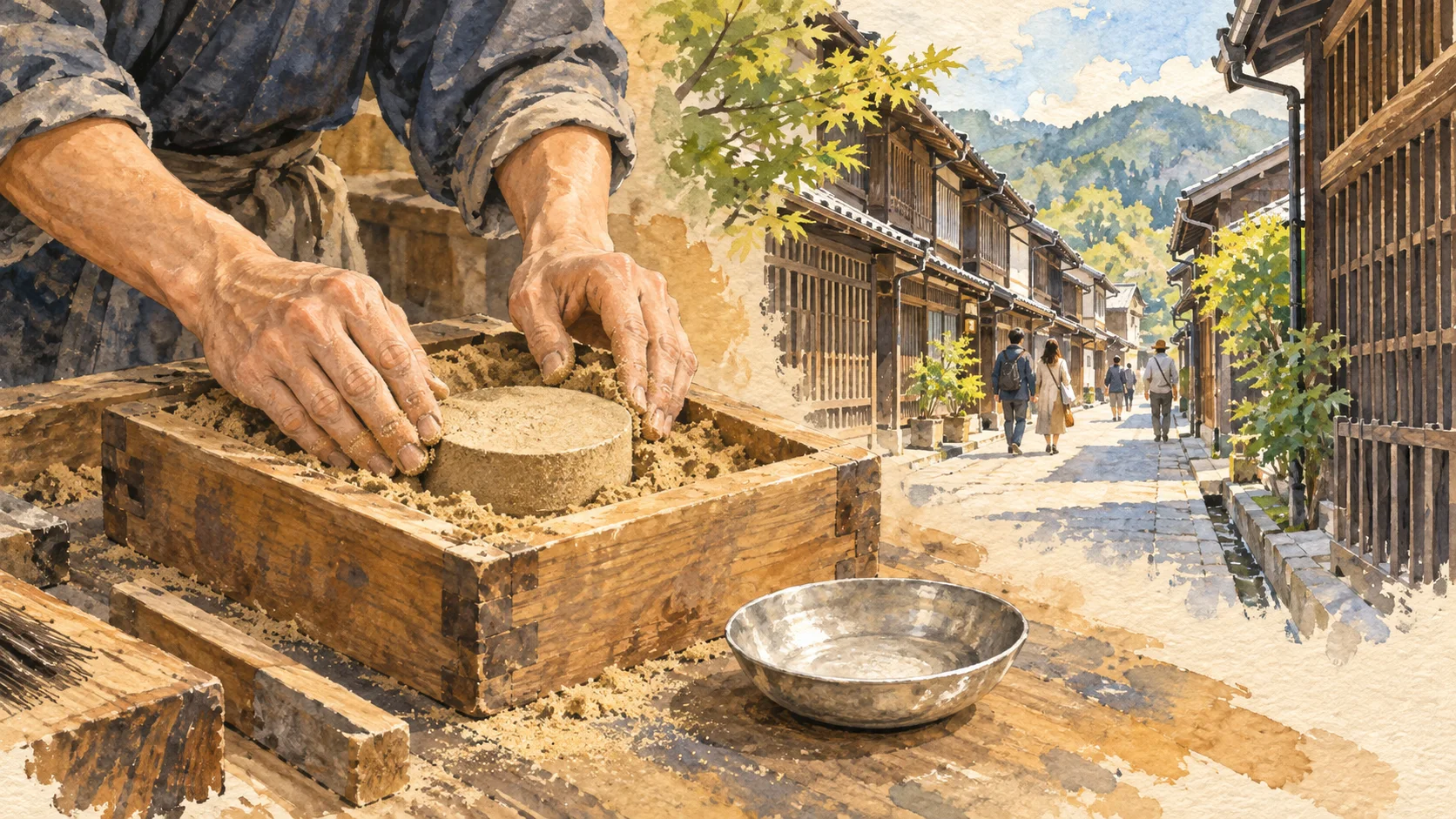
Nousaku LAB uses green-sand casting. A wooden pattern supplies the object’s shape. A metal frame around it holds the sand in place. Casting sand, mixed with a little water and clay, is packed and compacted around the pattern. Removing the pattern leaves a space for molten metal. Watch how the object’s solid shape becomes a space in the sand before and after the pattern comes out.
The wooden pattern and sand mould have different jobs. The first brings the shape into mould making; the second receives the metal, after which the casting is removed. Looking only at a finished tin cup, you may notice just its outline. After handling mould making, look again at its rim, body and base and ask how those shapes separate from the mould. Nousaku lists sake cups as more difficult, giving you a practical basis for choosing beyond appearance.
The 90-minute workshop includes making the mould, staff pouring the metal, then finishing and stamping. The 30-minute workshop includes mould making and staff pouring, with participants trying part of the mould-making process. Staff handle the hot metal. Participants concentrate on the steps they are taught. The longer workshop offers a fuller period of hands-on work; the short one introduces sand moulds.
Industrial green-sand production also includes removing the solidified casting, working its surface on a lathe, and finishing such as colouring and polishing. This sequence helps you understand both the factory and Kanayamachi museum tools. At LAB, you complete the object included in your chosen course. Follow the instructor’s allocation of work. Save questions about production equipment for the question session.
Nousaku explains that its sand is easier to reuse because green sand is neither fired nor chemically treated. This also explains the focus on filling and compacting sand rather than waiting for kiln firing. You can take your finished work away immediately. Travellers leaving Takaoka that day can pack it without adding a night to collect it.
Nousaku’s craft film, released in 2022, focuses on factory production. Alongside the explanation of sand moulds and pouring, observe how materials, tools and craft work connect in making a vessel.
Choosing a 90-minute object: use first, shape difficulty second
The 90-minute workshop starts at 10:30, 13:30 and 15:30. Choose your object at the counter that day. For a vessel with depth, compare the mountain-shaped sake cup, round sake cup and small bowl. Both cups cost ¥4,950 including tax. The mountain shape is 35 mm high and 64 mm in diameter; the round one is 32 mm high and 63 mm across. Nousaku also lists these sizes as suitable for small bowls. Choosing a cup means accepting a harder mould for an object that can hold a drink or a small serving of food.
The small bowl also costs ¥4,950 including tax. It is 25 mm high and 78 mm in diameter. Official suggested uses include a sake cup, ice-cream cup and condiment dish, and its mould is slightly easier than the sake cups. For a first attempt and an object used often at home, I would choose the small bowl. It is shallower, and drinking alcohol need not determine participation. Two people can make a cup and a bowl, then use each as suits their table.
The small plate costs ¥3,850 including tax, is 12 mm high and 90 mm in diameter, and suits small portions or soy sauce. It too is listed as slightly easier than a sake cup. If you already need a small dish, it is a direct choice. Heart-shaped plates and bowls are also available. Think where the object will go before choosing its shape, so it is easier to use once home.
For a still easier shape, choose the two-piece chopstick-rest set at ¥3,850 including tax. Its form draws on tin ingots and is listed as easier to mould. It retains the 90-minute course’s finishing and stamping with English letters and numbers. Its course content and shape differ from the flower and animal rests in the 30-minute course. The fact that both offer chopstick rests does not make their durations and prices directly comparable.
Write your intended letters or numbers on your phone beforehand, such as initials or a date, then follow staff instructions to stamp them. Different objects can share the same letters. On a tighter budget, choosing a plate or rests for their use and difficulty gives the ¥1,100 saving a clear reason. Choosing only the cheapest option may miss the three-dimensional mould making you wanted.
With children, count both 30-minute pieces and accompanying adults
Nousaku’s main table lists the 90-minute course for junior-secondary-school age and above. When an adult joins with a younger child, the adult does most of the making; the child can help with parts such as filling sand. If the aim is for a primary-school child to have their own piece, choose the 30-minute course. This avoids discovering after booking the longer course that the adult is the main maker. An adult who wants a sake cup can choose the longer course and share its permitted steps with the child.
The 30-minute course starts at 13:00 and 15:00, with flower or animal chopstick rests. Each participant can make up to two pieces. Each costs ¥550 including tax for primary-school children and ¥1,100 for other participants. The two-piece limit applies per person. An adult making two and a primary-school child making one pay ¥2,750 in total; one each costs ¥1,650. Write down each person’s quantity so the per-piece price is not mistaken for the whole course price.
Each child below primary-school age needs one guardian. Two preschool children need the corresponding number of guardians. LAB also limits accompanying people. Separate the makers from the accompanying family members when booking, especially if some only intend to watch. This is easier than deciding at the workshop door.
Flower rests come in cherry blossom, dahlia and leaf shapes; there are 12 animal designs. For groups, the venue may prepare animal designs at random from those 12. If a child strongly wants a particular shape, consider the standard flowers or several preferred animals. A rest they will use is a more flexible aim than making the entire activity depend on one animal.
Pay on arrival and leave time around the sand-mould workshop
Nousaku requires payment at the FACTORY SHOP counter 10 minutes before the reserved time, followed by assembly outside NOUSAKU LAB. For a 13:30 booking, payment must be complete by 13:20. Aim to reach headquarters earlier to find the counter and choose your object. A taxi arrival just minutes before the start squeezes both selection and payment.
Wear clothes and shoes that allow movement and are easy to deal with if sandy. The workshop lends aprons and plastic gloves free; ask staff for shoe covers if needed. Follow on-site instructions. Participation after drinking alcohol is prohibited, as are eating, drinking and smoking in the workshop. Keep lunch and drinks to dining areas such as IMONO KITCHEN, leaving the workbench for materials.
Course lengths are approximate and vary with factors such as participant numbers. For an afternoon train, I would allow the full making period plus payment, packing and the journey back. Treat 90 minutes as the course itself. Finished work can be taken away immediately. Gift wrapping is free, and a workshop-specific box costs ¥550 including tax. Include the box if giving the piece as a present; for personal use, choose packing to suit your luggage.
Nousaku permits photography and filming during tours and workshops, but prohibits commercial use of images taken inside. Record your companions without obstructing staff or other groups. Shooting for a commercial article, brand or paid content requires separate use permission. Buying the object you made and using photographs commercially are separate matters; the venue’s image rules still apply after payment.
Takaoka Casting Museum: connect the tools to the work you tried
Takaoka Casting Museum at 1-5 Kanayamachi is a small museum of cast objects, old documents, mould-making tools and casting tools. After trying a sand mould, use those actions to understand the tools: which leave a shape, which help make a mould and which serve pouring. Read the labels alongside the objects, and unfamiliar tool names gain a job you can picture.
The museum presents early Takaoka iron castings, including cooking pots, kettles and iron teapots, plus agricultural tools such as hoes and spades. Start with use: kitchen containers and tools for turning soil have shapes that serve daily work. These explain casting’s place in everyday life more directly than fine jewellery. With children, identify a pot, kettle or farm tool before reading materials and dates.
Next look at copper castings from the middle Edo period onwards, such as bells and lanterns, followed by Buddhist implements and vases. The museum links changing uses to decoration, appreciation and exports. Compare outlines, surface details and sizes, and consider which stages need different craftspeople. The division of labour seen at Nousaku now has physical examples across several uses, giving the visits continuity.
If visiting both the museum and Otera, put the museum earlier. It opens at 09:00 and closes at 16:30. Otera’s shop runs 10:00–17:00, accepting workshops until 16:00. Museum admission is ¥300 for upper-secondary-school age and above, ¥240 for ages 65 and over, and free for primary and junior-secondary pupils. Groups of 20 or more pay ¥240 each. Two standard adult tickets total ¥600; one adult with one primary-school child pays ¥300. There is no need to guess a child-ticket rule.
The museum closes on Tuesdays, or the following day when Tuesday is a public holiday, and from 29 December to 3 January. A Tuesday morning tool visit would meet a closed museum, so make Nousaku the main activity. For half a day in Kanayamachi without a late workshop rush, visit the museum in the morning and make jewellery early in the afternoon, with the street walk between.
Kanayamachi: look up from the stones to the close-set lattices
Kanayamachi’s interest lies in both paving and townhouses. The Agency for Cultural Affairs’ Japan Heritage account describes stone paving inset with copper and townhouses with senbon-goshi lattices. First look at the joins between metal and stone, then the fine lattice lines along the street. Comparing materials over a stretch of road makes the casting connection easier to remember than one old-street photograph at its entrance.
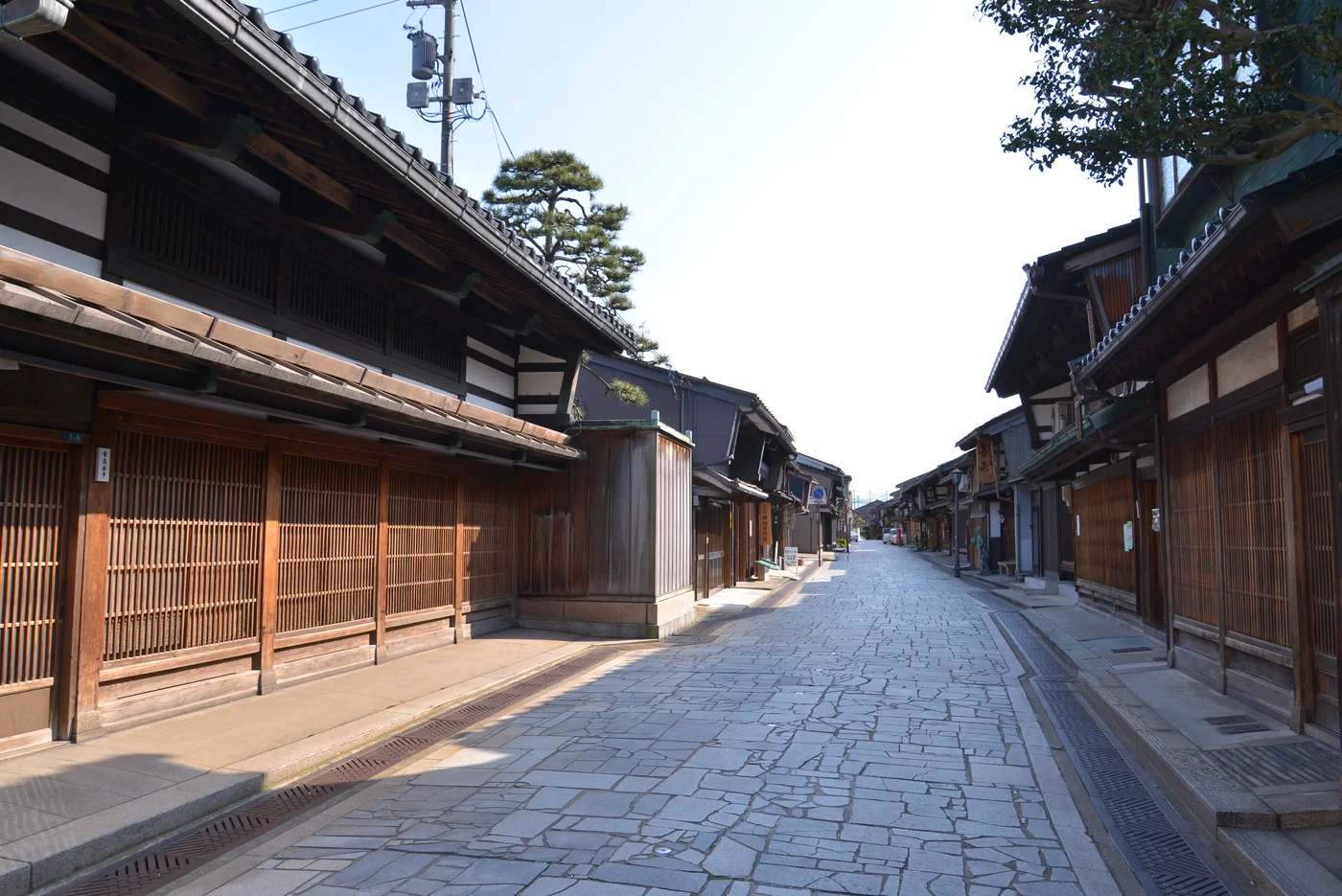
In 1611, Maeda Toshinaga invited seven casting masters here to form a metal-casters’ town, the starting point for Kanayamachi’s craft history. Then bring your attention back to the street: museum tools, Otera’s modern tin jewellery and the townhouses answer different questions about work, products and daily life.
Start near the museum, leave time for a free walk, then reach Otera for your booking. The museum is at 1-5 Kanayamachi and Otera at 6-9. Save both full addresses to your map and move at your own pace. View buildings from public streets, photographing lattices, frontages and paving. Follow signs on whether entrances are open, and leave residents room at their doors.
In rain, shorten the outdoor part: visit the museum, then Otera’s workshop, adding paving and house exteriors during a break in the weather. Stones, lattices and indoor tools reward observation at different scales, even on a short walk. For a craft-focused trip, time spent making or studying tools indoors is more useful than completing the whole street in rain.
Otera tin jewellery: choose something you will wear
The tin-jewellery workshop at Otera Kohachiro Shoten lasts about 30–60 minutes, and you take the finished piece home that day. Standard items cost ¥2,500 each; bracelets cost ¥4,000. Choices include earrings, necklaces, rings, keyrings, brooches and hair accessories. Think about whether you usually wear earrings or brooches, or would use a keyring every day, before choosing at the shop.
Necklaces include a cord, convenient if you do not want to find a separate chain. Keyrings suit companions who do not wear jewellery. Two standard items total ¥5,000; one standard item and one bracelet total ¥6,500. This makes the choice against Nousaku tableware clearer. Both bring tin home, but Otera focuses on accessories, while Nousaku’s longer course spends more time on sand moulds and finishing.
Otera accepts preschool children accompanied by a guardian. Families who prefer small accessories and time in the old district can include it in a Kanayamachi half day. If the child is most interested in sand, choose Nousaku’s 30-minute course. The two venues have separate age categories, objects and prices. Start with what the child wants to make before deciding to cross between areas.
Groups of 10 or more people, or making 10 or more items, must book at Otera and receive ¥200 off each item. Disability-handbook holders and one accompanying person also receive ¥200 off each item; the two discounts cannot be combined. For two people making one each, use standard prices. Larger parties should give both headcount and total quantity so the shop can apply the correct conditions.
Book through the official contact form by the previous day, stating date, preferred time, numbers, representative’s name and a telephone number. Bookings are generally on the hour, such as 10:00 or 11:00; workshops are accepted from 10:00 to 16:00. For same-day bookings call 0766-25-1911. Ordinary walk-in visitors are also accepted. With a fixed train departure, reserve workshop time first and fit the walk around it.
Choose the weekday first: Kanayamachi on Sunday, Nousaku on Tuesday
On Sundays or public holidays, Kanayamachi makes a fuller half day more easily. Otera explicitly opens on Sundays and holidays. The museum follows its own Tuesday and New Year closure rules. Visit the museum, then make jewellery at Otera, adjusting street time to the weather.
For Nousaku on a Sunday, choose LAB making, displays or the shop. LAB lists New Year as its regular closure, while tours also close on Sundays and holidays. Select the two activities separately. A 90-minute Sunday workshop plus displays gives craft enthusiasts time at headquarters. To watch production, move the visit to a working day with tours.
Otera closes on Tuesdays but opens if Tuesday is a public holiday. The museum closes on Tuesdays and moves that closure to the following day on public holidays. Their holiday handling differs. On an ordinary Tuesday, choose Nousaku and keep Kanayamachi to a short outdoor walk. If it is a public holiday, follow each venue’s rules. Factory tours also close on holidays, so a Tuesday visit to Nousaku does not automatically include a production tour.
On a rainy day, concentrate on one area. Headquarters has courses, displays and dining; Kanayamachi has the museum and workshop. Choose around your booked activity and companions’ expectations of walking outdoors. Once you have travelled for a workshop, finishing, resting and staying in that area usually makes better use of time than crossing again in rain.
Use Nousaku’s new address; approach Kanayamachi from Takaoka Station
The navigation address for Nousaku headquarters is 富山県高岡市オフィスパーク8-1, or 8-1 Office Park, Takaoka, Toyama. It moved to the new factory in April 2017. The venue recommends searching by address because its name or telephone number can return the old factory. Save the address with your course name when the confirmation arrives, and give it directly to the taxi driver to reach the headquarters containing FACTORY SHOP and LAB.
The venue gives taxi times of about 15 minutes from Shin-Takaoka Station and 20 minutes from Takaoka Station. Use these to plan the direction of travel, adding waiting time and payment on arrival. If arriving by Shinkansen and going straight to Nousaku, take the taxi from Shin-Takaoka. If staying near Takaoka Station, depart from there rather than doubling back for a more familiar station name.
The Nousaku access page links Kaetsuno Bus timetables for the World Heritage Bus and services towards Takaoka University of Law. Follow the venue’s links to the operator and select services for your date, direction and course time. For a workshop-led day, find an early-enough arrival first, then the return. A taxi is an option between activities if crossing areas and avoiding time spent transferring.
For Kanayamachi, both the museum and Otera give a walk of about 20 minutes from Takaoka Station. Take a Kaetsuno bus to Kanaya, then walk about two minutes to the museum or one minute to Otera. This approach works as the start of an old-district half day, continuing from museum to workshop. With luggage or if avoiding the station walk, use a bus or taxi and save your energy for the stones and townhouses.
Takaoka and Shin-Takaoka are different gateways. For longer journeys, see our Hokuriku Arch Pass and Tsuruga transfer guide. For this day, retain only the station-to-factory, station-to-Kanayamachi and cross-area journeys you need. Drivers can use Nousaku’s free parking. In Kanayamachi, follow museum or Otera directions to Kanaya Ryokuchi Park parking.
Link both areas with a full day: Nousaku, then museum and stone streets
For production and Kanayamachi, choose a weekday with tours and start at Nousaku. Use the 11:00 tour and 13:30 90-minute workshop as a starting point when checking reservations, leaving lunch between. After the workshop ends at about 15:00, travel to Kanayamachi and prioritise the museum before its 16:30 closing, then walk. This version spends time on the factory and making. Leave Otera jewellery for another visit and make only one kind of object that day.
To give more of the afternoon to the old district, choose the 10:30 90-minute workshop. After finishing around noon, eat, collect your work and move to Kanayamachi. See tools at the museum, then attend your booked Otera workshop. Each hands-on activity has its own slot. This suits people who already enjoy crafts. Omit the Nousaku tour, or the afternoon can become a rush to the workshop.
Both versions include the cross-area journey in the timetable. Even a taxi needs waiting, boarding and alighting time. If museum time becomes tight, remove Otera or another course to protect the main booked activity. Kanayamachi’s stones and lattices need some unallocated time. Chasing the next check-in as soon as you leave the museum loses the reason for visiting the old street.
For an easy family half day, choose Nousaku’s 13:00 30-minute course, pay beforehand, then visit the displays and shop. Another half-day option stays in Kanayamachi: museum early, street walk, then Otera jewellery. Each has a complete start and finish. Swap them according to age, weekday and weather rather than asking children to sit down for two small-object workshops in one day.
At home, hand-wash and dry your tinware
Two adults making sake cups at Nousaku pay ¥9,900 for the courses. Small plates cost ¥3,850 each, or ¥7,700 total. Add two ¥550 boxes and the totals become ¥11,000 and ¥8,800. The tour is free; two standard museum tickets cost ¥600. Add transport and food for the chosen route separately. Calculate the object and the decision to visit both areas separately to see what pays for making and what pays for crossing town.
Wash tinware with a soft sponge and neutral washing-up liquid, then dry with a cloth. Wash promptly after strongly acidic food or drink to avoid discolouration. Do not use a microwave, dishwasher or dryer, or put it in the freezer. To make the piece part of everyday meals, give it a place for hand-washing and drying. Consider your household habits when choosing a plate or bowl.
Hot food heats the vessel itself, so take care when handling it. Metal cutlery can scratch soft tin; consider this when eating dessert from a small bowl. Pure tin bends, but repeated excessive bending can crack or break it. Use the piece in its original shape and retain its stamping and making marks rather than repeatedly testing its flexibility.
A few useful answers
Do I need separate bookings for the Nousaku factory tour and casting workshop?
Book the factory tour and casting workshop separately. The free guided tour lasts about 30 minutes, with time for questions. If the tour is two days away or sooner, book by phone or email.
Which Nousaku casting workshop suits primary school children?
In the 30-minute workshop, primary pupils can make flower- or animal-shaped chopstick rests for ¥550 each, including tax. Each preschool child needs a guardian. In the 90-minute workshop, children below secondary school age can help fill the mould with sand while an accompanying adult does most of the work.
What can I make at Ootera in Kanayamachi, and what does it cost?
Standard tin accessories such as earrings, necklaces, rings and keyrings cost ¥2,500 each. A bracelet costs ¥4,000. Allow about 30 to 60 minutes for the workshop, and take your piece away as soon as it’s ready.
How do I get to Nousaku and Kanayamachi from the railway stations?
Nousaku is about 15 minutes by taxi from Shin-Takaoka station or 20 from Takaoka station. The casting museum and Ootera are each about a 20-minute walk from Takaoka station. From Kanaya bus stop, it’s about two minutes’ walk to the museum or one to Ootera.
Official information and references
Sources used in this guide.
- Nousaku | Casting workshops (read 28 October 2026)
- Nousaku | Factory tours (read 28 October 2026)
- Nousaku | Headquarters access and opening hours
- Takaoka City | Casting Museum (updated 24 August 2026)
- Agency for Cultural Affairs, Japan Heritage | Takaoka townspeople’s culture (11 September 2023)
- Nousaku | Techniques and materials
- Nousaku | Caring for tinware
- Otera Kohachiro Shoten | Access and opening days
- Otera Kohachiro Shoten | Tin-jewellery workshop