Track Tokyo's ginkgo foliage from Tachikawa to central Tokyo. Compare Showa Kinen Park's two avenues, Jingu Gaien's evening illuminations, Koshu Kaido, UTokyo Hongo and Marunouchi, with 2026 foliage updates, entrances, fares and wet-weather routes.
- Region & Focus
- TokyoWhen to visit
- Reading Scope
- 24 min read · 11 chapters · 7 Q&As
- Official Verification
- 32 official sources checkedUpdated 22 November 2026
- Key Topics
- SeasonsItinerariesRail travel
Chapter Route Map (tap any stop)
- Decide first between overhead canopies and leaf-strewn paths
- Showa Kinen Park's two ginkgo avenues sit near different gates
- Tickets and station exits for Showa Kinen Park's night walk
- Daytime foliage at Jingu Gaien vs. evening crowds
- Koshu Kaido in Hachioji: an easy add-on returning from Takao
- The University of Tokyo Hongo Campus: Main Gate to Yasuda Auditorium
- Kudanshita's shrine and Kitanomaru Park: prioritise whichever closes earlier
- Hibiya Park and Gyoko-dori: keeping walks tight west of Tokyo Station
- Koganei Park for families, Hikarigaoka for a straightforward stroll
- Where to stay depends on the next day's route
- One afternoon after rain: tackle early-closing spots first
- Quick Q&A
If you only have half a day for Tokyo's ginkgo trees and are staying near Tokyo Station, head for Hibiya Park and Gyoko-dori; if you want a dense canopy overhead, go to Jingu Gaien instead. It is only worth riding the Chuo Line out to Showa Kinen Park when you can spare more than half a day. Dates change the equation too: on 19 November 2026, Showa Kinen Park announced that both of its main ginkgo avenues had shed leaves in rain and wind and were past their peak. For late-November arrivals, spend the day in central Tokyo and connect to the Jingu Gaien illuminations from 21 to 29 November in the evening.
Decide first between overhead canopies and leaf-strewn paths
Once your travel dates are fixed, check the official photos first, then look at the listed foliage stage. When a park writes irozuki-hajime (starting to turn), the treetops usually colour earlier than the lower branches, so walking underneath lets you capture green and yellow leaves together. Migoro (peak colour) signals that the trees are at their best, though individual trees along the same row can still vary noticeably. Once updates switch to migoro-sugi (past peak) or rakuyo-chu (shedding leaves), shift your focus to the ground: after a gusty day, yellow leaves may carpet the path or be swept to the kerbs, so judge by the walkways and lawns shown in the photos. If your priority is two full, overarching rows of foliage, pick another spot where the leaves are still holding.
The Tokyo Metropolitan Government Bureau of Construction's autumn 2026 bulletin covers 37 metropolitan parks and gardens. Updates from the Tokyo Metropolitan Park Association normally publish every Monday and Thursday during the season, with the final bulletin scheduled for 17 December. When reading a single park page, check both the species and the exact area inside the grounds: maples in one corner may be at their peak while the ginkgoes are already bare. Showa Kinen Park runs its own Hanadayori flower and foliage updates, while the University of Tokyo's campus requires checking university access and visitor notices. Keep these three sources separate rather than applying one park association's colour scale to trees managed by someone else.
For a first trip around mid-November, set aside a full morning for Tachikawa. If your flight lands between late November and early December, focus on central streets and campuses across easily swappable half-days. Use this as a starting framework, as individual trees turn at different speeds. After overnight gales or a full day of rain, start somewhere with a second grove or indoor shelter nearby. Anyone staying at Tokyo Station can decide over breakfast whether to head up to Hongo or stay in Marunouchi, without being locked into a timed suburban ticket.
| What you want to see | Where to go | How to get in |
|---|---|---|
| Long daytime avenues and leaf-carpeted paths | Showa Kinen Park | JR Ome Line Nishi-Tachikawa Station Park Exit; walk towards Katarai Ginkgo Avenue first |
| A straight city boulevard lined with ginkgoes | Jingu Gaien | Ginza Line Gaiemmae Station Exit 4a; walk along Aoyama-dori |
| Ginkgoes framed by historic university buildings | University of Tokyo Hongo Campus | Namboku Line Todaimae Station Exit 1; follow Hongo-dori to the Main Gate |
| No park ticket needed and easy to cut short | Hibiya Park and Gyoko-dori | Hibiya Station Exit A10 or A14, finishing on foot at Tokyo Station |
| A roadside walk you can enjoy even on a short stretch | Hachioji Koshu Kaido | JR Takao Station North Exit; turn back whenever you have walked enough |
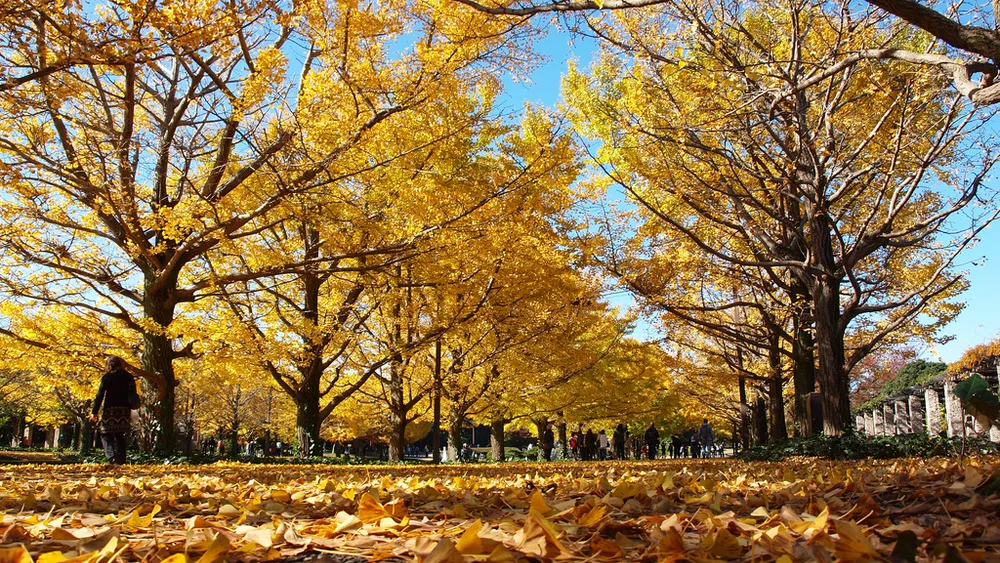
Track Tokyo's ginkgo foliage from Tachikawa to central Tokyo. Compare Showa Kinen Park's two avenues, Jingu Gaien's evening illuminations, Koshu Kaido, UTokyo Hongo and Marunouchi, with 2026 foliage updates, entrances, fares and wet-weather routes.
Showa Kinen Park's two ginkgo avenues sit near different gates
Search the map for the Canal and Katarai-no-Icho Namiki (Katarai Ginkgo Avenue). The Canal sits right by the Tachikawa Gate, where two neat rows of ginkgoes flank the water; the event map lists 106 trees over 150 metres. Katarai has 98 trees stretching roughly 300 metres, with branches arching over the path to form a deeper tunnel about 730 metres inside the Nishi-Tachikawa Gate. Walking from the Tachikawa Gate to Katarai is around 2 kilometres, and doubling back from the Nishi-Tachikawa Gate to the Canal is about 1 kilometre. If you have a pushchair, camera gear or only an hour left before closing, spend your ticket on the section you want most—there is still a lot of park between the two.
For reflections along the Canal, take the JR Chuo Line to Tachikawa Station and follow signs for the park from the North Exit. It takes roughly 10 minutes to reach the free-entry Akebono Gate, and about 18 minutes to reach the Tachikawa Gate for the paid zone. Walking through the Akebono Gate brings you into the Green Culture Zone, leaving a stretch still to go before the Canal itself. On a tight schedule, enter via the Tachikawa Gate for the Canal banks and return towards the station for lunch. For the longer avenue, change at Tachikawa for one stop on the JR Ome Line to Nishi-Tachikawa, where the Park Exit is about a 2-minute walk from the Nishi-Tachikawa Gate. Coming from central Tokyo, look for direct Chuo-to-Ome Line trains showing Nishi-Tachikawa on the departure board.
From November to the end of February, standard park hours run from 9:30 to 16:30. Admission is ¥450 for adults and ¥210 for visitors aged 65 and over (bring proof of age), with free entry for junior high school students and younger. Entering via Tachikawa in the morning and leaving by Nishi-Tachikawa in the afternoon lets you link the Canal, Waterfowl Pond and Katarai along one continuous path, without forcing the whole group to backtrack for lunch or bike returns. Save both gates on the park map before you set off. If someone in your group simply wants a bench once you reach Waterfowl Pond, they can rest by the water and exit at Nishi-Tachikawa.
The two avenues do not turn yellow at the same pace. The park's 5 November foliage update already listed the Canal as entering peak colour while the western Katarai avenue was still turning. By 19 November, official photos showed both avenues had lost leaves to wind and rain and passed their peak. If you are travelling specifically in late November for full canopies, prioritise central Tokyo spots that still show green-to-gold foliage on the same date. If low-angle shots of fallen leaves appeal, or you want to pair the ginkgoes with maples in the Japanese Garden, Tachikawa still warrants half a day. On the ground, checking how many leaves remain underfoot beats counting trees on a list.
With a pushchair, two adults can easily split the walk into stages. Use the Nishi-Tachikawa Gate or Waterfowl Pond area as a meeting point so one person can pause with the child while the other heads deeper in for photos. If you hire bicycles to save walking, factor in the return deadline: rental centres at Tachikawa, Nishi-Tachikawa and Sunagawa require bikes to be returned to the same depot at least 30 minutes before closing. For a one-way walk exiting through a different gate, going on foot works more smoothly. On busy ginkgo days, cover your priority avenue first before deciding whether to cycle elsewhere in the park.
Tickets and station exits for Showa Kinen Park's night walk
The 2026 Autumn Night Walk runs from 29 October to 29 November. Illuminations switch on at 16:30, lights go out and last entry closes at 20:30, and the park shuts at 21:00. Only the Nishi-Tachikawa and Tachikawa Gates stay open in the evening, with on-site park ticket sales ending at 20:15. Anyone entering via Akishima or Sunagawa during the day must move into the night-opening zone before 16:30 and leave via one of the two open gates. For an evening-only visit, Nishi-Tachikawa Station saves steps for the longer avenue; if you want the Canal first and a straight route back to the Chuo Line, use the Tachikawa Gate.
One crowd-control rule applies only after dark. On Saturdays, Sundays and public holidays between 14 and 29 November from 16:30 to 20:30, Katarai Ginkgo Avenue operates one-way from north to south—entering from the Keiryu Square Restaurant side and walking out towards the Akishima Gate. If you come through the Nishi-Tachikawa Gate for the lights, follow the evening stewards to the northern end before walking south. Because the Akishima Gate is shut at night, follow the lit return route back to the Nishi-Tachikawa Gate once you leave the avenue. Arrange to meet friends by the entrance gates or near the restaurant rather than blocking the avenue entrance.
Illuminations along the Canal and Katarai Ginkgo Avenue are included in standard park admission. Adding the Japanese Garden after 16:30 requires a separate viewing ticket: online tickets are ¥1,200 for adults and visitors aged 65 and over, and ¥600 for primary and junior high school students, on sale from one week ahead through the day of visit. Adults visiting specifically that day who also want to see the garden can compare the ¥1,600 combo ticket that includes park admission. Visitors already inside the Japanese Garden during the day must exit before 16:00 and re-enter via the evening queue. Plan your route around the dates shown on the booking page rather than pinning the whole evening on an unpurchased garden ticket.
Same-day tickets for the Japanese Garden are sold at Komorebi House from 16:00 to 20:00, cash only, at ¥1,300 for adults and over-65s, and ¥700 for primary and junior high school students. The park explicitly states that same-day window sales stop once the online allocation sells out. Late arrivals can skip the garden and head straight from the Nishi-Tachikawa Gate to Katarai Ginkgo Avenue. Walking from the Nishi-Tachikawa Gate to the Japanese Garden covers roughly 1.6 kilometres; allow extra time at strolling pace for entry queues, bridges and regrouping.
To save legs at night, an internal shuttle bus links Nagame Terrace and the Japanese Garden, with the first departure from Nagame Terrace at 17:30 and the last return from the garden at 20:30. Fares are ¥400 one way for adults and ¥200 for primary and junior high school students, cashless payment only, with no intermediate stops. Note that this shuttle only connects two points inside the park, so you still walk from Nagame Terrace back to the gate. If you have a train to catch or someone in your party feels the chill, finish after one illuminated zone and head back towards Tachikawa Station for dinner.
Daytime foliage at Jingu Gaien vs. evening crowds
Jingu Gaien's classic perspective sits at the Aoyama-dori end, looking down twin rows of ginkgoes towards the Meiji Memorial Picture Gallery. On the Tokyo Metro Ginza Line, take the Gaien Ginkgo Avenue ticket gate at Gaiemmae Station up to Exit 4a and follow Aoyama-dori to the start of the avenue. From Aoyama-itchome Station on the Hanzomon Line, walk via Kita-Aoyama to reach the same end. When companions are arriving on the Oedo Line from Shinjuku and the Ginza Line from Shibuya, pick a clear corner on Aoyama-dori or meet inside the underground station first—waiting on opposite sides of the avenue quickly gets separated by crowds and traffic lights.
The Tokyo Metropolitan Government Bureau of Construction lists the 2026 Jingu Gaien ginkgo illumination from 21 to 29 November, roughly 16:30 to 19:30 daily. Meiji Jingu Gaien Tennis Club also notes vehicle traffic restrictions along the avenue over the same period, with the Aoyama Car Park accessible only from Aoyama-dori. Evening illuminations funnel far denser crowds moving in the same direction than daytime visits. If you simply want natural leaf colour, aim for a weekday morning when light brings out the canopy shape and hue, then eat elsewhere in the evening. For the lights, arrive in the area just before switch-on, follow stewarding signs, and avoid gathering right at narrow station exits.
If you are flying in mainly for autumn colour, there is no need to lock your trip to illumination week. Floodlights shift the tone of early-turning or part-green trees, whereas daylight shows the true stage along both rows. From the pavement you can frame the trunks, canopy and the road narrowing towards the Picture Gallery. Follow marshals during traffic restrictions and do not step into the carriageway, set up bulky tripods or back up blindly for shots. With children, walk along one pavement as far as suits everyone and cut back towards Aoyama-dori at a convenient crossing rather than looping all the way to the far end.
Koshu Kaido in Hachioji: an easy add-on returning from Takao
This stretch of Koshu Kaido runs about 4 kilometres from Oiwake-cho to Takao-cho in Hachioji, lined with 763 trees according to city cultural heritage records. Stepping out of the JR Takao Station North Exit puts you right on it. As a working urban arterial with commuters, cars and shops, side streets and traffic signals break the avenue into distinct blocks. On a first visit, head east from Takao Station until you have seen your fill, then turn back—usually smoother than forcing the entire 4 kilometres. Leaving a stretch on both sides gives you an easy excuse to pause for backlit or sunlit angles on the walk back.
To walk the full avenue, start from Takao Station towards Oiwake-cho and finish at JR Nishi-Hachioji Station. Running the route in reverse ends at Takao Station for quick connections back towards Hachioji, Tachikawa or the Keio Line. Covering 4 kilometres takes well over an hour once you add photo stops, shops and pedestrian crossings. Keep to the pavements and use marked junctions; spots that look close across the tarmac often lack safe mid-block crossings. If part of your group prefers a shorter stroll, stay near the trees closest to Takao Station for an easy meeting point.
The 2026 Hachioji Ginkgo Festival runs on 21 and 22 November. Hachioji City's November municipal newsletter maps the stamp-rally checkpoints and event zones together, noting vehicle restrictions on selected sections from 10:00 to 16:00 on both days alongside marked pedestrian-only zones. To join in, ride to Takao or Nishi-Hachioji and head straight for your target checkpoints rather than hunting blindly along all 4 kilometres. The ¥700 wooden tsuko-tegata pass mentioned in the bulletin is purely a souvenir item for the stamp rally. On ordinary weekdays, walking the pavements to see the trees costs nothing and needs no pass.
Takao Station and Takaosanguchi Station serve different purposes. The Keio Line to Takaosanguchi puts you beside the Mount Takao trailheads and the Kiyotaki cable car station. To combine mountain maples and roadside ginkgoes in one day, hike up from Takaosanguchi in the morning, return to the base, and ride one Keio stop to Takao Station's North Exit for Koshu Kaido. Reaching the street late in the afternoon, a short out-and-back walk is plenty. You can plan the ascent and cable car options using Mount Takao routes and transport, leaving buffer time for the short hop from the mountain base to Takao Station.
The University of Tokyo Hongo Campus: Main Gate to Yasuda Auditorium
Hongo's ginkgo avenue sits inside the University of Tokyo's Hongo Campus, where the main axis leads from the Main Gate straight towards Yasuda Auditorium. Searching for Yasuda Auditorium pinpoints the central vista far more reliably than searching generically for UTokyo ginkgoes. Take Exit 1 at Todaimae Station on the Namboku Line along Hongo-dori, or Exit 4 from Hongo-sanchome Station on the Toei Oedo Line. Because the Marunouchi and Oedo lines have separate stations at Hongo-sanchome, check which line you rode before picking an exit. Approaching from Hongo-sanchome, you will pass the Red Gate (Akamon) first—keep walking up Hongo-dori to reach the Main Gate.
The Akamon remains closed for seismic-safety measures and is still listed by the university as inaccessible. The large leaves of the Main Gate open from 7:00 to 18:00 on weekdays and stay shut on weekends and public holidays. Its side pedestrian gate stays open daily from 7:00 until 0:30 the next morning, so individuals and small groups can still enter for daytime strolls. Groups of 15 or more must register with the university at least seven days ahead. The campus access page also lists restricted dates such as entrance exams, so check current entry notices if visiting later in winter.
Walking to Yasuda Auditorium and looking back gives you both the architecture-framed view and the reverse perspective towards the gate. Visitor access is limited to outdoor paths, public areas and separately open facilities; lecture halls and faculty buildings are generally closed. Stick to the central promenade and step to the side when taking photos so students and staff can pass easily. University guidelines also prohibit commercial shoots and unpermitted reporting—if you need formal filming permission, choose a public venue with an application process.
Hongo pairs neatly with a weekday morning visit before jumping back on the underground towards Kudanshita or Otemachi. From Todaimae, ride the Namboku Line towards Meguro to Iidabashi and change one stop on the Tozai Line towards Nishi-Funabashi for Kudanshita. If your afternoon continues around Tokyo Station, skip the extra cross-town transfer and take the Marunouchi Line towards Ogikubo from Hongo-sanchome straight to Tokyo Station for Gyoko-dori. Even if the campus trees are underwhelming on the day, you still have half a day left for the next stop.
Kudanshita's shrine and Kitanomaru Park: prioritise whichever closes earlier
Official access for Yasukuni Shrine is roughly a 5-minute walk from Kudanshita Station Exit 1, entering the outer approach through the Great Torii. The inner precinct opens at 6:00 year-round and closes at 17:00 in November and December. If you want both the ginkgo-lined approach and time inside the shrine grounds, visit Yasukuni first in the afternoon; if you only want the view from the Great Torii, keep the stop brief. For quieter photos, drop by in the morning and step clear of the centre of the approach whenever groups of worshippers pass through.
For Kitanomaru Park, leave Kudanshita Station via Exit 2 towards Tayasumon Gate and pass beside the Nippon Budokan into the grounds. To avoid stairs, follow the Ministry of the Environment's step-free route from lift-equipped Exit 6 along street level to Tayasumon Gate. The park's western side holds maple groves that contrast sharply with the shrine's ginkgo approach. When daylight is tight around dusk, pick whichever side matters most. To continue to Gyoko-dori, walking out of the park towards Takebashi saves backtracking to Kudanshita; if anyone in your group is flagging after the first stop, stay put and take the underground straight to Hibiya.
The Ministry of the Environment lists Kitanomaru Park's usual maple peak from late November to early December, and Chiyoda City's tourism guide pairs Yasukuni Shrine with surrounding autumn spots. Because ginkgoes and maples turn and drop at different speeds, Kitanomaru's maples may still hold strong colour even as Yasukuni's ginkgoes are shedding. Guests staying around Kudanshita or Iidabashi can fit in a morning walk before collecting bags from the hotel. If you have a Shinkansen to catch from Tokyo Station later that day, spending a full afternoon in Kudanshita stretches the return trip—staying along Gyoko-dori makes for a calmer finish.
Hibiya Park and Gyoko-dori: keeping walks tight west of Tokyo Station
Hibiya Park has multiple entrances. Exits A10 and A14 at Hibiya Station (served by both Tokyo Metro and Toei Subway) bring you straight to the park edge, and Exit B2 at Kasumigaseki Station also puts you right beside it. For ginkgoes, start with the Kubikake Ginkgo near Hibiya Matsumotoro, while the official park map highlights Kumogata Pond on the opposite side. If you want water reflections, pair the pond with paths shown open on the current map. Ongoing park redevelopment has fenced off sections—if you hit works inside an entrance, follow the open detour marked on the map or switch gates along the outer perimeter rather than ping-ponging between barriers.
From 13 to 29 November 2026, Hibiya Art Park places outdoor installations inside the grounds. Treat the artworks as bonus stops while keeping your main ginkgo route anchored around Hibiya Matsumotoro and Kumogata Pond. Check the official step-free map before arriving with a pushchair; if you plan to cross the whole park to another underground line, construction detours will affect your timing far more than train frequencies. When you only have one slot before a train at Tokyo Station, walk one main zone and head across to Marunouchi.
Gyoko-dori runs east–west from Tokyo Station's Marunouchi building towards the Imperial Palace, with a central pedestrian promenade ideal for framing ginkgoes against the brick facade. Arriving by JR, take the Marunouchi Central Exit straight onto the station plaza; from the Yaesu side, follow the free passage across to Marunouchi first. Walking up from Hibiya Park, follow Hibiya-dori towards Otemachi and turn down Gyoko-dori back towards the station. Short on time, stand in Marunouchi Plaza to gauge both sides, walk one side to the first junction and turn back—you still get the classic station backdrop.
If rain sets in harder, there is an indoor stop without boarding another train. Tokyo Station Gallery opens inside the Marunouchi North Exit dome, and is also easy to reach from the Marunouchi underground passage via Exit M12. From 21 November 2026 to 31 January 2027, the gallery hosts oil paintings and woodcuts by Norwegian artist Nikolai Astrup, neatly spanning the second half of ginkgo season. When companions have different tolerance for wet weather, view the exhibition together and step onto Gyoko-dori during a dry spell. Travellers rushing for a long-distance train can pick just one of the two.
When showers hit outside Tokyo Station, trim the walk to the short stretch between Marunouchi Plaza and Gyoko-dori, then duck into the station or neighbouring Marunouchi arcades. Because both sit on the same side, you can judge the rain before stepping out and avoid weaving repeatedly through ticket gates. Dusk shifts the focus onto the illuminated brick station and street perspective; for pure yellow foliage, visit Hibiya and Gyoko-dori before sunset. If you are transferring to a Shinkansen at Tokyo Station, leave extra time to walk back from street level to the right ticket gates—especially with large suitcases, agree on one fixed meeting spot inside the station rather than searching across opposite plazas.
Koganei Park for families, Hikarigaoka for a straightforward stroll
Koganei Park works well as a half-day lawn outing. From the JR Chuo Line Musashi-Koganei Station North Exit, take a Seibu Bus from stops 2 or 3 and alight at Koganei Park West Gate. From Hana-Koganei Station on the Seibu Shinjuku Line, walk to the Minami-Hana-Koganei stop for buses bound for Musashi-Koganei to the same gate. Unlike central parks right outside a station, both approaches require a short bus ride. Save both directions' bus stops on your phone before entering; if traffic backs up along Itsukaichi Kaido, leave the lawns early rather than banking on the last convenient bus.
Check the Tokyo Metropolitan Park Association's Koganei locations and park map for fallen leaves—the Eucalyptus Plaza area combines open lawns with easy tree viewing. Families can set a meeting point on the wide paths nearby so children can play while adults shoot photos, though skip sitting under the trees if the grass is damp. Koganei pairs more naturally with historic buildings than Tachikawa does. Inside sits the Edo-Tokyo Open Air Architectural Museum, where you can step inside selected historic houses while walking outdoors between them. General admission is ¥400, open 9:30 to 16:30 from October to March (last entry 16:00), and closed Mondays or the Tuesday when Monday is a public holiday. If visiting on a Monday when the museum is shut, treat Koganei as a pure park walk and head back towards Musashi-Koganei Station for lunch.
For a quieter neighbourhood ginkgo path, ride the Toei Oedo Line to Hikarigaoka Station and follow Exit A3 towards the park. Allow a short walk through the surrounding blocks between the station and the trees. The park's autumn map marks the ginkgo avenue and other foliage—look for Fureai-no-Michi for an open, unhurried promenade. Direct Oedo Line trains from Shinjuku make Hikarigaoka an easy single-stop morning switch when you want to avoid changing to JR at Tachikawa or catching buses off the Chuo Line.
Where to stay depends on the next day's route
Stay on the Marunouchi side to slot Gyoko-dori into your arrival or departure day, dropping bags after check-out for a quick photo walk. East-side Yaesu hotels suit highway coaches and certain rail exits, yet still require crossing back west for the ginkgo avenue. When easy foliage walks, dining and hotel rest matter most, checking the hotel's spot on a map tells you more than a generic 'minutes from Tokyo Station' claim. Ueno also works well as a central base: ride the Ginza Line from Ueno or Ueno-hirokoji straight to Gaiemmae by day, duck indoors to the Tokyo National Museum if it rains, and save Gyoko-dori for a clear window.
Shinjuku gives you two distinct options. On dry mornings, the Chuo Line reaches Tachikawa, Koganei or Takao with zero transfers. In sudden heavy rain, keep things compact around the station department stores and slip over to Shinjuku Gyoen if the weather clears. Ministry of the Environment hours for autumn and winter are 9:00 to 16:30 (last entry 16:00), with admission at ¥500 for adults, ¥250 for visitors aged 65 and over and high school students and older, and free for junior high school students and younger. Standard Monday closures resume from 16 November onwards, shifting to Tuesday when Monday is a public holiday. Enter via the Shinjuku Gate from JR Shinjuku Station South Exit, or the Okido Gate from Shinjuku-gyoemmae Station Exit 2 on the Marunouchi Line. Travelling with older relatives or toddlers from 15:00 onwards, stick near one gate instead of crossing the entire garden.
If you are tackling Hachioji and Showa Kinen Park across consecutive days—or returning late from evening illuminations—staying by Tachikawa Station saves repeated trips back into central Tokyo. Hotels near the North Exit let you walk straight to Showa Kinen Park's Akebono Gate in the morning and return via the Tachikawa Gate at night; with children, using the 2-minute walk from the Nishi-Tachikawa Gate and riding one stop back to Tachikawa is even easier. For a single Takao excursion, there is no need to haul suitcases to another hotel—day trips work cleanly from either Tachikawa or Shinjuku. Equally, do not move out west for Tachikawa if your next day focuses on Hongo and Hibiya.
Budget transport by route. JR lines cover Nishi-Tachikawa, Tachikawa, Takao and Musashi-Koganei (plus buses for Koganei Park), whereas Tokyo underground passes only cover Tokyo Metro and Toei Subway lines. For a simple Hibiya-to-Tokyo Station walk, or a daytime trip to Hongo followed straight back to the hotel, pay single fares with an IC card. If you plan multiple cross-city hops with frequent gate entries within 24 hours, compare individual fares using Tokyo subway pass coverage. Check child age thresholds separately too, as free park entry and child rail fares follow different rules.
One afternoon after rain: tackle early-closing spots first
Let last-entry times dictate your afternoon order. If you reach Tachikawa with under an hour left in Showa Kinen Park's daytime session, enter at the gate closest to your chosen avenue and leave the same way. At Shinjuku Gyoen, any arrival after 16:00 means switching to Gyoko-dori at Tokyo Station instead. Choosing between Kudanshita and Marunouchi, go to Kudanshita first if you want inside Yasukuni Shrine's precinct, or keep to Tokyo Station for a shorter city stroll. And if wind and rain have already stripped the branches, pivot from hunting overhead canopies to checking fallen leaves closest to your hotel, sparing yourself a long standing commute.
Wet leaves cling to stone steps, tiles and kerbs, so pick a wider, clear-sighted side of the path for low-angle shots. After pushing a buggy through leaf-strewn paths, find a pause spot to clear damp stems from the wheels before heading into shopping arcades. Both Koshu Kaido and Gyoko-dori involve traffic crossings on busy roads before dusk, so pause for photos only on spacious pavements. With older relatives or cold-sensitive children, arranging lunch near a station is far easier than waiting out twilight in an open park.
Whenever evening illuminations are on the schedule, limit the daytime plan to at most one large garden walk. Pairing Hongo or Hibiya by day with Jingu Gaien after dark keeps central-city walking manageable. After hiking Mount Takao or completing the 4-kilometre Koshu Kaido stretch, stay around Takao, Hachioji or Tachikawa for dinner and save night-time ginkgoes for another evening. To combine red maples, riverside views and ginkgoes in one itinerary, plan another half-day with Tokyo autumn foliage half-day area plans. With only a single gap left in the schedule, choose the spot closest to your hotel that is easiest to shorten.
A few useful answers
When is the best time to see ginkgoes in Tokyo?
Showa Kinen Park's typical official season runs from late October to late November, while central Tokyo peaks mainly from late November into early December. On 19 November 2026, Showa Kinen Park announced that both main avenues had shed leaves in rain and wind and were past peak.
Which entrance is closest to the ginkgoes in Showa Kinen Park?
The Canal is roughly 300 metres from the Tachikawa Gate. Katarai Ginkgo Avenue is around 730 metres from the Nishi-Tachikawa Gate, which sits about a 2-minute walk from JR Nishi-Tachikawa Station's Park Exit.
Do I need a separate ticket for Showa Kinen Park's night ginkgo illuminations?
Both ginkgo avenues are included in standard park admission. After 16:30, the Japanese Garden requires an extra viewing ticket: in 2026, online adult tickets are ¥1,200 alongside park entry, with an adult combo ticket also available.
Until when do the 2026 Jingu Gaien ginkgo illuminations run?
They run from 21 to 29 November, from around 16:30 to 19:30. Take the Tokyo Metro Ginza Line to Gaiemmae Station Exit 4a and walk along Aoyama-dori.
Can I combine Mount Takao and Hachioji's ginkgoes in one day?
Yes. Hike up from Keio Takaosanguchi Station first, return to the base, take the Keio Line one stop to Takao, and walk Koshu Kaido from the North Exit. If arriving late, stick to the stretch near the station.
Can you enter the University of Tokyo Hongo Campus through the Akamon (Red Gate) for ginkgoes?
No, the Akamon remains closed for seismic-safety measures. Head to the Main Gate towards Yasuda Auditorium; on weekends and public holidays, pedestrians enter through the small side gate beside the Main Gate.
Which spot near Tokyo Station works best for a quick stop before a train?
Leave bags in a station locker first. Walk from the Marunouchi Central Exit onto the station plaza, stroll along one side of Gyoko-dori and turn back to re-enter through the same exit.
Official information and references
Sources used in this guide.
- Tokyo Metropolitan Government Bureau of Construction: 2026 Metropolitan Park Autumn Foliage Survey and Update Schedule
- Tokyo Metropolitan Park Association: Autumn Foliage Updates for Metropolitan Parks
- GO TOKYO: Autumn Leaves Forecast for Central Tokyo and Suburbs
- Showa Kinen Park: 5 November 2026 Foliage Observation
- Showa Kinen Park: 19 November 2026 Foliage Observation
- Showa Kinen Park: Gate Access and Walking Times
- Showa Kinen Park: Opening Hours and Closure Dates
- Showa Kinen Park: Autumn Night Walk 2026, Avenue Distances, Fares and Evening Access
- Showa Kinen Park: One-Way Evening Access Notice for Katarai Ginkgo Avenue
- Showa Kinen Park: Bicycle Hire and Return Rules
- Tokyo Metropolitan Government Bureau of Construction: 2026 Jingu Gaien Ginkgo Illuminations
- Meiji Jingu Gaien Tennis Club: Vehicle Traffic Restrictions During the Event
- Tokyo Metro: Gaiemmae Station Exits
- Hachioji City: Koshu Kaido Ginkgo Avenue and Takao Station North Exit
- Hachioji City: November 2026 Municipal Newsletter with Ginkgo Festival Dates and Route Map
- The University of Tokyo: Hongo Campus Access and Station Exits
- The University of Tokyo: Hongo Campus Gate Hours
- The University of Tokyo: Hongo Campus Visitor Guidelines and Group Registration
- Yasukuni Shrine: Opening Hours and Underground Exits
- Ministry of the Environment: Kitanomaru Park Entrances and Step-Free Route
- Chiyoda City Tourism Association: Autumn Foliage Feature
- Chiyoda City Tourism Association: Gyoko-dori in Front of Tokyo Station
- Tokyo Metropolitan Park Association: Hibiya Park Access, Park Map and Redevelopment Notice
- Tokyo Metropolitan Park Association: 2026 Hibiya Art Park Schedule
- Tokyo Metropolitan Park Association: Koganei Park Access and Park Map
- Tokyo Metropolitan Park Association: Hikarigaoka Park Route and Park Map
- Edo-Tokyo Open Air Architectural Museum: Opening Hours, Closures and Admission
- Ministry of the Environment: Shinjuku Gyoen Opening Hours and Admission
- Ministry of the Environment: Shinjuku Gyoen Gate Access
- Tokyo Metro: Tokyo Subway Ticket Eligible Lines
- Tokyo Station Gallery: Exhibition Dates and Programme
- Tokyo Station Gallery: Marunouchi North Exit and Underground Passage Access