Follow Tokyo's ginkgo season from Tachikawa to the city center. Compare Showa Kinen Park's two avenues, Jingu Gaien's night illumination, Koshu Kaido, University of Tokyo Hongo, and Marunouchi, with 2026 foliage updates, entrances, fares, and rainy-day routes.
- Region & Focus
- TokyoWhen to visit
- Reading Scope
- 24 min read · 11 chapters · 7 Q&As
- Official Verification
- 32 official sources checkedUpdated November 22, 2026
- Key Topics
- SeasonsItinerariesRail travel
Chapter Route Map (tap any stop)
- Decide first between full canopies or leaf-strewn paths
- Showa Kinen Park's two avenues sit near opposite gates
- Tickets and exit gates for Showa Kinen Park's night walk
- Jingu Gaien's daytime color versus its evening crowds
- Walking Hachioji's Koshu Kaido on the way back from Takao
- University of Tokyo Hongo from the Main Gate to Yasuda Auditorium
- Kudanshita's shrine and Kitanomaru Park: start where gates close first
- Hibiya Park and Gyoko-dori: keeping your walk west of Tokyo Station
- Koganei Park for families, Hikarigaoka for a neighborhood stroll
- Where to stay based on tomorrow's itinerary
- Making the most of a single post-rain afternoon
- Quick Q&A
If you only have half a day for Tokyo's ginkgo trees and are staying near Tokyo Station, walk Hibiya Park and Gyoko-dori, or head to Jingu Gaien if you want an unbroken golden canopy overhead. Only if you have more than half a day is it worth riding the Chuo Line out to Showa Kinen Park. Your exact travel dates change the equation: on November 19, 2026, Showa Kinen Park announced that rain and wind had stripped leaves from both main avenues, putting them past peak. For late November trips, make central Tokyo your daytime base and pair it with the Jingu Gaien evening illumination from November 21 to 29.
Decide first between full canopies or leaf-strewn paths
Once your travel dates are locked in, check official photos first and the labeled foliage stage second. On park reports, "irozuki-hajime" means color is just starting, with treetops usually turning before lower branches so you get both green and yellow in one frame. "Migoro" marks peak viewing, though individual trees along an avenue can still vary noticeably. When listings switch to "migoro-sugi" (past peak) or "rakuyo-chu" (dropping leaves), shift your expectations to the ground: after a breeze, yellow leaves may carpet the path or be swept to the edges, so judge by the walkways and lawns in recent photos. If you want two full, overarching canopies meeting overhead, pick a different spot that still has leaves on the branches.
The Tokyo Metropolitan Government Bureau of Construction's 2026 autumn bulletin covers 37 metropolitan parks and gardens. During the season, the Tokyo Metropolitan Park Association typically updates its foliage tracker every Monday and Thursday, with the final update scheduled for December 17. Read species and sub-area labels carefully on the same page: maple trees in one corner of a park may be peaking while the ginkgo trees are already bare. Showa Kinen Park maintains its own "Hanadayori" flower and foliage report, and the University of Tokyo relies on campus access notices. Keeping those three sources separate prevents applying one park's color stage to an avenue managed by someone else.
For a trip centered around mid-November, dedicate a full morning to Tachikawa first. If you arrive in late November or early December, build flexible half-days around central avenues and campuses that are easy to swap. That is your starting framework, though individual trees turn on their own schedule. After overnight gales or an all-day downpour, make your first stop somewhere with a secondary grove or an indoor backup. Travelers staying near Tokyo Station can decide over breakfast between Hongo and Marunouchi without feeling forced to use a pre-booked suburban timed ticket.
| What you want to see | Where to go | How to enter |
|---|---|---|
| Long daytime avenues and leaf-carpeted paths | Showa Kinen Park | Ome Line Nishi-Tachikawa Station Park Exit, then walk toward Katarai Avenue |
| Straight city avenue framed by ginkgo trees | Jingu Gaien | Ginza Line Gaiemmae Station Exit 4a, walking along Aoyama-dori |
| Ginkgo trees alongside historic campus architecture | University of Tokyo Hongo Campus | Namboku Line Todaimae Station Exit 1, walking along Hongo-dori to the Main Gate |
| No admission fee and easy to cut short anytime | Hibiya Park and Gyoko-dori | Hibiya Station Exit A10 or A14, finishing on foot at Tokyo Station |
| A flexible street walk you can turn back from anytime | Koshu Kaido in Hachioji | JR Takao Station North Exit, turning back whenever you have walked enough |
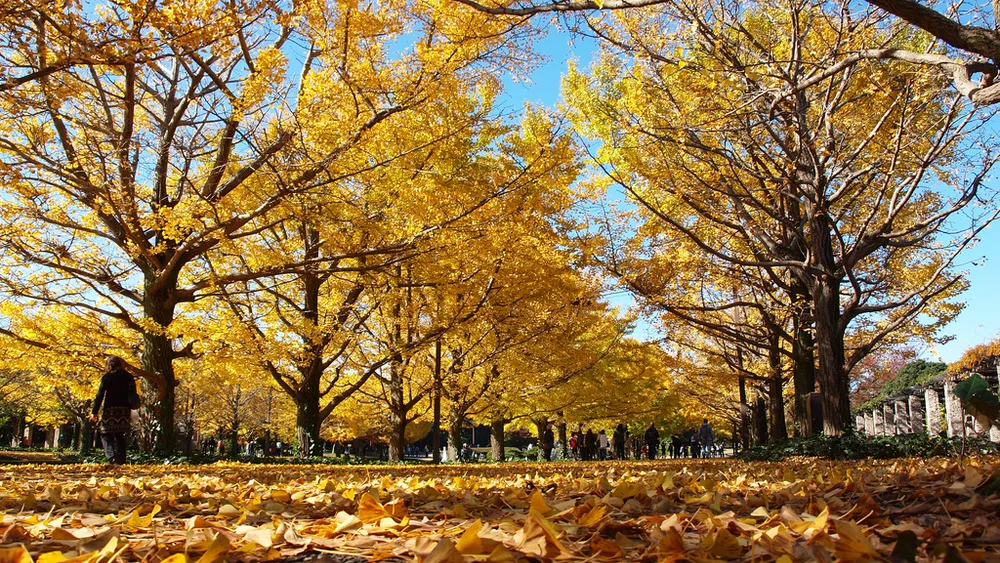
Follow Tokyo's ginkgo season from Tachikawa to the city center. Compare Showa Kinen Park's two avenues, Jingu Gaien's night illumination, Koshu Kaido, University of Tokyo Hongo, and Marunouchi, with 2026 foliage updates, entrances, fares, and rainy-day routes.
Showa Kinen Park's two avenues sit near opposite gates
Search the park map for the Canal ("Canaru") and Katarai Ginkgo Avenue ("Katarai no Icho Namiki"). The Canal avenue sits right inside Tachikawa Gate, where two neat rows of 106 ginkgo trees line a 150-meter reflecting canal according to the event map. Katarai Avenue has 98 trees stretching roughly 300 meters, with branches arching over the walkway to form a deeper tunnel about 730 meters in from Nishi-Tachikawa Gate. Walking from Tachikawa Gate to Katarai takes about 2 kilometers, and doubling back from Nishi-Tachikawa Gate to the Canal is roughly 1 kilometer. If you have a stroller, heavy camera gear, or only an hour before closing, spend your ticket on the single stretch you care about most rather than crossing the huge grounds between them.
For canal reflections, ride the Chuo Line to Tachikawa Station and follow park signs out of the North Exit. Walking to the free Akebono Gate takes about 10 minutes, while reaching Tachikawa Gate for the paid zone takes about 18 minutes. Passing through Akebono Gate puts you in the Green Culture Zone, still a fair walk from the canal. On a short stop, enter via Tachikawa Gate to see both sides of the canal and head back near the station for a meal. If your target is the 300-meter tunnel, transfer one stop at Tachikawa to the JR Ome Line for Nishi-Tachikawa, where the Park Exit puts you at Nishi-Tachikawa Gate in about 2 minutes; from central Tokyo, you can also board direct Ome Line trains marked for Nishi-Tachikawa or beyond.
From November through the end of February, regular daytime hours are 9:30 to 16:30. Admission is ¥450 for adults, ¥210 for visitors 65 and older (bring proof of age), and free for junior high school age and under. Entering via Tachikawa Gate in the morning and exiting at Nishi-Tachikawa in the afternoon lets you link the canal, Bird Sanctuary pond, and Katarai Avenue in one direction without backtracking for lunch or bike returns. Save both gate pins on the official map before setting out. If someone in your group decides they just want to sit by the pond halfway through, they can rest lakeside and leave directly via Nishi-Tachikawa Gate.
The two avenues turn yellow at different speeds. In its November 5, 2026 foliage report, the park listed the Canal trees as newly at peak while the western Katarai avenue was still turning. By November 19, official photos showed both avenues past peak after rain and wind stripped the branches. If you are heading out in late November specifically for full canopies, check same-day or recent city reports first. If you prefer low-angle shots of golden leaf carpets or want to combine the visit with Japanese Garden maples, Tachikawa still earns half a day, and leaf volume on the ground matters more than raw tree counts.
With a stroller, two adults can easily split the walk into legs. Use Nishi-Tachikawa Gate and the Bird Sanctuary area as your anchor so one person can rest with the child while the other walks deeper to photograph the avenue. If you rent bicycles to save energy, factor in return logistics: rental hubs at Tachikawa, Nishi-Tachikawa, and Sunagawa require bikes to be returned to the original pickup station at least 30 minutes before closing. Walking works better if you want to cross the park and exit from a different gate. On busy foliage days, hit your priority avenue on foot first before deciding whether to rent bikes for the rest of the grounds.
Tickets and exit gates for Showa Kinen Park's night walk
The 2026 Autumn Night Walk ("Aki no Yosanpo") runs from October 29 to November 29. Lights turn on at 16:30, shut off with last entry at 20:30, and the park closes at 21:00. Only Nishi-Tachikawa Gate and Tachikawa Gate stay open at night, with on-site park ticket sales listed until 20:15. Visitors entering earlier from Akishima or Sunagawa gates must move into the night-open zone before 16:30 and exit through one of the two open gates afterward. For an evening-only visit, Nishi-Tachikawa Station saves steps to Katarai Avenue, while Tachikawa Gate works best if you want the canal first and direct Chuo Line access back.
One crowd-control rule applies exclusively at night. On Saturdays, Sundays, and national holidays from November 14 to 29 between 16:30 and 20:30, Katarai Avenue switches to one-way foot traffic from north to south, entering near the Stream Square restaurant side and exiting toward Akishima Gate. Visitors coming from Nishi-Tachikawa Gate must follow event staff routing up to the north end before walking south through the trees. Because Akishima Gate is closed at night, loop back along the lit night path to Nishi-Tachikawa Gate afterward, and agree to meet friends near a main gate or restaurant rather than at the avenue entrance.
Illumination along the Canal and Katarai Avenue is covered by regular park admission. Adding the Japanese Garden after 16:30 requires a separate viewing ticket: online advance tickets from one week ahead through the day of visit cost ¥1,200 for adults and visitors 65+, and ¥600 for elementary and junior high students. Adults coming specifically for both the park and garden can compare the ¥1,600 combo ticket that includes park entry. Daytime garden visitors staying for the lights must exit the garden before 16:00 and re-enter via the evening queue; plan your main route around available reservation dates rather than treating an unbooked garden ticket as the centerpiece of the night.
Same-day Japanese Garden tickets are sold cash-only at Komorebi no Ie from 16:00 to 20:00, priced at ¥1,300 for adults and 65+, and ¥700 for elementary and junior high students. The park explicitly warns that on-site sales stop once online capacity sells out. Late arrivals can skip the garden altogether and enjoy Katarai Avenue straight from Nishi-Tachikawa Gate. Keep in mind that the walk from Nishi-Tachikawa Gate to the Japanese Garden is roughly 1.6 kilometers, so leave buffer time for entry lines, bridges, and regrouping.
To save your legs after dark, an event shuttle bus connects Nagame no Terrace (View Terrace) and the Japanese Garden entrance, with the first outbound bus at 17:30 and the last return bus at 20:30. One-way fares are ¥400 for adults and ¥200 for elementary and junior high students, cashless payment only, with no intermediate stops. Note that you still have to walk from View Terrace back out to an exit gate. If someone in your group gets cold easily or you are rushing for a train, finish one illuminated zone, head back to the station, and eat dinner around Tachikawa Station.
Jingu Gaien's daytime color versus its evening crowds
Jingu Gaien's classic perspective starts at the Aoyama-dori end, looking down twin rows of ginkgo trees toward the Meiji Memorial Picture Gallery. On the Tokyo Metro Ginza Line, take the Gaien Ginkgo Avenue ticket gate at Gaiemmae Station up to Exit 4a and follow Aoyama-dori to the avenue entrance. From the Hanzomon Line, exit at Aoyama-itchome Station and walk toward Kita-Aoyama to reach the same end. If members of your group are arriving on the Oedo Line from Shinjuku and the Ginza Line from Shibuya, pick a clear corner on Aoyama-dori or meet inside the station first, because heavy crowds and traffic lights easily separate people waiting on opposite sidewalks.
For 2026, the Tokyo Metropolitan Government announced the Jingu Gaien ginkgo illumination for November 21 through 29, running roughly 16:30 to 19:30 daily. The Jingu Gaien Tennis Club also posted vehicle traffic controls along the avenue for the period, restricting Aoyama Parking access to the Aoyama-dori side. Evening illumination draws dense, directional foot traffic compared with daytime visits. If your priority is natural foliage color, go on a weekday morning when clean light shows true leaf tones and tree shapes, then dine elsewhere at night; if you want the lights, arrive before dusk and avoid lingering in narrow subway exits.
Do not lock your flights solely around illumination week if you are flying in specifically for natural autumn color. Floodlights cast a warm tone over trees that are still partly green or early-turning, whereas daylight reveals actual leaf progression along both sides. Sidewalks give you clean sightlines of trunks, canopies, and the narrowing road toward the gallery. Respect traffic-control barriers, keep out of active vehicle lanes, and skip large tripods or repeated backing-up into walkways; with kids, simply walk as far as they enjoy and turn back at an intersection toward Aoyama-dori instead of forcing the full loop.
Walking Hachioji's Koshu Kaido on the way back from Takao
This stretch of Koshu Kaido runs roughly 4 kilometers from Oiwakecho to Takaomachi in Hachioji, lined with 763 ginkgo trees according to municipal cultural property records. Stepping out of JR Takao Station's North Exit puts you right onto the route. Because this is an active urban arterial road with commuters, cars, and storefronts, intersections and traffic signals naturally break the rows into segments. First-time visitors coming from Takao Station should walk east until they have seen enough and turn back, leaving both sidewalks available so you catch front-lit angles on the return leg.
If you want the full 4 kilometers, walk east from Takao Station toward Oiwakecho and catch the train back from JR Nishi-Hachioji Station, or reverse the route to end at Takao Station for easy connections toward Hachioji, Tachikawa, or the Keio Line. Depending on your pace, photo stops, shopping, and crosswalk waits, the full walk takes well over an hour. Stay on the sidewalks and cross only at marked intersections, even when a vantage point across the street looks tempting. If anyone in your group wants a shorter outing, focus on the trees closest to Takao Station so regrouping is effortless.
The 2026 Hachioji Ginkgo Festival takes place on November 21 and 22. Hachioji City's November municipal bulletin maps out stamp-rally checkpoints and event zones together, noting traffic restrictions on select sections from 10:00 to 16:00 both days alongside pedestrian-only zones. To join the festival, ride directly to Takao or Nishi-Hachioji and target specific checkpoints rather than trudging all 4 kilometers in search of booths. The wooden pass ("tsuko tegata") listed at ¥700 in the bulletin is solely for the stamp rally; on regular weekdays, walking the sidewalks is completely free and requires no ticket.
Keep Takao Station and Takaosanguchi Station straight in your itinerary. The Keio Line terminates at Takaosanguchi Station right next to the Mount Takao trailheads and Kiyotaki cable car station. To combine mountain maple foliage with Koshu Kaido's ginkgo trees in one day, climb Mount Takao in the morning from Takaosanguchi, then ride the Keio Line one stop back to Takao Station and exit the North Exit onto Koshu Kaido. Since you will likely finish descending near dusk, stick to a short out-and-back walk near the station; plan your mountain ascent and lift transfers with Mount Takao routes and access and leave buffer time between the base and Takao Station.
University of Tokyo Hongo from the Main Gate to Yasuda Auditorium
The University of Tokyo's ginkgo avenue runs inside Hongo Campus along the central axis leading from the Main Gate straight toward Yasuda Auditorium. Searching maps for "Yasuda Auditorium" pinpoints that iconic vista far more reliably than searching "Todai ginkgo." On the Tokyo Metro Namboku Line, take Todaimae Station Exit 1 and walk down Hongo-dori; on the Toei Oedo Line, use Hongo-sanchome Station Exit 4. Note that the Marunouchi Line and Oedo Line have separate stations at Hongo-sanchome, so follow exit signs for your line—and if you pass Akamon Gate first coming up Hongo-dori, keep walking to reach the Main Gate.
Akamon Gate remains closed under seismic safety measures, and the university still lists it as inaccessible. The large Main Gate (Seimon) opens weekdays from 7:00 to 18:00 and stays closed on weekends and holidays, while the small pedestrian gate beside it remains open daily from 7:00 to 0:30 the following morning for individuals and small groups. Groups of 15 or more must register with the university at least 7 days in advance. Check the campus access calendar for exam days and closed dates if you are visiting later in the winter.
Walking all the way to Yasuda Auditorium and looking back gives you both the framing shot with the auditorium facade and the reverse perspective toward the gate. Public access is limited to outdoor grounds, common areas, and designated open facilities—classrooms and department buildings are off-limits. Keep to the main promenade and step aside when taking photos so students and faculty can pass cleanly. Because the university prohibits unauthorized commercial shoots and media filming, pick another venue with formal permit channels if you are shooting commercial work.
Hongo pairs smoothly with a weekday morning visit followed by a quick subway hop to Kudanshita or Otemachi. From Todaimae Station, take the Namboku Line toward Meguro, transfer at Iidabashi to the Tozai Line toward Nishi-Funabashi, and ride one stop to Kudanshita. If Tokyo Station is on your afternoon schedule, skip cross-line transfers and board the Marunouchi Line from Hongo-sanchome toward Ogikubo straight to Tokyo Station for Gyoko-dori. That way, even if campus trees are past peak, you still have half a day left for your next stop.
Kudanshita's shrine and Kitanomaru Park: start where gates close first
Official access for Yasukuni Shrine is a 5-minute walk from Kudanshita Station Exit 1, leading past the grand torii gate along the outer approach. The inner sanctuary grounds open daily at 6:00 and close at 17:00 in November and December. Put the shrine first in the afternoon if you want to see both the ginkgo-lined approach and the inner precincts; if you only want a street-level view from the torii gate, keep the stop brief. For quieter photos, visit a short stretch in the morning and step out of the center walkway whenever worshippers arrive.
To reach Kitanomaru Park, leave Kudanshita Station via Exit 2 toward Tayasu-mon Gate and walk past the Nippon Budokan into the grounds. If you want to skip stairs, follow the Ministry of the Environment's step-free route using Exit 6's elevator to street level up to Tayasu-mon Gate. Inside, the western maple grove offers a sharp contrast to the shrine's ginkgo approach. If you are tight on time around dusk, pick whichever mood appeals more; if continuing to Gyoko-dori, walk out the Takebashi side of the park instead of backtracking to Kudanshita, or let tired companions catch the subway directly to Hibiya.
The Ministry of the Environment places Kitanomaru Park's typical maple peak from late November through early December, while Chiyoda City's tourism guide pairs Yasukuni Shrine with surrounding autumn spots. Because trees shed at different paces, Kitanomaru's maples are often still vibrant even after Yasukuni's ginkgo leaves start falling. Travelers staying near Kudanshita or Iidabashi can easily take a morning stroll before grabbing luggage at the hotel, whereas anyone catching a Shinkansen out of Tokyo Station later that day will have an easier return by sticking to Gyoko-dori instead.
Hibiya Park and Gyoko-dori: keeping your walk west of Tokyo Station
Hibiya Park has multiple convenient entrances. Exit A10 or A14 from Tokyo Metro or Toei Hibiya Station brings you straight to the park perimeter, and Kasumigaseki Station Exit B2 gives quick access to the opposite side. Look for the famous "Kubikake Ginkgo" near Hibiya Matsumoto-ro, and check the official park map for Kumogata-ike Pond on the other side if you want water reflections. Ongoing park redevelopment has fenced off some paths, so if you hit construction barriers, detour along currently open routes shown on the map or enter from another street side rather than doubling back between fences.
From November 13 to 29, 2026, the Hibiya Art Park event installs outdoor artworks across the grounds. Treat the installations as bonus stops while anchoring your walk around Hibiya Matsumoto-ro and Kumogata-ike Pond. If you are pushing a stroller, consult the official accessible route map beforehand, as footpath detours around construction affect crossing times far more than subway headways. When you are short on time and need to catch a train at Tokyo Station, explore just one main corner of the park and continue toward Marunouchi.
Gyoko-dori is the broad east-west boulevard linking Tokyo Station's Marunouchi Building directly toward the Imperial Palace, with a central pedestrian promenade lined with ginkgo trees. Arriving at Tokyo Station by JR, leave via the Marunouchi Central Exit straight onto the plaza; from the Yaesu side, take the connecting underground passage across to Marunouchi first. Walking up from Hibiya Park, follow Hibiya-dori toward Otemachi and turn onto Gyoko-dori facing the station facade. Even with only 15 minutes to spare, you can step onto the plaza, pick the more colorful side of the avenue up to the first crosswalk, and still frame the historic red-brick station behind golden branches.
If rain picks up, you have an indoor option without boarding another train. The Tokyo Station Gallery sits right inside the Marunouchi North Dome, reachable outdoors or via the Marunouchi underground concourse toward Exit M12. From November 21, 2026 to January 31, 2027, its exhibition of oil paintings and woodcuts by Norwegian artist Nikolai Astrup spans the second half of ginkgo season. Groups with mixed tolerance for wet weather can tour the gallery together and step out onto Gyoko-dori during a dry break, unless you are racing for an upcoming long-distance train and need to choose just one.
When rain hits right outside Tokyo Station, trim your walk to the short stretch between the Marunouchi plaza and the start of Gyoko-dori, then duck back inside the station or neighboring Marunouchi malls. Because everything sits on the same side of the tracks, you can watch the sky without wasting time going in and out of ticket gates. Aim for Gyoko-dori before sunset if you want crisp leaf color, saving dusk for illuminated station-facade depth shots. Before boarding a Shinkansen, leave extra buffer time to reach the right ticket gate with big bags, and pick a fixed indoor meeting point inside the station so companions do not lose each other across the two plazas.
Koganei Park for families, Hikarigaoka for a neighborhood stroll
Koganei Park makes an easy half-day built around wide lawns. From JR Chuo Line Musashi-Koganei Station North Exit, board a Seibu Bus from stops 2 or 3 to "Koganei Koen Nishiguchi." From Seibu Shinjuku Line Hana-Koganei Station, walk to the "Minami-Hanakoganei" bus stop for buses bound for Musashi-Koganei to the same park stop. Both routes require a short bus ride unlike rail-side city parks, so bookmark both inbound and outbound return stops on your phone and leave the lawn early if Itsukaichi-kaido traffic backs up instead of betting everything on the last bus.
Check the Tokyo Metropolitan Park Association's Koganei sub-area map for fallen leaves; Eucalyptus Lawn ("Yukari Hiroba") combines wide grass with mature trees. Adults can frame photos from the wide path while kids play nearby, though you should skip sitting under the trees when the grass is damp. Koganei pairs better with historic buildings than Tachikawa thanks to the Edo-Tokyo Open Air Architectural Museum inside the park, where you can step inside preserved structures while walking outdoors between them. General admission is ¥400, open 9:30 to 16:30 (last entry 16:00) from October to March, and closed Mondays (or Tuesday if Monday is a holiday); on Mondays, stick to the park grounds and head back toward Musashi-Koganei Station for lunch.
For a quiet residential ginkgo walk, take the Toei Oedo Line to Hikarigaoka Station and follow signs from Exit A3 toward Hikarigaoka Park. Leave a few minutes for the street walk between the station and the park entrance. The park's autumn map highlights the ginkgo avenue and other foliage along the wide "Fureai Path" (Fureai no Michi). Because the Oedo Line runs straight from Shinjuku to Hikarigaoka without a JR-plus-bus transfer, it is an easy morning swap when you want a single relaxed destination instead of heading out to Tachikawa.
Where to stay based on tomorrow's itinerary
Stay on the Marunouchi side of Tokyo Station if you want to fit Gyoko-dori in on your arrival or departure day after dropping bags at your hotel. While the east-facing Yaesu side is convenient for highway buses and certain exits, reaching the ginkgo boulevard requires crossing back to the west side—so check your hotel's exact pin on the map rather than relying on "minutes from Tokyo Station" claims. Ueno also works well as a central base: ride the Ginza Line straight from Ueno or Ueno-hirokoji to Gaiemmae on clear mornings, pivot indoors to the Tokyo National Museum if it rains, and save Gyoko-dori for a sunny gap.
Shinjuku gives you two different ways to play the forecast. On clear days, the Chuo Line runs straight west to Tachikawa, Koganei, or Takao. If heavy rain keeps you in town, stick to station department stores and slip over to nearby Shinjuku Gyoen as soon as the skies clear. Per Ministry of the Environment guidelines, autumn/winter hours run 9:00 to 16:30 (last entry 16:00), with admission at ¥500 for adults, ¥250 for seniors 65+ and high school/university students, and free for junior high age and under; regular Monday closures resume after November 16 (moving to Tuesday if Monday is a holiday). Enter via Shinjuku Gate from JR Shinjuku Station South Exit, or Okido Gate from Marunouchi Line Shinjukugyoemmae Station Exit 2—if traveling with seniors or toddlers at 15:00, stick to the nearest corner rather than crossing the entire garden.
If you plan two straight days covering Hachioji and Showa Kinen Park, or want an easy walk home after the night illumination, staying by Tachikawa Station beats commuting back and forth from central Tokyo. Hotels by the North Exit put you within walking distance of Akebono Gate in the morning and let you return via Tachikawa Gate at night, while families with kids can make the 2-minute walk to Nishi-Tachikawa Gate and one-stop ride back to Tachikawa their primary evening route. For a single day trip to Mount Takao, however, there is no need to haul luggage to a second hotel—staying in Tachikawa or Shinjuku works fine, just as you should not move west for one Tachikawa trip if the next day centers on Hongo and Hibiya.
Budget transit by the corridors you actually ride. JR covers Nishi-Tachikawa, Tachikawa, Takao, and Musashi-Koganei (plus buses for Koganei Park), whereas the Tokyo Subway Ticket only covers Tokyo Metro and Toei Subway lines. For a simple Hibiya-to-Tokyo walk or a morning in Hongo before heading straight back to your hotel, tap an IC card per ride. Only if you are hopping across multiple central wards within 24 hours should you run the numbers against Tokyo Subway Ticket coverage—and tally children's ages separately, since free park entry and child rail fares follow different age cutoffs.
Making the most of a single post-rain afternoon
Let last-entry cutoffs set your afternoon sequence. If you reach Tachikawa with under an hour left in regular park hours, enter through the gate closest to your target avenue and leave the same way. If you miss Shinjuku Gyoen's 16:00 cutoff, pivot straight to Gyoko-dori outside Tokyo Station. Groups choosing between Kudanshita and Marunouchi should hit Kudanshita first if they want inside Yasukuni Shrine before closing, or keep it short at Tokyo Station; if storms have already stripped the branches, trade a long standing-room commute for the nearest leaf-covered sidewalks near your hotel.
Wet ginkgo leaves cling to stone steps, tiles, and curbs, so pull over onto a wide, open stretch of path for low-angle shots. After pushing a stroller through wet foliage, brush leaf stems off the wheels before rolling into malls or cafes. Both Koshu Kaido and Gyoko-dori involve busy street crossings where late-autumn dusk traffic moves fast, so stay on broad sidewalks while framing photos. When traveling with seniors or kids who chill quickly, meeting for a warm lunch near the station works far better than waiting outdoors through twilight.
On days with an evening illumination, limit your daytime plan to at most one large park or garden. Pairing Hongo or Hibiya in the morning with Jingu Gaien at night keeps central-city walking manageable, while anyone hiking Mount Takao or all 4 kilometers of Koshu Kaido should eat dinner around Takao, Hachioji, or Tachikawa and save night lights for another evening. To weave maples and riverside spots into the rest of your trip, use Tokyo autumn foliage half-day area plans—and if you only have one open slot left, pick whichever spot is closest to your hotel and easiest to cut short.
A few useful answers
When is the best time to see ginkgo trees in Tokyo?
Showa Kinen Park's typical peak runs from late October to late November, while central Tokyo is best prioritized from late November through early December. On November 19, 2026, Showa Kinen Park announced that both of its main ginkgo avenues had shed leaves due to wind and rain and were past peak.
Which Showa Kinen Park entrance is closest to the ginkgo avenues?
The Canal ginkgo avenue is about 300 meters from Tachikawa Gate. Katarai Ginkgo Avenue is about 730 meters from Nishi-Tachikawa Gate, which is roughly a 2-minute walk from JR Nishi-Tachikawa Station's Park Exit.
Do I need a separate ticket for the Showa Kinen Park night ginkgo viewing?
Access to both ginkgo avenues is included in standard park admission. The Japanese Garden requires a separate illumination ticket after 16:30; in 2026, online adult admission is ¥1,200 (park admission sold separately), and an adult combo ticket is also available.
How long does the 2026 Jingu Gaien ginkgo illumination run?
It runs from November 21 to November 29, 2026, from around 16:30 to 19:30. Take the Tokyo Metro Ginza Line to Gaiemmae Station, exit via Exit 4a, and walk along Aoyama-dori.
Can I combine Mount Takao and Hachioji's ginkgo avenue in one day?
Yes. Hike up from Keio Takaosanguchi Station first, then take the Keio Line one stop back to Takao Station and walk along Koshu Kaido from the North Exit. If you arrive late in the day, stick to the stretch near the station.
Can I enter the University of Tokyo Hongo Campus through Akamon Gate for ginkgo viewing?
Akamon Gate is closed for seismic retrofitting work. Head to the Main Gate (Seimon) and walk toward Yasuda Auditorium; on weekends and holidays, you can enter through the small side gate next to the Main Gate.
What is the easiest ginkgo spot near Tokyo Station before catching a train?
You can store your luggage inside the station first. Walk from the Marunouchi Central Exit to the station plaza, stroll down one side of Gyoko-dori and loop back, then re-enter the station through the same gate.
Official information and references
Sources used in this guide.
- Tokyo Metropolitan Government Bureau of Construction: 2026 Metropolitan Park Autumn Foliage Survey and Update Schedule
- Tokyo Metropolitan Park Association: Autumn Foliage Live Reports for Metropolitan Parks
- GO TOKYO: Autumn Foliage Timing in Central and Suburban Tokyo
- Showa Kinen Park: November 5, 2026 Foliage Observation Report
- Showa Kinen Park: November 19, 2026 Foliage Observation Report
- Showa Kinen Park: Gate Access and Walking Times
- Showa Kinen Park: Opening Hours and Closed Days
- Showa Kinen Park: Autumn Night Walk 2026, Avenue Distances, Fares, and Night Access
- Showa Kinen Park: One-Way Traffic Notice for Evening Ginkgo Avenue Viewing
- Showa Kinen Park: Bicycle Rentals and Return Rules
- Tokyo Metropolitan Government Bureau of Construction: 2026 Jingu Gaien Ginkgo Illumination
- Meiji Jingu Gaien Tennis Club: Event Period Traffic Restrictions
- Tokyo Metro: Gaiemmae Station Exit Guide
- Hachioji City: Koshu Kaido Ginkgo Avenue and Takao Station North Exit Access
- Hachioji City: November 2026 Municipal Bulletin Ginkgo Festival Dates and Map
- The University of Tokyo: Hongo Campus Access and Station Exits
- The University of Tokyo: Hongo Campus Gate Opening Hours
- The University of Tokyo: Hongo Campus Visitor Guidelines and Group Registration
- Yasukuni Shrine: Gate Hours and Subway Access Guide
- Ministry of the Environment: Kitanomaru Park Entrances and Step-Free Route
- Chiyoda City Tourism Association: Autumn Foliage Feature
- Chiyoda City Tourism Association: Gyoko-dori at Tokyo Station
- Tokyo Metropolitan Park Association: Hibiya Park Access, Map, and Redevelopment Notices
- Tokyo Metropolitan Park Association: 2026 Hibiya Art Park Schedule
- Tokyo Metropolitan Park Association: Koganei Park Access and Map
- Tokyo Metropolitan Park Association: Hikarigaoka Park Routes and Park Map
- Edo-Tokyo Open Air Architectural Museum: Hours, Closures, and Admission
- Ministry of the Environment: Shinjuku Gyoen Hours and Admission Fares
- Ministry of the Environment: Shinjuku Gyoen Gate Access
- Tokyo Metro: Tokyo Subway Ticket Eligible Lines
- Tokyo Station Gallery: Exhibition Schedule and Details
- Tokyo Station Gallery: Marunouchi North Exit and Underground Access