Enter through the main gate from Komagome. Compare ¥300 daytime admission with the separate 2026 autumn evening event, and plan a half day around the pond, teahouses, accessible paths, and Kyu-Furukawa Gardens.
- Region & Focus
- TokyoFall foliage
- Reading Scope
- 30 min read · 16 chapters · 4 Q&As
- Official Verification
- 14 official sources checkedUpdated October 26, 2026 at 03:52 PM GMT+8
- Key Topics
- SeasonsItinerariesRail travel
Chapter Route Map (tap any stop)
- Choose daytime or evening first; each needs a different amount of time
- From Komagome to the main gate: the nearest gate is exit-only at night
- Daytime tickets: single admission, two-garden tickets, and annual passes
- Choosing a date: usual foliage season, this year’s events, and pond works
- The first part of a daytime walk: understand the pond from Naitei Daimon
- The wooded part: pavilions, streams, and a stone bridge
- With children, a wheelchair, or a slower pace, choose comfortable paths
- 2026 evening admission: ¥1,000 in advance or ¥1,200 on the day
- After buying: cancellation deadlines, payment, and ticket checks
- At night: start with the pond, then choose woods and projections
- Teahouses, dinner, and the one-hour closure between sessions
- A daytime half day: arrive at 9:30 a.m. and finish around lunch
- Day and evening together: visit in the afternoon and allow a proper dinner break
- A two-garden day: give Kyu-Furukawa Gardens a full visit of its own
- Earlier in November: cultural events and yukitsuri demonstrations
- Photography, rain, and departure: stop where it is safe
- Quick Q&A
Choose a daytime visit to see Rikugien’s pond, tree shapes, and garden layout. Buy a separate evening ticket for illuminated autumn leaves. The 2026 evening event runs from November 25 to December 6: everyone leaves at 5:00 p.m., and the garden reopens at 6:00 p.m. Allow for both admissions, the main gate, and a dinner break so you do not end up waiting for the lights with a daytime ticket.
Choose daytime or evening first; each needs a different amount of time
For a first visit to Rikugien, I would set aside half a day in daylight. The garden rewards changing viewpoints: looking across the pond toward Nakanoshima, walking into the woods, then returning to an open bank. This is a different experience from photographing a single long row of ginkgo trees. In daylight, bridges, changes in level, and branches are easier to see. It also suits first-time visitors with strollers, people who need frequent breaks, and anyone who wants to read the garden’s signs slowly. If you have only one afternoon left, a daytime circuit is more practical than waiting for the evening session.
The evening session suits visitors who want to make lighting, reflections, and photography their main activity that night. Eat dinner early, follow the open route inside, then return to your accommodation. If you visit both sessions, study the garden layout by day and return at night to the banks and wooded areas you want to compare. There is no need to repeat every stop. In 2026, last evening admission is at 7:30 p.m. and closing is at 8:30 p.m. Arriving at the entrance at 7:30 leaves just one hour, including ticket checks and walking. Allow two to three hours by day and one and a half to two hours at night. Photography, teahouse lines, display panels, and your group’s walking pace will affect your stay. With little time, keep one pondside stretch and one wooded stretch. Add a nearby garden only if you have time for a second main attraction.
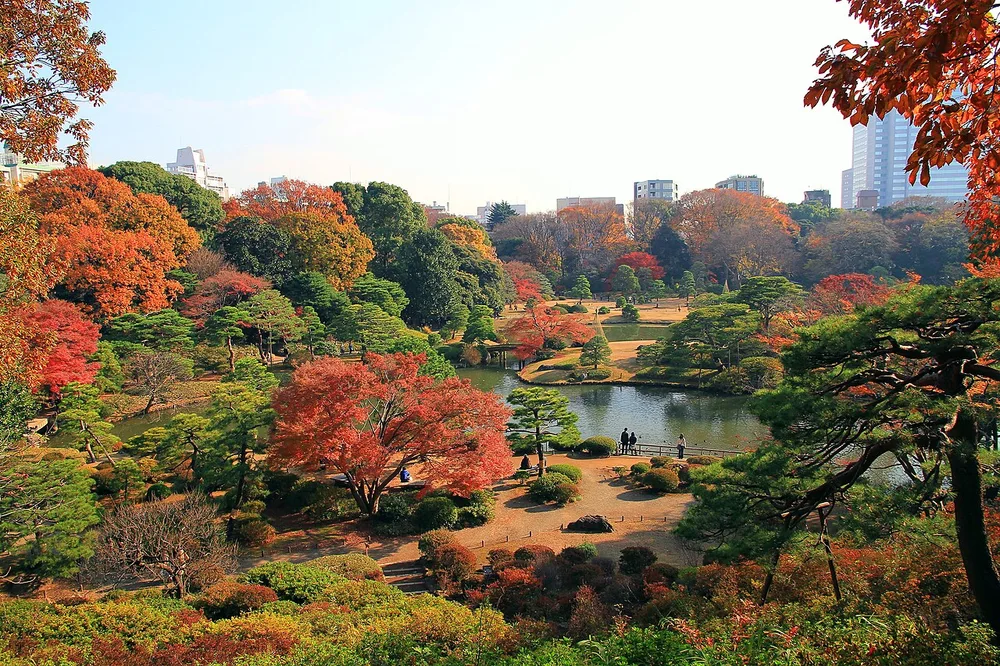
Enter through the main gate from Komagome. Compare ¥300 daytime admission with the separate 2026 autumn evening event, and plan a half day around the pond, teahouses, accessible paths, and Kyu-Furukawa Gardens.
From Komagome to the main gate: the nearest gate is exit-only at night
Rikugien’s address is 6-16-3 Honkomagome, Bunkyo-ku, Tokyo. The official walking time to the main gate is about seven minutes from JR Komagome Station’s South Exit or Exit 2 at Komagome Station on the Tokyo Metro Namboku Line. From the Toei Mita Line, the main gate is about ten minutes from Sengoku Station’s Exit A3. If you are staying along the Mita Line, compare the route via Sengoku rather than changing trains just because Komagome is the more familiar name. These times start at the station exit. Add time from the platform and for traffic lights.
The main gate is on the south side of the garden. Someimon Gate, near Komagome Station, is a separate entrance. The official garden map marks Someimon as a gate opened temporarily during events. Do not plan admission using only the shortest distance to the garden wall. The 2026 evening event page specifies entry through the main gate and exit through either the main gate or Someimon. Navigate to the main gate on arrival, then choose your exit to suit your train home.
There is no parking lot. For a trip focused on Rikugien, a train followed by a short walk is usually easier to plan. Even a car ride to the outer wall still requires finding an open entrance. Stroller and wheelchair users can first consult the station’s official accessibility page, choose a route to street level, then continue to the garden gate. The numbered subway exit and the elevator exit may be different. Carrying a stroller up stairs to save a few dozen meters is poor value. Before leaving at night, gather everyone inside the garden so separate groups do not leave through different gates.
Daytime tickets: single admission, two-garden tickets, and annual passes
The Rikugien daytime information page lists opening hours of 9:00 a.m.–5:00 p.m., with last admission at 4:30 p.m. General admission is ¥300, or ¥150 for visitors aged 65 and over. Elementary-school children and younger enter free with an accompanying adult. Junior-high students who live or attend school in Tokyo also qualify for free daytime entry. Overseas visitors whose children are already in junior high should budget for general admission. Bring proof of age for the 65-and-over rate. The garden closes from December 29 to January 1, which affects visits over New Year.
Buy a single ticket if you have only half a day. If you already plan to visit Kyu-Furukawa Gardens too, the Enmusubi two-garden ticket costs ¥400, or ¥200 for visitors aged 65 and over. The official information gives it no expiry date. Separate general tickets cost ¥300 plus ¥150, or ¥450, so the combined ticket saves ¥50. For visitors aged 65 and over, separate tickets cost ¥150 plus ¥70, or ¥220, so the saving is ¥20. The difference is small. Decide on two gardens according to your time and stamina, rather than adding an unwanted walk to save ¥50.
A Rikugien annual pass costs ¥1,200, or ¥600 for visitors aged 65 and over. The annual pass for nine Tokyo metropolitan gardens costs ¥4,000, or ¥2,000 for visitors aged 65 and over, and is valid for one year from issue. A daytime ticket is enough for a short-trip visitor coming once. If you plan repeat visits, compare the passes using the visits you will actually make.
The special evening event has its own tickets. Annual passes, two-garden tickets, and other admission tickets cannot replace them. The official online daytime ticket is also clearly marked for daytime use only. Check the product name before buying; the garden name alone does not identify the session.
Choosing a date: usual foliage season, this year’s events, and pond works
The GO TOKYO autumn guide places the main autumn color season in central Tokyo from mid-November to early December. Rikugien’s own autumn introduction highlights the maples around Tsutsuji Chaya in late November. If your trip falls in October or early November, you can still see the pond, pines, and garden layout by day; save expectations of widespread autumn color for a later trip. If you reach Tokyo on or after December 7, the evening event will have ended, but a daytime garden visit remains an option. Event dates are fixed. Leaf color changes with species, location, and that year’s weather, so decide on the two separately.
Before fixing a date, read the garden’s current notices and check when its photographs were taken. Then decide whether Rikugien should be your main activity that day. The facilities page links to live cameras around the weeping cherry tree and Shinsentei. Each camera covers a particular view, useful for judging local color and light rather than treating every corner of the garden as equally advanced. Autumn also brings ginkgo, maple, and enkianthus; you need not look only for a solid mass of red. There is a specific construction condition in 2026: the bank repair notice schedules work from May to November to repair wooden piles and stone banks. Water levels in Daisensui Pond and Enkeiryu Stream are lowered during the work, and some nearby paths close. In October and November, read the work-area map alongside the open paths. Move to another bank or focus on the woods rather than waiting at a fenced-off viewpoint. The daytime route around the whole pond also changes with this work.
The first part of a daytime walk: understand the pond from Naitei Daimon
After entering, find Naitei Daimon, the inner garden gate, rather than hurrying straight to the far end. The weeping cherry tree just inside is a useful landmark. In autumn, look at the space it occupies and the colors around it; its spring blossom belongs to another trip. Read the map first and note the service center, restrooms, teahouses, and direction of the main gate. You can then enjoy the pond without searching your phone at every turn.
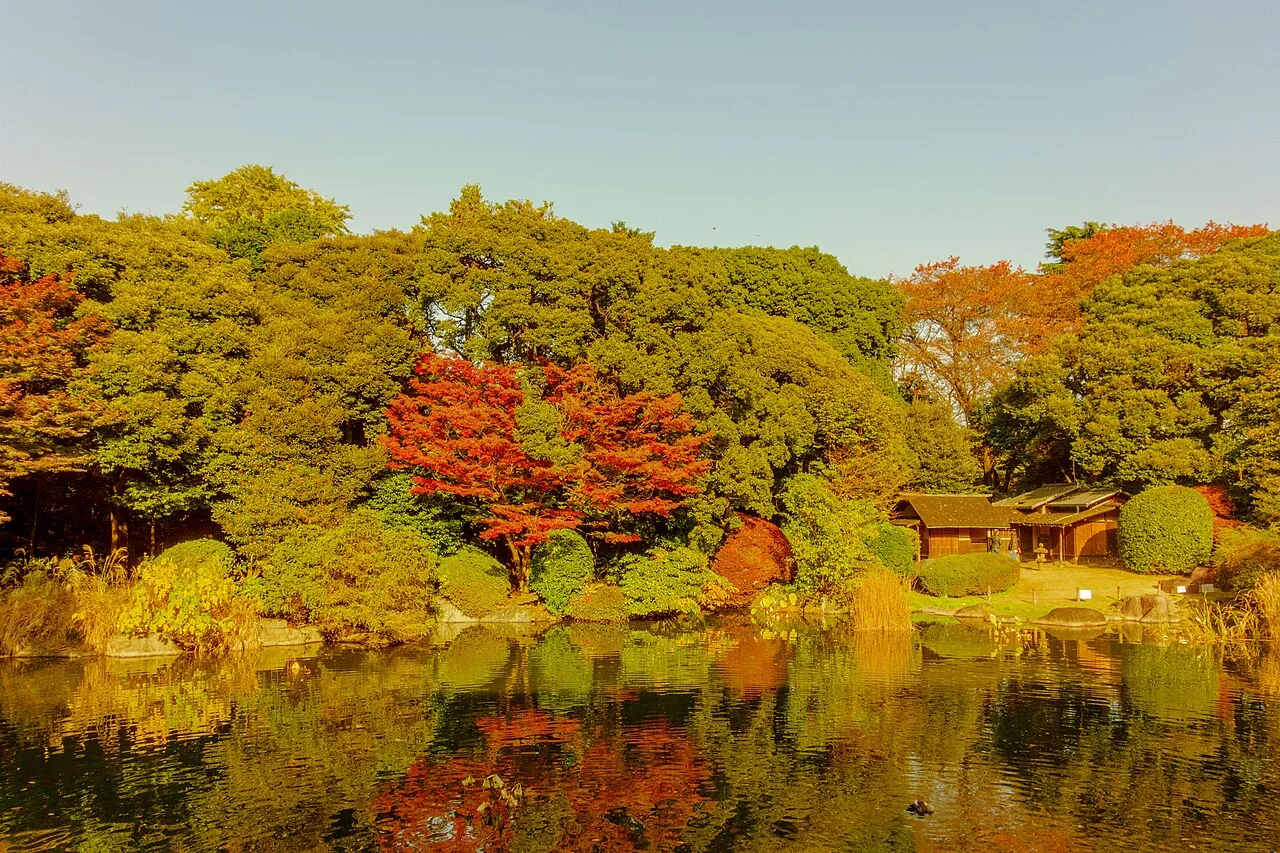
Deshio no Minato is a viewpoint on Daisensui Pond. The garden explains that Nakanoshima and Horaijima are visible from here. Start by seeing how the water separates the features, then follow the open path slowly. The water, pine branches, and trees on the opposite bank work together. Move a short distance and the foreground changes, as does the relationship between island and shore. A stretch of walking without taking pictures often helps you find a favorite angle more than a long stop at the first pond view.
Nakanoshima contains Imoyama and Seyama. The garden connects their names with old terms for women and men and with waka poetry. Such names give the garden another way to be read: what first looks like a small island gains meaning once you learn what its landforms were intended to express. Visitors follow the pond bank; the island is not a shortcut across the garden. Look at the overall shape before the closer details. When you return to the same pond view, it will be easier to identify which side you are on.
The wooded part: pavilions, streams, and a stone bridge
Follow signs toward Tsutsuji Chaya to shift your attention from open water to woodland. This pavilion was built in the Meiji era using old azalea timber, and the garden’s autumn introduction highlights the surrounding maples. Despite the word chaya in its name, it is primarily a resting pavilion. For matcha, go to Fukiage Chaya, which has its own business hours. Assuming every chaya serves food will disrupt your meal and rest plans.
At Takimi Chaya, focus on the stream and the sound of water. The garden describes water flowing over rocks in the woods. Compare this with the wide pond earlier: after looking at distant tree shapes, bring your attention closer to the stones, branches, and flow that make up this smaller scene. With children, ask which direction the water sounds come from, then follow the open path to find it rather than constantly hurrying to the next maple spot. Changing the purpose of the walk can make a garden circuit easier to finish.
Togetsukyo is a bridge made from two large stones, with a name drawn from waka poetry. Observe the bridge and surrounding stonework from a stable, open path first. Visitors who need a step-free route can follow the accessible garden map around it without trying to cross every bridge. Nearby Fujishirotoge is an artificial hill. Decide whether to climb only if it is open that day and your group can manage the changes in level. The main garden scenery is already visible from the pond bank, so families with strollers can stay together on gentler paths.
With children, a wheelchair, or a slower pace, choose comfortable paths
Rikugien provides a dedicated accessible garden map, updated in February 2026, separately from its general visitor map. At the entrance, wheelchair users can ask the service center to identify the paths open that day, then choose a pondside or teahouse turning point. If your group splits up, meet at a named building or gate rather than somewhere vague such as “by the pond.” The official evening information also states that some routes cannot accommodate wheelchairs and that detours are provided. Include these in your actual route.
Daytime visits suit families with strollers better. Complete a short circuit, then add a wooded stretch if the children are comfortable. This is a cultural-property garden, with specific routes around banks, bridges, and buildings. Plan running or ball games for a more open park on another day. Take turns photographing while another adult walks with the children to a place clear of the path, rather than stopping the whole family in a narrow section. Find chances for water and restroom breaks before going deeper into the woods. Elementary-school children and younger enter the evening event free with a guardian holding an evening ticket. If everyone is tired by late afternoon, finish with the daytime visit and go for dinner. If the evening event is what the whole family wants, reduce daytime walking, eat early, and take a shorter open route inside. Allow older companions enough rest and time to leave.
2026 evening admission: ¥1,000 in advance or ¥1,200 on the day
The 2026 Rikugien autumn evening event runs from November 25 to December 6, from 6:00 to 8:30 p.m., with last admission at 7:30 p.m. Advance tickets cost ¥1,000 and are sold online only. Sales open at 9:00 a.m. on November 1 and close at 11:59 p.m. the day before your visit. Tickets are date-specific, with a daily limit. Once you have chosen your evening, follow the ticket link on the official event page, select the correct date, then enter the number of visitors.
Same-day tickets cost ¥1,200. Online sales run from 9:00 a.m. to 7:30 p.m. on the visit date. The main-gate counter sells them for cash during evening admission, from 6:00 to 7:30 p.m. Arriving by day does not let you reserve a same-day evening ticket at the counter. The official rules do not accept reservations by phone, email, or the daytime ticket counter. Online ticket holders have a priority entry lane, although the garden says waits can still occur when busy. The ¥200 advance discount and the priority lane are separate considerations. Whichever ticket you choose, plan an arrival time you can reach comfortably.
Your evening ticket includes admission for that session. You do not need an additional ¥300 daytime ticket.
Junior-high students and older need an evening ticket, including students who live or attend school in Tokyo. Elementary-school children and younger enter free with a ticket-holding guardian. Holders of a disability certificate issued in Japan and one caregiver can each buy a discounted same-day ticket for ¥500 by showing the certificate or Mirairo ID as described on the official site. Daytime free-entry categories, annual passes, and other admission tickets are subject to the separate evening ticket rules for this event.
After buying: cancellation deadlines, payment, and ticket checks
The purchaser can cancel an advance ticket until 11:59 p.m. the day before the visit, using the instructions in the purchase email. If plans change and you want a different evening, cancel the original ticket and select a date with availability. A dated ticket is not valid on any day of your choice during the event. Canceled tickets for sold-out dates are released again, but there is no waiting list or notification when they become available. Holding up your entire Tokyo itinerary while waiting for a cancellation is usually not worthwhile.
Same-day tickets cannot be canceled or refunded after purchase. If the organizer cancels the event because of severe weather or another reason, the full ticket price is returned through the original payment method without a separate cancellation request. If the event goes ahead, wind or rain does not qualify for a refund. Transport and accommodation costs are excluded. To keep weather options open, decide by the advance-ticket cancellation deadline, or buy a same-day ticket once you know you will go. The trade-offs are price, availability, and cancellation flexibility; there is no need to buy every ticket far ahead.
Online admission requires an interactive ticket screen on a phone. Staff validate it on the screen; printouts and screenshots are not accepted. Open the ticket when the email arrives and check how to log in or retrieve it. If several people share one phone, arrive at the ticket check together. Keep enough battery and a working connection before leaving. Searching for the email at the entrance slows both you and the line behind you.
Online credit-card payments require 3D Secure authentication. If bank verification fails, follow the ticket platform’s error message. Same-day tickets at the venue are cash-only; daytime counter information about card payments does not apply.
At night: start with the pond, then choose woods and projections
Choose your priorities from the garden’s 2026 event announcement: illuminated foliage areas, projections on the storehouse and bamboo grove, and designated photo locations. On entry, look at that evening’s route map and restrictions, then choose the pond or woods for your first stretch. Unlike a daytime stroll, when you can slowly retrace your steps, a long wait at one photo location reduces how much of the remaining route you can walk. Keep time for the banks if you want water views, or spend more of it among the trees for close views of branches and leaves.
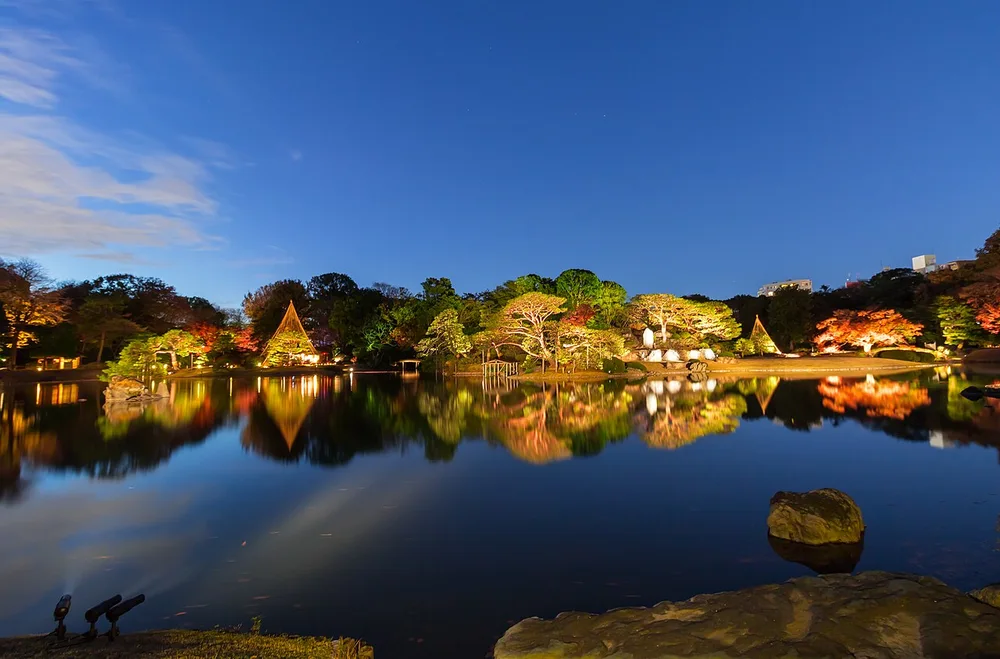
The official event page lists lighting around the ginkgo plaza beside Takimi Chaya, Tsutsuji Chaya and Yamakagebashi, Fukiage no Matsu, and Nakanoshima. Move from nearby maples to a pond view and you will see how the lighting separates pine branches and stonework as well as illuminating red leaves. View Nakanoshima from the bank; the island is closed to visitors. Areas seen by day, including Fujishirotoge, cannot simply be assumed open at night.
The storehouse dates from the Iwasaki family’s ownership. The 2026 event uses its exterior for projections and also includes bamboo-grove projections. Save it for a later stop to change the pace after the natural pond scenery. Then follow the route toward the exit. If you have already eaten dinner, there is no need to stand until closing for a final cycle. The official video below shows the 2022 event. Use it before your visit to understand the lighting and scale of the night scenery, then choose your route from the 2026 opening map.
Published by the Tokyo Metropolitan Park Association in 2023, this video shows the 2022 event and provides views of the pond and woods at night.
Teahouses, dinner, and the one-hour closure between sessions
Pondside Fukiage Chaya serves matcha and Japanese sweets. The official facilities page lists normal hours of 9:00 a.m.–4:45 p.m., with last orders at 4:30 p.m. and extended hours during the illuminations. If tea is part of your daytime walk, place it midway through, with enough time to return to the paths. Entering at 4:30 p.m. and hoping for tea puts you at both the last-admission and last-order deadline. Use the teahouse for a short break, and arrange a full meal before entering or after leaving.
The 2026 evening announcement lists matcha and sweets at Fukiage Chaya and Shinsentei, plus light food from stalls and food trucks in the plaza beside the storehouse and near the Ginkatei site. Last orders at the evening teahouses and stalls are at 8:00 p.m. For a full dinner, eat near Komagome Station first, then buy tea or snacks inside as needed. Some vendors do not accept cashless payments, so bring enough yen in cash for the evening.
If you visit both sessions, you must leave at 5:00 p.m. and cannot return until 6:00 p.m. That hour includes walking out, finding food, returning to the main gate, and ticket checks. A reserved dinner with several courses would be tight. Have a late lunch, buy a simple meal after leaving, or end the daytime session before 4:00 p.m. to allow a full meal. If the daytime walk is enough, returning to your accommodation completes a satisfying half day. Visiting the evening session on another night reduces the fatigue of standing and walking continuously into the evening.
A daytime half day: arrive at 9:30 a.m. and finish around lunch
To avoid packing too much into one day, use a 9:30 a.m. entry and departure around noon as a sample plan. Enter through the main gate, spend the first half hour finding your bearings and looking at the pond, then walk toward Tsutsuji Chaya and Takimi Chaya. Put Fukiage Chaya midway through and decide after sitting down whether to continue. Give the garden enough time first; add a second nearby stop only if you have the energy after leaving. For a shorter route, rest by the pond and return straight to the main gate.
Free Japanese-language garden tours on weekends and national holidays are listed at 11:00 a.m. and 2:00 p.m. English tours are listed at the same times on the first and third Sundays of each month, with no tours in July or August. Language and timing affect your route. For the 11:00 tour, get oriented near the entrance first, let the guide introduce the scenery, then return to favorite places independently. If you prefer walking alone, you need not spend the morning waiting for a tour. If weather cancels it, continue with your short circuit. Lunch in Komagome followed by the same railway line back is an easy finish.
Day and evening together: visit in the afternoon and allow a proper dinner break
If you have decided to buy separate daytime and evening tickets, a sample plan is to arrive around 2:00 p.m., leave after 4:00 p.m., and return after 6:00 p.m. Walk the banks and woods in the afternoon, completing paths that need good light. If the tea line is long, rest after leaving rather than spending the last hour waiting. Remember two views you want to compare, then see how the lighting changes them at night instead of photographing every point again. If you need more rest, start and finish the afternoon session earlier.
Do not travel to a distant neighborhood for the meal between sessions. Choose food toward the station that you can finish within your planned time, then return to the main gate. If you want to return to your hotel, include trains both ways, station walking, and getting ready to go out again. Use that option only if enough evening time remains. Use the restroom, put on your coat, and open the phone ticket before admission so you can start walking after the ticket check.
If you have already visited another large park that day, choose just Rikugien’s evening session. Families whose children are tired by afternoon and who have not bought evening tickets can finish without adding it. Advance-ticket holders must decide about cancellation by 11:59 p.m. the day before entry. After the event, you still need to walk to the station, ride the train, and return to your room. Include that time when planning sleep before an early departure the next day. If you are staying at one Tokyo base, split the visits over two days. You can still compare day and night while spreading out the walking.
A two-garden day: give Kyu-Furukawa Gardens a full visit of its own
Kyu-Furukawa Gardens suits visitors interested in comparing garden designs. Its Western-style house and garden occupy the higher ground, with a Japanese garden below, unlike Rikugien’s circuit around a large pond. The official access information gives a 12-minute walk from JR Komagome Station, or about seven minutes from Kami-Nakazato Station or Nishigahara Station on the Namboku Line. The two gardens are separated by city streets. You do not step out of Rikugien straight into the next garden. If walking distance matters, choose just one first.
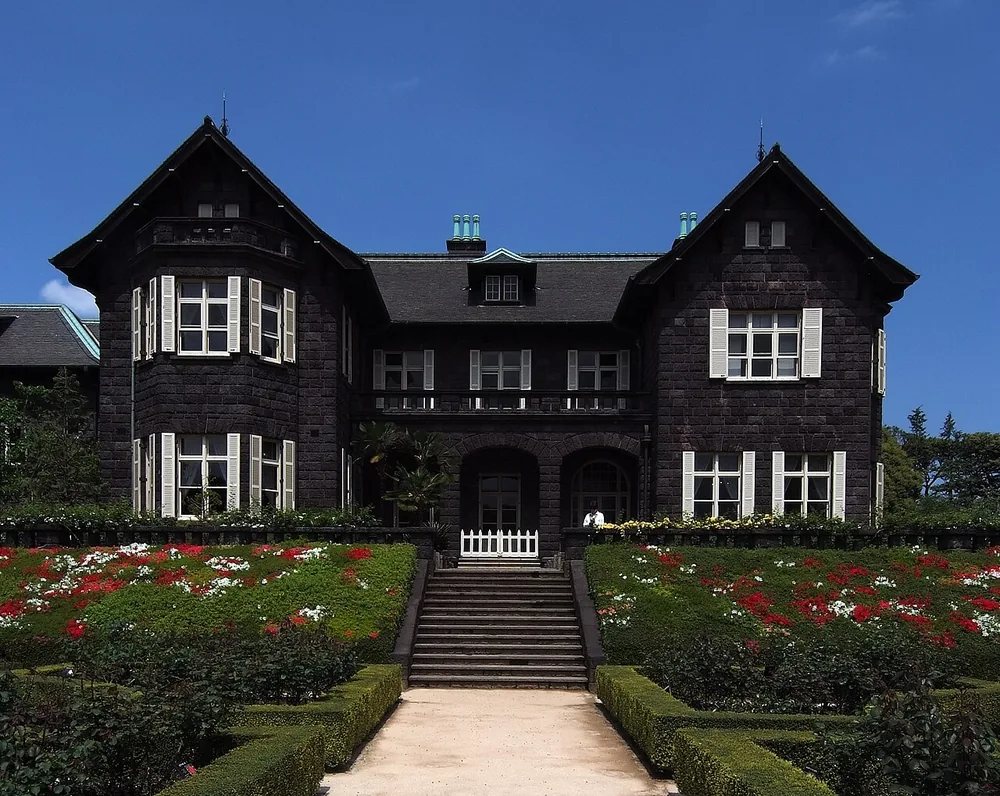
For Kyu-Furukawa in the morning and Rikugien in the afternoon, arrive from Kami-Nakazato or Nishigahara, then head toward Komagome for lunch before walking to Rikugien’s main gate. Lunch then separates the visits, with a rest before completing both gardens. The reverse order also works, but both stop admitting visitors at 4:30 p.m., so do not leave the second until near closing. Treat the combined ticket as two daytime admissions. Evening entry to Rikugien still needs a separate ticket. Kyu-Furukawa admission is ¥150, or ¥70 for visitors aged 65 and over. It opens from 9:00 a.m. to 5:00 p.m., with last admission at 4:30 p.m. The Western-style house is managed by the Otani Art Museum and has separate visiting hours and charges. If you want to see inside, reserve daytime for it rather than planning solely around garden hours. The garden also identifies changes in level, stairs, and slopes; wheelchair users should read the dedicated route first. Choosing two gardens to save ¥50 overlooks the additional street walking, slopes, and visiting time. This day is worthwhile when the garden design itself interests you.
Earlier in November: cultural events and yukitsuri demonstrations
You need not wait for the evening event to visit Rikugien. The 2026 Autumn at Rikugien program runs from October 17 to December 6, separately from the evening sessions beginning November 25. For November 3, the official schedule lists Tsugaru shamisen performances in front of Shinsentei at noon and 3:00 p.m., each about half an hour. They are free to attend without advance booking, but garden admission is extra, and rain cancels them. Fit one into your daytime walk, with pondside time before or after rather than reserving the whole day for a performance.
Display panels about Wakanoura stand in the plaza in front of the weeping cherry tree from October 17 to December 6. They help connect the poetic landscapes borrowed by Rikugien with the pond you see, and suit visitors who enjoy cultural explanations. If foliage is your focus, keep the time for the paths. The October 30 tea experience at Shinsentei is fully booked. Such reserved activities differ from ordinary teahouse service; you cannot request the same seats on arrival.
The yukitsuri traditional skills notice lists two separate tasks: making the central support pole in the plaza beside the storehouse from 10:30 a.m. on November 1, lasting about 15 minutes, and setting the ropes at Tamamo no Iso from 1:30 p.m. on November 15, lasting about 40 minutes. Both are open to watch and may be canceled by rain. Yukitsuri uses ropes to support branches against snow damage. The garden explains that Tokyo gets little snow and Rikugien installs it as a winter landscape feature. If you want to watch the gardeners, use the demonstration as a starting point for a daytime walk. It is a separate autumn option from the later evening illumination.
Photography, rain, and departure: stop where it is safe
Keep paths clear when taking pictures. Walk beyond narrow bridges, slopes, and places where people are passing before stopping. At night, start with a broad pondside composition, then take one or two close views. You need not line up for the same angle of every lit tree. Model shoots, pre-wedding photography, and similar sessions require advance application, whether commercial or noncommercial, professional or amateur. Contact the service center at least a week ahead for review. Ordinary travel group photos and organized portrait sessions have different arrangements. Unauthorized model photography and business activities are also prohibited at night. Apply in advance if you plan a full shoot.
Picnic mats are not permitted in the garden. The evening event is smoke-free with no smoking area, and pets are not admitted, including in carriers. Assistance dogs may accompany visitors under the garden rules. For a picnic, find a suitable place after leaving; teahouses and rest areas are the stops available during this walk. In rain, shorten the pondside and woodland walking, and open or close umbrellas clear of the path. If you need a handrail or walking assistance, let a companion take photographs and concentrate on your footing. Before leaving, identify your station and exit rather than scattering outside the gate to find directions. Evening visitors leaving through Someimon can follow station signs to Komagome. For Sengoku, choose the main gate. Remembering both gate directions reduces the chance of circling the outside wall at night. If severe weather cancels the event, follow the official refund announcement and spend the evening eating and resting near your accommodation.
A few useful answers
Can I stay for the 2026 evening illumination with a daytime ticket?
Everyone must leave at 5:00 p.m. The garden reopens at 6:00 p.m. for holders of separate evening tickets. Evening entry is through the main gate only; exits are the main gate and Someimon.
When do 2026 Rikugien evening tickets go on sale?
Advance sales open at 9:00 a.m. on November 1. General admission is ¥1,000 in advance, available until 11:59 p.m. the day before entry, or ¥1,200 on the day. Evening sessions run from November 25 to December 6.
Can I enter Rikugien with a screenshot of my online ticket?
For online evening tickets, open the interactive ticket on your phone for staff to validate on screen. Printouts and screenshots are not accepted.
Do children need tickets for the Rikugien evening event?
Elementary-school children and younger enter free with a guardian holding an evening ticket. Junior-high students and older need evening tickets, including those who live or attend school in Tokyo.
Official information and references
Sources used in this guide.
- Tokyo Metropolitan Park Association | Rikugien information, access, admission, and garden features
- Tokyo Metropolitan Park Association | 2026 Rikugien autumn evening event website
- Tokyo Metropolitan Park Association | 2026 special evening opening announcement
- Tokyo Metropolitan Park Association | Rikugien official garden map
- Tokyo Metropolitan Park Association | Rikugien accessible garden map, updated February 2026
- Tokyo Metropolitan Park Association | Rikugien facilities, live cameras, and Fukiage Chaya
- Tokyo Metropolitan Park Association | Rikugien bank repair notice
- Tokyo Metropolitan Park Association | Autumn at Rikugien 2026 events
- Tokyo Metropolitan Park Association | Kyu-Furukawa Gardens
- Tokyo Metro | Komagome Station and accessibility information
- GO TOKYO | Autumn in Tokyo and fall foliage
- Tokyo Metropolitan Park Association | Official Rikugien videos and official YouTube channel links
- Tokyo Metropolitan Park Association | 2026 yukitsuri traditional skills demonstrations
- Tokyo Metropolitan Park Association | Garden tours from September 2026