A 2026 Tokyo Christmas guide based on official announcements from Roppongi Hills, Marunouchi and Tokyo Midtown Hibiya: the Roppongi Christmas Market opening on 21 November, Marunouchi's 1.2 km champagne-gold illuminations, the CHRISTMAS HILLS five-venue stamp rally, schedules and evening routes.
- Region & Focus
- TokyoWhen to visit
- Reading Scope
- 17 min read · 7 chapters · 7 Q&As
- Official Verification
- 7 official sources checkedUpdated 20 November 2026
- Key Topics
- SeasonsItinerariesTokyo & Kanto
Chapter Route Map (tap any stop)
- Official 2026 Tokyo Christmas Season Timetable
- Roppongi Christmas Market: German Stalls and O-yane Plaza
- Marunouchi: 1.2 km of Champagne Gold and a Harry Potter Theme
- CHRISTMAS HILLS Stamp Rally and Evenings in Hibiya
- Three Evening Route Combinations
- Spending Breakdown: Admission, Stamps and Budgeting
- Integrating Daytime Plans with Christmas Evenings
- Quick Q&A
Tokyo's Christmas season does not switch on all at once across the city; instead, each venue launches in stages according to its official schedule. Roppongi Hills kicks off first on 5 November, followed by Marunouchi and Hibiya on 12 November, the Roppongi Christmas Market on 21 November, and Marunouchi Street Park on 27 November. Lining up these official dates alongside switch-on and lights-out times is the key to avoiding wasted trips and peak queues during a two- or three-hour evening window—showing at a glance where you will actually find German market stalls, which illuminated streets stay lit late into the night, how to complete the multi-venue stamp rally along one route, and how the construction closure of Hibiya Park's Fountain Plaza affects plans this year.
Official 2026 Tokyo Christmas Season Timetable
Placing the 2026 official announcements from the main venues on a single timeline makes the staggered rollout immediately clear. The wider Roppongi Hills Christmas 2026 season runs from 5 November to 25 December, coinciding with the 400-metre Keyakizaka Street 'SNOW&BLUE' illuminations, which glow daily from 17:00 to 22:00. The Roppongi Christmas Market itself opens later, running from 21 November to 25 December, daily from 11:00 to 21:00 at O-yane Plaza. Over in Marunouchi, the Harry Potter-themed MARUNOUCHI BRIGHT HOLIDAY runs from 12 November to 25 December, with the champagne-gold illuminations staying lit until 00:30, while Marunouchi Street Park 2026 Winter joins on 27 November along Marunouchi Naka-dori and Gyoko-dori. Meanwhile, Tokyo Midtown Hibiya's Magic Time Illumination shines from 12 November right through to 28 February 2027.
Behind this calendar lies the most practical crowd-dodging strategy: stagger your visit around the launch dates to bypass the heaviest footfall. In early November, only Roppongi is lit and festive crowds have yet to descend on the city's illumination spots, making the period before mid-November ideal for clean night shots along Keyakizaka. Once the market opens on 21 November, weekend evenings channel heavy crowds into O-yane Plaza and Keyakizaka; by the final two weeks before Christmas in December, both Marunouchi and Roppongi hit peak congestion every night. Scheduling illuminations for November and saving the market for a weeknight saves a substantial amount of queueing.
Hibiya Park requires separate attention this year. According to an announcement by the Tokyo Metropolitan Park Association, Hibiya Park's Great Fountain and Fountain Plaza are currently closed to the public due to construction works, and no new 2026 organiser announcement has been issued for the Hibiya Christmas Market traditionally held on the plaza. Travellers spending an evening around Hibiya should focus squarely on Tokyo Midtown Hibiya's Magic Time Illumination (12 November to 28 February 2027), plus the park's own two-day special illuminations around Shinji-ike Pond and HIBIYA PARK TERRACE events on 19 and 20 December, rather than heading straight to the Fountain Plaza expecting market stalls based on past years.
Working backwards from your travel dates splits the season into four distinct windows. From 5 to 20 November, Roppongi's lights are on without the market, while Marunouchi and Hibiya are either just starting or yet to open—this is the quietest phase across town and particularly suited to photographing Keyakizaka Street undisturbed. Between 21 November, when the market opens, and early December, every venue is up and running; weeknights in this window offer the sweet spot of a full programme with manageable crowds. From mid-December to 25 December comes the countdown peak, when weekend crowds at O-yane Plaza and Keyakizaka are at their densest—go then if you love a lively buzz, or steer clear if clean framing matters. After 25 December, both the Christmas market and the Keyakizaka lights come down, leaving only Marunouchi's extended winter festivities (until 14 February 2027) and Hibiya's illuminations (until 28 February) glowing through New Year and into late February.
Getting between them could not be simpler. All three headline venues sit right outside underground or railway exits: Roppongi Station serves Roppongi Hills, Tokyo Station marks the start of Marunouchi's illuminations, and Hibiya Station connects directly to Tokyo Midtown Hibiya, meaning zero long transfers and only standard urban metro fares between stops. Treat each area as its own self-contained walking district rather than criss-crossing town in a single night. Unlike sprawling suburban light parks, the main time sink on a central Tokyo Christmas evening is queues and crowds, not transit.
A 2026 Tokyo Christmas guide based on official announcements from Roppongi Hills, Marunouchi and Tokyo Midtown Hibiya: the Roppongi Christmas Market opening on 21 November, Marunouchi's 1.2 km champagne-gold illuminations, the CHRISTMAS HILLS five-venue stamp rally, schedules and evening routes.
Roppongi Christmas Market: German Stalls and O-yane Plaza
Running from 21 November to 25 December, daily from 11:00 to 21:00, the Roppongi Christmas Market sets up at Roppongi Hills' O-yane Plaza with 10 German-themed stalls. Official highlights include the heritage German Christmas shop Käthe Wohlfahrt alongside classic food and drink stands serving mulled wine and German sausages. Compact and focused, the 10-stall market takes around an hour to browse and eat through; its real strength lies not in spending half a day there, but in sitting steps away from the 400-metre Keyakizaka illuminations and Mohri Garden night views, making it effortless to step off the lit boulevard straight into the plaza for a mug of mulled wine. Daytime hours between 11:00 and 17:00 are noticeably quieter—ideal for browsing Käthe Wohlfahrt ornaments, picking up German treats, or visiting with children away from the evening crush—while atmosphere-seekers can wait for the 17:00 switch-on to pair Keyakizaka and the market in one sweep.
Keyakizaka Street's 'SNOW&BLUE' illuminations follow a silver-and-white theme from 5 November to 25 December, switching on at 17:00 and shutting off promptly at 22:00. That 22:00 lights-out arrives earlier than many travellers expect; linger over a two-hour dinner first and arrive after 21:30, and you risk missing them altogether. The most reliable sequence is to reach Roppongi Hills before 17:00, take a look by Mohri Garden, walk up Keyakizaka around 18:00 to frame the illuminated trees with Tokyo Tower in the distance, step into O-yane Plaza at 19:00 for the German market, and wrap up before the 21:00 closing bell to catch the train back—fitting cleanly inside official operating hours across a little over two hours.
Beyond the market and Keyakizaka, Roppongi Hills also hosts a third, indoor layer of festivities: CHRISTMAS GIFT SELECTION and seasonal dining promotions across its shops and restaurants run from 12 November to 25 December, launching earlier than the market itself. Shoppers after festive gifts or a sit-down meal can stay indoors, while strollers after street views and mulled wine head outside to Keyakizaka and O-yane Plaza—both routes sharing the same station exit. Better still, O-yane Plaza sits beneath a large overhead canopy, letting you browse the market comfortably even in chilly December rain and making it the safest wet-weather option of the three venues.
Travellers with room in the budget who want to elevate Christmas dinner to hotel standard will find seasonal offers right inside the complex at Grand Hyatt Tokyo: reservations for nine varieties of Christmas cake open from 1 to 25 December, while festive restaurant menus run from 19 to 25 December. You can sip mulled wine at O-yane Plaza at dusk and step straight next door into the hotel for a formal Christmas dinner, experiencing both casual and dressed-up sides of the season within a single complex. Cake orders and table reservations are handled through separate booking channels, so arrange both early if you plan on doing the two.
For a seamless evening itinerary in Roppongi, emerge from Roppongi Station into the complex before 16:30 and browse the indoor Christmas gift and dining displays (open from 12 November, so accessible even in mid-November). Step outside for the 17:00 switch-on along Keyakizaka's 400 metres of silver-white lights, taking in Mohri Garden along the way. After 18:30, head into O-yane Plaza for mulled wine and German sausages under the shelter of the roof while they are hot, then make your way back towards the underground station around 20:30 to beat the surge when the market closes at 21:00.
Returning visitors should not rely on old memories to find the stalls. In 2026, the Roppongi Christmas Market is anchored exclusively at O-yane Plaza; Keyakizaka Street carries tree illuminations only, with no stalls along the slope, so walking down to the bottom of the hill will not turn up any mulled wine stands. Because stall counts, layouts and opening hours at each complex can shift slightly from year to year, spending three minutes checking the official special event page before setting off beats rearranging your entire evening on arrival.
Marunouchi: 1.2 km of Champagne Gold and a Harry Potter Theme
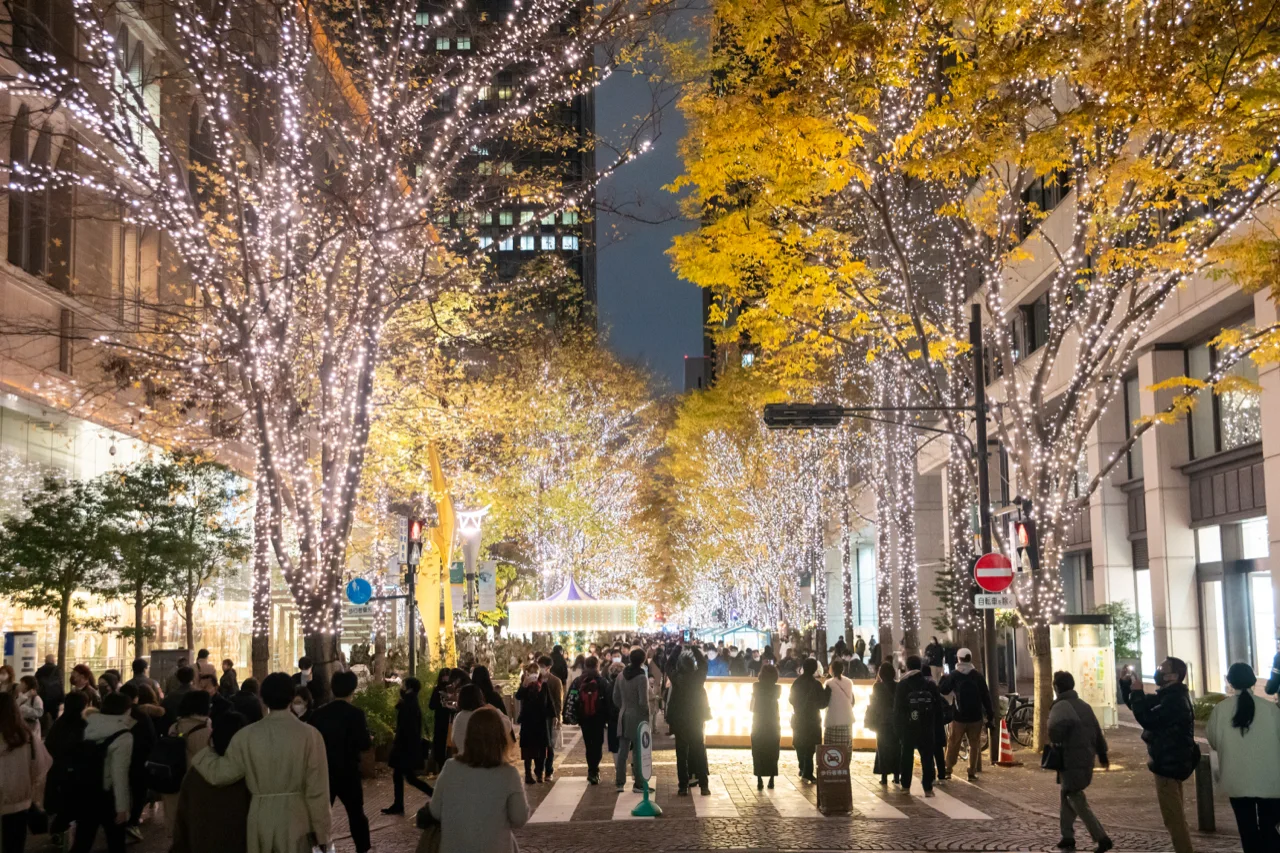
Marunouchi's centrepiece is a roughly 1.2-kilometre stretch of roadside trees wrapped in champagne-gold lights—the longest continuous walkable illumination corridor of Tokyo's Christmas season. Official viewing hours run from 06:00 right through to 00:30, giving you a full two and a half hours longer than Roppongi's 22:00 cut-off. Between 17:00 and 21:00, a light show also plays every 15 minutes for roughly three minutes at a time, transforming the entire street in unison on the hour, quarter-past, half-past and quarter-to with no need to stake out a specific viewing spot.
In 2026, Marunouchi layers two additions on top of its signature illuminations. First is the Harry Potter collaboration 'MARUNOUCHI BRIGHT HOLIDAY: Harry Potter—Magical Snow Illuminating Marunouchi', running from 12 November to 25 December. Second is 'Marunouchi Street Park 2026 Winter', arriving from 27 November along Marunouchi Naka-dori and Gyoko-dori to turn the roadway into an outdoor winter lounge and market space. Meanwhile, Marunouchi's broader 'Winter Holiday Season' continues until 14 February 2027, keeping the area lively for New Year and Valentine's trips well past Christmas.
The smoothest way to walk Marunouchi is to start at Tokyo Station and stroll south along Marunouchi Naka-dori towards Yurakucho, covering the full 1.2 km champagne-gold avenue and pausing whenever one of the post-17:00 light shows begins. From 27 November onwards, Street Park's market-style stalls dot the stretch between Naka-dori and Gyoko-dori, so you can pick up mulled wine and snacks as you walk before continuing straight on to Tokyo Midtown Hibiya's illuminations. The entire route from Tokyo Station through Naka-dori and Gyoko-dori to Hibiya is walkable from end to end without another underground transfer. Since the whole avenue is open to the elements, winter rain or brisk winds can make it feel sharply colder—on wet nights, flip your plans to Roppongi's covered O-yane Plaza or dine indoors at Tokyo Midtown Hibiya, saving Marunouchi for a crisp, clear evening.
Those 00:30 lights-out hours are a lifeline for late arrivals. If a late flight into Haneda Airport gets you and your luggage into central Tokyo past 22:00, Keyakizaka in Roppongi will already be dark, yet Marunouchi's champagne-gold trees remain lit for nearly two and a half hours more—step out of Tokyo Station for a stroll down Naka-dori and you still get a full dose of Christmas atmosphere on night one. Conversely, the 06:00 switch-on rewards early risers: at daybreak Naka-dori is deserted, and early morning light mingling with the warm champagne-gold bulbs reveals the avenue at its quietest.
When planning a trip in mid-to-late November, the single date to keep in mind is 27 November. The Harry Potter installations ('Magical Snow Illuminating Marunouchi') sit across various Marunouchi venues alongside the champagne-gold trees rather than replacing them; however, before Street Park opens on 27 November, Naka-dori and Gyoko-dori have no outdoor food or drink stalls. During those earlier days, head to Roppongi's O-yane Plaza or indoor restaurants in Hibiya for mulled wine and bites; once the 27th arrives, all three layers are active and you can eat, drink and stroll in Marunouchi all evening.
CHRISTMAS HILLS Stamp Rally and Evenings in Hibiya
For 2026, five Mori Building complexes—Roppongi, Azabudai, Toranomon, Omotesando and ARK Hills—are teaming up for the CHRISTMAS HILLS 2026 stamp rally from 5 November to 25 December. Download the Hills App and register for free; every single transaction of ¥1,000 or more (tax included) earns one digital stamp, and collecting one stamp each at three different Hills locations unlocks a ¥1,000 shopping and dining voucher. The smartest way to use it is to recoup money you were already planning to spend on meals and shopping—Roppongi and Azabudai sit within walking distance of each other, and adding Toranomon along the way lets you claim the voucher effortlessly without trekking across all five complexes.
Over in Hibiya, the evening headline act is Tokyo Midtown Hibiya's HIBIYA Magic Time Illumination 2026, running from 12 November through to 28 February 2027. Its standout advantage is sheer longevity: once most downtown Christmas markets and the Keyakizaka lights pack up after 25 December, Hibiya keeps glowing until the end of February, putting it right at the top of the list for evening walks in January or February. Next door at Hibiya Park, with Fountain Plaza fenced off for works, activity narrows to two special days on 19 and 20 December featuring illuminations around Shinji-ike Pond and HIBIYA PARK TERRACE events.
Combining Marunouchi and Hibiya into one evening flows effortlessly: set off from Tokyo Station at dusk, watch a light show along Marunouchi Naka-dori, cut across Gyoko-dori to Tokyo Midtown Hibiya for the Magic Time illuminations, and—if your dates happen to fall on 19 or 20 December—round it off inside Hibiya Park by Shinji-ike Pond. The entire walk covers roughly two kilometres; on a winter evening in central Tokyo, linking the two on foot is far less hassle than hopping on and off the underground.
Indoors, Tokyo Midtown Hibiya packs in parallel winter programming: a Christmas wreath giveaway and MY CHRISTMAS MY SHOWTIME run from 12 November to 25 December, the 'Bi no Matsuri' (Festival of Beauty) starts on 6 November, and the joint winter dining promotion 'Two Signature Dishes Winter Gastronomy Course' across two in-house restaurants also runs until 25 December. If temperatures plunge or winter rain sets in, Hibiya offers a much higher concentration of indoor dining and events than the open streets of Marunouchi, making it easy to step inside into the warmth.
To turn the CHRISTMAS HILLS stamp rally into a natural afternoon-to-evening walk, follow this sequence: start in the afternoon at underground-connected Toranomon Hills for afternoon tea or browsing to earn stamp one; walk across the redeveloped blocks to Azabudai Hills for an early dinner and stamp two; after eating, walk a dozen or so minutes along Loop Line No. 2 to Roppongi Hills in time for Keyakizaka's 17:00 switch-on, then make a qualifying purchase indoors or at O-yane Plaza for stamp three. All three count in the Hills App—simply present your logged-in screen at the till to pocket both the voucher and the night views. If your daytime plans already put you around Harajuku or Aoyama, you can swap in Omotesando Hills or ARK Hills instead; any three distinct Hills complexes with a single ¥1,000+ (tax-included) spend each qualify, with no fixed order required.
Three Evening Route Combinations
The three districts distil cleanly into three practical evening combinations. First is the 'Roppongi Standalone': arrive at Roppongi Hills before 17:00 for Mohri Garden and the 17:00 Keyakizaka switch-on, move to O-yane Plaza at 19:00 for the 10 German market stalls, and take the train back to your hotel before the 21:00 closing bell—ideal if you want food, drinks and photography in one hub, or need a covered plaza in the rain. Second is the 'Marunouchi + Hibiya Walk': start from Tokyo Station at 17:00, walk the 1.2 km champagne-gold corridor while catching an on-the-hour light show, snack along Gyoko-dori's Street Park, and continue on foot to Tokyo Midtown Hibiya for Magic Time, covering the longest uninterrupted stretch of lights. Third is the 'Hills Stamp Route': begin eating and browsing at Azabudai or Toranomon in the afternoon, walk into Roppongi at dusk for illuminations and the market, and cash in your ¥1,000 voucher—tailor-made if you already intend to dine and shop across complexes.
Crowd-avoidance tips follow the same timetable. Weekend evenings from mid-December onwards bring the heaviest crush at O-yane Plaza, so pick a weeknight or arrive before 18:00 if you want space to linger over mulled wine. Keyakizaka photography peaks during the first hour after sunset; return in the final 30 minutes before the 22:00 lights-out for far cleaner street shots. In Marunouchi, the light show repeats every 15 minutes from 17:00 to 21:00 across the whole avenue, so there is no need to camp out on a single corner half an hour early. Crowds thicken steadily towards late December, and pairing official timings with weeknight visits cuts out most unnecessary queueing.
Daytime plans slot straight into our Tokyo neighbourhoods guide, leaving evenings free for one of these three festive routes. If your itinerary also includes a suburban ski or hot-spring excursion, placing the Christmas market on your final night back in central Tokyo works particularly well, as these downtown lights and stalls need only the underground and your own two feet, with zero extra suburban rail fares.
Families with children have the easiest evening when early entry and short walks come first. Roppongi Christmas Market opens at 11:00, when daytime aisles are uncrowded and children can watch German stalls preparing treats up close; Marunouchi Street Park stretches along flat, wide Naka-dori pavements that are effortless with a pushchair; and Hibiya's illuminations cluster tightly in and around Tokyo Midtown Hibiya, keeping walking distances short. None of these require late nights—two to three hours after an early dinner gets everyone back to the hotel comfortably.
For sharp night photography, each venue calls for a different vantage point. On Keyakizaka, the classic angle shoots uphill from the bottom of the slope between 17:00 and 18:00, when the sky holds a deep blue gradient rather than pitching black. In Marunouchi, stand near the centre of a Naka-dori crossing for depth and stay put through one of the 15-minute light shows to capture three lighting transitions from the same frame. O-yane Plaza benefits from steady canopy lighting over the stalls, keeping vendors and festive dishes clearly lit regardless of ambient sky brightness. Casual photography is welcome across all venues, though tripods and commercial shoots are subject to local rules—on crowded pavements, keep moving and avoid blocking pedestrian flow.
Matching the three routes to the length of your stay is straightforward: Roppongi Standalone bundles market food, lights and rain cover into one stop; Marunouchi + Hibiya suits tight schedules, late-evening arrivals or anyone wanting the longest illumination walk; and the Hills Stamp Route turns planned multi-venue dining into an instant discount. Spend three evenings in Tokyo and you can try one each night; with just a single evening to spare, choose between Route 1 and Route 2 depending on whether German market stalls or a champagne-gold boulevard appeals more, rather than chasing a generic internet checklist.
Spending Breakdown: Admission, Stamps and Budgeting
All three Christmas markets and illumination zones are remarkably kind to your travel budget because admission is completely free. Roppongi's O-yane Plaza is open-access, Marunouchi Naka-dori and Gyoko-dori are public streets, and Tokyo Midtown Hibiya's lights span the building's indoor and outdoor spaces—entry costs zero yen across all three, so every yen spent goes strictly towards the food, mulled wine or gifts you choose to buy. If you only fancy an evening stroll beneath the lights, you can complete any route without spending a penny, free from entry fees or minimum-spend rules.
The clearest official reward across the season is the CHRISTMAS HILLS 2026 stamp rally: spend ¥1,000 or more (tax included) in a single transaction between 5 November and 25 December for one stamp, and three stamps across three Hills complexes yield a ¥1,000 store voucher. Provided you already planned to eat a meal, grab mulled wine or pick up a small gift across three venues, that ¥1,000 voucher is pure bonus; conversely, taking extra train rides or buying unwanted items just to chase stamps defeats the purpose. Simply schedule ¥1,000+ lunches or shopping stops at two complexes during the afternoon, then make your third purchase upon arriving at Roppongi Hills in the evening to redeem and spend it on the spot. Overlapping campaigns such as Roppongi's GIFT SELECTION and dining specials and Hibiya's winter food routes also run heavily between 12 November and 25 December, making that window handy for festive gift shopping.
Breaking down evening food budgets by venue shows clear differences in style: spending in Roppongi centres on German market mulled wine, sausages and complex shops; Marunouchi leans towards Street Park takeaway bites and boutiques along Naka-dori; and Hibiya revolves around sit-down restaurants and winter set menus inside the complex. Choose Roppongi or Marunouchi for casual grazing on the move, and pick Hibiya's restaurants or Grand Hyatt Tokyo's 19 to 25 December festive menus if you want a celebratory sit-down Christmas dinner—keeping total spend firmly in your own hands.
Integrating Daytime Plans with Christmas Evenings
The lowest-effort way to weave Christmas nights into a Tokyo trip is to keep your daytime itinerary as normal and pair each evening with the same neighbourhood. Use our Tokyo neighbourhoods guide for daytime themes: if Roppongi is on the cards for the evening, spend the day at Roppongi Hills' museum or around Minato Ward and roll straight into Keyakizaka and the market without changing stations; pair a Marunouchi evening with Tokyo Station and the Imperial Palace Outer Gardens; and combine Hibiya at night with daytime shopping in Ginza and Yurakucho. Each route finishes within a single station catchment, sparing you cross-town rush-hour underground rides.
If your itinerary also ventures out to snow resorts near Tokyo, slot your illumination evening into the night you return from or depart for the mountains. Pairing with ski day trips from Tokyo and Yuzawa stays, stepping off a Shinkansen at Tokyo Station puts you moments away from Marunouchi Naka-dori's champagne-gold lights; alternatively, spend your departure afternoon browsing Roppongi's market—open from 11:00—before catching your train. Late December is where Tokyo's festive season and ski season overlap, making city lights and snow country natural bookends on the same trip.
Finally, lock in the cut-off dates: Roppongi Hills' Christmas season, market, Keyakizaka lights, the CHRISTMAS HILLS stamp rally and Marunouchi's Harry Potter campaign all conclude promptly on 25 December. If you want the full German market and Christmas programme, arrive on or before 25 December. Visitors in Tokyo between 21 and 26 November will find Roppongi's market already open while Marunouchi Street Park waits until 27 November, so head straight to O-yane Plaza for outdoor stalls on those dates. For arrivals from 26 December onwards, switch to Marunouchi's extended winter season (through 14 February 2027) paired with Tokyo Midtown Hibiya's Magic Time Illumination (through 28 February 2027)—delivering full evening illuminations from New Year until late February without turning up at packed-down plazas.
A few useful answers
When does the 2026 Roppongi Christmas Market open?
From 21 November to 25 December, daily from 11:00 to 21:00 at Roppongi Hills O-yane Plaza, featuring 10 German Christmas-themed stalls serving mulled wine, sausages, German Christmas cakes and seasonal wares.
What time do the Keyakizaka illuminations turn on and off?
From 5 November to 25 December 2026, daily from 17:00 to 22:00 along roughly 400 metres of Keyakizaka Street in a silver-and-white 'SNOW&BLUE' theme. Lights switch off promptly at 22:00, so plan your timing carefully if you dine first.
How late do the Marunouchi illuminations stay on?
The roughly 1.2-kilometre stretch of champagne-gold roadside trees is lit from 06:00 until 00:30, making it the latest-running illumination strip of Tokyo's Christmas season; between 17:00 and 21:00, a roughly three-minute light show also runs every 15 minutes.
How does the CHRISTMAS HILLS stamp rally work?
From 5 November to 25 December, download the Hills App and register for free. Each single spend of ¥1,000 or more (tax included) earns one stamp; collect one stamp each at three different Hills complexes to exchange for a ¥1,000 store voucher. Roppongi, Azabudai and Toranomon are walkable between one another, making it easy to complete en route.
Is the Hibiya Park Christmas Market taking place in 2026?
The Tokyo Metropolitan Park Association has announced that Hibiya Park's Great Fountain and Fountain Plaza are closed to entry due to construction, and no new 2026 organiser announcement has been issued for the traditional market. Focus instead on Tokyo Midtown Hibiya's illuminations (12 November to 28 February 2027) and Hibiya Park's limited 19 and 20 December Shinji-ike Pond illumination events.
Can you still visit the Christmas markets if it rains?
O-yane Plaza, home to the Roppongi Christmas Market, has a large overhead roof, so you can eat and browse normally in the rain. Marunouchi and Hibiya illuminations are largely along open streets, where rain dampens the experience—switch to Roppongi or head indoors at Tokyo Midtown Hibiya on wet evenings.
Are there still Christmas illuminations in Tokyo after Christmas Day?
Yes. Tokyo Midtown Hibiya's Magic Time Illumination runs until 28 February 2027, and Marunouchi's wider 'Winter Holiday Season' programme continues until 14 February 2027, so both can still be enjoyed in January and February.
Official information and references
Sources used in this guide.
- Roppongi Hills Christmas 2026 | Roppongi Hills (Overall Season Schedule)
- Roppongi Hills CHRISTMAS 2026 Special Page (Christmas Market & Keyakizaka Illuminations)
- CHRISTMAS HILLS 2026 (Five-Complex Stamp Rally)
- MARUNOUCHI BRIGHT HOLIDAY 2026 | Marunouchi (Illumination Viewing Hours & Light Shows)
- Marunouchi Winter Holiday Season 2026 (Street Park Winter)
- Tokyo Midtown Hibiya | HIBIYA Magic Time Illumination 2026
- Tokyo Metropolitan Park Association | Hibiya Park (Fountain Plaza Construction Notice & December Events)