Plan an autumn foliage trip to Shuzenji in late November for Shuzen-ji Temple's Hojo Garden, the Katsura River, and Shuzenji Nature Park. Check 2026 Nijinosato illumination and fireworks tickets, the 17:42 last bus, and day trips from Mishima and Tokyo.
- Region & Focus
- Izu and Atami
- Reading Scope
- 24 min read · 10 chapters · 9 Q&As
- Official Verification
- 28 official sources checkedUpdated 22 November 2026
- Key Topics
- SeasonsHot springsItineraries
Chapter Route Map (tap any stop)
- Which Week in November Is Best for Autumn Leaves in Shuzenji?
- Catching the Bus After Arriving at Shuzenji Station
- Walking Shuzen-ji Temple, the Bamboo Grove Path, and Five Bridges Along the Katsura River
- Planning Separately for Shuzen-ji Temple's Principal Image and Garden
- Explore the Slopes of Shuzenji Nature Park Maple Forest Before Heading to the Mount Fuji Viewpoint
- Choosing Your 2026 Nijinosato Night Maple Tickets
- Deciding at British Village Whether to Walk, Ride the Bus, or Take the Miniature Railway
- Getting Back from Nijinosato After the 17:42 Last Bus
- Footbaths, Hakoyu Bathhouse, and Wet-Weather Shortcuts
- Connecting Buses on a Day Trip vs Saving Dinner Time Overnight
- Quick Q&A
First-time visitors heading to Shuzenji for autumn leaves will find late November ideal. Spend the day walking along the Katsura River past Shuzen-ji Temple, Katsura-bashi bridge, and the Bamboo Grove Path, then catch a bus up to Shuzenji Nature Park for dense stands of maples. In 2026, Shuzen-ji's Hojo Garden opens from 20 to 30 November, while Nijinosato's evening maple illumination runs from 7 November to 13 December. The last bus from Nijinosato back to Shuzenji Station departs at 17:42, so anyone staying for the illuminations or the 19:30 fireworks will need a pre-arranged taxi or a car.
Which Week in November Is Best for Autumn Leaves in Shuzenji?
Shuzenji has three distinct areas for autumn colour. Shuzen-ji Temple, the Bamboo Grove Path, and Katsura-bashi bridge sit right inside the onsen town and link together on foot from a single bus stop. Uphill at Shuzenji Nature Park, woodland trails weave through a maple forest where sunlit slopes and shaded hollows turn at slightly different speeds. Further along the road lies Nijinosato, a separate ticketed theme park that also hosts evening illuminations. If you only have half a day, focus on the onsen town; if your priority is sweeping stands of red maples, head up to Nature Park first before returning to town for lunch.
According to the Izu City Tourism Association's typical viewing calendar, the onsen town peaks from mid-November to mid-December, while the Maple Forest and Nijinosato run roughly from mid-November to early December. Shuzen-ji Temple's grounds usually hit their stride from late November. Travellers hoping to combine the temple, the Maple Forest, and night illuminations in one 2026 trip should target 20 to 30 November, when the temple's garden is specially open. By early December, shift your focus to riverside walks and Nijinosato's evening session, adding or trimming trails in Nature Park depending on leaf conditions.
Nijinosato night-time tickets go on sale from early November since the evening programme starts on 7 November, though for peak red maples it pays to aim for the tourism association's core window -- especially if you are booking an overnight stay. Conversely, if you reach Izu only in mid-December, put the onsen town at the top of your list. Nijinosato's 2026 autumn maple illuminations wrap up on 13 December, after which its winter light display runs on a separate calendar.
Photography priorities can also shape your timing. Visit Shuzen-ji Temple in daylight to frame its main gate against autumn maples, then cross Kaede-bashi bridge where overhanging branches and the Katsura River sit in a single shot within a few paces. Nature Park offers lower woodland paths, hillside groves, and a viewpoint; if you only have time for two areas, climb the hill in the morning and return to the river in the afternoon rather than scrambling for an uphill bus later in the day.
Plan an autumn foliage trip to Shuzenji in late November for Shuzen-ji Temple's Hojo Garden, the Katsura River, and Shuzenji Nature Park. Check 2026 Nijinosato illumination and fireworks tickets, the 17:42 last bus, and day trips from Mishima and Tokyo.
Catching the Bus After Arriving at Shuzenji Station
From Tokyo, there are two straightforward rail options. To reach the Maple Forest early in the morning, take the Tokaido Shinkansen to Mishima and change to the Izuhakone Railway Sunzu Line. Several Shinkansen services skip Mishima, so set Mishima as your destination when booking. The Sunzu Line takes about 30 minutes to its terminus at Shuzenji, with autumn 2026 ordinary single fares at ¥550 for adults and ¥280 for children. If buying tickets separately, the tourism association recommends allowing roughly 10 minutes to walk between the Shinkansen platforms and the Izuhakone Railway gates at Mishima -- or longer if you are queuing for tickets or carrying large luggage.
The Sunzu Line accepts compatible contactless credit and debit cards at its ticket gates. Regular Suica or PASMO users should either buy a Sunzu Line paper ticket at Mishima or tap in with a supported contactless card. Always tap in and out with the same card and avoid switching between a physical card and a mobile wallet mid-journey. On the return leg at Mishima, exit the Sunzu Line barriers before passing through the JR gates, and factor this walk in if you have reserved a specific Shinkansen departure.
To avoid a transfer, book the Shuzenji-bound carriages of the JR Limited Express Odoriko. JR East estimates the journey from Tokyo to Shuzenji at around 2 hours 8 minutes; some trains split at Atami between Izukyu-Shimoda and Shuzenji, so board according to the destination display and carriage number on your ticket. Passengers joining the Odoriko only between Mishima and Shuzenji must pay the ordinary fare plus a ¥200 adult (¥100 child) Sunzu Line limited express supplement using a non-reserved limited express ticket. When timings suit, ordinary trains go straight through to Shuzenji Station, where onsen-town buses depart right outside.
Exit Shuzenji Station via the South Exit and check your destination before joining a queue. For the temple and Katsura River, take the Tokai Bus bound for Shuzenji Onsen (Onsenba Line) from Stand 1; it takes about 8 minutes to Shuzenji Onsen and costs ¥300 for adults from October 2026. To go straight up to the Maple Forest or Nijinosato, use Stand 2 for the New Town, Nijinosato, and Heda Line, getting off at Momijibayashi-mae or Shuzenji Nijinosato respectively. Some Heda-bound departures bypass Nijinosato, so verify that your bus stops at Shuzenji Nijinosato on the timetable. The fare from the station is ¥430 to Momijibayashi-mae and ¥470 (roughly 20 minutes) to Nijinosato.
When heading uphill from the onsen town, Tokai Bus serves the same Shuzenji Onsen stop for both directions. Read the timetable top to bottom: uphill services call at Koen-dori and neighbouring stops before reaching the Maple Forest, whereas station-bound services stop next at Miyuki-bashi. Coming back down from Momijibayashi-mae, look for Stand 2 signed for Shuzenji Station -- the adult fare is ¥250 back to Shuzenji Onsen or ¥430 all the way to the station. Anyone planning an evening soak at Hakoyu should check onward buses back to the station before heading uphill.
Izuhakone Railway has filed an application to raise Sunzu Line ordinary fares from spring 2027. The proposal sets a maximum adult single fare of ¥650 between Mishima and Shuzenji, alongside a flat ¥50 child paper ticket anywhere on the line. Throughout autumn 2026, the existing ¥550 adult and ¥280 child fares remain in force.
Walking Shuzen-ji Temple, the Bamboo Grove Path, and Five Bridges Along the Katsura River
Step off at Shuzenji Onsen and walk towards Shuzen-ji Temple's Sanmon gate. Stone steps lead up inside the gate, so agree on a meeting spot outside if anyone in your group prefers to skip the climb. Leaving the temple, walk down past Kokei-bashi to the Katsura River, where Tokko-no-Yu sits across the water, then continue upstream past Katsura-bashi, Kaede-bashi, and Takishita-bashi. From downstream to upstream, the city guide lists the five bridges in order as Togetsu-bashi, Kokei-bashi, Katsura-bashi, Kaede-bashi, and Takishita-bashi -- look for the bridge crests carved onto each one.
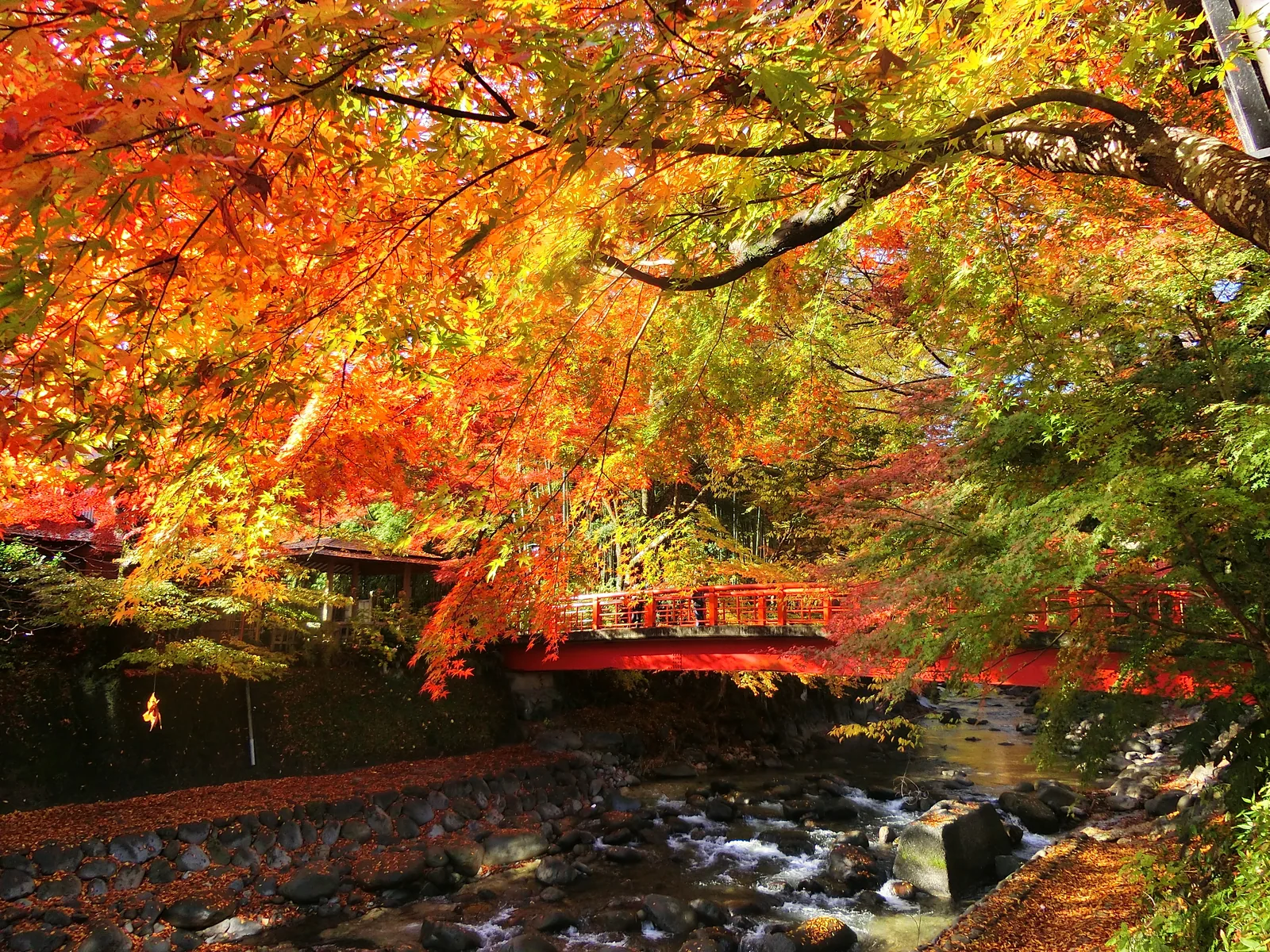
For a shorter stroll, concentrate between Katsura-bashi and Kaede-bashi. Katsura-bashi's vermilion railings sit beneath maple canopies, framing river boulders and flowing water below. Around Kaede-bashi, steps link directly onto the flagstone Bamboo Grove Path, where circular bamboo benches offer a breather. Light varies sharply between the open bridges and the shaded grove: overcast skies highlight the texture of the stalks and paving, while sunny spells reward waiting for dappled light through the canopy. Pause in wider bends when it is busy so the narrower sections stay clear for two-way foot traffic.
Hie Shrine and Shigetsuden fit naturally before or after the riverside walk. Hie Shrine stands right beside the temple and pairs easily with the Sanmon gate. Shigetsuden sits across the river near the grave of Minamoto no Yoriie, which the tourism association also highlights as a foliage spot. Walking all the way along the river tends to keep attention on the bridges alone, so cross over for this short detour if you want the Kamakura-era history; if pressed for time, turn back at Katsura-bashi or Kaede-bashi to catch your Nature Park bus.
Along the Bamboo Grove Path sits Shuzenji Kairo, a traditional wooden gallery listed on Izu City's tourism site that hosts seasonal photography exhibitions of Shuzenji. Using its entrance as a landmark makes regrouping with family far easier than saying "meet inside the bamboo grove". Set aside at least an hour for the temple plus a short riverside loop, or two hours to cover all five bridges, Shigetsuden, a footbath, and tea while waiting for the next Maple Forest bus.
Guests staying in the onsen town can save the Bamboo Grove Path for after dinner. According to the tourism association, the town is illuminated from sunset until 23:00, with shadow projections along the bamboo grove running from 20:00 to 22:00. Overnight visitors can simply stroll there and back along the lit bridges, whereas day-trippers heading back to Mishima should see the grove in daylight and head to the bus stop after dusk -- waiting for the 20:00 shadow projections means missing the final 19:39 Onsenba Line bus from Shuzenji Onsen to the station.
Planning Separately for Shuzen-ji Temple's Principal Image and Garden
While the town, station, and hot-spring quarter are written as Shuzenji, the temple itself is officially Shuzen-ji, traditionally founded by Kobo Daishi (Kukai) in 807 and affiliated today with the Soto Zen school. Entry to the general precincts is free, with the Sanmon gate open from 05:00 to 17:00, while the temple office and Treasure Hall usually keep hours from 08:30 to 16:30. Keep those two schedules separate when planning early-morning or dusk riverside walks if you hope to collect a goshuin temple stamp or view artefacts.
From 1 to 30 November 2026, the Treasure Hall holds a special public viewing of the temple's principal Dainichi Nyorai statue from 09:00 to 16:00 (¥300 adult, ¥200 child). According to temple records, Hojo Masako donated the statue -- sculpted by Kei-school master Jikkei -- in memory of her son Minamoto no Yoriie. If time permits, follow up across the river at Shigetsuden and Yoriie's grave to see the rest of that Kamakura story; families with young children might choose either the Treasure Hall or the grave so the afternoon stays relaxed along the river.
The normally closed Hojo Garden, known as Tokai Daiichi-en, opens to the public from 20 to 30 November 2026 between 09:00 and 16:00. Izu City lists a ¥200 garden maintenance contribution, and entry remains open in light rain. To fit the statue, garden, and Katsura River into one day, start at the temple in the morning; if arriving in the afternoon, see the garden and Treasure Hall before their 16:00 closing time, then head to Katsura-bashi, the footbaths, or the bamboo grove. Watch for on-site signs near the Sanmon gate showing the separate entrances for each area.
The temple grounds, Treasure Hall, and Hojo Garden each operate on their own timetable, so in December stick to the standard grounds hours and extend your walk along the river. Drivers should set a paid onsen-town car park as their satnav destination, as Shuzen-ji Temple has no parking of its own. If anyone in your party prefers to wait in the shopping lanes or at a footbath, agree to meet back at Kokei-bashi or the bus stop before moving on.
Explore the Slopes of Shuzenji Nature Park Maple Forest Before Heading to the Mount Fuji Viewpoint
Alight at Momijibayashi-mae for Shuzenji Nature Park's Maple Forest rather than staying on to the Nijinosato gate. Entry is free, and the Maple Forest sits at the heart of the park -- described by Izu City as covering around one hectare with 1,000 maple trees. Laid out in 1924 to commemorate the former Shuzenji Town gaining municipal status, the grounds also hold Japanese red pine, fragrant olive, and azaleas. Walking across different slopes reveals evergreens interspersed with scarlet foliage, rewarding unhurried wandering far more than rushing along the outer road towards Nijinosato.
Start at the park entrance map by the bus stop. Older visitors may want to stay on the gentler paths near the entrance and pause wherever the foliage catches their eye. On clear days, follow the signposts up to Fujimi Observatory for a view of Mount Fuji, first subtracting the return walk to Momijibayashi-mae so you do not miss your bus. When clouds hide the distant peaks, save the climb and spend the extra time among the maples instead.
Official maps show the Maple Forest and Nijinosato along the same hillside road, and first-timers can still treat them as two separate stops. Buses take roughly three to four minutes between Momijibayashi-mae and Nijinosato, making stop-by-stop timetable checks much more reliable than estimating walking distances from a map. If you visit the Maple Forest by day and plan to attend Nijinosato's night illumination, you can easily catch a bus back down to the onsen town for an early dinner and return uphill closer to evening opening -- handy with children or if you prefer not to wait outside between sessions.
For drivers in autumn, Izu City's visitor guide specifies that large coaches use the car park outside Nature Park, while standard cars are directed to the Shuzenji Bairin (Plum Grove) car park. Autumn 2026 parking rates are listed at ¥300 for standard cars, ¥610 for minibuses, and ¥810 for large coaches; once parked, follow seasonal signs up to the Maple Forest. Plan your afternoon town parking ahead of time instead of driving up to the temple gate, and note that Nijinosato operates its own car park with a separate fee if you park at both sites.
Allow roughly an hour for Nature Park, adding extra time for photography or the observatory walk. After rain, damp fallen leaves can make steep paths and stone steps slippery, so favour flatter trails inside the woods or head down to the Katsura River instead. Daylight fades quickly in early winter: check return bus times while still on the hillside, finish woodland trails before dusk, and move on to the lit streets of the onsen town or Nijinosato after dark.
Choosing Your 2026 Nijinosato Night Maple Tickets
Nijinosato's 2026 autumn event, Momiji Light-Up: Akiiro no Yumeakari, runs from 7 November to 13 December with evening hours from 17:00 to 21:00. A standard night ticket covers both the illuminated maple areas and the Illumi the Night display at ¥2,600 for adults (junior high school and above) and ¥1,500 for children (age 4 to primary school), with children aged 3 and under free. If you spend the daytime at Shuzen-ji Temple, the Katsura River, or Nature Park and arrive at dusk, this standard evening pass is all you need.
Fireworks are scheduled on three dates -- 14, 22, and 28 November -- beginning at 19:30. On those evenings, Nijinosato only sells a combined night ticket covering the maple light-up, illuminations, and fireworks at ¥3,300 for adults and ¥2,200 for children. To avoid the higher fare or leave earlier, pick another evening that week and focus on Takumi-no-Mura. Visitors coming specifically for the fireworks should eat dinner beforehand, pack warm layers for waiting outdoors, and pre-book a taxi pickup outside the main gate for after the show.
Those wishing to explore Nijinosato by day as well can buy a same-day Day & Night pass: ¥3,300 adult and ¥1,800 child on standard autumn dates, or ¥4,000 adult and ¥2,500 child on fireworks nights. For two adults and one primary-school child on a standard date, night-only tickets total ¥6,700 compared with ¥8,400 for the Day & Night pass -- a ¥1,700 difference. If the family wants to enjoy the daytime park grounds, that extra outlay covers full daytime entry; if you only want the night maples, skip the daytime pass and use those hours at Nature Park or over a sit-down meal in the onsen town.
Even with a Day & Night pass, visitors must exit during the changeover hour: in autumn, daytime hours end at 16:00 before evening gates open at 17:00. The pass lets you sort both tickets in one purchase, and official guidance notes that standard car parking is charged only once for the day. Foot passengers and bus travellers can use the 16:00 to 17:00 window outside the gate for toilets, refreshments, or confirming taxi pickups, while planning their first evening stop inside.
The winter Illumi the Night season spans 10 October 2026 to 31 March 2027 according to the monthly calendar on its dedicated site. Gates usually open at 17:00 until the end of February and 18:00 in March, closing at 21:00 with last admission at 20:30. Anyone visiting after 13 December can select winter illumination dates on the booking page and pair them with daytime Katsura River walks for late-season foliage.
| Dates | Night Session Only | Same-Day Daytime & Night |
|---|---|---|
| 7 Nov-13 Dec (Standard nights) | ¥2,600 / ¥1,500 | ¥3,300 / ¥1,800 |
| 14, 22, 28 Nov (Fireworks nights) | ¥3,300 / ¥2,200 | ¥4,000 / ¥2,500 |
Deciding at British Village Whether to Walk, Ride the Bus, or Take the Miniature Railway
Entry and exit to Nijinosato are both through British Village. For illuminated maples at night, the park designates Takumi-no-Mura (Craft Village) and Izu-no-Mura (Izu Village) as its two main maple zones, while Canadian Village hosts part of Illumi the Night. Look around the Japanese Garden for illuminated reflections on the water, or linger beneath the maples in Takumi-no-Mura. Every extra zone adds walking time back to the gate, so with slower walkers in your group, setting a firm regrouping time matters more than covering every corner.
During the autumn maple event, the park's Romney Bus runs outbound from British Village via Canadian Village and Takumi-no-Mura to Izu-no-Mura, then returns from Izu-no-Mura via Canadian Village back to British Village -- skipping Takumi-no-Mura on the return loop. If you alight at Takumi-no-Mura for photos, allow time to walk on to Izu-no-Mura or back to Canadian Village for the return bus. Autumn event notices list the park bus at ¥300 for adults and free for children. The Romney Railway operates separately between British Village and Canadian Village at ¥600 adult and ¥300 child per single night ride, with each service using its own boarding stops.
During autumn maple season, the final Romney Railway departure from British Village is listed at 20:15, and the last return train from Canadian Village to British Village at 20:45. If you have already booked a taxi outside the gate, count backwards carefully rather than risking a tight wait for the final train. Visitors focused mainly on autumn leaves can head first to Takumi-no-Mura, continue to Izu-no-Mura, and loop towards the exit -- or save Canadian Village for last if your group wants to ride the miniature train back to British Village.
Daytime visitors with babies or toddlers can hire pushchairs at British Village for ¥200 per day, while wheelchairs are loaned free of charge in limited numbers. Baby-care rooms are located beside the British Village Information Centre, in Nelson Hall at Canadian Village, and in Izu-no-Mura. Because Nijinosato is built across hilly ground, several paths are awkward or closed to pushchairs and wheelchairs; ask at the gate when picking up a map so everyone knows which routes are accessible and where to meet at main junctions.
In autumn and winter, daytime hours run from 10:00 to 16:00 with last admission at 15:00, and daytime-only tickets cost ¥1,220 for adults and ¥610 for children (age 4 to primary school). An afternoon gives enough time for British Village plus either the Japanese Garden and Takumi-no-Mura or Canadian Village, depending on children's energy levels. Check the official website's separate daytime and evening opening calendars; if coming after a morning in Nature Park, aim to board a bus straight after lunch so you reach the gate before 15:00.
Nijinosato has announced higher daytime admission fees taking effect from 1 April 2027: ¥1,500 adult and ¥750 child on standard weekdays, ¥1,600 / ¥800 on weekends and public holidays, and ¥1,760 / ¥880 during peak seasons. Standard car parking will rise from ¥300 to ¥500, and pushchair hire from ¥200 to ¥400. Use these figures when budgeting an autumn 2027 daytime visit; night maple events and evening passes for 2027 will be announced separately.
Getting Back from Nijinosato After the 17:42 Last Bus
Nijinosato's evening access page states clearly that the last bus back to Shuzenji Station departs at 17:42 and advises evening guests to return by taxi. Tokai Bus's November 2026 timetable lists this C32 service calling at Shuzenji Onsen at 17:50 and reaching Shuzenji Station at 18:00, while the park's own Romney Bus stays inside the grounds. Anyone staying for the 19:30 fireworks or an unhurried evening stroll should check local Shuzenji taxi numbers on the park's access page and book a pickup outside British Village, specifying whether you are going to your hotel, Shuzenji Onsen, or Shuzenji Station South Exit.
Heading back to Tokyo at night involves two rail transfers: Nijinosato to Shuzenji Station, the Sunzu Line to Mishima, and then a JR train onwards to Tokyo. Because the first leg is the easiest place to get delayed late in the evening, choose your Mishima departure first and work backwards to Shuzenji Station. Fit riverside walks and sit-down meals into the daytime; on fireworks nights, staying locally is far less stressful than juggling a taxi and two train connections after the crowds let out.
Travellers staying in the onsen town can return straight to their ryokan after the illuminations. If you hope to catch the bamboo grove shadow projections too, check how far the walk is from your accommodation first -- it may be easier to arrive early at Nijinosato or save the bamboo grove for a second evening. Drivers should make a note of where they parked before heading deeper into the park, and keep internal park transport clearly separated from onward road connections on your itinerary.
Footbaths, Hakoyu Bathhouse, and Wet-Weather Shortcuts
Tokko-no-Yu is a hot-spring landmark right on the Katsura River bed, linked by legend to Kukai striking the rock with a vajra staff; today it is for viewing only, with bathing and foot-soaking prohibited. For a proper footbath, head to nearby Kawara-yu or River Terrace Sugi-no-Yu in Tokko-no-Yu Park, which is free and seats around ten people. If Sugi-no-Yu is full midway through your riverside walk, cross Katsura-bashi and check back on the return leg -- and pack a small towel so your feet and socks are dry before stepping back onto the flagstones.
Hakoyu is the onsen town's public bathhouse for a full-body indoor soak, open from 10:00 to 21:00 (last entry 20:30) at ¥700 for junior high school and above and ¥400 for primary school children. Its hinoki cypress tubs make a welcome stop after walking the Maple Forest or when rain sets in. Hakoyu has no private car park, so drivers can use the same paid onsen-town parking as their riverside stroll; bus passengers planning dinner and a soak before returning to the station should enter early enough not to miss the final Onsenba Line bus.
On a drizzly late-November day, visit Shuzen-ji's garden first, stroll near Katsura-bashi for riverside maples, and duck into the Treasure Hall or Hakoyu if the weather worsens. If you decide to head back to Mishima early, use a break in the rain to locate the Shuzenji Onsen bus stop and verify the platform direction. Guests staying right in the onsen town can also pop back to their room mid-afternoon to change wet socks and layers before stepping out again at dusk.
With older travellers arriving from the station, keep daytime sightseeing around the temple gate, Katsura-bashi, and Sugi-no-Yu, leaving Nature Park's steeper trails for nimbler walkers. Before splitting up, pin Katsura-bashi, Kawara-yu, and Shuzenji Onsen on your phone map and agree on a bridge or bus stop for regrouping. Stick to clear paved paths in wet weather; if you still plan to see Nijinosato after dark, pack a waterproof outer layer, limit your walk to one illuminated zone, and ride back to the gate.
Connecting Buses on a Day Trip vs Saving Dinner Time Overnight
For a foliage-focused day trip, ride the Sunzu Line from Mishima to Shuzenji Station and head straight to the Maple Forest. Taking Tokai Bus's current timetable as an example, on operating days the 09:20 departure from Shuzenji Station reaches Momijibayashi-mae at 09:32. That leaves roughly 50 minutes in the park before catching the 10:23 return bus, arriving at Shuzenji Onsen at 10:30 for a full morning at the temple and afternoon entry to the Hojo Garden before 16:00. If you prefer a longer woodland walk, take the 11:12 bus down and have lunch before starting your riverside stroll.
When the 20 to 30 November Hojo Garden opening is your main draw, flip the order: start at Shuzenji Onsen for the temple and Katsura River, then catch a bus uphill from Shuzenji Onsen to the Maple Forest and Nijinosato in the afternoon. Tokyo day-trippers can head back down to the station early in the evening, while night-maple visitors can lunch in town after arranging evening exit transport. If mist or rain settles over the hillside by midday, swap the afternoon for an onsen soak in town -- or postpone the hill until the next morning if staying overnight.
For an overnight stay, look along the Katsura River near the Shuzenji Onsen bus stop so the bamboo grove is an easy walk after dinner. At Yukairou Kikuya, situated right beside the Shuzenji Onsen bus stop with no shuttle bus needed, guests typically choose between 17:30 and 19:45 dinner seatings at check-in on a first-come basis. Taking the 17:30 sitting leaves time for the shadow projections afterwards; on Nijinosato fireworks nights, booking a bed-and-breakfast plan lets you eat early in town and head uphill. Spreading a full ryokan dinner and a late illumination visit across two separate evenings is the easiest pace.
Travellers catching an early Shinkansen the next morning often find hotels around Mishima Station simpler to connect from, visiting the temple, river, and Maple Forest by day before returning to Mishima for dinner. Staying in Shuzenji Onsen instead lets you go straight from Shuzenji Station to the Maple Forest on your first afternoon and enjoy the Katsura River quietly early the next morning. With large suitcases, decide whether you want to haul luggage onto hillside buses -- either drop bags at your accommodation first or travel light from Mishima with a daypack. For more on ryokan and hot-spring stays, see our Shuzenji Onsen accommodation guide.
If you only pick one evening activity on a two-day trip, families with children, miniature-railway fans, or photographers chasing lit water reflections should save the second afternoon and evening for Nijinosato with return transport booked ahead. If you have an early departure and want a unhurried ryokan dinner, visit the hillside maples by day and wander out to Kaede-bashi and the bamboo grove after supper. To catch a reserved morning Shinkansen at Mishima, arrange a taxi before checkout or take an early bus from the Shuzenji Onsen stop.
A few useful answers
When is the best time to see autumn leaves in Shuzenji?
Mid-November to mid-December in the onsen town, and roughly mid-November to early December in Shuzenji Nature Park and Nijinosato. In 2026, visiting between 20 and 30 November coincides with Shuzen-ji Temple's Hojo Garden opening.
How long is the train from Mishima to Shuzenji?
The Izuhakone Railway Sunzu Line takes about 30 minutes and costs ¥550 single for adults (¥280 for children). From Shuzenji Station, Tokai Bus services reach the onsen town in around 8 minutes for ¥300 adult.
How do I get from Shuzenji Onsen to the Maple Forest?
Board a bus bound for Nijinosato or a Heda-bound service that stops at Maple Forest, and alight at Momijibayashi-mae. For Nijinosato itself, stay on until Shuzenji Nijinosato.
Can I stay inside Nijinosato from daytime straight through to the night illumination?
No -- the park closes between 16:00 and 17:00 for changeover. Visitors attending both sessions can buy a same-day Day & Night ticket and re-enter when the evening gates open.
When are the 2026 Nijinosato fireworks?
On 14, 22, and 28 November 2026, starting at 19:30. On those three evenings, only the combined night ticket covering fireworks, autumn maples, and illuminations is sold at ¥3,300 for adults and ¥2,200 for children.
Is there still a bus from Nijinosato back to Shuzenji Station at 21:00?
No -- the last bus from Nijinosato to Shuzenji Station departs at 17:42. If you leave after 17:42, you will need a taxi or your own car. The internal park bus only returns to the entrance gate at British Village.
Can you soak your feet in Tokko-no-Yu?
No -- Tokko-no-Yu is for viewing only. Use the nearby Kawara-yu or Sugi-no-Yu footbaths instead, or head to Hakoyu for a full-body indoor bath.
What hours is the Bamboo Grove Path lit up at night?
The onsen town's evening lighting runs from sunset until 23:00, and the Bamboo Grove Path shadow projections operate from 20:00 to 22:00.
Is there an entry fee for the Maple Forest, and where do drivers park?
Shuzenji Nature Park's Maple Forest is free to enter. During autumn foliage season, standard cars use the Shuzenji Bairin car park, listed at ¥300 per standard vehicle in autumn 2026.
Official information and references
Sources used in this guide.
- Izu City Tourism | 2026 Shuzenji Autumn Foliage & Hojo Garden Opening
- Shuzenji Tourism Association | Autumn Foliage Viewing Season
- Shuzenji Tourism Association | 2026 Autumn Foliage Walking Map (PDF)
- Izu City Tourism | Shuzenji Nature Park Maple Forest
- Shuzenji Tourism Association | Maple Forest Guide Map (PDF)
- Izu City Tourism | Shuzenji Onsen Town Map (PDF)
- Izu City Tourism | Five Bridges of the Katsura River
- Izu City Tourism | Shuzenji Kairo
- Shuzen-ji Temple | Visiting Hours & 2026 Principal Image Viewing
- Shuzenji Tourism Association | Onsen Town Illuminations & Shadow Projections
- Shuzenji Tourism Association | Tokko-no-Yu & Bamboo Grove Path
- Shuzenji Tourism Association | Footbaths & Hakoyu Bathhouse
- Nijinosato | 2026 Autumn Maple Illumination & Fireworks
- Nijinosato | 2026-2027 Winter Illumination, Day & Night Passes & Night Transport
- Nijinosato | Daytime Hours & 2027 Fare Revision Notice
- Nijinosato | 2027 Admission Price Schedule (PDF)
- Izuhakone Railway | Sunzu Line Timetable & Fares
- Izuhakone Railway | Sunzu Line Contactless Payment
- Izuhakone Railway | Sunzu Line 2027 Fare Cap Application (PDF)
- Izuhakone Railway | Sunzu Line Child Fare Revision Plan (PDF)
- JR East | Limited Express Odoriko & Shuzenji Carriages
- Tokai Bus | Shuzenji Station Stands 1 & 2 Routes
- Tokai Bus | Shuzenji Station to Momijibayashi-mae & Nijinosato Fares
- Tokai Bus | Momijibayashi-mae to Shuzenji Onsen & Shuzenji Station
- Tokai Bus | Shuzenji Onsen Departure Timetable
- Tokai Bus | Nijinosato to Shuzenji Station Timetable
- Yukairou Kikuya | Access & Shuttle Information
- Yukairou Kikuya | Dinner Seating Times