Plan an autumn foliage trip to Shuzenji in late November to see Shuzen-ji Temple's Hojo Garden, the Katsura River, and Shuzenji Nature Park. Includes 2026 Niji no Sato light-up and fireworks ticket prices, the 17:42 last bus, and day-trip routes from Mishima and Tokyo.
- Region & Focus
- Izu and Atami
- Reading Scope
- 24 min read · 10 chapters · 9 Q&As
- Official Verification
- 28 official sources checkedUpdated November 22, 2026
- Key Topics
- SeasonsHot springsItineraries
Chapter Route Map (tap any stop)
- Which Week in November Is Best for Shuzenji Autumn Foliage?
- Taking the Bus After Arriving at Shuzenji Station
- Walking Shuzen-ji Temple, the Bamboo Forest Path, and Five Bridges Along the Katsura River
- Plan Shuzen-ji Temple's Principal Image and Garden Separately
- Explore the Slopes of Shuzenji Nature Park's Maple Grove Before Heading to Fujimi Observatory
- Choosing Your 2026 Niji no Sato Autumn Illumination Ticket
- Walk, Bus, or Mini-Train Inside Niji no Sato Starting at British Village
- Getting Back From Niji no Sato After the 17:42 Last Bus
- Foot Baths, Hakoyu Bathhouse, and Rainy-Day Shortcuts
- Connecting Buses for a Day Trip, or Staying Overnight for Dinner
- Quick Q&A
For a first-time autumn trip to Shuzenji, late November is the sweet spot. Spend the day walking along the Katsura River through Shuzen-ji Temple, Katsurabashi Bridge, and the Bamboo Forest Path, then take a bus uphill to Shuzenji Nature Park for dense groves of maple trees. In 2026, Shuzen-ji's Hojo Garden opens from November 20 to 30, while Niji no Sato's evening autumn illumination runs from November 7 to December 13. The last bus from Niji no Sato back to Shuzenji Station leaves at 17:42, so arrange a taxi or rental car in advance if you plan to stay for the evening light-up or the 19:30 fireworks.
Which Week in November Is Best for Shuzenji Autumn Foliage?
Shuzenji's autumn foliage splits into three main areas. Shuzen-ji Temple, the Bamboo Forest Path, and Katsurabashi Bridge all sit within the hot spring town and connect easily on foot from the same bus stop. Uphill at Shuzenji Nature Park, walking trails wind through a maple grove where sun-facing slopes and shaded paths change color at different speeds. Further up the road, Niji no Sato is a separate gated theme park that hosts the evening illumination. If you only have half a day, focus on the hot spring town. If dense maple foliage is your main goal, head up to the Nature Park first and return to town for a meal.
According to the Izu City Tourism Association's typical foliage calendar, the hot spring town peaks from mid-November to mid-December, while the Maple Grove and Niji no Sato usually peak from mid-November to early December. The grounds of Shuzen-ji Temple generally hit peak color from late November. If anyone in your group wants to see the temple alongside the Maple Grove and night illumination, target the November 20–30 window in 2026 when the Hojo Garden is open. By early December, shift your focus toward riverside walks and Niji no Sato's evening sessions, adding or skipping Nature Park trails depending on current leaf conditions.
Niji no Sato illumination tickets are already available in early November because the park opens its evening sessions on November 7. However, if your main priority is deep red maples—especially when booking an overnight stay—aim for the tourism association's core foliage window. Conversely, if you arrive in Izu in mid-December, put the hot spring town at the top of your itinerary. The 2026 autumn foliage light-up ends on December 13, after which Niji no Sato switches to a separate winter illumination schedule.
Photography goals can also guide your timing and route. To frame Shuzen-ji's main gate with maple leaves, visit the temple earlier in the day. From Kaedebashi Bridge, you can shoot the overhanging branches and river surface in a single frame and shift angles within a few steps. The Nature Park offers lower woodland paths, hillside slopes, and a viewpoint; if you only have time for two areas, go up the hill in the morning and drop down to the river in the afternoon rather than scrambling for an uphill ride from town later on.
Plan an autumn foliage trip to Shuzenji in late November to see Shuzen-ji Temple's Hojo Garden, the Katsura River, and Shuzenji Nature Park. Includes 2026 Niji no Sato light-up and fireworks ticket prices, the 17:42 last bus, and day-trip routes from Mishima and Tokyo.
Taking the Bus After Arriving at Shuzenji Station
From Tokyo, you have two practical rail options. To reach the Maple Grove early in the morning, take the Tokaido Shinkansen to Mishima and transfer to the Izuhakone Railway Sunzu Line. Some Shinkansen services skip Mishima, so set Mishima directly as your destination when booking. The Sunzu Line takes about 30 minutes to reach the terminus at Shuzenji; for autumn 2026, local train fares are ¥550 one-way for adults and ¥280 for children. If buying tickets separately, the tourism association recommends allowing around 10 minutes to walk from the Shinkansen platforms to the Izuhakone Railway gates at Mishima Station—or longer if you still need to buy tickets or have bulky luggage.
The Sunzu Line accepts compatible contactless credit and debit cards for tap-in, tap-out travel. Regular Suica or PASMO users should buy a paper ticket for the Sunzu Line at Mishima or use a supported contactless bank card instead. Tap in and out with the exact same card, and do not switch between a physical card and a mobile wallet on the same trip. On your return to Mishima, exit the Sunzu Line gates first before passing through the JR transfer gates; factor that station walk into your timing if you are catching a reserved Shinkansen seat.
To skip a transfer, book a Shuzenji-bound car on the JR Odoriko limited express. JR East estimates the ride from Tokyo to Shuzenji at about 2 hours and 8 minutes; some trains split at Atami for Izukyu-Shimoda and Shuzenji, so board the correct car number and destination listed on your ticket. Travelers boarding the Odoriko at Mishima for Shuzenji must pay an in-line limited express supplement (¥200 for adults, ¥100 for children, using an unreserved seat limited express ticket) on top of the base fare. When the schedule aligns, local trains still take you straight to the terminus where buses for the hot spring town depart.
Step out of Shuzenji Station's South Exit and check your destination before lining up. For the temple and Katsura River, board a Tokai Bus toward Shuzenji Onsen from Boarding Stop 1 on the Onsenba Line; the ride to "Shuzenji Onsen" takes about 8 minutes and costs ¥300 for adults starting October 2026. To go straight to the Maple Grove or Niji no Sato, use Boarding Stop 2 for the New Town, Niji no Sato, and Heda lines, getting off at "Momijibayashi-mae" or "Shuzenji Niji no Sato." Some Heda-bound buses bypass Niji no Sato, so verify on the timetable that your bus stops at "Shuzenji Niji no Sato." From the station, the fare is ¥430 to Momijibayashi-mae and ¥470 (about 20 minutes) to Niji no Sato.
When heading uphill from the hot spring town, Tokai Bus routes in both directions stop at "Shuzenji Onsen." Even though the stop name is identical, buses toward the station and buses toward the hillside run in opposite directions. Read down the timetable to check the next stop: uphill buses pass stops such as "Koen-dori" before reaching the Maple Grove, while station-bound buses head next to "Miyukibashi." For the return ride from "Momijibayashi-mae," look for Stop 2 toward "Shuzenji Station." Getting off at "Shuzenji Onsen" costs ¥250 for adults, while riding all the way back to the Sunzu Line costs ¥430. If you plan to soak at Hakoyu in the evening, check your post-bath return bus times before heading up the hill.
Izuhakone Railway has filed for a base fare adjustment on the Sunzu Line scheduled to take effect in spring 2027. The announcement lists a proposed adult one-way cap of ¥650 between Mishima and Shuzenji, alongside a flat ¥50 fare per ride for in-line children's paper tickets. For autumn 2026, fares remain ¥550 for adults and ¥280 for children.
Walking Shuzen-ji Temple, the Bamboo Forest Path, and Five Bridges Along the Katsura River
Get off at "Shuzenji Onsen" and head first to Shuzen-ji Temple's main gate. Stone steps lead inside from the gate, so if anyone in your group moves slowly, pick a meeting spot outside before those climbing the steps head in. After leaving the temple, walk near Kokeibashi Bridge to the Katsura River, where Tokko-no-Yu is visible across the water. From there, stroll upstream past Katsurabashi, Kaedebashi, and Takishitabashi bridges. Listed from downstream to upstream in the city guide, the five bridges are Togetsubashi, Kokeibashi, Katsurabashi, Kaedebashi, and Takishitabashi—look closely for the bridge crests engraved on each one.
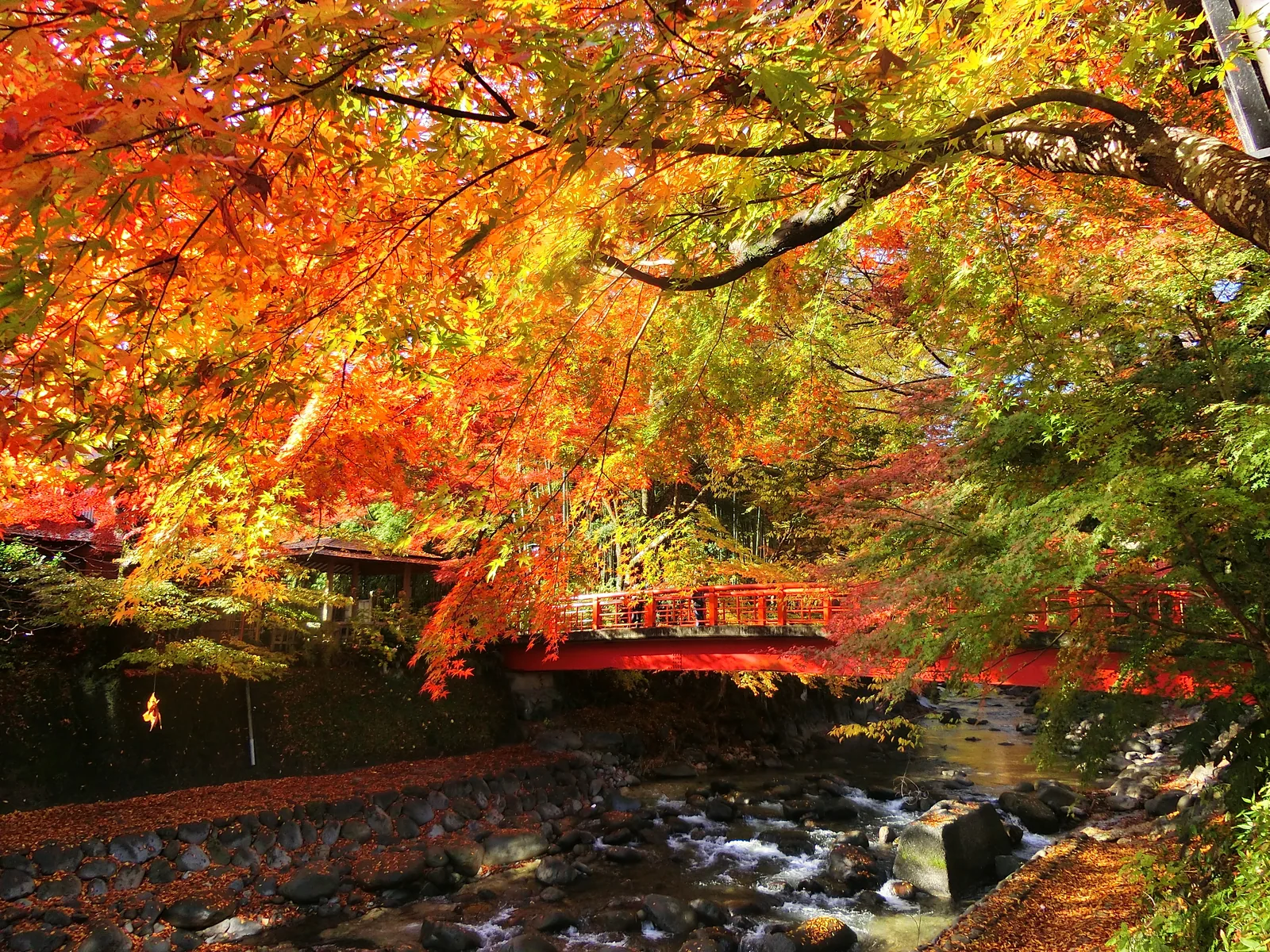
For a shorter walk, focus your time between Katsurabashi and Kaedebashi. Katsurabashi's red railings sit right beneath maple branches, letting you frame both river boulders and flowing water in one shot. Near Kaedebashi, the path joins the stone-paved Bamboo Forest Path; stay by the river for foliage photos, or step into the bamboo grove to rest on the circular bamboo bench. Light levels differ sharply between the shaded grove and open bridges: overcast skies bring out the textures of bamboo stalks and stone paving, while breaks of sunlight filtering through the leaves make great photo stops. When crowds pick up, pause at wider corners so two-way foot traffic can pass through narrow stretches.
Hie Shrine and Shigetsuden Hall fit easily before or after your riverside walk. Hie Shrine stands right beside Shuzen-ji Temple and pairs naturally with a visit to the main gate. Shigetsuden sits on the opposite bank near Minamoto no Yoriie's grave, which the tourism association also lists as an autumn foliage spot. Walking straight up the river makes it easy to focus only on the bridges, so cross over for this quick detour if you want some local history. If time is tight, turn back at Katsurabashi or Kaedebashi to leave plenty of buffer for the bus to the Nature Park.
Along the Bamboo Forest Path sits "Shuzenji Kairo," a small Japanese-style gallery listed on the Izu City tourism site that hosts local exhibitions such as seasonal photography of Shuzenji. Using its entrance as a landmark makes meeting up with family much clearer than saying "somewhere in the bamboo grove." Budget at least an hour for a short river walk plus the temple, or two hours to cross all five bridges, climb up to Shigetsuden, and stop for a foot bath or tea—which lines up neatly with the next bus up to the Maple Grove.
Overnight guests in the hot spring town can save the bamboo grove for after dinner. According to the tourism association, town streets are illuminated from sunset until 23:00, and the Bamboo Forest Path shadow projections run from 20:00 to 22:00. A simple out-and-back stroll along the lit bridges and bamboo path works well. Day-trippers catching a train transfer at Mishima should visit the bamboo grove during daylight and head to the bus stop once dusk settles—waiting for the 20:00 shadow projections puts you past the 19:39 last Onsenba Line bus from Shuzenji Onsen back to the station.
Plan Shuzen-ji Temple's Principal Image and Garden Separately
While the town, station, and hot spring area go by Shuzenji, the temple itself is formally named Shuzen-ji. According to temple history, it was founded by Kobo Daishi (Kukai) in 807 and now belongs to the Soto Zen school. The general grounds are free to enter, with the main gate open from 5:00 to 17:00. The temple office and Treasure Hall keep standard hours of 8:30 to 16:30, so factor those separate schedules into your route if you want a goshuin stamp or plan to view artifacts during an early morning or late afternoon river walk.
From November 1 to 30, 2026, the temple holds a special public viewing of its principal image in the Treasure Hall from 9:00 to 16:00 (¥300 for adults, ¥200 for children). Temple records note that Hojo Masako donated this Dainichi Nyorai statue, carved by Kei-school sculptor Jikkei, in memory of her son Minamoto no Yoriie. If you have spare time afterward, walk over to Shigetsuden and Yoriie's grave—two nearby landmarks tied to the same Kamakura-period story. Families with kids can visit one spot each from the Treasure Hall and grave area and still have plenty of afternoon left for the river.
The normally closed Hojo Garden, known as "Tokai Daiichien," opens from November 20 to 30, 2026, from 9:00 to 16:00. Izu City lists a ¥200 garden maintenance contribution, and the garden stays open in light rain. To see the principal image, garden, and Katsura River in a single day during this window, start at the temple in the morning. If you arrive in the afternoon, prioritize the garden and Treasure Hall before they close at 16:00, then head to Katsurabashi, the foot baths, or the bamboo grove. Follow on-site signage at the main gate to confirm the separate entrances for each viewing.
General worship, the Treasure Hall, and the Hojo Garden each keep distinct hours. Visiting in December still lets you climb through the main gate during normal hours to see the grounds' trees and architecture before extending your walk along the river. Drivers should set a paid parking lot in the hot spring town as their navigation destination, as the temple has no parking of its own. If anyone in your group prefers to wait along the shopping street or at a foot bath, agree to meet at Kokeibashi Bridge or the bus stop before moving on.
Explore the Slopes of Shuzenji Nature Park's Maple Grove Before Heading to Fujimi Observatory
Get off at "Momijibayashi-mae" for Shuzenji Nature Park's Maple Grove rather than riding all the way to the Niji no Sato main gate. Admission to the Nature Park is free, and Izu City describes the central Maple Grove as roughly one hectare with around 1,000 maple trees. Originally laid out in 1924 to mark the former Shuzenji Town's incorporation, the park also features red pines, sweet osmanthus, and azaleas. Walking across different slopes reveals evergreens weaving through the maples—taking your time on the best hillside sections shows off far more color than rushing down the outer road toward Niji no Sato.
Start by finding the park entrance and trail map near the bus stop. When walking with older travelers, stick to the gentler paths near the entrance and pause wherever the trees catch your eye. On clear days, follow signs up to Fujimi Observatory for a view of Mount Fuji. Before venturing too far, subtract the walk back to "Momijibayashi-mae" from your target return bus time. If clouds hide the distant peaks, spend that extra time inside the Maple Grove and loop back to the entrance early enough to catch your next connection smoothly.
Official maps show the Maple Grove and Niji no Sato along the same stretch of road, though first-time visitors should still plan each as its own bus stop. Timetables list a three- to four-minute ride between "Momijibayashi-mae" and Niji no Sato, and checking stop-by-stop schedules is far more reliable than judging straight-line map distances. If you finish the Maple Grove during the day and plan to attend the evening illumination, consider riding down to the hot spring town for a meal and heading back up near opening time—especially with kids or if you would rather not wait outside the gate between sessions.
During foliage season, Izu City's sightseeing page directs large buses to the Nature Park front lot and standard passenger cars to the Shuzenji Plum Grove (Bairin) parking lot. Announced autumn 2026 parking rates are ¥300 for standard cars, ¥610 for minibuses, and ¥810 for large buses. Once parked, follow event signage into the Maple Grove. If you plan to visit the hot spring town later in the afternoon, save a paid lot near town in your GPS beforehand so you aren't hunting for parking near the temple gate. Niji no Sato has its own parking lot, so parking separately at both the Maple Grove and the theme park incurs two separate fees.
Set aside about an hour for the Nature Park, or longer if you enjoy photography or plan to climb to the observatory. After rain, wet fallen leaves make slopes and stone steps slick, so sticking to flatter interior paths or shifting down to the Katsura River is easier. Daylight fades quickly in early winter; if you are still on the hillside in the afternoon, check return bus times early, save natural light for dirt trails, and move to the illuminated hot spring town or Niji no Sato after dark.
Choosing Your 2026 Niji no Sato Autumn Illumination Ticket
Niji no Sato's autumn foliage event, "Momiji Light-Up: Autumn-Colored Dream Lights," runs from November 7 to December 13, 2026, with evening hours from 17:00 to 21:00. Standard evening admission covers both the illuminated maple zone and the "Illumi the Night" light display at ¥2,600 for adults and ¥1,500 for children. If you spend the day at the temple, Katsura River, or Nature Park and only arrive at dusk, this standard evening ticket is all you need. Adult rates apply to junior high school students and up, child rates cover ages 4 through elementary school, and children 3 and under enter free.
Three evenings feature fireworks at 19:30: November 14, 22, and 28. On those nights, the park only sells a bundled evening pass covering the autumn foliage light-up, winter illuminations, and fireworks at ¥3,300 for adults and ¥2,200 for children. To avoid fireworks pricing or leave earlier, pick another night that same week and concentrate on Takumi Village. If you do go for the fireworks, eat dinner beforehand or pack warm layers for the wait, book your return taxi for after the show ends, and confirm your pickup point outside the park gate.
If you want daytime park access as well, a same-day Day & Night combo ticket costs ¥3,300 for adults and ¥1,800 for children on regular autumn foliage days, or ¥4,000 for adults and ¥2,500 for children on fireworks nights. For two adults and one elementary school child on a regular evening, night-only tickets total ¥6,700 compared to ¥8,400 for Day & Night combos—a ¥1,700 difference. That modest extra cost makes sense if your family wants to explore the grounds by day; if you only care about the night illumination, save the daytime hours for the free Nature Park or a sit-down meal in town.
Note that combo ticket holders must still clear the park during the afternoon turnover. In autumn, daytime hours end at 16:00 and evening admission reopens at 17:00, requiring all visitors to exit for one hour. The combo ticket bundles both sessions at once and includes single-charge standard car parking according to official guidelines. Visitors arriving on foot or by bus can treat the 16:00–17:00 gap as a break outside the gate to use restrooms, grab a drink, call and confirm a return taxi, and decide on their first stop once gates reopen.
The winter "Illumi the Night" season runs from October 10, 2026, to March 31, 2027, following a monthly operating calendar on its dedicated website. Evening hours generally begin at 17:00 through the end of February and shift to 18:00 in March, closing at 21:00 with last entry at 20:30. After December 13, check the ticket page for winter illumination operating dates. If seeing autumn leaves is still your main goal in mid-December, build your daytime around a Katsura River walk and check that week's calendar for evening options.
| Dates | Evening Only | Same-Day Day & Night |
|---|---|---|
| Nov 7–Dec 13 Regular Days | ¥2,600 / ¥1,500 | ¥3,300 / ¥1,800 |
| Nov 14, Nov 22, Nov 28 Fireworks | ¥3,300 / ¥2,200 | ¥4,000 / ¥2,500 |
Walk, Bus, or Mini-Train Inside Niji no Sato Starting at British Village
Entrance and exit at Niji no Sato both pass through British Village. For evening autumn leaves, the park highlights Takumi Village and Izu Village as its two foliage light-up zones, while Canadian Village hosts part of "Illumi the Night." If you are trying to match photos you have seen online, head toward the Japanese Garden for illuminated reflections on the water, and leave extra time in Takumi Village for unhurried walks beneath the maples. Every additional zone stretches your walk back to the main gate, so setting a clear regrouping time matters more than covering the entire park if anyone walks at a slower pace.
According to the park's autumn foliage notice, the Romney Bus runs outbound from British Village through Canadian Village and Takumi Village to Izu Village, then returns from Izu Village through Canadian Village back to British Village—skipping Takumi Village on the return leg. If you hop off at Takumi Village for photos, plan the walk onward to Izu Village or back to Canadian Village to catch your ride out. Event listings price the park shuttle bus at ¥300 for adults and free for children. The Romney Railway mini-train charges separately between British Village and Canadian Village at ¥600 for adults and ¥300 for children one-way at night, with each mode using its own boarding platforms.
During the autumn illumination, the Romney Railway's last departure from British Village is listed at 20:15, and its final return from Canadian Village back to British Village is listed at 20:45. If you have a taxi booked outside the gate, count backward from your pickup time so waiting for the last train doesn't leave you rushing. For a foliage-first loop, visit Takumi Village and Izu Village before working your way back toward the exit. If your group wants to ride the mini-train, save Canadian Village for the end and take the train straight back to British Village.
Daytime visitors with young children can rent strollers at British Village for ¥200 per day, while wheelchairs are available to borrow free of charge in limited quantities. Nursing rooms are located beside the British Village Information Center, at Nelson Hall in Canadian Village, and in Izu Village. Because the park is built on hilly terrain, several trails and steps are difficult or closed to strollers and wheelchairs—check the accessible routes on the park map when entering and arrange to meet along main paths or village entrances.
During autumn and winter, daytime hours run from 10:00 to 16:00 with last admission at 15:00. Daytime-only admission is ¥1,220 for adults and ¥610 for children aged 4 through elementary school. With one afternoon, start in British Village, then choose between the Japanese Garden and Takumi Village or stay around Canadian Village depending on kids' energy levels. Daytime and evening opening calendars are published separately on the official website; if you visit the Nature Park in the morning, aim to board a bus right after lunch so you reach the Niji no Sato gate well before the 15:00 cutoff.
Niji no Sato has announced daytime fee increases taking effect April 1, 2027. Regular weekday admission rises to ¥1,500 for adults and ¥750 for children, weekends and national holidays to ¥1,600 / ¥800, and peak-season dates to ¥1,760 / ¥880. Standard car parking increases from ¥300 to ¥500, and stroller rentals rise from ¥200 to ¥400. Use these updated rates when budgeting an autumn 2027 daytime visit; 2027 evening foliage event details and tickets will be announced separately.
Getting Back From Niji no Sato After the 17:42 Last Bus
Niji no Sato's evening access page clearly notes that the last bus back to Shuzenji Station leaves at 17:42 and advises night visitors to return by taxi. Tokai Bus's November 2026 timetable likewise lists this C32 service departing Niji no Sato, reaching "Shuzenji Onsen" at 17:50 and Shuzenji Station at 18:00. Inside the park, the Romney Bus only circulates within the grounds. Anyone staying for the 19:30 fireworks or leaving after dark should pull local Shuzenji taxi numbers from the park's access page and book a pickup outside British Village—be sure to specify whether you are heading to your ryokan, the "Shuzenji Onsen" area, or "Shuzenji Station South Exit."
Heading all the way back to Tokyo at night requires timing two train transfers: Niji no Sato to Shuzenji Station, the Sunzu Line to Mishima, and the JR transfer to Tokyo. The first leg is the easiest place to get bottlenecked, so lock in your Mishima departure first and work backward to Shuzenji Station. If anyone wants an unhurried walk along the Katsura River, finish that earlier in the day with a meal stop along the way. On fireworks nights, trying to squeeze park exit, a taxi wait, and two rail transfers into one evening is tight—staying overnight avoids waiting for stragglers at every connection.
If you are staying in the hot spring town, you can head straight back to your ryokan after the light-up. Wanting to add the bamboo grove shadow projections afterward? Agree on the walking distance back to your hotel beforehand, and decide whether to see the bamboo lights on another night or tackle the park illumination early. Drivers should note exactly where they parked so they head out the right exit after their last village stop. Keep internal park shuttles and post-exit transit clear as two separate legs on your itinerary.
Foot Baths, Hakoyu Bathhouse, and Rainy-Day Shortcuts
Tokko-no-Yu is a hot spring landmark set right in the Katsura River bed. Legend says Kukai struck the rock with his vajra staff to bring forth the spring, though today it is strictly for viewing—bathing and soaking your feet there are prohibited. For a real foot bath, head nearby to Kawara-no-Yu or "River Terrace Sugi-no-Yu" in Tokko-no-Yu Park. Sugi-no-Yu is free and seats roughly ten people at once; if it's full mid-walk, continue across Katsurabashi Bridge and stop on your way back. Bring a small hand towel so your feet are completely dry before putting socks and shoes back on for the stone paths.
Hakoyu is a paid public bathhouse in the hot spring town offering full indoor soaking from 10:00 to 21:00 (last entry 20:30) at ¥700 for junior high school students and up, and ¥400 for elementary school children. Its cypress wood tubs make an ideal stop after hiking the Maple Grove or as an indoor swap when rain hits. It has no dedicated parking lot, so drivers can share the same paid town lot used for strolling. Bus riders planning dinner and a soak before heading back to the station should enter the bathhouse early—staying until Hakoyu closes means missing the last Onsenba Line bus.
On a drizzly late November day, visit Shuzen-ji's Hojo Garden first, then walk near Katsurabashi Bridge for close-up riverside foliage; if wind and rain pick up, duck into the Treasure Hall or Hakoyu during open hours. If you decide to cut the day short and head back to Mishima, check the direction at the "Shuzenji Onsen" bus stop during a lull in the rain. Staying in town gives you the luxury of returning to your room mid-afternoon to swap wet socks and jackets before heading back out along the river at dusk, instead of spending all day exposed on the hillside.
When traveling from the station with older adults, keep the daytime route flat around Shuzen-ji's front gate, Katsurabashi Bridge, and Sugi-no-Yu foot bath, leaving the Nature Park slopes for stronger walkers. Pin "Katsurabashi," "Kawara-no-Yu," and "Shuzenji Onsen" on your phone map and pick a clear bridge or bus stop to reunite if you split up. Stick to well-lit, visible walkways in wet weather; if you still plan to visit Niji no Sato at night, pack a windproof rain shell, limit your walking to a single illuminated zone, and take the park shuttle back to the gate.
Connecting Buses for a Day Trip, or Staying Overnight for Dinner
For a foliage-focused day trip, ride the Sunzu Line from Mishima to Shuzenji Station and head straight to the Maple Grove. On Tokai Bus's operating calendar, for instance, you can catch a 9:20 bus from Shuzenji Station arriving at "Momijibayashi-mae" at 9:32. Spending roughly 50 minutes in the park lets you catch the 10:23 return bus past "Momijibayashi-mae" to arrive at "Shuzenji Onsen" at 10:30—leaving a full morning for the temple and plenty of time before the Hojo Garden closes at 16:00. To linger longer in the park, take the 11:12 bus down to the hot spring town and eat lunch before your riverside walk.
If the November 20–30 Hojo Garden opening is your top priority, flip the order: start at "Shuzenji Onsen" for the temple and Katsura River, then catch a bus uphill from town in the afternoon for the Maple Grove and Niji no Sato. Day-trippers returning to Tokyo can head back down to the station early in the evening from either the Maple Grove or the hot spring town. Staying for the night light-up? Have lunch in town and lock in your exit time and ride home before entering the park. If midday fog or rain rolls across the hills, swap your afternoon to a hot spring soak in town—or save the hillside for the next morning if you are staying the night.
For an overnight stay, look near the Katsura River and the Shuzenji Onsen bus stop so you can walk to the bamboo grove after dinner. At Yukairo Kikuya, for example, the ryokan sits right next to the Shuzenji Onsen bus stop with no shuttle needed, and guests typically choose either a 17:30 or 19:45 dinner seating in order of check-in. Picking the 17:30 slot leaves time to catch the bamboo shadow projections after eating. If you plan to stay at Niji no Sato until the fireworks end, book a breakfast-only room plan, grab an early dinner in the hot spring town, and head uphill afterward—separating a full evening at the illumination from a multi-course ryokan dinner across two nights keeps the pace relaxed.
If you need an early Shinkansen departure the next morning, hotels around Mishima Station make transfers much simpler. That setup works well if you tour the temple, Katsura River, and Maple Grove by day and eat dinner back in Mishima. Staying in Shuzenji Onsen instead lets you leave the quiet riverside walk for the next morning—heading straight from Shuzenji Station to the Maple Grove on arrival afternoon before checking in and strolling through town. With large luggage, staying in town versus Mishima comes down to whether you want to haul bags onto hillside buses; you can drop bags at your ryokan first or travel light for the day from Mishima. For more lodging and bath options, see the Shuzenji Onsen stays guide.
When choosing a single evening outing on a two-day trip, save Niji no Sato for the second afternoon if you are traveling with kids, want to ride the mini-train, or specifically want photos of illuminated maples reflected on water—with your return ride booked ahead. If you have an early departure or want an unhurried ryokan dinner, see the foliage up on the hill during the day and stick to a calm evening stroll to Kaedebashi Bridge and the bamboo grove. To catch a morning reserved Shinkansen at Mishima, arrange a taxi before check-out or walk to the town bus stop for an early morning bus.
A few useful answers
When is the best time to see autumn foliage in Shuzenji?
The hot spring town typically peaks from mid-November to mid-December, while Shuzenji Nature Park and Niji no Sato peak from mid-November to early December. In 2026, November 20–30 also lines up with the Hojo Garden opening.
How long is the train ride from Mishima to Shuzenji?
The Izuhakone Railway Sunzu Line takes about 30 minutes and costs ¥550 one-way for adults (¥280 for children). From Shuzenji Station, Tokai Bus takes about 8 minutes to the hot spring town for ¥300 for adults.
How do I get from Shuzenji Onsen to the Maple Grove?
Take a bus bound for Niji no Sato or a Heda-direction service that stops at the park, and get off at "Momijibayashi-mae." For Niji no Sato itself, ride to "Shuzenji Niji no Sato."
Can a Niji no Sato daytime ticket be used to stay into the evening?
No—the park closes between 16:00 and 17:00 to clear visitors for the night session. To visit both, buy a same-day Day & Night combo ticket and re-enter once evening gates open.
When are the 2026 Niji no Sato fireworks?
Fireworks take place on November 14, 22, and 28 at 19:30. On those three dates, evening combo passes covering fireworks, autumn foliage light-up, and illuminations cost ¥3,300 for adults and ¥2,200 for children.
Are there still buses back to Shuzenji Station when Niji no Sato closes at 21:00?
No—the last bus from Niji no Sato to Shuzenji Station departs at 17:42. If leaving after 17:42, arrange a taxi or rental car. Inside the park, the Romney shuttle bus returns only to the British Village entrance gate.
Can you soak your feet at Tokko-no-Yu?
No—Tokko-no-Yu is for viewing only. Use the nearby Kawara-no-Yu or Sugi-no-Yu foot baths instead, or visit Hakoyu bathhouse for a full-body indoor soak.
What time is the Bamboo Forest Path illuminated at night?
Streetlights across the hot spring town run from sunset until 23:00, and the Bamboo Forest Path shadow projections run from 20:00 to 22:00.
Is there an admission fee for the Maple Grove, and where do drivers park?
Shuzenji Nature Park's Maple Grove is free to enter. During foliage season, passenger cars use the Shuzenji Plum Grove (Bairin) parking lot, listed at ¥300 per standard car in 2026.
Official information and references
Sources used in this guide.
- Izu City Tourism | 2026 Shuzenji Autumn Foliage & Hojo Garden Opening
- Izu City Tourism Association Shuzenji Branch | Autumn Foliage Viewing Periods
- Izu City Tourism Association Shuzenji Branch | 2026 Autumn Foliage Walking Map (PDF)
- Izu City Tourism | Shuzenji Nature Park Maple Grove
- Izu City Tourism Association Shuzenji Branch | Maple Grove Trail Map (PDF)
- Izu City Tourism | Shuzenji Onsen Town Map (PDF)
- Izu City Tourism | Five Bridges of the Katsura River
- Izu City Tourism | Shuzenji Kairo
- Shuzen-ji Temple | Visiting Hours & 2026 Principal Image Viewing
- Izu City Tourism Association Shuzenji Branch | Hot Spring Town Illumination & Shadow Projections
- Izu City Tourism Association Shuzenji Branch | Tokko-no-Yu & Bamboo Forest Path
- Izu City Tourism Association Shuzenji Branch | Foot Baths & Hakoyu
- Niji no Sato | 2026 Autumn Foliage Event & Fireworks
- Niji no Sato | 2026–2027 Illumination, Day & Night Passes & Evening Access
- Niji no Sato | Daytime Hours & 2027 Price Revision Portal
- Niji no Sato | 2027 Admission Price Revision Table (PDF)
- Izuhakone Railway | Sunzu Line Timetable & Fares
- Izuhakone Railway | Sunzu Line Contactless Payment
- Izuhakone Railway | Sunzu Line 2027 Upper Fare Cap Application (PDF)
- Izuhakone Railway | Sunzu Line Child Fare Revision Plan (PDF)
- JR East | Odoriko Limited Express & Shuzenji Cars
- Tokai Bus | Shuzenji Station Stops 1 & 2 Routes
- Tokai Bus | Fares from Shuzenji Station to Momijibayashi-mae & Niji no Sato
- Tokai Bus | Momijibayashi-mae to Shuzenji Onsen & Shuzenji Station
- Tokai Bus | Shuzenji Onsen Departure Timetable
- Tokai Bus | Niji no Sato to Shuzenji Station Timetable
- Yukairo Kikuya | Access & Shuttle Information
- Yukairo Kikuya | Dinner Seating Hours