An official-data guide to the 46th Sapporo White Illumination (2026–2027-2027): dates and lighting hours for all seven venues, Odori Park's new displays, the 25th Munich Christmas Market, ENESS's world premiere at Nakajima Park, underground exits and one-night walking routes.
- Region & Focus
- Sapporo
- Reading Scope
- 18 min read · 6 chapters · 8 Q&As
- Official Verification
- 7 official sources checkedUpdated 27 November 2026
- Key Topics
- SeasonsItinerariesHokkaido
Chapter Route Map (tap any stop)
- Seven Venues at a Glance: Same Opening Night, Staggered Finales
- Odori Park & the Munich Christmas Market: Spending a Day at the Hub
- Ekimae-dori & Minami-ichijo-dori: Two Distinct Street Corridors
- The Northern Cluster: Station Square, Red Brick Office & Akapla
- Nakajima Park SNOWFISH: January's Daytime-to-Night Art Showcase
- Routes & Trip Lengths: Fitting All Seven Venues into Your Stay
- Quick Q&A
Entering its 46th edition in 2026, the Sapporo White Illumination undergoes its biggest footprint expansion in years. Previously centred on five sites across Odori Park and downtown streets, this winter adds two new venues—the Former Hokkaido Government Red Brick Office and Nakajima Park—forming a seven-venue light network running from 20 November 2026 through mid-March 2027. Based on official schedules from the organising committee (Sapporo Tourist Association), this guide breaks down dates, switch-on times, Odori's new installations, the 25th Munich Christmas Market, underground exits and walking routes for different trip lengths. Since debuting in 1981 with roughly 1,000 bulbs in Odori Park West 2-chome, the event has become the spine of Sapporo's winter calendar, linking December's Christmas market, January's contemporary art and February's Snow Festival into one continuous season.
Seven Venues at a Glance: Same Opening Night, Staggered Finales
Aside from Nakajima Park's January-only showcase, six of the seven venues switch on together on Friday, 20 November 2026, yet close on deliberately staggered dates. Match your travel dates to the lighting calendar before planning your itinerary so you do not miss the headline displays.
Laying this schedule over your trip dates immediately clarifies the best route. Visitors arriving for the December festive season enjoy six venues in full swing—Odori Park, Ekimae-dori, Minami-ichijo-dori, the Red Brick Office, Kita 3-jo Plaza (Akapla) and Sapporo Station South Exit Square—all easily covered in a single evening. By January, Odori Park has wrapped up, shifting the spotlight to Minami-ichijo-dori, Ekimae-dori, the Red Brick Office and Nakajima Park's contemporary art installation from 9 January. When the Sapporo Snow Festival takes over Odori Park in February and runs into early March, Sapporo Station South Exit Square stays illuminated until midnight nightly as the city's final holdout. To catch ENESS's new work at Nakajima Park, your visit must fall squarely within the 20-day window from 9 to 28 January 2027.
Organisers note across most venues that switch-on times adjust slightly with sunset and may change without prior notice. In December, dusk falls before 16:00 in Sapporo, meaning the 16:30 switch-on catches the twilight blue hour cleanly. From late January onwards, later sunsets push the actual illumination back by a few minutes. Arrive just before 16:30 if you want to watch the lights flicker on; wait until around 17:00, once the sky has lost its grey cast and turned deep indigo, for the strongest photographic contrast.
Four decades of evolution sit behind that calendar. What began in 1981 as a modest trial of roughly 1,000 bulbs on a single lawn in Odori Park West 2-chome expanded alongside Sapporo's winter night culture into hundreds of thousands of LEDs stretching from late November to mid-March. Run by the Sapporo White Illumination Organising Committee from the Sapporo Tourist Association offices (7F, Hokkaido Keizai Center near the station), the event publishes all schedule adjustments and pop-up programme notices first on Sapporo's official tourism portal, Yokoso Sapporo.
The 2026 edition stands out as a structural expansion that redraws the festival map. For years, the circuit stayed within five central spots—Odori, Ekimae-dori, Minami-ichijo-dori, Kita 3-jo Plaza (Akapla) and the station forecourt—along the corridor from JR Sapporo Station to Susukino. Elevating the Red Brick Office into a standalone architectural projection venue turns the historic building from a mere backdrop behind Akapla into a destination in its own right, while Nakajima Park introduces interactive daytime art from 10:00. Returning travellers relying on older five- or six-venue guides will miss two major additions if they stick to their old route.
| Venue | Dates | Lighting Hours |
|---|---|---|
| Odori Venue | 20 Nov - 25 Dec 2026 | 16:30-22:00 (until 24:00 on 23-25 Dec) |
| Ekimae-dori Venue | 20 Nov 2026 - 11 Feb 2027 | 16:30-22:00 (until 24:00 on 23-25 Dec) |
| Minami-ichijo-dori Venue | 20 Nov 2026 - 14 Mar 2027 | 16:30-22:00 (until 24:00 on 20-25 Dec) |
| Kita 3-jo Plaza (Akapla) Venue | 20 Nov 2026 - 14 Mar 2027 | 16:30-22:00 (adjusted for sunset) |
| Former Hokkaido Government Red Brick Office Venue | 20 Nov 2026 - 28 Feb 2027 | 16:30-22:00 (adjusted for sunset) |
| Sapporo Station South Exit Square Venue | 20 Nov 2026 - 14 Mar 2027 | 16:30-24:00 (adjusted for sunset) |
| Nakajima Park Venue | 9 Jan - 28 Jan 2027 | 10:00-20:00 |
An official-data guide to the 46th Sapporo White Illumination (2026–2027-2027): dates and lighting hours for all seven venues, Odori Park's new displays, the 25th Munich Christmas Market, ENESS's world premiere at Nakajima Park, underground exits and one-night walking routes.
Odori Park & the Munich Christmas Market: Spending a Day at the Hub
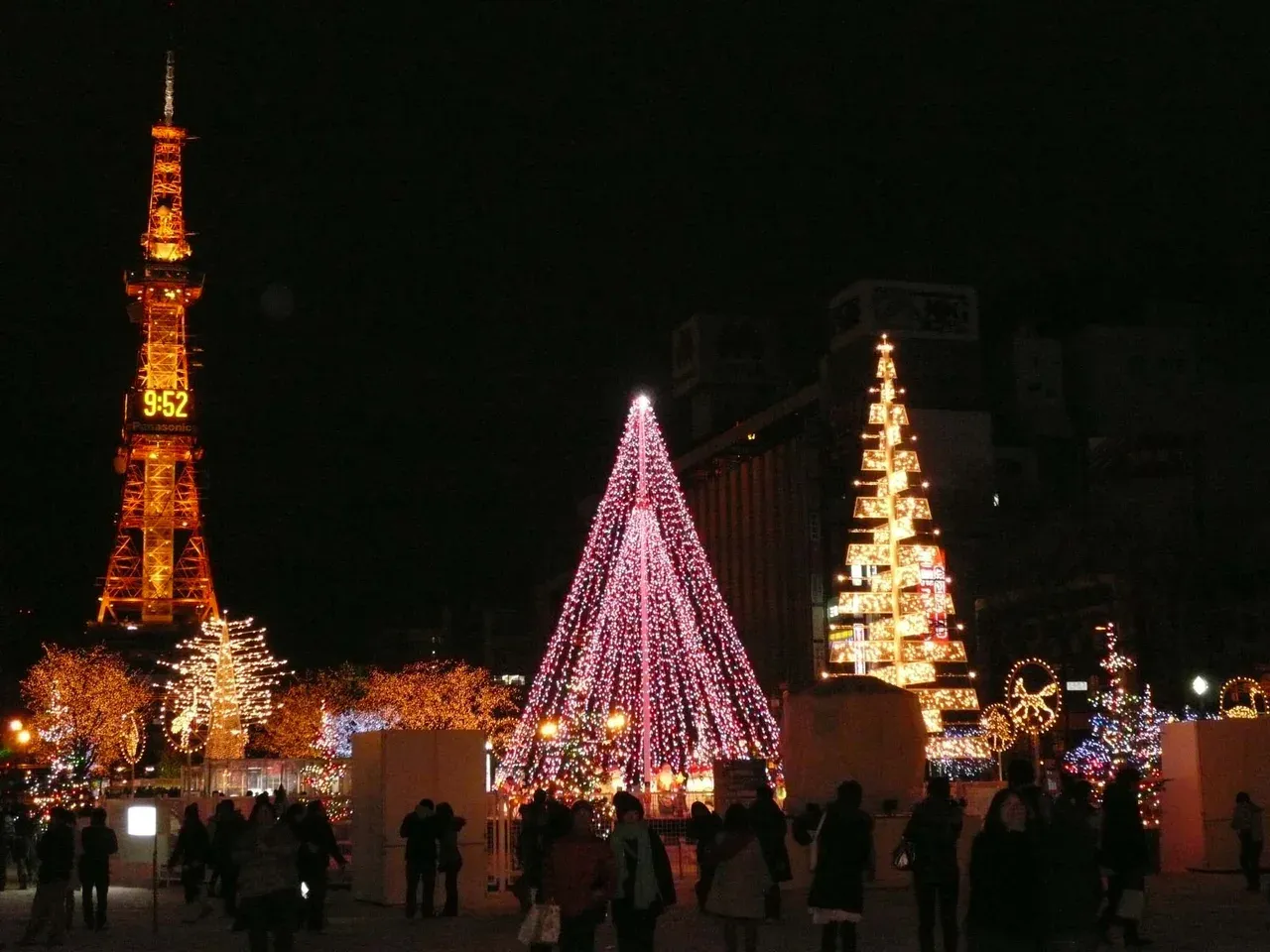
Open from 20 November to 25 December, Odori Park forms the beating heart of the festival, and its headline overhaul for 2026 sits in 3-chome. Replacing the 'Winter Blossoms' motif that anchored 3-chome for the past eight years, the new centrepiece 'Wonder Streams: Fountain of Light' uses flowing, colour-shifting illumination to evoke a spring welling up through snow. Alongside it are two interactive pieces: a playable keyboard installation that flashes lights in sync with every note, and 'More Stars', which shifts hue according to live humidity and temperature. Rather than a passive stroll past static bulbs, 3-chome now rewards families with an engaging half-hour interactive stop.
Running alongside the lights in Odori Park 1-chome and 2-chome is the 25th Munich Christmas Market in Sapporo. Born out of Sapporo's sister-city ties with Munich in 2002, this quarter-century tradition is far more substantial than a temporary pop-up stall row. Operating daily from 11:00 to 21:00 (last orders 20:45) in the same two blocks, its steady schedule makes it an easy evening fallback even if you are staying in Sapporo for three or four nights.
Over in 1-chome, Lichterbogen Square leans into festive atmosphere and family-friendly activities. At its centre stands a symbolic Christmas tree crafted from real living timber—the Lichterbaum—ringed by four wooden archways built in traditional German craft style. Relief carvings on the arches trace Christmas scenes from dawn to midnight, turning a full circuit of the square into a three-dimensional storybook. Surrounding wooden chalets (Hutte) host Santa meet-and-greets, hands-on craft workshops and rotating daily stage performances, easily filling an entire afternoon for visitors with young children.
Cross the street into 2-chome's Twinkle Market and the focus shifts squarely to food, drink and seasonal gifts. Stalls serve mulled wine, German sausages, hearty stews and handmade ornaments, with hot drinks typically using a German-style mug deposit system—return your empty mug to the counter to reclaim the deposit. December evenings in Sapporo feel markedly sharper than Tokyo's, so cradling a steaming cup of mulled wine or soup in the sub-zero square doubles as both a pre-dinner warmer and practical hand protection.
The smartest way to pair the market with the illuminations is to follow the fading light. Arrive in 2-chome before 16:00 while daytime queues are thinner to grab hot food, then walk into 3-chome for the 16:30 switch-on of Wonder Streams and the interactive pieces before strolling west through the rest of Odori Park and doubling back for a final hot drink prior to the 21:00 market close. Families with younger children can flip the pace: tackle 1-chome workshops and Santa photos by day, catch the 16:30 lights and head back to the hotel before temperatures plummet. Between 23 and 25 December, Odori's lights stay on until 24:00—the most atmospheric nights of the season, and also the longest food queues.
Ekimae-dori & Minami-ichijo-dori: Two Distinct Street Corridors
Stretching straight south from JR Sapporo Station to Susukino, the Ekimae-dori venue (20 November-11 February 2027) strings roughly 270,000 LEDs across median trees along a 1.5-kilometre boulevard. Rather than a spot to linger in one place, this avenue is designed to surround you with light on the move—walking out of the station towards Susukino for dinner or shopping puts you straight under the canopy. For 2026, a new programmed light show runs along the Odori-to-Susukino stretch, swapping static warm white bulbs for rhythmic colour shifts rippling across the treetops.
Minami-ichijo-dori (20 November-14 March 2027) works on the opposite scale. Concentrated between Minami 1-jo Nishi 1-chome and Nishi 3-chome, roughly 70,000 LEDs wrap 46 ginkgo trees lining both pavements to form a dense 300-metre corridor of light. Its compact footprint makes it ideal for composed photography, and as one of the three venues staying lit until mid-March, it takes over as downtown's main evening spectacle once Odori Park closes after Christmas. Its late-night holiday hours also start earlier than elsewhere, glowing until 24:00 for six straight nights from 20 to 25 December.
On foot, the two streets link naturally with Odori Park into a tight city-centre triangle. Start at JR Sapporo Station's South Exit and follow Ekimae-dori southwards, turning into Odori Park at the 4-chome junction for the market and main installations—or continuing straight down to Susukino. Running parallel one block south of Odori Park is Minami-ichijo-dori, reached by crossing a single block south and walking two junctions west. Everything sits within easy walking distance, and whenever an icy gust hits, you can duck down into the Sapporo Ekimae-dori Underground Walkway (Chi-Ka-Ho) or Odori Underground Shopping Arcade to warm up between segments using the clearly marked exits on the official map.
Ekimae-dori also carries an appealing everyday rhythm: it is the only venue built directly along Sapporo's main commuter artery, where locals heading home from work share the pavement with travellers gazing upwards. Anyone staying near the station or Odori rarely needs to set aside a dedicated evening just for Ekimae-dori—you will pass beneath its lights naturally on morning departures and late-night ramen runs. Staying lit through 11 February, its 270,000 bulbs also bridge straight into the Sapporo Snow Festival, framing the downtown streetscape around the snow sculptures.
Meanwhile, Minami-ichijo-dori's 46 ginkgoes deliver a distinctly Hokkaido seasonal twist. Sapporo's ginkgo leaves turn golden in late October and drop almost completely through November, leaving bare branches by the 20 November switch-on. Rather than floodlighting foliage, the 70,000 LEDs trace the naked wooden skeletons street-long—and once snow settles on the twigs, every branch reflects the pinpoint bulbs into a three-dimensional glowing tunnel. Walking the 300 metres briskly takes five minutes, yet most visitors spend twenty stopping for photos; during the 20-25 December midnight extension, it makes an ideal final stroll after late-night soup curry or ramen.
The Northern Cluster: Station Square, Red Brick Office & Akapla
Staying lit later than every other venue, Sapporo Station South Exit Square (20 November-14 March 2027) runs from 16:30 until 24:00 nightly—two full hours longer than most sites. Its centrepiece features programmed Colour Wall panels and interactive light installations set across an open plaza roomy enough to step back for wide-angle shots. Travellers arriving on late evening flights or returning to the station after a long dinner can still catch the full plaza lit up without rushing.
New for 2026, the Former Hokkaido Government Red Brick Office venue (20 November-28 February 2027) bathes the landmark heritage facade in deep blue floodlighting. Set against the warm red masonry, the cool blue wash creates a striking hot-and-cold contrast quite unlike the tree-lined avenues, looking especially vivid when snow is falling. Here the building itself is the subject rather than street trees: stand on the front garden side for a clean full-facade frame, or look east towards neighbouring Kita 3-jo Plaza (Akapla) to line up golden ginkgo lights in the foreground against the blue-lit brickwork behind.
Also open through 14 March 2027, Kita 3-jo Plaza (Akapla) takes 'Luminous Resonance' as its 2026 theme and stands as the northern cluster's sole venue pairing light with synchronised music. Scheduled sound-and-light sequences lasting several minutes trigger regularly after dark, concentrated mostly between 17:00 and 21:00 once mid-December nights set in early. Standing near the centre of the plaza towards the Red Brick Office edge gives the cleanest sightline, capturing both the glowing ginkgo wall and the historic silhouette in one glance.
For travellers short on time or simply overnighting in Sapporo between connections, this northern cluster—Station Square, Akapla and the Red Brick Office—delivers the highest return per minute. Sitting just three to five minutes apart on foot right outside the station's South Exit, they form a compact loop: start with the Colour Wall at Station Square, walk south into Akapla for a light-and-music cycle and finish facing the illuminated Red Brick Office—or run the loop in reverse walking north back from Odori.
Crowd patterns give the northern cluster another practical edge. After 19:00, Odori Park and the Christmas market remain bustling with dinner crowds, whereas the atmosphere around Akapla and the Red Brick Office quietens noticeably. If you want space to stand still for a few minutes of synchronised music or frame architectural and portrait shots without dodging heavy foot traffic, shifting your evening walk northwards makes for a much calmer experience.
Nakajima Park SNOWFISH: January's Daytime-to-Night Art Showcase
The other major newcomer for 2026, Nakajima Park (9-28 January 2027, 10:00-20:00), strikes a completely different tone from the six downtown light displays. Curated by the Sapporo International Art Festival (SIAF2027), it hosts the world premiere of 'SNOWFISH' by Australian art-and-technology studio ENESS. Inspired by shoals of fish and Hokkaido sea urchins, these monumental inflatable sculptures use AI sensors to shift light and sound in real time as visitors move—and uniquely, opening at 10:00 makes this the only venue in the entire festival you can experience in daylight.
Active in international museums and public-art commissions, ENESS previously exhibited at the 2024 Sapporo International Art Festival and now returns with a substantially upgraded premiere. Because the next full SIAF takes place in 2027, this Nakajima Park run serves as an official curated preview; organisers have also confirmed that ENESS's giant installation 'IWAGUMI Air Scape' will appear in Odori Park West 2-chome during the Sapporo Snow Festival from 4 to 21 February 2027. Together, they sketch a neat cultural trail for art fans: catch SNOWFISH in late January, then return to Odori in early February for IWAGUMI.
Getting to Nakajima Park could not be simpler: ride the Namboku Subway Line to Nakajima-koen Station, which opens directly onto the park just one stop south of Susukino—only a few minutes after dinner. A historic city park home to a Japanese garden, Hoheikan and the Hasso-an teahouse, its broad snowy lawns scatter the glowing inflatables across open ground rather than a city plaza. Remember that late-January evenings regularly dip around minus ten degrees Celsius, and winds across the open park cut noticeably harder than along sheltered downtown streets, so add an extra warm layer before heading in.
Treat daytime and evening at Nakajima Park as two distinct experiences. Natural light from 10:00 reveals the fabric textures and sheer scale of the inflatables against fresh snow, while dusk through 20:00 turns the lawns into an immersive sound-and-light stage. ENESS encourages visitors to step inside the large inflatable chambers—a huge hit with children—though with sub-zero afternoon air, parents should keep an eye on temperature swings and time spent moving in and out. Weekend afternoons draw the longest queues to enter, so aim for weekday mornings or right around opening if you want unhurried interaction.
If your ideal winter trip revolves around classic romantic street lights and contemporary inflatables hold little appeal, there is no need to squeeze Nakajima Park into a tight January schedule—spend your evening along Minami-ichijo-dori, Ekimae-dori and the Red Brick Office instead. Conversely, for repeat visitors who have already seen Odori's Christmas lights, or January travellers arriving after Odori has packed down, SNOWFISH brings the freshest focal point in town.
Routes & Trip Lengths: Fitting All Seven Venues into Your Stay
Choosing the right underground exits saves substantial walking in biting wind. Odori Station serves three lines—Tozai, Namboku and Toho—with numbered exits opening straight onto specific blocks of Odori Park: Exit 2 for 5-chome, Exit 5 for 4-chome, Exits 6 and 8 for 3-chome (pick Exit 8 for the lift if travelling with a pushchair or luggage), and Exit 27 for 1-chome. In short, head out of Exit 27 for the Munich Christmas Market and Exits 6 or 8 for Wonder Streams and the keyboard installation in 3-chome. Elsewhere, Nakajima Park links directly to Nakajima-koen Station on the Namboku Line, the Red Brick Office and Akapla sit within an easy walk between Nishi 11-chome and Odori stations, and Ekimae-dori traces the surface corridor between Sapporo and Susukino stations.
With only one evening in December, follow this seamless loop: step out of Exit 27 at 16:00 into Odori 1- and 2-chome for warm market food, move into 3-chome at 16:30 for the switch-on and new centrepiece, then turn north along Ekimae-dori at 17:30 towards Sapporo Station South Exit Square's Colour Wall, detouring briefly through the blue-lit Red Brick Office and Akapla's synchronised ginkgo display before finishing at the station. The full outdoor circuit covers around four to five kilometres, so dress warmly; alternatively, drop bags at a station hotel before 19:00, dine in Susukino and walk back north beneath Ekimae-dori's canopy afterwards.
Travellers visiting from January onwards with two nights can split the pace comfortably. Dedicate night one to the central evening trio of Minami-ichijo-dori's light corridor, the Red Brick Office and Akapla. On day two, visit Nakajima Park in afternoon daylight for SNOWFISH, hop one stop on the Namboku Line to Susukino for dinner after dark, and stroll home along Ekimae-dori. Between 9 and 28 January, Nakajima Park is the exclusive highlight; from 29 January to 11 February, Ekimae-dori bridges cleanly into Snow Festival preparations. Visitors arriving in early March still have Minami-ichijo-dori, Akapla and Station Square lit up—a quiet pre-thaw evening walk free of peak-season crowds.
Save the official contact numbers before you set off: during the main season (20 November-25 December) the information line is 080-5830-6001, out of season contact the Sapporo Tourist Association office on 011-281-6400 (weekdays 8:45-17:15), and Nakajima Park has a dedicated line on 011-211-2314—essential if heavy snowfall alters switch-on times, alongside checking official social channels. Photography is welcome everywhere, though Akapla's music shows and Odori's colour programmes run on set schedules, so check the day's timetable before staking out a spot. To expand Sapporo's illuminations into a wider winter itinerary, look ahead to February's Sapporo Snow Festival's three venues or balance city and coast with a four-day Sapporo and Otaru plan; pair dinner with our Sapporo crab restaurant guide, head south for Hakodate's winter nights and Christmas displays, or cross to Honshu's frost-covered trees at Zao Onsen Ski Resort.
Cold-weather and camera prep largely determine how long you last outdoors. December night wind-chill in Sapporo regularly sits between minus 5 degrees Celsius and minus 10 degrees Celsius, dropping towards minus 15 degrees Celsius in January, and outside the underground walkways every metre between the seven venues is exposed. Dress two levels warmer than for Tokyo winter lights: thermal base layers, a fleece mid-layer, windproof down coat, insulated gloves and a wool hat are non-negotiable—especially while standing still for Akapla's sound-and-light show. For photography, keep three small habits in mind: batteries drain rapidly in sub-zero air, so tuck a power bank inside an inner coat pocket; check daily showtimes in advance to capture full colour cycles; and do not retreat indoors when snow starts falling—the Red Brick Office's blue floodlights look sharpest through drifting flakes.
On budget, all seven illumination venues are free to enter, leaving only discretionary spending at the Munich Christmas Market, where mulled wine or hot dishes typically run from a few hundred yen up to around ¥1,000. Your real outlay goes on proper cold-weather layers and dining rather than tickets. Compared with winter light displays elsewhere in Japan, Sapporo's unmatched advantage is three walkable, ticket-free downtown corridors—traded against fierce cold and 16:00 darkness. Match your route to the venues open in your travel month, layer up properly and use the underground passages to thaw out between stops, and all seven sites slot effortlessly into a Hokkaido winter trip.
- All venues except Nakajima Park switch on 20 Nov 2026; closing dates: Odori 25 Dec, Ekimae-dori 11 Feb 2027, Red Brick Office 28 Feb, Minami-ichijo-dori, Akapla and Station Square 14 Mar
- Standard switch-on 16:30; Station Square runs until 24:00 nightly, Odori & Ekimae-dori until 24:00 (23-25 Dec), Minami-ichijo-dori until 24:00 (20-25 Dec)
- Munich Christmas Market: 20 Nov - 25 Dec, 11:00-21:00 (last orders 20:45) in Odori Park 1-chome & 2-chome
- Nakajima Park SNOWFISH: 9-28 Jan 2027, 10:00-20:00; ENESS world premiere with walk-in inflatable chambers
- Odori Station exits: Exit 2 for 5-chome, Exit 5 for 4-chome, Exits 6 & 8 for 3-chome (Exit 8 has a lift), Exit 27 for 1-chome
- Helplines: 080-5830-6001 (20 Nov - 25 Dec) / 011-281-6400 (Tourist Association, weekdays 8:45-17:15) / 011-211-2314 (Nakajima Park)
A few useful answers
What are the dates and lighting hours for the 2026–2027 Sapporo White Illumination?
Apart from Nakajima Park, all venues for the 46th edition switch on on 20 November 2026: Odori runs until 25 December (16:30-22:00; until 24:00 on 23-25 December), Ekimae-dori until 11 February 2027, the Red Brick Office until 28 February 2027, and Minami-ichijo-dori, Akapla and Sapporo Station South Exit Square until 14 March 2027 (with Station Square lit until 24:00). Nakajima Park runs exclusively from 9 to 28 January 2027 (10:00-20:00).
When is the Munich Christmas Market in Sapporo open?
The 25th Munich Christmas Market runs from 20 November to 25 December 2026 in Odori Park 1-chome and 2-chome, open daily from 11:00 to 21:00 (last orders 20:45). Daytime opening pairs neatly with the evening lights: 1-chome features the living-timber Lichterbaum tree, four carved wooden archways, Santa meet-and-greets and workshops, while 2-chome serves mulled wine and German festive dishes.
Which station is best to stay near for the illuminations?
Odori Station connects directly to the core venues (Exit 2 for 5-chome, Exit 5 for 4-chome, Exits 6 and 8 for 3-chome, Exit 27 for 1-chome), making hotels around either Odori or JR Sapporo Station ideal for walking the main circuit. Nakajima Park sits directly outside Nakajima-koen Station on the Namboku Line, just one stop from Susukino.
What is SNOWFISH at Nakajima Park?
SNOWFISH is a world-premiere installation by Australian art-and-tech studio ENESS, curated by the Sapporo International Art Festival (SIAF2027). Its large-scale inflatable sculptures—modelled on shoals of fish and Hokkaido sea urchins—use AI sensors to change light and sound in response to visitors' movements, and visitors can walk inside the structures. It runs from 9 to 28 January 2027, 10:00-20:00.
Are there still illuminations to see in Sapporo after January?
Yes. Although Odori Park closes on 25 December, Minami-ichijo-dori, Akapla and Station Square remain lit until 14 March 2027, Ekimae-dori continues until 11 February and the Red Brick Office runs until 28 February—plus Nakajima Park hosts the SNOWFISH art installation from 9 to 28 January.
Can lighting hours change due to weather or sunset?
Yes. Organisers specify that switch-on times track sunset and may change without notice during severe weather. Call the seasonal helpline on 080-5830-6001 (20 November-25 December), contact the Sapporo Tourist Association on 011-281-6400 out of season (weekdays 8:45-17:15), or check official social channels for same-day updates.
Can I combine the illuminations with the Sapporo Snow Festival or skiing?
Yes. The Sapporo Snow Festival takes place across the very same stretch of Odori Park in February 2027 (with its own evening lighting), and ENESS's 'IWAGUMI Air Scape' will be exhibited in Odori West 2-chome from 4 to 21 February 2027. If you want to add skiing on the same trip, Honshu's Zao Onsen Ski Resort opens for the season on 12 December.
Do you need tickets for the Sapporo White Illumination?
All seven venues—including Odori Park, Ekimae-dori, Minami 1-jo, Akapla, the Red Brick Building, Sapporo Station South Exit and Nakajima Park SNOWFISH—are free to enter. Only food, drinks and stalls at the Munich Christmas Market (Odori 1–2-chome) are charged, with hot drinks using a refundable mug deposit.
Official information and references
Sources used in this guide.
- Sapporo White Illumination Official Site (Venues, Dates & Lighting Hours)
- Odori Venue (Wonder Streams, Keyboard Installation & More Stars)
- Munich Christmas Market in Sapporo 2026 (25th Edition, Hours & Layout)
- Ekimae-dori Venue (1.5km Corridor, 270,000 LEDs & Light Programme)
- Minami-ichijo-dori Venue (46 Ginkgo Trees, 70,000 LEDs & 300m Promenade)
- Nakajima Park Venue (ENESS 'SNOWFISH' Curated by SIAF2027)
- Access Guide (Sapporo Underground Exits)