How to time Japan's 2026 ginkgo season across seven cities including Tokyo, Kyoto, Osaka and Sapporo, with Gaien and Showa Kinen Park illuminations, ticket prices and post-storm backup routes.
- Region & Focus
- Sapporo
- Reading Scope
- 20 min read · 10 chapters · 5 Q&As
- Official Verification
- 42 official sources checkedUpdated 22 November 2026
- Key Topics
- SeasonsItinerariesHokkaido
Chapter Route Map (tap any stop)
- City Forecasts, Sample-Tree Logs and On-Site Photos: What Each Tells You
- How to Choose Among the Seven Cities in 2026
- Half a Day in Tokyo: Which Stretch of Gaien, Shinjuku Gyoen or Tachikawa to Walk
- Showa Kinen Park: Choose Your Gate First, Then Work Out Evening Tickets
- Sapporo: Aim for Kita 13-jo Gate and Line Up a Sheltered Backup
- Nagoya: Central Park or Inazawa Sobue
- Kyoto's Nishi Hongan-ji by Day, Osaka's Midosuji into the Evening
- Yokohama Half-Day Harbour Walk: Cut Inland When the Wind Picks Up
- Fukuoka: Arrive Later and Walk from Maizuru Park's Ninomaru to Ohori
- Keep a Flexible Half-Day Open Before You Travel
- Quick Q&A
If you have already booked your 2026 flights and are now pinning down peak ginkgo season in Japan, late November favours Meiji Jingu Gaien in Tokyo and the Sobue Yellow Leaf Festival in Inazawa near Nagoya. Further west in Kyoto and Fukuoka, the Japan Meteorological Corporation forecasts peak yellow leaves for both cities on 30 November. Up in Sapporo, Hokkaido University's ginkgo avenue usually turns around a month earlier. Lock in your city and week when booking accommodation, then pick the exact street on the day using the latest photos published by the site's management. On 19 November 2026, both main ginkgo avenues at Showa Kinen Park were already past peak after wind and rain, while the trees in the park's play area were still vibrant yellow.
City Forecasts, Sample-Tree Logs and On-Site Photos: What Each Tells You
When searching for a Japan ginkgo forecast, look for the Japanese terms for yellow leaves (koyo, referring specifically to yellow foliage rather than red maple) or ginkgo (icho). In its third autumn update published on 4 November 2026, the Japan Meteorological Corporation lists red maples and yellow ginkgos in separate columns. Tokyo is forecast for peak ginkgo on 29 November and peak maple on 30 November, whereas Kyoto is put at 30 November for ginkgo and 14 December for maple. Planning leave around those pairs means a single Tokyo stay covers both colours, while in Kyoto a mid-December trip aimed at autumn maples risks missing the ginkgo tree you came to see.
City tables follow the Japan Meteorological Agency's sample-tree standard, defining the "yellow-leaf date" as the first day most of the tree's leaves have turned yellow, and the "leaf-fall date" as the first day roughly 80 per cent of the leaves have dropped. Reading both columns separately answers two different questions: how much foliage remains in the canopy, and when a yellow carpet might cover the ground. In 2026, Akita's sample ginkgo turned yellow on 4 November and reached leaf-fall on 14 November, while the maple sample tree did not turn red until 18 November. If you only have one weekend in Tohoku, picking separate spots for ginkgos and maples gives far more flexibility than expecting both species in the same park to peak on the same day.
Official JMA observation logs and private weather forecasts can also diverge. The 4 November 2026 city forecast placed Sapporo's ginkgo peak on 1 November, whereas the JMA's recent yellow-leaf table listed Sapporo as having no recorded observation that year. When your target is Hokkaido University, judge your timing from campus avenue photos and university notices instead. Whenever a local meteorological office table shows a blank cell or dash, go straight to the venue's current updates rather than guessing dates from another city's figures.
When checking on-site photos, look at the date the shot was taken first, then check the smaller area label beneath it. Official posts are sometimes uploaded days after a picture was taken, and a single update may mix photos from different dates. Search using the venue name together with the year, find the newest post and look for the Japanese status notes: irozuki-hajime (starting to colour), migoro (at peak) or migoro-sugi (past peak). Where a caption simply reads rakuyo (falling leaves), judge from the image how much colour stays on the branches versus the pavement. If an entire avenue is nearly bare, making a special detour by train rarely pays off compared with passing through as part of an existing route.
If your trip overlaps with a Japanese public holiday, check entry rules after checking the foliage. Labour Thanksgiving Day falls on Monday 23 November 2026, so anyone hoping to dodge crowds on a Monday will need another weekday. Weekend and holiday traffic restrictions around Meiji Jingu Gaien start earlier at 10:00, and Shinjuku Gyoen's usual Monday closure shifts forward when a holiday lands on Monday. Even within the same city, two parks run under different rules. Save the dates, opening hours and latest photos together on your phone so that if crowds swell or wind and rain pick up, you can switch venues immediately without researching everything again.
How to time Japan's 2026 ginkgo season across seven cities including Tokyo, Kyoto, Osaka and Sapporo, with Gaien and Showa Kinen Park illuminations, ticket prices and post-storm backup routes.
How to Choose Among the Seven Cities in 2026
If ginkgos are the main reason for your trip and your dates are flexible, start with Sapporo in late October to early November. The third week of November suits Nagoya, adding Inazawa's Sobue district if you are happy to head outside the city. The final week of November works for Tokyo, Kyoto or Osaka, while Fukuoka fits around the end of the month alongside existing plans in Tenjin or Ohori Park. The dates in the table below come from the Japan Meteorological Corporation's 4 November yellow-leaf forecast; the Yokohama entry uses streets listed in local tourism guidance as an easy day-trip option from a Tokyo base.
If you have already booked Tokyo for mid-November, put Showa Kinen Park in Tachikawa at the top of your shortlist. In 2026, photos posted by the park on 12 November marked the Katarai ginkgo avenue as just reaching peak, and by 19 November the same stretch was already past peak—both well ahead of Tokyo's 29 November city forecast. On the other hand, if you only have three or four free hours in central Tokyo, switching at the last minute to Meiji Jingu Gaien is far easier than persuading companions to make the extra journey out to Tachikawa.
Travelling to Japan over New Year puts you in winter event territory rather than foliage season. In 2026, the Midosuji Illuminations run until late on 31 December; although the wider Festival of the Lights in Osaka continues until 31 January 2027, the Midosuji section finishes at year-end. For an autumn 2027 trip, pick your week from each site's typical seasonal window, choose a city that still holds up in the rain if you have two weekends to spare, and book flexible or refundable accommodation rates. Hold off on reserved-seat rail tickets and separate evening event passes until organisers announce confirmed dates.
When you are travelling south to north with fixed arrival and departure airports, leaf-fall tables help you order your stops. On a late-November trip centred on Kyoto and Osaka, clear Nishi Hongan-ji first while there is daylight before the temple gates close, and keep a sunny slot aside for outdoor time in Osaka. If you arrive after dark, head straight to Midosuji for the illuminations. Arriving in Fukuoka a week later pairs Maizuru Park neatly with plans around Ohori Park or Tenjin. If a location report says peak is still a week away, look for trees turning earlier along the same streets or stations so you can swap them in effortlessly. Use city forecasts to allocate your time slots and reorder days around existing hotels—there is no need to change your long-distance rail tickets.
| City | 4 Nov 2026 City Forecast | Local Ginkgo Spots |
|---|---|---|
| Sapporo | 1 November | Hokkaido University Kita 13-jo Avenue |
| Nagoya | 16 November | Tsuruma Park, Inazawa Sobue |
| Osaka | 27 November | Midosuji (Yodoyabashi, Hommachi or Shinsaibashi sections) |
| Tokyo | 29 November | Meiji Jingu Gaien, Shinjuku Gyoen, Showa Kinen Park |
| Kyoto | 30 November | Front of Nishi Hongan-ji Goeido Hall |
| Fukuoka | 30 November | Maizuru Park Ninomaru |
| Yokohama | Timed by foliage on Nihon Odori and Yamashita Koen-dori | Nihon Odori and Yamashita Koen-dori |
Half a Day in Tokyo: Which Stretch of Gaien, Shinjuku Gyoen or Tachikawa to Walk
For a street-level ginkgo walk in central Tokyo, take Exit 4a from Gaiemmae Station on the Ginza Line, or walk along Aoyama-dori from Exit 1 at Aoyama-itchome Station. Both the Hanzomon and Oedo lines serve Aoyama-itchome, sparing you a transfer to the Ginza Line. The avenue begins off Aoyama-dori and runs roughly 300 metres towards the roundabout. Search for "Jingu Gaien icho namiki" or "Meiji Jingu Gaien Ginkgo Avenue" on your map—if you pin Meiji Jingu shrine next to Harajuku Station instead, you will end up at a completely different entrance and have to cross town. If anyone in your group uses a wheelchair or pushchair, Exit 1 (Kita-Aoyama side) at Aoyama-itchome Station has a lift up to street level leading straight onto Aoyama-dori.
The Tokyo Metropolitan Government's 2026 Gaien ginkgo illumination runs from 21 to 29 November, daily from 16:30 to around 19:30. To avoid the crush, go during weekday daylight hours—you can take half a dozen shots and continue towards Omotesando for a meal. If you are coming specifically for the lights, walk a stretch of the pavement before dusk to see the canopies in daylight, then step toward the outer edge once the lights come on. Partial road closures apply during the 2026 event: on-site notices list 12:00 to 21:00 on weekdays and 10:00 to 21:00 on weekends and public holidays, so taking the underground saves hunting for parking. For portraits, ask your companions to stand on the outer edges of the tree rows to keep the middle path clear for pedestrians. Looking north from the Aoyama-dori end usually frames the Meiji Memorial Picture Gallery, though it is scheduled to remain closed for seismic reinforcement and conservation work until the end of May 2027; for an indoor stop afterwards, ride the underground one station over.
If you want autumn colour, benches to rest on and an indoor backup in one place, head to Shinjuku Gyoen instead. Regular hours from 1 October to 14 March are 09:00 to 16:30, with last entry at 16:00. Standard admission is ¥500; the garden normally closes on Mondays—shifting to the next weekday if Monday is a public holiday—though it stays open throughout the Chrysanthemum Exhibition from 1 to 15 November. Walking from Exit 1 of Shinjuku-gyoemmae Station on the Marunouchi Line to Okido Gate takes about five minutes, putting you close to the Greenhouse. While the park does have ginkgos in autumn, the long, neatly trimmed avenue in the Formal Garden that also turns colour is actually planted with plane trees. When seeking a specific species, checking the autumn park map against each path is faster than navigating by photos alone.
If you are catching a Shinkansen or heading to the airport the same day, stay in central Tokyo. Meiji Jingu Gaien slots neatly into a walk between two stations, and at Shinjuku Gyoen you can limit yourself to Okido Gate and the Greenhouse area, whereas Showa Kinen Park requires separate travel time plus long walks inside the grounds. If you are staying in Shinjuku and want to visit two Tokyo spots, take Shinjuku Gyoen in the morning and Gaien at dusk, exiting via whichever of Okido Gate or Shinjuku Gate sits closer to your onward train. When you have only one night and your luggage is already stored at Tokyo Station, walking Gaien before heading back to the station is far simpler than hauling bags out to Nishi-Tachikawa and returning.
Showa Kinen Park: Choose Your Gate First, Then Work Out Evening Tickets
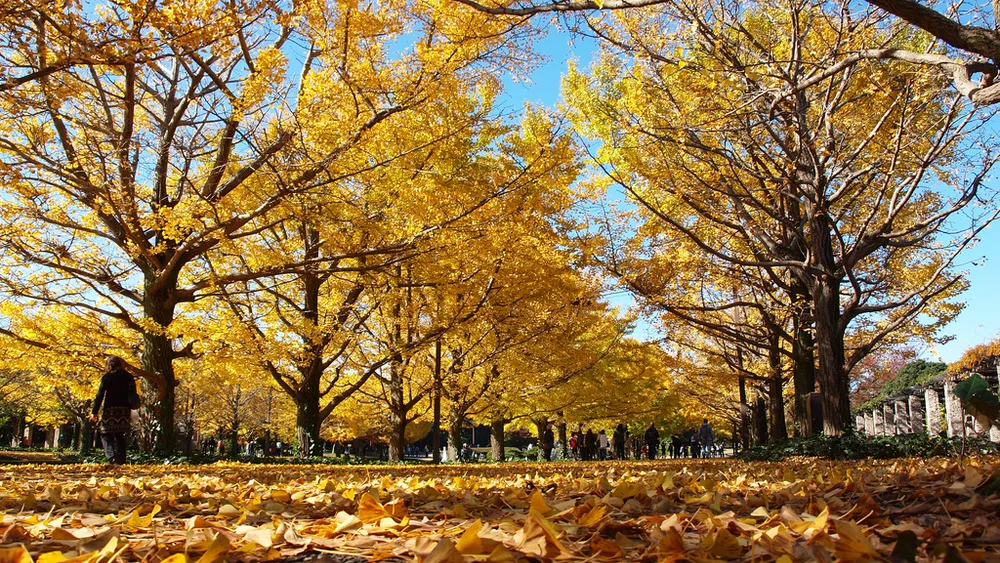
The park has two main ginkgo avenues. For the 300-metre Katarai avenue, where the tree canopies arch together, ride the JR Chuo Line to Tachikawa and change onto the Ome Line for one stop to Nishi-Tachikawa; it is about a two-minute walk from the station to Nishi-Tachikawa Gate and roughly 730 metres inside to the avenue. For neatly trimmed double rows flanking a water channel, pick the 200-metre Canal avenue instead—it sits around 300 metres inside Tachikawa Gate, compared with roughly 1,000 metres on foot if you enter from Nishi-Tachikawa Gate. Keen photographers can link both avenues together, while anyone travelling with older relatives, young children or limited evening time should stick to the avenue nearest their gate. From Nishi-Tachikawa Gate to the Japanese Garden is still about 1.6 kilometres, so factor in the walk back before attempting all three.
Standard daytime hours from November to February are 09:30 to 16:30. Regular admission is ¥450 for high-school age and above, ¥210 for visitors aged 65 and over with proof of age, and free for junior-high-school age and younger. In 2026, the Autumn Night Walk runs from 29 October to 29 November, with lights switched on at 16:30, switched off at 20:30 and the park closing at 21:00. Late arrivals should enter via Nishi-Tachikawa Gate or Tachikawa Gate, where evening ticket sales continue until 20:15. A standard park ticket covers the illuminated ginkgo avenues on their own, so you can visit the Japanese Garden during daylight, leave the inner garden before 16:00 and walk over to the avenues for the lights.
Evening entry to the Japanese Garden requires a separate ticket. Advance online garden-only tickets go on sale a week ahead at ¥1,200 for adults and visitors aged 65 and over, ¥600 for elementary and junior-high-school students, and free for pre-school children. Combined online bundles including park admission cost ¥1,600 for adults and ¥1,410 for visitors aged 65 and over. Same-day on-site tickets cost ¥1,300 for adults and ¥700 for elementary and junior-high-school students, cash only, and are not sold if the online allocation sells out. If you have already seen the garden in daylight and want to keep costs down, spend your post-sunset hours along the avenues instead. To save on walking, an evening shuttle runs between Nagame no Terrace and Nihon Teien-mae (Japanese Garden) for ¥400 one way for adults and ¥200 for elementary and junior-high-school students, cashless payment only, with wheelchairs and pushchairs folded to board. The first shuttle leaves Nagame no Terrace at 17:30 and the last departs Nihon Teien-mae at 20:30; if you queue after the final light cycle, keep enough energy in reserve to walk back to the exit.
On weekends and public holidays from 14 to 29 November 2026, the park operates a north-to-south one-way system along Katarai avenue between 16:30 and 20:30. For the evening lights, walk over to the Keiryu Square Restaurant side first and follow the avenue towards Akishima Gate. If you enter via Nishi-Tachikawa Gate with only enough time for a quick out-and-back stroll, arrive earlier while two-way daytime access is open, or visit Canal avenue near Tachikawa Gate instead. Two-way access remains in place in rainy weather.
On 19 November 2026, park staff reported that both Canal and Katarai avenues had moved past peak after wind and rain, while the ginkgos in the Wanpaku Yugu play area were still at their best. Visitors with children can shift their route towards the play area, and those after autumn maples should fit the Japanese Garden into daylight hours. If your goal is full yellow canopies overhead, check the latest foliage updates for how many leaves remain before committing to Nishi-Tachikawa. For map-based routes linking the park's gates, see our Showa Kinen Park autumn routes guide.
Sapporo: Aim for Kita 13-jo Gate and Line Up a Sheltered Backup
Hokkaido University lists the usual peak for its Sapporo campus ginkgo avenue as late October to early November. Kita 13-jo Street stretches about 380 metres and is lined with roughly 70 trees; walking in via Kita 13-jo Gate from Kita 12-jo Station on the Sapporo underground's Namboku Line puts the avenue at the very start of your visit. If you are staying near Sapporo Station, you can enter through the Main Gate, follow the north-south campus spine past the university museum and turn east down the avenue to exit. Walking from Sapporo Station avoids an underground transfer, whereas in cold snaps with rain or wet snow, ducking in and out via Kita 12-jo Station keeps exposure short.
In 2026, the university enforced vehicle restrictions—including bicycles—at Kita 13-jo Gate from 09:30 to 21:30 on 31 October and from 09:30 to 20:30 on 1 November. Sightseeing vehicles are barred from entering the campus on ordinary days as well, so arrange drop-offs outside the gates and avoid using the Hokkaido University Hospital outpatient car park. For wide autumn views on weekdays, aim for sunny morning light and leave room along the road for students, staff and campus traffic. If you visit for the evening event, walking off campus to the underground station afterwards is more practical than waiting for a car at restricted junctions. For detailed routes and extra campus stops, pair this with our Hokkaido University ginkgo avenue guide.
If temperatures plunge on the day, make the Hokkaido University Museum in the same area your anchor stop. It usually opens from 10:00 to 17:00 with free admission, closing on Mondays—or staying open on a Monday public holiday and closing on the following weekday instead. Tour the galleries first and save the tree-lined avenue for a short midday walk when rain or snow eases, so anyone in your group who feels the cold is not left waiting by the entrance during photos. If you fly out of New Chitose Airport the next morning, schedule this half-day the afternoon before and stick to brief stops around Sapporo Station after check-out. In Hokkaido, dry, bright daylight is the most valuable window you have; if an early start brings icy pavements, shifting your time slot beats forcing your way down the whole avenue.
Nagoya: Central Park or Inazawa Sobue
If you only have an hour in central Nagoya, enter Tsuruma Park through its main gate via JR Tsurumai Station or Exit 4 of Tsurumai Station on the underground Tsurumai Line. Walk in across the front plaza and follow the park map towards Aki-no-ike Pond to take in a mix of tree species along the paths. Staying right beside the station makes it easy to cut the walk short if the weather turns before riding back into the city centre. The Japan Meteorological Corporation's 4 November forecast put Nagoya's city ginkgo peak at 16 November; even when urban colour is showing, views here consist mainly of scattered trees along walkways and pond edges. If one traveller wants a stroll while another prefers somewhere to sit and rest, Tsuruma Park is far easier to manage than a trip out to a regional festival.
For a landscape shaped by commercial ginkgo orchards, take a Meitetsu train from Meitetsu Nagoya towards Meitetsu Ichinomiya, change onto the Bisai Line bound for Tsushima and get off at Yamazaki Station. Sobue's ginkgo trees weave through quiet lanes, Yusenji Temple and farmland; walking from Sobue Ginnan Park to Yusenji Temple takes you past working groves and ancient trees over 200 years old. The 29th Sobue Yellow Leaf Festival in 2026 runs from 21 to 29 November, though the evening illuminations at Yusenji Temple and the park only run until 28 November, from 17:00 to 20:00—so plan the final day, 29 November, for a daytime visit. When browsing the on-site photo gallery published by the local commerce association on 22 November, check which spot each frame shows before deciding whether to start near the temple or the park.
If driving, note that the paved car park at Sobue Ginnan Park on the east side of Yamazaki Station closes to general visitors from 19 November to 3 December for festival set-up and dismantling, with organisers directing drivers to the temporary car park at Nishijima Ground. Taking the Meitetsu train to Yamazaki Station drops you straight into the festival area. Check the return Bisai Line timetable back to Meitetsu Ichinomiya on your phone before deciding whether to stay until the illuminations switch off at 20:00. If you arrive in Nagoya from Tokyo with luggage the same day, store your bags before heading out of town; if you arrive late, stick to Tsuruma Park, or shift Sobue to the following morning and save a short city stop for your departure day.
Kyoto's Nishi Hongan-ji by Day, Osaka's Midosuji into the Evening
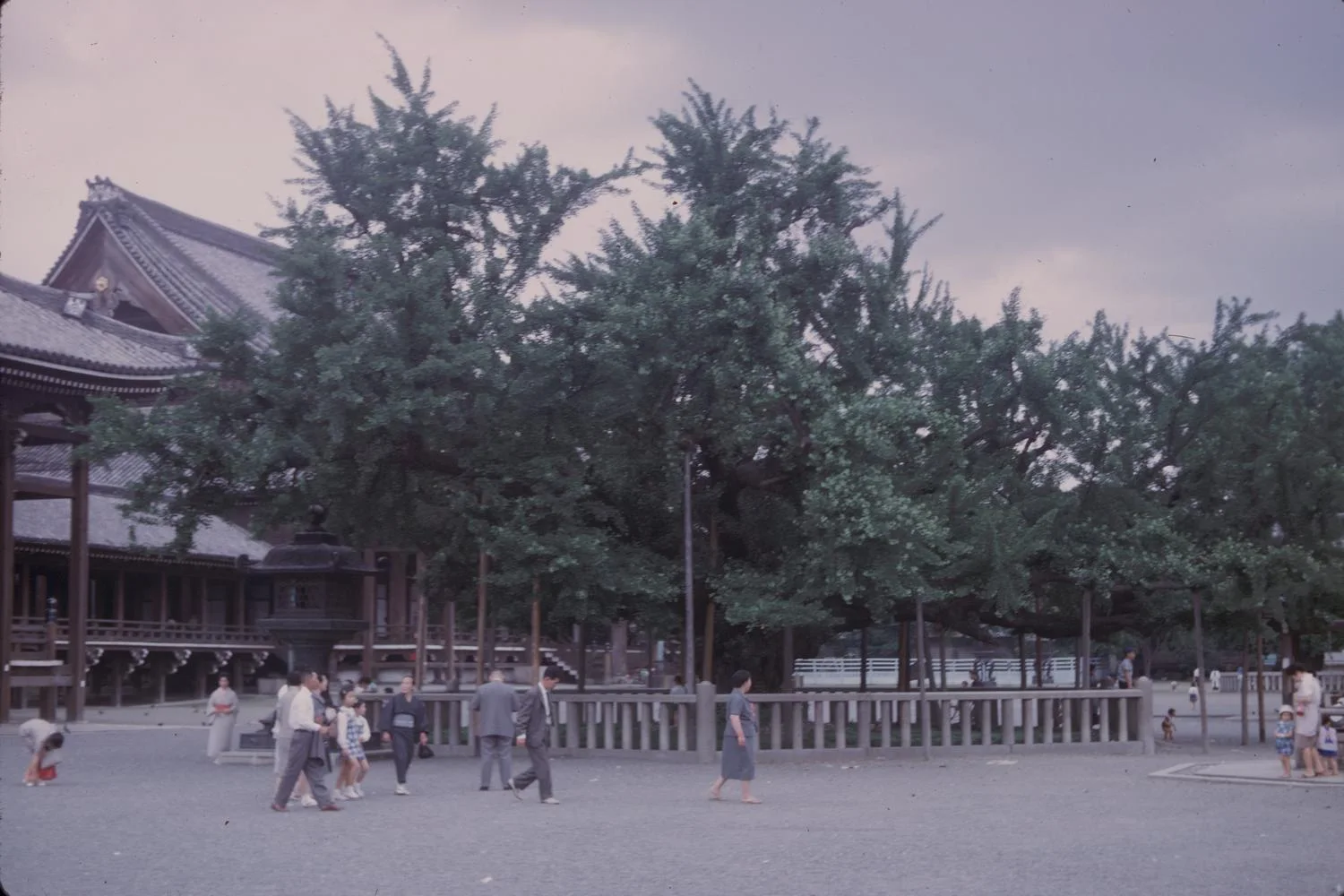
Standing before Goeido Hall at Nishi Hongan-ji, the roughly 400-year-old giant ginkgo spreads its branches horizontally—known locally as Sakasa Icho (the "upside-down ginkgo") and designated a Kyoto City Natural Monument. From Kyoto Station, take City Bus 9, 28 or 75 to Nishi-Hongan-ji-mae, or board Keihan Bus 311 or 312 from the Hachijo Exit to Nishi-Hongan-ji. On 22 November 2026, temple gates opened at 05:30 and closed at 17:00. Visiting early pairs easily with plans south of Kyoto Station; if you keep it as an afternoon backup, do not wait until after sunset in Higashiyama before crossing back to Horikawa-dori. To frame its wide canopy against the eaves of Goeido Hall, step back into the open courtyard, and keep main walkways clear for worshippers whenever a service is underway.
Nishi Hongan-ji works well when you combine temple worship with ginkgo viewing in a single stop. In light rain, admire the tree in the courtyard first and step inside the hall afterwards to shorten your time outdoors. If your group prefers tree-shaded paths and would rather not linger quietly inside a temple complex, set aside daylight hours for Kyoto Gyoen and city ginkgo spots and slot Nishi Hongan-ji into your arrival or departure day via Kyoto Station. On a three- or four-day Kansai itinerary, there is no need to cram ancient temple trees and every major garden into one morning: choose one silhouette you truly want to see and leave the afternoon for the neighbourhoods already on your list. Since the same 2026 weather forecast placed Kyoto's red maples later, travellers hoping for both colours in one day should pick gardens already showing red in recent photos before travelling across from Kyoto Station to Higashiyama.
If Nishi Hongan-ji's canopy is already thinning, Kyoto Gyoen National Garden offers several alternatives. A 13 November 2026 Ministry of the Environment update noted the large ginkgo at the Ichijo Residence Site turning yellow, alongside the tall tree at the Gyokado Site and the row of ginkgos just north of the Kan'in-no-miya Residence Site. For the southern end, ride the Karasuma Line to Marutamachi Station and take Exit 1 towards the Kan'in-no-miya Residence Site, where the trees stand immediately to the north; the Ichijo Residence Site lies closer to Imadegawa at the northern end, so picking one side cuts down the distance spent wheeling pushchairs over gravel paths. Kyoto Gyoen's grounds are free and open 24 hours, while the free exhibition rooms at Kan'in-no-miya generally admit visitors from 09:00 to 16:00 (closing at 16:30, closed Mondays except on public holidays). If rain arrives while you are at the south end, duck inside the exhibition rooms and return to Marutamachi Station rather than looping right around the park.
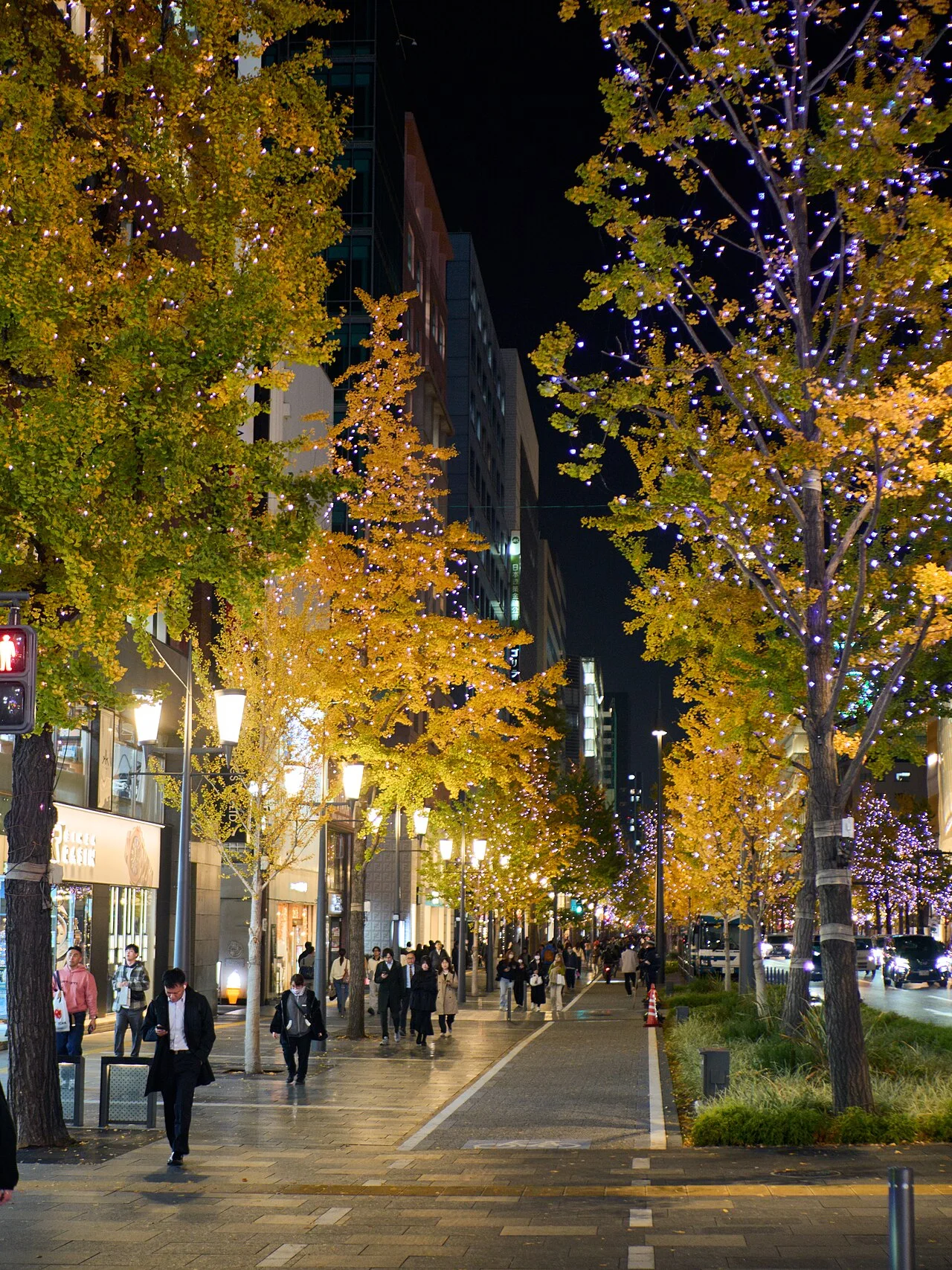
In Osaka, Midosuji works nicely split between daytime and evening. If you are staying in Yodoyabashi or Hommachi, photograph the trees framed between office towers by day and ride the Midosuji Line back to the same stretch at night for the lights. From a Namba base, focus on the section between Shinsaibashi and Namba so you can hop on at the nearest station back to your hotel once your feet tire. In 2026, the Midosuji Illuminations run from 3 November to 31 December, lit daily from around 17:00 until 01:00 the next morning along roughly four kilometres from the Hanshin-mae intersection in the north to the Namba Nishiguchi intersection in the south. If you rely on the underground to get back, check the last-train times separately rather than assuming services run until the 01:00 lights-out. In wet weather, browse a covered shopping arcade first and step one block onto Midosuji when the rain eases; use our Midosuji ginkgo and illumination walk to pick your start and finish stations.
For ginkgos set against stone ramparts or moat water, choose Osaka Castle Park by day and save Midosuji for after dinner. The park's 2026 autumn festival map put peak ginkgo viewing from late November to early December, distinguishing clearly between the East Outer Moat and the Honmaru inner bailey. Entering the park's south side from Exit 1 or 3-B of Morinomiya Station and walking along the East Outer Moat to JR Osakajokoen Station suits anyone focused solely on the trees. If companions want to climb the castle keep as well, budget extra time to walk into Honmaru and buy museum tickets. To link this with Midosuji afterwards, return to Morinomiya and ride the Chuo Line to Hommachi, keeping a clear break between castle sightseeing and evening lights. After rain along the East Outer Moat, stay on the paved footpath rather than stepping onto slick grassy slopes for low water-level angles.
Yokohama Half-Day Harbour Walk: Cut Inland When the Wind Picks Up
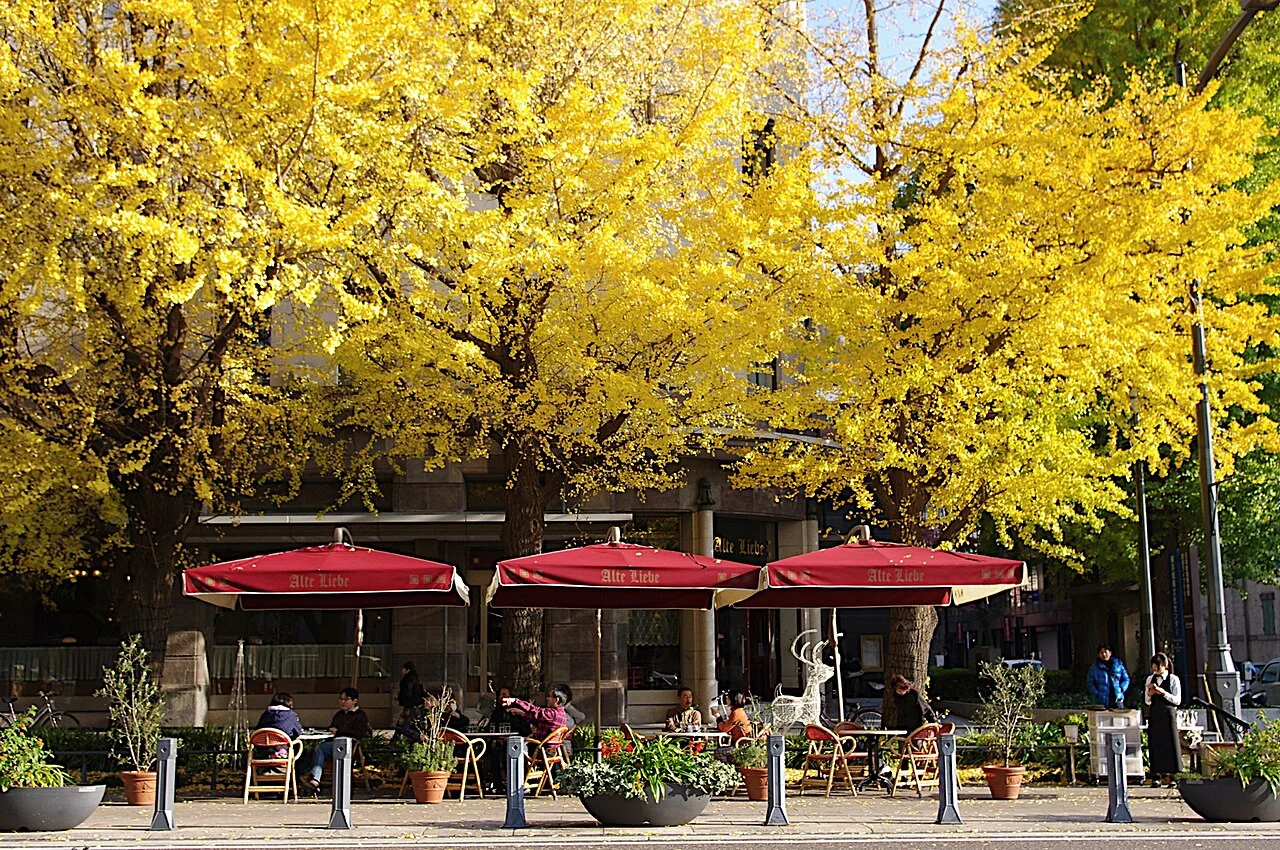
Stepping off the Minatomirai Line at Nihon-odori Station places you straight on the avenue linking Yokohama Park with the waterfront. Nihon Odori is lined on both sides with ginkgos framed by heritage Western-style buildings; walk from the Yokohama Park end towards the harbour and linger wherever colour is thickest. Continuing towards Yamashita Park brings you to the seaside boulevard's ginkgo row. Between Yamashita Park and the Yokohama Doll Museum, Porin Bridge offers an elevated vantage point over the treetops, and anyone tiring of walking can continue along the pavement to Motomachi-Chukagai Station rather than backtracking.
For a convenient indoor stop on a half-day around Nihon Odori, the Yokohama Archives of History sits roughly two minutes on foot from Exit 4 of Nihon-odori Station. It generally opens from 09:30 to 17:00 (last entry 16:30) and closes on Mondays, moving to the next weekday after a public holiday. When only Galleries 1 and 2 are open, standard admission is ¥200 for high-school age and above and ¥100 for elementary and junior-high students, rising to ¥500 and ¥250 during special exhibitions—check which schedule applies before setting off. Once any rain clears, step back out onto Nihon Odori and continue to Yamashita Park; if dusk is already falling when you leave the museum, skip the windiest waterfront stretch and take the train back from Nihon-odori.
If all you care about is canopy density, pick between Yokohama and central Tokyo based on current leaf reports rather than squeezing both cities into one day. Yokohama's historic streetscapes and ginkgos sit close to the station, making a short stroll down Nihon Odori ideal on your final morning before returning to Tokyo. If sea gusts along Yamashita Park start turning umbrellas inside out, stay in the shelter of Nihon Odori and turn into Chinatown for lunch instead. Conversely, if you are staying in Minato Mirai, stroll down to Yamashita Park at dusk and ride back from Motomachi-Chukagai Station instead of retracing the entire waterfront for night views. For exact station, bridge and street layouts, check our Yokohama ginkgo walk.
Fukuoka: Arrive Later and Walk from Maizuru Park's Ninomaru to Ohori
The Fukuoka Regional Headquarters' long-term average for its sample ginkgo is 20 November, whereas the Japan Meteorological Corporation's 2026 city forecast placed Fukuoka's peak on 30 November. Even neighbouring sites should be checked individually: Maizuru Park's seasonal guide highlights its large ginkgo in the Ninomaru bailey, so aim straight for Ninomaru on a late-autumn trip before deciding whether to climb up towards the Honmaru stone walls. Coming from Tenjin, enter from the Akasaka underground station side; if you are having lunch in Ohori Park, cross over from Ohorikoen Station or the eastern side of the lake. Nishitetsu Bus stops including Fukuoka-jo / Korokan-mae and Fukuoka Art Museum East Exit also leave you five to eight minutes on foot from the park.
Because Ohori and Maizuru parks sit side by side, you can cover a short loop through both in a single outing. When conditions are dry and the stone steps have good grip, climb into the castle ruins for ginkgo shots against the stone walls; after rain, stay on the lower path from Ninomaru across to Ohori Park. If winds whip off the lake, the galleries at the Fukuoka Art Museum easily fill half a day: its 2026 schedule lists standard hours of 09:30 to 17:30, about a ten-minute walk from Exits 3 and 6 of Ohorikoen Station. The Airport Line (Kuko Line) connects straight back to Tenjin, Hakata Station and the airport, so on your departure day you can leave bags at whichever station suits your onward train or flight and fit in a short park walk.
Keep a Flexible Half-Day Open Before You Travel
On a five-day Tokaido corridor itinerary, ring-fence at most two fair-weather half-days specifically for ginkgos. If your route takes in Tokyo, Nagoya, Kyoto and Osaka, slot Meiji Jingu Gaien into any flexible half-day in Tokyo, venture outside Nagoya only when festival dates and weather line up, and keep the rest of your Kyoto and Osaka plans intact. Because Kyoto and Osaka have nearly identical peak forecasts in late November, basing yourself in one city and taking intercity trains across saves changing hotels just for a single tree-lined street. With older companions or young children, a two-night Osaka stay lets you visit Kyoto in the morning and return for illuminated walks on whichever stretch of Midosuji lies closest to your hotel.
Before scrolling through leaf photos, agree on the kind of scene everyone wants most. For unbroken golden canopies, the foliage still clinging to branches and the spacing of the trees matter far more than leaves on the ground. For yellow carpets, half-bare branches still work well, though puddles, street sweeping and paving surfaces alter the look immediately. Ancient single trees are solo centrepieces: even when half-green and half-gold, framing the full trunk against a temple courtyard gives travellers interested in historic timber architecture plenty to enjoy. Choosing between parks, temples and city avenues also determines whether an indoor fallback sits nearby if rain arrives, saving you from switching cities every time the forecast shifts.
After wind and rain, sole grip matters more than water-repellent uppers, especially along pavements where crushed ginkgo nuts mix with wet leaves. Crouch along the edge of the walkway for low-angle carpet shots so pedestrians can keep moving. On narrow pavements at night, brace yourself firmly or raise your ISO rather than blocking the path with a tripod. If bright yellow leaves catch the light from beneath a sheltered arcade, grab a few quick frames before stepping indoors to dry your soles. For anyone pushing a pushchair, the short route from Tachikawa Gate to Canal avenue at Showa Kinen Park—or stepping off the bus right outside Nishi Hongan-ji in Kyoto—gives you a clean cut-off point if you need to wrap up early.
When your hotel dates are locked in and heavy wind or rain moves in, start by swapping morning and afternoon stops within the same area: spend a wet Tokyo morning inside the Shinjuku Gyoen Greenhouse and save Gaien for when the skies clear, or shift a Kyoto temple visit to the next dry day while browsing a covered Osaka arcade right by your station. Keep any pre-booked indoor admission slots as scheduled, hold one movable morning for natural light, and if rain lingers into the afternoon, stay in town so you can step straight out to the nearest ginkgo avenue as soon as a bright gap appears.
A few useful answers
Do ginkgos turn one to two weeks later than maples?
It depends on the site and the species. For 2026, the Japan Meteorological Corporation forecast Kyoto's ginkgo peak for 30 November and red maples for 14 December, whereas in Tokyo the two forecasts sat just one day apart—and individual parks and streets within the same city move at their own pace.
For Tokyo in late November 2026, should I visit Meiji Jingu Gaien or Showa Kinen Park first?
Put Meiji Jingu Gaien first if you want full canopies along the main avenues. By 19 November, Showa Kinen Park had already marked both Canal and Katarai avenues as past peak, though the play area still held yellow ginkgos and the Japanese Garden offered autumn maples.
Do I need a Japanese Garden ticket to see the illuminated ginkgos at Showa Kinen Park?
No. Both ginkgo avenues are covered by standard park admission (¥450 for high-school age and above). A separate ticket is only required to enter the Japanese Garden for its evening illumination after 16:30.
Which dates should I book accommodation for if I am planning a 2027 ginkgo trip?
Hokkaido University cites late October to early November as its typical peak. For central Tokyo and Kansai, look at late November stays with at least one flexible daytime slot, and wait for annual event notices before locking in illuminations or festival nights.
Where is easiest in Kansai with only half a day left in late November?
In Kyoto, Nishi Hongan-ji connects directly with Kyoto Station and lets you step inside the hall if it rains. If you are staying in Osaka, pick a single stop on the Midosuji Line—Yodoyabashi, Hommachi or Shinsaibashi—and walk from there without wasting time on transfers.
Official information and references
Sources used in this guide.
- Japan Meteorological Corporation: 2026 Third Autumn Maple and Ginkgo Forecast
- Japan Meteorological Agency: Nationwide Ginkgo Sample-Tree Observations and Records
- Akita Local Meteorological Office: 2026 Phenological Observations
- Fukuoka Regional Headquarters: Ginkgo Climate Averages and Observations
- Tokyo Metropolitan Government Bureau of Construction: 2026 Jingu Gaien Ginkgo Illumination
- Meiji Jingu Gaien Tennis Club: Traffic Restrictions During the Ginkgo Illumination
- Meiji Jingu Gaien: Ginkgo Avenue
- Tokyo Metro: Gaiemmae Station Exits and Facilities
- Tokyo Metro: Aoyama-itchome Station Exits and Facilities
- Ministry of the Environment: Shinjuku Gyoen Visitor Guide and Opening Days
- Ministry of the Environment: Shinjuku Gyoen Plants and Gardens
- Showa Kinen Park Foliage Report: 12 November 2026
- Showa Kinen Park Foliage Report: 19 November 2026
- Showa Kinen Park: Opening Hours and Schedule
- Showa Kinen Park: Autumn Night Walk 2026 (Admission, Night Tickets and Shuttle)
- Hokkaido University: Public Campus Facilities and Typical Ginkgo Avenue Peak
- Hokkaido University: Autumn 2026 Traffic Restrictions on Kita 13-jo Street
- Visit Sapporo Official Guide: Hokkaido University Walking Route
- Hokkaido University Museum: Opening Hours and Visitor Information
- Tsuruma Park: Main Gate and Underground Exit Map
- Sobue Town Chamber of Commerce and Industry: 2026 Yellow Leaf Festival and On-Site Photos
- Aichi Now Official Tourism Guide: 2026 Sobue Yellow Leaf Festival Access and Illuminations
- Nishi Hongan-ji: Giant Ginkgo on the Temple Grounds
- Nishi Hongan-ji: Gate Opening Hours and Worship Schedule
- Nishi Hongan-ji: Access Guide
- City of Osaka: 2026 Midosuji Illuminations and Festival of the Lights Dates
- Yokohama Official Visitors' Guide: Autumn Foliage on Nihon Odori and Yamashita Koen-dori
- Maizuru Park Management: Seasonal Information on the Ninomaru Giant Ginkgo
- Maizuru Park: Underground, Bus Access and Parking Information
- Fukuoka Art Museum: 2026 Opening Schedule and Exhibition Calendar
- Ministry of the Environment: Shinjuku Gyoen Gate Access and Walking Routes
- Ministry of the Environment: Kyoto Gyoen Ginkgo Status (13 November 2026)
- Ministry of the Environment: Kyoto Gyoen Kan'in-no-miya Residence Site Exhibition and Garden
- Ministry of the Environment: Kyoto Gyoen Opening Hours and Visitor FAQ
- Ministry of the Environment: Kyoto Gyoen Underground and Entrance Access
- Osaka Castle Park: 2026 Autumn Festival Foliage Map
- Osaka Castle Park: Access from Morinomiya Station Exits
- Yokohama Archives of History: Access, Opening Hours and Ticket Types
- Meiji Jingu Gaien: Meiji Memorial Picture Gallery Conservation Closure Until End of May 2027
- Showa Kinen Park: One-Way System on the Ginkgo Avenue During Autumn Night Walk
- Cabinet Office of Japan: National Holidays
- Japan Meteorological Agency: 2025–2026 Sample Ginkgo Yellow-Leaf Table