Osaka's Midosuji ginkgo trees typically turn yellow from late November to early December. Head above ground at Yodoyabashi, Hommachi or Shinsaibashi for a one-stop stroll, complete with 2026 illumination dates, underground fares and wet-weather routes.
- Region & Focus
- Osaka
- Reading Scope
- 23 min read · 11 chapters · 6 Q&As
- Official Verification
- 24 official sources checkedUpdated 22 November 2026
- Key Topics
- SeasonsNeighbourhoodsRail travel
Chapter Route Map (tap any stop)
- Visiting in late November: check how much foliage remains on the branches
- Yodoyabashi to Hommachi: one stop is plenty
- Shinsaibashi to Namba: save dinner for the south end
- Starting from Umeda: the northern end of the illuminations is outside Hanshin
- 2026 illuminations run until 31 December, lit until 01:00
- Save sunlit blocks for daytime photography
- Combining Nakanoshima projection mapping with Midosuji
- Pick your Osaka Castle exit first to link both spots smoothly
- Underground day passes and step-free exits for pushchairs
- Moving underground when wind and rain pick up
- Choosing a hotel by your departure line and exit
- Quick Q&A
If you only have one window in Osaka for the Midosuji ginkgo trees, walk from Yodoyabashi to Hommachi. Late November to early December is the usual peak for golden foliage, offering pockets of midday sunlight between the office towers and an easy underground ride whenever you are ready to stop. To combine shopping, dinner and evening lights, walk from Shinsaibashi to Namba instead. In 2026, the Midosuji illuminations run until 31 December, switching on around 17:00 each night. Staying in one neighbourhood until dusk is far more relaxing than racing the full four kilometres before dinner.
Visiting in late November: check how much foliage remains on the branches
Osaka Metro's travel guide places the Midosuji ginkgo season from late November to early December. If you are booking flights specifically for the autumn foliage, use the end of November as your anchor and pick hotel dates that leave a couple of afternoons flexible. Should the morning you visit Osaka Castle turn out sunny, shift Midosuji to that same afternoon. If your trip also includes Kyoto or Nara, keep outdoor days in separate cities apart so you have room to shuffle plans when the weather turns. For a weekend-only stay, save the outdoor walk for around lunchtime and head into the shopping districts after dark.
Recent on-the-ground photos are far more useful for choosing a stretch than citywide foliage forecasts. When searching online in Japanese for Midosuji ginkgo, add Yodoyabashi or Hommachi and look for dated shots that show street signs or intersections. A close-up of a single branch tells you very little; check wider views of the avenue to see how full the canopies still are. Low side light can make a handful of leaves look brilliantly yellow, and evening lights tint the foliage too, so look at daytime street views before picking an afternoon route. If you cannot find a fresh photo for one junction, earmark two neighbouring stations as backups so you can move straight on to the second.
Come above ground at Yodoyabashi; if the canopies still hold a mix of yellow and green, take your time along the sunlit side of the street rather than hopping stations in search of uniform gold. If a carpet of leaves already covers the pavement while only bare twigs remain overhead, frame the fallen leaves against stone facades by day, then return at dusk for the lines of string lights stretching down the boulevard. You are especially likely to see this after rain or strong winds; treat the remaining leaves as foreground detail and walk a single block before deciding whether to carry on. Even if you arrive a few days past peak, a brief look leaves the rest of your afternoon free for Nakanoshima or indoor shopping.
From afar, the ginkgos read as one unbroken avenue, though on foot they are divided by cross streets, building entrances and varying canopy heights. The City of Osaka maintains individual records for the roadside trees along Midosuji, replacing trees when necessary and planting male ginkgos for new specimens. When photographing the avenue, pick a cluster ahead with matching canopy heights and stay on the same pavement until shadows shift off one side, or cross to frame trees of contrasting sizes. There is no admission fee for the foliage walk—simply step straight onto the pavement.
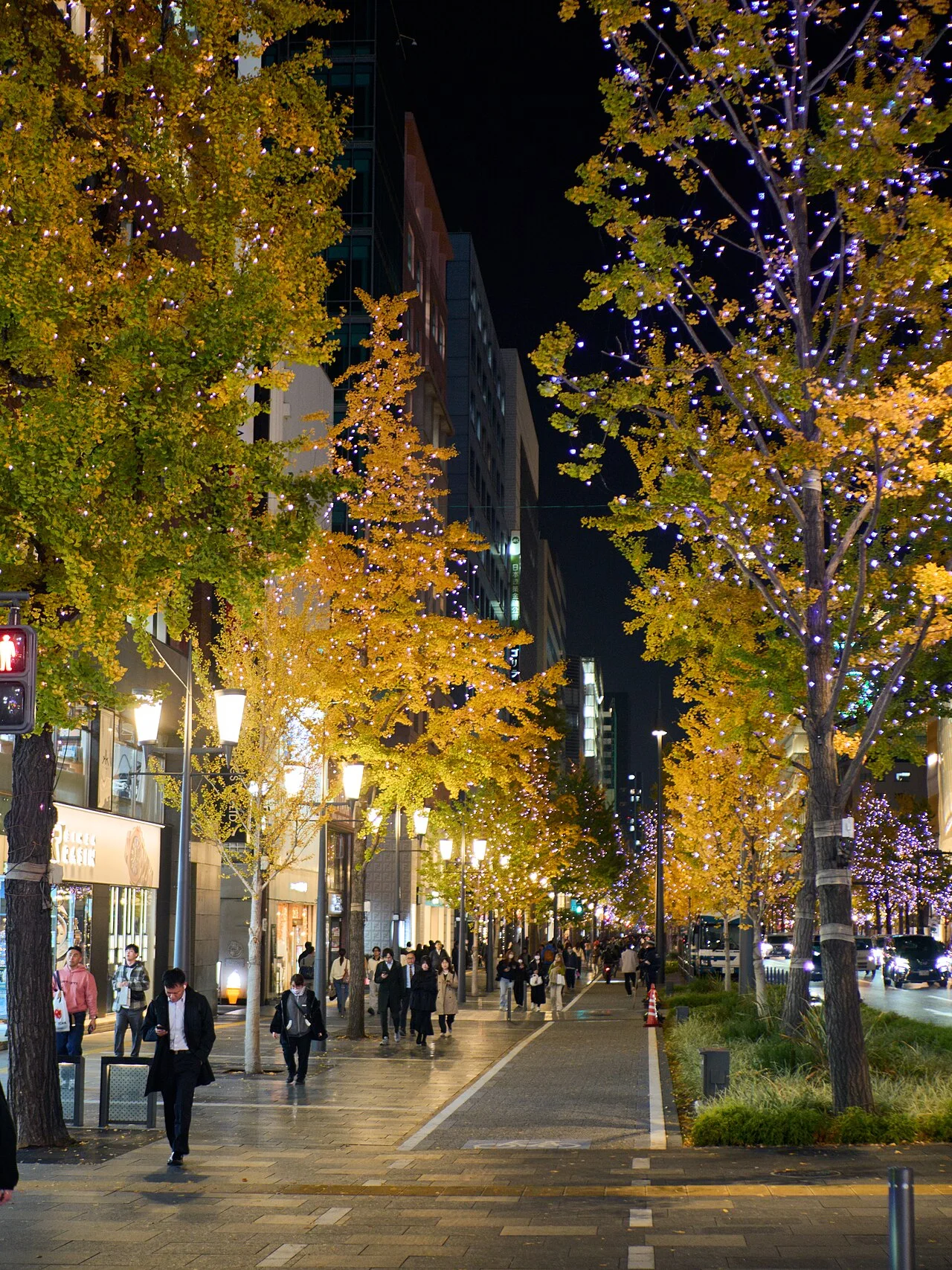
Osaka's Midosuji ginkgo trees typically turn yellow from late November to early December. Head above ground at Yodoyabashi, Hommachi or Shinsaibashi for a one-stop stroll, complete with 2026 illumination dates, underground fares and wet-weather routes.
Yodoyabashi to Hommachi: one stop is plenty
Alight at Yodoyabashi Station (M17) on the Midosuji Line and follow signs for Exit 1 towards Yodoyabashi and Nakanoshima. Once at street level, cross the bridge north to Osaka City Hall if you want riverside views, or turn south down Midosuji from the junction south of the bridge if you are here for the trees. Walk several blocks on one side before crossing at traffic signals for a wider view of the opposite canopy, rather than waiting at every pedestrian crossing across the broad carriageway. From the first train on 15 December 2026, Exit 9—which connects to an adjacent building—will close for reconstruction, so winter itineraries should use another exit as a meeting point.
Heading south from Tosabori-dori towards Hommachi takes you past offices, cafes and buildings with preserved historic facades. Near Hommachi, the entrance steps of Kita-Mido mark one of the landmarks behind the avenue's name: according to the Osaka Convention & Tourism Bureau, Midosuji originally linked the temples Kita-Mido and Minami-Mido. Both temples and the sculptures along the pavement make reliable reference points, allowing companions coming from different stations to meet on the same side of a block. Midosuji Sculpture Street runs all the way from Yodoyabashi to Shinsaibashi—just admire the pieces along your route rather than trying to tick off every single one before midday light fades.
When heading back underground, Exit 7 of Hommachi Station (M18) brings you near Hommachi-dori by The St. Regis Osaka. If you start at Hommachi instead, walking north towards Yodoyabashi connects easily to Nakanoshima, while walking south passes near Minami-Mido before reaching Nagahori-dori and Shinsaibashi. The Chuo, Yotsubashi and Midosuji lines all share Hommachi Station across a sprawling complex; when transferring from another line, note down both the Midosuji side and your exit number, or the nearest stairs may surface several blocks out of your way.
Allow 40 to 60 minutes for this single stop, leaving a margin for admiring the trees and waiting at traffic lights. When side light illuminates a row of trees on one pavement, linger there for photos and grab a coffee right on the avenue instead of detouring down a side street. Office workers fill the surrounding streets at weekday lunchtimes, so larger groups hoping to sit together should dine slightly outside peak hours. Remember that reaching street level from the train takes extra minutes for lifts, ticket gates and crossings; if you are meeting friends to start shooting straight away, pick an outdoor landmark rather than the platform. For mixed-pace groups or anyone unfamiliar with the station layout, set a restaurant near Hommachi as the finish line so everyone can arrive in their own time.
Shinsaibashi to Namba: save dinner for the south end
The South Ticket Gate at Shinsaibashi Station (M19) connects directly to Daimaru Shinsaibashi, while Exit 8 leads into Hotel Nikko Osaka. duck into Daimaru if the rain picks up; in dry weather, surface near Nagahori-dori and follow Midosuji south towards Dotonbori Bridge. Side alleys peel off towards Shinsaibashi-suji Shopping Arcade and Amerikamura. If you plan to return to the foliage after browsing the shops, keep Midosuji as your waypoint—once you step under the covered arcade roof, you have turned onto the indoor shopping route. Travellers with only one afternoon left can shop around Nagahori-dori first, then head south while daylight still holds.
Between Nagahori-dori and Dotonbori Bridge through Suocho, frequent side lanes let you slip into the shopping arcades whenever your legs tire. The City of Osaka has completed pedestrian improvements along parts of the side roads south of Shinbashi intersection, and sections of Midosuji's pedestrian space also carry cycle lanes. When pausing with a pushchair to photograph fallen leaves, pull into a pocket beside the tree beds wide enough for two people so cycle markings, department store entrances and foot traffic stay clear. Crowds thicken as you approach the river; for meet-ups, pick a named shopfront and step back out of the main flow while waiting.
Midosuji crosses the canal at Dotonbori Bridge. To see the Glico sign, turn east along the riverside walkway towards Ebisu Bridge; to stick with the ginkgos, stay on Midosuji south across Sennichimae-dori to Namba. Exit 14 of Osaka Metro Namba Station (M20) emerges right by Dotonbori amid dense city lights and traffic, making it just as convenient for walking north back to Shinsaibashi. If dinner is on the north side of Dotonbori, walk north from Namba; if you are eating near Nankai Namba Station, walk south from Shinsaibashi to save crossing the bridge twice. You can dip into the arcade for takoyaki as a snack, or pin a sit-down restaurant on your map in advance and end your walk at the closest junction.
Nankai Namba Station, Kintetsu and Hanshin's Osaka-Namba Station, JR Namba Station and the underground Namba Station all have separate entrances. When arranging to meet friends at Namba, specify both the railway operator and the exit. The Namba Nishiguchi intersection marks the southern end of the illuminations; if you are staying around the Nankai complex and need Takashimaya or the airport line, follow signs for Nankai before deciding whether to walk as far as the station plaza. Family members arriving from the north who simply want lights and a bowl of noodles can surface at Exit 14 and start the evening right there.
Starting from Umeda: the northern end of the illuminations is outside Hanshin
The official northern starting point of the illuminations is the Hanshin-mae intersection. Coming from JR Osaka Station or Hankyu Osaka-umeda Station, follow signs for the Hanshin Umeda Main Store; Hankyu sits on the far side of the station complex, and merely following signs for Osaka-umeda can add a long underground detour. Travelling south from Shin-Osaka on the Midosuji Line, ride straight through to Yodoyabashi for afternoon foliage, and only alight at Umeda (M16) if you plan to browse its department stores or walk the illuminations from their very start.
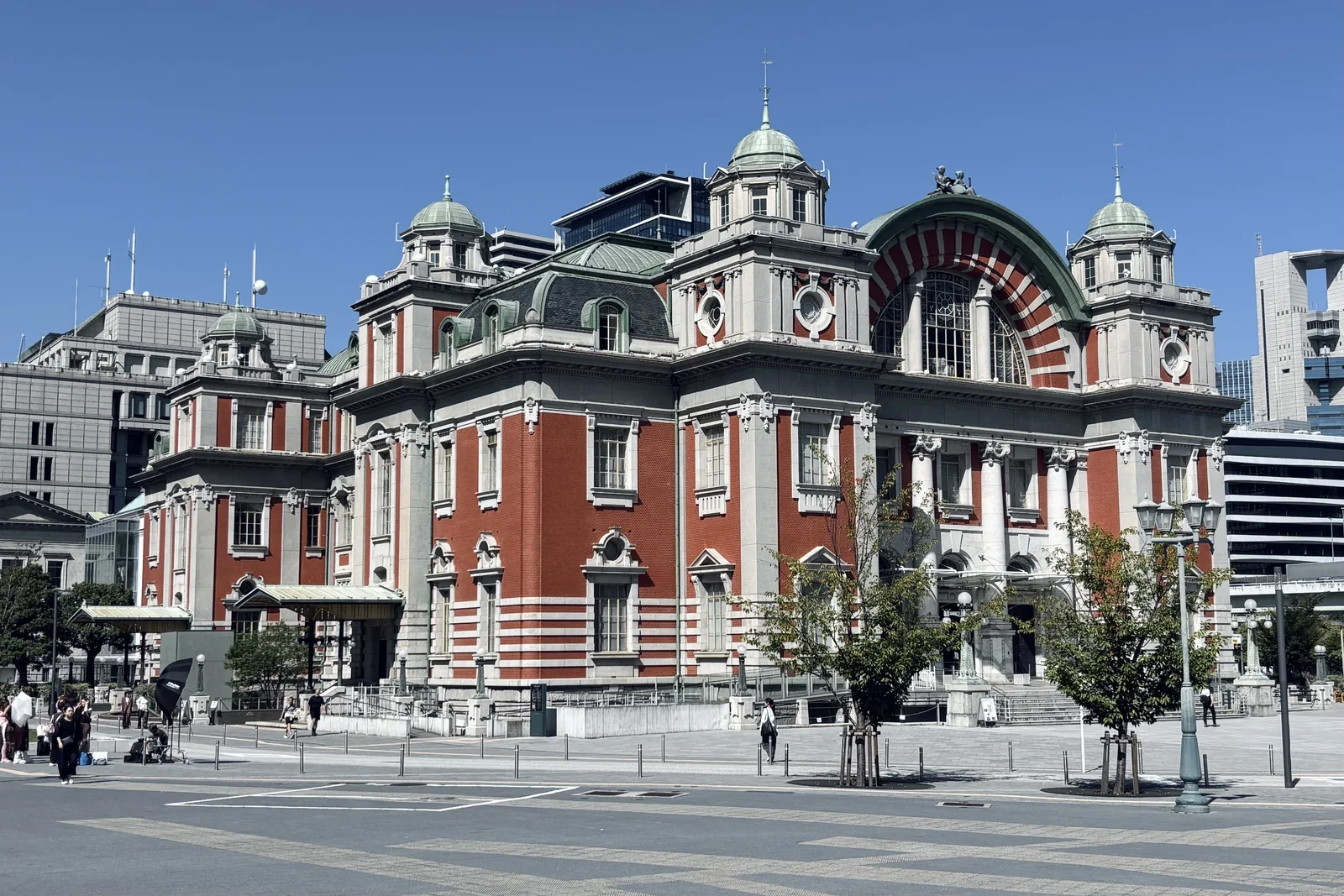
Bridges divide the northern stretch clearly. Heading south down Midosuji from outside Hanshin, you first cross Oebashi over the Dojima River onto Nakanoshima—where Osaka City Hall stands—and then Yodoyabashi Bridge over the Tosabori River before reaching the main tree-lined avenue towards Hommachi. If you only want this northern section, enter the underground at Yodoyabashi; if you are heading east to Osaka City Central Public Hall, turn left along the river right after the first bridge. Winter winds sweep across the open bridges, so keep gloves in your coat pocket and wait for companions or hot drinks in sheltered spots before or after crossing. To decide between the riverfront and the ginkgos, look out from Oebashi at dusk and let the sky make up your mind.
If you arrive from Shin-Osaka and drop your bags at a hotel near illumination time, starting at Umeda lets you combine department stores with the northern lights. If you arrive in the morning with clear skies, see the foliage between Yodoyabashi and Hommachi first and save shopping and dinner for after dark. Opened in 1937, Midosuji stacked a wide boulevard directly above the underground line along the same north-south axis, which is why you can cut a walk short at any station along the way. Walking the entire length means crossing many wide junctions, so allow half a day if you intend to take photos or browse shops. If you reach Yodoyabashi at a leisurely pace with time to spare, carry on south; if dinner time has crept up, catch the train straight to your restaurant's neighbourhood.
| What you want to see most | Start and finish | Easy adjustments along the way |
|---|---|---|
| Avenues of ginkgos and office architecture | Yodoyabashi (M17) to Hommachi (M18) | Cross the river from Yodoyabashi into Nakanoshima, or catch the Chuo Line at Hommachi towards Osaka Castle |
| Department stores, street lights and dinner | Shinsaibashi (M19) to Namba (M20) | Use the South Ticket Gate at Shinsaibashi to step into Daimaru, shortening the outdoor walk if it rains |
| The illuminations from the official north end | Hanshin-mae intersection to Yodoyabashi (M17) | Duck underground at Yodoyabashi if the bridge is windy, then ride the Midosuji Line south |
2026 illuminations run until 31 December, lit until 01:00
The 2026 Midosuji Illumination runs from 3 November to 31 December across roughly 4 kilometres between the Hanshin-mae and Namba Nishiguchi intersections, lit nightly from around 17:00 to 01:00 the next morning. Walking the pavements is free—simply come up from any station along the line. If you have a restaurant booked, pick a junction nearby for the lights beforehand and head to the station after eating. Even if someone in your group only wants twenty minutes outdoors, stepping outside the station closest to your hotel after dusk delivers a full slice of the illuminated boulevard.
You can also plan a single walk that transitions from daylight into evening. Start north from Hommachi shortly after 15:00 to photograph the leaf colour and architecture clearly, pause for a sit-down break, and return to the same stretch between Yodoyabashi and Hommachi just before 17:00. In rain, switch to Shinsaibashi and wait out dusk inside a department store. Cloud cover, ambient street lighting and the exact switch-on moment vary the mood each evening, so giving yourself ten spare minutes to watch the shift works better than gambling on a single minute of golden hour.
Because the lights stay on past midnight, plan your return around the actual timetable for your station and direction. On New Year's Eve in particular, it is easy to mistake the switch-off time for last trains; if you need to change lines across town, save your return departure on Osaka Metro's station timetable in advance and add walking time back to the ticket gates. With young children or older relatives, take a short stroll before dinner so you can head straight back to the hotel if the night turns cold. Organisers do not place temporary or event-only toilets along the avenue, so use restaurant facilities before stepping out to see the lights.
For trips spanning New Year, check the event names and dates carefully. The wider Festival of the Lights in OSAKA 2026 runs until 31 January 2027 with selected district events continuing from New Year's Day, whereas the Midosuji street illuminations themselves end after the 31 December session. If the boulevard lights are a priority, schedule them on an evening up to 31 December. Travellers arriving in January can still ride the Midosuji Line for shopping and look up the Area Programme listings on the official overview for displays that remain open. Groups with separate New Year's Eve countdown plans can meet briefly on Midosuji early in the evening before splitting up, avoiding slow searches through crowded plazas later on.
Save sunlit blocks for daytime photography
Midosuji runs roughly north to south. When the sun sits in the south, looking north usually keeps harsh glare out of your lens; stand slightly back from a junction to survey the whole block of foliage ahead. If backlighting catches the edges of a canopy, frame it against glass, stone walls or sky while keeping the carriageway minimal. Tall buildings slice the afternoon sun into shifting pockets, so shoot whenever light hits the trees in front of you rather than waiting for an entire corner to brighten.
Where the canopies rise too high for a phone lens alone, include shop windows, street-name plates or the pavement so the frame clearly places the trees in the city. For close-ups of leaves, choose lower branches near eye level with passing pedestrians and traffic visible ahead. To shoot the same spot by day and night, memorise an adjacent building corner and pavement direction in daylight; returning to the exact side after dark makes it easy to line up both shots and compare the balance of foliage and lights.
Phone cameras easily blow out street lamps and neon signs into white blobs. At night, stand near the edge of a shopfront's spill light to keep some yellow tone in the leaves alongside a stretch of string lights. Organisers ask general visitors not to use tripods, large rigs or drones; rely on handheld night mode with your elbows tucked in, leaving space on narrow pavements for passers-by. For lights receding down the street, shoot from the pavement edge once pedestrians have cleared the crossing rather than stopping in front of station exits where foot traffic bunches up.
Combining Nakanoshima projection mapping with Midosuji
To see both the Osaka City Central Public Hall projection mapping and the Midosuji lights on the same evening, aim for 11 to 25 December 2026. The OSAKA Hikari-Renaissance venue extends from around Osaka City Hall into Nakanoshima Park. Projection mapping on the east facade of the Central Public Hall runs from 17:30 to 21:30, with the final show starting at 21:20; meanwhile, the lights on Osaka City Hall's facade and Nakanoshima Illumination Street run from 3 November through 31 December. Late-November visitors in town for foliage can still enjoy the City Hall lights at dusk after finishing a daytime walk past the public hall.
Surface near Exit 1 at Yodoyabashi, cross the bridge and walk past City Hall into the park to reach the Central Public Hall first, then decide whether to continue east along the river depending on wind and rain. Crowds gather facing the east facade before each screening; families with young children may prefer standing along the outer edge before following signs back to Yodoyabashi or Kitahama. If you do not want to lose a screening window waiting for stray companions, agree on which side of the bridge to meet before entering the grounds—and save the Keihan Main Line and Sakaisuji Line entrances on your map if you plan to leave via Kitahama.
Travellers coming from Osaka Castle or Temmabashi during the day can take the Keihan Main Line to Kitahama or Yodoyabashi and walk west from the eastern end of the park towards Midosuji. If you are staying in Umeda, walk back north to Hanshin-mae or ride one stop from Yodoyabashi. For wheelchair access, use the internal lift at Yodoyabashi Station to the Central South Ticket Gate; organisers list street-level lift routes via the Keihan Midosuji Building and Yodoyabashi Mitsui Building. Expect localised detours inside the event zone; City Hall toilets are open 18:00 to 22:00 on weekdays and 16:00 to 22:00 on weekends and holidays, and organisers also list a multi-purpose toilet with baby-changing facilities at the Rose Garden east of Namba Bridge.
Anyone hoping to pair the walk with indoor galleries nearby should note that the Museum of Oriental Ceramics, Osaka closes for renovations from 3 August 2026 until around April 2027. If that was your late-afternoon stop and rain moves in, switch the afternoon to the department stores at Shinsaibashi instead. To stay on the Osaka Castle side of town, visit the permanent exhibition at the Osaka Museum of History near Tanimachi 4-chome before heading back into the centre for dusk. Visitors staying on Nakanoshima itself can enjoy a short riverside stroll by day and walk straight out to the lights after dinner; see our Osaka Nakanoshima accommodation guide for well-connected corners for the return walk.
Pick your Osaka Castle exit first to link both spots smoothly
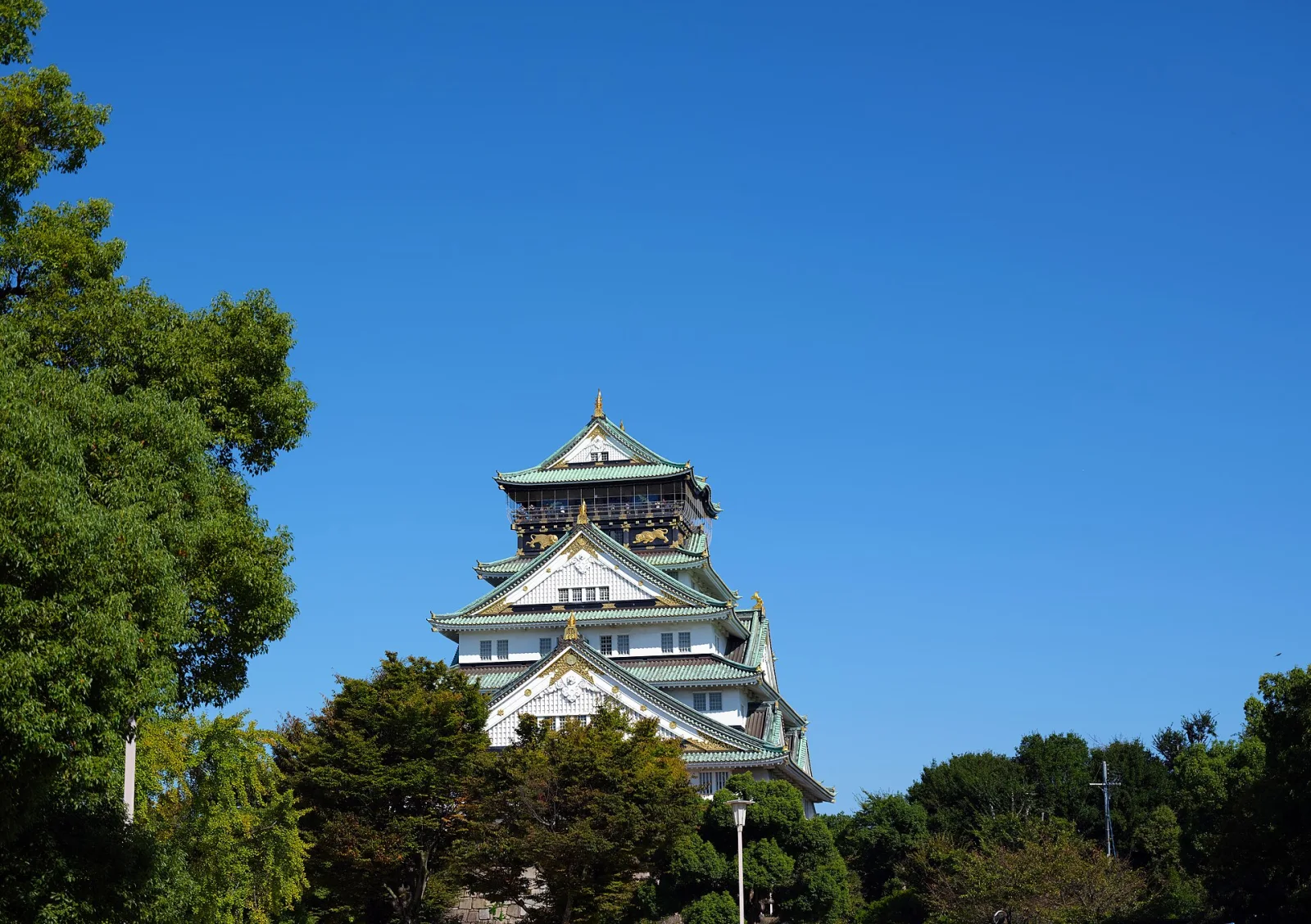
To pair Osaka Castle Park with Midosuji in one day, spend the morning in the park and the afternoon around Yodoyabashi or Hommachi. The park's autumn map marks ginkgo trees along the perimeter running path, making Morinomiya Station a straightforward entry point to view the outer avenues first. If you also intend to climb the main keep, budget extra time for queues, slopes and walking across the grounds, and save Shinsaibashi solely for dinner and lights. If autumn colour is your main goal, take Exit 3-B at Morinomiya towards the Music Hall for a focused walk among the yellow trees before returning to the same station.
From Osaka Castle back to Midosuji, take the Chuo Line from Morinomiya to Hommachi and walk north. If you are heading straight to Shinsaibashi for dinner, ride the Nagahori Tsurumi-ryokuchi Line directly from Morinomiya to Shinsaibashi to skip changing at Hommachi. Exiting via Otemon Gate or the Osaka Museum of History puts you closer to Tanimachi 4-chome for the Chuo Line back to Hommachi. Travellers entering from the east and walking west across the park should catch the train from whichever exit they finish at rather than trekking all the way back to their starting gate. You can check park entrances and tree-lined paths in our Osaka Castle Park autumn foliage guide.
If rain arrives early in the afternoon, the shortest walk from Tanimachi 4-chome to the Osaka Museum of History is via Exit 9 on the Chuo Line, which surfaces right outside; from the Tanimachi Line, walk roughly 300 metres east from Exit 2. Permanent exhibition admission is ¥600 for adults, ¥400 for high school and university students, and free for junior high school students and younger. Standard hours are 09:30 to 17:00 with last entry at 16:30; the museum closes on Tuesdays (or the following day when Tuesday is a public holiday) and from 28 December to 4 January. Leaving shortly before closing puts you on the Chuo Line back to Hommachi right around illumination time.
If you only have a brief window of clear weather, reverse the order. Visitors already in central Osaka who want daytime ginkgo photos should walk two or three blocks of Midosuji first and head to the park only if the dry spell holds. If the castle and park foliage are the family's top priority, use the sunny window at Osaka Castle and leave one stop near your hotel for dusk. When the castle keep eats up half the afternoon, limit your daylight Midosuji walk to a single block near Hommachi before sitting down for dinner and stepping out to see the lights.
Underground day passes and step-free exits for pushchairs
Single underground journeys in Zone 1 (up to 3 kilometres) cost ¥190 for adults and ¥100 for children; Zone 2 (over 3 to 7 kilometres) costs ¥240 for adults and ¥120 for children. Neighbouring stations fall within the short-distance fare. The simplest foliage outing is tapping an IC card once to arrive, walking one stop along the avenue, and tapping once to return—for example, two Zone 1 rides total ¥380 for an adult. Exiting above ground midway and re-entering starts a new fare, unlike transferring to the Chuo Line inside the paid concourse.
Osaka Metro's Enjoy Eco Card costs ¥820 for adults on weekdays, ¥620 on weekends and public holidays, and ¥310 for children, covering eligible Osaka Metro and Osaka City Bus routes. Compared with ¥190 Zone 1 adult fares (three rides total ¥570; four rides total ¥760), a weekend pass pays off by the fourth short hop, whereas on weekdays you need five short rides before the pass beats single tickets. If you are staying in Namba and simply walk one stop to Shinsaibashi and back, you may not need a ticket all evening. JR, Keihan and Nankai lines are priced separately, including the Nankai ride between Kansai International Airport and Namba.
For short walks with a pushchair or wheelchair, favour Yodoyabashi's street-level lift routes and stay on the same pavement until the next crossing before changing direction. Platform-to-gate and gate-to-street lifts often sit at different exits from the stairs, so those on foot can follow stair signs while lift users follow the accessible route and meet above ground. At multi-line hubs like Hommachi and Namba, check station maps first for the lift from the Midosuji Line platform to the ticket gate, and then for the street lift. While on the train, Osaka Metro's car boarding diagrams show which carriage doors align with lifts in each direction of travel.
Once shopping bags pile up or older relatives need a rest, keeping the outing to one or two blocks from a station and returning from the same entrance works best. For families where not everyone wants to walk far, Shinsaibashi offers an easy indoor base around the South Ticket Gate: photographers can loop a couple of blocks outdoors while others browse Daimaru, meeting back on an agreed floor before heading out for dinner. Fares depend on how many stops you ride each leg, whereas deciding whether to walk an extra stop comes down to seating options and how busy the crossings feel.
Moving underground when wind and rain pick up
Light rain still leaves room for a one-stop walk if you pick a stretch with indoor cover at the exits. The underground passage linking Shinsaibashi's South Ticket Gate directly to Daimaru gives immediate shelter if showers worsen; from Dotonbori, Namba Exit 14 drops you straight back underground near subterranean dining arcades. Walking far in wet weather means waiting at large traffic signals even in a raincoat, and guiding children under umbrellas across wide crossings slows everything down. Moving along the same side of the road to the next station entrance keeps coats and shoes noticeably drier.
Organisers generally keep the illuminations running in rain, though individual programmes may be cancelled. During a light shower, find a steady spot out of pedestrian flow to capture reflections on the wet pavement before ducking into a department store. In strong winds, skip exposed river bridges and wide junctions and save the foliage for the next dry spell. Packable insulating layers work better than a single heavy coat when you are stepping repeatedly between chilly streets, warm underground concourses and heated shops. If you are carrying shopping bags, stow wet umbrellas at shop entrances and agree on a meeting floor inside rather than regrouping outdoors between showers.
Wet pavements turn slippery around fallen ginkgo leaves, ginkgo seeds and metal utility covers. Check your footing before crouching for low-angle shots and steer clear of leaf piles along the kerb. With children, pick up a clean fan-shaped leaf along the walkway to look at its veins, then step clear of the trees before taking photos. Stow cameras away before crossings, keep children on the building side of the pavement and use dropped kerbs for pushchairs. Follow pedestrian diversions around any cordoned-off sections; when the weather deteriorates, drop the extra outdoor blocks from your map and link shopping, dinner and your hotel route underground.
Choosing a hotel by your departure line and exit
If Midosuji is simply one autumn outing on your itinerary, reaching it on the Midosuji Line from almost any central Osaka hotel is effortless. If you are still choosing where to stay, start with the day you will be hauling large suitcases. For early flights out of Kansai International Airport, staying by Nankai Namba saves a transfer before boarding: Swissotel Nankai Osaka sits directly above Nankai Namba Station, whereas hotels near JR Namba require a separate walk to reach the Nankai Airport Line. Travellers catching the Shinkansen at Shin-Osaka can stay in Umeda or Shin-Osaka and see the lights before dinner, while a hotel in Umeda also skips an underground connection if you are boarding JR intercity trains from Osaka Station the next morning.
To rest between afternoon foliage and evening illuminations, stay along the stretch best suited to the slowest walker in your group. In Shinsaibashi, Hotel Nikko Osaka connects directly via Exit 8 from the South Ticket Gate on the Midosuji Line, keeping Daimaru and arcade restaurants moments away and letting shoppers drop off bags easily. If anyone in your group relies on lifts, check the hotel's access guide beforehand for both legs of the journey: platform to exit, and exit to lobby. Travellers less focused on daily shopping can apply the exact same check to hotels around Hommachi to cut down on morning and evening walking.
For quieter nights and easy Chuo Line rides to Osaka Castle or Osaka Bay the next day, choose Hommachi or Yodoyabashi. Around Hommachi, use Hommachi-dori near The St. Regis Osaka as your reference; Yodoyabashi puts Nakanoshima and Kitahama within an easy walk while keeping you on the direct Midosuji Line back from dinner in Namba. Always set the hotel's street-level entrance as your map destination and check the exact line you will actually use—a listing that quotes minutes from Hommachi Station may measure from a different exit, and underground passages from the Chuo or Yotsubashi lines add real time when pulling luggage.
For a one-night stay, let your arrival and departure railway terminals dictate the hotel location. On a two- or three-night stay with daytime trips to Kyoto and evening walks beneath the lights, choose a station with minimal transfers and place your evening Midosuji stroll along the route back to bed. If you are requesting a room overlooking the illuminations, specify facing Midosuji along with the exact stretch you want. Even then, if night-view room supplements are steep, it often makes better sense to book a standard room right beside a convenient exit—throw on a coat for the lights, head upstairs as soon as you tire, and let shoppers in your group find their way back without fuss.
A few useful answers
When is the best time to see the Midosuji ginkgo trees?
Osaka Metro's travel guide places the peak season from late November to early December. Aim to be in Osaka in late November, and use a clear day for the walk between Yodoyabashi and Hommachi while the yellow leaves are still on the canopy.
Which station should I get off at for a first visit?
For daytime foliage, alight at Yodoyabashi (M17) on the Midosuji Line and walk towards Hommachi (M18). If you want shopping and evening illuminations together, come up to street level near the South Ticket Gate at Shinsaibashi (M19) and head towards Namba (M20).
Do the 2026 Midosuji illuminations require a ticket, and what time do they switch on?
Viewing along the pavements is free. From 3 November to 31 December 2026, the lights run nightly from roughly 17:00 to 01:00 the next morning, stretching from the Hanshin-mae intersection to the Namba Nishiguchi intersection.
Can I see the Nakanoshima Central Public Hall projection mapping in late November?
The projection mapping on the east facade of Osaka City Central Public Hall runs from 11 to 25 December. In late November, you can still see the facade lights on Osaka City Hall and Nakanoshima Illumination Street, which switch on from 3 November.
Is Midosuji still worth visiting if I only have half a rainy afternoon?
Yes—use the South Ticket Gate at Shinsaibashi Station to step straight into Daimaru, then head onto Midosuji for a few blocks during lighter rain or a dry spell. If the weather turns, duck back underground at Namba Station for dinner and keep the evening to one stop near your hotel.
Is an underground day pass worth buying just to see the ginkgo trees?
For just two or three short trips, paying per ride is cheaper. The Enjoy Eco Card costs ¥820 for adults on weekdays, ¥620 on weekends and public holidays, and ¥310 for children. Factor in Osaka Castle, shopping detours and your evening trip back before comparing the day pass against individual fares.
Official information and references
Sources used in this guide.
- Osaka Metro NiNE | Midosuji Autumn Foliage Season and Streetscapes
- City of Osaka | Midosuji Ginkgo and Roadside Tree Management
- City of Osaka | History of Midosuji's Opening
- Osaka Convention & Tourism Bureau | Midosuji Sculpture Street and Place-Name History
- City of Osaka | Pedestrian Space and Cycling Access South of Shinbashi
- Festival of the Lights in OSAKA | 2026 Midosuji Illumination Dates and Route
- Festival of the Lights in OSAKA | 2026 Nakanoshima Programme and Projection Mapping
- Osaka Prefecture | 2026 Festival of the Lights in OSAKA Implementation Overview
- Chuo Ward, City of Osaka | Festival of the Lights Schedule and New Year Programme
- Festival of the Lights in OSAKA | Photography, Wet-Weather Arrangements and Step-Free Access
- Osaka Metro | Midosuji Line Station Sequence and Boarding Positions
- Osaka Metro | Closure Notice for Yodoyabashi Station Exit 9
- Osaka Metro | Standard Subway Fares
- Osaka Metro | Enjoy Eco Card Day Pass
- Hanshin Umeda Main Store | Umeda Access
- Daimaru Shinsaibashi | Direct Link from Shinsaibashi South Ticket Gate
- Dotonbori Shopping Street Association | Namba Exit 14 and Station Access
- Osaka Castle Park | 2026 Autumn Ginkgo Distribution Map
- Osaka Castle Park | Morinomiya Exit 3-B to the Music Hall
- Museum of Oriental Ceramics, Osaka | 2026–2027 Renovation Closure
- Osaka Museum of History | Permanent Exhibition Fares, Closures and Station Exits
- Hotel Nikko Osaka | Shinsaibashi Exit 8 and Hotel Access
- The St. Regis Osaka | Hommachi Exit 7
- Swissotel Nankai Osaka | Nankai Namba Station and Kansai Airport Access